Fabrication and Characterization of IPMC Actuator for Underwater Micro
Robot Propulsor
M. F. Shaari1-2a,S.K. Saw 29b
and Z. Samad2gc
Faculty of Mechanical and Manufacturing Engineering, Universiti Tun Hussein Onn Malaysia, Parit Raja, 86400 Batu Pahat, 30h01, Malaysia.
*School of Mechanical Engineering, Universiti Sains Malaysia, 14300 Nibong Tebal, Pulau Pinang, Malaysia.
Keywords: IPMC, Underwater robot, Actuation force, Smart actuator
Abstract. The usage of Ionic Polymer-Metal Composite (IPMC) actuator as the propulsor for underwater robot has been worked out by many scientists and researchers. IPMC actuator had been selected due to its advantages such as low energy consumption, low operation noise and ability to work underwater. This paper presents the fabrication and characterization of the IPMC actuator. The IPMC actuator samples had been fabricated using electroless plating for three different thickness and lengths. The characterization was conducted to determine the influence of the thickness, length, input frequency, drive voltage and orientation angle on the tip force and output frequency. The results show that IPMC thickness has significant influence on the tip force generation and lower input frequency would results wider displacement. The recorded results are essential as future reference in developing the propulsor for the underwater robot.
Introduction
Ionic Polymer-Metal Composite (IPMC) is regarded as one of the smart actuator that suits as a propulsor for various types of underwater robot, especially for biomimetic and small scale underwater robot. For instance, the biomimetic underwater robots that employ IPMC actuators as their propulsor are including fish robot, jellyfish robot and lobster robot [I] [2] [3] [4]. The main reason to this selection is because the IPMC actuator requires water molecules to operate [5][6]. Besides, IPMC actuator consumes low energy between 1V and 3V, depend of type of the task [7].
IPMC actuator has few other advantages such as low noise operation and large bending strain [8]. However, this actuator has constraints that should be considered in order to develop the underwater robot propulsor. Generally,
IPMC
actuator has relatively low actuating force compared to the other smart actuators. Thus, in this paper the performance of the IPMC actuator had been investigated by varying the dimension of the IPMC and the input parameters. This studies focus on basic IPMC actuator without further treatment that would surplus the fabrication cost. The variation of dimension is including the thickness and length of the IPMC. The thickness would determine the stiffness and strength of the IPMC and the length would influence the displacement and frequency of the IPMC.IPMC Actuator
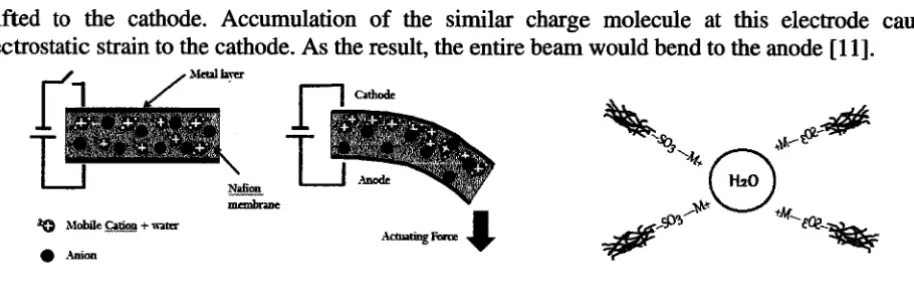
shifted to the cathode. Accumulation of the similar charge molecule at this electrode cause electrostatic strain to the cathode. As the result, the entire beam would bend to the anode [ll].
Figure 1: IPMC Actuation Mechanism Figure 2: Ionomeric clusters attracted water molecule
There are few factors that contribute to the strength of the bending force. These factors are the amount of the supply voltage, membrane thickness, type of the alkaline metal in the ionomer, number of ionomer and type of the electrode metal. In general, among the alkaline metals that form the ionomer, Li+ has the strongest charge and therefore could bend the IPMC at higher force relatively to other alkaline metals [12]. Meanwhile, the type of electrode metal is essential too, whereby it is important to ensure the low resistivity ratio during actuation and rest state. Basically the resistivity of the electrode increases during actuation and this condition reduces the actuation force. In order to overcome this matter, typically researcher will coats the electrode with gold layer which would provide more ductility to the electrode and retains the conductivity of the electrodes [9]. Membrane thickness would determine the stiffness of the actuation. Thicker membrane provides more ionomer and water molecules that would generates more actuation strength but at the same time increasing the stiflkess of the actuation. As the result, the displacement of the actuation reduced [l 11 [12].
Advantages and Limitations. IPMC actuator requires water to operate and thus it is suitable for
underwater application. Generally it consumes low supply voltage, between 1V and 3V, but in certain application it requires up to 4V supply voltage [12][13]. Electrolysis occurs on the electrode surface at 1.22V and higher than 4V supply voltage would damage the electrode [ll]. IPMC inherits polymer characteristics. Therefore it is light, has high strain actuation and could be shaped into certain form [8]. Another indicator that has been always referred in selecting an actuator is the actuating force-to-weight ratio. IPMC has good actuating force-to-weight ratio 1141. Among other smart actuator, JPMC provides low actuating force which is between 3gf and lOgf depending on the few factors as discussed above. Hence, in general IPMC actuator would fit for propulsor of small scale underwater robot.
Fabrication and Characterization Process
temperature is 40°C and end at 60°C. 0.2g sodium borohydrate will be added for every half an hour. The chemical reaction that occurred during this process is depicted in Eq. 1.
[image:3.599.117.497.228.350.2]The secondary plating process was carried out to increase the intensity of the deposited platinum layer by adding stronger reducing agent. Hydroxylamine hydrochloride 20%wt and Hydrazine Hydrate 5%wt (both from Sigma Aldrich) had been utilized as the reducing agents. In this process, again the reducing agent had been added gradually for half an hour from 40°C to 60°C using the water bath.
Figure 3: Electroless plating process in water bath Figure 4: Reduction process
Characterization process. Three IPMC actuators samples with different thickness; 190pm, 360pm and 450pm were prepared. Those samples had initial length of 50mm and IOmm width. The three observed outputs in the characterization process were actuating force, actuation displacement and output frequency. The IPMC electrodes were connected to a power supply (GW Instek PSM-3004). The drive voltage was set as lV, 2V, 3V and 4V to observe the influence of the voltage on the actuating force. A load cell (Transducer techniques, 30gm) was attached to the tip of the IPMC actuator to measure the tip force (Figure 5). Data was taken for different drive voltage and actuator's orientation (Figure 6). The data from this load cell was logged, displayed and monitored using NI-DAQmx software. In order to varies the length, the IPMC samples were cut to 20mm,
3 0 m ,
40mm and 50mm. For frequency characterization, the sample was attached to a sweep [image:3.599.84.256.545.672.2]function generator (GFG-8015G) at square wave 3V supply and being arnplif-ied by customized amplifier to increase to power. The input frequency was set at O.lHz, MHz, l.OHz, 1.5Hz and 2.OHz. A video camera with 30fps was utilized to record the displacement and the output frequency.
Figure 5: Overall characterization setup Figure 6: Actuation force characterization at diflerent actuator orientation
Results and Discussion
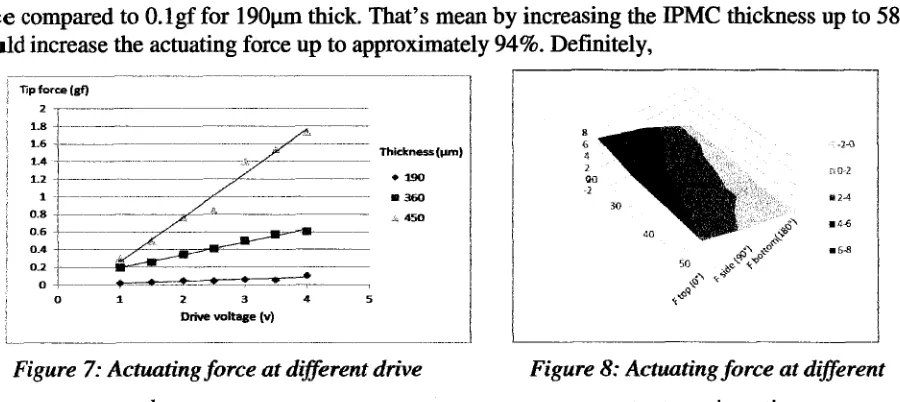
[image:3.599.327.510.549.674.2]force compared to O.lgf for 1 9 0 ~ thick. That's mean by increasing the IPMC thickness up to 58% I would increase the actuating force up to approximately 94%. Definitely,
- -- - -. - ---- - -- ---
Tip force (gf)
i
2 T---
- 1
i
-
1
-
-; 450 0.6
0.4 . ---
0.2
0
C'-~-2
c .--- *----0 1 2 3 4 5
[image:4.601.82.532.69.270.2] [image:4.601.62.537.313.670.2]Drive voltage (v)
Figure 7: Actuating force at diferent drive Figure 8: Actuating force at diferent
voltage actuator orientation
thicker P M C actuator has more charged ionomer and thus is able to attach more water than a thinner IPMC actuator. The big ionomer number has increased the actuating strength of the IPMC.
The changes of actuator's orientation would also vary the actuating force. As depicted in Figure 8, the top actuator orientation shows the highest actuating force and the bottom orientation has the lowest actuating force. This is because of the top actuation works in the same direction with gravity force and the bottom orientation actuation against the gravity direction. On the other axis in Figure 8 exhibits that shorter IPMC actuator would generate greater actuating force. However, the shorter IPMC actuator has lower displacement as the trade off to the actuating force (Figure 9). Longer IPMC actuator has greater actuation displacement. Greater actuation displacement could also be
achieved by reducing the input frequency. Figure 9 presents the relation between the input frequency, IPMC length and its displacement. Lower input frequency has greater actuation
displacement. A higher input frequency would limit the accumulation time of the mobile cation at the cathode and thus reducing the displacement magnitude. Jn Figure 10, the relation between the output frequency and the input frequency at different IPMC actuator length is displayed. From this
graph, it is obvious that longer IPMC actuator has higher output frequency compared to the shorter IPMC actuator. However, this value is depending on the input frequency. It seems like at different IPMC length, the relation trend between the input frequency and the output frequency is dissimilar.
aim
Conclusion
The results of fundamental characterization such as actuating force versus IPMC length, thickness
ionomer's alkaline metal but this work would increase the fabrication cost such as the utilization of gold plating. Most of the investigation focus on varying the dimension of the IPMC actuator and observed its relation with the targeted output. From the results, it could be concluded that increasing the IPMC thickness would increase the actuating force tremendously. Longer IPMC actuator has greater actuating force compared to the shorter one but this character needs to be traded off with the displacement. In addition, shorter
IPMC
actuator has higher output Erequency if relatively compared to longer IPMC actuator.Acknowledgment
The authors would like to address their compliment to the Ministry of Higher Education of Malaysia
(MOHE) for the FRGS grant sponsorship, Universiti Tun Hussein Om Malaysia and Universiti Sains Malaysia for their technical and facilities support on this research.
References
[I] Z. Chen, S. Shatara and X. Tan, Modelling of Biomimetic Robotic Fish Propelled by an Ionic
Polymer-Metal Composite Caudal Fin, IEEHASME Transactions on Mechatronics, vo1.15, no.3, (2010), pp 448-458.
[2] S. W. Yeom and I. K. Oh, A Biomimetic Jellyfish Robot Based on Ionic Polymer Metal
Composite Actuators, Smart Materials and Structures, vol. 18, no. 8, (2009), pp. 085002. [3] Najem Barber, A., Najem, J., Donald, L. and Blotman, J., Design and Development of Bio-
inspired Underwater Jellyfish like Robot Using Ionic Polymer Metal Composite (IPMC) Actuators, Proc. of SPIE, (201 I), 7976: 24-1
-
24- 11.[4] L. Sbi, S. Guo, S. Mao, M. Li and K. Asaka, Development of a Lobster-inspired Underwater
Microrobot, International Journal of Advanced Robotic Systems, vol10, (2013), pp. 1-15 [5] S. Nemat-Nasser, Micromechanics of actuation of ionic polymer-metal composites, Journal of
Applied Physics, vo1.92, (2002), pp.2899-29 15.
[6] E. Malone and H. Lipson, Freeform Fabrication of Ionomeric Polymer-Metal Composite Actuators, Rapid Prototyping Journal, ~011215, (2006), pp.244-253.
[7] L. Shi, S.Guo and K. Asaka, A Bio-inspired Underwater Microrobot with Compact Structure
and Multtfunctional Locomotion, IEEEIASME Int Conference on Advanced Intelligent Mechatronics (AIM 201 1) , (201 I), pp.203-208.
[8] M. F. Shaari, C.J.Jun and Z. Samad, Influence of Nozzle Size and Current Input on Thrust
of the Contractile Water Jet Thruster, EEE International Conference on Robotics,
Biornimetics, Intelligent Computational Systems (ROBIONETICS), (2013), pp. 15-18.
[9] Shahinpoor, K. J.Kim, 2001, Ionic Polymer Metal Composite:I. Fundamentals, Smart Mater. Struct. Vol. 10, pp. 819-833,2001.
[lo] C.K. Chung, P.K. Fung, Y.Z. Hong, M.S. Ju, C.C.K. Lin, T.C. Wu, A novel fabrication of
ionic polymer-metal composites (IPMC) actuator with silver nano-powders, Sensors and Actuators B, vo1.117,(2006), pp. 367-375.
[ l l ] S.G. Lee, H.C. Park, Surya D. Pandita, and Y. Yoo, Performance Improvement of IPMC
(Ionic Polymer Metal Composites) for a Flapping Actuator, International Journal of Control, Automation, and Systems, vol. 4, no. 6, pp. 748-755,2006
1121 S. Nemat-Nasser and Y. Wu, Tailoring the Actuation of Ionic Polymer-Metal Composite, Smart Materials and Structure, vol. 15, (20061, pp. 909-923.
[13] S. Guo, Y. Ge, L. Li and S. Liu, Underwater Swimming Micro Robot Using IPMC Actuator, Proceedings of the 2006 IEEE Int. Conference on Mechatronics and Automation, (2006), pp.249-254.