DECREASING THE WORKLOAD
AT A MENTAL HEALTHCARE
INSTITUTION
A SIMULATION STUDY
Sven Stienissen, S1853147
Bachelor Thesis Industrial Engineering & Management
Bachelor Thesis Industrial Engineering & Management
Decreasing the workload at a mental healthcare institution
A Simulation Study
Author
Sven Stienissen
s1853147
[email protected]
University of Twente
Pro Juventus Wijhe
Drienerlolaan 5
Oranjelaan 10
7522 NB, Enschede
8131 DB, Wijhe
The Netherlands
The Netherlands
Supervisors University of Twente
Supervisors Pro Juventus
Dr. Ir. M.E. Zonderland
Drs. E.H. (Dineke) Smit
Preface
Enschede, July 9th, 2019
Dear reader,
In front of you lies my report “Decreasing the workload at a mental healthcare institution”, which is the result of an enjoyable and interesting time I had at Pro Juventus, the host company where I conducted this research. This thesis is written to conclude my bachelor study, Industrial Engineering and Management, at the University of Twente.
Hereby I want to thank all people who have supported me in the past few months while I was conducting this research. First of all I want to thank Dineke Smit and Irene Homan (my supervisors at Pro Juventus) for giving me the opportunity to apply my knowledge at Pro Juventus. In addition, I want to thank them for giving me a warm welcome and for the feedback that I have received. In addition, I want to thank the department advice and support for the nice working atmosphere and for helping me to obtain useful information and data.
Furthermore, I want to thank my first supervisor of the University of Twente, Maartje Zonderland, for her valuable feedback on concept versions of this report and her involvement in this research. Next to my first supervisor, I want to thank Erwin Hans in assisting me to start this research. Finally, I would like to thank my fellow student Thom Rikken for his great feedback on earlier versions of this report.
I hope you will enjoy reading this thesis as much as I have enjoyed my time at Pro Juventus!
Kind regards,
Management Samenvatting
Achtergrond
Gedurende de afgelopen Jaren heeft Pro Juventus verschillende problemen ondervonden met betrekking tot de planning van hun cliënten. Op dit moment is Pro Juventus erg trots dat hun cliënten hen waarderen met hoge scores. Een belangrijk aspect van deze hoge scores is hun zorg op maat. Desalniettemin loopt de behandelplanning van Pro Juventus vast vanwege meer aanvragen, steeds moeilijker wordende behandelingen en beperkingen in aanvullende thuiszorg. Dit heeft vervolgens geresulteerd in langere wachttijden voor cliënten en een hogere ervaren werkdruk van behandelaren. Dit onderzoek zal zich richten op het tweede aspect: de hoge ervaren werkdruk van behandelaren.
Doel en Methode
Momenteel plant Pro Juventus hun afspraken in zonder rekening te houden met de variabiliteit van de afspraaktijden. Daarnaast worden de directe en indirecte afspraaktijden achter elkaar gepland en soms zijn er te veel lege plekken te vinden in de dagelijkse planning van een behandelaar. Dit is soms opzettelijk gepland vanwege het feit dat een aantal afspraken veel van behandelaren vergen. Echter gebeurt dit ook vanwege de cliëntgerichtheid die centraal staat binnen Pro Juventus. Als een bepaalde afspraak niet precies uitkomt voor een cliënt, wordt deze 15 minuten later gepland. Dit is niet in lijn met een optimale planning.
Dit rapport heeft als doel om Pro Juventus inzichten te geven in de effecten van variabiliteit en cliëntgerichtheid, met betrekking tot hun behandelplanning, op de ervaren werkdruk van de behandelaren. Dit dient zo gedaan te worden dat verbeterpunten uit deze inzichten zullen worden verkregen. Om dit doel te behalen, is een simulatieonderzoek uitgevoerd waarin meerdere planningsmethoden worden geanalyseerd.
Allereerst is er een overzicht gemaakt van de huidige processen die gerelateerd zijn aan de behandelplanning binnen Pro Juventus. Om de algehele prestatie van de behandelplanning te evalueren, worden drie zogenoemde key performance indicators (KPI’s) geformuleerd: de wachttijd van cliënten in de kliniek, de overuren die door behandelaren worden gemaakt en de productiviteit van de behandelaren.
Nadien is de huidige situatie vergeleken met drie planningsmethoden. De eerste planningsmethode die wordt gebruikt is de afspraakinterval methode. Bij deze methode wordt de lengte tussen twee opeenvolgende afspraken verkleind. Dit gebeurt voor zowel directe als indirecte afspraaktijden. De tweede planningsmethode die wordt geëvalueerd, is het gebruik van afspraaksloten van 4 uur. Als deze methode wordt gebruikt, worden cliënten eerst gepland in een tijdslot van 4 uur. Nadien, wanneer alle afspraken in dat tijdslot bekend zijn, zal de cliënt de exacte tijd voor de afspraak krijgen. De derde methode is een wachtrijdiscipline waarbij taken die moeten worden uitgevoerd niet worden gekozen op basis van een first-come, first-served principe. Daarnaast zullen de drie theorieën worden gecombineerd om te kijken of dit zal resulteren in een betere afsprakenplanning.
Resultaten
met slechts 25 seconden toenemen. Daarnaast zullen de gemiddelde overuren worden gereduceerd van 1,11% naar 0,75%.
Op het moment dat afspraaksloten van 4 uur worden gebruikt en er rekening wordt gehouden met de variabiliteit, neemt de productiviteit toe van 64,03% (huidige situatie) naar 77,17%. Ook zullen de gemiddelde overuren afnemen van 1,11% naar 0,39%. Echter zal de gemiddelde wachttijd in de kliniek aanzienlijk toenemen van 2 minuten en 12 seconden naar 5 minuten en 9 seconden.
Momenteel wordt er al een wachtrijdiscipline gebruikt binnen Pro Juventus. In het derde experiment worden inzichten gegeven wat er gebeurt als Pro Juventus geen wachtrijdiscipline zou gebruiken. Dit verschil zit vooral in de gemiddelde wachttijd van de cliënten, die zal toenemen van 2 minuten en 12 seconden naar 6 minuten en 35 seconden. De andere twee KPI’s blijven vrijwel hetzelfde.
Op het moment dat de beste opties van de drie planningsmethoden die hierboven zijn beschreven worden gebruikt, is de gemiddelde wachttijd van een cliënt in de kliniek gelijk aan 5 minuten en 11 seconden, de productiviteit gelijk aan 76,43% en de totaal gemaakte overuren gelijk aan 0,26%.
Conclusie en Aanbevelingen
Management Summary
Background
During the past few years, Pro Juventus has faced several problems concerning the planning of their clients. Currently, Pro Juventus is very proud that their clients rate them with high ratings. An important aspect of these high ratings is their customized care. Nonetheless, due to more applications, increasingly difficult treatments, and limitations in additional home care their treatment planning got stuck. Hence, waiting times for clients and the experienced workload of practitioners have increased. This research will focus on the second aspect: the high experienced workload of practitioners.
Goal and Method
Currently, Pro Juventus is scheduling their appointments without taking into account the variability of appointment times. In addition, the direct and indirect appointment times are scheduled one after another, and sometimes there are too much empty spaces within the daily planning of a practitioner. This is sometimes done deliberately after a severe appointment. Though, this happens also due to the client focus that is central within Pro Juventus. If a certain appointment time is not convenient for a client, he or she will be scheduled 15 minutes later, which is not preferable for an optimal planning.
In this report, the goal is to give Pro Juventus insights in the effects of variability and their client focus concerning their treatment planning on the experienced workload by practitioners, such that points of improvements will be gained from these insights. In order to do this, a simulation study is performed to analyze multiple scheduling methods.
First of all, an overview is made about the current processes that are related to the treatment planning at Pro Juventus. In order to evaluate the overall performance of the treatment planning, three key performance indicators (KPIs) are created: the waiting time of clients at the clinic, the overtime hours that are made by practitioners, and the productivity of the practitioners.
Afterwards, the current situation has been compared with three scheduling methods. The first scheduling method that is used is the appointment interval method. In this method, the length between two consecutive appointments will be decreased. This is done for both direct and indirect appointment times. The second scheduling method that is evaluated is the use of appointment slots of four hours. If this method is used, clients will first be scheduled in a timeslot of four hours. Afterwards, when all appointments in that timeslot are known, the client will obtain the exact appointment time. The third method is a queue discipline, in which tasks that need to be performed are not chosen on a first-come, first-served basis. In addition, the three theories will be combined in order to look if this will result in a better appointment schedule.
Results
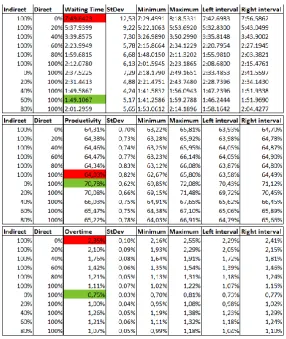
Since there are four experiments that have been executed with the simulation model, the results are divided into four parts. First of all, the results of the appointment interval method are presented. Using this method, it is best to decrease the appointment interval of the indirect appointment times to 0%, and to keep the appointment interval of the direct appointment times to 100%. This will result in an increase of the productivity of 6,75%, while the waiting times only increase 25 seconds on average. In addition, the overtime hours will decrease from 1,11% to 0,75%.
0,39%. Though, the average waiting time at the clinic will increase significantly from 2 minutes and 12 seconds to 5 minutes and 9 seconds.
Currently, a queue discipline is already used. However, in the third experiment, insights are given what happens if Pro Juventus does not use a queue discipline. The difference can mainly be found in the average waiting time of the clients which will increase from 2 minutes and 12 seconds to 6 minutes and 35 seconds. The other two KPIs remain almost the same.
If the best options of the three scheduling methods that are described above will be used, the average waiting time of a client is 5 minutes and 11 seconds at the clinic, the productivity is 76,43%, and the overtime hours are 0,26%.
Conclusion and Recommendation
Table of Contents
Preface ... 2
Management Samenvatting ... 3
Management Summary ... 5
Table of Contents ... 7
Reader’s Guide ... 9
Definitions ... 10
1. Introduction ... 11
1.1 Introduction to Pro Juventus ... 11
1.2 Motivation for the Research ... 11
1.3 Theoretical Framework ... 11
1.4 The Problem Identification ... 12
1.5 Research Objective ... 14
1.6 The Formulation of the Problem Solving Approach ... 14
1.7 Research Design ... 15
1.8 The Scope of this Research ... 18
2. Current Situation ... 19
2.1 The Growth of Pro Juventus ... 19
2.2 The Practitioners ... 19
2.3 The Clients ... 20
2.4 Application process ... 20
2.5 The Planning Process ... 21
2.6 Situations on the Appointment Day ... 21
2.7 KPIs that determine the performance of the planning process ... 22
2.8 The Actual Problem ... 23
3. Literature Review ... 24
3.1 Theory on Planning and Scheduling ... 24
3.2 Planning and Scheduling in the Healthcare Industry ... 24
4. Conceptual Model ... 27
4.1 Assumptions ... 27
4.2 Input Data ... 29
4.3 Output Data ... 32
5. Implementation, Verification and Validation of the Simulation Model ... 34
5.3 Verification and Validation of the Simulation Model ... 36
6. Experiments ... 39
6.1 Theory on Simulation Experimentation ... 39
6.2 Simulation Experiments... 40
6.3 Experimentation Results ... 42
7. Conclusions, Recommendations and Discussion ... 45
7.1 Conclusions and Recommendations ... 45
7.2 Discussion ... 45
7.3 Suggestions for Further Research ... 46
References ... 47
Appendix A: Distribution of the Specializations ... 49
Appendix B: Contract Hours per Week per Specialization ... 50
Appendix C: Number of Activities per Appointment Type ... 51
Appendix D: Appointment Types per Specialization ... 52
Appendix E: Appointment Planning ... 53
Appendix F: Minitab ... 54
Appendix G: Interarrival Times Distribution ... 56
Appendix H: Appointment Type Distribution ... 57
Appendix I: Contractual and Actual Working Hours... 58
Appendix J: Cumulative Probabilities of Assignment to Specialization... 59
Appendix K: Cumulative Probabilities of Assignment to a Practitioner ... 60
Appendix L: The Simulation Model ... 61
Appendix M: Warm-up period ... 62
Reader’s
Guide
This reader’s guide is created to give the reader a better understanding of the structure of this bachelor thesis. Below, a short overview is given of the different chapters in this bachelor thesis.
Chapter 1 Introduction
This chapter covers the introduction to this bachelor thesis. First, an introduction will be given about the company followed by the motivation for this research. Afterwards, the core problem, a problem solving approach and a research design will be presented amongst others.
Chapter 2 Current Situation
In this chapter, the current situation with regard to the planning process of Pro Juventus is described. Amongst others, the situations that could occur on the appointment day, information about the clients and practitioners, and key performance indicators for the planning process are presented.
Chapter 3 Literature Review
This chapter consists of a literature review that is conducted in order to improve the daily planning process of Pro Juventus. Therefore, several methods are discussed in order to improve a daily planning process.
Chapter 4 Conceptual Model
This chapter contains a conceptual model of the current planning process that is created in order to create a simulation model current planning process. Therefore, assumptions, input data and output data of the simulation model will be discussed.
Chapter 5 Implementation, Verification and Validation of the Simulation Model
This chapter comprises of theory on simulation model designs and the implementation of the conceptual model into a simulation model. Furthermore, it elaborates on the verification and validation of the simulation model.
Chapter 6 Experiments
This chapter covers theory on the preparations that need to be carried out in order to obtain accurate simulation results. Besides that, it covers all experiments that are performed in order to improve the planning process of Pro Juventus. These experiments are in line with the theory that is found during the literature review.
Chapter 7 Conclusions, Recommendations and Discussion
In this final chapter, conclusions will be drawn from the experiments that have been executed in chapter 6. After these conclusions are drawn, recommendations concerning the current planning process will be presented. Finally, a discussion about the research and suggestions for further research will be shown.
Definitions
In this bachelor thesis, several terms are used multiple times. Some of the terms seam natural, but it is good to define them to avoid misunderstandings while reading this bachelor thesis. Therefore, the list below with definitions has been made.
Practitioners All employees who provide mental support to clients. This includes, amongst others, psychiatrists, clinical psychologists and (youth) mental healthcare doctors.
Clients All people who had an appointment in the past or who are going to have an appointment in the future with a practitioner.
Medicore Medicore is an electronic patients file. In Medicore all information about clients, appointments and the practitioners can be found. Medicore is very useful since multiple data about appointments is
automatically administrated in advance.
Daily planning The planning of one specific day.
Client focus The orientation of an organization towards serving its clients’ needs.
Direct time of an appointment The time that is used for an appointment together with a client.
Indirect time of an appointment The time that is spent for an appointment without a client. This is for example time spent on preparing for an appointment, processing an intake or making a report about the appointment.
1. Introduction
In this chapter an introduction to Pro Juventus, the focus of this research, the problems that are faced and the problem solving approach with research design will be presented. This chapter is structured as follows:
• 1.1 Introduction to Pro Juventus • 1.2 Motivation for the research • 1.3 Theoretical framework • 1.4 The problem identification • 1.5 Research objective
• 1.6 The formulation of the problem solving approach • 1.7 The scope of this research
1.1 Introduction to Pro Juventus
Pro Juventus is a medium-sized mental healthcare institution which practices in numerous mental healthcare disciplines. To name a few: psychiatrists, clinical psychologists, psychomotor therapists and nurses. Pro Juventus started their business in 2009 and currently has five locations: Wezep, Wijhe, Ommen and two in Kampen. At these five locations multidisciplinary teams work together on the diagnosis and treatment of children, adolescents, and adult clients.
Pro Juventus is performing their business in line with three core values: client focus, knowledge driven, and flexibility. Their client focus can be found in multiple aspects of their organization. First of all, practitioners do not focus on the disorder of clients but on the request for help. Besides that, management is there to facilitate the primary process (diagnostics and treatments) and to guarantee the continuity of care. Lastly, the secretaries do their utmost to put the clients at ease and schedule their appointments as desired. The knowledge driven attitude of Pro Juventus can be seen in their drive to learn from the experiences of clients and partners. In addition, all employees have a fixed annual training budget, and the teams also have a training budget to organize joint training. Flexibility encourages Pro Juventus to keep thinking critically about the growing stream of bureaucracy in healthcare and to have the guts to swim against the stream sometimes.
1.2 Motivation for the Research
During the last few years, Pro Juventus has faced several problems concerning the planning of their clients. Currently, Pro Juventus is very proud that their clients rate them with high ratings. An important aspect of these high ratings is their customized care. Nonetheless, due to more applications, increasingly difficult treatments, and limitations in additional home care their treatment planning got stuck. Hence, waiting times for clients and the experienced workload of practitioners have increased. Since another student is already working on an assignment about the long waiting times, this research will focus on the high workload that is experienced by the practitioners. In order to decrease the high workload, this thesis will provide insights on how to improve Pro Juventus’ treatment planning. In section 1.4, a more in-depth analysis of the overall problems that Pro Juventus is facing can be found.
1.3 Theoretical Framework
The Managerial Problem Solving Approach is an approach to solve business problems in a systematic manner. This methodology is very general and can therefore be applied to many different problems. The managerial Problem Solving Method consists of the following 7 phases:
1. The problem identification 2. The solution planning 3. The problem analysis 4. The solution generation 5. The solution choice
6. The solution implementation 7. The solution evaluation
In this research project the Managerial Problem Solving Approach will be used as a theoretical framework.
1.4 The Problem Identification
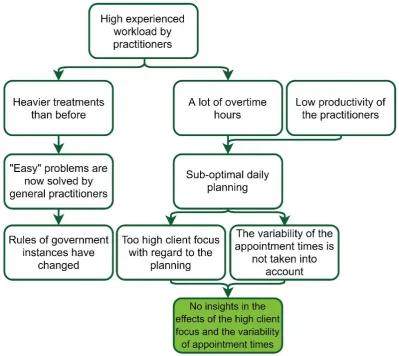
According to Heerkens & Van Winden (2012), an action problem is a discrepancy between the norm and reality perceived by the problem owner. As already mentioned above, the action problem regarding this project is that the practitioners at Pro Juventus experience a high workload. In this action problem, the norm is that the workload of practitioners in terms of overtime hours needs to be decreased, since the reality is that the number of overtime hours is too high at the moment. However, according to the director of Pro Juventus, currently the total number of overtime hours is not known, since not everyone is reporting the made overtime hours. In order to create structure in the problem context and to identify the so called “core problem”, a problem cluster is designed. According to Heerkens & Van Winden (2012), the core problem is the problem that has no known cause and that can be influenced by the researcher. In addition, the problem cluster also supports to determine cause and effect relationships between problems. The problem cluster is shown in figure 1.
Figure 1 shows that the problem of the high experienced workload by practitioners can be divided into two causes. The first cause is that the treatments at Pro Juventus are heavier than before. This does not only apply to Pro Juventus, but also to other mental healthcare institutions. A few years ago, rules of government instances have changed which resulted in general practitioners solving the “easier” mental healthcare problems. Therefore, only heavier problems remain at Pro Juventus, which results in a higher experienced workload by practitioners. Concluding, this first cause of the high experienced workload cannot be the core problem, since the researcher cannot influence the problem.
the variability of appointment times. Since this is not the case, an optimal daily planning is very hard to achieve.
[image:14.595.97.497.186.542.2]As can be seen in figure 1 the productivity of practitioners is low, while they make a lot of overtime hours. This may contradict each other, but due to a sub-optimal daily planning, there are a lot of empty spots in the daily planning of the practitioners. An example of this is that a client is scheduled at 09:00, while the practitioners starts working at 08:30 according to their contract.
Figure 1 - The Problem Cluster
In order to measure the high experienced workload by practitioners, the following two indicators have been chosen:
1. The percentage of the total number of overtime hours at the end of the day in proportion g to the total hours worked on a day
2. The percentage of the contractual working hours that a practitioner is actually working. G Also known as the productivity of a practitioner.
Preferably, in line with an optimal planning, the first indicator should be as low as possible and the second indicator should be as high as possible.
1.5 Research Objective
The main goal of this research is to give Pro Juventus insights in the effects of their client focus concerning the daily planning and the effects of variability on the experienced workload by practitioners. In addition to obtaining these insights, the goal of this research project is to deliver a list with substantiated points of improvement and recommendations regarding the planning process.
Furthermore, the recommendations of this research can serve as starting points for possible follow-up studies. Due to the complexity of the planning process not all problems found can be investigated and improved in this research. Therefore, these problems can serve as possible core problems in future research.
1.6 The Formulation of the Problem Solving Approach
The second phase of the Managerial Problem Solving Method (Heerkens & Van Winden, 2012, p.60) is the formulation of the problem approach. In this section, a design will be made in order to solve the problem, in this case, the high experienced workload by practitioners. First of all, a short definition of a simulation will be presented. Afterwards, a motivation will be given why a simulation study is chosen for this research. Eventually, an overview of the problem solving approach will be presented.
According to Shannon (1975), a simulation can be defined as: “The process of designing a model of a system and conducting experiments with this model for the purpose either of understanding the behaviour of the system or of evaluating various strategies (within the limits imposed by a criterion or set of criteria) for the operation of the system.” In the following section, the motivation to carry out a simulation study will be presented.
1.6.1 Motivation Simulation Study
1.6.2 Problem Solving Approach
In this section the problem solving approach will be discussed. This problem solving approach is composed together with the research design in section 1.7 in order to arrive at the intended deliverable of this research project: to give Pro Juventus insights in the effects of their client focus concerning the daily planning and the effects of variability on the experienced workload by practitioners. The problem solving approach consists of 6 phases. Below, the 6 phases of the problem solving approach are presented.
Phase 1: Collect information about the planning process of Pro Juventus
In this phase, information will be collected in order to understand the current planning process of Pro Juventus. Insights will be gained about how appointments are made within the planning of practitioners, how many and which appointments have been made, and if there are restrictions within the planning process that need to be taken into account in the simulation model.
Phase 2: Collect information about planning improvement techniques
In order to improve the planning process of Pro Juventus, several planning improvement techniques need to be investigated. In this section no planning optimization techniques can be used, since it is not feasible to find an optimal solution for Pro Juventus. This is the case, due to the fact that there are too many tasks that need to be performed within a day. Sometimes more than 20 tasks are performed by one practitioner. This will already result in more than 2 trillion different day schedules for every practitioner.
Phase 3: Create a conceptual model
In this phase, a conceptual model of the planning process of Pro Juventus will be built. In order to create a simulation model, a conceptual model is a very useful tool. In performing a simulation study the developer needs to make decisions about what to include in the simulation model and what to exclude. The modeler is faced with the very difficult choice of determining what is the best model to develop. The process of determining what to model is known as conceptual modeling (Robinson, 2011). In this phase, assumptions, input data and output data of the simulation model will be determined.
Phase 4: Implementation, verification and validation of the simulation model
In this phase, first the conceptual model will be implemented into a simulation model. This simulation model will look like the current planning process of Pro Juventus. Afterwards, the simulation model will be verified and validated.
Phase 5: Conduct experiments
In this phase, several experiments will be conducted using the chosen planning improvement techniques. First, the experiments that are needed to get insights into the effects of the client focus will be determined. Subsequently, the outcomes of the experiments will be elaborated.
Phase 6: Present the recommendations on the planning process
In the last phase, conclusions will be drawn from the experiments and recommendations to Pro Juventus about their planning process will be given. Eventually, the limitations of the simulation model and suggestions for further research will be discussed.
1.7 Research Design
Phase 1: Collect information about the planning process of Pro Juventus
For this phase, one main research question has been formulated, supported by four sub-questions, which can both be seen below.
1) How does the current planning process of Pro Juventus look like and what are the degrees of freedom concerning the planning process?
a) How are appointments scheduled? Is it done via an application on the internet, phone call, mail or in person at the secretary desk?
b) How many and which appointments have been scheduled in the past? c) Which restrictions are applicable to the planning process?
d) What are variables that need to be taken into account while reducing the experienced g . workload at Pro Juventus?
To answer the first and third sub-question, an interview will be conducted with the secretary and the registration office, since they know a lot about the scheduling processes and the restrictions that they need to take into account while planning a client. Besides that, for the third sub-question an interview will be conducted with the director of Pro Juventus to specify the restrictions with regard to the new planning method even further. In order to answer the second sub-question, a quantitative data analysis will be conducted on the obtained data. Eventually, the variables that need to be taken into account will be discussed. These variables will be chosen by conducting a literature review.
Phase 2: Collect information about planning improvement techniques
For this phase, one main research question has been formulated, supported by one sub-questions, which can both be seen below.
2) How can the daily planning process of Pro Juventus be improved?
a) Which mathematical planning model can be used to improve the daily planning?
For the sub-question above, a literature review will be conducted. This will be done in order to find multiple mathematical planning and scheduling methods. After the review has been conducted, the methods will be used within the simulation model.
Phase 3: Create a conceptual model
For this phase, one main research question has been formulated, supported by four sub-questions, which can both be seen below.
3) How does the conceptual model of the daily planning of Pro Juventus look like? a) What needs to be included into a clear conceptual model?
b) Which assumptions can be made in the simulation model? c) What is the input data for the simulation model?
d) What are the output variables of the simulation model?
Phase 4: Implementation, verification and validation of the simulation model
For this phase, one main research question has been formulated, supported by two sub-questions, which can both be seen below.
4) How can the simulation model be implemented, verified and validated?
a) How can the conceptual model be implemented into a simulation model? b) How can the simulation model be verified and validated?
To answer the first sub-question, the conceptual model that has been designed in phase 3 will be used. During the implementation of the simulation model probably several problems will occur. Therefore, knowledge will be gained about the implementation of a conceptual model into a simulation model. Since it is currently not known which information will be needed exactly, an unsystematic literature review will be executed. Once the simulation model is created, the simulation model will be verified and validated. In order to do this, a systematic literature review will be conducted to find several verification and validation techniques.
Phase 5: Conduct experiments
For this phase, one main research question has been formulated, supported by three sub-questions, which can both be seen below.
5) Which experiments will be conducted in the simulation study and what is needed to execute the experiments?
a) How can the mathematical models be implemented into the simulation model?
b) Which experiments are needed to get insights into the effects of variability and the client . focus?
c) What are the results of the experiments?
Before the experiments can be executed, the mathematical models that have been found in phase 2 need to be implemented into the simulation model. Since probably several problems will occur during the implementation of the mathematical models, an unsystematic literature review will be conducted. To decide which experiments will be conducted, the information obtained in phase 1 will be used. In phase 1 restrictions on the planning process have been established. These restrictions need to be taken into account when deciding which experiments can be conducted. Besides this, possible experiments will be discussed with the management team to confirm if these experiments are applicable. Eventually, the results of the experiments will be presented after they have been executed.
Phase 6: Present the recommendations on the planning process
For this phase, one main research question has been formulated, supported by three sub-questions, which can both be seen below.
6) Which planning method should be used by Pro Juventus? a) What can be concluded from the experiments?
b) Which are the recommendations regarding the planning process?
c) Which limitations does the simulation model have concerning the accuracy of the output?
1.8 The Scope of this Research
2. Current Situation
In this chapter, the current situation of Pro Juventus is described. This is done to get more insights in the current performance of Pro Juventus and to analyze several problems within the current situation. Therefore, the following research question will be answered: “How does the current planning process of Pro Juventus look like and what are the degrees of freedom concerning the planning process?”. This chapter contains the following subjects:
• 2.1 The growth of Pro Juventus • 2.2 The practitioners
• 2.3 The clients
• 2.4 Application process • 2.5 Planning process
• 2.6 Situations on the appointment day
• 2.7 KPIs that determine the performance of the planning process
2.1 The Growth of Pro Juventus
In order to get more insights in the current situation of Pro Juventus, first an analysis is made about the growth that Pro Juventus has experienced during the past years.
[image:20.595.116.480.394.611.2]As can be seen in figure 2, Pro Juventus has faced an immense growth since the start of their business in May 2009. The number of activities and number of practitioners increased on average around 27% and 23% per year from 2010 till 2018, respectively.
Figure 2 - Growth of Pro Juventus
The growth of Pro Juventus can also be seen in the number of locations that are owned by Pro Juventus. In 2009 Pro Juventus started in a small building in Hattem, which they rented at that time. Only a short period after starting the business it became clear that the building was too small. At this moment Pro Juventus has five locations. The newest building was opened in March 2019.
2.2 The Practitioners
Currently, there are 74 practitioners working at Pro Juventus spread over the five locations. These 74 practitioners occupy in total twelve different specializations within the organization. In appendix A, the distribution of these specializations can be seen for the total organization and for the five locations
0 10 20 30 40 50 60 70 80 0 10000 20000 30000 40000 50000 60000 70000 80000 90000
2010 2011 2012 2013 2014 2015 2016 2017 2018
N u m b er o f p ra ctitio n ers N u m b er o f a ctiv itie s
Growth of Pro Juventus
separately. Besides that, in appendix B the total contract hours per week can be found per specialization.
All twelve specializations perform different tasks in the organization. In total there are 102 distinct tasks that have been executed in 2018 and the first four months of 2019. These tasks include intelligence tests for youth, initial interviews, pharmacotherapy, psychiatric examination, email or telephone contact with the client and a lot of other tasks. Among these tasks there are a lot of tasks that are rarely performed. In appendix C an overview is given about the number of activities per appointment type. Out of the 102 tasks, there are 57 tasks that are only performed less than 100 times. In the simulation model all these tasks will be seen as remaining, since they only occupy 1,1% of the total activities.
In appendix D an overview can be found about the appointment types that each specialization can perform according to the data of 2018 and the first four months of 2019. As can be seen, a lot of tasks overlap the different specializations.
2.3 The Clients
At Pro Juventus there are a lot of different clients with different backgrounds and different ages. The practitioners treat children, young adults and adults. To give an impression, Pro Juventus had treated 2.384 unique clients in 2018. Most of the practitioners can treat both children and (young) adults.
2.4 Application Process
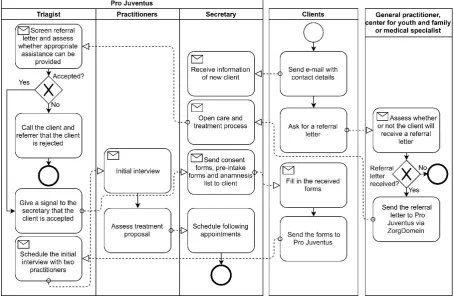
[image:21.595.70.525.438.736.2]In this section the application process of Pro Juventus will be presented. The application process includes the whole process between the first contact with a client and the first appointment of a client. In figure 3, a business process model can be seen of the application process. As can be seen, the initial interview is not seen as the first appointment and is therefore included into the application process.
As can be seen at the general practitioner, center for youth and family or medical specialist, ZorgDomein is mentioned. ZorgDomein is a digital platform where care providers request care, offer care and where they can exchange patient information quickly and securely. ZorgDomein is linked to the electronic patients file Medicore. If referral letters of new clients are sent via ZorgDomein, the client is automatically added to Medicore.
During the initial interview, the expectations and wishes from the client or the client’s parents are discussed. Besides this, the pre-intake forms and anamnesis lists are discussed together with the client. After this, the two practitioners will deliberate which treatment will be appropriate for the client. Most of the times, the treatment proposal consists of a diagnostic proposal, for children this is often an intelligence test. During the consultation, a more extensive treatment proposal is made about the required treatment. Afterwards, the following appointments will be scheduled together with the secretary.
Currently, there is no prioritization while choosing the next client to help. So, the longest waiting client will be chosen first to plan an initial interview or other appointments. This is also known as the principle of first-come, first-served (FCFS).
2.5 The Planning Process
Once the application process is finished, the client is going to have his or her first treatment. Most of the times a treatment consists of multiple appointments. Sometimes these appointments are scheduled all at once and sometimes these are scheduled one after another. If the appointments are all scheduled at once, the program Medicore tries to find a regularity in the planning. So, if clients need to make an appointment every week, Medicore tries to schedule the appointment at the same day at the same time every week. If at a certain moment it is not possible to schedule someone at the same time, Medicore skips that week and schedules the appointment the next week. In appendix E an example can be found of planning multiple appointments in Medicore.
The problem here is that Medicore is only trying to find an appointment on the exact same time on the exact same day, without taking into account the other appointment times on that day. This could result in a schedule that is far from optimal, since appointments could be scheduled with too much time in between.
Most of the times the secretaries try to avoid this by rescheduling the appointments made by Medicore. Though, it happens too often that there is too much time in between the appointments. This is also partly due to the fact that some of the appointments are scheduled by practitioners themselves. Generally, this is less efficient than when the secretaries schedule the appointment. In addition, sometimes time is deliberately scheduled between two appointments. This is done, since some appointment types are very demanding for practitioners. Therefore, to give them some rest, a little bit of resting time between two consecutive appointments is scheduled.
For every distinct appointment type there is a standard time that is scheduled. This standard time consists of direct time, indirect time and travel time. Most of the times, this standard time is maintained. However, it happens too often that there is a deviation from this time. Therefore this is not negligible.
2.6 Situations on the Appointment Day
2.6.1 Normal Situation
In a normal situation the client shows up and the appointment will be executed. In this normal situation three things can happen. The first thing is that the appointment could be shorter than was initially scheduled. At this moment the practitioner can start earlier with the indirect time of that appointment. Since the appointment is shorter, the practitioner will be able to do other tasks that he or she still has to do. However, if there are no other tasks, he or she will have nothing to do until the next appointment. This will result in a lower productivity. The second thing that could happen is that the appointment will be longer than was initially scheduled. If this happens the practitioner has less indirect time. As a result, the practitioner cannot finish their tasks before the next appointment. Therefore, the practitioner will need to do these tasks at a later time that day. If the whole day is already fully scheduled with appointments, he or she needs to do it at the end of the day and thus make overtime hours. The third and most preferable thing that could happen is that the appointment is exactly as long as scheduled. At this moment the practitioner has exactly enough indirect time after the appointment to finish their tasks before the next client arrives.
2.6.2 Cancellation > 24 hours
Appointments that are scheduled can also be cancelled by clients or by practitioners. If an appointment is cancelled more than 24 hours before the appointment, it will be seen as a cancellation. From the 1st of January 2015 till the 11th of February 2019, 11,196% of the scheduled appointments had been cancelled. It is not known how long in advance these appointments had been cancelled. If it possible to plan a new appointment in that timeslot, this will be done. Most of the times this will be possible. Nonetheless, most of the times the planning is less efficient if another appointment is scheduled during that time. Though it will be the better than no appointments during that time. If there are no new appointments that can be scheduled at the cancellation time, the practitioners try to do other tasks. If this is not possible, the productivity will decrease.
2.6.3 No-shows < 24 hours
Besides cancellations, the so called no-shows could occur. An appointment is seen as a no-show if the appointment is cancelled within 24 hours of the appointment time or if the client does not show up for the appointment. From the 1ste of January 2015 till the 11th of February 2019, 1,275% of the client-related appointments were no-shows. If there is a no-show, practitioners still try to write time for that appointment. They do this by contacting the client. Most of the times they try to call the client and to make a report out of this phone conversation. Generally this is much less time than the appointment, therefore the productivity will decrease. During the no-show time, most of the times the practitioners try to take on other tasks.
2.6.4 Emergency clients
In addition to the scheduled appointments, emergency clients could arrive at Pro Juventus. Most of the times, family, acquaintances of the client or the client self calls to Pro Juventus to say that things are going really bad. At that moment, support is offered to the client wherever this is possible. It is not known how much emergency arrivals happen per unit of time. Though, this does not happen very often relative to the total number of appointments according to some employees.
2.7 KPIs that Determine the Performance of the Planning Process
2.7.1 Overtime Hours
The overtime hours are all hours that a practitioner has worked after their contractual hours. For most of the practitioners this will be hours made after five o’clock in the afternoon. However, this will not always hold since some of the practitioners stop working around 3 o’clock in the afternoon sometimes. If they work after 3 o’clock this will count as overtime. The following KPI is drawn from the overtime hours: the average percentage of overtime hours on one day divided by the total hours worked on one day.
2.7.2 Productivity
The second KPI of the planning process is the productivity. The productivity is measured in terms of written time per working hour. The written time consists of direct time, indirect time and travel time. Once a practitioner has executed a task, he can write down the direct, indirect and travel time that he has spent on that task in Medicore.
2.7.3 Waiting Time
The third KPI of the planning process is the average waiting time of the clients. The waiting time is measured in terms of the time between the arrival of a client at the clinic and the start time of an appointment. So, the waiting time at home for an appointment is not taken into account.
2.8 The Actual Problem
As already mentioned in section 1.4, Pro Juventus has no insights in the effects of variability of appointment times, and the effects of their client focus with regard to the planning. As a recap, with client focus concerning the planning, it is meant that almost all wishes of clients will be fulfilled. After a thorough analysis of the current situation, several problems can be derived from the situations that could occur on the appointment day as described in section 2.6. The main problem can be found within the daily planning process of Pro Juventus. Due to the fact that Pro Juventus is scheduling both direct and indirect times of an appointment one after another, productivity will decrease if an appointment has ended earlier than scheduled. Due to this productivity loss, less clients can be treated on an appointment day. Therefore, schedules of practitioners are already fully booked for a long time. Besides that, if a day is fully scheduled and an appointment takes longer than scheduled, overtime hours are easily made. Therefore it is important to look at the effects of planning direct and indirect times together or separate. Besides that, it is significant to look at other planning methods that can be used to improve the planning process with regard to the KPIs mentioned above.
3. Literature Review
In this chapter a literature review will be carried out. The goal of this literature review is to answer the following research question: “How can the daily planning process of Pro Juventus be improved?”. This chapter is divided in two sections:
• 3.1 Theory on planning and scheduling
• 3.2 Planning and scheduling in the healthcare industry
3.1 Theory on Planning and Scheduling
In this section the basic concepts of planning and scheduling are introduced. First of all, a definition is given for both planning and scheduling to see the difference between the two. Second, the purpose of planning and scheduling in a company are described and an introduction is made to planning and scheduling in service industries.
According to Slack (1999), planning is defined as the process of reconciling supply and demand (i.e., dealing with capacity decisions). Scheduling is described as defining the sequence and time allocated to the activities of an operation. It is the construction of a detailed timetable that shows at what time or date jobs should start and when they should end (Slack, 1999). An important thing to mention is that the problem of scheduling consist of two steps: sequencing and scheduling (Baker & Trietsch, 2009). In the first step, a sequence is planned or a decision is made on how to select the next task. In the second step, the start time and completion time of each task will be determined. In short, planning concerns the matter of effectively defining what is to be done and how, while scheduling is the decision of when the tasks need to be done.
According to Pinedo (2009), the planning and scheduling functions in a company rely on mathematical techniques and heuristic methods that allocate limited resources to the activities to be done. This allocation of resources has to be done in such a way that the company optimizes its objectives and achieves its goals. In order to improve the planning and scheduling functions, several methods will be discussed in section 3.2.
Describing a generic service organization and its planning and scheduling systems is not as straightforward as describing a generic manufacturing system (Pinedo, 2009). In service industries resources need to be reserved (e.g., meeting rooms or time slots), equipment needs to be allocated (e.g., specialized equipment), and the workforce need to be allocated and scheduled (e.g., shifts in a call center). In this simulation study, the allocation of equipment will not be taken into account, since this is not a core business in the mental healthcare industry, i.e. special equipment is barely needed. Since planning and scheduling systems in service organizations are different from manufacturing systems, only theory on planning and scheduling in service industries will be analyzed.In the section below, a focus is made on planning and scheduling in the healthcare industry.
3.2 Planning and Scheduling in the Healthcare Industry
In this section theory on planning and scheduling in the healthcare industry is discussed. First of all general theory with regard to this subject is presented and afterwards three appointment scheduling methods will be discussed in order to improve the daily planning process of Pro Juventus.
patients without offering a room, a bed and board. In addition, an ambulatory care service may be free-standing or part of a hospital. In the literature review, the focus will therefore be on theory that is focused on the planning, specifically appointment scheduling, within ambulatory care services.
Appointment scheduling comprises the design of blue prints that can be used to provide a specific date and time for patient consultation. The objectives of this design are generally to reduce the waiting of a patient or client, to maximize resource utilization (in this case the productivity of the practitioners) or to minimize resource overtime (in this case the overtime hours made by practitioners) (Hulshof et al., 2012). According to Ho and Lau (1992), there is a key trade-off between patient waiting time and resource waiting time. If someone wants to decrease the patient waiting time, the resource waiting time will increase, which results in a lower productivity. According to Hulshof, Kortbeek, Boucherie & Hans (2012) there are six frequently modeled aspects that influence the performance of an appointment schedule: patient punctuality, patients not showing up, walk-in patient or urgent patients, doctor lateness at the start of a consultation session, doctor interruptions, and the variance of consultation duration. In this simulation study, the focus is on the variance of consultation duration.
[image:26.595.167.427.404.577.2]As already mentioned, there is a trade-off between patient waiting time and resource waiting time. This is also depicted in figure 4 below from Welch & Bailey (1952), where an example is shown of clinics where 25 patients are scheduled on one day with an average appointment time of five minutes, and an appointment interval with exactly five minutes. The appointment interval is the interval between two successive appointment times (Cayirli & Veral, 2003). The trade-off between patient waiting time and resource waiting time would look like figure 4. In this figure Welch & Bailey assume that the appointment times are independent identically distributed following a Gamma-distribution.
Figure 4 - Trade-off between Consultant's idle time and Patient's waiting time (Welch & Bailey, 1952)
In addition to the above mentioned key performance indicators of appointment scheduling (patients’ waiting time and practitioner’s idle time), Cayirli and Veral (2003) discuss another frequently used key performance indicator in the healthcare industry: the overtime hours made by practitioners. According to Cayirli and Veral (2003), a “reasonable” trade-off level between those key performance indicators is to be decided subjectively by the decision-maker.
The Length of the Appointment Interval
As already mentioned, the appointment interval is the interval between two successive appointment times. To clarify, if a patient is scheduled at 9:00 and the next patient is scheduled at 9:10, the appointment interval is 10 minutes. Generally, according to Fetter and Thompson (1966), the length of the appointment interval and the resource idle time are positively correlated, so if the length of the appointment interval decreases, the resource idle time will also decrease. The patients’ waiting time is however negatively correlated with the length of the appointment interval. If the length of the appointment interval decreases, the patients’ waiting time will increase. The length of appointment intervals can be constant or variable. According to Cayirli and Veral (2003), there are seven appointment rules that can be used to schedule patients. In this simulation study only the second appointment rule that is mentioned by Cayirli and Veral (2003) is used, which is the individual-block/fixed-interval rule. As the name of the rule already says, clients are scheduled individually during an appointment slot and the length of the appointment interval is fixed.
The Sequence of Appointments
In this section the importance of the sequence of appointments will be discussed. According to Hulshof, Kortbeek, Boucherie & Hans (2012), when different patient groups are involved, the sequence of appointment influences waiting times and resource utilization. In a lot of sequencing methods, scheduling of multiple clients during one timeslot is involved. Due to the sometimes long appointment times, this is not possible for Pro Juventus. Therefore, these methods are not taken into account. From a paper of Klassen and Rohleder (1996), patients can be classified based on their expected service time variability. According to their simulation, it is better to plan patients with a relatively low expected service time variability at the beginning of a session and the patients with a relatively high expected service time variability at the end of a session.
The Queue Discipline in the Waiting Room
In this section the importance of the queue discipline in the waiting room will be discussed. According to Hulshof, Kortbeek, Boucherie & Hans (2012), the queue discipline in the waiting room affects patient waiting time. In most cases, the queue discipline in the waiting room is first-come, first-served (FCFS). This is however, not always an optimal discipline. In most cases, a queue discipline is used when emergency patients or walk-in patients are included into the planning process.
4. Conceptual Model
In this chapter the conceptual model of the simulation model will be presented and therefore the following research question will be answered: “How does the conceptual model of the daily planning of Pro Juventus look like?” This chapter consists of the following parts:
• 4.1 Assumptions • 4.2 Input variables • 4.3 Output variables
4.1 Assumptions
This section answers the question: “Which assumptions can be made in the simulation model?”. Below, all assumptions that are made in the simulation model are listed. In total there are 13 assumptions listed.
Remaining appointments
In the available data there are a lot of appointment types that have only occurred for a few times from the 1st of January 2018 till the 24th of April 2019, which can be seen in C. Therefore, these appointments will be grouped into “remaining appointments” in the simulation model.
The same specializations can perform the same tasks
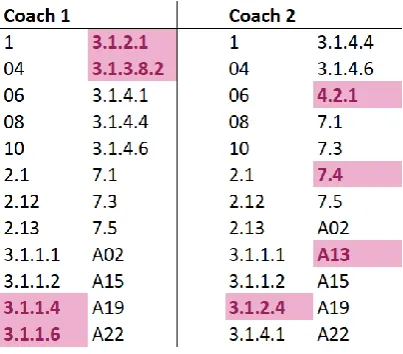
[image:28.595.196.398.413.590.2]From the obtained data it can be seen that two practitioners with the same specialization perform slightly different tasks. An example can be seen below where two coaches perform different tasks (the purple filled cells). For the simulation model the assumption is made that the same specializations can perform the same tasks.
Table 1 - Same specializations can perform the same tasks
There is no seasonal demand
In reality it could occur that there is seasonal demand for mental healthcare. Though, this will not be very significant and is therefore not taken into account into the simulation model.
Data from 2018 and 2019
current situation of arrivals. Besides that, the data will not present the length of the appointments since several appointments have changed over the past years.
Each practitioner has the same processing speed
In reality, it could be the case that there is a distinction between the processing speed of different practitioners for the same appointment. With processing speed the speed of processing an appointment, both direct and indirect time, is meant. In the simulation this distinction is not taken into account.
No appointments with multiple practitioners
In the simulation model, there are no appointments with multiple practitioners. In reality there are appointments in which multiple practitioners are involved. Most of the times this is a multidisciplinary consultation, which is a conversation between practitioners to discuss the status and treatment of a client. Appointments with multiple practitioners are not taken into account, since it will make the simulation model a lot more complex. Though, if for example there was an appointment with three practitioners, this appointment will arrive three times in the simulation model. Therefore, the workload will still be the same.
No emergency clients
In reality sometimes emergency clients could show up. It is not known exactly how many clients are emergency clients, but according to some employees an emergency client arrives less than once a week. This is less than 0,07% of the total appointments and is therefore not taken into account.
There are no No-Shows < 24 hours
As already mentioned in section 2.6.3 the number of no-shows (< 24 hours) over the period of 1 January 2015 till 11 February 2019 is 1,275%. This amount is a lot, but due to the fact that according to the data the number of no-shows decreased over the past years, and due to an increase in costs for the clients as a result of a new no-show policy, it is assumed that the number of no-shows will be negligible.
The are no cancellations > 24 hours
In the simulation model, the cancellations that occur more than 24 hours before the appointment will not be taken into account. This is not taken into account due to two reasons. First of all, looking at Medicore, it is most of the times possible to reschedule a client during that time, and second, the input data for the simulation model will be the appointments that have been executed. Therefore, the cancellations > 24 hours are not included in the number of client arrivals.
Maximum scheduled hours
The maximum scheduled hours per practitioner on a day are equal to the hours that a practitioner is working on a day. So, as an example to clarify, if a practitioner is working six hours on a Monday, the maximum scheduled sum of the appointment times should be equal or smaller than six hours.
Clients arrive on time
In the simulation model all clients arrive exactly at the clinic on their appointment time and can therefore be treated from that time if the practitioner is available.
Processing times are variable
The chances of accepting an appointment day
In the simulation model it is assumed that a client is accepting a random appointment day with a probability of 50%. To clarify, for example the client will accept an appointment on a Monday with a probability of 50%.
4.2 Input Data
In this section the following research question will be answered: “What is the input data for the simulation model?”. The input data will be divided into three main parts: arrival data, practitioner data and appointment length data.
4.2.1 Arrival Data
The following arrival data are input for the simulation model: the interarrival times between consecutive appointments and the appointment type distribution. Below the data of these two are presented.
Interarrival Times
Before the data of the interarrival times will be shown, first a definition about interarrival times is given to clarify this input variable. The interarrival time is defined as the time between the “start” of two events. In this case, the start of an event will be the arrival of a client. So, the interarrival time is the difference between the arrival of two consecutive clients. In order to be as accurate as possible in analyzing the interarrival times of the clients, only the data from 2018 and 2019 is used. This is done, since Pro Juventus has faced an immense growth in activities over the past years as discussed in section 2.1. If the interarrival times from a longer time ago will be used, the simulation will not represent reality.
Below in figure 5 the interarrival times are shown in a graph. However it seems that the interarrival times are following an exponential distribution, according to calculations in Minitab this is not the case, as can be seen in Appendix F. Therefore, a histogram of the interarrival times will be used in the simulation model. In order to create a histogram that will represent reality it is significant to choose the bin-width that is appropriate for the data. In order to choose the correct bin-width two formulas are used. Scott’s rule (1979) is the first:
ℎ𝑛= 3,49𝑠𝑛−1/3
Where ℎ𝑛 is the bin-width if there are 𝑛 observation with an estimated standard deviation 𝑠. The
second rule that is used is devised by Freedman & Diaconis (1981) and is formulated as follows:
𝐵𝑖𝑛 𝑤𝑖𝑑𝑡ℎ =2 ∗ 𝐼𝑄𝑅(𝑥) √𝑛
3
Where 𝐼𝑄𝑅(𝑥) is the interquartile range of the data of sample 𝑥 with 𝑛 observations.
Figure 5 - Interarrival times of Clients
Appointment Type Distribution
In order to determine the appointment type of an arrival, an appointment type distribution is made. In this distribution, the probabilities of having a specific appointment are calculated. This is done by analyzing how many times a specific appointment type occurred in 2018 and 2019. In Appendix H the appointment types with corresponding probabilities of occurrence can be found.
4.2.2 Practitioner Data
The following practitioner data are input for the simulation model: the working hours per week per practitioner, the probabilities of assigning an appointment to a certain specialization and the probabilities of assigning an appointment to a certain practitioner. In this section, these three input data are presented. As already mentioned in chapter 2, there are currently 74 practitioners working at Pro Juventus. Since the focus of this research is to improve the daily planning per practitioner, all practitioners will be included in this simulation.
Working Hours per Week
Since all practitioners will be included into this simulation, as mentioned above, the working hours per week per practitioner serve as input of the simulation. To clarify the term working hours per week, this means the actual working hours per week, so not the contractual hours. Thus, the working hours are the contractual hours excluding holidays and sick days. According to Intermediair (2013), the average person in the Netherlands has 30 days off if he or she is employed full time. This will be calculated pro rata. Besides this, according to the Central Bureau of Statistics (CBS, 2019), the sickness absence rate in the Netherlands was 4,3% in 2018. In addition, the CBS says that the sickness absence rate in healthcare is higher, but for smaller enterprises the sickness absence rate is lower. Therefore, the average sickness absence rate of 4,3% will be used in the simulation model. Below the actual working hours per contractual hour will be calculated:
𝑊𝑜𝑟𝑘𝑖𝑛𝑔 ℎ𝑜𝑢𝑟𝑠 𝑝𝑒𝑟 𝑐𝑜𝑛𝑡𝑟𝑎𝑐𝑡𝑢𝑎𝑙 ℎ𝑜𝑢𝑟 = 1 −(𝐷𝑎𝑦𝑠 𝑜𝑓𝑓 + 𝑠𝑖𝑐𝑘𝑛𝑒𝑠𝑠 𝑎𝑏𝑠𝑒𝑛𝑐𝑒 𝑟𝑎𝑡𝑒 ∗ 𝑤𝑜𝑟𝑘𝑖𝑛𝑔 𝑑𝑎𝑦𝑠) ∗ 8
𝐶𝑜𝑛𝑡𝑟𝑎𝑐𝑡𝑢𝑎𝑙 ℎ𝑜𝑢𝑟𝑠 𝑝𝑒𝑟 𝑦𝑒𝑎𝑟
𝑊𝑜𝑟𝑘𝑖𝑛𝑔 ℎ𝑜𝑢𝑟𝑠 𝑝𝑒𝑟 𝑐𝑜𝑛𝑡𝑟𝑎𝑐𝑡𝑢𝑎𝑙 ℎ𝑜𝑢𝑟 = 1 −(30 + 0,043 ∗ (52 ∗ 4,5 − 30)) ∗ 8
36 ∗ 52 ≈ 0,8343
In Appendix I all contract hours and actual working hours per week can be found. As can be seen, for the input of the simulation model, the actual working hours are round on half hours. This is done for
0 5000 10000 15000 20000 25000 30000 35000 40000 45000 50000 Occu re n ce s
Appointments Assigned to a Specialization
As already mentioned in section 4.1.3, if a practitioner has the same specialization as another practitioner, they can both perform the same appointment types. If the appointment type of a client is established, he or she will first get assigned to a specialization in the simulation model. In order to do this, first the appointment types that a certain specialization can perform are determined. The appointment types per specialization can be found in Appendix D. Afterwards, the probabilities of assigning an appointment type to a specialization have been determined. This is calculated by dividing the total contractual hours for a specialization divided by the total contractual hours of all specializations that can perform a certain appointment types. The contractual hours per specialization can be found in Appendix B. For this calculation it does not matter whether the contractual working hours or the actual working hours are used, since the probabilities will be relative to the total contractual or actual working hours respectively. To clarify the description above, the following example is given: a client arrives at the clinic and needs an appointment type 04. The probability that he or she will get assigned to a psychomotor therapist is
𝐶𝑜𝑛𝑡𝑟𝑎𝑐𝑡𝑢𝑎𝑙 ℎ𝑜𝑢𝑟𝑠 𝑝𝑠𝑦𝑐ℎ𝑜𝑚𝑜𝑡𝑜𝑟 𝑡ℎ𝑒𝑟𝑎𝑝𝑖𝑠𝑡
𝑇𝑜𝑡𝑎𝑙 𝑐𝑜𝑛𝑡𝑟𝑎𝑐𝑡𝑢𝑎𝑙 ℎ𝑜𝑢𝑟𝑠−𝑐𝑜𝑛𝑡𝑟𝑎𝑐𝑡𝑢𝑎𝑙 ℎ𝑜𝑢𝑟𝑠(𝑝𝑎𝑟𝑒𝑛𝑡 𝑚𝑒𝑛𝑡𝑜𝑟+𝑡𝑟𝑎𝑖𝑛𝑒𝑒)= 152
1879≈ 0,0809. The cumulative
probabilities of the assignment of appointment types per specialization can be found in Appendix J.
Appointments Assigned to a Practitioner
Once the client is assigned to a particular specialization, he or she needs to be assigned to one of the practitioners within that specialization. This is done by evaluating the probabilities of assigning a client to a practitioner taking into account the contractual hours per practitioner. The contractual hours per practitioner can be found in Appendix I and the cumulative probabilities of assigning a client with a certain specialization to a practitioner can be found in Appendix K.
4.2.3 Appointment Length Data
The following two appointment length data are input for the simulation model: the appointment length distributions per appointment type and the distributions of the processing times per appointment length per appointment type.
Appointment Length Distributions
Generally, every appointment type has its own standard appointment length in Medicore. Once a practitioner or the secretary is planning a certain appointment there will always be a standard length that is scheduled. Though, it is possible to change this standard time and to make the appointment longer or shorter. According to the data this happens too often to neglect this. Therefore, the appointment length distributions are determined for every appointment type. Once the appointment type for a client is determined, the scheduled direct and indirect time of an appointment will be determined.
Processing Time Distributions
4.2.4 Conceptual Model of the Simulation Model
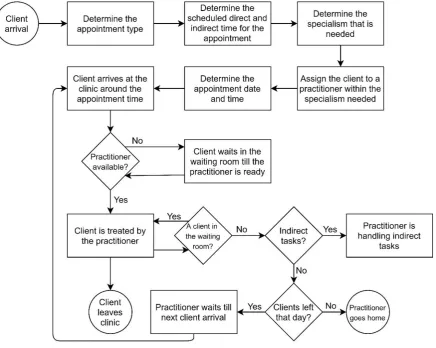
[image:33.595.76.513.180.528.2]In figure 6, the conceptual model of the simulation model can be seen. There is one thing that is significant to mention that is not included in the conceptual model below. If a client arrives at the clinic while a practitioner is handling indirect tasks, the practitioner will directly quit doing indirect tasks and he or she will start treating the arrived client. Once the client is treated and no other clients are in the waiting room, the practitioner will continue working on the indirect tasks where he left.
Figure 6 - Conceptual Model of the Simulation Model
4.3 Output Data
In this section the following research question will be answered: “What is the output data for the simulation model?”. The output variables in this section are already mentioned in section 2.7: The overtime, productivity and waiting time.