Original citation:
Auinger, Michael, Praig, Vera G., Linder, Bernhard and Danninger, Herbert. (2015) Grain boundary oxidation in iron-based alloys, investigated by 18O enriched water vapour - the effect of mixed oxides in binary and ternary Fe-{Al, Cr, Mn, Si} systems. Corrosion Science, Volume 63. pp. 133143.
Permanent WRAP url:
http://wrap.warwick.ac.uk/67315
Copyright and reuse:
The Warwick Research Archive Portal (WRAP) makes this work of researchers of the University of Warwick available open access under the following conditions. Copyright © and all moral rights to the version of the paper presented here belong to the individual author(s) and/or other copyright owners. To the extent reasonable and practicable the material made available in WRAP has been checked for eligibility before being made available.
Copies of full items can be used for personal research or study, educational, or not-for-profit purposes without prior permission or charge. Provided that the authors, title and full bibliographic details are credited, a hyperlink and/or URL is given for the original metadata page and the content is not changed in any way.
Publisher statement:
“NOTICE: this is the author’s version of a work that was accepted for publication in Corrosion Science. Changes resulting from the publishing process, such as peer review, editing, corrections, structural formatting, and other quality control mechanisms may not be reflected in this document. Changes may have been made to this work since it was submitted for publication. A definitive version was subsequently published in Corrosion Science, 2015 http://dx.doi.org/10.1016/j.corsci.2015.04.009
A note on versions:
The version presented here may differ from the published version or, version of record, if you wish to cite this item you are advised to consult the publisher’s version. Please see the ‘permanent WRAP url’ above for details on accessing the published version and note that access may require a subscription.
Accepted Manuscript
Grain Boundary Oxidation in Iron-Based Alloys, investigated by 18O enriched Water Vapour - The Effect of Mixed Oxides in binary and ternary Fe-{Al, Cr, Mn, Si} Systems
Michael Auinger, Vera G. Praig, Bernhard Linder, Herbert Danninger
PII: S0010-938X(15)00169-9
DOI: http://dx.doi.org/10.1016/j.corsci.2015.04.009
Reference: CS 6273
To appear in: Corrosion Science
Received Date: 30 October 2014 Accepted Date: 4 April 2015
Please cite this article as: M. Auinger, V.G. Praig, B. Linder, H. Danninger, Grain Boundary Oxidation in Iron-Based Alloys, investigated by 18O enriched Water Vapour - The Effect of Mixed Oxides in binary and ternary Fe-{Al, Cr, Mn, Si} Systems, Corrosion Science (2015), doi: http://dx.doi.org/10.1016/j.corsci.2015.04.009
Grain Boundary Oxidation in Iron-Based Alloys,
investigated by
18O enriched Water Vapour - The Effect
of Mixed Oxides in binary and ternary Fe-
{
Al, Cr, Mn,
Si
}
Systems
Michael Auingera,c,e,∗, Vera G. Praig b,c,∗∗, Bernhard Linderd, Herbert
Danningerb,c
aMax-Planck-Institut f¨ur Eisenforschung GmbH, Max-Planck-Strasse 1, D-40237 D¨usseldorf, GERMANY
bInstitute for Chemical Technologies and Analytics, Vienna University of Technology, Getreidemarkt 9, A-1060 Vienna, AUSTRIA
cChristian Doppler Laboratory for Diffusion and Segregation Processes during Production of High Strength Steel Sheets
dvoestalpine Stahl GmbH, voestalpine-Straße 3, A-4020 Linz, AUSTRIA eWMG, International Manufacturing Centre, University of Warwick, Coventry
CV4 7AL, UNITED KINGDOM
Abstract
Selective oxidation experiments at 700◦C in binary and ternary iron-based
model alloys containing Al, Cr, Mn, and Si were carried out. The internal
oxidation behaviour along grain boundaries and inside ferrite grains was
an-alyzed by LOM, SEM and ToF-SIMS. Oxygen isotope exchange revealed the
location of fast diffusion pathways in the alloy. Numerical calculations of
oxide distributions were compared to experimental findings, revealing that
oxygen transport within ferrite grains is significantly lower than reported
from literature. Discrepancies between simulations and experiments were
discussed. The presented hypothesis of oxygen trapping represents an
im-portant viewpoint to explain internal oxidation in metallic alloys.
Keywords: A. Steel, A. Alloy, B. Modelling Studies, C. High temperature
corrosion, C. Selective oxidation, C. Internal oxidation
1. Introduction
1
Steels and other corrosion resistant alloys are an important backbone for
2
applications in the automotive and construction industry as well as for novel
3
energy conversion technologies [1, 2]. However, a safe application of those
4
materials in highly corrosive atmospheres such as for gas turbine blades [3],
5
propulsion engines, boiler steels [4, 5] or waste incineration plants [6]
ne-6
cessitates the formation of a protective layer that hinders further corrosive
7
attack at elevated temperatures [1, 2, 7, 8]. Other than that, oxidation plays
8
an essential role during the manufacturing of steels for automotive
applica-9
tions. Here, high-strength materials that often contain manganese (such as
10
TRIP/TWIP-steels [9]) are frequently used because of their unique
mechan-11
ical properties. This allows a significant reduction of sheet thickness and
12
as a consequence the vehicle becomes lighter, which helps to reduce carbon
13
dioxide emissions and meets today’s emission criteria as well as the ideas of
14
modern energy politics.
15
During manufacturing of a sheet material, the alloy undergoes a series of high
16
temperature treatments in oxygen-rich atmospheres, which are often
com-17
bined with plastic deformation. Hot-rolling of slabs has proven to be quite
18
effective for quick size reduction and good mechanical properties of the final
19
sheet material. However, oxide formation underneath the materials surface
(so-called ”internal oxidation” [10]) becomes problematic as the hot-rolled
21
sheet is only rapidly cooled down to temperatures between 600 and 800 ◦C
22
before coiling. The hot coil is then left to cool in the ambient atmosphere,
23
which occurs during a time-frame of several hours. Here, the initially formed
24
w¨ustite layer (iron oxide at the surface) acts as an oxygen reservoir for
in-25
ternal oxidation of the alloy additions - both inside the grains (termed ”bulk
26
oxidation”) and along grain boundaries [11, 12]. Whereas bulk oxidation
rep-27
resents a rather complex discipline that combines reaction kinetics, element
28
transport, defects chemistries [13], nucleation, interface properties and many
29
more, grain boundary oxidation is strongly connected to the atomic
struc-30
ture of grain boundaries [14, 15]. Especially oxides along grain boundaries
31
weaken the cohesion between individual grains, which may even fall off after
32
subsequent forming processes (e.g. for view parts in automotive industry).
33
Therefore, an in-depth understanding of transport properties and oxidation
34
at high temperatures becomes vitally important to invent novel protection
35
strategies against high temperature corrosion. Beside the many works on
36
high temperature oxidation of steels and nickel-based alloys, only little is
re-37
ported on the corrosion properties of well-defined model systems [16, 17, 18].
38
Hence, this work aims at providing a fundamental understanding of grain
39
boundary oxidation in iron-based alloys, including the four most important
40
metallic alloy additions in steel manufacturing - aluminium, chromium,
man-41
ganese and silicon [9, 19]. Mixtures of hydrogen and water vapour were used
42
in this study to mimic the selective oxidation condition underneath the outer
43
scale layer [20, 21], generating a scenario with maximal internal oxidation.
44
Furthermore, the exchange of the oxygen isotopes (16O to 18O) during
posure helps to determine the pathways of fast oxygen diffusion into the
46
material and to elucidate the origin of oxygen transport. Although the
oxy-47
gen transport [22, 23] and the decomposition kinetics of the w¨ustite phase
48
[24] often determine the oxygen activity at the metal-scale interface - which
49
may differ from the experimental conditions in this study - this approach
pro-50
vides a fundamental understanding of alloy composition on oxide formation
51
[18]. Numerical simulations were carried out to predict the internal oxidation
52
behaviour and local (oxide) phase distribution [21, 25]. The results from
cal-53
culations are compared to the experimental findings and critically discussed.
54
55
2. Experimental
56
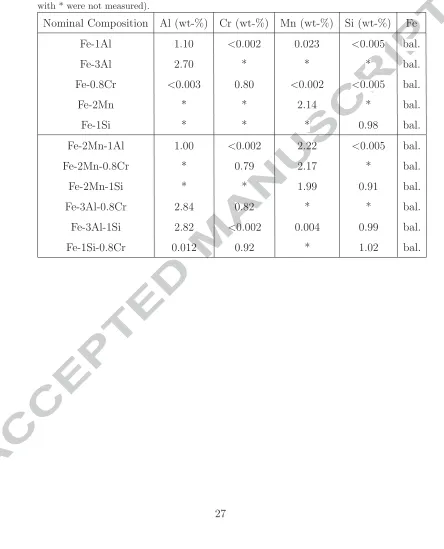
Hot rolled iron-based alloy samples (in house production; see table B.1)
57
were cut into square shaped pieces of 15 mm× 15 mm× 1 mm in size. All
58
surfaces were mechanically ground by using grinding papers from 400 down to
59
2500 grit size, to ensure an optimal compromise between sample roughness
60
and the efficiency of sample heating in an infra-red furnace [26]. Prior to
61
exposure, all samples were ultrasonically cleaned in ethanol and dried in a
62
cold stream of dry air.
63
(TABLE 1)
64
Selective oxidation experiments were carried out at 700 ◦C for a total
65
time of 60 min in a horizontal infra-red furnace, equipped with a vacuum
66
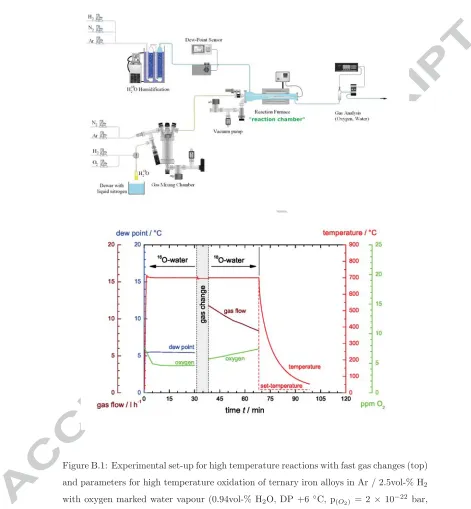
pump and connected to a 8 L gas mixing chamber. Details of the
experi-67
mental set-up have been published previously [27] and can also be found in
figureB.1. The sample temperature was measured by a Ni/CrNi
thermocou-69
ple, which was pressed with a small quartz piston onto the sample surface.
70
Gas exchange after 30 min has been achieved by closing the first gas line,
71
evacuating the reaction chamber with a turbo-molecular pump and switching
72
to the gas mixture from the gas mixing chamber. Two mixtures of Ar/H2
73
(97.5/2.5, v/v) with a humidity of +6 ◦C dew point (0.94vol-% H2O) were
74
used, which corresponds to an oxygen activity in the atmosphere closely
be-75
low the onset of w¨ustite formation under these conditions (+13◦C dew point)
76
[34]. During the first 30 min at elevated temperatures, the argon/hydrogen
77
mixture was saturated with water vapor at +6◦C by bubbling 15 L h−1 (±
78
0.5% [27]) dry gas through deionised water. The second gas mixture,
contain-79
ing 18O-enriched water vapour (high purity water from Sigma Aldrich, 99%
80
H18
2 O), was prepared in a separate gas mixing chamber which had firstly been
81
evacuated to 10−6 mbar. Degassed H18
2 O was evaporated into the evacuated
82
chamber until a pressure of 41.5 mbar was reached. After this, 112.5 mbar
83
hydrogen was added and the chamber was filled with argon to a total pressure
84
of 4.5 bar, yielding the same gas composition as before (97.5% Ar, 2.5% H2,
85
≈0.93vol-% H18
2 O). To avoid condensation in the filled gas mixing chamber,
86
the vessel was thermally insulated, wrapped in aluminium foil and heated
87
up to 40 ◦C. The gas flow conditions from the gas mixing chamber were in
88
the range between 15 and 8 L h1 , depending on the actual pressure in the
89
chamber which varied from 4.5 bar in the beginning to≈2.5 bar at the end of
90
the exposure. However, the pressure drop between reaction chamber and the
91
ambient atmosphere was constant during both oxidation steps and mostly
92
defined by the height of two filled water columns in the gas exhaust line,
that were installed to avoid oxygen back-diffusion. All process parameters
94
during the experiment were recorded fully automatically and stored in a
sin-95
gle protocol file by using an in-house written software routine [27]. Great care
96
has been taken to reduce the oxygen impurity content in the reaction
cham-97
ber below 10 ppm O2. After thermal treatment, the samples were allowed
98
to cool in the flowing gas stream, covered with an electrodeposited nickel
99
layer (tampon galvanisation, 20-50 mA cm−2, Ni-Anode, commercial NiSO 4
100
electrolyte [28]) and mounted in epoxy (PolyFast, Struers). Cross sections
101
of the samples were prepared with a 10◦ tilt angle relative to the specimen
102
surface to enlarge the oxidised zone depth by a factor of 5.67, polished with
103
1μm diamond paste and analysed by means of optical microscopy (Axiovert
104
405M, Zeiss, Germany), scanning electron microscopy (FEI Quanta 200 k,
105
FEI COMPANY, The Netherlands) and ToF-SIMS (TOF-SIMS 5, ION-TOF
106
GmbH, Germany). The operation mode of the ToF-SIMS has been set to
107
dual beam sputtering analysis by 25 keV Bi+ (80 μm × 80 μm) and 2 keV
108
Cs+ (500 μm × 500 μm) presputtering, called ”burst alignment” mode to
109
enhance the sensitivity of the two different oxygen isotopes16O and18O.
110
3. Mathematical Modelling
111
Numerical simulations of the phase distributions were calculated by a
112
subsequent two-step based algorithm ”ASTRID” [29], consisting of element
113
migration and thermodynamic reactions [21, 25, 26, 27, 30]. Transport of the
114
atomic species (oxygen, iron and the alloying elements) has been derived from
115
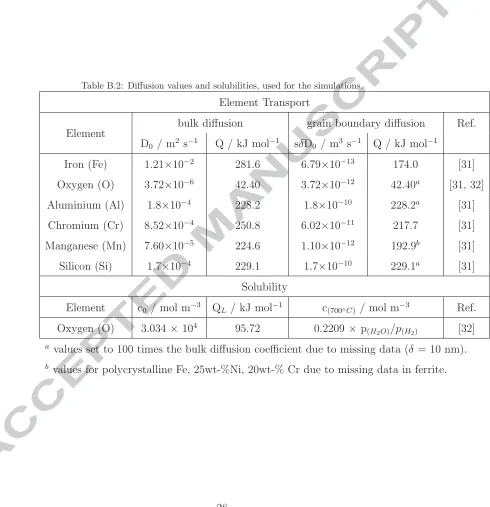
the set of partial differential equations. Diffusion coefficients were chosen
116
from carefully selected literature sources and are listed in table B.2. Phase
diagrams of the alloy systems (see figures B.7 and B.8 in the appendix)
118
indicate that only the diffusion properties in the ferrite phase need to be
119
considered. This follows from the consequence that the crystal structure of
120
the iron matrix does not undergo a phase change (α-γ transition) during
121
heating or at the applied treatment temperature. The alloy content in the
122
samples of this study is either too low to stabilise the austenite phase or does
123
not stabilise the austenite phase at all. Hence, depletion of dissolved alloy
124
element additions (Al, Cr, Mn, Si) due to oxide formation does not lead to
125
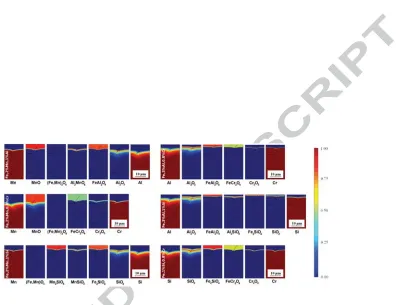
a phase change in the experiments.
126
(TABLE 2)
127
The oxygen concentration at the surface (upper boundary) is set to a
128
constant value, according to the maximum solubility of oxygen under given
129
temperature and oxygen activity in the reaction gas (0.65 ppm [O], see [32],
130
or table B.2). This corresponds to the constant source model firstly proposed
131
by Wagner [33], which reflects the actual conditions at the sample surface
132
in a sufficiently accurate manner. Hence, this assumption is most commonly
133
used in theoretical simulation studies of internal oxidation [21, 25, 30, 34, 35].
134
The calculation of the diffusion has been carried out for small time intervals
135
(≤ 1 min). The results after each calculation step have been used to
de-136
rive the local concentrations of each phase with thermodynamic subroutine
137
ChemApp (GTT-Technologies, Germany) [36]. The amount of each phase
138
from the equilibrium calculation was set as the starting value for the
diffu-139
sion calculation in the next time interval. After the last simulation step, the
140
results were displayed as a two-dimensional concentration map, similar to a
cross section polish of the specimen, indicating the amount and spatial
dis-142
tribution of each stable phase separately. For reasons of graphical simplicity,
143
the sample microstructure was composed by hexagonal grains, separated by
144
a 50 nm thick grain boundary domain. Theoretical results will be presented
145
as a density distribution with values between 1 (maximum concentration)
146
and 0. This mode of presentation has been chosen because the concentration
147
of the alloying elements, and hence the amount of formed precipitate phases,
148
is very low compared to the iron in the matrix.
149
4. Results and Discussion
150
Very stable process conditions during the exposure could be achieved and
151
typical values are summarised in figure B.1. Slight overheating in the
ini-152
tial stages of heating can be attributed to the extremely fast heating rate
153
of 7 K s−1 (see the small temperature peak in Figure B.1 at 2 min). The
154
temperature however, quickly stabilises at 700◦C and remains constant
dur-155
ing the remaining exposure time, except during the gas exchange where the
156
set-temperature has been lowered by 5 K for better visualisation. Although a
157
time frame of 7 min in the temperature program has been set for evacuation
158
and gas exchange in the reaction chamber, this process was often finished
159
within 4-5 min. Slight decreases of the gas flow of the 18O-enriched
atmo-160
sphere can be attributed to the drop of pressure in the gas mixing chamber
161
with time. Simultaneously, the content of oxygen impurities in the reaction
162
gas increases with time but always remains below a limit of 10 ppm O2.
163
After heat treatment, the samples show a grey-shiny or even metallic
sur-164
face, indicating the absence of outer scale formation, which underlines the
successful experimental conditions for avoiding the formation of an outer
166
(iron) oxide scale [18, 37]. Results of the oxidation depths in all samples will
167
be summarised in tableB.3.
168
(TABLE 3)
169
4.1. Binary Alloys
170
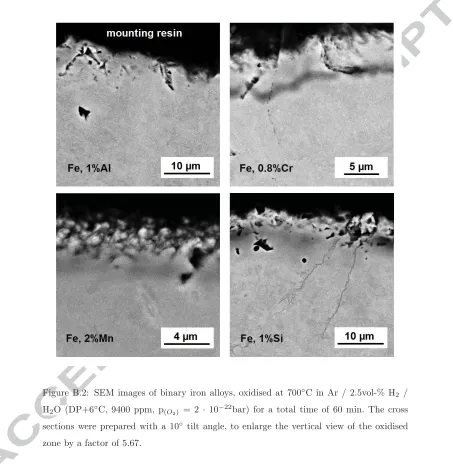
Little to no signs of pure internal oxidation could be observed in the
171
SEM pictures of figureB.2, as the oxide precipitates, formed inside the
fer-172
rite grains, are less than 100 nm in size. Similar to previous studies [18], a thin
173
layer of (Fe,Mn)O could be observed near the surface of Fe-2Mn. The
oxida-174
tion depth appears to be quite uniform in Fe-{1,3}Al and Fe-2Mn, whereas
175
fine patterns of 50 nm to 200 nm thick grain boundary oxides could only be
176
seen in Fe-0.8Cr and Fe-1Si. The structure of the grain boundary oxides in
177
Fe-1Si appears to be homogeneously distributed and uniform in thickness,
178
whereas in Fe-0.8Cr small oxide particles align at the grain-grain interface.
179
Some works theorize about the existence of a continuous network of alloy
180
precipitates (”seaweed-like structure” [38]), that forms between the metal
181
grains as a consequence of local changes of the grain boundary orientation.
182
(FIGURE 2)
183
The differences in the bulk oxidation depth between experiments and
the-184
oretical predictions are likely to be caused by the interaction of the elements
185
with individual oxygen traps in the metal lattice (e.g. single defects).
Trap-186
ping leads to a slower diffusion rate in reality [37], compared to the ideal
crys-187
tal from theoretical predictions [39]. Segregation during sample preparation
or kinetic effects of oxide phase formation may also cause minor deviations.
189
However, grain boundary segregation of elements is quite small at elevated
190
temperature [40, 41] and diffusion lengths into the grain are extremely short
191
[14, 15] which would mainly affect the near-surface oxide distribution during
192
the initial stages of oxidation.
193
Surface and interface energies can have a detrimental influence on oxide
nu-194
cleation, which may hamper the formation of individual phases. It is well
195
known that the formation of hexagonal chromia nuclei in a cubic ferrite
en-196
vironment is kinetically hindered [1, 2]. Consequently, local supersaturation
197
of oxygen in the ferrite matrix and - in extreme cases - the direct conversion
198
of dissolved chromium into the spinel phase has been observed [42]. In the
199
case of aluminium, it is known that cubic θ-Al2O3 forms initially and then
200
slowly transforms into the more stable α-Al2O3 phase (trigonal) [43]. Due to
201
this behaviour, the energy barrier for oxide formation and hence local oxygen
202
supersaturation in the metal are minimised.
203
Polycrystalline oxides such as MnO and spinels [44] possess a quite high
oxy-204
gen diffusion coefficient, compared to pure Al2O3, Cr2O3 and SiO2 at given
205
oxygen activities in this study [7, 22, 45]. Hence their presence should not
206
block the internal oxidation process completely and would allow the
observa-207
tion of pronounced grain boundary oxide formation in the material. Despite
208
the fact that manganese is an element that easily switches between its
va-209
lency states, grain boundary oxidation in pure iron-manganese samples was
210
not observed. This indicates that the formation of defect-rich oxides with
rel-211
atively high ion mobilities alone does not lead to enhanced grain boundary
212
oxidation.
4.2. Ternary Alloys
214
Light optical micrographs of the metallographic sections revealed clear
215
signs of internal oxidation, as shown in figure B.3. Remarkably, the ternary
216
alloy compositions containing 2 wt-%Mn show a well-pronounced oxide
for-217
mation along grain boundaries (figure B.3, left column) forming a wavy
pat-218
tern of the oxide front. The total oxidation depth in these alloys is
gov-219
erned by the large network of thin oxides along the intergranular region and
220
reaches values between 7 μm (Fe-2Mn-0.8Cr) and 10 μm (Fe-2Mn-1Si). A
221
homogeneous zone of bulk oxides can be seen in the cases of
manganese-222
free alloys containing silicon, aluminium or chromium (figure B.3, right
col-223
umn). Within this group of materials, indications of an enhanced oxide
224
formation along grain boundaries could only be seen in the case of
Fe-3Al-225
0.8Cr (4.5 μm). The presence of grain boundary oxides, however, has only
226
minor influence on the total oxidation depth, which is very similar to the
227
homogeneous layer of the bulk oxidation zone. Little to no signs of grain
228
boundary oxidation could be observed in the cases of Fe-3Al-1Si and
Fe-1Si-229
0.8Cr where the cross section only shows a distinct 3-4μm thick band of bulk
230
oxides underneath the sample surface.
231
(FIGURE 3)
232
SEM analyses of the cross sections in figure B.4 revealed the presence
233
of finely dispersed oxides inside the grains, that compose the bulk oxidation
234
band (i.e. the grey shaded area in figures B.3 and B.4). Grain boundary
235
oxides showed to be up to 250 nm thick and mostly continuously distributed
236
along the grain boundaries. Individual oxide particles that align along the
grain boundaries could only be seen in the case of Fe-2Mn-0.8Cr. The
mi-238
crostructure near the sample surface of all alloys seems to be composed of
239
smaller ferrite grains than in the interior near the oxidation front. This may
240
be attributed to grain boundary pinning by the newly formed oxides in the
241
early stages of the experiment [46]. As a consequence, recrystallisation
dur-242
ing the heat treatment at 700◦C will be blocked as soon as oxides are present.
243
This effect is dominant in close proximity to the surface and loses its influence
244
towards the sample interior, since there has been more time for grain growth
245
prior to grain boundary pinning by oxides. Occasionally, extremely fine
ox-246
ide structures in sub-grain boundaries could be detected. These structures
247
form as a tensile stress release mechanism that compensates the mechanical
248
energy caused by the local volume increase due to oxide formation. Since
249
the increase of molar volume is biggest in the case of silicon (ΔVm= 10.63×
250
10−6 m3 mol−1 for Si→SiO
2 [18, 47]), the visibility of sub-grain boundaries
251
is dominant in silicon containing alloys.
252
(FIGURE 4)
253
Since oxygen diffuses from the surface towards the interior, the local
oxy-254
gen activity decreases towards the sample interior and reaches a critical limit
255
for oxide formation at the oxidation front. Close to the surface, the
oxy-256
gen activity becomes higher which stabilises oxygen-rich precipitates such as
257
spinels or mixed oxides of the alloy additions with iron (compare figureB.5).
258
Such a behaviour could be confirmed by qualitative EDX analyses although
259
this data is not shown because this technique detects a huge iron signal,
260
owing to the relatively large measurement spot compared to the tiny oxide
particles. However, an increased alloy content near the oxidation front could
262
be observed. This points to the presence of a lower iron content in the oxides
263
(or even pure alloy element oxides) close to the oxidation front.
264
Calculations of the spatial phase distribution were carried out by using the
265
pure substance thermodynamic dataset from FactSage [48]. As a
conse-266
quence, the calculated phases possess the stoichiometric composition that is
267
determined from the database. However, especially in the case of MnO, the
268
cation sites in the crystal lattice can easily be occupied by either manganese
269
or iron, which leads to the good miscibility of MnO and w¨ustite (FeO) [49].
270
This leads to a variation of the minimal oxygen activity, needed for
forma-271
tion of an oxide, depending on the local iron/manganese ratio. Assuming the
272
thermodynamics of ideal mixing, one would expect for the oxide composition
273
(1) an increased content of manganese towards the internal oxidation front
274
(2) the formation of mixed iron-manganese oxides near (or at [18]) the
sur-275
face with a manganese content, corresponding to the oxygen activity in the
276
reaction gas.
277
(FIGURE 5)
278
Interstingly, the calculated oxidation depths are always larger than
exper-279
imental observations. Whereas the biggest deviation of more than a factor of
280
2 has been measured in the absence of grain boundary oxidation, little to no
281
deviation of the total oxidation depth could be observed for manganese
con-282
taining alloys that show preferential grain boundary oxidation. Within this
283
study, all alloys show a bulk oxidation behaviour that is significantly lower
284
than expected from theoretical predictions. This strongly suggests inhibition
of the element transport inside the ferrite grains, which may again likely be
286
caused by defect structures and element trapping [13, 39]. Whereas defects
287
can decrease diffusion due to their trapping behaviour in a well-defined
crys-288
tal lattice and also across grain boundaries in a wider sense, their influence
289
almost vanishes along the diffuse grain boundary region at elevated
tempera-290
tures [13, 15, 51] where the oxygen atoms ”jump” from one defect site to the
291
other without interactions with the ideal crystall lattice. While theoretical
292
simulations only consider diffusion and local thermodynamic equilibria,
oxy-293
gen isotope experiments help to shine light on the influence of substitution
294
reactions in the fine-grained oxide precipitates [52, 53, 54]. This helps to
un-295
ravel the pathways of fast oxygen transport in the alloy and leads towards the
296
origin of the pronounced grain boundary oxidation in some alloys. Previous
297
studies show that two hypothetical and extreme mechanisms determine the
298
oxygen isotope distribution pattern - transport via diffusion (including fast
299
diffusion pathways) and oxygen isotope substitution in the already formed
300
oxide precipitates. A pure oxygen isotope substitution mechanism under the
301
conditions shown in figure B.6 would lead to two separated oxide regions,
302
where the upper layer near the sample surface just contains 18O. This
do-303
main ”pushes” the 16O-isotopes further inwards during thermal treatment,
304
which can then be found directly underneath the 18O layer. Consequently,
305
the presence of16O determines the total oxidation depth in the alloy. A pure
306
diffusion mechanism without substitution implies that18O-isotopes move
in-307
wards and form oxides near the oxidation front. In this case, no changes
308
of the 16O-distribution would be observed - 16O being firmly bonded at its
309
original sites - and the total oxidation depth is then defined by the innermost
presence of 18O-isotopes.
311
(FIGURE 6)
312
Clear signs of fast oxygen diffusion along the grain boundary domain
313
could be seen in all manganese containing alloys (figure B.6, left column).
314
The majority of18O passes the region of previously formed16O-oxides along
315
the grain boundaries with little to no oxygen isotope substitution. This
indi-316
cates that oxygen transport along grain boundaries has only little interaction
317
with oxygen diffusion through the ferrite grains. Slight signs of grain
bound-318
ary oxidation could be detected in Fe-3Al-0.8Cr. Consequently we conclude
319
that the grain boundaries act as a channel of fast oxygen transport through
320
the internal precipitate zone, leading to an increased amount of 18O-oxides
321
near the oxidation front. Similar to the pronounced diffusion mechanism
322
along grain boundaries (with little to no oxygen isotope substitution), 18O
323
has to move through the ferrite grains and partially substitutes the
oxy-324
gen isotopes (16O by 18O) in the bulk oxides. Consequently, the 18O-region
325
near the sample surface pushes the 16O-oxide region further inwards, which
326
becomes now sandwiched between two clearly visible 18O-regions. This
be-327
haviour can nicely be seen in the case of Fe-3Al-1Si (figure B.6).
328
The fact, that predominant grain boundary oxidation could only be observed
329
in the case of manganese alloys, suggests a significant influence of this
ele-330
ment. In contrast to these findings, we found no signs of grain boundary
331
oxidation in binary low alloyed iron-manganese (figure B.2) which has also
332
been confirmed in previous studies [18, 55]. This leads to the consequence
333
that not a single-element effect of manganese but the combination of
man-334
ganese and additional alloy elements lead to the pronounced grain boundary
oxide formation. Manganese possess the unique possibility to quickly vary its
336
valency states, which may allow for relatively fast ion transport in the oxide
337
crystal. The fact, that surface energies may alter thermodynamic stability
338
(and hence phase diagrams) [56] is likely not to be responsible for the fast
339
oxygen diffusion along grain boundaries. The manganese free alloys in this
340
study do not possess such a high redox-flexibility of the alloy element’s
va-341
lency states (or do not form mixed oxides at all) and hence show little to no
342
oxidative attack along grain boundaries. Another possibility is to attribute
343
the result to a convolute effect of enhanced element transport along grain
344
boundaries and an overall lower oxygen diffusion due to interaction with
de-345
fects in the ferrite lattice. Such an explanation, however, would imply that
346
the oxygen-trap-interaction in the diffuse grain boundary domain is similar
347
to interaction in the well-ordered crystal lattice, which seems very unlikely.
348
It needs to be emphasised that the experimental approach presented here
349
may not strictly reflect the behaviour underneath a dense w¨ustite layer for
350
typical industrial conditions. In an industrial process, the oxygen activity
351
at the metal-scale interface is defined by the oxygen transport properties
352
through the outer scale layer as well as by w¨ustite decomposition kinetics
353
[24]. These barriers may lead to a significant decrease of the local oxygen
354
activity in the metal and alter the formation of oxides. However, the present
355
study describes the internal oxidation behaviour of iron-based alloys at
el-356
evated temperatures in such a pure and simple way that results may even
357
be used to extend theoretical knowledge by the synergies of ternary element
358
additions.
5. Conclusions
360
Selective oxidation experiments at 700 ◦C in binary and ternary
iron-361
based alloys, containing Al, Cr, Mn and Si have been performed. Cross
362
sections of all ternary iron-manganese based samples revealed a fine network
363
of up to 250 nm thick grain boundary oxides that separate individual grains
364
and show severest oxidative attack (7-11 μm). The fact, that pronounced
365
grain boundary oxidation is absent in binary Fe-2Mn, may partially be due
366
to the formation of sparsely distributed oxides at the surface of the Fe-2Mn
367
samples. However, this is more likely to be an effect of mixed oxide formation
368
in ternary alloy compositions (Al, Cr or Si) with Mn.
369
Bulk oxidation behaviour (oxide formation inside the ferrite grains) became
370
dominant in Fe-{1, 3}Al, Fe-2Mn as well as ternary manganese-free alloys,
371
characterised by the presence of finely dispersed oxide particles that reach
372
up to 4 μm into the material. An intermediate case of bulk oxidation with
373
slight signs of grain boundary oxidation was observed in Fe-3Al-0.8Cr.
374
Remarkably, only minor discrepancies of≤1μm between simulations and
ex-375
periments could be verified in alloys that show pronounced grain boundary
376
oxidation. This behaviour is attributed to trapping reactions in the grain
377
that effectively slow down bulk diffusion behaviour (predominantly oxygen
378
diffusion). Hence, the diffuse crystal structure near grain boundaries at
el-379
evated temperatures favours fast oxygen transport along (but not across!)
380
them, and does not exceed the limit of pure grain boundary diffusion data
381
from literature.
382
”Enhanced grain boundary oxidation” - which is often found in the literature
383
- would be misleading in the present case as one might expect a diffusion
mechanism that is faster than theoretical expectations. Findings in Fe-0.8Cr,
385
Fe-1Si and ternary iron-manganese alloys rather suggest that diffusion along
386
grain boundaries does not change much by crystal defects. However, pure
387
bulk oxidation was indeed slowed down in all other alloys.
388
Oxygen isotope exchange experiments prove the fast diffusion pathways along
389
grain boundaries and the small interaction between grain boundary oxides
390
and oxide particles inside the grains. Here, the 18O-isotope signal along
391
grain boundaries in ternary iron-manganese based alloys was predominant,
392
compared to the16O signal. Oxygen isotope exchange becomes significant in
393
the absence of grain boundary oxides, leading to the formation of an internal
394
16O region. An intermediate situation between fast oxygen transport and
395
oxygen isotope substitution could be observed in Fe-3Al-1Si, where the16O
396
domain is sandwiched between two 18O domains.
397
Since Al, Cr and Si form stiochiometric oxides due to their low flexibility
398
in their valency state (compared to Mn), fast oxygen transport along grain
399
boundaries may likely be caused by the formation of mixed oxides with Mn
400
(ternary alloys) and/or the atomic structure in the metal near the grain-oxide
401
interface (Fe-0.8Cr, Fe-1Si).
402
6. Acknowledgements
403
The authors thank M. DeBardi, K. Piplits and Prof. H. Hutter (all
Vi-404
enna University of Technology) for their assistance with the ToF-SIMS
mea-405
surements. Helpful support with the thermal insulation of the pressurised
406
gas mixing chamber by S. Evers and D. Vogel (both Max-Planck-Institut f¨ur
407
Eisenforschung GmbH) is greatfully acknowledged. M. Auinger is thankful
to D. Paesold (voestalpine Stahl GmbH) and Prof. J. Fleig (Vienna
Uni-409
versity of Technology) for scientific discussions. Financial support by the
410
voestalpine Stahl GmbH (Austria) and the Christian Doppler
Forschungsge-411
sellschaft (Austria) for the Christian Doppler Laboratory, led by M.
Rohw-412
erder (Max-Planck-Institut f¨ur Eisenfoschung GmbH), is gratefully
acknowl-413
edged.
414
Appendix A. Binary Phase Diagrams
415
(FIGURE 7)
416
Appendix B. Ternary Phase Diagrams
417
(FIGURE 8)
418
References
419
[1] N. Birks, G.H. Meier, F.S. Pettit, Introduction to High Temperature
Ox-420
idation of Metals, second ed. Cambridge: Cambridge University Press,
421
2006.
422
[2] D.J. Young, High Temperature Oxidation and Corrosion of Metals, in:
423
Burstein T (Eds.). Elsevier Corrosion Series. Oxford: Elsevier, 2008.
424
[3] P.J. Meschter, E.J. Opila, N.J. Jacobson, Water Vapor-Mediated
425
Volatilization of High-Temperature Materials, Annu. Rev. Mater. Res.
426
43 (2013) 559-588.
[4] E. Essuman, G.H. Meier, J. ˙Zurek, M. H¨ansel, L. Singheiser, W.J.
428
Quadakkers, Enhanced internal oxidation as trigger for breakaway
oxi-429
dation of Fe-Cr alloys in gases containing water vapor, Scipta Mater. 57
430
(2007) 845-848.
431
[5] Grabke HJ, Sch¨utze M, Oxidation of Intermetallics, second edn.,
Wein-432
heim: Wiley VCH, 2008.
433
[6] M. S´anchez Past´en, M. Spiegel, High temperature corrosion of metallic
434
materials in simulated waste incineration environments at 300 - 600◦C,
435
Mater. Corros. 57 (2006) 192-195.
436
[7] A.H. Heuer, D.B. Hovis, J.L. Smialek, B. Gleeson, Alumina Scale
For-437
mation: A New Perspective, J. Am. Ceram. Soc. 94 (2011) 146-153.
438
[8] E. Essuman, G.H. Meier, J. ˙Zurek, M. H¨ansel, W.J. Quadakkers, The
439
Effect of Water Vapor on Selective Oxidation of Fe-Cr Alloys, Oxid.
440
Met. 69 (2008) 143-162.
441
[9] O. Gr¨assel, L. Kr¨uger, G. Frommeyer, L.W. Meyer, High strength
Fe-442
Mn-(Al,Si) TRIP/TWIP steels development - properties - application,
443
Int. J. Plasticity 16 (2000) 1391-1409.
444
[10] P. Hou, Segregation Phenomena at Thermally Grown Al2O3/Alloy
In-445
terfaces, Annu. Rev. Mater. Res. 38 (2008) 275-298.
446
[11] M. H¨ansel, C.A. Boddington, D.J. Young, Internal oxidation and
car-447
burisation of heat-resistant alloys, Corros. Sci. 45 (2003) 967-981.
[12] L. Liu, Z.G. Yang, C. Zhang, M. Ueda, K. Kawamura, T. Maruyama,
449
Effect of water vapour on the oxidation of Fe-13Cr-5Ni martensitic alloy
450
at 973 K, Corros. Sci. 60 (2012) 90-97.
451
[13] B. Pieraggi, R.A. Rapp, J.P. Hirth, Role of Interface Structure and
452
Interfacial Defects in Oxide Scale Growth, Oxid. Met. 44 (1995) 63-79.
453
[14] I. Kaur, Y. Mishin, W. Gust, Fundamentals of Grain and Interphase
454
Boundary Diffusion, third edn. Weinheim: John Wiley & Sons, 1995.
455
[15] P.L. Williams, Y. Mishin, Thermodynamics of grain boundary
premelt-456
ing in alloys. II. Atomistic simulation, Acta Mater. 57 (2009) 3786-3794.
457
[16] A. Atkinson, A Theoretical Analysis of the Oxidation of Fe-Si Alloys,
458
Corros. Sci. 22 (1982) 87-102.
459
[17] B.A. Pint, I. Wright, The Oxidation Behavior of Fe-Al Alloys, Mat. Sci.
460
Forum. 461-464 (2004) 799-806.
461
[18] M. Auinger, E.M. M¨uller-Lorentz, M. Rohwerder, Modelling and
exper-462
iment of selective oxidation and nitridation of binary model alloys at
463
700◦C - The systems Fe, 1 wt.%{Al, Cr, Mn, Si}, Corros. Sci. 90 (2015)
464
503-510.
465
[19] D.J. Young, J. Zurek, L. Singheiser, W.J. Quadakkers, Temperature
466
dependence of oxide scale formation on high-Cr ferritic steels in Ar-H2
-467
H2O, Corros. Sci. 53 (2011) 2131-2141.
468
[20] H.J.T. Ellingham, Reducibility of Oxides and Sulphides in Metallurgical
469
Processes, J. Soc. Chem. Ind.-L 5 (1944) 125-133.
[21] M. Auinger, A. Vogel, V.G. Praig, H. Danninger, M. Rohwerder,
Ther-471
mogravimetry and insitu mass spectrometry at high temperatures
com-472
pared to thermochemical modelling - The weight loss during selective
473
decarburisation at 800◦C, Corros. Sci. 78 (2014) 188-192.
474
[22] A. Holt, P. Kofstad, Electrical conductivity and defect structure of
475
Cr2O3 I. High temperatures (<≈1000◦C), Solid State Ionics 69 (1994)
476
127-136.
477
[23] F. Millot, Y. Niu, Diffusion of18O in Fe
3O4: An Experimental Approach
478
to Study the behavior of Minority Defects in Oxides, J. Phys. Chem.
479
Solids. 58 (1997) 63-72.
480
[24] M.H. Davies, M.T. Simnad, C.E. Birchenall, On the Mechanism and
481
Kinetics of the Scaling of Iron, T. Metall. Soc. AIME 10 (1951) 889-896.
482
[25] T.J. Nijdam, L.P.H. Jeurgens, W.G. Sloof, Modelling the thermal
oxi-483
dation of ternary alloys-compositional changes in the alloy and the
de-484
velopment of oxide phases, Acta Mater. 51 (2003) 5295-5307.
485
[26] M. Auinger, P. Ebbinghaus, A. Bl¨umich, A. Erbe, Effect of surface
486
roughness on optical heating of metals, J. Europ. Opt. Soc. Rap. Public.
487
9 (2014) 14004.
488
[27] M. Auinger, D. Vogel, A. Vogel, M. Spiegel, M. Rohwerder, A novel
489
laboratory set-up for investigating surface and interface reactions during
490
short term annealing cycles at high temperatures, Rev. Sci. Instr. 84
491
(2013) 085108.
[28] B.L. Bramfitt, A.O. Benscoter, Metallographer’s Guide - Practice and
493
Procedures for Irons and Steels, first edn., Materials Park Ohio: ASM
494
International, 2002.
495
[29] M. Auinger, R. Naraparaju, H.J. Christ, M. Rohwerder, Modelling High
496
Temperature Oxidation in Iron-Chromium Systems: Combined Kinetic
497
and Thermodynamic Calculation of the Long-Term Behaviour and
Ex-498
perimental Verification, Oxid. Met. 76 (2011) 247-258.
499
[30] W.M. Pragnell, H.E. Evans, A finite-difference model to predict 2D
de-500
pletion profiles arising from high temperature oxidation of alloys,
Mod-501
elling Simul. Mater. Sci. Eng. 14 (2006) 733-740.
502
[31] H. Mehrer, Landolt B¨ornstein - Numerical Data and Functional
Re-503
lationships in Science and Technology: Group III, vol. 26, Berlin:
504
Springer, 1990.
505
[32] J.H. Swisher, E.T. Turkdogan, Solubility, Permeability, and Diffusivity
506
of Oxygen in Solid Iron, T. Metall. Soc. AIME 239 (1967) 426-431.
507
[33] C. Wagner, Theoretical Analysis of the Diffusion Processes Determining
508
the Oxidation Rate of Alloys, J. Electrochem. Soc. 99 (1952) 369-380.
509
[34] U. Krupp, H.J. Christ, Selective Oxidation and Internal Nitridation
dur-510
ing High-Temperature Exposure of Single-Crystalline Nickel-Base
Su-511
peralloys, Metall. Mater. Trans. A 31 (2000) 47-56.
512
[35] D. Huin, P. Flauder, J.B. Leblond, Numerical Simulation of Internal
513
Oxidation of Steels during Annealing treatments, Oxid. Met. 64 (2005)
514
131-167.
[36] S. Petersen, K. Hack, The thermochemistry library ChemApp and its
516
applications, Int. J. Mat. Res. 98 (2007) 935-945.
517
[37] M. Auinger, A. Vogel, D. Vogel, M. Rohwerder, Early stages of
oxida-518
tion observed by in situ thermogravimetry in low pressure atmospheres,
519
Corros. Sci. 86 (2014) 183-188.
520
[38] H. Kokawa, M. Shimada, Y.S. Sato, Grain-Boundary Structure and
Pre-521
cipitation in Sensitized Austenitic Stainless Steel, JOM 52 (2000) 34-37.
522
[39] M. Auinger, Hydrogen Transport in non-ideal Crystalline Materials,
523
Chem Phys Chem 15 (2014) 2893-2902.
524
[40] H.J. Grabke, Surface and Grain Boundary Segregation on and in Iron
525
and Steels, ISIJ Int. 29 (1989) 529-538.
526
[41] P. Lejˇcek, Grain Boundary Segregation in Metals, in: Hull R, Parisi J,
527
Jagadish C, Wang Z, Osgood RM, Warlimont H (Eds.). Springer Series
528
in Materials Science. Heidelberg: Springer-Verlag, 2010.
529
[42] D.J. Young, M.L. Burg, P.R. Munroe, Internal Precipitation of Al2O3
530
and Cr2O3 in Austenitic Alloys, Mat. Sci. Forum 461-464 (2004) 21-28.
531
[43] W. Zhao, Z. Li, B. Gleeson, A New Kinetics-Based Approach to
Quan-532
tifying the Extent of Metastable → Stable Phase Transformation in
533
Thermally-Grown Al2O3 Scales, Oxid. Met. 79 (2013) 361-381.
534
[44] J. T¨opfer, S. Aggarwal, R. Dieckmann, Point defects and cation tracer
535
diffusion in (CrxFe1−x)3−δO4 spinels, Solid State Ionics 81 (1995)
251-536
266.
[45] E.J. Opila, Oxidation and Volatilization of Silica Formers in Water
Va-538
por, J. Am. Ceram. Soc. 86 (2003) 1238-1248.
539
[46] ¨O.N. Dogan, G.M. Michal, H.W. Kwon, Pinning of Austenite Grain
540
Boundaries by AlN Precipitates and Abnormal Grain Growth, Metall.
541
Mater. Trans. A 23 (1992) 2121-2129.
542
[47] D.R. Lide, CRC Handbook of Chemistry and Physics, CRC Press, Boca
543
Raton, FL; 2010 Internet Version (http://www.hbcpnetbase.com).
544
[48] C.W. Bale, P. Chartrand, S.A. Degterov, G. Eriksson, K. Hack, R. Ben
545
Mahfoud, J. Melanon, A.D. Pelton, S. Petersen, FactSage
Thermochem-546
ical Software and Databases, Calphad 26 (2002) 189-228.
547
[49] W.K. Chen, N.L. Peterson, Effect of the Deviation from Stoichiometry
548
on Cation Self-Diffusion and Isotope Effect in W¨ustite, Fe1−xO, J. Phys.
549
Chem. Solids 36 (1975) 1097-1103.
550
[50] Y. Takada, S. Shimada, J. Lee, M. Kurosaki, T. Tanaka, The Effect of
551
Si and Mn Content on Dynamic Wetting of Steel with Liquid Zn, ISIJ
552
Int. 49 (2009) 100-104.
553
[51] A. Atkinson, Grain-boundary Diffusion: An Historical Perspective, J.
554
Chem. Soc. Faraday Trans. 86 (1990) 1307-1310.
555
[52] B.A. Pint, J.R. Martin, L.W. Hobbs,18O/SIMS Characterization of the
556
Growth Mechanism of Doped and Undoped α-Al2O3, Oxid. Met. 39
557
(1993) 167-195.
[53] K. Bongartz, W.J. Quadakkers, J.P. Pfeifer, J.S. Becker, Mathematical
559
modelling of oxide growth mechanisms measured by18O tracer
experi-560
ments, Surf. Sci. 292 (1993) 196-208.
561
[54] A.H. Heuer, T. Nakagawa, M.Z. Azar, B.D. Hovis, J.L. Smialek, B.
562
Gleeson, N.D.M. Hine, H. Guhl, H.S. Lee, P. Tangney, W.M.C. Foulkes,
563
W.M. Finnis, On the growth of Al2O3 scales, Acta Mater. 61 (2013)
564
6670-6683.
565
[55] P. Jackson, G. Wallwork, High Temperature Oxidation of
Iron-Man-566
ganese-Aluminum Based Alloys, Oxid. Met. 21 (1984) 135-170.
567
[56] J. Olives, Surface thermodynamics, surface stress, equations at surfaces
568
and triple lines for deformable bodies, J. Phys. Condens. Matter 22
569
(2010) 085005.
Table B.1: Alloy compositions, measured by atomic absorption spectroscopy (AAS, values with * were not measured).
Nominal Composition Al (wt-%) Cr (wt-%) Mn (wt-%) Si (wt-%) Fe
Fe-1Al 1.10 <0.002 0.023 <0.005 bal.
Fe-3Al 2.70 * * * bal.
Fe-0.8Cr <0.003 0.80 <0.002 <0.005 bal.
Fe-2Mn * * 2.14 * bal.
Fe-1Si * * * 0.98 bal.
Fe-2Mn-1Al 1.00 <0.002 2.22 <0.005 bal.
Fe-2Mn-0.8Cr * 0.79 2.17 * bal.
Fe-2Mn-1Si * * 1.99 0.91 bal.
Fe-3Al-0.8Cr 2.84 0.82 * * bal.
Fe-3Al-1Si 2.82 <0.002 0.004 0.99 bal.
Table B.2: Diffusion values and solubilities, used for the simulations.
Element Transport
Element
bulk diffusion grain boundary diffusion Ref.
D0 / m2 s−1 Q / kJ mol−1 sδD
0 / m3 s−1 Q / kJ mol−1
Iron (Fe) 1.21×10⁻² 281.6 6.79×10⁻¹³ 174.0 [31]
Oxygen (O) 3.72×10⁻⁶ 42.40 3.72×10⁻¹² 42.40a [31, 32]
Aluminium (Al) 1.8×10⁻⁴ 228.2 1.8×10⁻¹⁰ 228.2a [31]
Chromium (Cr) 8.52×10⁻⁴ 250.8 6.02×10⁻¹¹ 217.7 [31]
Manganese (Mn) 7.60×10⁻⁵ 224.6 1.10×10⁻¹² 192.9b [31]
Silicon (Si) 1.7×10⁻⁴ 229.1 1.7×10⁻¹⁰ 229.1a [31]
Solubility
Element c0 / mol m−3 Q
L / kJ mol−1 c(700◦C) / mol m−3 Ref.
Oxygen (O) 3.034× 10⁴ 95.72 0.2209×p
(H2O)/p(H2) [32]
a values set to 100 times the bulk diffusion coefficient due to missing data (δ = 10 nm).
Table B.3: Experimental (dexp) and calculated (dsim) corrosion depth and presence of
grain boundary oxides (GB-oxides) in binary and ternary iron-based alloys after heat treatment at 700◦C for 60min in Ar / 2.5vol-%H2/ 0.94vol-%H2O.
Alloy GB-oxides dexp (μm) dsim (μm) dexp/dsim
bulk GB bulk GB bulk GB
Fe-1Al No 1.5 * 7.3 8.8 0.210 *
Fe-3Al No 1.2 * 4.0 5.3 0.305 *
Fe-0.8Cr Yes 1.1 2.8 10.8 13.9 0.106 0.201
Fe-2Mn No 1.7 * 9.8 11.7 0.177 *
Fe-1Si Yes 1.5 3.1 5.5 7.3 0.273 0.419
Fe-2Mn-1Al Yes 2.4 8.2 6.3 8.9 0.386 0.920
Fe-2Mn-0.8Cr Yes 1.5 7.4 7.6 9.2 0.196 0.800
Fe-2Mn-1Si Yes 1.5 10.2 5.3 10.2 0.281 0.993
Fe-3Al-0.8Cr slightly 3.1 4.5 4.6 8.5 0.674 0.528
Fe-3Al-1Si No 2.5 * 4.3 8.5 0.573 *
Figure B.6: ToF-SIMS measurements of oxygen isotope distribution in ternary iron alloys, oxidised at 700◦C for 60 min in Ar / 2.5vol-% H2/ 0.94vol-% H2O (DP +6◦C, p(O2) = 2×10⁻²² bar). After 30 min, the gas mixture for the heat treatment was switched from H162 O to H182 O. The distributions are displayed for18O (green),16O (red) and Ni (blue). The top red part in the pictures is due to the embedding material. Cross sections were
•
• !"#$!%#& '
• ('
• )''''*