A Thesis Submitted for the Degree of PhD at the University of Warwick
http://go.warwick.ac.uk/wrap/77119
This thesis is made available online and is protected by original copyright. Please scroll down to view the document itself.
Axel Finke
On
Extended State-Space
Constructions
for
Monte Carlo Methods
Thesis submitted for the degree of
Doctor of Philosophy
Summary
This thesis develops computationally efficient methodology in two areas. Firstly, we consider a particularly challenging class of discretely observed continuous-time point-process models. For these, we analyse and im-prove an existing filtering algorithm based on sequential Monte Carlo
(
smc
) methods. To estimate the static parameters in such models, we devise novel particle Gibbs samplers. One of these exploits a sophisticated non-centred parametrisation whose benefits in a Markov chain Monte Carlo(mcmc
) context have previously been limited by the lack ofblock-wise updates for the latent point process. We apply this algorithm to a Lévy-driven stochastic volatility model. Secondly, we devise novel Monte Carlo methods – based around pseudo-marginal and conditional
smc
approaches – for performing optimisation in latent-variable models and more generally. To ease the explanation of the wide range of techniques employed in this work, we describe a generic importance-sampling frame-work which admits virtually all Monte Carlo methods, including
smc
andmcmc
methods, as special cases. Indeed, hierarchical combinations of different Monte Carlo schemes such assmc
withinmcmc
orsmc
withinDeclaration
This thesis is the result of my own work and research, except where otherwise indicated. Chapter 4 is a condensed version of the published journal article
Finke, A., Johansen, A. M. & Spanò, D. (2014). Static-param-eter estimation in piecewise dStatic-param-eterministic processes using particle Gibbs samplers. Annals of the Institute of Statistical Mathematics,66(3), 577–609.
This thesis has not been submitted for examination to any other institution than the University of Warwick.
Acknowledgements
There are many people without whom I could not have written this thesis or undertaken the research on which it is based.
First, I would like to thank my supervisors, Adam M. Johansen and Dario Spanò, for their patience, guidance, refreshing sarcasm, and con-stant support throughout the past three-and-a-half years. I consider myself extremely fortunate for the substantial amount of enthusiasm and intuition for Monte Carlo methods they have bestowed upon me.
For significantly improving the presentation of this thesis, in particular of Chapters 1, 3 and 6, I am indebted to my other proofreaders: Cyril Chimisov, Andreas L. Hetland, and Felipe Medina-Aguayo.
I have benefited immensely from stimulating discussions with my col-leagues (in no particular order): Murray Pollock, Giacomo Zanella, and Kirsty Hey, for which I am deeply grateful. I would also like acknowledge all the other participants of the Feynman–Kac and Markov chain Monte Carlo reading groups, and the various other seminars on computational statistics at Warwick. By furthering my understanding of the topic, they have all, in some way, contributed to this thesis.
I would also like to thank Gareth O. Roberts and Nick Whiteley for taking the time to read and examine my thesis and for taking an interest in my research.
Furthermore, I wish to express my thanks to Professor Mark Trede for introducing me to computational statistics and for encouraging me to study in the
uk
.This work was also generously supported by Engineering and Physical Sciences Research Council Doctoral Training Grant
ep/j500586/1
.Contents
Introduction xix
Context . . . xix
Outline . . . xx
Notation . . . xxi
I
Generic Monte Carlo Framework
1 Elementary Monte Carlo Tools 1 1.1 Importance Sampling . . . 11.1.1 Motivation . . . 1
1.1.2 Change of Measure . . . 2
1.1.3 Sampling-Based Approximation . . . 2
1.1.4 Theoretical Properties . . . 3
1.2 Self-Normalised Importance Sampling . . . 4
1.2.1 Motivation . . . 4
1.2.2 Sampling-Based Approximation . . . 5
1.2.3 Theoretical Properties . . . 5
1.2.4 Effective Sample Size . . . 6
1.3 State-Space Extension and Reduction . . . 7
1.3.1 Enlarging the Space . . . 7
1.3.2 Importance Sampling on the Joint Space . . . 8
1.3.3 Rao–Blackwellisation . . . 9
1.3.4 Examples . . . 10
1.4 Marginalised One-Sample Importance Sampling . . . 13
1.4.1 Extended Target Measure . . . 13
1.4.2 Generic Estimator . . . 15
1.4.3 Pseudo-Marginal Interpretation . . . 17
1.4.4 Application to Standard Importance Sampling . . 19
2 Sequential Monte Carlo Methods 23
2.1 Introduction . . . 23
2.1.1 Motivation . . . 23
2.1.2 Particles and Parent Indices . . . 25
2.1.3 Resampling . . . 26
2.1.4 Generic Algorithm . . . 28
2.2 Interpretation as Importance Sampling . . . 29
2.2.1 Extended Proposal Distribution . . . 29
2.2.2 Extended Target Measure . . . 31
2.2.3 Importance Weights . . . 33
2.2.4 Rao–Blackwellisation . . . 35
2.2.5 Theoretical Results . . . 36
2.3 Some Important
smc
Algorithms . . . 382.3.1 Simple
sir
Algorithm . . . 382.3.2
smc
Samplers . . . 412.3.3 Re-Using All Particles . . . 44
2.3.4 Discrete Particle Filter . . . 49
2.3.5 Other
smc
Algorithms . . . 512.4 Sample Impoverishment and Remedies . . . 52
2.4.1 Particle-Path Coalescence . . . 52
2.4.2 Backward Smoothing . . . 53
2.4.3 Backward Sampling . . . 57
2.5 Summary . . . 57
3 Markov Chain Monte Carlo Methods 59 3.1 Introduction . . . 59
3.1.1 Motivation . . . 59
3.1.2 Note on Ergodicity . . . 60
3.1.3 Generic Algorithm . . . 61
3.1.4 Interpretation as Importance Sampling . . . 62
3.2 Generic
mcmc
Kernel . . . 643.2.1 Elementary Kernels . . . 64
3.2.2 Combinations of Kernels . . . 65
3.2.3 Generic
mcmc
Kernel . . . 663.2.4 Finite State-Space Kernels . . . 69
3.3 General State-Space Kernels . . . 71
Contents
3.3.2 Reversible-Jump
mcmc
. . . 753.3.3 Randomised
mcmc
. . . 763.3.4 Pseudo-Marginal
mcmc
. . . 793.3.5 Ensemble
mcmc
. . . 823.4 Conditional
smc
Kernels . . . 873.4.1 Iterated
csmc
Kernel . . . 873.4.2 Variance-Reduction Techniques . . . 89
3.4.3 Duality of Backward and Ancestor Sampling . . . 92
3.4.4 Application to Particle Gibbs Samplers . . . 95
3.5 Summary . . . 98
II
Some Novel Monte Carlo Schemes
4 Inference in Piecewise Deterministic Processes 103 4.1 Introduction . . . 1034.1.1 Motivation . . . 103
4.1.2 Contribution . . . 104
4.2 Piecewise Deterministic Processes . . . 105
4.2.1 Definition . . . 105
4.2.2 Elementary Change-Point Example . . . 107
4.2.3 Shot-Noise Cox-Process Example . . . 108
4.2.4 Object-Tracking Example . . . 110
4.3 Existing
smc
Algorithms . . . 1114.3.1 Variable-Rate Particle Filter . . . 111
4.3.2
smc
Filter forpdp
s . . . 1144.3.3 Theoretical Analysis . . . 116
4.4 Reformulation of the
smc
Filter . . . 1214.4.1 General Idea . . . 121
4.4.2 Extended Target Distribution . . . 121
4.4.3 Extended Proposal Distribution . . . 124
4.4.4 Distribution Over Birth-Move Locations . . . 125
4.4.5 Incremental and Backward-Sampling Weights . . 126
4.4.6 The Algorithm . . . 128
4.5 Simulation study . . . 130
4.5.1 General Setup . . . 130
4.5.3 Shot-Noise Cox-Process Model . . . 133
4.6 Summary . . . 135
5 Particle Gibbs Samplers for Poisson-Process Models 137 5.1 Introduction . . . 137
5.1.1 Motivation . . . 137
5.1.2 Contribution . . . 139
5.2 Non-Centred Metropolis-Within-Gibbs Algorithm . . . . 139
5.2.1 Actual Target Distribution . . . 139
5.2.2 Non-Centred Parametrisation . . . 140
5.2.3 Extended Target Distribution . . . 143
5.2.4 The Algorithm . . . 144
5.3 Non-Centred Particle Gibbs Sampler . . . 145
5.3.1 Motivation . . . 145
5.3.2 Conditional
smc
Kernel . . . 1465.3.3 Full Algorithm . . . 148
5.4 Application to Lévy-Driven Stochastic Volatility Models . 149 5.4.1 Model Description . . . 149
5.4.2 Choice of Priors . . . 150
5.4.3 Algorithm Details . . . 151
5.4.4 Simulation Study . . . 153
5.5 Summary . . . 158
6 Pseudo-Marginal Monte Carlo Optimisation 161 6.1 Introduction . . . 161
6.1.1 Motivation . . . 161
6.1.2 Contribution . . . 163
6.2 Background . . . 164
6.2.1 Simulated Annealing . . . 164
6.2.2 State Augmentation for Marginal Estimation . . . 164
6.2.3 Optimisation Using
smc
Samplers . . . 1676.3 Novel Methodology . . . 169
6.3.1 Pseudo Gibbs Samplers . . . 169
6.3.2 Pseudo-Marginal Optimisation . . . 171
6.3.3 Incorporation Into
smc
Samplers . . . 1756.4 Applications . . . 175
Contents
6.4.2 Linear Gaussian State-Space Model . . . 178
6.4.3 Simple Stochastic Volatility Model . . . 182
6.5 Discussion . . . 186
Conclusion 189 Summary . . . 189
Contributions . . . 190
Future Directions . . . 193
A Resampling Schemes 195 A.1 Overview . . . 195
A.2 Multinomial Resampling . . . 195
A.3 Stratified Resampling . . . 196
A.4 Systematic Resampling . . . 197
A.5 Optimal Finite-State Resampling . . . 197
Notation 201
Abbreviations 203
List of Figures
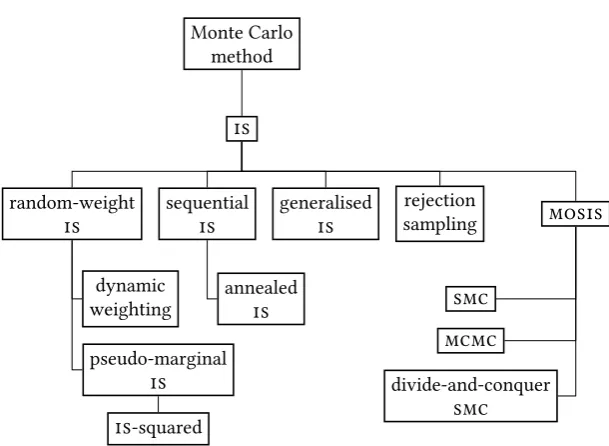
1.1 Relationship between various Monte Carlo schemes . . . 21
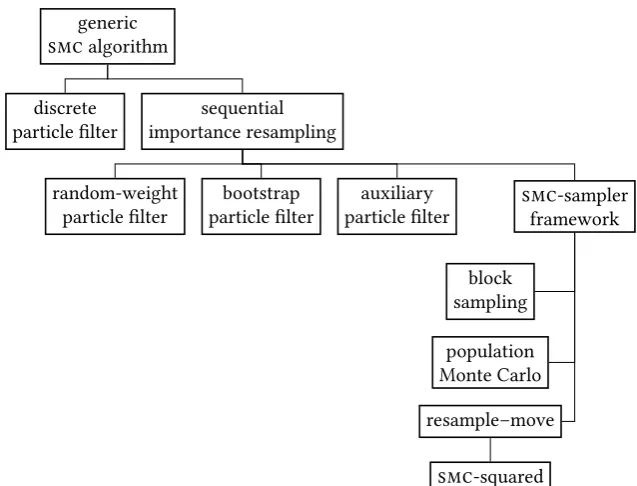
2.1 Relationship between various
smc
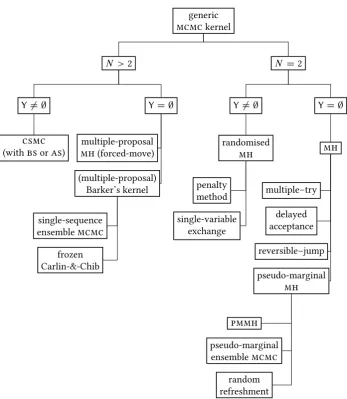
algorithms . . . 583.1 Relationship between various
mcmc
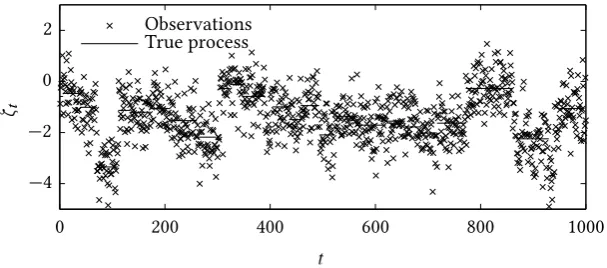
kernels . . . 994.1 Data simulated from the change-point model . . . 108
4.2 Data simulated from the Cox-process model . . . 110
4.3 Jump-size proposal distributions for
pdp
s . . . 1184.4 Static-parameter estimates for the change-point model . 134 4.5 Traces for the simple change-point model . . . 135
4.6 Static-parameter estimates for the Cox-process model . . 136
5.1 Parameter estimates in one-component Lévy-driven stochastic volatility models . . . 156
5.2 Autocorrelation of the parameter estimates in one-component Lévy-driven stochastic volatility models . . . 157
5.3 Parameter estimates in two-component Lévy-driven stochastic volatility models . . . 159
5.4 Autocorrelation of the parameter estimates in two-component Lévy-driven stochastic volatility models . . . 160
6.1 Loglikelihood in the Student-t toy model . . . 176
6.2 Traces in the Student-t toy model . . . 179
6.3
ml
estimates for the Student-t toy model . . . 1806.4 Traces for the linear Gaussian
hmm
. . . 1836.5
ml
estimates for the linear Gaussianhmm
. . . 184Introduction
Context
Since its invention in the 1940s, the idea of approximating integrals by random samples, known as the Monte Carlo method, has served as a vital tool for scientific discovery in a wide range of disciplines such as biology (Wilkinson, 2011), econometrics (Greenberg, 2012; Durbin & Koop-man, 2012), engineering (Cappé, Moulines & Rydén, 2005), epidemiology (Gibson & Renshaw, 1998; O’Neill & Roberts, 1999), operations research (Fishman, 1996), physics (Spanier & Gelbard, 1969; Sokal, 1997; Lapeyre, Pardoux & Sentis, 2003), and political science (Gelman et al., 2013)
In addition, the Monte Carlo method has spurred technological pro-gress appreciable in everyday life. For instance, it now aids the tracking and positioning of mobile robots (Dellaert, Fox, Burgard & Thrun, 1999), produces weather forecasts (Epstein, 1969; Leith, 1974), predicts elec-tions (‘FiveThirtyEight’, 2015), prices complicated financial instruments (Glasserman, 2004), and generates visual effects in blockbuster movies from animation studios such as Pixar (Veach & Guibas, 1995; Lokovic & Veach, 2000) – even leading to a Technical Oscar for Thomas Lokovic and Eric Veach (‘The 86th Scientific & Technical Awards’, 2014).
This thesis is largely concerned with developing sophisticated instances of the Monte Carlo method tailored to particular challenging real-world problems. To that end, we combine, extend, and improve a number of existing algorithms. As a by-product, we provide a unifying Monte Carlo framework which admits new insight into the relationship between the vast array of complex Monte Carlo algorithms that exist today.
Outline
This thesis is divided into two parts. Part I provides some background on various Monte Carlo algorithms. Novel methodology is mostly, but not exclusively, confined to Part II.
Part I. In the first part, we briefly review basic Monte Carlo methodology,
such asimportance sampling(
is
),sequential Monte Carlo(smc
) methods,andMarkov chain Monte Carlo(
mcmc
) methods. To provide the readerwith a better intuition for such a plethora of techniques, we present a gen-eric
is
framework, best described asmarginalised one-sample importance sampling (mosis
), which admits essentially all instances of the MonteCarlo method, including those mentioned above, as special cases.
Chapter 1 reviews
is
as a particularly useful interpretation of the MonteCarlo method. We also describe self-normalised
is
as well as state-space extension and state-space reduction techniques. Combining these ideas, we then develop the genericmosis
framework which forms the heart of any Monte Carlo algorithm. We also show that this framework can, for instance, be used to justify pseudo-marginal approaches.Chapter 2 devises a generic
smc
scheme and demonstrates that it admitsessentially any
smc
algorithm as a special case, including, for instance, the discrete particle filter which could hitherto not be viewed as a stand-ardsmc
algorithm. In turn, we show that the genericsmc
algorithm is itself a special case ofmosis
. In addition, we generalise and improve existing schemes which approximate integrals by recycling all particles generated by ansmc
sampler.Chapter 3 shows that
mcmc
methods, too, can be viewed asmosis
andthat a repeated, hierarchical application of
mosis
forms the basis of allmcmc
kernels, including pseudo-marginal, randomised, and ensembleNotation
Part II. In the second part, we develop novel Monte Carlo methodology
for two problems. Firstly, we devise methods for filtering and static-parameter estimation in a class of discretely observed continuous-time piecewise deterministic processes. These may also be viewed as partially-observed point processes. Secondly, we construct efficient Monte Carlo algorithms for optimisation in latent-variable models and more generally.
Chapter 4 motivates the use of piecewise deterministic processes and
reviews, analyses and improves an existing
smc
-based filter for such models. Around it, we also devise a particle Gibbs sampler – with a novel auxiliary-variable rejuvenation step – to perform static-parameter estimation.Chapter 5 considers static-parameter estimation in partially-observed
piecewise deterministic processes driven by compound Poisson pro-cesses. To improve mixing of the particle Gibbs chain, we adopt a non-centred parametrisation. The resulting algorithm is applied to a particularly challenging Lévy-driven stochastic volatility model.
Chapter 6 develops a framework for performing optimisation, e.g. for
maximum likelihood or maximum a-posteriori estimation in latent-variable models. Specifically, we devise generic
smc
andmcmc
optim-isation schemes within which sophisticated Monte Carlo approaches such as pseudo-marginal methods or particle Gibbs samplers can be incorporated.A detailed list of novel contributions can be found on Page 190.
Notation
It may be helpful to clarify some notational conventions used throughout this work although non-standard notation is also explained in the main text on the first use. For easy reference, we also provide a list of frequently used symbols on Page 201 along with a list of acronyms on Page 203.
Sets. We denote byRZN, respectively, the sets of real numbers,
integers and positive integers. We often make use of the following subsets of the latter two: Zk;l WD fz 2 Z j k z lg and Nl WD Z1;l.
Furthermore, #Adenotes the cardinality of some countable setA. Finally, A1WnWD
pnD1Ap WDA1 An represents the Cartesian product ofVectors. We write x1tWN WD.xt1; : : : ; xNt /and xn
1WT WD.x n
1; : : : ; xTn/. To
avoid ambiguity, we often use the bold face notation xt WDx1tWN when
both sub- and superscripts need to be vector valued. In this case, we often letxtk WD.x1tWk 1; x
kC1WN
t /be the vectorxwithout itskth component.
Finally,ATdenotes the transpose of some matrixA.
Measures. All measures considered in this work will be positive. We
writeM¢.X/M.X/ M1.X/for the sets of (positive)¢-finite, finite,
and probability measures on some measurable space.X;X/. Whenever
possible, we take,X DWB.X/, whereB.X/is the Borel¢-algebra onX.
In this case, we refer to elements of the above-mentioned sets as measures ‘onX’. In particular, Leb 2 M¢.R/denotes the Lebesgue measure on
R. For; 2 M¢.X/, we write if absolutely continuous with
respect toand in this case, d=ddenotes the corresponding Radon–
Nikodým derivative, i.e. D Œd=d. It is sometimes convenient to
abuse the notation for Radon–Nikodým derivatives and to alternatively writeŒd=d.x/DW.dx/=.dx/.
Functions. For measurable spaces.X;X/and.Y;Y/, endowed with
suit-able¢-algebrasXandY, we define F.X;Y/WD˚
f WX !Yˇˇf isX=Y-measurable :
Furthermore, we let idX 2F.X;X/denote the identity function and let
1B 2F.X;f0;1g/represent the indicator function ofB X, i.e.
1B.x/WD
(
1; ifx 2B,
0; ifx 2XnB.
IfB DX, we set1X DW1. For any functionf WX !Y, andB Y, the
preimage ofBunderf is denotedf 1.B/WD fx 2X jf .x/2Bg. For
functionsf andg with domainXandY, respectively, we use the
tensor-product notation Œf ˝g.x; y/ WD .f .x/; g.y//, for .x; y/ 2 X Y.
Furthermore, ifX DY, we writefg.x/WDf .x/g.x/, forx 2X, as usual.
Integrals. For any2M¢.X/and anyp 2Œ0;1/, we let
Lp./WD˚
f 2F.X;R/ˇˇ.jfjp/ <1
denote the set of p-times-integrable real-valued functions with the
convention that L1./ DW L./, and with the following convenient
shorthand for integrals: .f /WDR
Notation
Kernels. For measurable spaces.X;X/and.Y;Y/, a (positive)¢-finite
kernel is a functionKW XY !Œ0;1/if it satisfies both the following
properties:
8A2 YW K.; A/2 F.X; Œ0;1//; 8x 2XW K.x; /2 M¢.Y/:
We callK,finiteifK.x; / 2M.Y/, andstochastic ifK.x; /2 M1.Y/,
for anyx 2 X. We denote byK¢.X;Y/ K.X;Y/ K1.X;Y/the sets
of¢-finite, finite, and stochastic transition kernels from.X;X/to.Y;Y/.
For suitable kernelsK 2 K¢.X;Y/andL2 K¢.Y;Z/, we may define a
kernelK ˝L2K¢.X;YZ/by
ŒK ˝L.x; AB/WDK.x;1AL.;1B//;
for all.x; A; B/2 XYZ, and define a kernelKL2 K¢.X;Z/by KL.x; B/WDŒK ˝L.x;YB/;
for all.x; B/2 XZ.
By extension, we setK1˝WnWD
Nn
pD1Kp WDK1˝ ˝Kn, for suitable
kernels K1; : : : ; Kn. In particular, if K1 D D Kn D K, we use the
shorthandK1˝WnDWK˝n.
The same conventions for (tensor)products apply to measures by view-ing them as kernels which are constant in their first argument. Finally, especially in Part II, we write a stochastic kernel K 2 K1.X;Y/ as K.x;dy/DK.dyjx/, forx 2X. In particular, the distributionK.dyjx/
is then sometimes implicitly defined to be the full conditional distribution of the second component under the probability measureK 2 M1.XY/.
Distributions. We generally work with some underlying probability
space.Ω;A;P/and letE;Vdenote expectation and variance under
some probability measure , with the convention that EP D E and
VP DV. Hence, for arandom variable X 2F.Ω;Rd/with distribution WDP ıX 12M1.X/, whereX 1.A/is the preimage ofAunderX, and
forf 2 L./, we have the usual identity.f / D EŒf D EŒf .X /.
For this work, important probability measures are N;˙, the normal
distribution with mean and covariance matrix ˙, and •x, the Dirac
measure or point mass centred at x, defined by•x.A/ WD 1A.x/. For a
Part I
Generic Monte Carlo
1
Elementary Monte Carlo Tools
1.1
Importance Sampling
1.1.1
Motivation
In this chapter, we describe tools that form the basis of all known Monte
Carlo algorithms. In Sections 1.1 and 1.2, we justify importance sampling and
self-normalised importance sampling. In Section 1.3, we describe state-space
extension techniques and also ways of reducing the dimension of the state
space (i.e. Rao–Blackwellisation). Finally, Section 1.4 combines the ideas
from the preceding sections into a generic importance-sampling framework
which admits essentially all known Monte Carlo schemes as a special case.
Let.Ω;A;P/be some probability space and letM.X/denote the set
of finite positive measures on some measurable space .X;B.X//. For 2M.X/, assume that we want to calculate integrals
.f /WD Z
X
f d; (1.1)
for all test functionsf 2FL. / WD ff W X!Rjf is-integrableg.
1.1 Remark. LetM¢.X/denote the set of¢-finite (positive) measures on
.X;B.X//. Note that any finite integral .Q f /Q with respect toQ 2 M¢.X/ may be written in the form of Equation1.1by applying the change of measure
WD QfQ (wherefQ .A/Q WD Q .fQ1A/, forA2B.X/), and settingf 1.
Analytical computation of such integrals is often too costly or even impossible. Instead, numerical integration methods such as quadrature rules may be used. Unfortunately, the error of these methods is typically of orderO.N c=d), whered is the dimension of the state spaceX,c >0,
andN is the number of grid points. The need forN to be exponentially
large in d is known as thecurse of dimensionality (Bellman, 1957). It
1.1.2
Change of Measure
To apply the methods developed in this work, we need to turn.f /into
an integral with respect some probability measure. This can always be achieved as follows. LetM1.X/denote the set of probability measures on .X;B.X//and select 2M1.X/such that . In this case,
.f /D .wf /DE Œwf ;
wherewdenotes the Radon–Nikodým derivativew WDd=d .
1.2 Remark. It suffices that f . However, we make the stronger requirement: , here because it is independent of the particular test function and we are usually concerned with approximating.f /for a large class of test functions,F.
1.1.3
Sampling-Based Approximation
Given a vector of independent and identically distributed (
iid
) drawsX WDX1WN from , (a suitable version of) the Glivenko–Cantelli theorem
(Billingsley, 2012, Theorem 20.6) justifies using the empirical measure of these samples to approximate theprobability measure ,
mc;N
WD 1 N
N
X
nD1 •Xn:
Here,•x 2 M1.X/is the point mass (orDirac measure) located atx 2X.
We may thus approximate theintegral .f /D .wf /DE Œwf by
mc;N.wf /
D Z
X
wf d mc;N D 1 N
N
X
nD1
wf .Xn/;
i.e. we estimate the expectation by the corresponding sample mean. Approximating integrals with respect to some probability measure in this way – usually by generatingX on a computer using pseudo-random
numbers – is known as theMonte Carlomethod. It was developed during
1.1 Importance Sampling
Project at the Los Alamos Scientific Laboratory, New Mexico. Some of the earliest available references include Goertzel and Kahn (1949), Metropolis and Ulam (1949). Historical accounts can be found in Metropolis (1987), Eckhard (1987), Rota (2008).
Note that we may also view the Monte Carlo method as a procedure for approximating themeasure by the following (random) unnormalised weighted empirical measure,
is;N WD 1 N
N
X
nD1
w.Xn/•Xn;
wherew.Xn/is known as an unnormalisedimportance weight.
1.3 Remark. Throughout this work, for simplicity, we refer to the unnor-malised importance weights w.Xn/ simply as ‘weights’ or ‘importance weights’ and we refer to is;N as a ‘weighted empirical measure’, even thoughPN
nD1w.Xn/¤1, in general.
This view of the Monte Carlo method is known asimportance sampling(
is
)(Goertzel & Kahn, 1949). Though, initially, it was also referred to asquota sampling (Goertzel, 1949). Plugging in the test function, it clearly leads to
the same estimator for.f /as above, i.e.is;N.f /D mc;N.wf /. One
of the goals of Part I of this work is to demonstrate that essentially every Monte Carlo algorithm can be seen as a special case of
is
which, in turn, is merely a convenient re-interpretation of the Monte Carlo method.The
is
-interpretation of the Monte Carlo method is useful because we are usually concerned with approximating.f /for a large class oftest functions, F, but without selecting and sampling from a different
proposal distribution for eachf 2 Fas this tends to be costly. The
is
-interpretation helps separating the influence of the test functionf from
the influence of the proposal distribution on the estimatoris;N.f /
through the oscillations ofw.
1.1.4
Theoretical Properties
It is easy to see that is;N.f /is an unbiased estimator for .f / and
thestrong law of large numbers (
slln
) (Billingsley, 2012, Theorem 22.1)set Li. / WD ff W X ! R j fi is -integrableg. Ifwf 2 L2. /, so
that the asymptotic variance 2.f / WD VŒf exists, a simple central limit theorem(
clt
) (Billingsley, 2012, Theorem 27.1) guarantees thatp N
is;N.f / .f / N!1
! Z N0;2.f /;
in distribution. In particular, the Monte Carlo errorjis;N.f / .f /j
vanishes at a rateOP.N 1=2/which is independent of the dimensiond.
1.2
Self-Normalised Importance Sampling
1.2.1
Motivation
Assume that we wish to approximate.f /, for some probability measure 2 M1.X/andf 2 L./. In many applications, the Radon–Nikodým
derivative wz WD d=d can only be evaluated up to some unknown
constantz>0. That is, we can evaluatew WDzwz point-wise but notwz.
The intractability ofzrenders (standard)
is
inapplicable because wecan then only approximate the measure 2M.X/, defined by
WDw Dz
and ¤ , except in the trivial case that z D 1. Self-normalised
is
exploits fact that if is a probability measure thenz D .1/. Based
on this identity, we may use standard
is
to separately approximate the numerator and denominator in the identity D=zas described in thenext subsection.
We conclude this subsection by noting that the intractability ofzusually
arises because the target distribution or the proposal distribution are
constructed via non-linear transformations of some other measures onX.
More precisely, for2 M¢.X/andg 2L./, define theBoltzmann–Gibbs transformationofunderg,‰g, by
‰g./ WDg=.g/:
Assume that is constructed via D‰g.$ /and is constructed via
D ‰h./, for some $; 2 M¢.X/, g 2 L.$ /, and h 2 L./. In
this case, we often have that z D $ .g/=.h/and this ratio is usually
1.2 Self-Normalised Importance Sampling
1.4 Example (Bayesian posterior). In Bayesian statistics, may be the posterior distribution given some prior distribution$and some dataywith associated likelihood g.Q ; y/ DW g D L, i.e. D ‰L.$ /. The ‘model evidence’ or ‘marginal likelihood’,$ .L/, is then typically intractable.
1.2.2
Sampling-Based Approximation
The idea of self-normalised
is
is to separately approximate the numerator and denominator on the right hand side in the identity D =z viastandard
is
. That is, we approximate the measure byis;N D 1 N
N
X
nD1
w.Xn/•Xn
and the integralzD.1/by
zis;N WDis;N.1/D 1 N
N
X
nD1
w.Xn/:
LetWn.X/WDw.Xn/=zis;N denote thenthself-normalised importance weight. Combining the previous two approximations then defines the
self-normalised
is
approximation of,is?; N D
is;N
zis;N D N
X
nD1
Wn.X/•Xn:
Again, we can approximate the integral.f /by
is?; N.f /D
N
X
nD1
Wn.X/f .Xn/:
1.2.3
Theoretical Properties
The estimatoris?; N.f /is biased but strongly consistent, i.e.is?; N.f /
converges almost surely to .f /, asN ! 1. As shown by Geweke
(1989), for instance, the estimator again satisfies a
clt
, i.e.p N
is?; N.f / .f / N!1
in distribution, if we assume that w; wf 2L2. / to ensure that the
asymptotic variance2.f /WD.wŒfz .f /2/exists. More precisely,
Liu (2001, p. 35) proves that
Eis?; N.f /D.f /C .wŒfz .f //
N CO.N
2/;
Vis?; N.f /D .wŒfz .f /
2/
N CO.N
2/:
In particular,zis;N is again an
is
estimate ofzand thus unbiased.Finally, even though is?; N.f / is biased, its mean-square error can
sometimes be smaller than that of a standard
is
estimateis;N.f /(as-suming thatwz can be evaluated). Intuitively, the former can obtain
vari-ance reductions by exploiting the fact that is a (random) probability
measure. Indeed,is?; N is a (random) probability measure butis;N is
not, in general, because its weights do not sum to 1.
1.2.4
Effective Sample Size
From the expression for the asymptotic variance2.f /above, it is clear
that the performance of self-normalised
is
is determined by how closely the target distribution resembles the proposal distribution , at least ifwe neglect the contribution from the oscillations off.
Several criteria have been proposed to measure the efficiency of
is
approximations, such as theeffective sample size(
ess
), defined by Kong,Liu and Wong (1994) as
ESS WD N
V .w/z C1 D Nz
.w/; (1.2)
ifwis-integrable. The effective sample size takes values in.0; N . If D thenwz 1 so thatESSDN. On the other hand,ESSdecreases
the more and differ.
Unfortunately, the
ess
cannot be calculated analytically because the difficulty of computing integrals of the form.w/is one of the reasonsfor turning to importance sampling in the first place. We thus have to resort to estimating it by
ESSN WD
Nzis;N is?; N.w/ D
ŒPN
nD1w.Xn/2
PN
mD1Œw.Xm/2
D PN 1
nD1ŒWn.X/2
1.3 State-Space Extension and Reduction
This estimate of the effective sample size ranges from 1 (all self-normalised importance weights are zero except one) toN (all importance weights
are identical).
Care must be taken when interpreting this estimate. For finiteN, it
is easy to construct examples in which the self-normalised
is
estimator has a high variance despite it being very likely that all self-normalised importance weights are roughly identical. This is the case if the proposal distribution is likely to miss high-probability regions under.1.3
State-Space Extension and Reduction
1.3.1
Enlarging the Space
Assume again that we are interested in approximating (integrals with respect to) a measure 2M.X/by
is
, using some proposal distribution 2 M1.X/such that . Sometimes, we cannot evaluate the Radon–Nikodým derivative w WD d=d point-wise – not even up to some
unknown proportionality constant. Thus, direct
is
approximations ofand, by extension, self-normalised
is
approximations of a probabilitymeasure / are not available.
However, in some cases, the intractability of the importance weights can be circumvented by approximating a measureN on an extended space
which admits as a marginal. More precisely, assume that
(1) there exists a measure N 2M.xX/on some spaceXxWDXZwhich
admits as a marginal, i.e..A/D N .AZ/, for anyA2B.X/,
(2) we can sample from a distribution N 2M1.Xx/satisfyingN N,
(3) we can evaluatewx WDd =N dN point-wise.
In this case, we can simply construct an
is
approximationNis;N ofN.As shown below, the relevant marginal ofNis;N then approximates.
1.5 Example (Bayesian posterior, continued). Many models are spe-cified through extra latent (unobserved) parametersZso that is a mar-ginal of the joint posterior distribution N WD ‰x
L.$ /x associated with the
joint prior $x 2 M1.Xx/ and the ‘joint’ likelihood for both parameters,
Q
1.6 Example (complex proposal distributions). Even ifw Dd=d can be evaluated, it can often be desirable to work on some extended spaceXx on which a more efficient proposal distribution N can be constructed (and
the additional auxiliary variables Z included in N cannot be integrated out). In this case, we need to devise a suitable extended measureN.
1.3.2
Importance Sampling on the Joint Space
In the setting described above, we can perform self-normalised
is
on the joint space xX. LetXxn D .Xn; Zn/whereXx1; : : : ;XxN areiid
samplesdistributed according to N. Given an
is
approximationN
is;N WD N
X
nD1
x
w.Xxn/•Xxn
of N, we then immediately obtain an approximation of the marginal
measure in the form of
N WD
N
X
nD1
x
w.Xxn/•Xn:
The approximationN of the marginal measure is sometimes referred
to asrandom-weight
is
(Fearnhead, Papaspiliopoulos, Roberts & Stuart,2010). This is because the weights are still random even after conditioning on the sample points X1; : : : ; XN which determine the location of the
point masses used in the construction ofN. Special cases of this include
is
-squared(Tran, Scharth, Pitt & Kohn, 2014), for instance.Unfortunately, performing
is
on an extended space Xx D X Z isgenerally less efficient than working directly on the (smaller) marginal spaceX. However, the fact that working on the marginal space might be
impossible (as in Example 1.5) or that we might be able to construct more efficient proposal distributions by working on an extended space (as in Example 1.6) often justifies this approach.
When working on an extended space, there is often a considerable degree of freedom in constructing N and N. Modern methodological
1.3 State-Space Extension and Reduction
1.3.3
Rao–Blackwellisation
In the preceding subsections we mentioned the utility of performing
is
on an extended space. However, approximating distributions on large spaces comes at a cost. Even though theorder of the Monte Carlo convergencerate,OP.N 1=2/, is independent of the dimension of the state space, the number of sample points,N, usually needs to grow exponentially with
its dimension in order to guarantee a constant Monte Carlo error. As many components as possible (of the target measure ) should
therefore be integrated out analytically as advocated by Trotter and Tukey (1956). By performing Monte Carlo approximations only on a smaller space, substantial variance reductions can be attained.
More precisely, let 2M.X/be some finite measure onXWD zXZand
letf 2L.X/be some test function with domainX. Assume thatis;N
is an
is
approximation of based oniid
samplesX1; : : : ; XN whichare drawn from some suitable proposal distribution and which can be decomposed asXnD.Xzn; Zn/, whereXzntakes values inzXandZntakes
values inZ.
It is then preferable to use theRao–Blackwellisedestimator
0.f /WDEis;N.f /ˇˇXz1WN
;
(if we can calculate this integral) rather than1.f / WDis;N.f /itself.
This is because by Jensen’s inequality, the former is dominated by the latter in the convex order, i.e. for any convex functionW R!Rsuch
that the following integrals are well defined,
EŒ.0.f // EŒ.1.f //:
Note that this result impliesVŒ0.f /VŒ1.f /and the same ordering
holds for the mean-square error sinceEŒ0.f /DEŒ1.f /.
This result does not generally carry over to self-normalised
is
ap-proximations. That is, 0.f /=0.1/ is not necessarily dominated by 1.f /=1.1/in the convex order (Liu, 2001, p. 38).1.7 Remark. Note that0.f /is just a standard
is
estimate of the integralQ
1.3.4
Examples
A main thread throughout this work is that most seemingly-complicated Monte Carlo algorithms can be viewed as special cases of
is
on a suitably extended space (and thus as instances oftheMonte Carlo method). Forexample, it is well known thatsequential importance sampling (the idea
of which dates at least as far back as (Hammersley & Morton, 1954; M. N. Rosenbluth & Rosenbluth, 1955) and special cases of it such asannealed importance sampling (Jarzynski, 1997b, 1997a; Neal, 2001) may be viewed
as standard
is
.In this subsection, we show, by example, that this also applies to many other algorithms. First, as shown in Example 1.8,rejection sampling (also
referred to asaccept–reject method) first described in Kahn (1949), may
be viewed as a special case of (self-normalised)
is
on an extended space. This was pointed out in Y. Chen (2005), for instance.1.8 Example (rejection sampling). Rejection sampling is usually viewed as generating a random number of
iid
samples from some distribution2M1.X/, as follows.
(1) Propose
iid
samplesX1; : : : ; XN from some distribution 2M1.X/ satisfying .(2) Assume there existsz>0such thatwWDzd=d 1and such that
wcan be evaluated.
(3) Forn 2 NN WD fn 2 N j n Ng, independently ‘accept’Xnwith probabilityw.Xn/and setK WD fn2 NN jXnis ‘accepted’g. Then marginally,.Xn/n2K is an
iid
sample from.Rejection sampling thus entails generating
iid
samplesXx1; : : : ;XxN from an extended proposal distributionN WD ˝UnifŒ0;1 2M1.Xx/;
whereXxWDXŒ0;1. These proposals are then used to form an
is
approx-imationNis;N of the extended measureN
WD ˝L2M.xX/;
1.3 State-Space Extension and Reduction
self-normalised
is
approximation of can then easily be seen to beN WD.#K/ 1X n2K
•Xn;
where#K denotes the cardinality of the setK. In particular,Nis;N.1/is an unbiased estimate of the marginal acceptance probability,z.
Finally, a standard
is
approximation of Dz on the marginal spaceX (with proposal distribution ) can be viewed as a Rao–Blackwellisation ofthe rejection-sampling approximation. That is,
is;N.f /D 1 N
N
X
nD1
wf .Xn/DENis;N.f ˝1Œ0;1/
ˇ ˇX
:
Note that we are fixing the number of proposed samples, N, in the rejection-sampling scheme. A Rao–Blackwellisation in the case where
rejec-tion sampling is performed until a certain number of acceptedsamples has
been obtained was developed in Casella and Robert (1996).
Many other algorithms that seem to be generalisations of
is
, at a first glance, can actually also be viewed as standardis
on an extended space, as shown in Examples 1.9 and 1.10.1.9 Example (generalised importance sampling). Let x 2 K1.X;X/ be some-invariant stochastic kernel, i.e. such that x D. As shown in MacEachern, Clyde and Liu (1999, Theorem 6.1) it is possible to apply such a
kernel to the weighted sample used to construct an
is
approximation of without having to adjust the weights.Even though this procedure is sometimes referred to as ‘generalised’
im-portance sampling (e.g. Robert & Casella, 2004, Section 14.2), as pointed out
in Doucet and Johansen (2011) (see also Del Moral, Doucet & Jasra, 2006b),
it may be viewed as standard importance sampling on the extended space
x
X WDX2(i.e.ZDXin the notation of this section), with extended proposal distribution N WD ˝ and extended target measureN WD˝˘, where
˘.x0;dx/ WD d .x; /
d .x
0/.dx/ D d .x; /
d .x
0/.dx/
represents thetime-reversal kernelof associated with. Indeed writing
x
1.10 Example (dynamic weighting). Thedynamically weighted Monte
Carlo-framework (Wong & Liang, 1997; Liu, Liang & Wong, 2001; Liang, 2002) designs an extended measure
Q
.dxdv/ WDvg.dx;dv/;
on Xz WD X Œ0;1/. Here, g 2 P.zX/, Xz WD XŒ0;1/, is said to be
correctly weighted with respect to ifQ admits as a marginal, i.e. if
.A/D Q .AŒ0;1//for anyA2B.X/. In this case, an
iid
samplez
X1; : : : ;XzN Q WDg;
whereXznD.Xn; Vn/, can be used to approximate by standard
is
. The method is called ‘dynamic’ importance sampling because the nth importance weight, w.z Xzn/ D Vn, is not necessarily deterministic givenXn. It is also referred to as ‘generalised’ importance sampling in Liu (2001,
pp. 36–37), Liang (2002) because taking
g.dxdv/WD .dx/•w.x/.dv/;
wherew WDd=d , leads back to a direct
is
approximation of the marginalusing as a proposal distribution.
However, this approach is clearly no more than standard
is
on an extended space. Indeed, let N 2 M.xX/be some other extended measure on a spacex
X DXZsuch that (1)N admits as a marginal, (2)N has a densitywx with respect to some probability measure N 2M1.Xx/. Using the proposal distribution N, we can then construct an
is
approximationN
is;N WD 1 N
N
X
nD1
x
w.Xxn/•Xxn
ofN and hence obtain an approximationN of the marginal.
Note, however, thatZ and thusXxD XZis often a high-dimensional space which can render the preceding
is
scheme inefficient. Since we are only interested in the marginal measure, the key insight here is that we can turn thisis
scheme into anis
scheme on the potentially lower-dimensional spacezXD XV, withVWDŒ0;1/, with extended targetQ and proposal1.4 Marginalised One-Sample Importance Sampling
Define WD idX˝ xw, Q D g WD N ı 1, then we can see that the marginal approximations of based on performing
is
using the pair. ;Q /Q and using the pair. ;N /N coincide, i.e.N D 1 N
N
X
nD1
x
w.Xxn/•Xn D 1 N
N
X
nD1
z
w.Xzn/•Xn D 1 N
N
X
nD1
Vn•Xn;
whereXxn D.Xn; Zn/.
The transformation used in Example 1.10 to interpret the marginal of
an
is
approximation of a measureN on a potentially high-dimensionalspacexXZ as the marginal of an
is
approximation of a measureQ onthe potentially lower-dimensional spacezXis also the main justification of
pseudo-marginalMonte Carlo approaches (Andrieu & Roberts, 2009) the
general idea of which is described in Subsection 1.4.3.
1.4
Marginalised One-Sample Importance
Sampling
1.4.1
Extended Target Measure
In this section, we present a generic extended measure which admits the target measure,, as a marginal. It is based on the
is
frameworkintro-duced in Andrieu and Roberts (2009), Andrieu, Doucet and Holenstein (2010) which was also extensively analysed in Lee (2011).
As shown in the next two chapters, virtually all known Monte Carlo schemes, e.g. Markov chain Monte Carlo (
mcmc
) methods, sequential Monte Carlo(smc
) methods, and even generalisations of the latter such as Divide-&-Conquersmc
(Lindsten, Johansen et al., 2014), can be regardedas Rao–Blackwellised
is
approximations – based on a single sample – targeting this measure (or as self-normalised versions thereof).A repeated, hierarchical application of this framework justifies employ-ing one such Monte Carlo scheme into another, e.g. usemploy-ing standard
is
As before, we want to approximate an integral.f /, where 2M.X/
is some finite measure andf 2Fis some-integrable test function.
To that end, we define an extended target measure N 2 M.Xx/and
an extended proposal distribution N 2 M1.Xx/such that wx WD d =N dN
exists and can be evaluated (point-wise). Here,Xx WDX xZis an extended
space such that if Xx D .X;Zx/ N, then Zx can be decomposed as
x
Z D.K;Z/D.K;X; Y /, where
K is some discrete index taking values in a finite spaceK,
X represents the elements of a ‘pool’ of candidates for each of the
components of the vector X WD =.1/ such that the set of
candidate components indexed byK, denotedXK, takes values inX
(see Remark 1.11 below for more details),
Y is some set of other auxiliary variables taking values in a spaceY.
1.11 Remark. The definition ofXx D.X; K;Z/is left deliberately vague so that the framework covers a wide range of Monte Carlo schemes.
(1) To simplify the notation and without loss of generality, we restrict our
exposition in this section to the case:KDNN andXDXN, for some
N 2 N n f1g. In other words,XK is theKth element out of a pool of
N candidates,X DX1WN, forX.
(2) More generally, letX DX1Wt havet components for each of which we have a pool ofN0candidates. We could then consider an index vector
K1Wt taking values in.NN0/t such that .XK1
1 ; : : : ; XtKt/takes values
inX. This is the case in
smc
algorithms outlined in the next chapter. However, by applying a suitable reparametrisation and by introducingsome additional conditionally degenerate copies of the components in
the pool, we can always reduce such a seemingly more complex setting
to the case in which we only have a one-dimensional indexK taking values inNN, hereN D.N0/t.
(3) We could also consider a random number of candidates, e.g.
smc
al-gorithms with random numbers of particles (Crisan, Del Moral & Lyons,1998). However, we refrain from doing so in order to work on a product
spaceXx DXKZwhich greatly simplifies the notation.
We are now ready to define the extended target measureN. Take some
1.4 Marginalised One-Sample Importance Sampling
used to define the full conditional distribution ofZx under the extended
target distributionN WD N = .N 1/, where we call
N
.dxN/WD.dx/˘ .x;x dzN/
theextended target measure.Clearly,N admitsas a marginal. In addition
to admitting as a marginal, we make the following minimal assumption
on this extended target measure.
1.12 Assumption. The stochastic kernel˘x 2K1.X;Zx/is such that
x
X N ) XK DX; almost everywhere.
Similarly, define anextended proposal distribution
N
.dxN/WD .dz/ .z;dk/•xk.dx/;
where the probability measure 2 M1.Z/ and the stochastic kernel 2K1.Z;K/are chosen such thatN N.
1.4.2
Generic Estimator
Letwx WD d=N dN. Using Xx D.X;Zx/D.X; K;Z/drawn from N, we
may approximate the extended measure N by Nis;1 WD xw.Xx/•Xx. This
represents an
is
approximation ofN based on a single sample. Define the kth ‘weight’wk.Z/WDEw.x Xx/1fkg.K/ ˇ ˇZ
;
then we may analytically integrate out (‘marginalise out’) some subvector ofXxwhich includes.X; K/– for simplicity, we only integrate out.X; K/,
here – to yield the followingmarginalised one-sample importance sampling
(
mosis
) approximation of the marginal measure,mosis;N.A/WDENis;1.A xZ/ˇˇZ
DX
k2K
for any A 2 B.X/. If desired, a self-normalised
is
approximation ofmay then be constructed as
mosis?; N WD
mosis;N
zmosis;N D
X
k2K
Wk.Z/•Xk;
whereWk.Z/WDwk.Z/=zmosis;N will be called thekth self-normalised
weight andzmosis;N WDmosis;N.1/is a standard
is
estimate of thenor-malising constant,z, and is therefore clearly unbiased.
The estimate of the normalising constant is a key quantity and its variance is strongly connected with the efficiency of the
mosis
scheme due to the following result.1.13 Proposition. Let .z;fng/DWn.z/, for any.n;z/2 KZ, then
x
w.xN/Dzmosis;N; for anyxN 2 xX.
Proof. This follows immediately from the definition ofwn.z/.
We stress that while this framework ensures unbiasedness, it does not necessarily ensure consistency because for anyN 2N, we are still
performing
is
with only one sample point. The following trivial counter example demonstrates this problem.1.14 Example. For some distributionq2 M1.X/with q, set
x
˘ .x;dzN/WDUnifK.dk/•x.dxk/
Y
n2Knfkg
•xk.dxn/;
.dx/WDq.dx1/ N
Y
nD2
•x1.dxn/;
and .z;dk/ WD UnifK.dk/. Then, writing w WD d=dq, the estimator
mosis;N.f / is almost surely equal to wf .X1/, for any N 2 N. It is therefore unbiased but clearly not consistent.
Effective Sample Size. Finally, we may use this framework to obtain
an approximation of the
ess
, which, in this case, is defined according to Equation 1.2 asESS DNz2= .N w/x . An approximation ofESSis thusESSN D N.
EŒNis;1.1/jZ/2 EŒNis;1.w/x jZ D
N ŒP
k2Kw
k.Z/2
P
k2KŒw
1.4 Marginalised One-Sample Importance Sampling
If .z; /DUnifNN, for anyz2Z, then this reduces to
ESSN D 1
P
k2KŒWk.Z/2
:
1.4.3
Pseudo-Marginal Interpretation
Assume now that the target measure, extended target measure and exten-ded proposal distribution depend on some parameter 2 Θ. We indicate
this by writing them as suitable kernels, i.e. by writing.; /, .;N /, N
.; /and d .;N /=d .;N / D xw. Furthermore, let $ 2 M.Θ/be
some finite measure.
Suppose that we want to approximate the following ‘marginal’ measure under the measure$ ˝, defined by
?.A/ WD$ .1A.;1//DŒ$ ˝ .AX/;
for allA2 B.Θ/. Unfortunately, the function.;1/is often intractable.
We must therefore resort to approximating it via
mosis
(often within some other Monte Carlo scheme). More precisely, we use some other Monte Carlo scheme to target the extended measure$˝ N(which admits ?as a marginal) or a normalised version thereof.1.15 Example (Bayesian posterior, continued). If is the (marginal) posterior distribution of some parameter, thenL. /D.;1/is its (mar-ginal) likelihood. This is often intractable if the model is specified through
additional latent variables,X, which need to be integrated out to obtain
.;1/. However, in order to approximate D ‰L.$ / D L$=$ .L/ it usually suffices to approximate the (unnormalised) measureL$ D?. This approximation suffices for a self-normalised
is
approximation of. Or, withinmcmc
schemes, the normalising constant$ .L/ D ?.1/cancels out in the ‘acceptance probabilities’ (see Chapter 3).WriteT .;z /WD N .;/ı.wx/ 1, where.wx/ 1denotes the preimage
underwx, then, for allA2B.Θ/, we have the identity
D Z
AV
$ .d /.;1/T .;z dv/ v .;1/
D Z
A
?.d /E
V
.;1/
;
where V zT .; / and V WD Œ0;1/. Note that for any 2 Θ, the
random variableV is an (unbiased)
is
estimate of.;1/and henceE
V .;1/
D1:
We may thus use some other Monte Carlo scheme to approximate$˝ N
(or its normalised version), based on the proposal distributionq˝ N for
someq 2M1.Θ/satisfying?q. Ideally, we would like work on the
marginal space and approximate the marginal?using samples fromq.
However, this is impossible here because the ‘marginal’ Radon–Nikodým derivativeŒd?=dq. /involves.;1/and is therefore intractable.
Instead, we work on the extended space Θ xX and target $ ˝ N.
Then any realisation.;xN/of.;Xx/q˝ N implies a corresponding
realisationv D xw.xN/ofV zT .; /. As a result,
d$
dq . /wx .
N
x/D d
?
dq . / v .;1/
can be viewed as a ‘noisy’ but often tractable (becausewx is tractable)
evaluation of the intractable Radon–Nikodým derivativeŒd?=dq. /.
The interpretation as a noisy evaluation of an intractable marginal dens-ity has led to such constructions being termedpseudo-marginalmethods.
They were introduced by Beaumont (2003), Andrieu and Roberts (2009), extended by Andrieu et al. (2010) and are usually applied within
mcmc
methods. However, the pseudo-marginal target measure$˝ N can be
approximated by other types of
mosis
schemes, too. For instance, some pseudo-marginalsmc
algorithms are mentioned in Subsection 2.3.5.As mentioned in Example 1.10, an approximation of the marginal meas-ure?obtained from performing
is
on the potentially high-dimensionalspace Θ xX(with proposal distribution q ˝ N) can be interpreted as
1.4 Marginalised One-Sample Importance Sampling
1.4.4
Application to Standard Importance Sampling
By construction,
mosis
is obviously a special case of (Rao–Blackwellised)is
on the extended spacexX. However, to demonstrate the power of thisapproach, this subsection shows that
mosis
may also be viewed as a generalisation ofis
on the original space,X.LetN 2N,KDNN,XDXN, and writeZx D.K;X/with the pool of
candidatesX DX1WN. That is, we do not use further auxiliary variables, Y, here. Take
x
˘ .x;dzN/WD.dk/•x.dxk/q˝.N 1/.dx k/; (1.4)
whereX n WD .X1Wn 1; XnC1WN/ denotes the pool of candidates from
which the nth element has been removed, and set WD UnifK. For
q 2M1.X/, define the extended proposal distribution via WDq˝N
and .z; /WDUnifK, for anyz2Z.
The importance weight is then given byw.x xN/DŒd=dq.x/DWw.x/.
ThusNis;1 WD xw.Xx/•Xx represents an
is
approximation of N based ona single sample point Xx N. However, we are only interested in
ap-proximating the marginal measure. Noting thatwk.z/ D w.xk/=N,
we may analytically integrate out.X; K/to obtain a Rao–Blackwellised
estimator, for anyA2B.X/defined by
mosis;N.A/DE N
is;1.AZ/ˇˇZ
DX
k2K
wk.Z/•Xk.A/
D 1 N
N
X
nD1
w.Xn/•Xn.A/
Dis;N.A/:
Hence,
is
can be viewed as a special case ofmosis
. In particular, the approximation of theess
reduces to the expression in Equation 1.3,ESSN D
ŒP
k2Kw
k.Z/2
P
k2KŒwk.Z/2
D ΠPN
nD1w.Xn/2
PN
1.5
Summary
Of course, the
mosis
-framework presented in this chapter is not neces-sary for justifying a standardis
approximation as that given above.Its power resides in the fact that it still guarantees unbiased estimates of.f /when ‘generalising’ standard
is
to settings in which(1) the candidates X1; : : : ; XN are not necessarily independently or
identically proposed, i.e. ¤q˝N for any distributionq,
(2) we can evaluatewx Dd =N dN but not necessarily the Radon–Nikodým
derivative of with respect to a suitable marginal under the joint
proposal distribution .
1.16 Remark. Equation1.4shows that in the example considered in this subsection, the extended target measure,N, is constructed by extending the actual target measure,, using the full conditional distribution of theN 1 candidatesX k under the joint proposal distribution . The importance weights therefore force us to evaluate (densities with respect to) themarginal
distribution of the kth candidate under . This makes it difficult to use complex joint proposal distributions, e.g. joint proposal distributions under
which the candidates are dependent.
The major innovation due to Andrieu and Roberts (2009) – which has
received surprisingly little attention and is rarely exploited outside of particle
mcmc
methods – is the realisation that the extended target measure can also be constructed by extending differently. This permits a much more flexible choice of joint proposal distribution. More precisely, following Andrieuand Roberts (2009), we can constructN in such a way that the importance weights only require us to evaluate (densities with respect to) theconditional
distribution of thekth candidate under .
Combined with the introduction of the auxiliary variableY in Andrieu et al. (2010), this realisation turns the
mosis
approach into an extremely powerful instance of the Monte Carlo method.Other instances of the
mosis
framework – more complicated than the standardis
approximation described in the previous subsection – will be described in the next two chapters. In particular, we show thatsmc
(Chapter 2) and
mcmc
(Chapter 3) methods may be viewed as special cases ofmosis
. One possible way of viewing the relationship between1.5 Summary
Monte Carlo method
is
random-weight
is
dynamic weighting
pseudo-marginal
is is-squared
sequential
is
annealed
is
generalised
is samplingrejection mosis
smc mcmc
divide-and-conquer
[image:48.595.125.430.237.460.2]smc
2
Sequential Monte Carlo Methods
2.1
Introduction
2.1.1
Motivation
In this chapter, we describe sequential Monte Carlo methods. Section 2.1
outlines a generic sequential Monte Carlo algorithm which admits essentially
all known sequential Monte Carlo algorithms as a special case. In Section 2.2,
we show that this generic algorithm can itself be viewed as a special case of
the marginalised one-sample importance sampling framework introduced in
Chapter 1 and thus as importance sampling. This was already established in
Andrieu et al. (2010) and extended to non-exchangeable resampling schemes
in Lee, Murray and Johansen (in prep.). We extend the latter construction
to also allow for biased resampling schemes. In Section 2.3, we interpret a
number of sequential Monte Carlo algorithms, such as the discrete particle
filter, as special cases of this framework. In Subsection 2.3.3 we generalise and
improve existing schemes for re-using all particles to approximate integrals.
Finally, in Section 2.4, we show that forward filtering–backward smoothing,
too, is a special case of importance sampling.
Sequential Monte Carlo (
smc
) methods are a class of Monte Carloschemes suitable for approximating a sequence of related measures. Dat-ing at least as far back as Stewart and McCarty Jr (1992), Gordon, Salmond and Smith (1993), Del Moral (1995),
smc
methods were originally de-veloped to approximate the optimal filtering problem in discrete-time target tracking applications, e.g. in non-linear or non-Gaussian(general state-space) hidden Markov models(hmm
s) (sometimes calledstate-space models). In this particular setting, they are often called ‘particle filters’.(Cérou, LeGland, Del Moral & Lezaud, 2005), for inference in continuous-time models (Fearnhead et al., 2010), for optimisation (Johansen, Doucet & Davy, 2008), for model selection (Peters, 2005; Jasra, Doucet, Stephens & Holmes, 2008; Yan Zhou, Johansen & Aston, 2013), and for approximately solving inverse problems (Kantas, Beskos & Jasra, 2014).
A tutorial-style introduction to the area can be found in Doucet and Johansen (2011). A book-length treatment of their application to
hmm
s can be found in Cappé et al. (2005). A comprehensive theoretical framework was developed in the monographs Del Moral (2004, 2013) – see also, Del Moral and Doucet (2014) for a gentle introduction to this framework in the case of finite state spaces.Various kinds of
smc
algorithms have been developed, each tailored to individual problems. We detail some of these in Section 2.3. Essentially any such algorithm can be viewed as special cases of the genericsmc
al-gorithm presented in the next subsection. In turn, as shown in Section 2.2, the genericsmc
algorithm can itself be viewed as no more than a special case of themarginalised one-sample importance sampling(mosis
) schemedescribed in Chapter 1.
The basic idea of
smc
methods is as follows. Assume that we want to approximate (integrals with respect to) a family of positive finite measures.Qt/t2T; usually,TDNT, forT 2 NorT DN. In this case, we can define
a sequence of extended measures.t/t2T, wheret 2M.X1Wt/, such that t admitsQt as a marginal. As described in Section 1.3 in the previous
chapter, working on such a product spaceX1Wt WD
tsD1Xs, which typicallyincludes all random variables generated over the course of the algorithm, is usually necessary to circumvent the calculation of intractable integrals related to the importance weights.
At Step t 1, the algorithm approximates t 1, and thus Qt 1, by
weighted samples. To obtain an approximation oft, and thusQt,
smc
methods can be thought of as extending and re-weighting an existing collection of sample points, often called ‘particles’.
2.1 Remark. To reduce the notational burden, we assume here that the number of particles generated at Stept,Nt 2 T, is deterministic. However, all developments in this chapter still hold if it was made a (non-degenerate)
random variable as, for instance, in Crisan et al. (1998), Jasra, Lee, Yau and
2.1 Introduction
2.1.2
Particles and Parent Indices
LetXt WDXt1WNt denote the collection ofNt particles which takes values
inXt WDXNt
t . These are generated at Stept of an
smc
algorithm targetinga measuret 2M.X1Wt/, whereX1Wt WD
tsD1Xs. Thenth particle at Steps, Xn
t , will be considered as the offspring of theAnt 1th particle generated at
Stept 1. We therefore callAnt 1thenth parent index sampled at Stept.
For simplicity, we collect the parent indices in vectors At 1WDA1tWN1t
taking values inAt 1 WDKNt
t 1, whereKt WDNNt.
To simplify the notation, we collect all random variables generated by the
smc
algorithm at Stept in a vectorZt. That is, we writeZ1 WDX1andZt WD .Ot 1;At 1;Xt/, fort > 1. These take values in the spaces Z1 WD X1 andZt WD Ot 1 At 1 Xt, for t > 1. Here, Ot 1 is an
auxiliary variable taking values in some spaceOt 1. It will parametrise
the proposal and resampling kernels and hence allow us to formalise adaptive resampling schemes, for instance.
After Stept 1, we have already sampledZ1Wt 1based on which we have
constructed an approximation oft 1given by the weighted empirical
measure
smc;N1Wt 1
t 1 WD Nt 1
X
nD1
wnt 1.Z1Wt 1/•XBn1Wt 1jt 1 1Wt 1 :
Here, we have used the following notation.
Xb1Wt
1Wt D.X b1
1 ; : : : ; Xtbt/denotes the particlepathortrajectory
associ-ated with some particle indicesb1Wt.
B1nWtjt D.B1njt; : : : ; Bntjt/represents the particle indices formed by
tra-cing back the nth ancestral lineage at Step t (as determined by the
parent indicesA1Wt 1 D.A1; : : : ;At 1/), i.e.Btnjt Dnand
Bsnjt DABsnC1jt
s ; fors < t.
wnt 1.z1Wt 1/2 Œ0;1/is a weight associated with thenth particle path
at Stept. As before, we use this terminology even though these ‘weights’
do not sum to 1, in general. The correspondingself-normalisedweights
At Stept, to obtain an approximation oft,
smc;N1Wt
t WD
Nt X
nD1
wnt.Z1Wt/•XBn1Wtjt
1Wt ;
smc
algorithms sample additional particles, parent indices and potentially other auxiliary random variables, all collected in the ordered setZt, froma particular stochastic kernel t 2 K1.Z1Wt 1;Zt/ defined below. The
extended set of samplesZ1Wt is then used to construct a new collection
of weights, .wnt.z1Wt//n2Kt. In many cases, the computational cost of
sampling the additional random variables and of computing the new weights is constant int. This constant cost per step makes
smc
methodsparticularly beneficial in settings in which sequences of measures need to be approximated under computational constraints, e.g. in real-time object-tracking applications.
The conditional distribution of the random variables generated at Stept
is then given by the stochastic kernel
t.z1Wt 1;dzt/WDSt 1.z1Wt 1;dot 1/Rt 1..z1Wt 1; ot 1/;dat 1/
Qt..z1Wt 1; ot 1;at 1/;dxt/:
The individual components of this kernel are as follows. Some examples of these quantities are discussed in Section 2.3.
Rt 1 2 K1.Z1Wt 1 Ot 1;At 1/ generates the parent indicesAt 1,
a process usually known as resampling (see Remark 2.2 in the next
subsection for a more precise explanation of the terminology).
Qt 2K1.Z1Wt 1Ot 1At 1;Xt/, fort >1, generates new particles
at Stept. It is commonly referred to as the (particle)proposal kernel.
At Step 1, X1 is sampled from some suitable proposal distribution
q1 2M1.X1/.
St 1 2 K1.Z1Wt 1;Ot 1/generates an auxiliary variableOt 1 which
governs the type of resampling or proposal kernel chosen at Stept.
2.1.3
Resampling
2.2 Remark. We use the convention that ‘not resampling’ at Step.sC1/ of an