http://wrap.warwick.ac.uk
Original citation:
Cygan, Marek, Lokshtanov, Daniel, Pilipczuk, Marcin, Pilipczuk, Michał and Saurabh,
Saket. (2014) On cutwidth parameterized by vertex cover. Algorithmica, Volume 68
(Number 4). pp. 940-953
Permanent WRAP url:
http://wrap.warwick.ac.uk/66061
Copyright and reuse:
The Warwick Research Archive Portal (WRAP) makes this work of researchers of the
University of Warwick available open access under the following conditions.
This article is made available under the Creative Commons Attribution 4.0 International
license (CC BY 4.0) and may be reused according to the conditions of the license. For
more details see:
http://creativecommons.org/licenses/by/4.0/
A note on versions:
The version presented in WRAP is the published version, or, version of record, and may
be cited as it appears here.
DOI 10.1007/s00453-012-9707-6
On Cutwidth Parameterized by Vertex Cover
Marek Cygan·Daniel Lokshtanov· Marcin Pilipczuk·Michał Pilipczuk· Saket Saurabh
Received: 29 February 2012 / Accepted: 24 October 2012 / Published online: 8 November 2012 © The Author(s) 2012. This article is published with open access at Springerlink.com
Abstract We study the CUTWIDTHproblem, where the input is a graphG, and the objective is find a linear layout of the vertices that minimizes the maximum number of edges intersected by any vertical line inserted between two consecutive vertices. We give an algorithm for CUTWIDTHwith running timeO(2knO(1)). Herekis the size of a minimum vertex cover of the input graphG, andnis the number of vertices inG. Our algorithm gives anO(2n/2nO(1))time algorithm for CUTWIDTH on bipartite graphs as a corollary. This is the first non-trivial exact exponential time algorithm for CUTWIDTHon a graph class where the problem remains NP-complete. Additionally, we show that CUTWIDTHparameterized by the size of the minimum vertex cover of the input graph does not admit a polynomial kernel unless NP⊆coNP/poly. Our
ker-A preliminary version of this paper appeared at International Symposium on Parameterized and Exact Computation, IPEC 2011.
M. Cygan and M. Pilipczuk were supported by Polish Ministry of Science grant no. N206 567140 and Foundation for Polish Science. Michał Pilipczuk is supported by ERC grant “Rigorous Theory of Preprocessing”, reference number 267959.
M. Cygan·M. Pilipczuk (
)Institute of Informatics, University of Warsaw, Banacha 2, 02-097 Warsaw, Poland e-mail:[email protected]
M. Cygan
e-mail:[email protected]
D. Lokshtanov
University of California, San Diego, La Jolla, CA 92093-0404, USA e-mail:[email protected]
M. Pilipczuk
University of Bergen, Bergen, Norway e-mail:[email protected]
S. Saurabh
nelization lower bound contrasts with the recent results of Bodlaender et al. (ICALP, Springer, Berlin,2011; SWAT, Springer, Berlin,2012) that both TREEWIDTHand PATHWIDTHparameterized by vertex cover do admit polynomial kernels.
Keywords Cutwidth·Vertex cover parameterization·Parameterized complexity· Composition algorithms·Polynomial kernel
1 Introduction
In the CUTWIDTHproblem we are given ann-vertex graphGtogether with an inte-gerw. The task is to determine whether there exists a linear layout of the vertices of
Gsuch that any vertical line inserted between two consecutive vertices of the layout intersects with at mostw edges (see Sect.2 for a formal definition). The cutwidth
(cw(G))of Gis the smallest w for which such a layout exists. The problem has numerous applications [10,23,24,29], ranging from circuit design [1,27] to pro-tein engineering [4]. Unfortunately CUTWIDTH is NP-complete [18], and remains so even when the input is restricted to subcubic planar bipartite graphs [13,28] or split graphs where all independent set vertices have degree 2 [20]. On the other hand, the problem has a factorO(log2(n))-approximation on general graphs [26] and is polynomial time solvable on trees [12,32], graphs of constant treewidth and constant degree [31], threshold graphs [20], proper interval graphs [34] and bipartite permuta-tion graphs [19].
In this article we study the complexity of computing cutwidth exactly on general graphs, where the running time is measured in terms of the size of the smallest vertex cover of the input graphG. A vertex cover of G is a vertex setS such that every edge ofGhas at least one endpoint inS. We show that CUTWIDTH can be solved in time 2knO(1)wherekis the size of the smallest vertex cover ofG. An immediate consequence of our algorithm is that CUTWIDTH can be solved in time 2n/2nO(1)
on bipartite graphs. This is the first non-trivial exact exponential time algorithm for CUTWIDTHon a graph class where the problem is NP-complete. Furthermore, our algorithm improves considerably over the previous best algorithm for CUTWIDTH parameterized by vertex cover [15], whose running time isO(22O(k)nO(1))(however, it was not the focus of [15] to optimize the running time dependence onk).
Additionally, we show that CUTWIDTH parameterized by vertex cover does not admit a polynomial kernel unless NP⊆coNP/poly. A polynomial kernel for CUTWIDTHparameterized by vertex cover is a polynomial time algorithm that takes as input a CUTWIDTHinstance(G, w), whereGhas a vertex cover of size at mostk
and outputs an equivalent instance(G, w)of CUTWIDTHsuch thatG has at most
kO(1)vertices. We show that unless NP⊆coNP/poly such a kernelization algorithm can not exist. This contrasts with the recent results of Bodlaender et al. [7,8] that both TREEWIDTHand PATHWIDTHparameterized by the vertex cover number of the input graph do admit polynomial size kernels.
optimizes a problem specific objective function. Graph layout problems, such as TREEWIDTH, BANDWIDTHand HAMILTONIANPATHare not amenable to “branch-ing” techniques, and hence the design of faster exact exponential time algorithms for these problems has resulted in several new and useful tools. For example, Karp’s inclusion-exclusion based algorithm [25] for HAMILTONIANPATHwas the first ap-plication of inclusion-exclusion in exact algorithms. Another example is the intro-duction of potential maximal cliques as a tool for the computation of treewidth. Most graph layout problems (with the exception of BANDWIDTH) admit an O(2nnO(1)) time dynamic programming algorithm [2,21]. For several of these problems, faster algorithms with running time belowO(2n)have been found [3,16, 30], a stellar example is the recent algorithm by Björklund [3] for HAMILTONIAN PATH. The CUTWIDTH problem is perhaps the best known graph layout problem for which a
O(2nnO(1))time algorithm is known, yet no better algorithm has been found. Hence, whether such an improved algorithm exists is a tantalizing open problem. While we do not resolve this problem in this article, we make considerable progress; hard in-stances of CUTWIDTHcannot contain any independent set of sizecnfor anyc >0.
Our choice of the vertex cover number as a relevant parameter for the CUTWIDTH problem originates in a recent interest in structural parameters (see e.g. [6–8,22]), in particular from the study of a very closely related problems of computing treewidth and pathwidth of the input graph. Note that both these problems can be easily seen to be AND-compositional when parameterized by the target treewidth or pathwidth of the graph (see [5] for discussion and relevant definitions) and an AND-composition, together with existence of a polynomial kernel, is now known to cause a collapse of the polynomial hierarchy [14]. This situation, together with the importance of the TREEWIDTHand PATHWIDTHproblems, motivated Bodlaender et al. [7,8] to inves-tigate their other, stronger parameterizations. Among many other results, they have proven that both these problems admit a polynomial kernel with respect to the vertex cover of the graph, while such a kernel is unlikely if we parameterize by the deletion distance to a clique. We show that, although CUTWIDTHseems very similar to PATH -WIDTH, these problems behave differently with respect to polynomial kernelization: CUTWIDTHdoes not admit a polynomial kernel when parameterized by the vertex cover number unless NP⊆coNP/poly, which is known to imply a collapse of the polynomial hierarchy to its third level [11,33].
Organization of the Paper In Sect.2we present a dynamic programming algorithm which computes cutwidth in timeO(2knO(1))for a given vertex cover of size k, whereas in Sect.3we show that CUTWIDTHparameterized by vertex cover does not admit a polynomial kernel unless NP⊆coNP/poly. Section4is devoted to conclud-ing remarks.
Notation All graphs in this paper are undirected and simple. For a vertex v∈V
we define its neighbourhoodNG(v)= {u:uv∈E(G)}and closed neighbourhood
NG[v] =NG(v)∪ {v}. IfGis clear from the context, we might omit the subscript. ForX⊆V we denoteNG[X] =
2 Faster Cutwidth Parameterized by Vertex Cover
In this section we show that given a graphG=(C∪I, E) such thatC is a vertex cover ofGof sizek, we can compute the cutwidth ofGin timeO(2knO(1)), using a dynamic programming approach. We start by showing that there always exists an optimal ordering of a specific form.
For an orderingσ=v1· · ·vn ofV =C∪I we defineVi= {vj:j≤i}. For ver-ticesuandv∈V we say thatu≤σvifuoccurs beforevinσ. Denote byδ(Vi)the number of edges betweenVi andV \Vi. The cutwidth of the ordering, cwσ(G), is defined as the maximum ofδ(Vi)fori=1,2, . . . ,|V| −1, and the cutwidth of the graphGis the minimum cutwidth over all possible orderingsσ of V. The rank of a vertexvi with respect to an orderingσ is denoted by rankσ(vi)and it is equal to |N (vi)\Vi| − |N (vi)∩Vi|. Notice thatδ(Vi+1)=δ(Vi)+rankσ(vi+1)and hence
δ(Vi)=
j≤irankσ(vj). Moving a vertex vp backward to positionq withq < p results in the ordering
σ=v1v2· · ·vq−2vq−1vpvqvq+1· · ·vp−2vp−1vp+1vp+2· · ·vn.
Movingvpforward to a positionq withq > presults in the ordering
σ=v1v2· · ·vp−2vp−1vp+1vp+2· · ·vq−2vq−1vpvqvq+1· · ·vn.
Notice that any vertex with odd degree must have (nonzero) odd rank. Moreover, moving a vertex backward cannot decrease its rank, whereas moving a vertex forward cannot increase its rank.
Lemma 1 If movingvp backward to positionq results in an orderingσ such that rankσ(vp)≤0 then cwσ(G)≤cwσ(G). If movingvpforward to positionq results in an orderingσsuch that rankσ(vp)≥0 then cwσ(G)≤cwσ(G).
Proof Suppose movingvp backward to position q results in an ordering σ such that rankσ(vp)≤0. For every non-negative integeridefineVito contain the firsti vertices ofσ. Then, for everyi < q andi≥pwe haveVi=Vi and henceδ(Vi)=
δ(Vi). For everyisuch thatq≤i < pwe have thatVi=Vi−1∪ {vp}. Observe that for any other vertexvj,j =p, rankσ(vj)≤rankσ(vj), while rankσ(vp)≤0. Thus
δ(Vi)=rankσ(vp)+
j≤i−1rankσ(vj)≤δ(Vi−1)and cwσ(G)≤cwσ(G). The proof that if moving vp forward to position q results in an ordering σ such that rankσ(vp)≥0 then cwσ(G)≤cwσ(G)is analogous.
Fig. 1 Illustration of the definition of the setsX(S, v) andY (S, v)
backward) to the rightmost position whereuhas rank 0. This results in an optimal cutwidth orderingσwith the following properties.
1. For every vertexv∈I of even degree rankσ(v)=0 and every vertexv∈I of odd degree rankσ(v)∈ {−1,1}.
2. For every vertexv∈I such that rankσ(v)≥0 andci∈Cwe haveci≤σvif and only if|N (v)∩Ci| ≤ |N (v)\Ci|.
3. For every vertexv∈Isuch that rankσ(v) <0 andci∈Cwe haveci≤σvif and only if|N (v)∩Ci−1|<|N (v)\Ci−1|.
DefineI0 andIk to be the set of vertices inI appearing beforec1and afterckinσ, respectively. Foribetween 1 andk−1 we denoteIithe set of vertices inI appearing betweenciandci+1inσ. For anyi, ifIicontains any vertices of rank−1, we move them backward to the position right afterci. This results in an orderingσ where for every i, all the vertices of Ii with negative rank appear before all the vertices ofIi with non-negative rank. By Lemma1and the fact that moving a vertex from independent set does not affect the rank of another vertex from the independent set we have thatσis still an optimal cutwidth ordering. Also,σsatisfies the properties 1–3. We say that an orderingσisC-good if it satisfies properties 1–3 and orders the vertices between vertices ofCin such a way that all vertices of negative rank appear before all vertices of non-negative rank. The construction ofσ from an optimal orderingσ proves the following lemma.
Lemma 2 LetG=(C∪I, E)be a graph andCbe a vertex cover ofG. There exists an optimal cutwidth orderingσofGwhich isC-good.
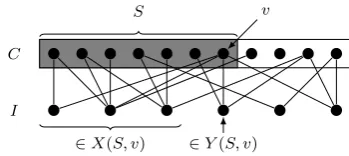
In aC-good orderingσ, consider a positioni such thatci ∈C. Because of the properties of aC-good ordering we can essentially deduceVi∩I fromVi∩C and the vertexci. We will now formalize this idea. For a setS⊆Cand vertexv∈Swe define the setX(S, v)⊆I as follows. A vertexu∈I of even degree is inX(S, v)
if|N (u)∩S|>|N (u)\S|. A vertexu∈I of odd degree is inX(S, v)if|N (u)∩ (S\ {v})|>|N (u)\(S\ {v})|. Now we define the setY (S, v). A vertexu∈I is in
Y (S, v)ifuv∈Eand|(N (u)\ {v})∩S| = |(N (u)\ {v})\S|. Note that the vertices
inY (S, v)have odd degrees andY (S, v)is disjoint withX(S, v). We refer to Fig.1
for an illustration. The following observation follows directly from the properties of aC-good ordering.
Observation 3 In aC-good orderingσ letibe an integer such thatci ∈C and let
A prefix orderingφ is a set Vφ⊆C∪I together with an ordering ofVφ. The size of the prefix ordering φis just |Vφ|. Similarly to normal orderings we define
Viφ= {v1· · ·vi}. Letc1c2· · ·c|Vφ∩C| be the ordering imposed onVφ∩C byφ, and
for everyi≤ |Vφ∩C|we setCiφ= {c1, . . . , ci}. The rank of a vertex v∈Vφ with respect toφis defined as rankφ(vi)= |N (vi)\Viφ| − |N (vi)∩Viφ|. We now extend the notion of beingC-good from orderings ofGto prefix orderings ofGin such a way that the restriction of anyC-good orderingσ ofGto the firstt vertices, where
vt ∈C, must beC-good. We say that a prefix orderingφ=v1· · ·vt of sizet with
vt∈CisC-good if the following conditions are satisfied.
1. For every vertexv∈Vφ∩I of even degree, rankφ(v)=0 and for every vertex
v∈Vφ∩I of odd degree, rankφ(v)∈ {−1,1}.
2. X(Vφ∩C, vi)⊆Vφ∩I ⊆X(Vφ∩C, vi)∪Y (Vφ∩C, vi)
3. For every vertexv∈X(Vφ∩C, ci)such that rankφ(v)≥0 andci∈Vφ∩C we haveci≤φvif and only if|N (v)∩Ciφ| ≤ |N (v)\C
φ i |.
4. For every vertexv∈X(Vφ∩C, ci)such that rankφ(v) <0 andci ∈Vφ∩C we haveci≤φvif and only if|N (v)∩Ci−φ1|<|N (v)\C
φ i−1|.
5. Between two verticesci, ci+1∈C∩Vφ, all vertices with rankφ(v) <0 come be-fore all vertices with rankφ(v)≥0.
Comparing the properties ofC-good orderings andC-good prefix orderings it is easy to see that the following lemma holds.
Lemma 4 Letσ=v1· · ·vn be aC-good ordering and letφbe the restriction ofσ to the firsttvertices, such thatvt ∈C. Thenφis aC-good prefix ordering.
For a prefix orderingφdefine the cutwidth ofGwith respect toφto be cwφ(G)= maxi≤|Vφ|δ(V
φ
i ). For a subsetS of C and vertex v∈S, define T (S, v)to be the minimum value of cwφ(G)where the minimum is taken over allC-good prefix or-deringsφwithVφ∩C=Sandvbeing the last vertex ofφ. Notice that property 5 ofC-good prefix orderings implies that in aC-good prefix orderingφthere must be someiwithvi∈C∩Vφsuch that cwφ(G)=δ(Vi)or cwφ(G)=δ(Vi−1). Also, no-tice that for any setS⊆Cand verticesu, v∈Swe have thatX(S\ {v}, u)⊆X(S, v)
and Y (S\ {v}, u)⊆X(S, v). Finally, observe that for any set S⊆C and vertex
v∈S, every vertexu∈Y (S, v) is adjacent tov and satisfies |(N (u)\ {v})∩S| =
|(N (u)\ {v})\S|. Thus, for any setI⊆I withX(S, v)⊆I⊆X(S, v)∪Y (S, v)
the value ofδ(S∪I)depends only on|Y (S, v)∩I|and not onY (S, v)∩Iin gen-eral. We letYi(S, v)be an arbitrary subset ofY (S, v)of sizei. The discussion above yields that the following recurrence holds forT (S, v), whereS⊆Candv∈S.
T (S, v)=min
u∈S0≤i≤|minY (S,v)|max ⎧ ⎨ ⎩
δ(S∪X(S, v)∪Yi(S, v))
δ((S\ {v})∪X(S, v)∪Yi(S, v))
T (S\ {v}, u)
⎫ ⎬ ⎭.
above naturally leads to a dynamic programming algorithm for CUTWIDTHrunning in timeO(2knO(1)). This proves the main theorem of this section.
Theorem 5 There is an algorithm that given a graphG=(C∪I, E)such that C
is a vertex cover ofG, computes the cutwidth ofG in running timeO(2|C|(|C| +
|I|)O(1)). Thus, MINIMUM CUTWIDTH on bipartite graphs can be solved in time
O(2n/2nO(1)), wherenis the number of vertices of the input graph.
3 Kernelization Lower Bound
In this section we show that CUTWIDTH parameterized by vertex cover does not admit a polynomial kernel unless NP⊆coNP/poly.
3.1 The Auxiliary Problem
We begin by introducing an auxiliary problem, namely HYPERGRAPH MINIMUM BISECTION. LetH=(V , E)be a multihypergraph with|V| =n, wherenis even. A bisection ofV is a colouring B:V → {0,1} such that|B−1(0)| = |B−1(1)| = n/2. For a hyperedgeelet us define the cost ofewith respect to a bisection Bas cost(e,B)=min(|e∩B−1(0)|,|e∩B−1(1)|). The cost of a bisection is defined as the sum of the contributions of the hyperedges, i.e., cost(B)=e∈Ecost(e,B).
HYPERGRAPHMINIMUMBISECTION Parameter:n
Input: MultihypergraphHwithnvertices, wherenis even; an integerk Question: Does there exist a bisection ofHwith cost at mostk?
In the case when all the hyperedges are in fact edges (have cardinalities 2) and there are no multiedges, the problem is equivalent to the classical MINIMUM BI -SECTIONproblem. As MINIMUMBISECTIONis NP-hard, HYPERGRAPHMINIMUM BISECTIONis also NP-hard, so NP-complete as well.
The goal now is to prove that CUTWIDTHparameterized by the size of vertex cover does not admit a polynomial kernel, unless NP⊆coNP/poly. We do it in two steps. First, using the OR-distillation technique of Bodlaender et al. [5] (with the back-bone theorem proven by Fortnow and Santhanam [17]) we prove that HYPERGRAPH MINIMUMBISECTIONdoes not admit a polynomial kernel, unless NP⊆coNP/poly. Second, we present a parameterized reduction from HYPERGRAPH MINIMUM BI -SECTIONto CUTWIDTHparameterized by vertex cover.
3.2 No Polynomial Kernel for HYPERGRAPHMINIMUMBISECTION
We use the OR-distillation technique (first introduced by Bodlaender et al. [5]) put into the framework called cross-composition [6]. Let us recall the crucial definitions.
Definition 6 (Polynomial Equivalence Relation [6]) An equivalence relationRon
two stringsx, y∈Σ∗decides whetherR(x, y)in(|x| + |y|)O(1) time; (2) for any finite setS⊆Σ∗the equivalence relationRpartitions the elements ofSinto at most
(maxx∈S|x|)O(1)classes.
Definition 7 (Cross-Composition [6]) Let L⊆Σ∗ and letQ⊆Σ∗×Nbe a pa-rameterized problem. We say thatLcross-composes intoQif there is a polynomial equivalence relationRand an algorithm which, giventstringsx1, x2, . . . , xt belong-ing to the same equivalence class ofR, computes an instance(x∗, k∗)∈Σ∗×Nin time polynomial inti=1|xi|such that (1)(x∗, k∗)∈Qiffxi∈Lfor some 1≤i≤t; (2)k∗is bounded polynomially in maxt
i=1|xi| +logt.
Theorem 8 [6, Theorem 9] If L⊆Σ∗ is NP-hard under Karp reductions and L
cross-composes into the parameterized problemQthat has a polynomial kernel, then NP⊆coNP/poly.
Lemma 9 HYPERGRAPHMINIMUM BISECTION, parameterized by the size of the universe, does not admit a polynomial kernel, unless NP⊆coNP/poly.
Proof As MINIMUM BISECTION is NP-hard under Karp reductions, it suffices to prove that it cross-composes into the HYPERGRAPHMINIMUMBISECTIONproblem, parameterized byn—the size of the universe. LetRbe an equivalence relation onΣ∗
defined as follows:
– all words that do not correspond to instances of MINIMUMBISECTIONform one equivalence class;
– all the well-formed instances are partitioned into equivalence classes having the same number of vertices, the same number of edges and the same demanded cost of the bisection.
It is straightforward that R is a polynomial equivalence relation. Therefore, we can assume that the composition algorithm is given a sequence of instances
(G0, k), (G1, k), . . . , (Gt−1, k) of MINIMUM BISECTION with |V (Gi)| = n and |E(Gi)| =m for alli=0,1, . . . , t−1 (n is even). Moreover, by copying some instances if necessary we can assume without losing generality thatt=2l for some integerl. Note that in this manner we do not increase the order of logt.
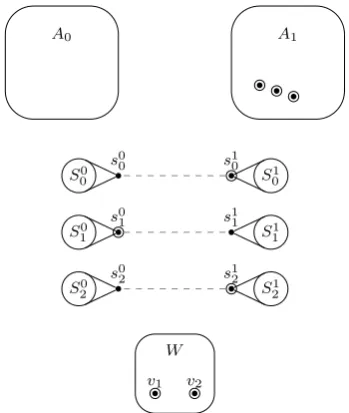
We now proceed to the construction of the composed HYPERGRAPHMINIMUM BISECTIONinstance (H, K). LetN =2m·((l+2)2l−1−1)+2k+1 andM= N (l2−l)+N. We begin by creating two sets of verticesA0andA1, each of size 2nl. We introduce each setA0, A1as a hyperedge of the constructed hypergraphM times.
Fig. 2 The constructed hypergraphHforl=3; encircled vertices indicate the hyperedgee0constructed for e=v15v25∈E(G5)
Now, we construct a set ofnverticesv1, v2, . . . , vn and denote it byW. For ev-ery instanceGa we arbitrarily choose an ordering of its vertices and denote it by
v1a, va2, . . . , vna. Letbl−1bl−2· · ·b1b0be the binary representation ofa, with trailing zeroes added so that its length is equal tol. For every edgee=vagvha∈E(Ga)we create two hyperedges:
– e0, consisting of vertices vg, vh, sibi for all i=0,1, . . . , l−1 and l vertices fromA1, chosen arbitrarily;
– e1, consisting of vertices vg, vh, si1−bi for all i=0,1, . . . , l−1 and l vertices fromA0, chosen arbitrarily.
Finally, we set the expected cost of the bisection toK=M−1=N (l2−l)+2m· ((l+2)2l−1−1)+2k. We refer to Fig.2for an illustration.
Assume that some graph Ga has a bisection B having cost at most k. Let
bl−1bl−2· · ·b1b0be the binary representation ofa, as in the previous paragraph. We now construct a bisectionBofHas follows:
– for eachu∈A0we setB(u)=0, for eachu∈A1we setB(u)=1;
– for each u∈Spi ∪ {sip}for p=0,1, i=0,1, . . . , l−1 we set B(u)=p+bi
(mod 2);
– for eachvj∈Wwe setB(vj)=B(vaj).
Observe thatB bisects each of the setsA0∪A1,SandW, so it is a bisection. We now prove that its cost is at mostK. Let us count the contribution to the cost from every hyperedge ofH.
there areN edges, apart from the pairs(s0i, si1). Note that all these pairs are coloured differently; therefore, there are exactlyN (l2−l)edges inH[S]contributing 1 to the cost.
Takec∈ {0,1, . . . , t−1}such thatc =a. Letdl−1dl−2· · ·d0be the binary repre-sentation ofc. Fore∈E(Gc)let us count the contribution to cost(B)of the hyper-edgese0ande1. Suppose thatq= |{i:bi =di}|>0. Among vertices ofe0,l from
A1are coloured 1,qfromSare coloured 1 as well andl−qfromSare coloured 0. In total, we havel+q vertices coloured 1 andl−q coloured 0, so regardless of the colouring of the remaining two vertices fromW, the contribution is equal to the number of vertices coloured 0 ine0, namely l−q + |e0∩W∩B−1(0)|.
Analo-gously, the contribution of the hyperedgee1is equal to the number of vertices ofe1
coloured 1, namelyl−q+ |e1∩W∩B−1(1)|. As there are exactly two vertices in e0∩W=e1∩W, cost(e0,B)+cost(e1,B)=2(l−q)+2. Thus, the total contri-bution of hyperedgese0,e1fore∈E(Gc)is equal to 2m(l−q)+2m.
Now we count the contribution of the edgese0ande1fore∈E(Ga). Analogously as in the previous paragraph, both edgese0,e1containlvertices coloured 0,lvertices coloured 1 plus two vertices fromW. If both these vertices are coloured in the same way, the sum of the contributions ofe0ande1is equal to 2l; however, if the vertices are coloured differently, the sum is equal to 2l+2. As the cost of bisectionBwas at mostk, the total contribution of edgese0,e1fore∈E(Ga)is at most 2ml+2k.
Finally, we sum up the contributions:
costB≤Nl2−l+2m
l
q=1
(l−q+1)
l q
+2ml+2k
=Nl2−l+2m·2l−1+2m
l
q=0
(l−q)
l q
+2k
=Nl2−l+2m·2l−1+2ml2l−1+2k
=Nl2−l+N−1=K.
We proceed to the second direction. Assume that we have a bisectionBofHsuch that cost(B)≤K. Observe that asM > K, both the setsA0, A1are monochromatic with respect toB. Moreover, they have to be coloured differently, as they contain more than half of the vertices of the graph in total. Without losing generality we can assume thatA0is coloured in colour 0, whileA1is coloured in colour 1, by flipping the colours if necessary.
Now consider the setSpi ∪ {spi}for p=0,1,i=0,1, . . . , l−1. Analogously as in the previous paragraph,Spi ∪ {sip}has to be monochromatic. Furthermore, observe that exactlylsuch sets have to be coloured 0 inBand the same number have to be coloured 1, as every setSpi ∪ {sip}contains the same number of vertices as the setW
andBis a bisection. Therefore,Bhas to bisect each of the setsA0∪A1,SandW. Exactlyl vertices sip are coloured 0 in B and exactly l are coloured 1. Let r
be the number of indices i, such that si0 andsi1 are coloured differently. Observe that analogously to our previous arguments, the contribution of the edges ofH[S]
N (l2−l)+N > K, a contradiction. Therefore, all the pairs(si0, s1i)are coloured differently.
Letabe a number with binary representationB(sl0−1)B(sl1−2)· · ·B(s01). Consider a bisectionBofGadefined as follows:B(via)=B(vi). We claim that the cost ofB is at mostk. Indeed, the same computations as in the previous part of the proof show that
costB=Nl2−l+2m(l+2)2l−1−1+2cost(B)
Therefore, as cost(B)≤K, then cost(B)≤k.
3.3 From HYPERGRAPHMINIMUMBISECTIONto CUTWIDTH
Let us briefly recall the notion of polynomial parameter transformations.
Definition 10 [9] LetP andQbe parameterized problems. We say thatP is polyno-mial parameter reducible toQ, written P ≤pQ, if there exists a polynomial time computable function f :Σ∗×N→Σ∗×N and a polynomial p, such that for all(x, k)∈Σ∗×Nthe following holds: (x, k)∈P iff(x, k)=f (x, k)∈Qand
k≤p(k). The functionf is called a polynomial parameter transformation.
Theorem 11 [9] Let P and Q be parameterized problems andP˜ and Q˜ be the unparameterized versions ofP andQrespectively. Suppose thatP˜ is NP-hard and
˜
Qis in NP. Assume there is a polynomial parameter transformation fromP toQ. Then ifQadmits a polynomial kernel, so doesP.
We apply this notion to our case.
Lemma 12 There exists a polynomial-time algorithm that, given an instance of the
HYPERGRAPHMINIMUMBISECTIONproblem withnvertices, outputs an equivalent instance of the CUTWIDTHproblem along with its vertex cover of sizen.
Proof Let(H=(V , E), k)be an instance of HYPERGRAPHMINIMUMBISECTION given in the input, where|V| =n(nis even) and|E| =m. We construct a graphG
as follows.
Let us denoteN =mn+1. We begin by taking the whole setV to be the set of vertices ofG. For every distinctu, v∈V we introduceN new verticesxiu,vfor
i=1,2, . . . , N, each connected only touandv. Then, for everye∈Ewe introduce a new vertexyeconnected to allv∈e. Denote the set of all verticesxu,vi byXand the set of all verticesyebyY. This concludes the construction. Observe thatV is a vertex cover ofGof sizen. We now prove thatH has a bisection with cost at mostk
if and only ifGhas cutwidth at mostn2N/4+k.
Now, we prove that the cutwidth of the constructed ordering is at mostn2N/4+k. Consider any cutC, dividing the order onV (G) into a first partV1and a second partV2. Suppose that|V1∩V| =n/2−lfor some−n/2≤l≤n/2, thus|V2∩V| =
n/2+l. Observe thatC cuts exactly N (n/2−l)(n/2+l)=n2N/4−l2N edges betweenV and X. Note that there are not more than nm < N edges between V
andY. Therefore, if l =0, thenC can cut at mostn2N/4−N+nm < n2N/4+k
edges.
We are left with the case whenl=0. Observe thatV1∩V=B−1(0)andV2∩V =
B−1(1). Moreover, the cutC cuts exactlyn2N/4 edges between setsV andX. As far as edges betweenV andY are concerned, for every hyperedgee∈E, the cutC
cuts exactly cost(e,B)edges incident onye. As cost(B)≤k, the cutCcuts at most
n2N/4+kedges.
Now assume that there is an ordering of vertices ofGthat has cutwidth at most
n2N/4+k. We construct a bisectionB ofH as follows. LetB(v)=0 for everyv
among the firstn/2 vertices fromV with respect to the ordering, andB(v)=1 for
vamong the secondn/2 vertices. We now prove that the cost of this bisection is at mostk.
LetC be any cut dividing the order into the first partV1and the second partV2, such thatV1∩V =B−1(0)andV2∩V =B−1(1). As the cutwidth of the ordering is at mostn2N/4+k,Ccuts at mostn2N/4+kedges. Observe thatCneeds to cut at leastn2N/4 edges between setsV andX, therefore it cuts at mostkedges between setsV andY. For every hyperedgee∈E,C cuts at least cost(e,B)edges incident
toye, thus cost(B)≤k.
From Lemmas9,12and Theorem11we conclude the following.
Theorem 13 CUTWIDTHparameterized by the size of vertex cover does not admit a polynomial kernel, unless NP⊆coNP/poly.
4 Conclusions
In this paper we studied the complexity of computing the cutwidth of a graph parame-terized by the size of a given vertex cover. We have shown an algorithm with running timeO(2knO(1)), wherekis the cardinality of the vertex cover andnis the number of vertices of the graph. Moreover, we have proven that polynomial kernelization of the problem is unlikely, thus counterpoising the recent result of Bodlaender et al. [7]. The thrilling and natural question is whether the insight we have given into the problem can be a starting point to breaking the 2n barrier for an exact algorithm computing cutwidth. Our result implies that one can assume that in any hard instance all the independent sets are small, i.e., of size not larger thancnfor an arbitrarily small constantc >0.
References
1. Adolphson, D., Hu, T.C.: Optimal linear ordering. SIAM J. Appl. Math. 25, 403–423 (1973) 2. Bellman, R.: Dynamic programming treatment of the travelling salesman problem. J. ACM 9(1), 61–
63 (1962)
3. Björklund, A.: Determinant sums for undirected hamiltonicity. In: FOCS, pp. 173–182. IEEE Comput. Soc., Los Alamitos (2010)
4. Blin, G., Fertin, G., Hermelin, D., Vialette, S.: Fixed-parameter algorithms for protein similarity search under mRNA structure constraints. J. Discrete Algorithms 6, 618–626 (2008)
5. Bodlaender, H.L., Downey, R.G., Fellows, M.R., Hermelin, D.: On problems without polynomial kernels. J. Comput. Syst. Sci. 75(8), 423–434 (2009)
6. Bodlaender, H.L., Jansen, B.M.P., Kratsch, S.: Cross-composition: a new technique for kernelization lower bounds. In: Schwentick, T., Dürr, C. (eds.) STACS, LIPIcs, vol. 9, pp. 165–176 (2011). Schloss Dagstuhl—Leibniz-Zentrum fuer Informatik
7. Bodlaender, H.L., Jansen, B.M.P., Kratsch, S.: Preprocessing for treewidth: a combinatorial analysis through kernelization. In: Aceto, L., Henzinger, M., Sgall, J. (eds.) ICALP (1). Lecture Notes in Computer Science, vol. 6755, pp. 437–448. Springer, Berlin (2011)
8. Bodlaender, H.L., Jansen, B.M.P., Kratsch, S.: Kernel bounds for structural parameterizations of path-width. In: Fomin, F.V., Kaski, P. (eds.) SWAT. Lecture Notes in Computer Science, vol. 7357, pp. 352– 363. Springer, Berlin (2012)
9. Bodlaender, H.L., Thomassé, S., Yeo, A.: Kernel bounds for disjoint cycles and disjoint paths. Theor. Comput. Sci. 412(35), 4570–4578 (2011)
10. Botafogo, R.A.: Cluster analysis for hypertext systems. In: Korfhage, R., Rasmussen, E.M., Willett, P. (eds.) SIGIR, pp. 116–125. ACM, New York (1993)
11. Cai, J., Chakaravarthy, V.T., Hemaspaandra, L.A., Ogihara, M.: Competing provers yield improved Karp-Lipton collapse results. Inf. Comput. 198(1), 1–23 (2005)
12. Chung, M., Makedon, F., Sudborough, I., Turner, J.: Polynomial time algorithms for the min cut problem on degree restricted trees. SIAM J. Comput. 14, 158–177 (1985)
13. Diaz, J., Penrose, M., Petit, J., Serna, M.: Approximating layout problems on random geometric graphs. J. Algorithms 39, 78–117 (2001)
14. Drucker, A.: New limits to classical and quantum instance compression. In: FOCS. IEEE Comput. Soc., Los Alamitos (2012, to appear)
15. Fellows, M.R., Lokshtanov, D., Misra, N., Rosamond, F.A., Saurabh, S.: Graph layout problems pa-rameterized by vertex cover. In: Hong, S.H., Nagamochi, H., Fukunaga, T. (eds.) ISAAC. Lecture Notes in Computer Science, vol. 5369, pp. 294–305. Springer, Berlin (2008)
16. Fomin, F.V., Kratsch, D., Todinca, I., Villanger, Y.: Exact algorithms for treewidth and minimum fill-in. SIAM J. Comput. 38(3), 1058–1079 (2008)
17. Fortnow, L., Santhanam, R.: Infeasibility of instance compression and succinct PCPs for NP. J. Com-put. Syst. Sci. 77(1), 91–106 (2011)
18. Gavril, F.: Some NP-complete problems on graphs. In: 11th Conference on Information Sciences and Systems, pp. 91–95 (1977)
19. Heggernes, P., van’t Hof, P., Lokshtanov, D., Nederlof, J.: Computing the cutwidth of bipartite per-mutation graphs in linear time. In: Thilikos, D.M. (ed.) WG. Lecture Notes in Computer Science, vol. 6410, pp. 75–87 (2010)
20. Heggernes, P., Lokshtanov, D., Mihai, R., Papadopoulos, C.: Cutwidth of split graphs and threshold graphs. SIAM J. Discrete Math. 25(3), 1418–1437 (2011)
21. Held, M., Karp, R.M.: A dynamic programming approach to sequencing problems. J. Soc. Ind. Appl. Math. 10(1), 196–210 (1962)
22. Jansen, B.M.P., Kratsch, S.: Data reduction for graph coloring problems. In: Owe, O., Steffen, M., Telle, J.A. (eds.) FCT. Lecture Notes in Computer Science, vol. 6914, pp. 90–101. Springer, Berlin (2011)
23. Junguer, M., Reinelt, G., Rinaldi, G.: The travelling salesman problem. In: Handbook on Operations Research and Management Sciences, vol. 7, pp. 225–330 (1995)
24. Karger, D.R.: A randomized fully polynomial time approximation scheme for the all-terminal network reliability problem. SIAM J. Comput. 29(2), 492–514 (1999)
25. Karp, R.M.: Dynamic programming meets the principle of inclusion and exclusion. Oper. Res. Lett. 1, 49–51 (1982)
27. Makedon, F., Sudborough, I.H.: On minimizing width in linear layouts. Discrete Appl. Math. 23, 243–265 (1989)
28. Monien, B., Sudborough, I.H.: Min cut is NP-complete for edge weighted trees. Theor. Comput. Sci. 58, 209–229 (1988)
29. Mutzel, P.: A polyhedral approach to planar augmentation and related problems. In: Spirakis, P.G. (ed.) ESA. Lecture Notes in Computer Science, vol. 979, pp. 494–507. Springer, Berlin (1995) 30. Suchan, K., Villanger, Y.: Computing pathwidth faster than 2n. In: Chen, J., Fomin, F.V. (eds.)
IW-PEC. Lecture Notes in Computer Science, vol. 5917, pp. 324–335. Springer, Berlin (2009) 31. Thilikos, D.M., Serna, M.J., Bodlaender, H.L.: Cutwidth II: Algorithms for partial w-trees of bounded
degree. J. Algorithms 56, 24–49 (2005)
32. Yannakakis, M.: A polynomial algorithm for the min cut linear arrangement of trees. J. ACM 32, 950–988 (1985)
33. Yap, C.K.: Some consequences of non-uniform conditions on uniform classes. Theor. Comput. Sci. 26, 287–300 (1983)