Bachelor thesis Gezondheidswetenschappen
Late pulmonary effects of different treatments after
breast conserving surgery
July 2019
Martijn Koers
S1491342
First supervisor: Prof. Dr. S. Siesling
Abstract
Background
Breast cancer is a disease with many victims that is closely watched by the national breast cancer screening. There are multiple ways of treating breast cancer. In most cases patients undergo surgery and receive additional treatment in the form of radiotherapy, hormonal- or chemotherapy, or regional radiotherapy. These treatments often lead to side effects, on the short or long term. Considering the high survival rate, long term effects can be identified. This study focuses on the pulmonary late effects of different breast cancer treatments.
Patients and method
This study’s design is a retrospective cohort study, with data from the Netherlands Cancer Registry (NKR) and patient files in Medisch Spectrum Twente, where the patients were treated. These patients underwent breast cancer treatment between 1986 and 2007 and were followed for at least 10 years to be able to determine late effects. Three groups were made, where patients were included based on the treatment they received. This was breast conserving
surgery combined with radiotherapy, with radiotherapy and hormonal- or chemotherapy and with radiotherapy, regional radiotherapy and possible hormonal- or chemotherapy. One-way ANOVA was used to compare baseline patient characteristics. Chi-squared tests were used to identify differences in comorbidities and late effects. Kaplan-Meier and Cox proportional hazard survival analyses were used to compare the groups’ occurrence of late effects and to correct for factors that could influence outcomes.
Results
There were significant differences between the groups in prevalence of comorbidities and age of the patients at the date of surgery. Late pulmonary effects differed significantly between groups (p=0.001). For individual pulmonary late effects, only COPD differed significantly. Cox
proportional hazard method showed that regional radiotherapy and smoking more than doubles the risk of late pulmonary events occurring
Conclusion
Introduction
Breast cancer is the eighth largest cause of death among women worldwide. In 2016, almost 600.000 women died of breast cancer (1). There were about 1.7 million new cases, which makes the death rate roughly 1 in 3 (2). In 2016, almost 3,200 Dutch women died of breast cancer, while just over 14,000 women were diagnosed (3). One of the main reasons for the higher survival rate for Dutch women might possibly be the nationwide breast cancer screening program. According to the Dutch National Institute for Public Health and the Environment (RIVM), 87% of women with breast cancer survive at least five years and the ten-year survival rate is over 77% (4).
Breast cancer treatment consists of a wide range of possible treatments, which require the attention of different specialisms. Oncologists, surgeons, radiologists and other professions work together to ensure the best possible outcome for the patient. There are many factors that influence the specific treatment. The first one is the classification of the tumor, according to the TNM-classification system. This system classifies tumors in three categories: Status of the primary tumor, status of regional lymph nodes, and whether the tumor has metastasized (5). Secondly, it is important whether the tumor is ductal (originating from the milk ducts) or lobular (originating from one or more mammary glands) (6). Another important factor is the hormonal receptor status (7).
The first and foremost goal of breast cancer treatment is removal of the tumor itself. In almost all cases this involves some kind of surgery. The type of surgery depends greatly on the size of the tumor. There are two types of surgery. The first one is a (radical) mastectomy, which means that the entire breast is removed. The second type is called Breast Conserving Surgery (BCS), where only the tumor is excised; this often involves a lumpectomy. This leaves most of the breast intact (7). Another type of a BCS is a quadrantectomy, where a full quadrant of the breast is removed. Both these types of surgery have many different ways in which to perform it, influencing the aesthetic outcome of the procedure. To reduce the risk of metastases, sentinel lymph nodes may be resected. To examine whether lymph nodes in the vicinity of the tumor are affected, surgery is also used (7,8). There are two ways to do this, namely a Sentinel Node (SN) procedure, where the nearest lymph nodes are removed and checked on tumor presence. The other option is an axillary lymphadenectomy, where the lymph nodes in the axilla are removed (9).
During surgery, a margin of tissue around the tumor is also excised, to ensure that no tumor tissue remains. However, recurrence of the tumor is always a possibility. To greatly reduce the chance of recurrence, radiotherapy can be used. Especially after a lumpectomy, radiotherapy is very common.
Chemotherapy can be administered before the surgery, to shrink the tumor, thus simplifying the procedure, this is called neoadjuvant chemotherapy. More common is to treat the patient with chemotherapy after surgery (adjuvant), to decrease the chance of recurrence or to eliminate metastases in an early stage (7).
Most breast cancers, roughly 2 out of 3, have certain proteins (receptors) that bind with estrogen or progesterone. When these receptors bind to these hormones, they help the tumor grow faster. To prevent these receptors from attaching, or to decrease the production of these hormones, hormonal (endocrine) therapy can be administered. This reduces the tumor growth rate, or can even make it shrink. If the endocrine therapy is neoadjuvant, which means that it is given prior to surgery, to shrink the tumor and make it easier to excise. Adjuvant endocrine therapy is prescribed after surgery, when the tumor is excised. This greatly reduces the chance of recurrence of a breast tumor (10). Chemotherapy and hormonal therapy will henceforth be grouped together in adjuvant systemic therapy (AST).
All these postoperative treatments have immediate effects on the patient, as well as possible negative side-effects. An example of this is radiation pneumonitis induced by radiotherapy, or fatigue (11). Not all effects of the treatment occur immediately after treatment. It is possible that the treatment has effects on the patient after treatment has been concluded. These effects can occur in different organs. The heart can be affected, but there can also be neurological or psychological complications. Pulmonary complications are also fairly common and will be the focus of this study. For the aforementioned therapies, pulmonary complications may differ (12).
Many articles are very clear on the fact that more research on late effects of cancer treatments needs to be done (12,13,14), but still more research can be done regarding this subject. This is remarkable, since having a clear view of the late effects of breast cancer treatment can help improve it. For a disease with 14,000 new cases annually, proper follow-up is important and that is why the aim of this study is to determine whether the late pulmonary effects of three different groups differ. These three groups with their respective therapies are shown in table 1.
Abbreviation Type of therapy RT Radiotherapy
RT + AST Radiotherapy and adjuvant systemic therapy (chemotherapy, endocrine therapy or both) RT + RRT (+AST) Radiotherapy, regional radiotherapy and in
some cases chemotherapy, endocrine therapy or both
Table 1 Three cohorts and their respective treatments
All these considerations lead to the following research question:
Methods
The Netherlands Cancer Registry (NKR) collects data on all malignancies in the Netherlands and where those are treated. Patients for this study have been found in the NKR database and were selected from the radiological medical files of Medical Spectrum Twente (MST) in Enschede.
The study focuses on female patients who have undergone a BCS at the MST and have received further treatment there. This follow-up treatment is subdivided in RT alone, RT as well as adjuvant systemic therapy (AST), and a third group that was administered regional radiotherapy (RRT) and in some cases also AST. The patients underwent BCS between 1986 and 2007 and survived at least ten years after surgery, which makes it possible to determine late effects.
The medical records of the MST have been investigated for patient characteristics that might influence late effects such as smoking, hypertension and diabetes. Relevant oncological data, such as the occurrence of metastases, recurring tumors or secondary tumors, have been gathered from the patient files. The most important data that was gathered was information about pulmonary (late) effects that could possibly be related to the treatment. These were identified in prior research as radiation pneumonitis, pleural fluid, pleural fibrosis, bronchiectasis, asthma, COPD and pneumonia (15).
The initial datasets contain information on the age, date of surgery, additional therapy (RT/AST) and laterality of the breast cancer. Patient files were used to collect information on the medical status of the patients. This also includes length, weight, smoking habits, diabetes, other comorbidities and use of medication.
Patients who, prior to their breast cancer, had been diagnosed with another malignancy and have undergone radiotherapy or systemic therapy as a result were excluded, as their late effects might also be attributed to the prior treatment. Patients who had their follow-up in other hospitals were also excluded, as their medical history after moving away was unknown.
Statistical analysis was used to compare late effects between the three different groups. All variables that will be investigated in the patient files fit in either of the three concepts shown in table 2.
Concept Investigated variables
Patient characteristics Age, BMI, lateralization tumor, smoking habits Comorbidities Hypertension, hypercholesterolemia, diabetes,
asthma t0, COPD t0
Pulmonary late effects Pleural fluid, pleural fibrosis, radiation pneumonitis, bronchiectasis, asthma, COPD, pneumonia
Statistical analysis
[image:6.612.72.541.253.297.2]IBM’s SPSS version 25 is the software program that is used to carry out statistical analyses. Out of the gathered data, new variables will have to be computed. For example to find the age of the patient at date of surgery, by subtracting the date of birth from the date of surgery. BMI will be computed when the height and length of the patient are found. The length of the follow up will be determined by calculating the amount of years between surgery and the last time the patient was seen by a specialist in the MST. More variables are needed on whether any pulmonary complications developed during follow up, how many months after surgery these complications developed and another variable for every pulmonary complication that shows when said effect occurred after at least ten years to be able to analyze late effects. An example is graphically presented in figure 1.
Figure 1 Schematically show n how variables are to be transformed to filter late effects.
Patient characteristics will be plotted in histograms to be able to determine if these factors are normally distributed. A one-way ANOVA will be used to compare the cohorts on BMI and age. If a significant difference between groups arises, a post-hoc-test will be used to find where the difference is. To compare the groups on prevalence of comorbidities such as hypertension, chi-square tests will be used to make sure the groups are comparable. If significant differences are found, groups will be filtered to find where the difference is significant.
To determine the relation between the two groups and the occurrence of late effects, a chi-squared test will be used. For these late effects, filters will be placed in the cohorts to be able to compare the cohorts 1-to-1.
Results
Out of the NKR, 264 patients with BCS were included in the study and divided into three cohorts, namely a regular radiotherapy group, a radiotherapy group with additional adjuvant systemic therapy and a third group with regional radiotherapy and possible adjuvant systemic therapy (see table 1). The patient characteristics are shown in table 3. Breast-conserving surgery was performed on all of these patients between 1986 and 2007. After their surgery, patients were followed for an average of 17.67 years. The variables Age, Weight, Height and BMI were plotted in a histogram and found to be normally distributed.
RT RT+AST RRT (+AST)
Base characteristics n=95 n=107 n=62
Age (at surgery) 57.0 ± 9.3¹ 53.7 ± 10.5 52.7 ± 7.7
BMI 27.3 ± 6.6 28.7 ± 6.8 27.1 ± 4.5
Lateralization tumor L-R 49-46 59-48 27-35
Smoking
Never-smokers 63 (66.3%) 74 (69.2%) 37 (59.7%)
[image:7.612.81.542.211.395.2](Ex-)smoker 32 (33.7%) 33 (30.8%) 25 (40.3%)
Table 3 Patient characteristics and prevalence w ithin the cohorts.
¹The patients in this group w ere significantly older at the time of their surgery compared to the other tw o groups.
A one-way ANOVA showed no significant difference in BMI, but showed a significant difference in age between the groups. The RT-only group was, on average, a little older than the AST- and the RRT-group (p=0.033 resp. 0.016). A chi-squared test was used to check patient characteristics for homogeneity. The factors smoking, tumor lateralization and Asthma/COPD at time of diagnosis proved to have no significant difference.
Comorbidities
Comorbidities RT RT + AST RRT (+AST)
n=95 n=107 n=62
Hypertension 29 (30.5%) 36 (33.6%) 33 (53.2%)¹
Hypercholesterolemia 13 (13.8%) 16 (15.0%) 20 (32.3%)²
Diabetes Mellitus 11 (11.6%) 12 (11.2%) 18 (29.0%)³
Asthma t0 5 (5.3%) 3 (2.8%) 0
[image:8.612.73.544.405.635.2]COPD t0 1 (1.1%) 3 (2.8%) 0
Table 4 Comorbidities and prevalence w ithin the cohorts.
¹This group is significantly more often hypertensive compared to the other tw o groups. ²This group is significantly more often hypercholesterolemic compared to the other tw o groups. ³This group is significantly more often diabetic compared to the other tw o groups.
Pulmonary late effects
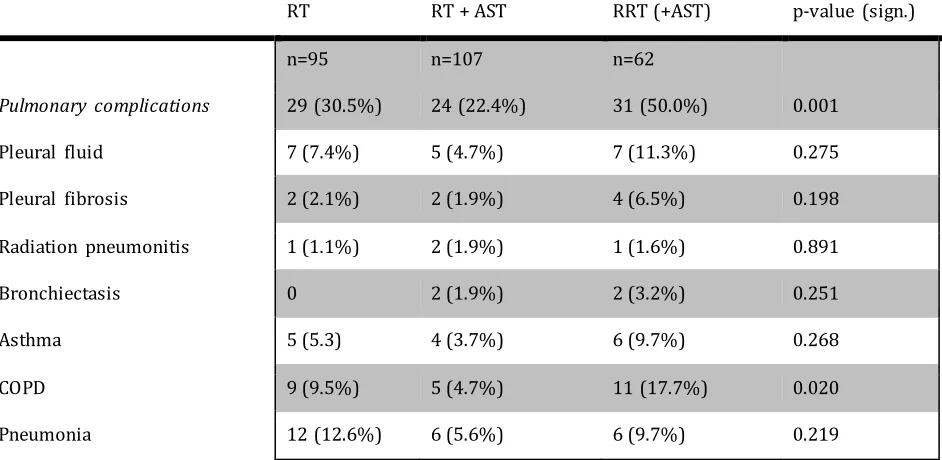
Information on pulmonary complications after treatment was collected and compared to the cohort the patients were in. A total of 84 patients (33.0%) experienced one or more pulmonary complications. These complications are: pleural fluid, pleural fibrosis, radiation pneumonitis, bronchiectasis, asthma, COPD and pneumonia. Chi-squared tests were used to find a difference between the three cohorts and filtering, followed by new chi-squared tests were used to locate the exact difference if there was significance. These results are displayed in table 5.
RT RT + AST RRT (+AST) p-value (sign.)
n=95 n=107 n=62
Pulmonary complications 29 (30.5%) 24 (22.4%) 31 (50.0%) 0.001
Pleural fluid 7 (7.4%) 5 (4.7%) 7 (11.3%) 0.275
Pleural fibrosis 2 (2.1%) 2 (1.9%) 4 (6.5%) 0.198
Radiation pneumonitis 1 (1.1%) 2 (1.9%) 1 (1.6%) 0.891
Bronchiectasis 0 2 (1.9%) 2 (3.2%) 0.251
Asthma 5 (5.3) 4 (3.7%) 6 (9.7%) 0.268
COPD 9 (9.5%) 5 (4.7%) 11 (17.7%) 0.020
Pneumonia 12 (12.6%) 6 (5.6%) 6 (9.7%) 0.219
The data clearly show that pulmonary complications are more common in the RRT-cohort than in the other two. The chi-squared test confirms that there is a significant difference between the groups. Which groups significantly differ from each other is not clear with this test. Filtering the cohorts and independently comparing them on pulmonary effects shows that there is no significant difference between the RT-group and the RT+AST-group. However, there is a difference between the RT-group and the RRT-group (p=0.014) and between the RT+AST-group and the RRT-RT+AST-group (p=0.000). For COPD, there is a significant difference between the groups, which after filtering shows that there is a significant difference between the AST-group and the RRT-group, where the RRT-group shows significantly more cases of COPD (p=0.005).
Kaplan-Meier survival
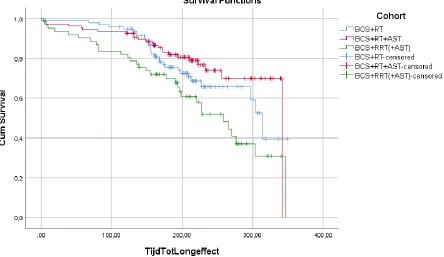
[image:9.612.86.530.327.584.2]A Kaplan-Meier survival analysis was carried out to find when pulmonary complications arose and whether there is a difference between the groups. Figure 2 shows the cumulative survival of a pulmonary complication arising per group. The RRT-group can clearly be seen to develop pulmonary complications earlier and more often than the other two groups (p=0.066). What is interesting is that the patients who received adjuvant systemic therapy seem to develop pulmonary complications later and less often than the radiotherapy-only group.
Cox proportional hazard
Since age and three comorbidities showed significant differences between the groups, it is possible that those factors influence the outcomes of the survival. To correct for these differences, Cox regression was used. First, a model was made that includes and corrects all found significant differences between groups. The effects of hypercholesterolemia, hypertension, and diabetes did not significantly influence the occurrence of pulmonary late effects and were excluded from the model. Age was found to influence the occurrence of late effects, as well as smoking, and the cohort the patients were in.
In table 6, the hazard ratios and significance are shown of the different factors that influence the occurrence of late effects. Smoking was found to more than double the risk of developing late pulmonary effects. Furthermore, regional radiotherapy also greatly increased the chance of developing late effects, with a hazard ratio of 2.15. The effect of age was found to be marginal, yet significant.
Factor Significance Hazard ratio
Age 0.000 1.052
Smoking 0.001 2.108
Cohort 0.002 -
RT vs. RT + AST 0.634 0.876
[image:10.612.69.544.252.332.2]RT vs. RT + RRT (+AST) 0.005 2.150
Table 6 Influence of different factors on occurrence of pulmonary late effects.
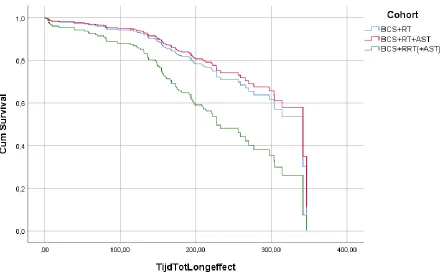
The RT-group was significantly older than the other two groups. When corrected for age and smoking habits, the RT-group is seen to develop less pulmonary late effects than before the correction. Still, AST-patients develop pulmonary late effects earlier and more often than the other two groups, as seen in figure 3.
[image:10.612.77.519.423.695.2]Discussion
Patient characteristicsAll 264 patients that underwent a BCS in the Medical Spectrum Twente (MST) between 1986 and 2007 were included, provided they had not undergone radiotherapy or endocrine therapy for prior malignancies, which could have also caused late effects. Next to that, patients who moved away after surgery and had their follow-up elsewhere were also excluded, since their medical files were inaccessible. No further selection was made. This protects the internal validity of the study and shows that there was no bias in the selection of the patients. The patients that were included in the study were comparable to the (female) Dutch general public on the factors hypertension, hypercholesterolemia and diabetes (16).
The normal radiotherapy group was found to be significantly older than the other groups. In the RRT-group, three comorbidities: hypertension, hypercholesterolemia and diabetes were found to be more prevalent. With the current data, it is impossible to know whether these comorbidities were present at the time of surgery, or if they developed during follow up.
Pulmonary complications
In total, 33.0% of patients developed pulmonary complications after therapy. Even though the occurrence of complications was higher in the RRT-group than in the other two groups, for individual complications - besides COPD - there was no significant difference. This is likely to be attributed to the small number of patients who developed the individual pulmonary complications. COPD turned out to significantly differ between the three groups, even though smoking habits and COPD at date of surgery did not. This eliminates smoking as a possible confounder
Strengths and limitations
The small size of the population is the main limitation of this study. The 264 patients are divided into three groups, of which only a portion had specific pulmonary complications. This inevitably led to insignificant outcomes for specific pulmonary complications. If this study was carried out in collaboration with many hospitals across the country, the results would give a better and more reliable insight in late pulmonary complications after breast conserving therapy.
One of the strengths of this study is that because of the low amount of selection criteria and the high comparability of the subjects, the (be it small) population of the study is representative for the female population in the researched age brackets.
Future research
Since prevalence of hypertension differs significantly between groups, and the date of diagnosis is unknown, it would be interesting to know whether hypertension developed during follow up, or if the patient was already diagnosed with hypertension at the date of surgery.
Lastly, since some of the patients in the RRT-group also received AST, these effects could not be investigated. In future research another group could be added, that only received BCS and RRT, without possible AST. The earlier described (possible) protective effect of AST could be filtered out in this way.
For further research, a control group of women who underwent a mastectomy without further treatment would be interesting. This gives valuable insights on the effects of the normal radiotherapy on the patient on the long term.
Conclusion
Bibliography
(1) WHO. (2018). Global Health Observatory Top 10 causes of death. Retrieved February, 2019, from http://www.who.int/gho/mortality_burden_disease/causes_death/top_10/en/
(2) World Cancer Research Fund. (2018). Breast cancer statistics. Retrieved February, 2019, from
https://www.wcrf.org/dietandcancer/cancer-trends/breast-cancer-statistics
(3) Integraal Kankercentrum Nederland. (2018). Cancer Statistics, incidence and prevalence.
Retrieved February, 2019, from
https://www.cijfersoverkanker.nl/selecties/incidentie_borst/img5b9615eec0dcc
(4) Rijksinstituut voor Volksgezondheid en Milieu. (2014). Breast cancer in the Netherlands. Retrieved February, 2019, from https://www.rivm.nl/en/breast-cancer-screening-programme/breast-cancer-in-netherlands
(5) Brierley, J., Gospodarowicz, M. K., & Wittekind, C. (2017). TNM classification of malignant tumours(8th ed.). Chichester, West Sussex, UK: John Wiley & Sons. doi:978-1-119-26357-9
(6) Borst, M. J., MD, & Ingold, J. A., MD. (1993). Metastatic patterns of invasive lobular versus invasive ductal carcinoma of the breast. Surgery,114(4), 637-642.
(7) IKNL. (2018, July 2). Landelijke richtlijn borstkanker. Retrieved February, 2019, from
https://www.oncoline.nl/borstkanker
(8) Halsted, W. S. (1894). The Results of Operations for the Cure of Cancer of the Breast Performed at the Johns Hopkins Hospital from June, 1889, to January, 1894. Annals of Surgery,20(5), 497-555. (9) Gioliano, A. E., & Kirgan, D. M. (1994). Lymphatic mapping and sentinel lymphadenectomy for breast cancer. Annals of Surgery,220(3), 391-401.
(10) American Cancer Society. (2017, September 26). Hormone Therapy for Breast Cancer. Retrieved February, 2019, from https://www.cancer.org/cancer/breast-cancer/treatment/hormone-therapy-for-breast-cancer.html#references
(11) Lingos, T. I., MD, & Recht, A., MD. (1991). Radiation pneumonitis in breast cancer patients treated with conservative surgery and radiation therapy. International Journal of Radiation Oncology,21(2), 355-360. doi:10.1016/0360-3016(91)90782-Y
(12) Mols, F., & Vingerhoets, J. J. (2005). Quality of life among long-term breast cancer survivors: A systematic review. European Journal of Cancer,41(17), 2613-2619. doi:10.1016/j.ejca.2005.05.017 (13) Soerjomataram, I., & Louwman, M. W. (2007). An overview of prognostic factors for long-term survivors of breast cancer. Breast Cancer Research and Treatment,107, 309-330. doi:10.1007/s10549-007-9556-1
(14) Carver, J. R., & Shapiro, C. L. (2007). American Society of Clinical Oncology Clinical Evidence Review on the Ongoing Care of Adult Cancer Survivors: Cardiac and Pulmonary Late Effects. Journal of Clinical Oncology,25(25), 3991-4008.
(15) De Rijk, L. J. (2018). Long term pulmonary complications after treatments in breast-cancer survivors (Master thesis). Retreived from: https://essay.utwente.nl/view/programme/60022.html.