University of Warwick institutional repository:
http://go.warwick.ac.uk/wrap
A Thesis Submitted for the Degree of PhD at the University of Warwick
http://go.warwick.ac.uk/wrap/67088
This thesis is made available online and is protected by original copyright.
Please scroll down to view the document itself.
i
Crystallisation and Characterisation
of Bimetallic- and
Lanthanide-Organic Frameworks
By
Matthew I. Breeze
Supervisor: Richard I. Walton
Thesis submitted for the degree of
Doctor of Philosophy in Chemistry
iii
Contents
1. Introduction
1.1. Introduction ... 0
1.2. Definitions ... 0
1.3. History of Metal-Organic Frameworks ... 2
1.4. Metal-Organic Frameworks ... 4
1.4.1. Structures ... 4
1.4.2. Synthesis of Metal-Organic Frameworks ... 6
1.4.3. Isoreticular Synthesis of Metal-Organic Frameworks ... 8
1.4.4. Post-synthetic modification of metal-organic frameworks ... 10
1.4.5. Dynamic Metal-Organic Frameworks ... 10
1.4.6. Potential Applications ... 12
1.5. Heterometallic-Organic Frameworks ... 14
1.5.1. Introduction ... 14
1.5.2. Intercalated Nano-Particles@MOFs ... 16
1.5.3. MOFs with counter-ions ... 17
1.5.4. Intercalated Polyoxometalates ... 17
1.5.5. Polyoxometalate-organic frameworks ... 17
1.5.6. Metallo-ligands ... 18
1.5.7. Heterometallic sites ... 19
1.5.8. Homometallic sites... 19
iv
1.6.1. Introduction ... 20
1.6.2. Structure and Properties ... 21
1.6.3. Effect of the Metal Centre on MIL-53 on its dynamic behaviour ... 22
1.6.4. Notable non-trivalent analogues of MIL-53 ... 23
1.6.5. Mixed-Metal MIL-53 ... 24
1.7. Lanthanide-Organic Frameworks ... 25
1.7.1. Introduction ... 25
1.7.2. Diversity of Structures... 26
1.7.3. Applications of lanthanide-organic frameworks ... 30
1.8. Aims of this work ... 31
1.9. References ... 33
2. Experimental 2.1. Introduction ... 40
2.2. Sample Preparation ... 40
2.2.1. Solvothermal synthesis ... 40
2.2.2. Thermal activation of metal-organic frameworks ... 41
2.3. Powder X-ray Diffraction ... 42
2.3.1. Introduction ... 42
2.3.2. Laboratory powder XRD ... 52
2.3.3. D5000 ... 52
2.3.4. D8 ... 52
v
2.3.6. High-resolution powder XRD ... 53
2.3.7. PXRD Refinement ... 54
2.3.8. EDXRD ... 54
2.3.9. In Situ XRD Crystallisation Studies ... 56
2.4. Single Crystal X-ray Diffraction ... 57
2.5. X-ray Absorption Spectroscopy ... 58
2.5.1. Introduction ... 58
2.5.2. X-Ray Absorption Near Edge Spectroscopy ... 58
2.5.3. Extended X-ray Absorption Fine Spectra ... 59
2.5.4. Beamline B18 ... 59
2.6. Other Characterisation Techniques ... 60
2.6.1. Infrared Spectroscopy ... 60
2.6.2. Raman Spectroscopy ... 61
2.6.3. Thermogravimetric Analysis ... 61
2.6.4. Elemental Analysis ... 62
2.6.5. Mössbauer Spectroscopy ... 62
2.6.6. Photoluminescence studies ... 64
2.7. References ... 65
3. Mixed-Metal MIL-53 3.1. Introduction ... 66
3.2. [(Fe, V)(BDC)(DMF, F)] ... 67
vi
3.2.2. Structure and Composition ... 68
3.2.3. XANES ... 71
3.2.4. 57Fe Mössbauer Spectroscopy... 72
3.2.5. Thermal Behaviour ... 75
3.2.6. Infrared Spectroscopy of (Fe0.88V0.12)(BDC)(OH, F) ... 77
3.3. [(Fe, V)(BDC)(OH, F)]0.5-∙0.5DMA+ ... 78
3.3.1. Synthesis ... 78
3.3.2. Structure and Composition ... 79
3.3.3. XANES ... 81
3.3.4. 57Fe Mössbauer Spectroscopy... 83
3.3.5. Thermal Behaviour ... 85
3.3.6. Infrared and Raman Spectroscopy ... 87
3.4. MIL-53(Fe, V) ... 90
3.4.1. Synthesis ... 90
3.4.2. Structure and Composition ... 91
3.4.3. XANES ... 93
3.4.4. 57Fe Mössbauer Spectroscopy... 96
3.4.5. Infrared and Raman Spectroscopy ... 97
3.4.6. Thermal Behaviour ... 100
3.4.7. Sorption of Ethanol by MIL-53(Fe0.74V0.26) ... 102
3.4.8. Porosity Studies of MIL-53(Fe, V) ... 104
vii
3.5. [(Fe, Co)(BDC)(OH, F)]0.5-∙0.5DMA+ ... 106
3.5.1. Synthesis ... 106
3.5.2. Structure ... 107
3.5.3. Calcination ... 108
3.5.4. XANES ... 109
3.6. MIL-53(Fe, Cr) ... 110
3.6.1. Introduction ... 110
3.6.2. Fitting Model ... 111
3.6.3. EXAFS Analysis of MIL-53(Cr0.6Fe0.4) ... 113
3.7. Summary... 117
3.8. References ... 119
4. Ytterbium-Organic Frameworks 4.1. Introduction ... 121
4.2. MB2 – [Yb2(BDC)3(DMF)2]∙ H2O... 123
4.2.1. Synthesis ... 123
4.2.2. Structure ... 123
4.2.3. Thermal Behaviour of MB2 ... 129
4.2.4. Porosity Studies of MB2 ... 138
4.2.5. Infrared Spectra of MB2 and Its Calcination Products ... 139
4.2.6. Synthesis of MB2 with other lanthanides ... 142
4.2.7. Doping of MB2 with other lanthanides... 143
viii
4.3.1. Synthesis ... 150
4.3.2. Structure of MB3 ... 150
4.3.3. Thermal Behaviour of MB3 ... 154
4.3.4. Gas Adorption Studies of MB3 ... 162
4.3.5. Infrared Spectra of MB3 and Its Calcined Products ... 163
4.4. Synthesis of Isoreticular Analogues of MB2 and MB3 ... 166
4.4.1. Synthesis ... 166
4.4.2. MB5 – [Yb2(NDC)3(H2O)4]∙ H2O ... 168
4.4.3. Thermal Behaviour of MB5 ... 172
4.5. Summary... 175
4.6. References ... 177
5. Crystallisation of Metal-Organic Frameworks 5.1. Introduction ... 179
5.2. Experimental Set-Up... 181
5.3. Crystallisation of MB2 ([Yb2(BDC)3(DMF)2]∙ H2O) ... 183
5.3.1. In Situ Studies ... 183
5.3.2. Ex Situ Study ... 191
5.4. Crystallisation of MB3 - ([Yb2(BDC)3(DMF)2(H2O)2]) ... 197
5.5. Crystallisation of interpenetrated MOF-5 ... 202
5.5.1. MOF-5 and its interpenetrated form ... 202
5.5.2. Synthesis of MOF-5int ... 204
ix
5.6. Summary... 212
5.7. References ... 214
6. Conclusions 6.1. Summary... 216
6.2. Future Work ... 218
6.3. References ... 219
A. Appendix A.1. Precious Metal-O ga i F a e o ks……….220
A.2. Synthesis of Iridium-O ga i F a e o ks……….220
A.3. Synthesis of Ruthenium-O ga i F a e o ks……….…….224
A. . “ thesis of P e ious Metal Doped MOFs……….223
A. . “u a ………..230
x
Acknowledgements
My first and most important acknowledgement has to go to my supervisor, Richard I. Walto . Fo the last ea s I e ee at the U i e sit of Wa i k, his suppo t has
guided e th ough u de g aduate a d the thesis p oje t. These last fou ea s I e
been able to travel about Europe, play with some fancy bits of kits and actually gather enough data to sum up in this thesis- ook thi g. “o, tha ks ‘i ha d fo this, it s ee g eat.
“e o dl , I d like to tha k the e e s of the Walto g oup, past a d p ese t, fo
your help and advice over the years. Far too many sleepless nights spent with you guys collecting data at synchrotrons. Special mentions to Luke Daniels for collecting TGA data for many of the compounds featured, Helen Playford for getting me up to scratch with GSAS, Craig Hiley for some of the worst puns imaginable and especially Alexis Munn, fellow HASYLAB survivor and cofounder of the shortly-lived but totally awesome Team MOF.
Special thanks to Guy Clarkson who solved the crystal structures of the lanthanide materials. Without your expertise, there would t e u h of a fou th hapte to this thi g.
I am exceedingly grateful to MACADEMIA for three years of funding towards this PhD and whom without, this PHD never would have happened. MACADEMIA has allowed me to travel about Europe and collaborate with researchers from universities across the EU. Many of these people have collected data for us and I would like to thank Franck Millange (Université de Versailles) for measurement of gas adsorption data, Marco Daturi and his group (Université de Caen Basse-Normandie) for IR and Raman spectroscopy, Jean-Marc Greneche (Université du Maine, Le Mans) for Mössbauer spectroscopy and Ben Van de Voorde (K.U. Leuven) for xylene sorption data.
I d like to tha k fa il . Not su e if ou e e u de stood a of hat I was doing
xi “pe ial e tio goes to ‘o e t Cookie Cook. It s ee a ei d fe ea s li i g
ith ou e tai l has t helped ut it s e e ee o i g. You also i t odu ed e to
Warwick Rock Soc, some of the friendliest a d ei dest people I e e e et a d I all the ette fo e e ha i g k o . I d espe iall like to tha k Lee Bu to a d Je e B o fo
xii
Declaration
This thesis is submitted to the University of Warwick in support of my application for the degree of Doctor of Philosophy. It has been compiled by myself and has not been submitted in any previous applications for my degree.
The work presented (including data generation and analysis) was carried out by the author except in the cases outlined below:
Various contributions have been made to this work by other researchers and MACADEMIA partners. These have been indicated clearly within the text
Parts of this thesis have been published by the author:
Nouar, F.; Devic, T.; Chevreau, H.; Guillou, N.; Gibson, E.; Clet, G.; Daturi, M.; Vimont, A.; Greneche, J. M.; Breeze, M. I.; Walton, R. I.; Llewellyn, P. L.; Serre, C.: Tuning the breathing behaviour of MIL-53 by cation i i g Chem. Commun. (Cambridge, U. K.)2012, 48,
10237-10239
xiii
Abstract
Several new mixed-metal analogues of MIL-53 have been synthesised using iron and vanadium. The properties of the mixed-metal materials are affected greatly by the ratio of the two metals. Analysis of the EXAFS spectra of a mixed-metal MIL-53(Fe, Cr) sample was performed supporting the homogeneity of the material. The investigation of mixed iron-cobalt materials was also studied.
Several new lanthanide-organic frameworks are described. Through mediation of the reaction solvent and subsequent calcinations, several new ytterbium-organic
frameworks have been synthesised and their properties investigated. Using a solvent mixture of between 1:0 and 6:4 DMF to water leads to the formation of MB2,
[Yb2(BDC)3(DMF)2]∙ H2O, which contains ytterbium-carboxylate chains. Calcination of MB2
creates Yb2(BDC)3, a material that exhibits permanent porosity. Further decreasing the DMF
to water ratio in synthesis leads to the formation of MB3, [Yb2(BDC)3(DMF)2(H2O)2], which
contains ytterbium-carboxylate dimers. Although sharing similar chemical formulae, MB2 and MB3 vary greatly in terms of structure and properties. Despite of this, both MB2 and MB3 can be calcined into the same Yb2(BDC)3 material, seen from the calcination of MB2.
Attempts to create analogues of MB2 and MB3 using other lanthanides were unsuccessful with the exception of lutetium. In spite of this, doping of MB2(Yb) with other lanthanides was successful and their luminescence properties studies. Synthesis of isoreticular
analogues of MB2 and MB3 were partially successful with an isoreticular analogue of MB3, MB5, being formed.
Crystallisation of several metal-organic frameworks were followed using both ex situ and in
situ methods and it was shown these two sets of techniques can complement one another
0
1.
Introduction
1.1.
Introduction
Metal-organic frameworks are a relatively new class of porous material, consisting of metal-ion or metal-ion clusters linked by polydentate organic ligands. Their discovery and the realisation of their stability and properties represented a new development at the interface between coordination chemistry and materials science. Many of these metal-organic frameworks have been shown to exhibit properties that outweigh those of
conventional porous materials, such as gas adsorption and selectivity.1,2 The purpose of this
chapter is to give a brief introduction into metal-organic frameworks with particular focus on bimetallic and lanthanide materials, which are the topic of this thesis. There are now many review articles and books on metal-organic frameworks, to which the reader is referred for further information.3-7
1.2.
Definitions
Owing to the rapid expansion of research into metal-organic frameworks in the past 10 years, large discrepancies in the nomenclature used to report these materials can be see i the lite atu e. The te s etal-o ga i f a e o k , oo di atio pol e a d
oo di atio et o k ha e ofte ee used interchangeably. Further confusion has arisen
from inconsistencies in naming of materials between research groups. In 2013, the International Union of Pure and Applied Chemistry (IUPAC) proposed guidelines on the correct nomenclature to be used in the reporting of such materials.8 The term
oo di atio pol e is defi ed as a oo di atio o pou d ith epeati g oo di atio
e tities e te di g i , o di e sio s. The te oo di atio et o k efe s to
1 links between two or more individual coordination entities. Metal-organic frameworks exist as a fu the su set of this, defi ed as a oo di atio et o k ith o ga i ligands
containing potential voids. Although metal-organic frameworks may appear to be non-porous initially, many of these materials show changes in porosity when exposed to
temperature, pressure or other external stimuli. In order to be referred to as metal-organic frameworks, a coordination polymer must be shown to have potential porosity via
experimental or theoretical means.
The large number of research groups working on metal-organic frameworks and the relative newness of the field, has meant that no clear guidelines on the naming and structural characteristics of these materials at present exist. Some groups choose to use the IUPAC recommended nomenclature for coordination compounds, e.g.,
Poly[hexa-aqua-bis( 2-terephthalato)( 2-terephthalato)diytterbium(III)].9 This method, although useful for compositional analysis, gives little information about the structure itself (such as
coordination environment of the metal or porosity) and makes identification of analogues difficult. Other groups tend to use acronyms or abbreviations. The Yaghi group uses the MOF-XX notation (XX is a number used to denote a particular framework),10 whereas other groups choose to use an acronym referring to the institution where the materials where synthesised, such as MIL-XX (Matériaux Institut Lavoisier),11 UiO-XX (Universitetet i Oslo)12
or STAM-XX (St Andrews MOF).13 This notation can be expanded to make identification of materials and structural analogues easy; for example, NH2-MIL-53(Al) refers to the MIL-53
structure containing framework aluminium and amino-substituted
2 As well as the chemical composition, another important factor in the description of metal-organic frameworks is the dimensionality and connectivity of the materials. Metal-organic frameworks and similar materials can be connected by Metal-organic or inMetal-organic moieties. Cheetham, Rao and Feller described a nomenclature where materials could be categorised in terms of their dimensionality through their connectivity by either organic or inorganic groups.15 Inorganic connectivity, i.e. M-X-M where X = O, OH, F, etc., is denoted
I a d o ga i o e ti it th ough the liga ds is gi e O . This leads to the otatio
ImOn where m and n refer to the number of dimensions the connectivity is propagated for inorganic and organic connectivity, respectively. For example, a chain coordination polymer with only organic connectivity would be described as I0O1, whereas three-dimensional
zeolites would be described as I3O0. Metal-organic frameworks can also contain mixtures of
both inorganic and organic connectivities. For example, the structure of MIL-53 contains one-dimensional inorganic metal-oxide chains connected to one another in two dimensions by the linkers with gives an overall three-dimensional system with the classification I1O2.11
Although the notation gives little information with regards to the structure itself (such as metal coordination), it provides a useful way of comparing the connectivity of different metal-organic frameworks, when used alongside other nomenclature.
1.3.
History of Metal-Organic Frameworks
Although not known as such, coordination polymers have been used throughout history. A classic example can be found in the tanning process used to preserve animal skins as leather. During the process, chromium (III) ions are incorporated into the collagen of the hide, leading to cross-linking of the collagen and the metal-ions via olation.16 These
crude coordination polymers help the material to resist decay and weathering that affect non-treated hides.17 Another well known historical coordination polymer is Prussian Blue,
3 The first porous coordination polymer i.e. a metal-organic framework was reported by Hoffman et al. who described the synthesis of [Ni(CN)4Ni(NH3)2]∙ C6H6.18 The structure of
this material was determined by Rayner et al. using X-ray diffraction.19 Using the
Cheetham-Rao-Feller notation, the structure can described as I2O0 with layered square nets
of Ni(CN)2 with amines coordinated perpendicular to the nets. Between these layers, the
extra-framework benzene is found. Since the benzene occupies what could be classed as a pore in the material, it can be successfully argued that this material is indeed a metal-organic framework. Although other similar materials were reported, relatively little interest was taken in the field of coordination polymers until 1990.
In 1990, Hoskins, Robson and co-workers published a series of articles outlining a net based approach to the design of coordination polymers.20-23 This work outlined how
three-dimensional structures could be designed using octahedral and tetrahedral centres linked by od-like u its . Th ough this desig app oa h, the atio alised that ate ials ould e engineered with characteristics such as porosity and catalytic activity assuming that the synthesis could be perfected.
The te etal-o ga i f a e o k as oi ed by Yaghi et al. in 1995 who reported
the design and synthesis of a layered material containing 1,3,5-benzenetricarboxylate, pyridine and cobalt.24 Since this material displayed selective and reversible adsorption of
aromatic compounds, it was argued that the properties of the material could be altered via modification of the functionality of the frameworks. Since 1995, research into metal-organic frameworks has expanded rapidly.4 Interest has been driven by the sheer versatility
4
1.4.
Metal-Organic Frameworks
1.4.1.
Structures
Metal-organic frameworks can be thought of as a structures o p isi g of joi ts a d st uts . The joi ts (or 'nodes') are typically metal-oxide polyhedra and are often referred
to as secondary building units (SBUs) ith the te p i a uildi g u its PBUs efe i g to the coordination about the metal centre itself. SBUs may also be clusters of metal atoms linked by oxide. The number of points of extension (i.e. where co-ordination occurs) control the geometry of the framework and can take a large range of values depending on the cluster.25The st uts a e polydentate organic ligands (or 'linkers') often with oxygen or
nitrogen donor atoms, commonly carboxylates, pyridine or imidazolates. These linkers can take a variety of shapes, rigidities, size and number of and position of donor atoms.26 The
st uts control the geometry, the size of the pores and the pore environment in
5
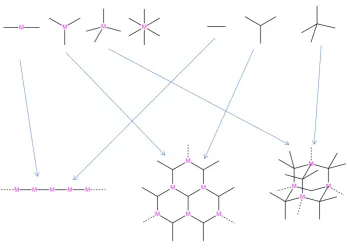
Figure 1.4.1: How one, two and three-dimensional metal-organic frameworks can be created using a range of generic secondary building units and linkers
The structures of metal-organic frameworks are often compared to those of zeolites since they may share similar extended networks with microporous structures. For example, ZIF-8 (ZIF – zeolitic imidazolate framework) shares the SOD-type framework as sodalite.28 The pore-size in metal-organic frameworks, however, is not limited to the microporous range (less than 2 nm in dimension); several metal-organic frameworks have been reported to have pores in the mesoporous range (2-50 nm).29-31 Several other
potential advantages of using metal-organic frameworks are apparent. During the synthesis of zeolites, additio al ole ules o io s a e ofte e ui ed to te plate the st ucture (and
which must be removed later), whereas metal-organic framework synthesis generally does not require additional reagents. Zeolite frameworks are either anionic (aluminosilicate) or neutral (siliceous). Metal-organic frameworks do not have this limitation – cationic, anionic and neutral frameworks have all been reported. Functionalisation of metal-organic
6 linker for a functionalised variant during the synthesis, or after synthesis to allow reactive groups to be added. By comparison, functionalisation of zeolites often requires harsh post-synthetic modification, high temperatures and long reaction times.32 The use of organic
linkers has additional benefits – hydrophilic and hydrophobic regions can be incorporated into a material, modifying the adsorption ability of the material. The use of linkers
containing chiral functional groups allows for the formation of chirally-selective
frameworks – a feat impossible using zeolites.33 In contrast to supramolecular chemistry,
the organic and inorganic components of metal-organic frameworks are covalently bonded, giving rise to thermally robust and chemically resistant materials. The applications of MOFs will be described in more detail below in Section 1.4.6.
1.4.2.
Synthesis of Metal-Organic Frameworks
7
Figure 1.4.2: Schematic diagram of an autoclave typically used in the laboratory to perform solvothermal synthesis
During the synthesis of metal-organic frameworks, solvent molecules and unreacted linker are often incorporated into the material as extra-framework entities. These can generally be removed through heating, reduced pressure, or substitution with other guest molecules to generate porous materials, a step often described as 'activation'.
Although ligand geometry and choice of metal have a huge effect on the metal-organic framework formed, equally important are the reaction conditions and reagents chosen. McKinstry et al. investigated the synthesis of MOF-5 and found that reaction temperature, duration of reaction and stirring affected both the purity and final product itself.38 Ahnfeldt et al. described changing the aluminium salt from the nitrate to the chloride leading to the formation of the unrelated frameworks, MIL-53(Al)-NH2 and CAU-1
8
1.4.3.
Isoreticular Synthesis of Metal-Organic Frameworks
[image:23.595.118.450.406.678.2]Assuming that the geo et ies of the li ke ole ule a d the etal joi t e ai consistent, the linker can be extended or modified and the metal substituted while maintaining the overall topology of the system. This can lead to the synthesis of large ranges of structurally similar analogous materials. The substitution of the metal or the linker during synthesis while maintaining the overall topology is known as isoreticular synthesis.40 This term was first coined by the Yaghi group to describe now the structure of MOF-5 could be modified using functionalised terephthalate (BDC) linkers or extended by using longer linkers such as biphenyldicarboxylate (BPDC) or terphenyldicarboxylate (TPDC). Another example of isoreticular synthesis is the use of functionalised linkers to give a family of materials with the same structure; this was shown for MIL-47(V) by Biswas et al. using six different functionalised terephthalates.41
9
Ma et al. described the synthesis of a series of mixed-component metal-organic
frameworks formulated ZnL2L ∙sol e t.43 These materials contain two different types of
ligands: one dicarboxylate and the other with bi-pyridyl functionality. Both of these ligands could be substituted for extended analogues with a 1500 % increase in free volume between the fumarate-bipyridine and the biphenyldicarboxylate- di(4-pyridyl)-1,4,5,8-naphthalenetetracarboxydiimide systems. Furthermore since materials constructed from pyridyl ligands alone are often thermally unstable the use of carboxylate co-ligands was found to increase the stability of the materials.
The concept of isoreticular synthesis involves complete substitution of one linker for another. A more selective approach would be partial substitution of the linker. If the uptake of the two or more linkers could be controlled, i.e. similar to the initial reactant ratio, it may be possible to vary the properties of the materially lineally with regards to the li ke atio. This i ed- o po e t app oa h to etal-organic synthesis may similar to the solid solutio app oa h see i inorganic chemistry, if both single ligand end-members
can be prepared, or may be analogous to doping if one ligand is added in small amounts compared to a predominant ligand.44It is o th oti g the te i olog i ed- o po e t when used with regards to ligands refers to ligands that share the same coordination modes with the metal, but with differing functionality.
The first example of a mixed-component metal-organic framework prepared in this way was described by Chun et al. who used a 1:1 ratio of 1,4-benzenedicarboxylate (BDC)
and tetramethyl-benzenedicarboxylate (TMBDC) with zinc and
1,4-diazabicyclo[2.2.2]octane (DABCO) to form [Zn2(BDC)(TMBDC)(DABCO)].45 This
10 allow for the incorporation of functionality that is difficult by conventional means. Yaghi and co-workers reported the incorporation of nitro-1,4-benzenedicarboxylate into the MOF-5 system.46 The synthesis of [Zn
4O(BDC)2.14(BDC-NO2)0.86] is particularly interesting – using nitro-1,4-benzenedicarboxylate as the sole linker does not form [Zn4O(BDC-NO2)3].
Mixed-component syntheses of metal-organic frameworks do not solely pertain to the substitution of linkers with substitution of metals also possible. This will be discussed later in section 1.5.
1.4.4.
Post-synthetic modification of metal-organic
frameworks
Owing to the relative robustness of metal-organic frameworks towards
temperature and solvents, reactions can be performed upon the framework itself. This is typically achieved via functional group interconversion on the bridging ligands. The first example of post-synthetic modification of metal-organic frameworks was reported by Seo
et al. who reported a two-dimensional homochiral metal-organic framework, POST-1, for
enantioselective separation and catalysis.47 Uncoordinated pyridyl groups in POST-1 were
converted to N-methylpyridinium ions through reaction with excess methyl iodide at room temperature. Since then, a wide range of post-synthetic modifications through covalent transformations have been reported including amide coupling,48 imine condensation,49
urea formation,50 N-alkylation,47 bromination,51 reduction,52 click reactions53,54 and
protonation.55 Post-synthetic modifications of metal-organic frameworks involving tandem reactions have also been reported.56-61
1.4.5.
Dynamic Metal-Organic Frameworks
Many metal-organic frameworks are rigid, displaying little to no changes in the framework dimensions after removal of solvent molecules. Some metal-organic
11 stimuli e.g. temperature, pressure and gas adsorption. This is accompanied by a reversible expansion or contraction of framework –a p ope t ofte efe ed to as eathi g a d su h ate ials that displa this p ope t te ed as d a i .7,62 This property is not
unique to metal-organic frameworks and has been reported for zeolites and
perovskites,63,64 but the ability of metal-organic frameworks to reversibly expand and contract far exceeds that of conventional solid state materials with atomic displacements of several Ångströms possible.7
This breathing effect is most pronounced in the MIL-88 family of isoreticular analogues, first reported by Férey and co-workers.65-67 The MIL-88 series,
[M3O(H2O)3(XDC)3]∙guest he e M = C III , Fe III , V III a d XDC = fu a ate MIL-88A),
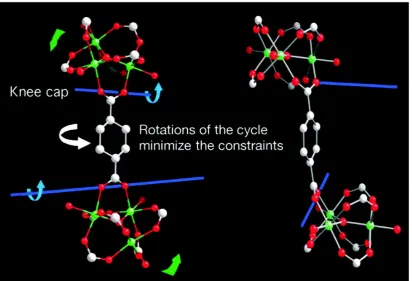
1,4benzenedicarboxylate (MIL88B), 2,6naphthalenedicarboxylate (MIL88C) and 4 -biphenyldicarboxylate (MIL-88D), display a massive breathing effect with an increase of up to 270 % seen upon solvent adsorption. This expansion is achieved through rotation of the linker molecule around the dicarboxylate group, leads to a massive increase in the porosity of the material (Figure 1.4.4). Such behaviour is also known for hydrated MIL-53,
[M BDC OH ]∙H2O, where dehydration of the material leads to a reversible expansion of
the structure by around 30 %.68 The dynamic breathing behaviour of MIL-53 will be
12
Figure 1.4.4: Rotation about the carboxylate group seen in MIL-88B66
1.4.6.
Potential Applications
The accessible porosity of metal-organic frameworks is the driving factor in research into potential applications for these materials. The well-defined porosity of metal-organic frameworks is a characteristic shared by zeolites and indeed many of the potential applications studied mirror this.
The ability of metal-organic frameworks to reversibly absorb molecules makes them candidates for adsorption and storage of molecules. Species such as gases, liquids, drug molecules, metals and inorganic nano-particles can be introduced into metal-organic frameworks.34,69,70 Sorption of gases is one of most widely studied area of metal-organic framework research. Metal-organic frameworks can adsorb considerable quantities of gases such as CH4, NO2, CO2, O2 and H2.42,71-75 The storage of hydrogen is being studied
13 The shape and definition of porosity of metal-organic frameworks make them ideal candidates for size-selective separation of mixtures of molecules, similar to zeolite systems. Selective adsorption based mainly on the molecular sieving effect has been confirmed in several metal-organic frameworks.80 This property has been used to separate both mixtures
of gases and liquids.81-83
A particular advantage of metal-organic frameworks is separation of mixtures based upon their interaction with the framework itself. Combined with the ability to modify the functionality of the linkers through isoreticular synthesis, there is the potential to
customise metal-organic frameworks with regards to the separation required. Separation of two or more components is achieved by exploiting the differing affinities of the
adsorbates to the framework itself. Gas-phase separations investigated include resolution of CO2 from CH4,71 C2H6 from C2H4,84 and MeOH over MeCN.85 Liquid-phase studies include
resolution of xylene mixtures and removal of nitrogen and sulphur heterocycles from fuel mixtures.86-89 The difficulties in separating xylene isomers arise from their similar boiling
points making techniques such as fractional distillation inefficient.90 Since techniques used
industrially such as fractional crystallisation are energy intensive, a simplistic adsorption based separation technique would be of benefit from a cost perspective. The MIL-53 series of materials display high selectivity for individual xylene isomers which has been used by Alaerts et al. and by El Osta et al. to resolve mixtures of xylene isomers into their separate components under close to ambient conditions.87,88 Use of chiral linkers affords the ability to separate racemic mixtures into their separate enantiomers.47,91,92
14 based upon the preferential adsorption of heavier isotopes when confined in very narrow spaces or channels. Chen et al. reported the ability of Zn3(bdc)3[Cu(Pyen)] (H2Pyen =
5-methyl-4-oxo-1,4-dihydro-pyridine-3-carbaldehyde) to preferentially adsorb hydrogen over deuterium onto unsaturated Cu(II) sites present in micro-pores.93 Similar behaviour was
seen for [Cu(4,4'-bipyridine)2(CF3SO3)2] by Noguchi et al..94 Deliberate engineering of
metal-organic framework to contain extremely narrow pores would have benefits for this and other applications.
The ability of metal-organic frameworks to adsorb molecules into their structure akes the suita le fo pote tial use as se so s. This a t pi all e o ito ed ia
changes in their photoluminscent properties. Li et al. reported the sensing of DMF by
[Eu2L3(H2O)4] (L=2′,5′-bis(methoxymethyl)-[1,1′:4′,1′′-terphenyl]-4,4′′-dicarboxylate) that
displayed a fast and strong response when exposed to DMF vapour.95 Wang et al. described how the luminescence of [Cd(NH2-BDC)(H2O)2] was quenched when exposed to
nitroaromatic compounds.96 The ability to detect nitroaromatics simply and effectively is of
great importance to detection of explosives.
1.5.
Heterometallic-Organic Frameworks
1.5.1.
Introduction
Heterometallic-organic frameworks (HMOFs) contain two or more metals incorporated into the same metal-organic framework. With the majority of isoreticular syntheses involve complete substitution of either the ligand or the metal, it stands to reason that a more selective process would involve the partial substitution of the substituents – a mixed-component approach.44 Mixed-ligand and mixed-metal MOFs could be considered to be
ole ula su stitutio al allo s he e the p ope ties of the aterial could be varied
15 unlike those of either single component materials. Incorporation of two or more metals into the same materials could lead to interesting optical, magnetic and catalytic properties for example.
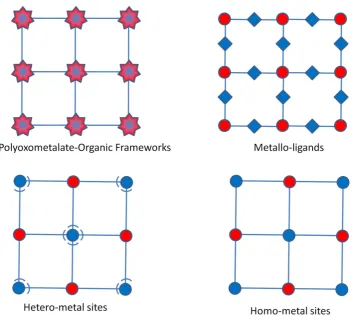
Heterometallic-organic frameworks can be separated into two main groups: extra-framework or intra-extra-framework. Extra-extra-framework HMOFs contain one metal incorporated into the framework with further metals existing in the pores of the materials in one of three ways: counter-ions, nano-particles or as polyoxometalate clusters (Figure 1.5.1). Intra-framework HMOFs have both metals incorporated into the framework as either the secondary building unit or into the linker itself (Figure 1.5.2).
16
Figure 1.5.2: Examples of intra-framework heterometallic-organic frameworks
1.5.2.
Intercalated Nano-Particles@MOFs
Because of their well defined and large pore structure, metal-organic frameworks can be used to stabilise and control the formation of metal nano-particles within their structure.97 The incorporation of active metal nano-particles into metal-organic
frameworks is relevant for a number of potential applications involving heterogeneous catalysis and gas storage.98,99 Intercalation is usually achieved via decomposition of volatile
organic precursors although it can be achieved using wetness impregnation, mechanical and co-precipitation methods.98,100-106 Schroeder
et al. described how Pd-Ru nanoparticles
were incorporated into MOF-5 using chemical vapour deposition.107 The presence of Pd-Ru
17 activity towards CO oxidation greater than that of either MIL-101 or the surface-mounted nano-particles allowing for efficient low temperature reactions.
1.5.3.
MOFs with counter-ions
Unlike zeolites which solely have anionic or neutral frameworks, metal-organic frameworks can also have cationic frameworks. In both of the non-neutral cases, counter-ions are required to balance this charge. In many cases, simple alkali metal catcounter-ions are present to neutralise anionic frameworks.109-111 Cation exchange has been reported for several metal-organic frameworks.112-114 Yaghi et al. reported the synthesis of MOF-235,
[Fe3O(BDC)6(H2O)3]FeCl4, an example of a cationic framework with a metallic counter-ion
([FeCl4]).115
1.5.4.
Intercalated Polyoxometalates
Polyoxometalates (POMs) are well known for their thermal stability, reversible reduction, magnetism, and luminescent properties.116 Incorporation of polyoxometalates into metal-organic frameworks may lead to interesting magnetic and catalytic properties. Ribeiro et al. described the encapsulation of [PW12O40]3- into the chromium analogue of
MIL-101 with the material showing promise as a catalyst for oxidative desulfurisation of S-heterocycles.117 Polyoxometalates can also be using as templating agent as was seen by
Bajpe et al. who reported the accelerated formation of HKUST-1 with encapsulation of
Keggin polyoxometalates within its pores.118
1.5.5.
Polyoxometalate-organic frameworks
Polyoxometalate-organic frameworks (POMOFs) are MOFs constructed using polyoxometalates as the secondary building units. The wide range of polyoxometalate structures and geometries comprised of a variety of metals combined with the
18 same framework and may lead to interesting catalytic and magnetic properties.119 POMOFs
can be linked in several ways, typically through transition/lanthanide metals and/or organic linkers.120 When heteropolyoxometallates are used as nodes then heterometallic MOFs are
produced. Zheng et al. reported a collection of frameworks that could be constructed using
a nickel-substituted phosphotungstate and a variety of carboxylate linkers including 1-D chains and 2-D layered structures depending on the geometry of the linker.121 Zhang et al.
described the synthesis of a POMOF constructed by [GeMo12O40]4- and [Ln(NMP)4(H2O)4]4+
(Ln = Ce(IV), Pr(IV) and Nd(III), NMP = N-methyl-2-pyrrolidone) with a 2-D porous structure that displayed photochromic behaviour upon radiation with UV light.122
1.5.6.
Metallo-ligands
The linkers of metal-organic frameworks can be designed as such to allow coordination of metals into the linker itself as well as coordinating to node metals. Zhou and co-workers reported the synthesis of PCN-224, a zirconium metal-organic framework containing metalloporphyrin-functionalised ligands which themselves include coordinated metals.123 Several analogous PCN-224 materials were synthesised containing divalent iron,
nickel and cobalt, and display high catalytic activity towards the CO2/propylene oxide
coupling reaction. Zou et al. described the reaction of metalated MH4TCPP (M = CoII, NiII, CuII and VIVO) (H
6TCPP = 5,10,15,20-tetracarboxyphenylporphyrin) with lead nitrate leading
to the formation of several metallo-ligand metal-organic frameworks with associated blue-shifts in the photoluminescence spectra.124 Wang
et al. reported the reaction of AlL3 (L=
3-(4-pyridyl)acetylacetonate) with MCl2 (M = Zn, Cd, Hg) where the choice of divalent metal
has pronounced effects on the topology of the metal-organic framework synthesised due to the coordination of the divalent metal by 3-(4-pyridyl)acetylacetonate.125 Incorporation
of the metal into the metallo-ligand can also be achieved post-synthesis. Kaye et al.
19 of (BDC)Cr(CO)3 organometallic species attached to the framework.126 Photolysis of the
Cr-CO bands in H2 or N2 environments led to the appearance of Cr(CO)2X2 species that
displayed enhanced thermal stability when compared to molecular analogues generated in frozen gas matrices or supercritical fluids. A recent review article on post-synthetic
metalation of metal-organic frameworks has been published by Evans et al..127
1.5.7.
Heterometallic sites
One-pot syntheses using two or more metals may result in the formation of a single-phase framework with both metals incorporated into the framework albeit at crystallographically distinct sites. This is particularly pronounced for reactions with metals from different groups. A commonly used method to achieving this is through use of a bifunctional ligand containing differing functional groups to act as hard and soft binding points for two different metals. An example of a ligand used is nicotinic acid that contains both carboxylate and pyridine functionality. This linker was used was used by Lian et al. to
synthesise a mixed neodymium-silver MOF containing neodymium-carboxylate subunits and silver centres, both solely coordinated to the carboxylate or pyridine functionality respectively.128 Examples include heterometallic metal-organic frameworks containing
transition and lanthanide metals,129-132 lanthanide and actinide metals,133,134 transition and
main group metals,135,136 lanthanide and alkali metals137 and, alkali and main group metals.138
1.5.8.
Homometallic sites
Unlike metal-organic frameworks containing heterometallic sites which are
20 single metal phases rather than a mixed phase, due to the differing reactivities of two, or more, metals in the chemical precursors used in synthesis, often as solvated cations. One way to overcome this is to use lanthanide metals where the reactivity across the series is similar,139-141 and the ability to easily create mixed-lanthanide porous materials has
pote tial i the fields of ole ula se si g a d ole ula a odes .142-144 Because of the
similarity of the two metals used in this situation, careful analysis is needed to prove that the two metals are truly present as mixtures within individual crystals.
Several mixed-metal organic frameworks have been reported. Munn et al. reported a range of [MII(BDC)(PNO)] (M = Mn, Co, Ni; PNO = pyridine N-oxide) analogues where solid solutions of composition [(M1-xMx)(BDC)(PNO)] were prepared and identified as single
phase by high resolution XRD.145 Yaghi and co-workers synthesised mixed-metal analogues
of MOF-74 containing 2, 4, 6, 8 and 10 different divalent metals with inclusion of all metals supported by elemental analysis with reproducible results suggesting true mixing of the material.146 Several mixed-metal analogues of MIL-53, M(BDC)(OH), have been reported,
some during the course of the work described in this thesis, and will be discussed in the following section.
1.6.
MIL-53 (M
III(OH)(BDC))
1.6.1.
Introduction
MIL-53, MIII(BDC)(OH,F), displays a range of interesting and unique properties including
21
1.6.2.
Structure and Properties
MIL-53 has the general chemical composition MIII(BDC)(OH) and consists of 1-D chains of
trans linked metal-oxide octahedra chains cross-linked to one another by
1,4-benzenedicarboxylate (BDC) dianions, Figure 1.6.1. In this simplest form of the material, the metal is trivalent and in an octahedral environment, coordinated to four oxygens from 1,4-benzenedicarboxylates and two from the trans bridging 2-hydroxyl groups. The
[image:36.595.117.520.301.601.2]interconnectivity of the 1-D metal-oxide chains with the BDC linkers leads to a structure with one-dimensional, diamond-shaped channels running parallel to the hydroxide chains.
22
1.6.3.
Effect of the Metal Centre on MIL-53 on its dynamic
behaviour
The first example of the MIL-53-type structure reported was in fact a related vanadium material, MIL-47, which contains bridging oxy groups (O2) along the inorganic
backbone of the structure, instead of hydroxyl (OH) groups.147 Now several analogues of the material have been reported, containing either solely transition metals (Cr,11 Fe,148 Sc,149) or Group 13 metals (Al,150 Ga,151 In152), and in these cases the metal is in the +3
oxidation state and the bridging groups are usually hydroxyls, or may be partially replaced by fluoride, as in the case of MIL-53(Fe),153 or completely replaced to give a fully fluorinated materials, as for MIL-53(Al).154 Upon heating the as-made MIL-53(VIII) in air to remove unreacted 1,4-benzenedicarboxylic acid from the pores, it undergoes irreversible oxidation of vanadium from 3+ to 4+ with associated dehydrogenation of the bridging hydroxyl groups to oxy groups to produce MIL-47. This leads to a permanently fully open structure of the type shown in Figure 1c. Later, utilising a careful activation technique, Leclerc et al.
isolated an evacuated vanadium MIL-53(VIII) analogue that did display reversible flexibility
upon heating, but only in the absence of air.155 Despite being isostructural in nature, the flexibility of the MIL-53 materials varies greatly from metal to metal.26 Typically, MIL-53
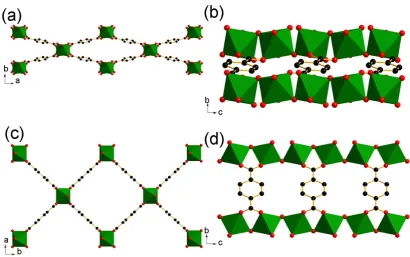
materials have a closed hydrated form at room temperature, Figure 1.6.2(a) and (b), and upon heating the extra-framework water is removed. At this point, the chromium and aluminium materials convert to a fully open, o LP la ge po e structure, Figure 1.6.2(c) and (d), with a large increase in pore volume, whereas the iron analogue undergoes a slight contraction of its structure.11,156 Even upon heating further, MIL-53(Fe) only slightly
expands, essentially remaining in the NP a o po e st u tu e. The chromium and aluminium materials return to the closed form upon cooling to 5 K,157 or upon
rehydration.11 The chromium material also shows 'superhydration', giving full expansion in
23 form.68 This differing behaviour found for isostructural materials cannot be easily explained
[image:38.595.114.525.187.444.2]using factors such as the strength of the hydrogen bonding from the metal backbone, the ionic radii of the metal or the electronic structure of the metal, and is still a matter of debate in the literature.
Figure 1.6.2: Two views of closed and open forms of the MIL-53 structure. The closed form (a) and (b) can be reversibly converted into the open form (c) and (d) by removal or addition of guest molecules, and in some cases by application of temperature and pressure. The structures were drawn using the published crystal structures of hydrated and dehydrated MIL-53(Cr), respectively.68
1.6.4.
Notable non-trivalent analogues of MIL-53
As noted for MIL-47(VIV), the MIL-53 framework is capable of stabilising valance states other than the usual trivalent state. In order to vary the oxidation state of the metal centres, either the bridging ligand must be substituted or a counter-ion introduced to balance the overall charge.
Substitution of the bridging hydroxyl ligand for the doubly anionic oxide group allows for the stabilisation of tetravalent vanadium in MIL-47(VIV). In a similar manner,
24 Fe BDC DMF hi h o tai s di ale t i o ith oo di ated eut al 2-N,N
-dimethylformamide. The use of pyridine-N-oxide ligands has facilitated the synthesis of MII(BDC)(PNO) (M = Co, Ni, Mn).145,158,159 These materials are analogous to MIL-53 and
incorporate metals that cannot be used to synthesise trivalent MIL-53, MIII(BDC)(OH).
An alternative to ligand substitution is to balance the charge using a counter-ion. This can be done pre- or post-synthesis. Medina et al. reported the synthesis of a mixed-valent MIL-53(Fe) analogue, [FeIII
0.5FeII0.5(BDC)(OH, F)]0.5-∙0.5DMA+, that contains alternating
FeIII / FeII along the metal-oxide chains.160The a io i f a e o k s ha ge is ala ed the presence of dimethylammonium (DMA+) cations. Heating of this material to 300 °C allows for removal of the dimethylammonium cations and subsequent oxidation of the framework to generate 53(Fe). Férey and co-workers introduced lithium into MIL-53(Fe) post-synthetically, reducing around 60 % of the trivalent iron to iron(II).109 Around 0.6 lithium atoms were incorporated per formula unit and the material studied for its potential use as a cathode in a Li-ion battery. It was found that the material could be reversibly charged and discharged, consistent with uptake / removal of Li+ and the
reversible reduction of FeIII into FeII.
1.6.5.
Mixed-Metal MIL-53
Atte pts to odif the fle i ilit a d a so ptio p ope ties of MIL-53 materials
have primarily focused on modifying the organic linkers with varying functional groups.161
However, a simpler and more intuitive method of modifying MIL-53 behaviour would be the synthesis of bimetallic MIL-53 materials. A mixed metal analogue,
[Fe0.28V0.72(OH)0.8BDC ]∙ . H2BDC∙(NH4)0.2, was reported by Whitfield et al.,162 but
mixed-25 metal MIL-53, but during the course of the work, some work appeared in the literature (see Chapter 3). MIL-53(Cr0.6Fe0.4) was reported by Nouar et al.163where the reactivity of the
Fe(III) salt during synthesis was tempered to match the slower reactivity of Cr(III) salts by instead using iron metal, while small amounts (1 % ) of Cr(III) were introduced into MIL-53(Al) by Mendt et al.164 Kozachuk et al. reported the synthesis of [Al1-xVx(BDC)(OH)1-xOx] (0
< x < 1), a solid solution of MIL-53(AlIII) and MIL-47(VIV).165 As the vanadium content was
i eased, the ate ial s igidit i eased, o siste t ith the su stitutio of h d o l
groups for oxide.
1.7.
Lanthanide-Organic Frameworks
1.7.1.
Introduction
Unlike metal-organic frameworks containing transition metals where the
framework geometry is primarily dependent on electronic configuration, lanthanides with their shielded f-orbitals act as hard acids making cation size the main factor in coordination. Coupled with the larger radii of lanthanide ions, with preferences for higher coordination number (7,8 and 9 are not uncommon),leading to novel framework structures not seen for the transition metals. The formation of isostructural lanthanide MOF series is also
26 The trivalent lanthanide ions are characterised by filling of the 4f orbitals from 4f0
(La3+) to 4f14 (Lu3+). These electronic [Xe]4fx configurations, (x = 0 – 14) can generate a wide range of luminescent emissions ranging from ultraviolet to near infrared. Lanthanide electronic transitions are forbidden by parity (Laporte) selection rules, leading to weak absorbance and low quantum yields. This problem can be overcome by using ligands that can participate in energy transfer processes with the lanthanide ion. This is known as
lu i es e e se sitisatio o the a te a effe t a d has ee e ploited i se e al
lanthanide-organic frameworks.173,174
1.7.2.
Diversity of Structures
Lanthanide metals have several properties that make them more difficult to form metal-organic frameworks with predictable structures. Bonding in f-block metals is predominately ionic in character, leading to coordination geometries dependent on the steric demands of the ligands themselves rather than the directive electronic effects driving coordination geometry in transition metals.4 Owing to the vast range of lanthanide-organic frameworks reported, only the structures of materials containing heavier lanthanides coordinated by 1,4-benzenedicarboxylate will be discussed here as this is most relevant to the work described in this thesis These lanthanide-organic frameworks are of particular use to this work for their use in identifying new materials and their decomposition products.
Carboxylate-based ligands are of particular use in synthesis of lanthanide-organic frameworks due to the oxophilic nature of the lanthanide cations. The range of potential binding modes relates well to the lack of any preferential coordination geometry of 4f
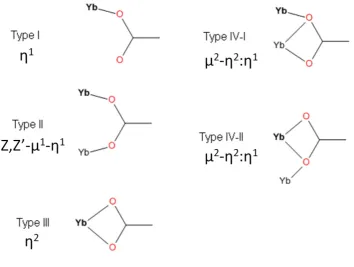
etals. Ca o late liga ds a oo di ate si gl η1 o a t i a idgi g ),)- 1η1) or
helati g η2) manner (Figure 1.7.1). A single carboxylate can act in a simultaneous bridging
a d helati g i di g ode 2-η2:η1). For simplicity, these coordination modes have been
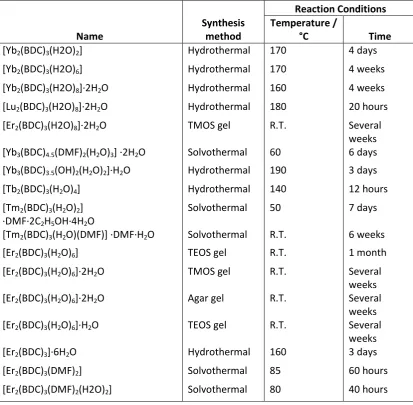
27 A list of structurally relevant lanthanide-BDC frameworks that have been reported in the literature and structurally investigated is given in Table 1.7.1 with the variety of reaction conditions required for synthesis given in Table 1.7.2. This considers the later lanthanides which are relevant for the work in this thesis.
28
Table 1.7.1 : Connectivity and coordination of selected lanthanide (Ln)-BDC frameworks reported in the literature. Connectivity about Ln refers to the number of coordination points about the Ln centre and how the ligands coordinate to the metal centre. The sum of coordination points from singly and doubly coordinating ligands allows the coordination number (C.N.) to calculated
Name
Space group
Ln
C.N. Connectivity about Ln Ref
[Yb2(BDC)3(H2O)2] �̅ 6 1(I), 5(II) 140
7 5(II), 2H2O
[Yb2(BDC)3(H2O)6] �̅ 8 1(I), 2(II), 1(III), 3H2O 9,140
[Yb2(BDC)3(H2O)8]∙2H2O �̅ 8 2(I), 1(III), 4H2O 140
[Lu2(BDC)3(H2O)8]∙2H2O �̅ 8 2(I), 1(III), 4H2O 174
[Er2(BDC)3(H2O)8]∙2H2O �̅ 8 2(I), 1(III), 4H2O 175
[Yb3(BDC)4.5(DMF)2(H2O)3]
∙ H2O
�̅ 8 3(II), 2(III), H2O 176
8 5(II), 2H2O, DMF
8 4(II), 1(IV-I), 1(IV-II), DMF [Yb3(BDC)3.5(OH)2(H2O)2]∙H2O � 8 4(II), 1(IV-II), 1µ3-OH, H2O 177
8 3(II), 2(IV-I), 3µ3-OH,
8 3(II), 1(IV-II), 2µ3-OH, H2O
[Tb2(BDC)3(H2O)4] �̅ 8 6(II), 2H2O 178
[Tm2(BDC)3(H2O)2]
·DMF·2C2H5OH·4H2O
� / 7 6(II), H2O 179
[Tm2(BDC)3(H2O)(DMF)]
∙DMF·H2O
�̅ 7 6(II), H2O 179
7 6(II), DMF
[Er2(BDC)3(H2O)6] �̅ 8 3(I), 1(III), 3H2O 180
[Er2(BDC)3(H2O)6]∙ H2O � / 8 1(I), 2(II), 1(III), 3H2O 175
[Er2(BDC)3(H2O)6]∙ H2O � / 8 1(I), 2(II), 1(III), 3H2O 175
[Er2(BDC)3(H2O)6]∙H2O �̅ 8 1(I), 2(II), 1(III), 3H2O 175
8 2(II), 1(III), 4H2O
[Er2(BDC)3]∙ H2O � 8 1(I), 5(II), 2H2O 181
7 5(II), 2H2O
7 6(II), H2O
[Er2(BDC)3(DMF)2] � / 7 6(II), DMF 182
29
Table 1.7.2: Reaction conditions used to synthesise lanthanide-organic frameworks given in Table 1.7.1
Name
Synthesis method
Reaction Conditions Temperature /
°C Time
[Yb2(BDC)3(H2O)2] Hydrothermal 170 4 days
[Yb2(BDC)3(H2O)6] Hydrothermal 170 4 weeks
[Yb2(BDC)3(H2O)8]∙ H2O Hydrothermal 160 4 weeks
[Lu2(BDC)3(H2O)8]∙ H2O Hydrothermal 180 20 hours
[Er2(BDC)3(H2O)8]∙ H2O TMOS gel R.T. Several
weeks [Yb3(BDC)4.5(DMF)2(H2O)3] ∙ H2O Solvothermal 60 6 days
[Yb3(BDC)3.5(OH)2(H2O)2]∙H2O Hydrothermal 190 3 days
[Tb2(BDC)3(H2O)4] Hydrothermal 140 12 hours
[Tm2(BDC)3(H2O)2]
·DMF·2C2H5OH·4H2O
Solvothermal 50 7 days
[Tm2(BDC)3(H2O DMF ] ∙DMF∙H2O Solvothermal R.T. 6 weeks
[Er2(BDC)3(H2O)6] TEOS gel R.T. 1 month
[Er2(BDC)3(H2O)6]∙ H2O TMOS gel R.T. Several
weeks [Er2(BDC)3(H2O)6]∙ H2O Agar gel R.T. Several
weeks [Er2(BDC)3(H2O)6]∙H2O TEOS gel R.T. Several
weeks
[Er2(BDC)3]∙ H2O Hydrothermal 160 3 days
[Er2(BDC)3(DMF)2] Solvothermal 85 60 hours
[Er2(BDC)3(DMF)2(H2O)2] Solvothermal 80 40 hours
Zehnder et al. reported a series of [Yb2(BDC)3(H2O)x] (x = 2, 6, 8), illustrating the
wide range of structures possible with a simple set of components.141 These three
lanthanide-organic frameworks exhibit structurally unrelated frameworks with [Yb2(BDC)3(H2O)2] assembling in a 3-D network with two crystallographically distinct
ytterbium positions, [Yb2(BDC)3(H2O)6] forming 2-D layers linked by hydrogen bonds and
[Yb2(BDC)3(H2O)8] consisting of 1-D chains that interact via hydrogen bonds. Erbium and
lutetium analogues of [Yb2(BDC)3(H2O)8] have also been reported.175,185
8-30 coordinated ytterbium in three distinct coordination environments.177 Weng
et al. reported
the synthesis of [Yb3(BDC)3.5(OH)2(H2O)2]∙H2O that also contains three unique coordination
e i o e ts a d the p ese e of idgi g 3-OH, rarely seen in lanthanide-organic
frameworks.178
Analogous lanthanide-organic frameworks sharing the same framework connectivity albeit with differing coordinating solvents are seen for
[Tm2(BDC)3(H2O)2]·DMF·2C2H5OH·4H2O, [Tm2(BDC)3(H2O DMF ]∙DMF·H2O,186 and
[Er2(BDC)3(DMF)2].183 These three materials all share the same connectivity with 1-D
lanthanide-carboxylate chains cross-linked by BDC to form 1-D diamond shaped channels. They differ, however, in the ratio of water to DMF with
[Tm2(BDC)3(H2O)2]·DMF·2C2H5OH·4H2O and [Er2(BDC)3(DMF)2] solely coordinating H2O and
DMF respectively and [Tm2(BDC)3(H2O DMF ]∙DMF·H2O coordinating water or DMF in a 1:1
ratio.
1.7.3.
Applications of lanthanide-organic frameworks
The combination of inherent porosity and luminescent properties in lanthanide-organic frameworks have been shown to sensing of small lanthanide-organic molecules,187,188 anions,189
metal ions,112,190 nitro-aromatics,96,191,192 dyes,193,194 and polyoxometalates195 via changes in their photoluminescence spectra.
31
al. who doped ZJU-1, [La2(PDA)3(H2O)5] (PDA = pyridine-2,6-dicarboxylate), with small
amounts of europium and terbium to form a series of colour tuneable lanthanide-organic frameworks.196 Two of these doped materials displayed emissions close to the CIE
Co issio I te atio ale de l E lai age h o ati it alues fo pu e hite light.
The emissive profile of two lanthanides was used by Cui et al. to form a luminescent thermometer using the mixed-lanthanide [(Eu0.0069Tb0.9931)2(DMBDC)3(H2O)4]·DMF·H2O
(DMBDC = 2,5-methoxy-1,4-benzenedicarboxylate).197 At 10 K, the intensities of the 5D 4→ 7F
5 (Tb3+, 545 nm) and 5D0→ 7F2 (Eu3+, 613 nm) transitions are approximately equal in
intensity. As the temperature increases, the europium emissions range constant whereas the terbium emissions diminish which leads to a gradual change in colour of the emissive profile from green to yellow to red over the range 10 to 300 K.
1.8.
Aims of this work
The objective of this thesis were to use various X-ray diffraction techniques and other complementary studies to investigate the synthesis and crystallisation and properties of mixed-metal MIL-53, lanthanide-organic frameworks and other MOFs. MIL-53 can be synthesised using a range of metals and the properties of this material depend greatly on the metal used. Although the properties of single-metal MIL-53 have been extensively investigated, at the start of the work described herein, very little work had been done on mixed-metal analogues. It was hoped that by preparation of mixed-metal MIL-53 analogues their properties could be tuned from the single-metal materials. The synthesis and
32 Lanthanide-organic frameworks allow the combination of the unique properties of the lanthanide series with those of porous frameworks. Investigation of synthesis and thermal treatments are required to optimise the properties of these materials. Small changes to the synthesis of these materials can greatly change both the structure and the composition of the lanthanide-organic framework synthesised. Crystallisation of these materials can be investigated using both in situ and ex situ methods and may help to rationalise why solvent and temperature have such an effect on the lanthanide-organic framework formed. The combined use of temperature-resolved XRD and thermogravimetric analysis allows for greater understanding of the thermal decomposition of these materials. An extensive study of two lanthanide-organic frameworks formed through mediation of the reaction solvent is presented in this thesis.
Some of the work presented here in the thesis was performed as part of the MACADEMIA project (MOFS as Catalysts and Adsorbants: Discovery and Engineering of Mate ials fo I dust ial Appli atio s . MACADEMIA as pa t of the Eu opea Co u it s
Seventh Framework Programme (FP7/2007-2013). The Walton research group at the University of Warwick were responsible for the synthesis and characterisation of new MOF materials, particularly using in situ X-ray diffraction methods. Characterisation of these
33
1.9.
References
(1) Chae, H. K.; Siberio-Perez, D. Y.; Kim, J.; Go, Y.; Eddaoudi, M.; Matzger, A. J.; O'Keeffe, M.; Yaghi, O. M. Nature2004, 427, 523.
(2) Furukawa, H.; Go, Y. B.; Ko, N.; Park, Y. K.; Uribe-Romo, F. J.; Kim, J.; O'Keeffe, M.; Yaghi, O. M. Inorg. Chem.2011, 50, 9147.
(3) Schröder, M. Functional metal-organic frameworks : gas storage,
separation and catalysis; Springer: Heidelberg, 2010.
(4) Batten, S. R.; Neville, S. M.; Turner, D. R. Coordination polymers : design,
analysis and application; RSC Pub.: Cambridge, 2009.
(5) Farrusseng, D. Metal-organic frameworks : applications from catalysis to
gas storage; Wiley-VCH: Weinheim, 2011.
(6) Fu uka a, H.; Co do a, K. E.; O Keeffe, M.; Yaghi, O. M. Science2013, 341.
(7) Schneemann, A.; Bon, V.; Schwedler, I.; Senkovska, I.; Kaskel, S.; Fischer, R. A. Chem. Soc. Rev.2014, 43, 6062.
(8) Batten, S. R.; Champness, N. R.; Chen, X. M.; Garcia-Martinez, J.; Kitagawa, S.; Ohrstrom, L.; O'Keeffe, M.; Suh, M. P.; Reedijk, J. Pure Appl. Chem.2013, 85, 1715.
(9) Feng, S. Acta Crystallogr., Sect. E: Struct. Rep. Online2009, 66, m33. (10) Yaghi, O. M.; O'Keeffe, M.; Ockwig, N. W.; Chae, H. K.; Eddaoudi, M.; Kim, J.
Nature2003, 423, 705.
(11) Serre, C.; Millange, F.; Thouvenot, C.; Nogues, M.; Marsolier, G.; Louer, D.; Ferey, G. J. Am. Chem. Soc.2002, 124, 13519.
(12) Katz, M. J.; Brown, Z. J.; Colon, Y. J.; Siu, P. W.; Scheidt, K. A.; Snurr, R. Q.; Hupp, J. T.; Farha, O. K. Chem. Commun.2013, 49, 9449.
(13) Mohideen, M. I. H.; Xiao, B.; Wheatley, P. S.; McKinlay, A. C.; Li, Y.; Slawin, A. M. Z.; Aldous, D. W.; Cessford, N. F.; Düren, T.; Zhao, X.; Gill, R.; Thomas, K. M.; Griffin, J. M.; Ashbrook, S. E.; Morris, R. E. Nat Chem2011, 3, 304.
(14) Cheng, X.; Zhang, A.; Hou, K.; Liu, M.; Wang, Y.; Song, C.; Zhang, G.; Guo, X.
Dalton Trans.2013, 42, 13698.
(15) Cheetham, A. K.; Rao, C. N. R.; Feller, R. K. Chem. Commun.2006, 4780. (16) Covington, A. D. Chem. Soc. Rev.1997, 26, 111.
(17) Zuckerman, J. J.; Hagen, A. P. Inorganic reactions and methods; Deerfield
Beach.
(18) Hofmann, K. A. K. Z. Z. Anorg. Chem.1897, 15, 204.
(19) Rayner, J. H.; Powell, H. M. J. Chem. Soc.1952, 319.
(20) Hoskins, B. F.; Robson, R. J. Am. Chem. Soc.1989, 111, 5962.
(21) Hoskins, B. F.; Robson, R. J. Am. Chem. Soc.1990, 112, 1546.
(22) Abrahams, B. F.; Hoskins, B. F.; Liu, J. P.; Robson, R. J. Am. Chem. Soc.1991,
113, 3045.
(23) Robson, R.; Abrahams, B. F.; Batten, S. R.; Gable, R. W.; Hoskins, B. F.; Liu, J. P. ACS Symp. Ser.1992, 499, 256.
(24) Yaghi, O. M.; Li, G. M.; Li, H. L. Nature1995, 378, 703.
(25) Tranchemontagne, D. J.; Mendoza-Cortes, J. L.; O'Keeffe, M.; Yaghi, O. M.
Chem. Soc. Rev.2009, 38, 1257.
(26) Czaja, A. U.; Trukhan, N.; Muller, U. Chem. Soc. Rev.2009, 38, 1284. (27) Park, K. S.; Ni, Z.; Côté, A. P.; Choi, J. Y.; Huang, R.; Uribe-Romo, F. J.; Chae, H. K.; O Keeffe, M.; Yaghi, O. M. Proc. Natl. Acad. Sci. U. S. A.2006, 103, 10186.
(28) Park, Y. K.; Choi, S. B.; Nam, H. J.; Jung, D.-Y.; Ahn, H. C.; Choi, K.; Furukawa, H.; Kim, J. Chem. Commun.2010, 46, 3086.
(29) Lan, Y.-Q.; Jiang, H.-L.; Li, S.-L.; Xu, Q. Adv. Mater. (Weinheim, Ger.)2011,
34 (30) Plaza, M. G.; Ribeiro, A. M.; Ferreira, A.; Santos, J. C.; Hwang, Y. K.; Seo, Y. K.; Lee, U. H.; Chang, J. S.; Loureiro, J. M.; Rodrigues, A. E. Microporous Mesoporous Mater.
2012, 153, 178.
(31) Senapati, S.; Zimdars, J.; Ren, J.; Koller, H. J. Mater. Chem.2014, 2, 10470.
(32) Pardo, E.; Train, C.; Gontard, G.; Boubekeur, K.; Fabelo, O.; Liu, H. B.; Dkhil, B.; Lloret, F.; Nakagawa, K.; Tokoro, H.; Ohkoshi, S.; Verdaguer, M. J. Am. Chem. Soc.2011, 133, 15328.
(33) Ferey, G. Chem. Soc. Rev.2008, 37, 191.
(34) Forster, P. M.; Thomas, P. M.; Cheetham, A. K. Chem. Mater.2002, 14, 17. (35) Garay, A. L.; Pichon, A.; James, S. L. Chem. Soc. Rev.2007, 36, 846.
(36) Zacher, D.; Shekhah, O.; Woell, C.; Fischer, R. A. Chem. Soc. Rev.2009, 38, 1418.
(37) McKinstry, C.; Cussen, E. J.; Fletcher, A. J.; Patwardhan, S. V.; Sefcik, J. Cryst.
Growth Des.2013.
(38) Ahnfeldt, T.; Gunzelmann, D.; Loiseau, T.; Hirsemann, D.; Senker, J.; Ferey, G.; Stock, N. Inorg. Chem.2009, 48, 3057.
(39) Yaghi, O. M. Abstr. Pap. Am. Chem. Soc.2002, 223, A35.
(40) Biswas, S.; Vanpoucke, D. E. P.; Verstraelen, T.; Vandichel, M.; Couck, S.; Leus, K.; Liu, Y.-Y.; Waroquier, M.; Van Speybroeck, V.; Denayer, J. F. M.; Van Der Voort, P.
J. Phys. Chem. C2013, 117, 22784.
(41) Eddaoudi, M.; Kim, J.; Rosi, N.; Vodak, D.; Wachter, J.; O'Keeffe, M.; Yaghi, O. M. Science2002, 295, 469.
(42) Ma, B.-Q.; Mulfort, K. L.; Hupp, J. T. Inorg. Chem.2005, 44, 4912. (43) Burrows, A. D. CrystEngComm2011, 13, 3623.
(44) Chun, H.; Dybtsev, D. N.; Kim, H.; Kim, K. Chem. Eur. J.2005, 11, 3521.
(45) Deng, H. X.; Doonan, C. J.; Furukawa, H.; Ferreira, R. B.; Towne, J.; Knobler, C. B.; Wang, B.; Yaghi, O. M. Science2010, 327, 846.
(46) Seo, J. S.; Whang, D.; Lee, H.; Jun, S. I.; Oh, J.; Jeon, Y. J.; Kim, K. Nature
2000, 404, 982.
(47) Smalley, A. P.; Reid, D. G.; Tan, J. C.; Lloyd, G. O. CrystEngComm2013, 15, 9368.
(48) Rood, J. A.; Noll, B. C.; Henderson, K. W. Main Group Chem.2009, 8, 237.
(49) Bernt, S.; Guillerm, V.; Serre, C.; Stock, N. Chem. Commun.2011, 47, 2838.
(50) Sun, F.; Yin, Z.; Wang, Q.-Q.; Sun, D.; Zeng, M.-H.; Kurmoo, M. Angew. Chem., Int. Ed.2013, 52, 4538.
(51) Morris, W.; Doonan, C. J.; Furukawa, H.; Banerjee, R.; Yaghi, O. M. J. Am.
Chem. Soc.2008, 130, 12626.
(52) Wang, Z.; Liu, J.; Arslan, H. K.; Grosjean, S.; Hagendorn, T.; Gliemann, H.; Braese, S.; Woell, C. Langmuir2013, 29, 15958.
(53) Zhu, W.; He, C.; Wu, X.; Duan, C. Inorg. Chem. Commun.2014, 39, 83.
(54) Wang, X.-S.; Ma, S.; Sun, D.; Parkin, S.; Zhou, H.-C. J. Am. Chem. Soc.2006, 128, 16474.
(55) Arnanz, A.; Pintado-Sierra, M.; Corma, A.; Iglesias, M.; Sánchez, F. Adv. Synth. Catal.2012, 354, 1347.
(56) Burrows, A. D.; Keenan, L. L. CrystEngComm2012, 14, 4112. (57) Chen, C.; Allen, C. A.; Cohen, S. M. Inorg. Chem.2011, 50, 10534.
(58) Hindelang, K.; Vagin, S. I.; Anger, C.; Rieger, B. Chem. Commun.2012, 48,
2888.
(59) Jiang, D.; Keenan, L. L.; Burrows, A. D.; Edler, K. J. Chem. Commun.2012, 48, 12053.