Bachelor Thesis: Changing Stress Mindsets
Marie Miebert June, 2019
University of Twente, Enschede
Department of Behavioural, Management and Social Sciences Subject: Psychology
Abstract
Stress mindset describes people’s believe about stress, which may be either that stress has positive consequences, called a stress-is-enhancing (SIE) mindset, or that stress has negative consequences, called a stress-is-debilitating (SID) mindset.. The purpose of this study was to examine whether stress mindsets can be changed as well as to investigate the influence of self-esteem on the relationship between stress mindset and well-being. It was hypothesized that stress mindsets can be changed. Further, it was hypothesized that a SIE mindset is related to increased well-being, which is mediated by self-esteem, while a SID mindset is related to lower well-being mediated through self-esteem. Respondents were randomly assigned to one of three condition groups: SIE, SID or control. In the timespan of about one week, participants (N = 75) filled in a pre- and a post-test online survey and the SIE and SID condition watched three short video clips with either positive or negative factual information about stress. The control group received filler questions instead of the videos. Apart from questions concerning the demographic data, respondents answered questionnaires regarding their stress mindset, well-being and self-esteem levels. After the video manipulation participants in the SIE condition developed more of a SIE mindset compared to the SID and control condition. This indicates that the intervention was effective in the SIE condition in changing the mindset about stress. In contrast to expectations, the results showed no significant effect of both a SIE and a SID mindset on well-being that was mediated by self-esteem. A significant effect of changes in self-esteem on changes in well-being has been found in the SID but not in the SIE condition. Future research should focus on examining if the stress mindset moderates the relationship between changes in self-esteem and changes in well-being.
Introduction
A large body of research has pointed out the negative aspects of stress, and hence explained approaches to decrease or cope with stress. As a result, most approaches aim at preventing and lowering stress, ignoring the fact that some people may not be in a position to decrease the degree of stress they encounter in their daily lives, which may lead to more stress subsequently (Crum, Salovey, & Achor, 2013). Nevertheless, even though stress has originally been regarded negatively, current studies on stress have illuminated the positive impact and assets of stress (e.g. Crum, et al., 2013; Crum, Akinola, Martin, & Fath, 2017).
Even though stress has been defined in various ways (e.g. Lazarus & Folkman, 1984), stress can largely be regarded as the experience of encountering or anticipating challenges within one’s target-oriented attempts (Caver & Connor-Smith, 2010). According to an evolutionary perspective, the stress response reinforces mental and physiological efficiency to deal with approaching demands and allow survival (Sapolsky, 1996). When a person is facing a challenge, physiological excitation is increased and focus is sharpened to cope with the particular demand (Crum et al. 2013). In their research on defensive pessimism, Norem and Cantor (1986) indicate that people can successfully utilize stress as motivation for anticipatory solution finding by contemplating and preparing for all thinkable situations. However, this proactive approach can go wrong, triggering anxiety and concern, but with a particular stress mindset, the stress response can be directed effectively and profitable, placing body and brain in an ideal state for performance (Crum et al. 2013).
Stress Mindset
The mindset about stress has been shown improve one’s stress response. Dweck (2008) defines mindset as the cognitive structure that selectively encodes and arranges information, consequently organising people to an individual way of experience and comprehension, leading to according reactions. Increasing scientific evidence indicates that mindset is not merely related to outcomes in areas of intelligence (Dweck, 2008) and aging (Levy & Myers, 2004), but also forms the stress response (Crum et al., 2013).
physiological reactions and more approach-directed behaviours when encountering stress. Particularly, respondents with a SIE mindset exhibited moderate cortisol responsiveness and were more open for feedback that those who reported having a SID mindset when confronted with a severely demanding situation. In addition to that, Crum et al. (2013) proved that video interventions can have an effect on performance and well-being, as participants presented with the enhancing effects of stress established a SIE mindset and also stated increased work productivity and improved states of health.
The findings from Crum et al. (2013) suggest that individuals can be influenced with an intervention to accept a SIE mindset. Consistent with research indicating that mindsets can be altered relatively easy just by exposing people to diverse information (e.g. Blackwell, Trzesniewski, & Dweck, 2007; Dweck, 2008; Paunesku et al., 2015; Tamir, John, Srivastava, & Gross, 2007; Walton, 2014), stress mindsets can be transformed by letting persons watch a series of three videos of approximately three minutes length respectively, familiarizing them to either the debilitating or enhancing consequences of stress (Crum et al., 2013). The impacts of video interventions on stress mindset are in line with studies more generally emphasizing the long-term effects of interventions by means of videos or articles to change mindset in other areas such as aging (Levy & Myers, 2004), intelligence (Blackwell et al., 2007), emotion regulation (Tamir et al., 2007) and belongingness (Walton, 2014).
Changing Stress mindsets have been associated with positive outcomes and can be changed, which might suggest that changing the mindset about stress could have desirable outcomes in relation to well-being. Well-being describes the satisfaction with one’s own life in the sense of functioning as well as feeling well (Huppert & Cooper, 2014). Crum et al. (2013) found that a SIE mindset was associated with better health, whereas a SID mindset was associated with more health problems. Moreover, the findings by Levy and Myers (2004) suggest that compared to people with a SID mindset, people with a SIE mindset live longer and are more often involved in activities that are beneficial for their well-being, such as, exercising, eating healthy and regular medical consultations (Levy & Myers, 2004; Levy, Slade, Kunkel, & Kasl, 2002).
Self-Esteem
well-being (Diener & Diener, 1995), mental adaptation (Zeigler-Hill & Wallace, 2012) and perseverance in challenging tasks (Di Paula & Campbell, 2002).
There is considerable scientific evidence that low esteem, as opposed to high self-esteem, is strongly related to negative consequences such as physical and psychological health problems. For example, past research indicates that low self-esteem is associated with depression (Dori & Overholser, 1999; Rice, Ashby, & Slaney, 1998), depressed moods (Patterson & Capaldi, 1992), hopelessness, suicidal tendencies and attempts (Overholser, Adams, Lehnert, & Brinkman, 1995). Moreover, the work from Trzesniewski et al. (2006) suggests that low self-esteem in adolescents poses a risk for a reduced physical and mental health in adulthood. In their study, participants with a low self-esteem displayed an increased body mass, indicated a low perceived health as adults and were more prone to develop an anxiety or major depression disorder or a tobacco addiction than respondents with high self-esteem. Additionally, Lu, Li, Wang, Song, and Liu (2018) found an association between higher self-esteem and better physical health. Finally, Baumeister, Campbell, Krueger and Vohs (2003) discovered a relationship between high self-esteem and among others coping, satisfaction, mental health, happiness and success.
It is worth mentioning that previous meta-analyses let assume that self-esteem is changeable by psychological interventions. For instance, meta-analytic reviews indicate that self-esteem can be increased through the application of interventions (e.g. O’Mara, Marsh, Craven, & Debus, 2006). Furthermore, a meta-analysis from Haney & Durlak (1998) demonstrated that interventions for the improvement of self-esteem were as effective as other programs in altering different functional areas such as educational achievement and behaviours. Also, different school interventions directed to enhance mental health that have included the subject of self-esteem, served as successful prevention actions for problem behaviour (Flay & Ordway, 2001), eating disorders (O'Dea & Abraham, 2000), and decreasing anxiety, drug abuse and antisocial behaviour (Short, 1998).
Current Research
[image:6.595.67.491.343.465.2]The research question of the present study aimed to examine how the stress mindset affects people’s self-esteem and how this is related to well-being. The goal of this research was to find out whether self-esteem mediated the relationship between stress mindset and well-being. Figure 1 shows the theoretical model of this research. First, it was hypothesized, that the video manipulation will have an effect on the stress mindset. Participants in the SIE condition were expected to report significantly higher stress mindset levels after the video manipulation (H1). Participants in the SID condition were expected to report significantly lower stress mindset levels after the video manipulation (H2). Secondly, it was hypothesised that the SIE mindset will be related to high well-being and this is mediated by high self-esteem. In contrast, the SID mindset will be related to low well-being and this is mediated by low self-esteem (H3).
Figure 1. Mediation model of the research.
Method Procedure and Design
The study included a between-subjects pre-test-post-test design with three conditions: SIE, SID and control. Respondents have been recruited through convenience sampling. Participants could either apply for the study through SONA-systems or through opening a link to the Qualtrics survey that was distributed by the researchers over social media. The research was ethically authorized by the BMS (Behavioural, Management and Social Sciences) Ethics Committee of the University of Twente1.
In this study, participants first encountered an informed consent which needed to be accepted via mouse click to start the questionnaire. In the beginning of the survey, demographic data was inquired. After that, participants were asked to answer questions about
1 Request number: 190356. Stress Mindset SIE/ SID
Self-Esteem
their stress mindset and their well-being. At the end of the survey participants were randomly assigned into one of three groups. In the SIE condition participants were asked to watch a video of approximately three minutes length highlighting the enhancing effects of stress. Participants in the SID condition received approximately 3-minute videos emphasizing the damaging characteristics of stress. The videos were composed of music, words and suitable images. The control group received a few filler-questions, which took about three minutes to answer. Three days after completing the first survey, respondents of the SIE and SID condition received an e-mail and were asked to watch a second video inducing either a SIE or SID mindset. Finally, another three days later, participants of all three conditions received an e-mail and were either asked to watch a SIE or a SID video and to answer a questionnaire after that, while the control group is only asked to answer the questionnaire. Answering the questions of the first and the third survey took approximately 20-30 minutes. Participation took approximately one hour in total to complete the study. Respondents applying through SONA-systems, the online application system of the University of Twente, received SONA credit points as a reward for their participation. The period of data collection started on the 9th of April and was finished on the 5th of May.
Participants
For this research seventy five participants with a larger proportion of female (70.7%) than male (29.3%) respondents and an age range from 18 to 29 years (M = 21.89, SD = 2.45) have been recruited. The sample was primarily German (84.0% German, 9.3% Dutch and 6.7% other) and students (94.7% students and 5.3% employed). Most respondents weresingle or unmarried (98.7%) and only 1.3 percent were married. Participation in the study required to be at least in the age of 18 years and master sufficient English skills at the time of participating in the study.
Videos and Questionnaires
In the SID condition, participants watched three videos of approximately three minutes length focussing on the negative consequences of stress. In detail, they watched videos highlighting the negative effects of stress on learning and growth and cognitive performance. The videos displayed statements such as “The high alert system may be useful in the short-term but over time it threatens your well-being”. Moreover, pictures with stressful situations and negative health outcomes were shown to the participants with intense background music. Stress Mindset Measurement
The Stress Mindset Measurement (SMM) has been used to measure the stress mindset (Crum et al., 2013). Respondents were asked to answer eight items on a five-point Likert Scale ranging from 0 (strongly disagree) to 4 (strongly agree). An example item of the SMM is: “Experiencing stress facilitates my learning and growth.” Crum et al. (2013) demonstrated the SMM to be a valid and reliable measure. In this study, a Cronbach’s alpha of .78 was found in the pre-test, indicating a high internal consistency. In the post-test a Cronbach’s alpha of .88 was found.
Mental Health Continuum Short Form
To measure the participants’ well-being the Mental Health Continuum Short Form (MHC–SF) has been used (Keyes, 2009). The scale consists of 14 items, measuring the emotional (item 1-3), social (item 4-8) and psychological (item 9-14) well-being of its respondents. Participants rated each item on a six-point Likert Scale from 0 (never) to 5 (almost every day). An example question would be “Please answer the following questions about how you have been feeling during the past week: Happy.” Several studies have indicated that the MHC-SF is a valid and reliable measure with a high internal consistency (Keyes, 2005b, 2006; Keyes et al., 2008; Lamers Westerhof, Bohlmeijer, ten Klooster, & Keyes 2011; Westerhof & Keyes, 2009). In this study, a high internal consistency was found in the pre-test with a Cronbach’s alpha of .92 as and in the post-test with a Cronbach’s alpha of .91.
State Self-Esteem Scale
found in the pre-test of this study, pointing out a high internal consistency of the scale. In the post-test a Cronbach’s alpha of .91 was found.
Data Analysis
Analyses were performed using IBM SPSS Statistics 24 (SPSS Inc.), as well as PROCESS, a tool computing moderation, mediation and conditional process modelling for SPSS (Hayes, 2012). First, participants who did not complete all measures were excluded from the dataset. Subsequently, the descriptive statistics and Pearson correlations were computed. After that, three Chi-Square tests were performed between the three conditions and gender, nationality and occupation, to examine whether randomization was successful. To test the first hypothesis if the video manipulation was effective, two One-Way Analyses of Variances (ANOVA) was implemented, using the pre-test and the post-test measurement of the stress mindset as the dependent variable and the three conditions as the between-subjects variable. Before conducting the ANOVA’s, the assumption of homogeneity of variances of the stress mindset mean was tested on the basis of Levene’s F test for the pre- and post-test. A Welch’s F test was performed for the post-test. Games-Howell post-hoc test was used to interpret a significant difference between the conditions.
Finally, to test the second hypothesis and the mediation model two mediation analyses were performed. As dichotomous independent variable SIE condition and control group were used in the first analysis and SID condition and control group in the second. In both analyses the difference score was used for well-being as the dependent variable and for self-esteem as the mediator. Mediation analysis was implemented using the bootstrapping method provided by Preacher and Hayes (2004), as it does not require a normal distribution as the theoretical framework proposed by Baron and Kenny (1986). Thus, to test the indirect effect of the mediator self-esteem, a resampling size of 5,000 was used to receive a 95% confidence interval (CI).
Results Preliminary Analyses
Table 1
Means and Standard Deviations (in Parentheses) for Stress Mindset (IV), Well-Being (DV)
and Self-Esteem (Mediator) for Pre- and Post-Test
Condition
Variable Pre-Test Post-Test Total SIE SID CG
Stress Mindset 1.77 (.59) 1.66 (.74) 2.15 (.85) 1.31 (.59) 1.55 (.54) Well-Being 2.43 (1.02) 2.49 (.97) 2.48 (.85) 2.77 (.94) 2.27 (1.05) Self-Esteem 2.53 (.64) 2.57 (.64) 2.48 (.67) 2.73 (.54) 2.52 (.69)
N 75 75 23 24 28
Note. SIE = Stress-is-enhancing condition; SID = stress-is-debilitating condition; CG = control group condition.
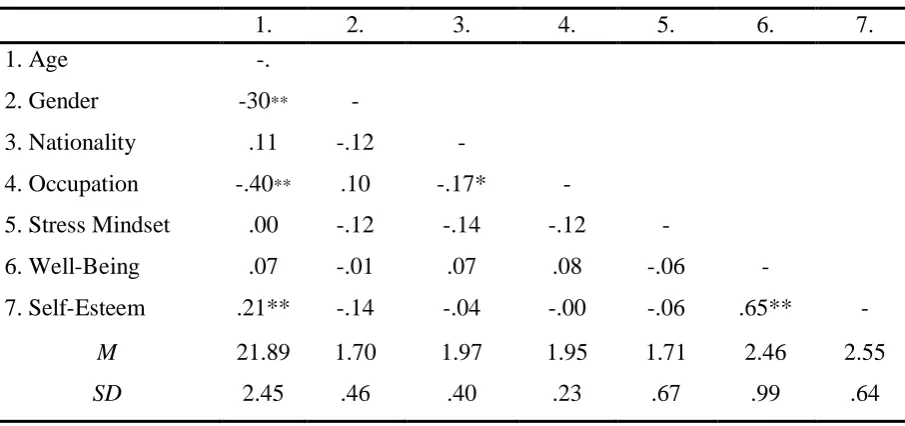
Table 2
Aggregated Correlations of Pre- and Post-Test (N = 150)
1. 2. 3. 4. 5. 6. 7.
1. Age -.
2. Gender -30** -
3. Nationality .11 -.12 -
4. Occupation -.40** .10 -.17* -
5. Stress Mindset .00 -.12 -.14 -.12 -
6. Well-Being .07 -.01 .07 .08 -.06 -
7. Self-Esteem .21** -.14 -.04 -.00 -.06 .65** -
M 21.89 1.70 1.97 1.95 1.71 2.46 2.55
SD 2.45 .46 .40 .23 .67 .99 .64
Note. *p < .05. **p < .001.
The assumption for homogeneity of variances was met for stress mindset in the pre-test, F(2, 72) = .10, p = .905. Moreover, the main effect of the one-way ANOVA for the stress mindset scores in the pre-test was statistically insignificant, F(2, 72) = .58, p = .563, n² = 26.543.
[image:10.595.74.527.351.564.2]β = .03
β = -.05 (β = -.05) β = -.06
In the post-test, the assumption of homogeneity of variances was not satisfied, F(2, 72) = 4.64, p = .013. Therefore, a Welch’s F test was performed. The test outcomes showed that the video manipulation was effective, Welch’s F(2, 44.49) = 7.73, p < .05. Games-Howell post-hoc analyses indicated that the differences in stress mindset levels were statistically significant between the SIE condition and the SID condition (p = .001) and between the SIE condition and the control group (CG) condition (p = .015). The differences between the SID condition and CG condition were statistically insignificant (p = .284). Therefore, the SIE video condition was associated with increased stress mindset levels, while the SID condition was not associated with any changes in stress mindset levels. The results support the first hypothesis that the video manipulation is effective in enhancing mindset levels in the SIE condition. The second hypothesis that the video manipulation is effective in debilitating stress mindset levels in the SID condition was not supported by the results.
SIE Mindset
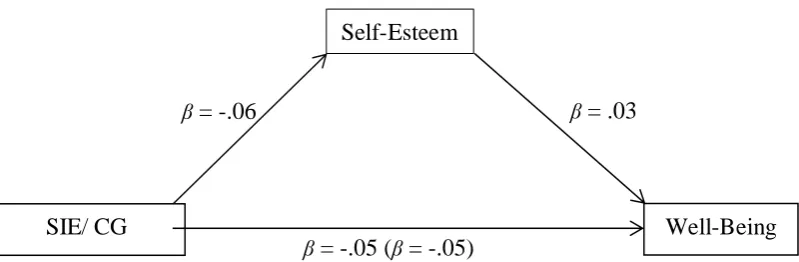
Contrary to expectations, the first mediation analysis revealed an insignificant association between stress mindset and changes in well-being (total effect: β = -.05, t(53) = -.72, p = .48;direct effect: β = -.05, t(53) = -.68, p = .45). Moreover, the associations between stress mindset and changes in self-esteem (β = -.06, t(53) = -1.02, p = .31) and between self-esteem and changes in well-being (β = .03, t(53) = .16, p = .87) were non-significant.
[image:11.595.89.489.552.683.2]The total indirect effect of self-esteem in the bias corrected 95% CI included zero [-.03, .04], which means that self-esteem was not significantly mediating the association between stress mindset and well-being. Thus, the third hypothesis was rejected. The results are presented in Figure 2.
Figure 2. Mediation model of self-esteem on the relationship between SIE mindset and well-being. *p < .05. **p < .01. The value between the parentheses indicates the ‘total’ effect.
SIE/ CG Well-Being
β = .64**
β = .03 (β = -.02) β = -.09
SID Mindset
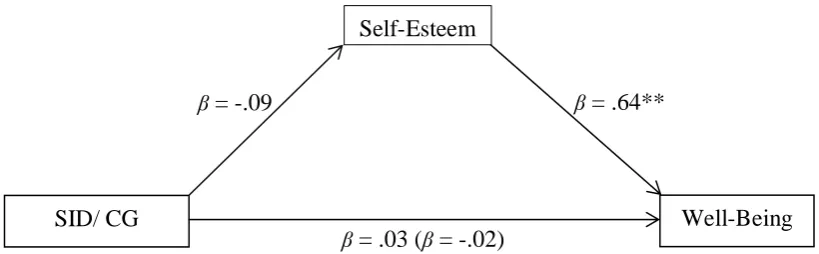
The second mediation analysis also revealed an insignificant association between stress mindset and changes in well-being (total effect: β = -.02, t(52) = -.17, p = .87;direct effect: β = .03, t(52) = .23, p = .82). Additionally, the associations between stress mindset and changes in self-esteem (β = -.09, t(52) = -.76, p = .45) were non-significant. However, a statistically significant association was found between self-esteem and changes in well-being (β = .64, t(52) = 3.81, p < .001).
[image:12.595.81.491.308.435.2]The total indirect effect of self-esteem in the bias corrected 95% CI included zero [-.23, .08], which means that self-esteem was not significantly mediating the association between stress mindset and well-being. Thus, the third hypothesis was rejected. The results are presented in Figure 3.
Figure 3. Mediation model of self-esteem on the relationship between SID mindset and well-being. *p < .05. **p < .01. The value between the parentheses indicates the ‘total’ effect.
Discussion
The aim of this study was to examine whether stress mindsets can be changed by means of a video intervention and to investigate the mediating impact of self-esteem in the relation between stress mindset and well-being. The video manipulation had an effect on the stress mindset with participants in the SIE condition reporting higher SIE mindsets than participants in the SID condition. Stress mindsets were not related to changes in well-being and these were not mediated by changes in self-esteem.
Stress mindset levels appeared to change after the video manipulation. In the SIE condition participants developed more towards a SIE mindset as a consequence of watching videos highlighting the benefits of stress. These findings are in line with previous research that indicates mindsets can be transformed by introducing persons to different information (e.g. Blackwell et al., 2007; Dweck, 2008; Paunesku et al., 2015; Tamir et al., 2007; Walton, 2014). Specifically, the results support prior studies about the effectiveness of interventions using videos or articles to change mindsets (e.g. Blackwell et al., 2007; Levy & Myers, 2004;
SID/ CG Well-Being
Tamir et al., 2007; Walton, 2014) and a study by Crum et al. (2013) who found that stress mindsets could be altered towards a debilitating or enhancing direction by exposing participants to three three-minute videos. However, the SID condition did not significantly change towards more of a SID mindset. The stress mindset differences between SID and CG condition were insignificant. It is possible that the information in the videos of the SID condition confirmed pre-existing beliefs and therefore, no mindset changes appeared in that condition group. This is in line with Crum et al. (2013), who stated that people tend to hold a SID mindset as their standard mindset. The outcomes of this study indicate that short video clips, which factually emphasize the upsides of stress, could promote equivalent alterations toward more of a SIE mindset, whereas videos emphasizing the negative effects of stress do not influence the SID mindset.
Changes in Self-esteem were not significantly affected by the stress mindset. Neither the SIE mindset nor the SID mindset significantly affected self-esteem. This contradicts with previous research, where an association between mindset and levels of self-esteem has been found (e.g. Kyoung Hwang & Lee, 2018; Taylor & Gollwitzer, 1995). Additionally, the results did not support the third hypothesis. There was no relationship found between a SIE or a SID mindset and changes in well-being mediated by self-esteem. This is contradicting with Crum et al. (2013), who found that health was positively influenced by a SIE mindset, while a SID mindset had a negative effect on health. One explanation for these two conflicting results may be that the short-time intervention over the period of one week was not powerful enough for changes in self-esteem and well-being to emerge. This is in line with previous research, indicating that interventions seem to be more effective over longer periods of time (Boiler et al., 2013; Sin & Lyubomirsky, 2009).
self-esteem and changes in well-being. Further research needs to explore this unexpected effect. Even though previous research revealed the moderating effect of stress mindset in the association between stress and well-being (Crum et al., 2017; Park et al., 2018), there is a lack of research on the moderating effect of a SIE mindset in the relation between changes in self-esteem and changes in well-being. Therefore, further research is needed to examine SIE mindset as a moderator between self-esteem and well-being.
Strengths and Limitations
This study provides some important strengths. A strong aspect of this study was the design. The pre-test measurement enabled to view participant differences that already existed before the beginning of the research. Furthermore, the risk for confounding variables was reduced through the inclusion of a control condition. In addition to that, participants were randomly assigned into the three conditions to avoid systematic differences between the condition groups. Taken together, these strengths increase the validity of this study and diminish bias of the results.
The present research also offers some limitations. First, female participants were overrepresented in the sample. Female participants represented by 70.7%, whereas male participants were represented by 29.3%. Therefore, the results may not be representative for males. The study by Jiang, Zhang, Ming, Huang and Lin (2019) found an association between stress mindset and life satisfaction in females but not in males, indicating gender-related differences in the outcomes of stress mindset. Second, most respondents were German students. Therefore, the results may not be generalizable to other nationalities or occupational areas as, for example, past research found differences in levels of self-esteem between ethnic identities (Bachman, O'Malley, Freedman-Doan, Trzesniewski, & Donnellan, 2011) as well as a relationship between occupation and health and well-being (Law, Steinwender, and Leclair, 1998). Finally, it is possible that the videos did not only have an effect on the stress mindset but also on affect. This is because the short-films not only displayed factual information but the selected music and pictures in the videos also addressed the emotions of the viewer. The videos could have triggered changes in affect, which triggered changes in the stress mindset as past research has demonstrated the emotion-evoking effects of music (Schaefer, 2017) and pictures (Katahira, Fujimura, Okanoya, & Okada, 2011). Thus, the results of this study may not be conclusive as affect was not measured,
Future Research
differences of the influence of the stress mindset on different outcomes. Moreover, future research could focus on exploring long-term stress mindset interventions to test their effectiveness on changes in self-esteem and changes in well-being and other positive outcomes. In addition to that, future studies could examine if the video manipulations are actually changing the stress mindset or other variables such as affect. The reasons for the difference in the two stress mindset conditions in the association between changes in self-esteem and changes in well-being are still unclear. Therefore, further research should explore the moderating effect of the stress mindset in the relationship between self-esteem and well-being.
Conclusion
References
Bachman, J. G., O'Malley, P. M., Freedman-Doan, P., Trzesniewski, K. H., & Donnellan, M.
B. (2011). Adolescent self-esteem: Differences by race/ethnicity, gender, and age. Self
and Identity, 10(4), 445-473. doi:10.1016/0140-1971(92)90030-9
Baron, R. M., & Kenny, D. A. (1986). The moderator–mediator variable distinction in social psychological research: Conceptual, strategic, and statistical considerations. Journal of personality and social psychology, 51(6), 1173.
Baumeister, R. F., Campbell, J. D., Krueger, J. I., & Vohs, K. E. (2003). Does high self-esteem cause better performance, interpersonal success, happiness, or healthier lifestyles? Psychological Science in the Public Interest, 4, 1– 44.
Blackwell, L. S., Trzesniewski, K. H., & Dweck, C. S. (2007). Implicit theories of intelligence predict achievement across an adolescent transition: A longitudinal study and an intervention. Child Development, 78, 246–263. doi:10.1111/j.1467- 8624.2007.00995.x
Brown, J. D., & Marshall, M. A. (2006). The three faces of selfesteem. In M. Kernis (Ed.), Self-esteem: Issues and answers, 4-9. New York, NY: Psychology Press.
Bolier, L., Haverman, M., Westerhof, G. J., Riper, H., Smit, F., & Bohlmeijer, E. (2013). Positive psychology interventions: a meta-analysis of randomized controlled studies. BMC public health, 13(1), 119.
Carver, C. S., & Connor-Smith, J. (2010). Personality and coping. Annual Review of Psychology, 61, 679–704. doi:10.1146/annurev.psych.093008.100352
Cohen, S., Kamarck, T., & Mermelstein, R. (1983). A global measure of perceived stress. J. Health Soc. Behav.24, 385–396.
Crum, A. J., Akinola, M., Martin, A., & Fath, S. (2017). The role of stress mindset in shaping cognitive, emotional, and physiological responses to challenging and threatening stress. Anxiety, Stress, & Coping, 30(4), 379-395.
Crum, A., & Lyddy, C. (2014). The Power of Mindsets and the Art of Stressing Mindfully. The Wiley Blackwell handbook of mindfulness, 948.
Crum, A. J., Salovey, P., & Achor, S. (2013). Rethinking stress: The role of mindsets in determining the stress response. Journal of personality and social psychology, 104(4), 716.
Di Paula, A., & Campbell, J. D. (2002). Self-esteem and persistence in the face of failure. Journal of Personality and Social Psychology, 83, 711-724.
Dori, G. A., & Overholser, J. C. (1999). Depression, hopelessness, and self‐esteem: Accounting for suicidality in adolescent psychiatric inpatients. Suicide and Life‐ Threatening Behavior, 29(4), 309-318.
Dweck, C. S. (2008). Can personality be changed? The role of beliefs in personality and change. Current Directions in Psychological Science,17, 391–394.
Flay, B. R., Allred, C. G., & Ordway, N. (2001). Effects of the Positive Action program on achievement and discipline: Two matched-control comparisons. Prevention Science, 2(2), 71-89.
Galanakis, M. J., Palaiologou, A., Patsi, G., Velegraki, I. M., & Darviri, C. (2016). A literature review on the connection between stress and self-esteem. Psychology, 7(5). Haney, P., & Durlak, J. A. (1998). Changing self-esteem in children and adolescents: A
meta-analytical review. Journal of clinical child psychology, 27(4), 423-433.
Hayes, A. F. (2012). PROCESS: A versatile computational tool for observed variable mediation, moderation, and conditional process modeling. Retrieved from http://www.afhayes.com/ public/process2012.pdf
Heatherton, T.F. & Polivy, J. (1991). Development and validation of a scale for measuring state self-esteem. Journal of Personality and Social Psychology, 60, 895-910.
Huppert, F. A., & Cooper, C. L. (Eds.). (2014). Wellbeing: A Complete Reference Guide, Interventions and Policies to Enhance Wellbeing (Vol. 6). John Wiley & Sons.
Jiang, Y., Zhang, J., Ming, H., Huang, S., & Lin, D. (2019). Stressful life events and well-being among rural-to-urban migrant adolescents: The moderating role of the stress mindset and differences between genders. Journal of adolescence, 74, 24-32. doi:10.1016/j.adolescence.2019.05.005
Katahira, K., Fujimura, T., Okanoya, K., & Okada, M. (2011). Decision-making based on emotional images. Frontiers in psychology, 2, 311. doi: 10.3389/fpsyg.2011.00311 Keyes, C. L. M. (2005b). The subjective well-being of America’s youth: Toward a
comprehensive assessment. Adolescent and Family Health, 4, 3−11.
Keyes, C. L. M. (2006). Mental health in adolescence: Is America’s youth flourishing? American Journal of Orthopsychiatry, 76, 395–402.
Keyes, C. L. M., Wissing, M., Potgieter, J. P., Temane, M., Kruger, A., & van Rooy, S. (2008). Evaluation of the Mental Health Continuum Short Form (MHC-SF) in Setswana speaking South Africans. Clinical Psychology and Psychotherapy, 15, 181– 192.
Kilby, C. J., & Sherman, K. A. (2016). Delineating the relationship between stress mindset and primary appraisals: preliminary findings. SpringerPlus, 5(1), 336.
KyoungHwang, Y., & Lee, C. S. (2018). Relationship between Stress and Happiness in Middle School Students: Dual Mediation Effect of Growth Mindset and Self-Esteem. Medico-Legal Update, 18(1).
Lamers, S.M.A., Westerhof, G.J., Bohlmeijer, E.T., ten Klooster, P.M., & Keyes, C.L.M. (2011). Evaluating the psychometric properties of the Mental Health Continuum-Short Form (MHC-SF). Journal of Clinical Psychology, 67, 99-110.
Law, M., Steinwender, S., & Leclair, L. (1998). Occupation, health and well-being. Canadian Journal of Occupational Therapy, 65(2), 81-91.
Lazarus, R. S. (1974). Psychological stress and coping in adaptation and illness. International Journal of Psychiatry in Medicine, 5, 321–333. doi:10.2190/T43T-84P3-QDUR-7RTP Lazarus, R. S., & Folkman, S. (1984). Stress, appraisal, and coping. New York, NY:
Springer.
Levy, B. R., & Myers, L. M. (2004). Preventive health behaviors influenced by self-perceptions of aging. Preventive Medicine, 39(3), 625–629. doi:10.1016/j.ypmed.2004.02.029
Levy, B. R., Slade, M. D., Kunkel, S. R., & Kasl, S. V. (2002). Longevity increased by positive self-perceptions of aging. Journal of Personality and Social Psychology, 83, 261–270.
Lu, H., Li, X., Wang, Y., Song, Y., & Liu, J. (2018). The hippocampus underlies the association between self-esteem and physical health. Scientific reports, 8(1). doi:10.1038/s41598-018-34793-x
Norem, J. K., & Cantor, N. (1986). Anticipatory and post hoc cushioning strategies:
Optimism and defensive pessimism in “risky” situations. Cognitive therapy and
research, 10(3), 347-362.
O’Mara, A. J., Marsh, H. W., Craven, R. G., & Debus, R. L. (2006). Do self-concept interventions make a difference? A synergistic blend of construct validation and meta-analysis. Educational Psychologist, 41, 181–206.
Overholser, J. C., Adams, D. M., Lehnert, K. L., & Brinkman, D. C. (1995). Self-esteem deficits and suicidal tendencies among adolescents. Journal of the American Academy of Child & Adolescent Psychiatry, 34(7), 919-928.
Park, D., Yu, A., Metz, S. E., Tsukayama, E., Crum, A. J., & Duckworth, A. L. (2018). Beliefs About Stress Attenuate the Relation Among Adverse Life Events, Perceived Distress, and Self‐Control. Child development, 89(6), 2059-2069. doi:10.1111/cdev.12946
Patterson, G.R. & Capaldi, D.M. (1992). Mediational model for boys depressed mood. In Rolf, J., Masten, A.S., Cicchetti, D., Nuechterlein, K.H. and Weintraub, S. (eds), Risk and Protective Factors in Development of Psychopathology. Cambridge University Press, Cambridge, 141–163.
Paunesku, D., Walton, G. M., Romero, C., Smith, E. N., Yeager, D. S., & Dweck, C. S. (2015). Mind-set interventions are a scalable treatment for academic underachievement. Psychological Science, 0956797615571017. doi:10.1177/
Preacher, K. J., & Hayes, A. F. (2004). SPSS and SAS procedures for estimating indirect effects in simple mediation models. Behavior research methods, instruments, & computers, 36(4), 717-731.
Rice, K. G., Ashby, J. S., & Slaney, R. B. (1998). Self-esteem as a mediator between perfectionism and depression: A structural equations analysis. Journal of counseling psychology, 45(3), 304.
Rosenberg, M. (1989). Society and the adolescent self-image. Middeltown, CT: Wesleyan University Press.
Sapolsky, R. M. (1996). Stress, glucocorticoids, and damage to the nervous system: The current state of confusion. Stress, 1, 1–19. doi:10.3109/10253899609001092
Saleh, D., Camart, N., & Romo, L. (2017). Predictors of stress in college students. Frontiers in psychology, 8, 19.
Schaefer, H. E. (2017). Music-evoked emotions—Current studies. Frontiers in neuroscience, 11, 600. doi: 10.3389/fnins.2017.00600
Sin, N. L., & Lyubomirsky, S. (2009). Enhancing well‐being and alleviating depressive symptoms with positive psychology interventions: A practice‐friendly meta‐ analysis. Journal of Clinical Psychology, 65(5), 467-487. doi:10.1002/jclp.20593 Sommers-Spijkerman, M., Trompetter, H., Schreurs, K., & Bohlmeijer, E. (2018). Pathways
to improving mental health in compassion-focused therapy: Self-reassurance, self-criticism and affect as mediators of change. Frontiers in psychology, 9, 2442.
Tamir, M., John, O. P., Srivastava, S., & Gross, J. J. (2007). Implicit theories of emotion: Affective and social outcomes across a major life transition. Journal of Personality and Social Psychology, 92(4), 731. doi:10.1037/0022-3514.92.4.731
Taylor, S. E., & Gollwitzer, P. M. (1995). Effects of mindset on positive illusions. Journal of personality and social psychology, 69(2), 213.
Trzesniewski, K. H., Donnellan, M. B., Moffitt, T. E., Robins, R. W., Poulton, R., & Caspi, A. (2006). Low self-esteem during adolescence predicts poor health, criminal behavior, and limited economic prospects during adulthood. Developmental Psychology, 42(2), 381–390. doi:10.1037/0012-1649.42.2.381
Walton, G. M. (2014). The new science of wise psychological interventions. Current Directions in Psychological Science, 23(1), 73–82. doi:10.1177/0963721413512856 Westerhof, G. J., & Keyes, C. L. M. (2010). Mental illness and mental health: The two
continua model across the lifespan. Journal of Adult Development, 17, 110–119. Zeigler-Hill, V. (2013). Self-esteem. London, England: Psychology Press.