Original citation:
Morrison, Christopher, Saharan, L., Ikeda, Y., Takano, K., Hrkac, G. and Thomson, T.. (2013) Quantifying exchange coupling in segregated granular materials. Journal of Physics D: Applied Physics, Volume 46 (Number 47). Article number 475002.
Permanent WRAP url:
http://wrap.warwick.ac.uk/58857
Copyright and reuse:
The Warwick Research Archive Portal (WRAP) makes this work of researchers of the University of Warwick available open access under the following conditions. Copyright © and all moral rights to the version of the paper presented here belong to the individual author(s) and/or other copyright owners. To the extent reasonable and practicable the material made available in WRAP has been checked for eligibility before being made available.
Copies of full items can be used for personal research or study, educational, or not-for-profit purposes without prior permission or charge. Provided that the authors, title and full bibliographic details are credited, a hyperlink and/or URL is given for the original metadata page and the content is not changed in any way.
Publisher’s statement:
© (2013) American Institute of Physics. This article may be downloaded for personal use only. Any other use requires permission of the American Institute of Physics. The
following article first appeared in
Journal of Physics D: Applied Physics, Volume 46 (Number 47). Article number 475002. And may be found at
http://dx.doi.org/10.1088/0022-3727/46/47/475002 A note on versions:
The version presented here may differ from the published version or, version of record, if you wish to cite this item you are advised to consult the publisher’s version. Please see the ‘permanent WRAP url’ above for details on accessing the published version and note that access may require a subscription.
Quantifying exchange coupling in segregated granular
materials
C Morrison1,*, L Saharan2, Y Ikeda3, K Takano3, G Hrkac2,4, and T Thomson1
1
School of Computer Science, University of Manchester, Manchester, UK
2
Department of Engineering Materials, University of Sheffield, Sheffield, UK
3
San Jose Research Center, HGST, San Jose, California, USA
4
College of Engineering, Mathematics and Physical Sciences, University of Exeter, Devon, UK
The volume of a magnetic grain, together with its anisotropy, determines the probability of
thermally activated reversal. Thus for grain volume distributions where the median volume is
close to the superparamagnetic limit there will be a sub-set of grains which are either
superparamagnetic on the time scale of a typical magnetic measurement (10s), or reverse due
to magnetostatic fields from surrounding grains. We use this effect to probe exchange
coupling in segregated granular materials, using CoCrPt-SiOx granular recording media as
model systems. As the film thickness is reduced below 10 nm the remanent magnetization of
these films decreases, due to thermal activation and magnetostatic reversal. Varying film
thickness and temperature allows us to thermally select a population of grains that contribute
to the measurement. Exchange coupling is characterized by the angle dependence of remanent
coercivity where we associate a breaking of symmetry from the Stoner-Wohlfarth model
towards the Kondorsky model as a measure of the incoherency of reversal. Combining these
models allows an estimate to be made of the volume fraction of grains that are exchange
coupled and we find that, for well segregated CoCrPt-SiOx media, approximately 8% of the
magnetic volume undergoes some degree of exchange coupling.
PACS: 75.30.Et 75.50.Ss 75.60.Jk 75.70.-i
High anisotropy, segregated, granular CoCrPt-SiOx thin films are key materials in
perpendicular magnetic recording [1]. When incorporated into an exchange coupled
composite medium, by layering with a lower anisotropy magnetic material, the maximum
recording density can be increased towards 1 Tbit/in2, with no loss in writeability [2,3]. More
generally, nano/micro-scale granular materials are also highly applicable as permanent
magnet materials [4-6]. It is important to understand how grains interact in these granular
materials, and the effect these interactions have on magnetic reversal, especially when
considering a more complex composite material where simple models do not adequately
describe the switching process. The origins of incoherency in granular CoCrPt systems have
been studied previously [7], and the effect of intergranular exchange coupling has been
studied by creating a model multilayer system [8,9] and through measurements of real CoCrPt
granular media [10-13]. The contribution of inhomogeneous microstructure to intergranular
coupling has also been studied [14].
In this paper, we report the switching behaviour of granular materials with a grain size
distribution in thermal regimes above and below room temperature. The volume of the
individual grains is controlled by tuning the thickness of the thin film. An example grain
volume distribution is shown in figure 1. This allows us to distinguish the effects of thermal
activation from inter-granular exchange coupling, confirming the methodology that we have
developed previously [12,13] across a range of film thicknesses and temperatures. Due to
reduced magnetocrystalline anisotropy energy KuV (Ku is the magnetocrystalline anisotropy
and V is the volume) in thin films, we are able to thermally select sub-sections of the grain
population for magnetic remanence measurements. In these measurements, only grains that
switch during application of a reverse field are measured i.e. the grains that contribute to the
remanent state. In weakly exchange coupled granular systems, grains will contribute to the
remanence if their anisotropy energy is sufficient or if they are exchange coupled to
caused by incoherency, and this is explored as an intrinsic property close to the limit of
granular thermal stability.
The granular materials used in this study were heterogeneous CoCrPt-SiOx granular media
intended for perpendicular magnetic recording. The samples were deposited via dc magnetron
sputtering onto 65mm diameter, 0.6mm thick glass substrates. Initially a 30nm thick
CoFe-based soft underlayer (SUL) structure was deposited onto the substrate, followed by a Ru seed
layer, and then a CoCrPt-SiOx granular segregated recording layer of thicknesses from 4nm to
16nm. Finally, the media were capped with a protective carbon overlayer and a lubricant.
DC demagnetizing remanence curves were measured using a Microsense DMS model 10
vector vibrating sample magnetometer (VSM), with temperature control and a maximum field
of 20 kOe. Due to the presence of the SUL, a measurement technique is required that can
separate the measured magnetic moment due to the SUL from that of the granular recording
layer, which is of interest [15]. This involves application of an in-plane pinning field during
the measurement of remanent moment perpendicular to the film plane. Applying the field at
an arbitrary angle allows a series of remanence curves to be measured.
Remanence curves were measured as a function of applied field angle relative to the easy axis
of the material (perpendicular to the plane), for CoCrPt-SiOx films with thicknesses ranging
from 4 nm to 11 nm. Example remanence curves measured for films of 6 and 11nm at two
angles (0º and 45º), are shown in figure 2. When the film thickness is reduced to 6 nm the
material is no longer fully remanent due to thermal activation and magnetostatic reversal of
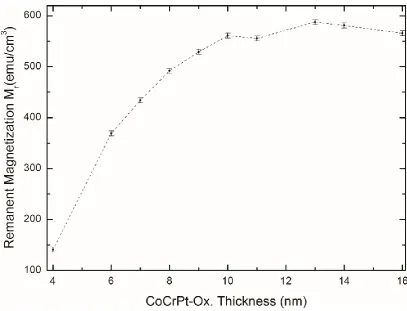
the smallest grains in the grain size distribution. The remanent magnetization (saturation point
in the remanence curve) is plotted in figure 3 as a function of film thickness. These data
clearly show that for films 10nm thick and below a proportion of the grain population is no
population of grains based on the grain volume distribution, the temperature and the coupling
(exchange or magnetostatic) between grains.
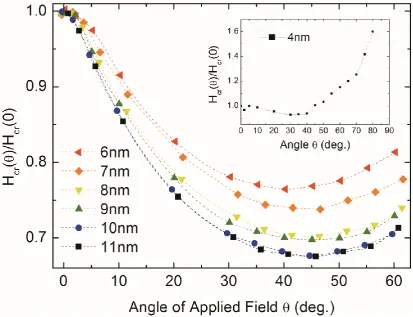
The remanent coercivity Hcr at room temperature was extracted from the raw remanence data
and then plotted as a function of angle between 0º and 60º for each film thickness, as shown
in figure 4. The remanence curves are expected to exhibit behaviour between the two limits of
the Stoner-Wohlfarth model [16] (coherent rotation for isolated particles) and the Kondorsky
model [17] (domain wall motion in highly exchange coupled systems). There is a dispersion
of easy axes in the granular material [15], which has a Gaussian form and is characterized by
σ = 3. This results in the measured remanence curve being the sum of curves for individual
grains with a mosaic spread of easy axes of anisotropy. This results in a change in the
functional form of the reversal curve, with a minimum switching field of 0.58Hcr(0º)
(Compared to 0.5Hcr(0º) for the unmodified Stoner-Wohlfarth model). CoCrPt-SiOx. thin
films of 11nm thickness have been shown in previous work, within the resolution of the
technique, to exhibit switching behaviour that demonstrates coherent, exchange-decoupled
switching of individual grains [12]. We therefore use this thickness as a reference to explore
the evolution of incoherency in reversal as the thickness is reduced.
Figure 4 shows the evolution of the switching behaviour as the thickness of the films is varied
between 6 nm and 11 nm. For a small decrease in the thickness of the film from the optimal
(fully remanent) case of 11nm the switching behaviour remains unchanged. As the thickness
of the layer is decreased below 10nm, the switching field minimum becomes shallower, and
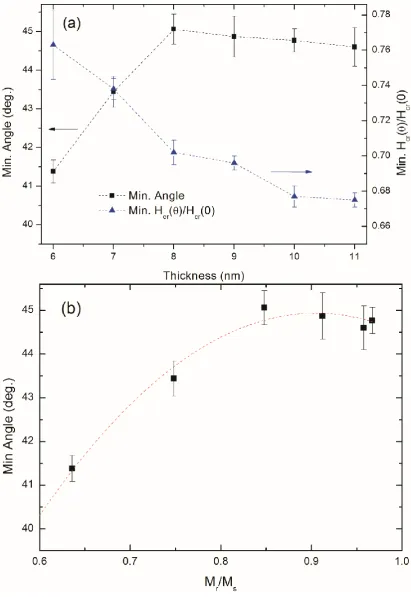
occurs at a smaller angle, reaching a minimum at 41 for the thinnest film (6nm) as shown in
figure 5(a). This can be attributed to an increased degree of incoherent switching in the
material relative to the total, e.g. the ratio
M
inc/(
M
inc
M
coh)
has increased, where Minc andMcoh are the total magnetizations that switch incoherently and coherently, respectively. Our
minimum switching field, and not the angle at which this minimum occurs [12]. The
reduction in remanent magnetization is therefore not simply due to the shift in the mean
anisotropy energy to lower values – if this were the case, all the remanent grains would switch
coherently, and this is not supported by the data in figures 4 and 5(a). A film with thickness
4nm was also measured (figure 3 insert), and showed reversal behaviour with significant
incoherency, the curve more closely resembling the Kondorsky model of switching (Hcr
cos(θ)-1).
The change in angle dependent switching in sub-10nm thick films cannot be due to reduced
coherency within the grains. Individual grains have lateral dimensions roughly equal to the
exchange length in CoCrPt, which may be estimated using the expression
l
ex
A
/
K
u ,where A is the exchange constant and Ku is the uniaxial anisotropy of the grain, including both
magnetocrystalline and shape terms. Inserting values of A = 1×10⁻⁶erg/cm and Ku =
5×10⁶erg/cm3 yields lex ~ 5nm. Therefore individual grains might be expected to switch
coherently, were they in complete isolation. However, coupling with adjacent grains provides
a mechanism for the observed incoherency. Inter-granular coupling is normally assumed to be
negligible, as evidenced by the switching curve for the 11nm film, which exhibits a minimum
switching angle of 45º, consistent with the Stoner-Wohlfarth model of coherent switching
(isolated grains). However, due to thermal activation or magnetostatic interactions, there will
be a population of grains where either the grain volume is too small for the grains to be
remanent or the grains will orient in the opposite direction. These grains would either not
individually participate in the remanence experiment (thermal activation) or reduce the net
remanent magnetization (magnetostatic interaction). This can be seen from figure 3, where for
film thicknesses below 10nm the remanent magnetization begins to decrease. In order for
these grains to participate or align with neighbouring grains, we hypothesize that they must be
coupled via inter-granular exchange coupling, thus enhancing the effective volume of the
conditions employed (T = 292 K, t = 10 seconds). These grain ensembles can reverse
incoherently, due to increased lateral dimensions and coupling effects. Another possible
explanation could be that the first few layers of magnetic material grow with poor granularity,
as has been seen previously, and this causes incoherent reversal. However, from figure 4 it
can be seen that once the film thickness reaches 10nm, coherent reversal is measured as this is
the dominant contribution. This would not be possible if a percentage of the thickness were
poorly segregated.
Figure 5(b) shows the minimum switching field angles for the remanence curves shown in
figure 4, plotted as a function of squareness (Mr/Ms). Below a threshold value of
approximately 0.8, the minimum angle begins to reduce. This indicates that the smallest 20%
of the grains become thermally unstable or misaligned and cannot be stabilized in the field
direction by exchange coupling to neighbouring grains. Beyond this point increased
incoherency is observed, due to the enhanced contribution of coupled grains to the measured
remanence.
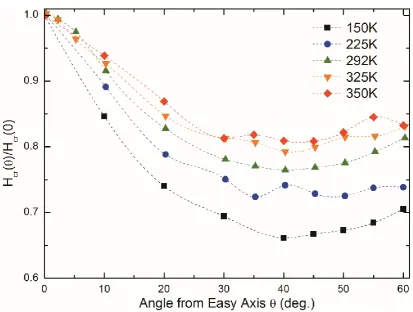
Measurements of angle dependence of remanence for the 6 nm thick film, over a range of
temperatures, are plotted in figure 6. More uncertainty is visible in the curves at higher
temperatures due to increased error in the extracted values of Hcr. This arises because of a
reduced signal-to-noise ratio in the raw data, as the remanent magnetization is reduced due to
thermal activation and magnetostatic reversal. In contrast to previous temperature dependent
measurements on thicker films (11nm and 16nm) [12], the minimum switching field angle
varies as a function of temperature. This suggests that by increasing the temperature we are
sampling a larger proportion of coupled grains, resulting in more incoherent reversal.
Temperature therefore provides an additional method of probing inter-granular coupling
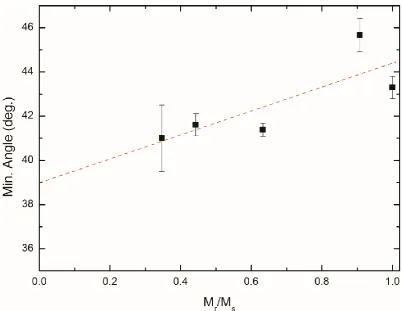
Figure 7 shows the variation in minimum switching angle plotted as a function of Mr/Ms for
the data in figure 6. An approximately linear relationship is observed. Extrapolating a linear
fit to the data to zero remanence allows us to estimate the maximum reduction in minimum
switching angle for the 6nm thick film (39±2 deg). Using a model that comprises a weighted
average of two switching regimes (Kondorsky-like for coupled grains, Stoner-Wohlfarth
coherent switching for un-coupled grains),
)
(
)
1
(
)
cos(
)
0
(
)
(
W S cr crH
x
x
H
H
, (1)where x is the fraction of inter-granularly coupled material, and HS-W(θ) is the
Stoner-Wohlfarth switching field incorporating a 3 dispersion of easy axes. This function is plotted
in figure 8 for six values of x. The validity of this zero temperature approach has been
established in previous work, through micromagnetic simulation and experiment [12,13]. We
demonstrated that thermal activation changes only the depth of the minimum, not the angle at
which it occurs. We therefore compare only the minimum angle and exclude the effects of
thermal activation and the temperature dependence of material constants. The closest match to
the experimental minimum switching angle is for x=8±3%, corresponding to an estimated 8%
of remanent magnetic material being coupled. This is the first estimate that has been made of
the volume of magnetization that is coupled in granular media. The results demonstrate that
with a properly controlled set of samples, an estimate of the absolute proportion of coupled
grains may be obtained. This opens the possibility of both comparing different materials and
process conditions and comparing experimental data to simulation.
In conclusion, we have performed a detailed study of angular remanence as a function of
CoCrPt-Ox. film thickness and temperature. By reducing the mean anisotropy energy we are
coupling are detectable through angular remanence measurements. We have shown that from
these measurements the volume of magnetization that is exchange coupled in granular
magnetic materials can be estimated. The incoherency observed in reversal is due to the
exchange coupling of smaller grains that would otherwise not participate in the experiment
individually due to thermal activation or switching as a result of magnetostatic fields. Our
method identifies incoherency by symmetry breaking from the Stoner-Wohlfarth (S-W)
model towards a hybrid S-W/Kondorsky model. Comparison of the minimum switching field
angle values from experiment to the hybrid S-W/Kondorsky model allows an estimate to be
made of the percentage of coupled grains (8±3%) in our samples. The estimate is obtained by
extrapolating to find the minimum switching field angle at zero remanence as this point
represents the maximum sensitivity to coupled grains. The technique described here can be
applied more generally to explore inter-granular exchange coupling and coherency of reversal
in granular magnets that comprise nominally decoupled grains at optimal thicknesses and
temperatures.
We would like to thank the EPSRC for financial support under grants no. EP/G032440/1 and
EP/G032300/1.
References
[1] Piramanayagam S 2007 J. Appl. Phys. 102 011301
[2]Dittrich R, Schrefl T, Kirschner M, Suess D, Hrkac G, Dorfbauer F, Ertl O and Fidler J
2005 IEEE Trans. Magn. 41 3592
[3] Victora R H and Shen X 2005 IEEE Trans. Magn. 41 2828
[4] Shinba Y, Konno T J, Ishikawa K, Hiraga K and Sagawa M 2005 J. Appl. Phys. 97
053504
[6] Hrkac G, Woodcock T G, Freeman C, Goncharov A, Dean J, Schrefl T and Gutfleisch O
2010 Appl. Phys. Lett. 97 232511
[7] Jung H S, Kuo M, Malhotra S S and Bertero G 2007 Appl. Phys. Lett. 91 212502
[8] Sokalski V, Laughlin D E and Zhu J G 2009 Appl. Phys. Lett. 95 102507
[9] Sokalski V M, Zhu J G and Laughlin D E 2010 IEEE Trans. Magn. 46 2260
[10] Berger A 2012 Physica B: Cond. Mat. 407 1322
[11] Brandt R, Tibus S, Springer F, Fassbender J, Rohrmann H, Albrecht M and Schmidt H
2012 J. Appl. Phys. 112 033918
[12] Morrison C,Saharan L, Hrkac G, Schrefl T, Ikeda Y, Takano K, Miles J J and Thomson
T 2011 Appl. Phys. Lett. 99 132507
[13] Saharan L, Morrison C, Miles J J, Thomson T, Schrefl T and Hrkac G 2011 J. Appl.
Phys. 110 103906
[14] Tham K K, Saito S, Hasegawa D, Itagaki N, Hinata S, Ishibashi S and Takahashi M 2012
J. Appl. Phys. 112 093917
[15] Thomson T, Lengsfield B, Do H and Terris B D 2008 J. Appl. Phys.103 07F548
[16] Stoner E C and Wohlfarth E P 1948 Phil. Trans. R. Soc. Lond. A 240 599
Figures:
Figure 1: Illustration of unstable (US), ferromagnetic regions that exhibit intergranular
exchange coupling (FM Coupled) and ferromagnetic (FM) regions in the grain diameter
Figure 2: Example remanence measurements for CoCrPt-Ox. films of 6 and 11nm thickness,
at angles of 0 and 45º relative to the perpendicular anisotropy axis, measured by vector
vibrating sample magnetometry. The 11nm film is fully remanent at room temperature; the
6nm film is no longer fully remanent due to thermal excitation and/or magnetostatic reversal
Figure 3: Remanent magnetization Mr plotted as a function of CoCrPt-Ox. recording layer
thickness. Below 10nm thickness Mr starts to reduce, indicating a fraction of the grain size
distribution becomes unmeasurable due to thermal activation or magnetostatic reversal. The
Figure 4: Remanent coercivity Hcr as a function of film thickness. A clear evolution in the
function form of the curves indicates reduced coherency of switching as film thickness is
reduced. Inset: Data for a 4nm thick film showing highly incoherent reversal. Dashed lines are
Figure 5: (a) Angle of minimum remanent coercivity and the corresponding normalized value
of the minimum as a function of CoCrPt-Ox. film thickness. A decrease in the minimum
[image:15.595.91.503.76.674.2]switching field as a function of remanence ratio (squareness) for the thickness series of
[image:16.595.91.505.225.537.2]CoCrPt-Ox. Dashed lines are a guide to the eye.
Figure 6: Remanent coercivity Hcr as a function of angle for a 6nm thick CoCrPt-Ox. film at
five temperatures between 150K and 350K. The angle of the minimum decreases due to
increased relative contribution of exchange coupled grains to the reversal process. Dashed
Figure 7: Minimum switching field angle as a function of squareness for a 6nm thick film of
Figure 8: Theoretical reversal curves plotted using equation 1 for six values of the