Empirical Exploitation of Click Data for Task Specific Ranking
Anlei Dong Yi Chang Shihao Ji Ciya Liao Xin Li Zhaohui Zheng
Yahoo! Labs 701 First Avenue Sunnyvale, CA 94089
{anlei,yichang,shihao,ciyaliao,xinli,zhaohui}@yahoo-inc.com
Abstract
There have been increasing needs for task specific rankings in web search such as rankings for specific query segments like long queries, time-sensitive queries, navi-gational queries, etc; or rankings for spe-cific domains/contents like answers, blogs, news, etc. In the spirit of ”divide-and-conquer”, task specific ranking may have potential advantages over generic ranking since different tasks have task-specific fea-tures, data distributions, as well as feature-grade correlations. A critical problem for the task-specific ranking is training data insufficiency, which may be solved by us-ing the data extracted from click log. This paper empirically studies how to appro-priately exploit click data to improve rank function learning in task-specific ranking. The main contributions are 1) the explo-ration on the utilities of two promising ap-proaches for click pair extraction; 2) the analysis of the role played by the noise information which inevitably appears in click data extraction; 3) the appropriate strategy for combining training data and click data; 4) the comparison of click data which are consistent and inconsistent with baseline function.
1 Introduction
Learning-to-rank approaches (Liu, 2008) have been widely applied in commercial search en-gines, in which ranking models are learned using labeled documents. Significant efforts have been made in attempt to learn a generic ranking model which can appropriately rank documents for all queries . However, web users’ query intentions are extremely heterogeneous, which makes it difficult for a generic ranking model to achieve best rank-ing results for all queries. For this reason, there
have been increasing needs for task specific rank-ings in web search such as rankrank-ings for specific query segments like long queries, time-sensitive queries, navigational queries, etc; or rankings for specific domains/contents like answers, blogs, news, etc. Therefore, a specific ranking task usu-ally correspond to a category of queries; when the search engine determines that a query is be-longing to this category, it will call the ranking function dedicated to this ranking task. The mo-tivation of this divide-and-conquer strategy is that, task specific ranking may have potential advan-tages over generic ranking since different tasks have task-specific features, data distributions, as well as feature-grade correlations.
Such a dedicated ranking model can be trained using the labeled data belonging to this query cat-egory (which is called dedicated training data). However, the amount of training data dedicated to a specific ranking task is usually insufficient because human labeling is expensive and time-consuming, not to mention there are multiple rank-ing tasks that need to be taken care of. To deal with the training data insufficiency problem for task-specific ranking, we propose to extract click-through data and incorporate it with dedicated training data to learn a dedicated model.
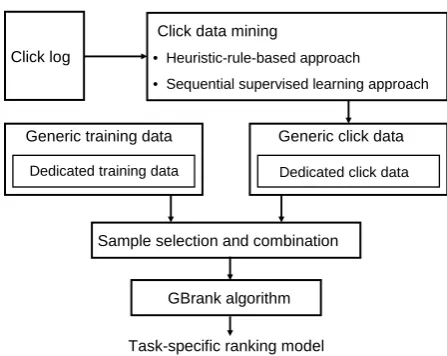
In order to incorporate click data to improve the ranking for a dedicate query category, it is critical to fully exploit click information. We empirically explore the related approaches for the appropriate click data exploitation in task-specific rank func-tion learning. Figure 1 illustrates the procedures and critical components to be studied.
1) Click data mining: the purpose is to extract informative and reliable users’ preference infor-mation from click log. We employ two promis-ing approaches: one is heuristic rule approach, the other is sequential supervised learning approach.
2) Sample selection and combination: with la-beled training data and unlala-beled click data, how
Generic training data
Dedicated training data
GBrank algorithm
Task-specific ranking model
Generic click data
Dedicated click data
Sample selection and combination Click log
Click data mining
• Heuristic-rule-based approach
• Sequential supervised learning approach
Figure 1: Framework of incorporating click-through data with training data to improve dedi-cated model for task-specific ranking.
to select and combine them so that the samples have the best utility for learning? As the data distribution for a specific ranking task is differ-ent from the generic data distribution, it is nat-ural to select those labeled training samples and unlabeled click preference pairs which belong to this query category, so that the data distributions of training set and testing set are consistent for this category. On the other hand, we should keep in mind that: a) non-dedicated data, i.e, the data that does not belong the specific category, might also have similar distribution as the dedicated data. Such distribution similarity makes non-dedicated data also useful for task-specific rank function learning, especially for the scenario that dedicated training samples is insufficient. b) The quality of dedicated click data may be not as reliable as hu-man labeled training data. In other words, there are some extracted click preference pairs that are inconsistent with human labeling while we regard human labeling as correct labeling.
3) Rank function learning algorithm: we use GBrank (Zheng et al., 2007) algorithm for rank function learning, which has proved to be one of the most effective up-to-date learning-to-rank algorithms; furthermore, GBrank algorithm also takes preference pairs as inputs, which will be il-lustrated with more details in the paper.
2 Related work
Learning to rank has been a promising research area which continuously improves web search rel-evance (Burges et al., 2005) (Zha et al., 2006)
(Cao et al., 2007) (Freund et al., 1998) (Fried-man, 2001) (Joachims, 2002) (Wang and Zhai, 2007) (Zheng et al., 2007). The ranking prob-lem is usually formulated as learning a ranking function from preference data. The basic idea is to minimize the number of contradicted pairs in the training data, and different algorithm cast the preference learning problem from different point of view, for example, RankSVM (Joachims, 2002) uses support vector machines; RankBoost (Freund et al., 1998) applies the idea of boost-ing from weak learners; GBrank (Zheng et al., 2007) uses gradient boosting with decision tree; RankNet (Burges et al., 2005) uses gradient boost-ing with neural net-work. In (Zha et al., 2006), query difference is taken into consideration for learning effective retrieval function, which leads to a multi-task learning problem using risk mini-mization framework.
There are a few related works to apply multi-ple ranking models for different query categories. However, none of them takes click-through infor-mation into consideration. In (Kang and Kim, 2003), queries are categorized into 3 types, infor-mational, navigational and transactional, and dif-ferent models are applied on each query category.
a KNN method is proposed to employ different ranking models to handle different types of queries (Geng et al., 2008). The KNN method is unsuper-vised, and it targets to improve the overall ranking instead of the rank-ing for a certain query cate-gory. In addition, the KNN method requires all feature vector to be the same.
[image:2.595.68.292.58.236.2]Table 1: Statistics of click occurrences for heuris-tic rule approach.
imp impression, number of occurrence of the tuple
cc number of occurrence of the tuple where two documents both get clicked
ncc number of occurrence of the tuple where url1
is not clicked but url2is clicked
cnc number of occurrence of the tuple where url1
is clicked but url2is not clicked
ncnc number of occurrence of the tuple where url1
and url2are not clicked
and Smyth, 2007) (Glance, 2001) (R. Jin, 2008).
3 Technical approach
This section presents the related approaches in Figure 1. In Section 4, we will make deeper anal-ysis based on experimental results.
3.1 Click data mining
We use two approaches for click data mining, whose outputs are preference pairs. Apreference pairis defined as a tuple{< xq, yq >|xq Âyq},
which means for the query q, the documentxq is
more relevant than yq. We need to extract
infor-mative and reliable preference pairs which can be used to improve rank function learning.
3.1.1 Heuristic rule approach
We use heuristic rules to extract skip-above pairs and skip-next pairs, which are similar to Strategy 1 (click>skip above) and Strategy 5 (click> no-click next) proposed in (Joachims et al., 2005). To reduce the misleading effect of an individual click behavior, click information from different query sessions is aggregated before applying heuristic rules. For a tuple (q,url1,url2,pos1,pos2) where
q is query, url1 and url2 are urls representing two documents, pos1 and pos2 are ranking positions for the two documents with pos1 ≺ pos2 mean-ing url1has higher rank than url2, the statistics for this tuple are listed in Table 1.
Skip-above pair extraction: if ncc is much
larger than cnc, and cc
imp, ncncimp is much smaller
than 1, that means, when url1is ranked higher than url2 in queryq, most users click url2but not click url1. In this case, we extract a skip-above pair, i.e., url2 is more relevant than url1. In order to have highly accurate skip-above pairs, a set of
thresh-Table 2: Skip-above pairs count vs. human judge-ments (e.g., the element in the third row and sec-ond column means we have 40 skip-above pairs with ”excellent” url1 and ”perfect” url2). P: per-fect; E: excellent; G: good; F: fair; B: bad.
P E G F B
[image:3.595.346.487.141.230.2]P 13 13 12 4 0 E 40 44 16 2 2 G 27 53 103 29 8 F 10 15 43 27 5 B 4 4 11 20 14
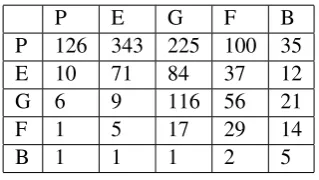
Table 3: Skip-next pairs vs. human judgements (e.g., the element in the third row and second col-umn means we have 10 skip-next pairs with ”ex-cellent” url1 and ”perfect” url2 ). P: perfect; E: excellent; G: good; F: fair; B: bad.
P E G F B
P 126 343 225 100 35 E 10 71 84 37 12 G 6 9 116 56 21
F 1 5 17 29 14
B 1 1 1 2 5
olds are applied to only extract the pairs that have high impression andnccis larger enough thancnc.
Skip-next pair extraction: if pos1 = pos2 −1,
cncis much larger thanncc, andimpcc ,ncncimp is much smaller than 1, that means, in most of cases when url2 is ranked just below url1 in query q, most users click url1 but not click url2. In this case, we regard this tuple as a skip-next pair.
[image:3.595.337.497.324.414.2]and there are 38% skip-above pairs judged as tie pairs by editors.
Table 3 shows skip-next pair distribution. Sum-ming up the tied pairs, agreed and disagreed pairs, 70% skip-next preference judgments agree with editors, 4% skip-next preference judgments dis-agree with editors, and 26% skip-next pairs judged as tie pairs by editors.
Therefore, skip-next pairs have much higher accuracy than skip-above. That is because in a search engine that already has a good ranking function, it is much easier to find a correct skip-next pairs which are consistent with the search en-gine than to find a correct skip-above pairs which are contradictory to the search engine. Skip-above and skip-next preferences provide us two kinds of users’s feedbacks which are complementary: skip-above preferences provide us the feedback that the user’s vote is contradictory to the current ranking, which implies the current relative ranking should be reversed; skip-next preferences shows that the user’s vote is consistent with the current ranking, which implies the current relative ranking should be maintained with high confidence provided by users’ vote.
3.1.2 Sequential supervised learning
The click modeling by sequential supervised learning (SSL) was proposed in (Ji et al., 2009), in which user’s sequential click information is exploited to extract relevance information from click-logs. This approach is reliable because 1) the sequential click information embedded in an aggregation of user clicks provides substantial rel-evance information of the documents displayed in the search results, and 2) the SSL is supervised learning (i.e., human judgments are provided with relevance labels for the training).
The SSL is formulated in the framework of global ranking (Qin et al., 2008). Let x(q) = {x(q)
1 , x(2q), . . . , x(nq)} represent the
doc-uments retrieved with a query q, and y(q) =
{y1(q), y2(q), . . . , y(nq)} represent the relevance
la-bels assigned to the documents. Here n is the number of documents retrieved with q. Without loss of generality, we assume that nis fixed and invariant with respect to different queries. The SSL determines to find a function F in the form ofy(q)=F(x(q)) that takes all the documents as its inputs, exploiting both local and global infor-mation among the documents, and predict the
rel-evance labels of all the document jointly. This is distinct to most of learning to rank methods that optimize a ranking model defined on a sin-gle document, i.e., in the form ofyi(q)=f(x(iq)),
∀i= 1,2, . . . , n. This formulation of the SSL is important in extracting relevance information from user click data since users’ click decisions among different documents displayed in a search session tend to rely not only on the relevance judg-ment of a single docujudg-ment, but also on therelative
relevance comparison among the documents dis-played; and the global ranking framework is well-formulated to exploit both local and global infor-mation from an aggregation of user clicks.
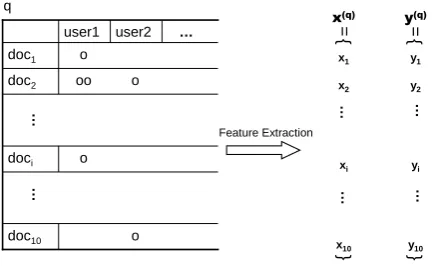
The SSL aggregates all the user sessions for the same query into a tuple <query, n-document list, and an aggregation of user clicks>. Fig-ure 2 illustrates the process of featFig-ure extrac-tion from an aggregated session, where x(q) =
{x(1q), x2(q), . . . , x(nq)} denotes a sequence of
fea-ture vectors extracted from the aggregated ses-sion, withx(iq)representing the feature vector ex-tracted for document i. Specifically, to form fea-ture vectorx(iq) , first a feature vectorx(i,jq) is ex-tracted from each userj’s click information, and
j ∈ {1,2, . . .}, thenx(iq) is formed by averaging overx(i,jq),∀j ∈ {1,2, . . .}, i.e.,x(iq)is actually an aggregated feature vector for document i. Table 4 lists all the features used in the SSL modeling. Note that some features are statistics independent of temporal information of the clicks, such as “Po-sition” and “Frequency”, while other features re-ply on their surrounding documents and the click sequences. We use 90,000 query-url pairs to train the SSL model, and 10,000 query-url pairs for best model selection.
With the sequential click modeling discussed above, several sequential supervised algorithms, including the conditional random fields (CRF) (Lafferty et al., 2001), the sliding window method and the recurrent sliding window method (Diet-terich, 2002), are explored to find a global ranking functionF. We omit the details but refer one to (Ji et al., 2009). The emphasis here is on the im-portance to adapt these algorithms to the ranking problem.
=
{
}
…
o o user2
doc10 o doci
oo doc2
o doc1
user1 q
…
…
Feature Extraction x(q)
x1
x2
xi
x10
…
…
=
{
}
y(q)
y1
y2
yi
y10
…
…
[image:5.595.74.291.62.195.2]Figure 2: An illustration of feature extraction for an aggregated session for SSL approach. x(q) de-notes an extracted sequence of feature vectors, and y(q)denotes the corresponding label sequence that is assigned by human judges for training.
Table 4: Click features used in SSL model.
Position Position of the document in the result list
ClickRank Rank of 1st click of doc. in click seq. Frequency Average number of clicks for this doc. FrequencyRank Rank in the list sorted by num. of clicks IsNextClicked 1 if next position is clicked, 0 otherwise IsPreClicked 1 if previous position is clicked,
0 otherwise
IsAboveClicked 1 if there is a click above, 0 otherwise IsBelowClicked 1 if there is a click below, 0 otherwise ClickDuration Time spent on the document
prediction. For the reason of convenience, we also call the preference pairs contradicting with pro-duction ranking as skip-above pairs and those con-sistent with production ranking as skip-next pairs, so that we can analyze these two types of prefer-ence pairs respectively.
3.2 Modeling algorithm
The basic idea of GBrank (Zheng et al., 2007) is that if the ordering of a preference pair by the ranking function is contradictory to this preference, we need to modify the ranking function along the direction by swapping this prefence pair. Preferences pairs could be gen-erated from labeled data, or could be extracted from click data. For each preference pair < x, y > in the available preference set S =
{< xi, yi >|xi Âyi, i= 1,2, ..., N}, x should
be ranked higher thany. In GBrank algorithm, the problem of learning ranking functions is to com-pute a ranking function h, so thath matches the set of preference, i.e, h(xi) ≥ h(yi) , ifx  y,
i= 1,2, ..., N as many as possible. The following loss function is used to measure the risk of a given ranking functionh.
R(h) = 12XN
i=1
(max{0, h(yi)−h(xi)+τ})2, (1)
whereτ is the margin between the two documents in the pair. To minimize the loss function,h(x)has to be larger thanh(y)with the marginτ, which can be chosen as constant value, or as dynamic val-ues varying with pairs. When pair-wise judgments are extracted from editors’ labels with different grades, pair-wise judgments can include grade dif-ference, which can further be used as margin τ. The GBrank algorithm is illustrated in Algorithm 1, and two parameters need to be determined: the shrinkage factorηand the number of iteration.
Algorithm 1GBrank algorithm.
Start with an initial guessh0, form= 1,2, ... 1. Construct a training set: for each< xi, yi >∈
S, derive (xi,max{0, hm−1(yi)− hm1(xi) + τ}), and
(yi,−max{0, hm−1(yi)−hm1(xi) +τ}).
2. Fit hm by using a base regressor with the
above training set.
3. hm =hm−1+ηsmhm(x), wheresmis found
by line search to minimize the object function,
ηis shrinkage factor.
3.3 Sample selection and combination
We use a straightforward approach to learn rank-ing model from the combined data, which is illus-trated in Algorithm 2.
Algorithm 2Learn ranking model by combining editorial data and click preference pairs.
Input:
•Editorial absolute judgement data.
•Preference pairs from click data.
1. Extract preference pairs from labeled data with absolute judgement.
2. Select and combine preference pairs from click data and labeled data.
3. Learn GBrank model from the combined preference pairs.
nqquery-url pairs with corresponding grades,{<
query,urli,gradei>|i= 1,2, . . . , nq}, its
prefer-ence pairs are extracted as
{< query,urli,urlj,gradei−gradej > |i, j =
1,2, . . . , nq, i6=j}.
When combining human-labeled pairs and click preference pairs, we can give use different relative weights for these two data sources. The loss func-tion becomes
R(h) = Nw
l
X
i∈Labeled
(max{0, h(yi)−h(xi) +τ})2
1−w Nc
X
i∈Click
(max{0, h(yi)−h(xi) +τ})2,(2)
wherewis used to control the relative weights be-tween labeled training data and click data, Nl is
the number of training data pairs, and Nc is the
number of click pairs. The marginτ can be deter-mined as grade difference for editor pairs, and be a constant parameter for click pairs.
Step 2 is critical for the efficacy of the approach. A few factors need to be considered:
1) data distribution: for the application of task-specific ranking, our purpose is to improve ranking for the queries belonging to this category. An im-portant observation is that the relevance patterns for the ranking within a specific category may have some unique characteristics, which are differ-ent from generic relevance ranking. Thus, it is rea-sonable to consider only using dedicated labeled training data and dedicated click preference data for training. The reality is that dedicated training data is usually insufficient, while it is possible that non-dedicated data can also help the learning.
2) click pair quality: it is inevitable there exist some incorrect pairs in the click preference pairs. Such incorrect pairs may mislead the learning. So overall, can the click preference pairs still help the learning for task-specific ranking? By our study, skip-above pairs usually contain more incorrect pairs compared with skip-above pairs. Does this mean skip-next pairs are always more helpful in improving learning than skip-above pairs?
3) click pair utility: use labeled training data as baseline, how much complimentary information can click pairs bring? This is determined by the methodology of click data mining approach.
While it is possible to achieve some learning improvement for task-specific ranking by using click pairs by a plausible method, we attempt to empirically explore the above interweaving
fac-tors for deeper understanding, in order to apply the most appropriate strategy to exploit click data on real-world applications of task-specific ranking.
4 Experiments
4.1 Data set
Query category: in the experiments, we use long
query ranking as an example of task-specific rank-ing, because it is commonly known that long query ranking has some unique relevance patterns com-pared with generic ranking. We define the long queries as the queries containing at least three to-kens. The techniques and analysis proposed in this paper can be applied to other ranking tasks, such as rankings for specific query segments like time-sensitive queries, navigational queries, or rankings for specific domains/contents like answers, blogs, news, as long as the tasks have their own charac-teristics of data distributions and discriminant rank features.
Labeled training data: we do experiments
based on a data set for a commercial search en-gine, for which there are 16,797 query-url pairs (with 1,123 different queries) that have been la-beled by editors. The proportion of long queries is about 35% of all queries. The data distribution of such long queries may be different from gen-eral data distribution, as it will be validated in the experiments below.
The human labeled data is randomly split into two sets: training set (8,831 query-url pairs, 589 queries), and testing set (7,966 query-url pairs, 534 queries). The training set will be combined with click preference pairs for rank function learn-ing, and the testing set will be used to evaluate the efficacy of the ranking function. In the training set, there are 3,842 long query-url pairs (229 queries). At testing stage, the learned rank functions are ap-plied only to the long queries in the testing data, as our concern in this paper is how to improve task-specific ranking, i.e., long query ranking in the experiment. In the testing data, there are 3,210 query-url pairs (193 queries) are long query data, which will be used to test rank functions.
Click preference pairs: using the two
Table 5: Use click data by heuristic rule approach (Data Selection: ”N”: not use; ”D”: use dedicated data; ”G”: use generic data. Data Source: ”T”: training data; ”C”: click data)
(a) skip-next pairs
NT DT GT
NC n/a 0.7736 0.7813 DC 0.7822 0.7906 (1.2%) 0.7997(2.4%) GC 0.7834 0.7908 (1.2%) 0.7950 (1.7%)
(b) skip-above pairs
NT DT GT
NC n/a 0.7736 0.7813
DC 0.6649 0.7676 (-1.6%) 0.7748 (-0.8%) GC 0.6792 0.7656 (-2.0%) 0.7989 (2.2%)
4.2 Setup and measurements
We try different sample selection and combination strategies to train rank functions using GBrank al-gorithm. For the labeled training data, we either use generic data or dedicated data. For the click preference pairs, we also try these two options. Furthermore, as more click preference pairs may bring more useful information to help the learn-ing while on the other hand, the more incorrect pairs may be given so that they mislead the learn-ing, we try different amounts of these prefence pairs: 5,000, 10,000, 30,000, 50,000, 70,000 and 100,000 pairs.
We use NDCG to evaluate ranking model, which is defined as
NDCGn=ZnPni=1log(2r(ii)+1)−1
whereiis the position in the document list,r(i)is the score of Documenti, andZnis a normalization
factor, which is used to make the NDCG of ideal list be 1.
4.3 Results
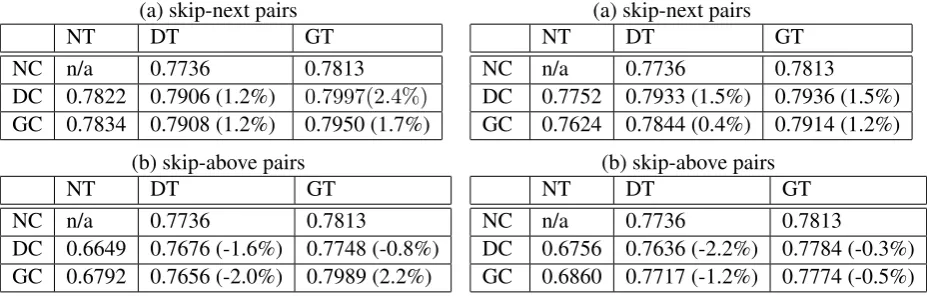
Table 5 and 6 show the NDCG5 results by using heuristic rule approach and SSL approach respec-tively. We do not present NDCG1 results due to space limitation, but NDCG1results have the sim-ilar trends as NDCG5.
Baseline by training data: there are two
base-line functions by using training data sets 1) use dedicated training data (DT), NDCG5 on the test-ing set by the rank function is 0.7736; 2) use generic training data (GT), NDCG5 is 0.7813. It is reasonable that using generic training data is
Table 6: Use click data by SSL approach (Data Selection: ”N”: not use; ”D”: use dedicated data; ”G”: use generic data. Data Source: ”T”: training data; ”C”: click data)
(a) skip-next pairs
NT DT GT
NC n/a 0.7736 0.7813 DC 0.7752 0.7933 (1.5%) 0.7936 (1.5%) GC 0.7624 0.7844 (0.4%) 0.7914 (1.2%)
(b) skip-above pairs
NT DT GT
NC n/a 0.7736 0.7813
DC 0.6756 0.7636 (-2.2%) 0.7784 (-0.3%) GC 0.6860 0.7717 (-1.2%) 0.7774 (-0.5%)
better than only using dedicated training data, be-cause the distributions of non-dedicated data and dedicated data share some similarity. As the ded-icated training data is insufficient, the adoption of the extra non-dedicated data helps the learning. We compare learning results with Baseline 2) (use generic training data, the slot of NC + GT in the tables), which is the higher baseline.
Baseline by click data: we then study the
utili-ties of click preference pairs by using them alone for training without using labeled training data. In Table 5 and 6, each of the NDCG5 results us-ing click preference pairs is the highest NDCG5 value over the cases of using different amounts of pairs (5000, 10,000, 30,000, 50,000, 70,000 and 100,000 pairs). The results regarding the pairs amounts are illustrated in Figure 3, which will help us to analyze the results more deeply.
dedi-1 2 3 4 5 6 7 8 9 10
x 104
0.755 0.76 0.765 0.77 0.775 0.78 0.785 0.79 0.795 0.8
click pairs
NDCG
5
dedicate train + dedicate click generic train + dedicate click dedicate click
[image:8.595.64.281.71.236.2]generic click
Figure 3: Incorporate different amounts of skip-next pairs by heuristic rule approach with generic training data.
0.1 0.2 0.3 0.4 0.5 0.6 0.7 0.8 0.9
0.76 0.77 0.78 0.79 0.8 0.81
trainging sample weight
NDCG
5
[image:8.595.69.280.311.472.2]+ 5,000 dedicate click + 10,000 dedicate click + 30,000 dedicate click
Figure 4: The effects of using different combin-ing weights. Skip-next pairs by heuristic rule ap-proach are combined with generic training data.
cated click pairs alone is always better than using generic click pairs alone. With more click pairs being used (> 30,000), the noise rates become higher in the pairs, which makes the distribution factor less important.
Combine training data and click data: we
compare the four table slots, DC+DT, GC+DT, DC+GT, GC+GT, in Table 5 and 6, and there are quite a few interesting observations:
1)Skip-next vs. skip-above: overall,
incorporat-ing skip-next pairs with trainincorporat-ing data is better than incorporating skip-above pairs, due to the reason that there are more incorrect pairs in skip-above pairs, which may mislead the learning. The only exception is the slot GC+GT in Table 5 (b), whose NDCG5improvement is as high as 2.2%. We
fur-ther track this result, and find that this is the case by using only 5,000 generic skip-above pairs. The noise rate of these 5,000 pairs is low because they have the highest pair extraction confidence values. At the same time, these 5,000 pairs may provide good complementary signals to the generic train-ing data, so that the learntrain-ing result is good. How-ever, in general, skip-next pairs have better utilities than skip-above pairs.
2) Dedicated training data vs. generic
train-ing data: using generic training data is
gen-erally better than only using dedicated training data. If training data is insufficient, the extra non-dedicated data provides useful information for relevance pattern learning, and the distribu-tion dissimilarity between dedicated data and non-dedicated data is not the most important factor.
3)Dedicated click data vs. generic click data:
using dedicated click data is more effective than using generic click data. From Figure 3, we ob-serve that when 30,000 or fewer pairs are incorpo-rated into training data, using dedicate click pairs is always better than using generic click pairs.
0 0.5 1 1.5 2 2.5
0.784 0.786 0.788 0.79 0.792 0.794 0.796 0.798 0.8 0.802
τ
NDCG
5
+ 5,000 dedicate click + 10,000 dedicate click + 30,000 dedicate click
Figure 5: The effects of using different margin values for click preference pairs. Skip-next pairs by heuristic rule approach are incorporated with generic training data.
4) Heuristic rule approach vs. SSL approach:
the preference pairs extracted by heuristic rule ap-proach have better utilities than those extracted by SSL approach.
5) GBrank parameters for combining training
data and click pairs: the relative weight w for
[image:8.595.301.515.399.559.2]for which skip-next pairs by heuristic rule ap-proach are combined with generic training data. We observe that neither over-weighting training data or over-weighting click pairs yields good re-sults while the two data sources are best exploited at certain weight values when there is good bal-ance between them. Another concern is the ap-propriate margin valueτ for the click pairs in (2). Figure 5 shows thatτ = 1consistently yields good learning results, which suggests us that click pair provides good information atτ = 1.
4.4 Discussions
we have defactorized the related approaches for exploiting click data to improve task-specific rank learning. The utility of click preference pairs de-pends on the following factors:
1) Data distribution: if click pairs have good quality, we should use dedicated click pairs in-stead of generic click pairs, so that the samples for training have similar distribution to the task of task-specific ranking.
2) The amount of dedicated training data: the more dedicated training data, the more reliable the task-specific rank function is; thus, the less room for learning improvement using click data. For the case in the experiment that dedicated training is in-sufficient, the non-dedicated training data can also help the learning as non-dedicated training data share relevance pattern similarity with the dedi-cated data distribution.
3) The quality of click pairs: if we can extract large amount of high-quality click pairs, the learn-ing improvement will be significant. For example, as shown in Figure 3, at the early stage with fewer click pairs (5,000 and 10,000 pairs) being com-bined with training data, the learning improvement is best. With more click pairs are used, the noise rate in the click pairs becomes higher so that the learning misleading factor is more important than information complementary factor. Thus, it is im-portant to improve the reliability of the click pairs. 4) The utility of click pairs: by our study, the quality of click pairs extracted by SSL approach is comparable to those extracted by heuristic rule approach. The possible reason that heuristic-rule-based click pairs can bring more benefit is that these pairs provide more complementary infor-mation compared with SSL approach. As the methodologies of these two click data extraction approaches are totally different, in future we will
explore the concrete reason that causes such utility difference.
5 Conclusions
References
E. Agichtein, E. Brill, and S. Dumais. 2006. Improv-ing web search rankImprov-ing by incorporatImprov-ing user
behav-ior information.Proc. of ACM SIGIR Conference.
S. M. Beitzel, E. C. Jensen, A. Chowdhury, and O. Frieder. 2007. Varying approaches to topical
web query classification. Proceedings of ACM
SI-GIR conference.
C. Burges, T. Shaked, E. Renshaw, A. Lazier, M. Deeds, N. Hamilton, and G. Hullender. 2005.
Learning to rank using gradient descent. Proc. of
Intl. Conf. on Machine Learning.
Z. Cao, T. Qin, T. Liu, M. Tsai, and H. Li. 2007. Learning to rank: From pairwise approach to
list-wise.Proceedings of ICML conference.
B. Carterette, P. N. Bennett, D. M. Chickering, and S. T. Dumais. 2008. Here or there: preference judgments for relevance.Proc. of ECIR.
O. Chapelle and Y. Zhang. 2009. A dynamic bayesian
network click model for web search ranking.
Pro-ceedings of the 18th International World Wide Web Conference.
K. Chen, Y. Zhang, Z. Zheng, H. Zha, and G. Sun. 2008. Adapting ranking functions to user
prefer-ence.ICDE Workshops, pages 580–587.
M. Coyle and B. Smyth. 2007. Supporting intelligent web search.ACM Transaction Internet Tech., 7(4).
T. G. Dietterich. 2002. Machine learning for sequen-tial data: a review. Lecture Notes in Computer Sci-ence, (2396):15–30.
S. Fox, K. Karnawat, M. Mydland, S. Dumias, and T. White. 2005. Evaluating implicit measures to
improve web search. ACM Trans. on Information
Systems, 23(2):147–168.
Y. Freund, R. D. Iyer, R. E. Schapire, and Y. Singer. 1998. An efficient boosting algorithm for
combin-ing preferences. Proceedings of International
Con-ference on Machine Learning.
J. Friedman. 2001. Greedy function approximation: a gradient boosting machine. Ann. Statist., 29:1189– 1232.
X. Geng, T. Liu, T. Qin, A. Arnold, H. Li, and H. Shum. 2008. Query dependent ranking with k nearest
neighbor.Proceedings of ACM SIGIR Conference.
N. S. Glance. 2001. Community search assistant.
In-telligent User Interfaces, pages 91–96.
S. Ji, K. Zhou, C. Liao, Z. Zheng, G. Xue, O. Chapelle, G. Sun, and H. Zha. 2009. Global ranking by ex-ploiting user clicks. InSIGIR’09, Boston, USA, July 19-23.
T. Joachims, L. Granka, B. Pan, and G Gay. 2005. Accurately interpreting clickthough data as implicit
feedback. Proc. of ACM SIGIR Conference.
T. Joachims. 2002. Optimizing search engines using
clickthrough data. InProceedings of the ACM
Con-ference on Knowledge Discovery and Data Mining (KDD).
I. Kang and G. Kim. 2003. Query type classification
for web document retrieval. Proceedings of ACM
SIGIR Conference.
J. Lafferty, A. McCallum, and F. Pereira. 2001. Con-ditional random fields: Probabilistic models for seg-menting and labeling sequence data. InICML, pages 282–289.
U. Lee, Z. Liu, and J. Cho. 2005. Automatic
identifi-cation of user goals in web search. Proceedings of
International Conference on World Wide Web. X. Li, Y.Y Wang, and A. Acero. 2008. Learning query
intent from regularized click graphs. Proceedings of ACM SIGIR Conference.
T. Y Liu. 2008. Learning to rank for information re-trieval. SIGIR tutorial.
T. Qin, T. Liu, X. Zhang, D. Wang, and H. Li. 2008. Global ranking using continuous conditional ran-dom fields. InNIPS.
H. Li R. Jin, H. Valizadegan. 2008. Ranking re-finement and its application to information retrieval.
Proceedings of International Conference on World Wide Web.
F. Radlinski and T. Joachims. 2007. Active exploration for learning rankings from clickthrough data. Proc. of ACM SIGKDD Conference.
F. Radlinski, M. Kurup, and T. Joachims. 2008. How does clickthrough data reflect retrieval quality? Pro-ceedings of ACM CIKM Conference.
D. E. Rose and D. Levinson. 2004. Understanding user
goals in web search. Proceedings of International
Conference on World Wide Web.
X. Wang and C. Zhai. 2007. Learn from web search
logs to organize search results. In Proceedings of
the 30th ACM SIGIR.
H. Zha, Z. Zheng, H. Fu, and G. Sun. 2006. Incor-porating query difference for learning retrieval
func-tions in world wide web search. Proceedings of the
15th ACM Conference on Information and Knowl-edge Management.