A Structured Vector Space Model for Word Meaning in Context
Katrin Erk
Department of Linguistics University of Texas at Austin [email protected]
Sebastian Pad´o Department of Linguistics
Stanford University [email protected]
Abstract
We address the task of computing vector space representations for the meaning of word oc-currences, which can vary widely according to context. This task is a crucial step towards a robust, vector-based compositional account of sentence meaning. We argue that existing mod-els for this task do not take syntactic structure sufficiently into account.
We present a novel structured vector space model that addresses these issues by incorpo-rating the selectional preferences for words’ argument positions. This makes it possible to
integrate syntax into the computation of word
meaning in context. In addition, the model per-forms at and above the state of the art for mod-eling the contextual adequacy of paraphrases.
1 Introduction
Semantic spaces are a popular framework for the rep-resentation of word meaning, encoding the meaning of lemmas as high-dimensional vectors. In the de-fault case, the components of these vectors measure the co-occurrence of the lemma with context features
over a large corpus. These vectors are able to pro-vide a robust model ofsemantic similaritythat has
been used in NLP (Salton et al., 1975; McCarthy and
Carroll, 2003; Manning et al., 2008) and to model experimental results in cognitive science (Landauer and Dumais, 1997; McDonald and Ramscar, 2001).
Semantic spaces are attractive because they provide a model of word meaning that is independent of dictio-nary senses and their much-discussed problems
(Kil-garriff, 1997; McCarthy and Navigli, 2007).
In a default semantic space as described above, each vector represents one lemma, averaging over
all its possible usages (Landauer and Dumais, 1997; Lund and Burgess, 1996). Since the meaning of words can vary substantially between occurrences
(e.g., for polysemous words), the next necessary step is to characterize the meaning of individualwords in context.
There have been several approaches in the liter-ature (Smolensky, 1990; Schutze, 1998; Kintsch,¨ 2001; McDonald and Brew, 2004; Mitchell and La-pata, 2008) that compute meaning in context from
lemma vectors. Most of these studies phrase the prob-lem as one of vector composition: The meaning of a target occurrenceain contextbis a single new vector cthat is a function (for example, the centroid) of the vectors:c=ab.
The contextbcan consist of as little as one word,
as shown in Example (1). In (1a), the meaning of
catch combined withball is similar tograb, while in
(1b), combined withdisease, it can be paraphrased bycontract. Conversely, verbs can influence the
in-terpretation of nouns: In (1a),ball is understood as a
spherical object, and in (1c) as a dancing event.
(1) a. catch a ball b. catch a disease c. attend a ball
In this paper, we argue that models of word mean-ing relymean-ing on this procedure of vector composition are limited both in their scope and scalability. The
underlying shortcoming is a failure to considersyntax in two important ways.
The syntactic relation is ignored.The first problem
concerns the manner of vector composition, which ignores the relation between the targetaand its con-textb. This relation can have a decisive influence on their interpretation, as Example (2) shows:
(2) a. a horse draws b. draw a horse
In (2a), the meaning of the verbdraw can be para-phrased aspull, while in (2b) it is similar tosketch.
This difference in meaning is due to the difference in
relation: in (2a),horse is the subject, while in (2b) it is the object. On the modeling side, however, a
vector combination function that ignores the relation will assign the same representation to (2a) and (2b).
Thus, existing models are systematically unable to capture this class of phenomena.
Single vectors are too weak to represent phrases.
The second problem arises in the context of the im-portant open question of how semantic spaces can
“scale up” to provide interesting meaning representa-tions for entire sentences. We believe that the current vector composition methods, which result in a single vectorc, are not informative enough for this purpose. One proposal for “scaling up” is to straightforwardly
interpretc = ab as the meaning of the phrase a+b(Kintsch, 2001; Mitchell and Lapata, 2008). The problem is that the vectorccan only encode a fixed amount of structural information if its dimen-sionality is fixed, but there is no upper limit on sen-tence length, and hence on the amount of structure to be encoded. It is difficult to conceive howccould encode deeper semantic properties, like predicate-argument structure (distinguishing “dog bites man” and “man bites dog”), that are crucial for
sentence-level semantic tasks such as the recognition of textual
entailment (Dagan et al., 2006). An alternative ap-proach to sentence meaning would be to use the vec-tor space representation only for representing word meaning, and to represent sentence structure
sepa-rately. Unfortunately, present models cannot provide
this grounding either, since they compute a single vector cthat provides the same representations for
both the meanings ofaandbin context.
In this paper, we propose a new,structured vector spacemodel for word meaning (SVS) that addresses these problems. ASVS representation of a lemma comprises several vectors representing the word’s
lexical meaning as well as theselectional preferences that it has for its argument positions. The meaning of wordain contextbis computed by combininga
withb’s selectional preference vector specific to the
relation betweenaandb, addressing the first problem
above. In an expressiona+b, the meanings ofa andbin this context are computed as two separate
vectorsa0andb0. These vectors can then be combined
with a representation of the structure’s expression (e.g., a parse tree), to address the second problem discussed above. We test theSVSmodel on the task of recognizing contextually appropriate paraphrases, finding thatSVSperforms at and above the state-of-the-art.
Plan of the paper. Section 2 reviews related work.
Section 3 presents theSVSmodel for word meaning in context. Sections 4 to 6 relate experiments on the paraphrase appropriateness task.
2 Related Work
In this section we give a short overview over existing
vector space based approaches to computing word meaning in context.
General context effects. The first category of
models aims at integrating the widest possible range of context information without recourse to linguistic structure. The best-known work in this category is
Schutze (1998). He first computes “first-order” vec-¨ tor representations for word meaning by collecting co-occurrence counts from the entire corpus. Then, he determines “second-order” vectors for individual word instances in their context, which is taken to be a simple surface window, by summing up all first-order
vectors of the words in this context. The resulting vectors form sense clusters.
McDonald and Brew (2004) present a similar model. They compute the expectation for a word wiin a sequence by summing the first-order vectors for the wordsw1 towi−1 and showed that the
dis-tance between expectation and first-order vector for
wicorrelates with human reading times.
Predicate-argument combination. The second
category of prior studies concentrates on contexts consisting of a single word only, typically modeling
the combination of a predicatepand an argumenta.
centroid of its members’ vectors. The procedure does not take the relation betweenpandainto account.
Mitchell and Lapata (2008) propose a framework
to represent the meaning of the combinationp+aas a functionf operating on four components:
c=f(p, a, R, K) (3)
R is the relation holding betweenpand a, andK additional knowledge. This framework allows sen-sitivity to the relation. However, the concrete
in-stantiations that Mitchell and Lapata consider disre-gardsK andR, thus sharing the other models’
limi-tations. They focus instead on methods for the direct
combination ofp anda: In a comparison between
component-wise addition and multiplication ofpand a, they find far superior results for the multiplication
approach.
Tensor product-based models. Smolensky (1990)
uses tensor product to combine two word vectorsa andbinto a vectorcrepresenting the expressiona+b.
The vector cis located in a very high-dimensional space and is thus capable of encoding the structure of the expression; however, this makes the model infeasible in practice, as dimensionality rises with every word added to the representation. Jones and Mewhort (2007) represent lemma meaning by using circular convolution to encoden-gram co-occurrence information into vectors of fixed dimensionality. Sim-ilar to Brew and McDonald (2004), they predict most
likely next words in a sequence, without taking
syn-tax into account.
Kernel methods. One of the main tests for the
quality of models of word meaning in context is the ability to predict the appropriateness of paraphrases
in given a context. Typically, a paraphrase applies
only to some senses of a word, not all, as can be seen in the paraphrases “grab” and “contract” of “catch”.
Vector space models generally predict paraphrase ap-propriateness based on the similarity between vectors. This task can also be addressed with kernel methods,
which project items into an implicit feature space for efficient similarity computation. Consequently, vector space methods and kernel methods have both been used for NLP tasks based on similarity,
no-tably Information Retrieval and Textual Entailment.
Nevertheless, they place their emphasis on different
types of information. Current kernels are mostly tree
kernels that compare syntactic structure, and use
se-mantic information mostly for smoothing syntactic
similarity (Moschitti and Quarteroni, 2008). In
con-trast, vector-space models focus on the interaction between the lexical meaning of words in composi-tion.
3 A structured vector space model for word meaning in context
In this section, we define the structured vector space (SVS) model of word meaning.
The main intuition behind our model is to view the interpretation of a word in context as guided by expectations about typical events. For example, in
(1a), we assume that upon hearing the phrase “catch a ball”, the hearer will interpret the meaning of “catch” to matchtypical actions that can be performed with a ball. Similarly, the interpretation of “ball” will reflect the hearer’s expectations abouttypical things that can be caught. This move to include typical arguments and predicates into a model of word meaning can be motivated both on cognitive and linguistic grounds.
In cognitive science, the central role of expecta-tions about typical events for human language pro-cessing is well-established. Expectations affect
read-ing times (McRae et al., 1998), the interpretation of
participles (Ferretti et al., 2003), and sentence pro-cessing generally (Narayanan and Jurafsky, 2002; Pad´o et al., 2006). Expectations exist both for verbs and nouns (McRae et al., 1998; McRae et al., 2005).
In linguistics, expectations, in the form of selec-tional restrictionsandselectional preferences, have
long been used in semantic theories (Katz and Fodor,
1964; Wilks, 1975), and more recently induced
from corpora (Resnik, 1996; Brockmann and Lapata,
2003). Attention has mostly been limited to selec-tional preferences of verbs, which have been used for example for syntactic disambiguation (Hindle and Rooth, 1993), word sense disambiguation (Mc-Carthy and Carroll, 2003) and semantic role
label-ing (Gildea and Jurafsky, 2002). Recently, a
vector-spaced model of selectional preferences has been
proposed that computes the typicality of an argument
simply through similarity to previously seen argu-ments (Erk, 2007; Pad´o et al., 2007).
catch
he fielder
dog
cold baseball
drift obj subj
accuse say claim
comp-1
ball whirl
fly provide
throw catch organise
obj-1 subj-1
mod
[image:4.612.69.303.54.168.2]red golf elegant
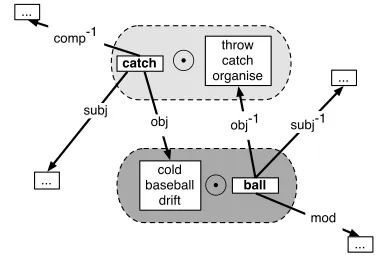
Figure 1: Structured meaning representations for noun balland verbcatch: lexical information plus expectations
that integrates lexical information with selectional
preferences. Then, we show how theSVSmodel
pro-vides a new way of computing meaning in context.
Representing lemma meaning. We abandon the
traditional choice of representing word meaning as a single vector. Instead, we encode each word as a combination of (a) one vector that models the lexical meaning of the word, and (b) a set of
vec-tors, each of which represents thesemantic expecta-tions/selectional preferencesfor one particular rela-tion that the word supports.1
The idea is illustrated in Fig. 1. In the
representa-tion of the verbcatch, the central square stands for the lexical vector ofcatch itself. The three arrows link it tocatch’s preferences for its subjects (subj), its objects (obj), and for verbs for which it appears
as a complement(comp−1). The figure shows the se-lectional preferences as word lists for readability; in practice, each selectional preference is a single vector (cf. Section 4). Likewise,ballis represented by one vector forball itself, one forball’s preferences for its modifiers (mod), one vector for the verbs of which it is a subject (subj−1), and one for the verbs of which
is an object (obj−1).
This representation includes selectional prefer-ences (like subj, obj, mod) exactly parallel to inverse selectional preferences (subj−1, obj−1, comp−1). To our knowledge, preferences of the lat-ter kind have not been studied in computational lin-guistics. However, their existence is supported in psycholinguistics by priming effects from nouns to typical verbs (McRae et al., 2005).
Formally, letDbe a vector space (the set of
possi-1We do not commit to a particular set of relations; see the discussion at the end of this section.
catch
... baseballcold drift obj subj ...
comp-1
ball
... throw
catch organise
obj-1 subj-1
mod ...
!
[image:4.612.327.517.57.185.2]!
Figure 2: Combining predicate and argument via relation-specific semantic expectations
ble vectors), and letRbe some set of relation labels. In thestructured vector space (SVS)model, we rep-resent the meaning of a lemmawas a triple
w= (v, R, R−1)
wherev∈Dis a lexical vector describing the word
witself,R:R →Dmaps each relation label onto a vector that describesw’s selectional preferences, andR−1 : R → Dmaps from role labels to
vec-tors describing inverse selectional preferences ofw.
BothRandR−1are partial functions. For example,
the direct object preference would be undefined for intransitive verbs.
Computing meaning in context. TheSVSmodel
of lemma meaning permits us to compute the
mean-ing of a word a in the context of another word b in a new way, via their selectional preferences. Let
(va, Ra, R−a1) and(vb, Rb, R−b1) be the representa-tions of the two words, and letr∈ Rbe the relation
linkingatob. Then, we define the meaning ofaand
bin this context as a pair(a0, b0)of vectors, where a0is the meaning ofain the context ofb, andb0the meaning ofbin the context ofa:
a0 = vaR−b1(r), Ra− {r}, R−a1
b0 = vbRa(r), Rb, R−b1− {r}
(4)
wherev1v2is a direct vector combination function
as in traditional models, e.g. addition or component-wise multiplication. If eitherRa(r)orR−b1(r)are
not defined, the combination fails. Afterwards, the ar-gument positionris considered filled, and is deleted
Figure 2 illustrates this procedure on the
represen-tations from Figure 1. The dotted lines indicate that
the lexical vector forcatch is combined with the in-verse object preference ofball. Likewise, the lexical vector forballis combined with the object preference vector ofcatch.
Note that our procedure for computing meaning in context can be expressed within the framework of Mitchell and Lapata (Eq. (3)). We can encode the expectations ofaandbas additional knowledgeK.
The combined representationcis the pair(a0, b0)that is computed according to our model (Eq. (4)).
TheSVSscheme we have proposed incorporates syntactic information in a more general manner than previous models, and thus addresses the issues we
have discussed in Section 1. Since the representation retains individual selectional preferences for all rela-tions, combining the same words through different
relations can (and will in general) result in different adapted representations. For instance, in the case of
Example (2), we would expect the inverse subject preference ofhorse (“things that a horse typically does”) to push the lexical vector ofdrawinto the
di-rection ofpulling, while its inverse object preference
(“things that are done to horses”) suggest a different interpretation.
Rather than yielding a single, joint vector for the
whole expression, our procedure for computing mean-ing in context results in one context-adapted meanmean-ing
representation per word, similar to the output of a WSD system. As a consequence, our model can be combined with any formalism representing the
structure of an expression. (The formalism used then determines the setRof relations.) For example, com-biningSVSwith a dependency tree would yield a tree in which each node is labeled by a SVS tuple that represents the word’s meaning in context.
4 Experimental setup
This section provides the background to the following experimental evaluation ofSVS, including parameters used for computing theSVSrepresentations that will
be used in the experiments.
4.1 Experimental rationale
In this paper, we evaluate theSVSmodel against the
task of predicting, given a predicate-argument pair,
how appropriate a paraphrase (of either the predicate
or the argument) is in that context. We perform two experiments that both use the paraphrase task, but
differ in their emphasis. Experiment 1 replicates an
existing evaluation against human judgments. This evaluation uses synthetic dataset, limited to one
par-ticular construction, and constructed to provide
max-imally distinct paraphrase candidates. Experiment 2 considers a broader class of constructions along with
annotator-generated paraphrase candidates that are not screened for distinctness. In both experiments, we compare theSVSmodel against the
state-of-the-art model by Mitchell and Lapata 2008 (henceforth M&L; cf. Sec. 2 for model details).
4.2 Parameter choices
Vector space. In our parameterization of the vector space, we largely follow M&L because their model
has been rigorously evaluated and found to outper-form a range of other models.
Our first space is a traditional “bag-of-words”
vec-tor space (BOW, (Lund and Burgess, 1996)). For
each pair of a target word and context word, the BOW space records a function of their co-occurrence fre-quency within a surface window of size 10. The space is constructed from the British National
Cor-pus (BNC), and uses the 2,000 most frequent context words as dimensions.
We also consider a “dependency-based” vector
space (SYN, (Pado and Lapata, 2007)). In this space,´ target and context words have to be linked by a “valid” dependency path in a dependency graph to count as co-occurring.2 This space was built from BNC de-pendency parses obtained from Minipar (Lin, 1993). For both spaces, we used pre-experiments to pare two methods for the computation of vector com-ponents, namely raw co-occurrence counts, the stan-dard model, and the pointwise mutual information (PMI) definition employed by M&L.
Selectional preferences. We use a simple,
knowledge-lean representation for selectional preferences inspired by Erk (2007), who models
selectional preference through similarity to seen filler
vectors~va: We compute the selectional preference vector for word b and relation r as the weighted
centroid of seen filler vectors~va. We collect seen fillers from the Minipar-parse of the BNC.
Letf(a, r, b)denote the frequency ofaoccurring in relationrtobin the parsed BNC, then
Rb(r)SELPREF =
X
a:f(a,r,b)>0
f(a, r, b)·~va (5)
We call this base model SELPREF. We will also study two variants ofSELPREF, based on two dif-ferent hypotheses about what properties of the se-lectional preferences are particularly important for meaning adaption. The first model aims specifically at alleviating noise introduced by infrequent fillers, a common problem in data-driven approaches. It only uses fillers seen more often than a thresholdθ. We call this modelSELPREF-CUT:
Rb(r)SELPREF-CUT =
X
a:f(a,r,b)>θ
f(a, r, b)·~va (6)
Our second variant again aims at alleviating noise,
but noise introduced by low-valued dimensions rather than infrequent fillers. It achieves this by taking each
component of the selectional preference vector to thenth power. In this manner, dimensions with high counts are further inflated, while dimensions with low counts are depressed.3 This model,SELPREF-POW, is defined as follows: IfRb(r)SELPREF =hv1, . . . , vmi,
Rb(r)SELPREF-POW =hvn1, . . . , vmni (7)
The inverse selectional preferences R−b1 are de-fined analogously for all three model variants. We instantiate the vector combination function as component-wise multiplication, following M&L.
Baselines and significance testing. All tasks that
we consider below involve judgments for the
mean-ing of a wordain the context of a wordb. A first
baseline that every model must beat is simply using
the original vector fora. We call this baseline “target
only”. Since we assume that the selectional prefer-ences ofbmodel the expectations fora, we useb’s
selectional preference vector for the given relation as a second baseline, “selpref only”.
3Since we focus on the size-invariant cosine similarity, the use of this model does not require normalization.
verb subject landmark sim judgment
slump shoulder slouch high 7
slump shoulder decline low 2
slump value slouch low 3
[image:6.612.309.537.57.126.2]slump value decline high 7
Figure 3: Experiment 1: Human similarity judgements for subject-verb pair with high- and low-similarity landmarks
Differences between the performance of mod-els were tested for significance using a stratified shuffling-based randomization test (Yeh, 2000).4.
5 Exp. 1: Predicting similarity ratings
In our first experiment, we attempt to predict human similarity judgments. This experiment is a replication of the evaluation of M&L on their dataset5.
Dataset. The M&L dataset comprises a total of
3,600 human similarity judgements for 120
experi-mental items. Each item, as shown in Figure 3,
con-sists of an intransitive verb and a subject noun that are combined with a “landmark”, a synonym of the
verb that is chosen to be either similar or dissimilar to the verb in the context of the given subject.
The dataset was constructed by extracting pairs
of subjects and intransitive verbs from a parsed
ver-sion of the BNC. Each item was paired with two landmarks, chosen to be as dissimilar as possible ac-cording to a WordNet similarity measure. All nouns and verbs were subjected to a pretest, where only those with highly significant variations in human judgments across landmarks were retained.
For each item of the final dataset, judgements on a 7-point scale were elicited. For example, judges
considered the compatible landmark “slouch” to be
much more similar to “shoulder slumps” than the incompatible landmark “decline”. In Figure 3, the
columnsimshows whether the experiment designers
considered the respective landmark to have high or low similarity to the verb, and the columnjudgment
shows a participant’s judgments.
Experimental procedure. We used cosine to
com-pute similarity to the lexical vector of the landmark.
4The software is available athttp://www.nlpado.de/ ∼sebastian/sigf.html.
5
Model high low ρ BOWspace
Target only 0.32 0.32 0.0
Selpref only 0.46 0.4 0.06**
M&L 0.25 0.15 0.20**
SELPREF 0.32 0.26 0.12**
SELPREF-CUT,θ=10 0.31 0.24 0.11** SELPREF-POW,n=20 0.11 0.03 0.27**
Upper bound – – 0.4
SYNspace
Target only 0.2 0.2 0.08**
Selpref only 0.27 0.21 0.16**
M&L 0.13 0.06 0.24**
SELPREF 0.22 0.16 0.13**
SELPREF-CUT,θ=10 0.2 0.13 0.13** SELPREF-POW,n=30 0.08 0.04 0.22**
[image:7.612.69.296.54.296.2]Upper bound – – 0.4
Table 1: Experiment 1: Mean cosine similarity for items with high- and low-similarity landmarks; correlation with human judgements (ρ). (**: p<0.01)
“Target only” compares the landmark against the
lexi-cal vector of the verb, and “selpref only” compares it to the noun’ssubj−1 preference. For the M&L model, the comparison is to the combined lexical vectors of verb and noun. For our modelsSELPREF,
SELPREF-CUTandSELPREF-POW, we combine the verb’s lexical vector with thesubj−1preference of the noun. We used a held-out dataset of 10% of the
data to optimize the parameters ofθofSELPREF-CUT andnofSELPREF-POW. Vectors with PMI compo-nents could model the data, while raw frequency components could not; we report only the former.
We use the same two evaluation scores as M&L:
The first score is the average similarity to compatible landmarks (high) and incompatible landmarks (low). The second is Spearman’sρ, a nonparametric corre-lation coefficient. We computeρbetween individual human similarity scores and our predictions. Based on agreement between human judges, M&L estimate an upper boundρof 0.4 for the dataset.
Results and discussion. Table 1 shows the results
of Exp. 1 on the test set. In the upper half (BOW), we replicate M&L’s main finding that simple
component-wise multiplication of the predicate and argument vectors results in a highly significant correlation of
Model lex. vector obj−1 selpref
SELPREF 0.23 (0.09) 0.88 (0.07)
[image:7.612.315.540.56.113.2]SELPREF-CUT(10) 0.20 (0.10) 0.72 (0.18) SELPREF-POW(30) 0.03 (0.08) 0.52 (0.48)
Table 2: Experiment 1: Average similarity (and standard deviation) between the inverse subject preferences of a noun and (left) its lexical vector and (right) inverse object preferences vector (cosine similarity in SYNspace)
ρ= 0.2, significantly outperforming both baselines. It is interesting, though, that thesubj−1preference itself (“Selpref only”) is already highly significantly correlated with the human judgments.
A comparison of the upper half (BOW) with the lower half (SYN) shows that the dependency-based
space generally shows better correlation with human judgements. This corresponds to a beneficial effect of syntactic information found for other applications of
semantic spaces (Lin, 1998; Pad´o and Lapata, 2007). All instances of theSELPREFmodel show highly
significant correlations.SELPREFandSELPREF-CUT show very similar performance. They do better than both baselines in the BOW space; however, in the
cleaner SYNspace, their performance is numerically
lower than using selectional preferences only (ρ = 0.13vs. 0.16). SELPREF-POWis always significantly
better thanSELPREFandSELPREF-CUT, and shows the best result of all tested models (ρ= 0.27, BOW space). The performance is somewhat lower in the
SYNspace (ρ= 0.22). However, this difference, and
the difference to the best M&L model atρ = 0.24, are not statistically significant.
TheSVSmodel computes meaning in context by combining a word’s lexical representation with the
preference vector of its context. In this, it differs from previous models, including that by M&L, which used what we have been calling “direct combination”. So it is important to ask to what extent this difference in method translate to a difference in predictions. We analyzed this by measuring the similarity by the nouns’ lexical vectors, used by direct combination
methods, and their inverse subject preferences, which
SVS uses. The result is shown in the first column in Table 2, computed as mean cosine similarities and standard deviations between noun vectors and selectional preferences. The table shows that these
reduced by applying cutoff and potentiation. Thus,
the predictions ofSVSwill differ from those of direct
combination models like M&L.
A related question is whether syntax-aware
vec-tor combination makes a difference: Does the model
encode different expectations for different syntactic
relations (cf. Example 2)? The second column of Ta-ble 2 explores this question by comparing inverse
se-lectional preferences for the subject and object slots. We observe that the similarity is very high for raw
preferences, but becomes lower when noise is
elim-inated. Since theSELPREF-POWmodel performed
best in our evaluation, we read this as evidence that
potentiation helps to suppress noise introduced by mis-identified subject and object fillers.
In Experiment 1, all experimental items were
verbs, which means that all disambiguation was done
through inverse selectional preferences. As inverse selectional preferences are currently largely unex-plored, it is interesting to note that the evidence that they provide for the paraphrase task is as strong as that of the context nouns themselves.
6 Exp. 2: Ranking paraphrases
This section reports on a second, more NLP-oriented
experiment whose task is to distinguish between
ap-propriate and inapap-propriate paraphrases on a broader
range of constructions.
Dataset. For this experiment, we use the
SemEval-1lexical substitution(lexsub) dataset (McCarthy and
Navigli, 2007), which contains 10 instances each of
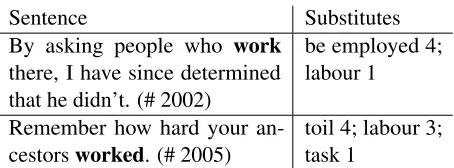
200 target words in sentential contexts, drawn from Sharoff’s (2006) English Internet Corpus. Contex-tually appropriate paraphrases for each instance of each target word were elicited from up to 6 partic-ipants. Fig. 4 shows two instances for the verbto work. The distribution over paraphrases can be seen as a characterization of the target word’s meaning in each context.
Experimental procedure. In this paper, we
pre-dict appropriate paraphrases solely on the basis of a
single context word that stands in a direct predicate-argument relation to the target word. We extracted all instances from the lexsub test data with such a relation. After parsing all sentences with verbal and nominal targets with Minipar, this resulted in three
Sentence Substitutes
By asking people who work
there, I have since determined that he didn’t. (# 2002)
be employed 4; labour 1
Remember how hard your an-cestorsworked. (# 2005)
[image:8.612.312.539.55.139.2]toil 4; labour 3; task 1
Figure 4: Lexical substitution example items for “work”
sets of sentences: (a), target intransitive verbs with
noun subjects (V-SUBJ, 48 sentences); (b), target
tran-sitive verbs with noun objects (V-OBJ, 213 sent.); and (c), target nouns occurring as objects of verbs (N-OBJ,
102 sent.).6 Note that since we use only part of the lexical substitution dataset in this experiment, a
di-rect comparison with results from the SemEval task
is not possible.
As in the original SemEval task, we phrase the task as a ranking problem. For each target word, the paraphrases given for all 10 instances are pooled. The task is to rank the list for each item so that appropriate paraphrases (such as “be employed” for # 2002) rank higher than paraphrases not given (e.g., “toil”).
Our model ranks paraphrases by their similarity to the following combinations (Eq. (4)): forV-SUBJ,
verb plus the noun’ssubj−1preferences; forV-OBJ,
verb plus the noun’sobj−1 preferences; and forN -OBJ, the noun plus the verb’sobjpreferences. Our comparison model, M&L, ranks all paraphrases by their similarity to the direct noun-verb combination. To avoid overfitting, we consider only the two mod-els that performed optimally in in the SYNspace in Experiment 1 (SELPREF-POWwithn=30 and M&L).
However, since we found that vectors with raw
fre-quency components could model the data, while PMI components could not, we only report the former.
For evaluation, we adopt the SemEval “out of ten” precision metricPOOT. It uses the model’s ten
top-ranked paraphrases as its guesses for appropri-ate paraphrases. LetGi be the gold paraphrases for
itemi,Mithe model’s top ten paraphrases fori, and f(s, i)the frequency ofsas paraphrase fori:
POOT = 1/|I|
X
i P
s∈Mi∩Gif(s, i) P
s∈Gif(s, i)
(8)
McCarthy and Navigli propose this metric for the
6
Model V-SUBJ V-OBJ N-OBJ
Target only 47.9 47.4 49.6
Selpref only 54.8 51.4 55.0
M&L 50.3 52.0 53.4
[image:9.612.66.363.58.127.2]SELPREF-POW,n=30 63.1 55.8 56.9
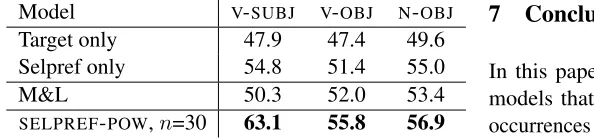
Table 3: Experiment 2: Mean “out of ten” precision (POOT)
dataset for robustness. Due to the sparsity of
para-phrases, a metric that considers fewer guesses leads
to artificially low results when a “good” paraphrase was not mentioned by the annotators by chance but is ranked highly by a model.
Results and discussion. Table 6 shows the mean
out-of-ten precision for all models. The behavior is
fairly uniform across all three datasets.
Unsurpris-ingly, “target only”, which uses the same ranking for
all instances of a target, yields the worst results.7
M&L’s direct combination model outperforms “tar-get only” significantly (p <0.05). However, on both theV-SUBJand theN-OBJthe “selpref only” baseline
does better than direct combination. The best results on all datasets are obtained bySELPREF-POW. The difference between SELPREF-POW and the “target
only” baseline is highly significant (p <0.01). The difference to M&L’s model is significant atp= 0.05.
We interpret these results as encouraging evidence for the usefulness of selectional preferences for judg-ing substitutability in context. Knowledge about the
selectional preferences of a single context word can
already lead to a significant improvement in precision.
We find this overall effect even though the word is
not informative in all cases. For instance, the subject of item 2002 in Fig. 4, “who”, presumably helps little in determining the verb’s context-adapted meaning.
It is interesting that the improvement ofSELPREF
-POW over “selpref only” is smallest for theN-OBJ dataset (1.9%POOT). N-OBJuses selectional
prefer-ences for nouns that may fill the direct object position,
, while V-SUBJ and V-OBJ use inverse selectional preferences for verbs (cf. the two graphs in Fig. 1).
7“Target only” still does very much better than a random baseline, which performs at 22% POOT.
7 Conclusion
In this paper, we have considered semantic space models that can account for the meaning of word
occurrences in context. Arguing that existing models do not sufficiently take syntax into account, we have introduced the new structured vector space (SVS)
model of word meaning. In addition to a vector
rep-resenting a word’s lexical meaning, it contains vec-tors representing the word’s selectional preferences. These selectional preferences play a central role in the computation of meaning in context.
We have evaluated theSVSmodel on two datasets on the task of predicting the felicitousness of para-phrases in given contexts. On the M&L dataset, SVSoutperforms the state-of-the-art model of M&L, though the difference is not significant. On the Lex-ical Substitution dataset, SVS significantly outper-forms the state-of-the-art. This is especially interest-ing as the Lexical Substitution dataset, in contrast to the M&L data, uses “realistic” paraphrase candidates that are not necessarily maximally distinct.
The most important limitation of the evaluation that we have given in this paper is that we have only considered single words as context. Our next step will be to integrate information from multiple rela-tions (such as both the subject and object posirela-tions of a verb) into the computation of context-specific meaning. Our eventual aim is a model that can give
a compositional account of a word’s meaning in
con-text, where all words in an expression disambiguate
one another according to the relations between them.
We will explore the usability of vector space mod-els of word meaning in NLP applications, formulated as the question of how to perform inferences on them in the context of the Textual Entailment task (Dagan et al., 2006). Paraphrase-based inference rules play a large role in several recent approaches to Textual
Entailment (e.g. Szpektor et al (2008));
appropriate-ness judgments of paraphrases in context, the task of Experiments 1 and 2 above, can be viewed as testing
the applicability of these inferences rules.
Acknowledgments.Many thanks for helpful
dis-cussion to Jason Baldridge, David Beaver, Dedre
References
C. Brockmann, M. Lapata. 2003. Evaluating and combin-ing approaches to selectional preference acquisition. In Proceedings of EACL, 27–34.
I. Dagan, O. Glickman, B. Magnini. 2006. The PASCAL
Recognising Textual Entailment Challenge. In
Ma-chine Learning Challenges, Lecture Notes in Computer Science, 177–190. Springer.
K. Erk. 2007. A simple, similarity-based model for selec-tional preferences. InProceedings of ACL, 216–223.
T. Ferretti, C. Gagne, K. McRae. 2003. Thematic role fo-´ cusing by participle inflections: evidence form concep-tual combination.Journal of Experimental Psychology, 29(1):118–127.
D. Gildea, D. Jurafsky. 2002. Automatic labeling of
semantic roles. Computational Linguistics, 28(3):245–
288.
D. Hindle, M. Rooth. 1993. Structural ambiguity and lexical relations.Computational Linguistics, 19(1):103– 120.
M. Jones, D. Mewhort. 2007. Representing word mean-ing and order information in a composite holographic lexicon.Psychological review, 114:1–37.
J. J. Katz, J. A. Fodor. 1964. The structure of a semantic theory. InThe Structure of Language. Prentice-Hall. A. Kilgarriff. 1997. I don’t believe in word senses.
Com-puters and the Humanities, 31(2):91–113.
W. Kintsch. 2001. Predication. Cognitive Science, 25:173–202.
T. Landauer, S. Dumais. 1997. A solution to Platos prob-lem: the latent semantic analysis theory of acquisition, induction, and representation of knowledge. Psycho-logical Review, 104(2):211–240.
D. Lin. 1993. Principle-based parsing without
overgener-ation. InProceedings of ACL, 112–120.
D. Lin. 1998. Automatic retrieval and clustering of simi-lar words. InProceedings of COLING-ACL, 768–774. K. Lund, C. Burgess. 1996. Producing high-dimensional semantic spaces from lexical co-occurrence. Behav-ior Research Methods, Instruments, and Computers, 28:203—208.
C. D. Manning, P. Raghavan, H. Sch¨utze. 2008.
Introduc-tion to InformaIntroduc-tion Retrieval. CUP.
D. McCarthy, J. Carroll. 2003. Disambiguating nouns, verbs, and adjectives using automatically acquired selectional preferences. Computational Linguistics, 29(4):639–654.
D. McCarthy, R. Navigli. 2007. SemEval-2007 Task 10: English Lexical Substitution Task. InProceedings of SemEval, 48–53.
S. McDonald, C. Brew. 2004. A distributional model of semantic context effects in lexical processing. In Proceedings of ACL, 17–24.
S. McDonald, M. Ramscar. 2001. Testing the distribu-tional hypothesis: The influence of context on judge-ments of semantic similarity. InProceedings of CogSci, 611–616.
K. McRae, M. Spivey-Knowlton, M. Tanenhaus. 1998. Modeling the influence of thematic fit (and other con-straints) in on-line sentence comprehension. Journal of
Memory and Language, 38:283–312.
K. McRae, M. Hare, J. Elman, T. Ferretti. 2005. A basis for generating expectancies for verbs from nouns. Memory and Cognition, 33(7):1174–1184.
J. Mitchell, M. Lapata. 2008. Vector-based models of semantic composition. InProceedings of ACL, 236– 244.
A. Moschitti, S. Quarteroni. 2008. Kernels on linguistic structures for answer extraction. In Proceedings of ACL, 113–116, Columbus, OH.
S. Narayanan, D. Jurafsky. 2002. A Bayesian model predicts human parse preference and reading time in sentence processing. InProceedings of NIPS, 59–65. S. Pado, M. Lapata. 2007. Dependency-based construc-´
tion of semantic space models. Computational
Linguis-tics, 33(2):161–199.
U. Pado, F. Keller, M. W. Crocker. 2006. Combining syn-´ tax and thematic fit in a probabilistic model of sentence processing. InProceedings of CogSci, 657–662. S. Pado, U. Pad´ o, K. Erk. 2007. Flexible, corpus-based´
modelling of human plausibility judgements. In Pro-ceedings of EMNLP/CoNLL, 400–409.
P. Resnik. 1996. Selectional constraints: An
information-theoretic model and its computational realization.
Cog-nition, 61:127–159.
G. Salton, A. Wang, C. Yang. 1975. A vector-space model for information retrieval.Journal of the American
So-ciety for Information Science, 18:613–620.
H. Schutze. 1998. Automatic word sense discrimination.¨ Computational Linguistics, 24(1):97–124.
S. Sharoff. 2006. Open-source corpora: Using the net to
fish for linguistic data.International Journal of Corpus
Linguistics, 11(4):435–462.
P. Smolensky. 1990. Tensor product variable binding and the representation of symbolic structures in connection-ist systems.Artificial Intelligence, 46:159–216. I. Szpektor, I. Dagan, R. Bar-Haim, J. Goldberger. 2008.
Contextual preferences. InProceedings of ACL, 683– 691, Columbus, OH.
Y. Wilks. 1975. Preference semantics. InFormal
Seman-tics of Natural Language. CUP.