Specialized models and ranking for coreference resolution
Pascal Denis ALPAGE Project Team
INRIA Rocquencourt F-78153 Le Chesnay, France
Jason Baldridge Department of Linguistics University of Texas at Austin Austin, TX 78712-0198, USA
Abstract
This paper investigates two strategies for im-proving coreference resolution: (1) training separate models that specialize in particu-lar types of mentions (e.g., pronouns versus proper nouns) and (2) using a ranking loss function rather than a classification function. In addition to being conceptually simple, these modifications of the standard single-model, classification-based approach also deliver sig-nificant performance improvements. Specifi-cally, we show that on the ACE corpus both strategies producef-score gains of more than 3% across the three coreference evaluation metrics (MUC,B3, andCEAF).
1 Introduction
Coreference resolution is the task of partitioning a set of entity mentions in a text, where each par-tition corresponds to some entity in an underlying discourse model. While early machine learning ap-proaches for the task relied on local, discriminative classifiers (Soon et al., 2001; Ng and Cardie, 2002b; Morton, 2000; Kehler et al., 2004), more recent ap-proaches use joint and/or global models (McCallum and Wellner, 2004; Ng, 2004; Daum´e III and Marcu, 2005; Denis and Baldridge, 2007a). This shift im-proves performance, but the systems are consider-ably more complex and often less efficient. Here, we explore two simple modifications of the first type of approach that yield performance gains which are comparable, and sometimes better, to those obtained with these more complex systems. These modifica-tions involve: (i) the use ofrankersinstead of
clas-sifiers, and (ii) the use of linguistically motivated, specialized modelsfor different types of mentions.
Ranking models provide a theoretically more ad-equate and empirically better alternative approach to pronoun resolution than standard classification-based approaches (Denis and Baldridge, 2007b). In essence, ranking models directly capture during training the competition among potential antecedent candidates, instead of considering them indepen-dently. This gives the ranker additional discrimina-tive power and in turn better antecedent selection ac-curacy. Here, we show that ranking is also effective for the wider task of coreference resolution.
Coreference resolution involves several different types of anaphoric expressions: third-person pro-nouns, speech pronouns (i.e., first and second person pronouns), proper names, definite descriptions and other types of nominals (e.g., anaphoric uses of in-definite, quantified, and bare noun phrases). Differ-ent anaphoric expressions exhibit differDiffer-ent patterns of resolution and are sensitive to different factors (Ariel, 1988; van der Sandt, 1992; Gundel et al., 1993), yet most machine learning approaches have ignored these differences and handle these different phenomena with a single, monolithic model. A few exceptions are worth noting. Morton (2000) and Ng (2005b) propose different classifiers models for dif-ferent NPs for coreference resolution and pronoun resolution, respectively. Other partially capture the differential preferences between different anaphors via different sample selection strategies during train-ing (Ng and Cardie, 2002b; Uryupina, 2004). More recently, Haghighi and Klein (2007) use the distinc-tion between pronouns, nominals and proper nouns
in their unsupervised, generative model for corefer-ence resolution; for their model, this is absolutely critical for achieving better accuracy. Here, we show that using specialized models for different types of referential expressions improves performance for supervised models (both classifiers and rankers).
Both these strategies lead to improvements for all three standard coreference metrics: MUC (Vilain et al., 1995), B3 (Bagga and Baldwin, 1998), and
CEAF (Luo, 2005). In particular, our specialized ranker system provides absolute f-score improve-ments against an otherwise identical standard clas-sifier system by 3.2%, 3.1%, and 3.6% forMUC,B3, andCEAF, respectively.
2 Ranking
Numerous approaches to anaphora and coreference resolution reduce these tasks to a binary classifica-tion task, wherebypairsof mentions are classified as coreferential or not (McCarthy and Lehnert, 1995; Soon et al., 2001; Ng and Cardie, 2002b). Usually used in combination with a greedy right-to-left clus-tering, these approaches make very strong indepen-dence assumptions. Not only do they model each coreference decision separately, they actually model each pair of mentions as a separate event. Recast-ing these tasks as rankRecast-ing tasks partly addresses this problem by directly making the comparison between different candidate antecedents for an anaphor part of the training criterion. Each candidate is assigned a conditional probability with respect to the entire candidate set. (Re)rankers have been successfully applied to numerous NLP tasks, such as parse se-lection (Osborne and Baldridge, 2004; Toutanova et al., 2004), parse reranking (Collins and Duffy, 2002; Charniak and Johnson, 2005), question-answering (Ravichandran et al., 2003).
The twin-candidate classification approach pro-posed by (Yang et al., 2003) shares some similarities with the ranker in making the comparison between candidate antecedents part of training. An important difference however is that under the twin-candidate approach, candidates are compared inpairwise fash-ion (and the best overall candidate is the one that has won the most round robin contests), while the ranker considers the entire candidate set at once. Another advantage of the ranking approach is that its
com-plexity is only square in the number of mentions, while that of the twin-candidate model is cubic (see Denis and Baldridge (2007b) for a more detailed comparison in the context of pronoun resolution).
Our ranking models for coreference take the fol-lowing log-linear form:
Prk(αi|π) =
exp
m
P
j=1
wjfj(π, αi)
P
k
exp
m
P
j=1
wjfj(π, αk)
(1)
whereπ stands for the anaphoric expression,αi for
an antecedent candidate,fj the weighted features of
the model. The denominator consists of a normal-ization factor over thekcandidate mentions. Model parameters were estimated with the limited memory variable metric algorithm and Gaussian smoothing (σ2=1000), usingTADM(Malouf, 2002).
For the training of the different ranking models, we use the following procedure. For each model, in-stances are created by pairing each anaphor of the proper type (e.g., definite description) with a set of candidates which contains: (i) a true antecedent, and (ii) a set of non-antecedents. The selection of the true antecedent varies depending on the model we are training: for pronominal forms, the antecedent is selected as the closestpreceding mention in the chain; for non-pronominal forms, we used the clos-est precedingnon-pronominalmention in the chain as the antecedent. For the creation of the non-antecedent set, we collect all the non-non-antecedents that appear in a window of two sentences around the antecedent.1 At test time, we considerallpreceding mentions as potential antecedents.
Not all referential expressions in a given docu-ment are anaphors: some expressions introduce a discourse entity, rather than accessing an existing one. Thus, coreference resolvers must have a way of identifying such “discourse-new” expressions. This is easily handled in the standard classification ap-proach: a mention will not be resolved if none of its candidates is classified positively (i.e., as coreferen-tial). The problem is more troublesome for rankers, which always pick an antecedent from the candidate
1
set. A natural solution is to use a model that specifi-cally predicts the discourse status (discourse-new vs. discourse-old) of each expression: only expressions that are classified as “discourse-old” by this model are considered by rankers.
Ng and Cardie (Ng and Cardie, 2002a) introduced the use of an “anaphoricity” classifier to act as a fil-ter for coreference resolution in order to correct er-rors where antecedents are mistakenly identified for non-anaphoric mentions or antecedents are not de-termined for mentions which are indeed anaphoric. Their approach produced significant improvements in precision, but with consequent larger losses in re-call. Ng (2004) improves recall by optimizing the anaphoricity threshold. By using joint inference for anaphoricity and coreference, Denis and Baldridge (2007a) avoid cascade-induced errors without the need to separately optimize the threshold.
We use a similar discourse status classifier to Ng and Cardie’s as a filter on mentions for our rankers. We rely on three main types of information sources: (i) the form of mention (e.g., type of linguistic ex-pression, number of tokens), (ii) positional features in the text, (iii) comparisons of the given mention to the mentions that precede it in the text. Evaluated on theACE datasets, training the model on thetrain
texts, and applying the classifier to the devtest
texts, the model achieves an overall accuracy score of 80.8%, compared to a baseline of 59.7% when predicting the majority class (“discourse-old”).
3 Specialized models
Our second strategy is to use different, specialized models for different referential expressions, simi-larly to Elwell and Baldridge’s (2008) use of connec-tive specific models for identifying the arguments of discourse connectives. For this, one must determine along which dimension to split such expressions. For example, Ng (2005b) learns models for each set of anaphors that are lexically identical (e.g., I, he, they, etc.). This option is possible for closed sets like pronouns, but not for other types of anaphors like proper names and definite descriptions. Another option is to rely on the particularlinguistic formof the different expressions, as signaled by the head word category and the determiner (if any). More concretely, we use separate models for the
follow-ing types: (i) third person pronouns, (ii) speech pro-nouns, (iii) proper names, (iv) definite descriptions, and (v) others (i.e., all expressions that don’t fall into the previous categories).
The correlation between the form of a referen-tial expression and its anaphoric behavior is actually central to various linguistic accounts (Prince, 1981; Ariel, 1988; Gundel et al., 1993). Basically, the idea is that linguistic form is an indicator of the status of the corresponding referent in the discourse model. That is, the use by the speaker of a particular lin-guistic form corresponds to a particular level of acti-vation (or familiarity or salience or accessibility) in (what she thinks is) the addressee’s discourse model. For many authors, the relation takes the form of a continuum and is often represented in the form of a referential hierarchy, such as:
Accessibility Hierarchy(Ariel, 1988)
Zero pronouns>>Pronouns>> Demonstra-tive pronouns >> Demonstrative NPs >> Short PNs>>Definite descriptions>>Full PNs>>Full PNs + appositive
The higher up, the more accessible (or salient) the entity is. At the extremes are pronouns (these forms typically require a previous mention in the local con-text) and proper names (these forms are often used without previous mentions of the entity). This type of hierarchy is validated by corpus studies of the distribution of different types of expressions. For instance, pronouns find their antecedents very lo-cally (in a window of 1-2 sentences), while proper names predominantly find theirs at longer distances (Ariel, 1988).2 Using discourse structure, Asher et al. (2006) show that while anaphoric pronouns sys-tematically obey the right-frontier constraint (i.e., their antecedents have to appear on the right edge of the discourse graph), this is less so for definites, and even less so for proper names.
From a machine learning perspective, these find-ings suggest that features encoding some aspect of salience (e.g., distance, syntactic context) are likely to receive different sets of parameters depending on the form of the anaphor. This therefore suggests that better parameters are likely to be learned in the
2
Type/Count train test 3rdpron. 4,389 1,093 speech pron. 2,178 610 proper names 7,868 1,532 def.NPs 3,124 796
others 1,763 568
[image:4.612.313.542.56.339.2]Total 19,322 4,599
Table 1: Distribution of the different anaphors inACE
context of different models.3 While the above stud-ies focus primarily on salience, there are of course other dimensions according to which anaphors differ in their resolution preferences. Thus, the resolution of lexical expressions like definite descriptions and proper names is likely to benefit from the inclusion of features that compare the strings of the anaphor and the candidate antecedent (e.g., string matching) and features that identify particular syntactic config-urations like appositive structures. This type of in-formation is however much less likely to help in the resolution of pronominal forms. The problem is that, within a single model, such features are likely to re-ceive strong parameters (due to the fact that they are good predictors for lexical anaphors) in a way that might eventually hurt pronominal resolutions.
Note that our split of referential types only partially cover the referential hierarchies of Ariel (1988) or Gundel et al. (1993). Thus, there is no sep-arate model for demonstrative noun phrases and pro-nouns: these are very rare in the corpus we used (i.e., theACEcorpus).4 These expressions were therefore
handled through the “others” model. There is how-ever a model for first and second person pronouns (i.e., speech pronouns): this is justified by the fact that these pronouns behave differently from their third person counterparts. These forms indeed of-ten behave like deictics (i.e., they refer to discourse participants) or they appear within a quote.
The total number of anaphors (i.e., of mentions that are not chain heads) in the data is19,322and 4,599for training and testing, respectively. The dis-tribution of each anaphoric type is presented in Ta-ble 1. Roughly, third person pronouns account for
3
Another possible approach would consist in introducing different salience-based features encoding the form of the anaphor.
4There are only114demonstrative
NPs and12 demonstra-tive pronouns in the entireACEtraining.
Linguistic Form
pn αis a proper name{1,0} def np αis a definite description{1,0} indef np αis an indefinite description{1,0} pro αis a pronoun{1,0}
Context
left pos POS of the token precedingα
right pos POS of the token followingα
surr pos pair of POS for the tokens surroundingα
Distance
s dist Binned values for sentence distance betweenπandα
np dist Binned values for mention distance betweenπandα
Morphosyntactic Agreement
gender pairs of attributes{masc, fem, neut, unk}forπandα
number pairs of attributes{sg, pl}forπandα
person pairs of attributes{1, 2, 3, 4, 5, 6}forπandα
Semantic compatibility
wn sense pairs of Wordnet senses forπandα
String similarity
str match πandαhave identical strings{1,0}
left substr one mention is a left substring of the other{1,0} right substrone mention is a right substring of the other{1,0} hd match πandαhave the same head word{1,0}
Apposition
apposition πandαare in an appositive structure{1,0}
Acronym
[image:4.612.117.258.56.141.2]acronym πis an acronym ofαor vice versa{1,0}
Table 2: Features used by coreference models.
22-24% of all anaphors in the entire corpus, speech pronouns for 11-13%, proper names for 33-40%, and definite descriptions for16-17%. The distribu-tion is slightly different from one dataset to another, probably reflecting genre differences. For instance,
BNEWS shows a larger proportion of pronouns in general (pronominal forms account for 40-44% of all the anaphoric forms).
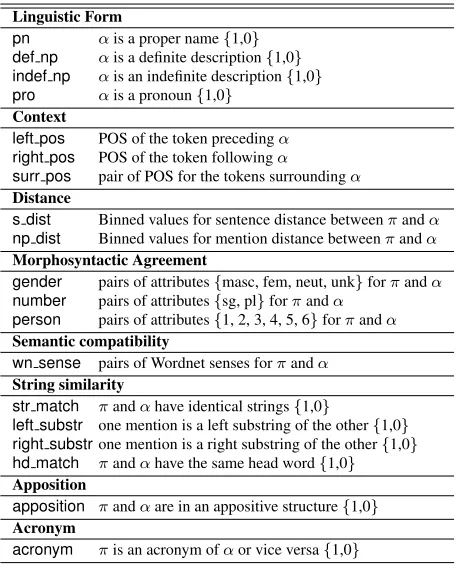
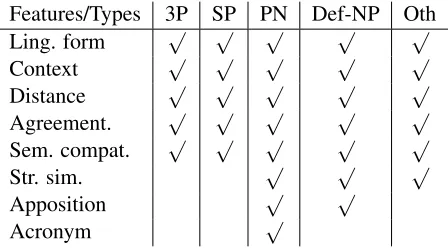
We use five broad types of features for all mention types, plus three others used by specific types, sum-marized in Table 3. Our feature extraction relies on limited linguistic processing: we only made use of a sentence detector, a tokenizer, a POS tagger (as pro-vided by the OpenNLP Toolkit5) and the WordNet6
database. Since we did not use parser, lexical heads for the NP mentions were computed using simple heuristics relying solely on POS sequences. Table 2 describes in detail the entire feature set, and Table 3 shows which features were used for which models.
Linguistic form: the referential form of the an-tecedent candidate: a proper name, a definite
de-5
http://opennlp.sf.net.
Features/Types 3P SP PN Def-NP Oth
Ling. form √ √ √ √ √
Context √ √ √ √ √
Distance √ √ √ √ √
Agreement. √ √ √ √ √
Sem. compat. √ √ √ √ √
Str. sim. √ √ √
Apposition √ √
[image:5.612.74.298.57.181.2]Acronym √
Table 3: Features for each type of referential expression.
scription, an indefiniteNP, or a pronoun.
Context: the context of the antecedent candidate: these features can be seen as approximations of the grammatical roles, as indicators of the salience of the potential candidate (Grosz et al., 1995). For instance, this includes the part of speech tags sur-rounding the candidate, as well as a feature that indicates whether the potential antecedent is the first mention in a sentence (approximating subject-hood), and a feature indicating whether the candi-date is embedded inside another mention.
Distance: the distance between the anaphor and the candidate, measured by the number of sentences and mentions between them.
Morphosyntactic agreement: indicators of the gender, number, and person of the two mentions. These are determined for non-pronominalNPs with heuristics based on POS tags (e.g.,NNvs. NNSfor number) and actual mention strings (e.g., whether the mention contains a male/female first name or honorific for gender). These features consist of pairs of attributes, ensuring that not only strict agreement (e.g.,singular-singular) but also mere compatibility (e.g.,masculine-unknown) is captured.
Semantic compatibility: features designed to as-sess whether the two mentions are semantically compatible. For these features, we use the Word-Net database: in particular, we collected the syn-onym set (or synset) as well as the synset of their direct hypernyms associated with each mention. In the case of common nouns, we used the synset asso-ciated with the first sense assoasso-ciated with the men-tion’s head word. In the case of proper names, we
used the synset associated with the name if avail-able, and the string itself otherwise. For pronouns (which are not part of Wordnet), we simply used the pronominal form.
All these features were used in all five models. While one may question the use of distance for non-pronominal anaphors,7 their inclusion can be justi-fied in that they might predict some “obviation” ef-fects. Definite descriptions and proper names are sensitive to distance too, although not in the same way as pronouns are: they show a preference for an-tecedents that appear outside a window of one or two sentences (Ariel, 1988).
Several features are used only for particular men-tion types:
String similarity: similarity of the anaphor and the candidate strings. Examples are perfect string match, substring matches, and head match (i.e., the two mentions share the same head word).
Appositive: whether the anaphor is an appositive of the antecedent candidate. Since we do not have access to syntactic structure, we use heuristics (e.g., the presence of a comma between the two mentions) to extract this feature.
Acronym: whether the anaphor string is an acronym of the candidate string (or vice versa): e.g., NSFandNational Science Foundation.
4 Coreference systems
We evaluate several systems to explore the effect of ranking versus classification and specialized versus monolithic models. The different systems follow a generic architecture. LetMbe the set of mentions present in a document. For all models, each mention
m ∈ Mis associated at test time with a set of an-tecedent candidatesCm, which includes all the men-tions that linearly precedem. The best candidate is determined by the model in use. The final output of each system consists in a list of mention pairs (i.e., the coreference links) which in turn defines (through reflexive, transitive closure) a partition over the set
M. Our models are summarized in Table 4.
The use of the discourse status filter is straightfor-ward. For each mentionm∈M, the discourse status
7
Model Disc. Model Name Type Specialized? Status
CLASS class No No
CLASS+DS class No Yes
CLASS+SP class Yes No
CLASS+DS+SP class Yes Yes
[image:6.612.364.488.56.138.2]RANK+DS+SP rank Yes Yes
Table 4: Model names and their properties.
model is first applied to determine whetherm intro-duces a new discourse entity (i.e., it is classified as “new”) or refers back to an existing entity (i.e., it is classified as “old”). If m is classified as “new”, the process terminates and goes to the next mention. If m is classified as “old”, m along with its set of antecedent candidatesCmis sent to the model.
For classifiers, we replicate the procedures of Ng and Cardie (2002b). During training, instances are formed by pairing each anaphor with each of its pre-ceding candidates, until the antecedent is reached: the closest preceding antecedent in the case of a pronominal anaphor, or the closest non-pronominal antecedent for other anaphor types. For classifiers, the use of a discourse status filter at test time is op-tional. When a filter is not used, then a mention is left unresolved if none of the pairs created for a given mention is classified positively. If several pairs for a given mention are classified positively, then the pair with the highest score is selected (i.e., “Best-First” link selection). If a filter is used, then the can-didate with the highest score is selected, even if the probability of coreference is less than one-half.8
The use of specialized models is simple, for both classifiers and rankers. Specialized models are cre-ated for: (i) third person pronouns, (ii) speech pro-nouns, (iii) proper names, (iv) definite descriptions, (v) other types of phrases. The mention type is
de-8This is very similar to the approach of Ng and Cardie (2002a). An important difference is that their system does not necessarily yield an antecedent for each of the anaphors pro-posed by the discourse status model. In their system, if the coreference classifier finds that none of the candidates for a “new” mention are coreferential, it leaves it unresolved. In this case, the coreference model acts as an additional filter. Not sur-prisingly, these authors report gains in precision but compar-atively larger losses in recall. Our development experiments revealed that forcing a decision on items identified as new pro-vided performed better across all metrics.
System Accuracy
3rdpron. 82.2 speech pron. 66.9 proper names 83.5 def. NPs 66.5
[image:6.612.74.300.56.153.2]others 63.6
Table 5: Accuracy of the different ranker models.
termined and the best candidate is chosen by the appropriate model Following Elwell and Baldridge (2008), these models could be interpolated with a monolithic model, or even word specific models, but we have not explored that option here.
The feature sets for the classifiers in the base-line systems includes all the features that were used for the described in Section 3. For the classi-fiers that do not use specialized models (CLASSand
CLASS+DS), we have also added extra features de-scribing the linguistic form of the potential anaphor (whether it is a pronoun, a proper name, and so on). This is in accordance with standard feature sets in the pairwise approach. It gives these models a chance to learn weights more appropriately for the different types within a single, monolithic model.
5 Experiments
We use the ACE corpus (Phase 2). The corpus has three parts, each corresponding to a different genre: newspaper texts (NPAPER), newswire texts (NWIRE), and broadcast news (BNEWS). Each set is split into
atrainpart and adevtestpart. In our experi-ments, we consider onlytrueACE mentions.
5.1 Antecedent selection results
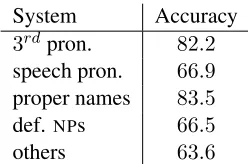
The best accuracy results on the entire ACE cor-pus are found first for the proper name resolver with a score of83.5%, then for the third person pronoun resolver with 82.2%, then for the definite descrip-tion and speech pronoun resolvers with66.9% and 66.5% respectively. The worst scores are obtained for the “others” category. The high scores for the third person pronoun and the proper name rankers most likely follow from the fact that the resolution of these expressions relies on simple, reliable pre-dictors, such as distance and morphosyntactic agree-ment for pronouns, and string similarity features for proper names. The resolution of definite descrip-tions and other types of lexicalNPs (which are
han-dled through the “others” model) are much more challenging: they rely on lexical semantic and world knowledge, which is only partially encoded via our WordNet-based features. Finally, note that the reso-lution of speech pronouns is also much harder than that of the other pronominal forms: these expres-sions are much less (if at all) constrained by re-cency and agreement. Furthermore, these expres-sions show a lot of cataphoric uses, which are not considered by our models. The low scores for the “others” category is likely due to the fact that it en-compasses very different referential expressions.
5.2 Coreference Results
For evaluating the coreference performance, we rely on three primary metrics: (i) the link based MUC
metric (Vilain et al., 1995), the mention based B3
metric (Bagga and Baldwin, 1998), and the entity based CEAFmetric (Luo, 2005). Common to these metrics is: (i) they operate by comparing the set of chains S produced by the system against the true chainsT, and (ii) they report performance in terms ofrecalland precision. There are however impor-tant differences in how each metric computes these scores, each producing a different bias.
MUC scores are based on the number of links (pairs of mentions) common to S and T. Recall is the number of common links divided by the to-tal number of links inT; precision is the number of common links divided by the total number of links inS. This focus givesMUC two main biases. First, it favors systems that create large chains (and thus fewer entities). For instance, a system that produces a single chain achieves 100% recall without severe
degradation in precision. Second, it ignores single mention entities, which are involved in no links.9
The B3 metric was designed to address theMUC
metric’s shortcomings. It ismention-based: it com-putes both recall and precision scores for each men-tion i. LetS be the system chain containingm, T
be the true chain containingm. The set of correct elements inS is thus|S∩T|. The recall score for a mentioniis |S|∩TT||, while the precision score fori
is |S|∩ST||. Overall recall/precision is obtained by av-eraging over the individual mention scores. The fact that this metric is mention-based by definition solves the problem of single mention entities. Also solved is the bias favoring larger chains, since this will be penalized in the precision score ofeachmention.
The Constrained Entity Aligned F-Measure (CEAF) (Luo, 2005). aligns each system chain S
withat most onetrue chainT. It finds the best one-to-one mapping between the set of chainsS andT, which is equivalent to finding the optimal alignment in a bipartite graph. The best mapping maximizes the similarity over pairs of chains (Si, Ti), where
the similarity between two chains is the number of common mentions to the two chains. With CEAF,
recall is computed as the total similarity divided by the number of mentions in all theT (i.e., the self-similarity), while precision is the total similarity di-vided by the number of mentions inS.
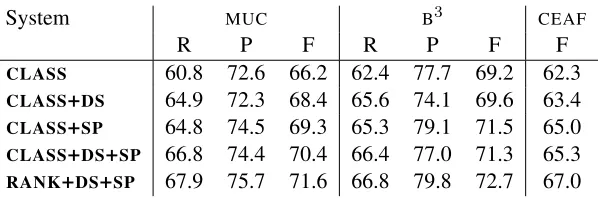
Table 6 gives scores for all three metrics for the different models on the entire ACE
corpus. Two main patterns emerge: sig-nificant improvements are obtained by using specialized models (CLASS vs CLASS+SP and
CLASS+DS vs CLASS+DS+SP) and by using a ranker (CLASS+DS+SPvsRANK+DS+SP). Overall, theRANK+DS+SPsystem significantly outperforms the other systems on the three different metrics.10
The f-scores for RANK+DS+SP are 71.6% with
the MUC metric, 72.7% with the B3, and 67.0% with the CEAF metric. These scores place the
RANK+DS+SP among the best coreference
resolu-tion systems, since most existing systems are typi-cally under the bar of the70% inf-score with the
9
It is worth noting that theMUCcorpus does not annotate single mention entities.
System MUC B3 CEAF
R P F R P F F
CLASS 60.8 72.6 66.2 62.4 77.7 69.2 62.3
CLASS+DS 64.9 72.3 68.4 65.6 74.1 69.6 63.4 CLASS+SP 64.8 74.5 69.3 65.3 79.1 71.5 65.0
CLASS+DS+SP 66.8 74.4 70.4 66.4 77.0 71.3 65.3
[image:8.612.158.457.55.154.2]RANK+DS+SP 67.9 75.7 71.6 66.8 79.8 72.7 67.0
Table 6: Recall (R), Precision (P), andf-score (F) results on the entireACEcorpus using theMUC, B3, andCEAF metrics. Note that R=P=F for CEAF when using true mentions, as we do here.
MUC and B3 metrics (Ng, 2005a). An interesting point of comparison is provided by Ng (2007), who also relies on true mentions and reports MUC f -scores only slightly superior to ours (73.8%) while relying on perfect semantic class information. His best results otherwise are 64.6%. The fact that our improvements are consistent across the different evaluation metrics is remarkable, especially given that these three metrics are quite different in the way they compute their scores. The gains in f -score range from 1.2 to 5.4% on the MUC metric (i.e., error reductions of 4 to 15.9%), from 1.4 to 3.5% on the B3 metric (i.e., error reductions of4.8
to11.4%), and from1.7to4.7% on theCEAF met-ric (i.e., error reductions of6.9to17%). The larger improvements come from recall, with improvements ranging from 1.9 to 7.1% with MUC, from 2.4 to 5.6% with B3.11 This suggests that RANK+DS+SP
predicts many more valid coreference links than the other systems. Smaller but still significant gains are made in precision: RANK+DS+SPis also able to re-duce the proportion of invalid links.
The overall improvements found with
RANK+DS+SP suggest that it is able to
capi-talize on the better antecedent selection capabilities offered by the ranking approach. This is supported by the error analysis on the development data. Errors made by a coreference system can be con-ceptualized as falling into three main classes: (i) “missed anaphors” (i.e., an anaphoric mention that fails to be linked to a previous mention), (ii) “spuri-ous anaphors” (i.e., an non-anaphoric mention that is linked to a previous mention), and (iii) “invalid resolutions” (i.e., a true anaphor that is linked to a
11Recall that recall and precision scores are identical with
CEAF, due to the fact that we are using true mention boundaries.
incorrect antecedent). The two first types of error pertain to the determination of the discourse status of the mention, while the third regards the selection of an antecedent (i.e., anaphora resolution). Con-sidering the systems’ invalid resolutions, we found that theRANK+DS+SPhad a much lower error rate: only 17.9% of all true anaphors were incorrectly resolved by this system, against23.1% for CLASS, 24.9% for CLASS+DS, 20.4% for CLASS+SP, and 22.1% forCLASS+DS+SP.
Denis (2007) provides multi-metric scores for the
JOINT-ILP model of Denis and Baldridge (2007a), which uses integer linear programming for joint in-ference over corein-ference resolution and discourse status: f-scores of 73.3%, 68.0%, and 58.9% for
MUC, B3, andCEAF, respectively. Despite the fact that thisMUC score beatsRANK+DS+SP’s, it is ac-tually worsethan even the basic model CLASS for B3 and CEAF. This difference fact that MUC gives more recall credit for large chains without a conse-quent precision reduction, and shows the importance of usingB3andCEAFscores in addition toMUC.
Denis (2007) also extends theJOINT-ILP system by adding named entity resolution and constraints on transitivity with respect to coreference links. The best model reported there (JOINT-DS-NE-AE-ILP) obtains f-scores of 70.1%, 72.7%, and 66.2% for
MUC, B3, and CEAF, respectively. Interestingly,
RANK+DS+SP actually performs better across all metrics despite being a simpler model with fewer sources of information.
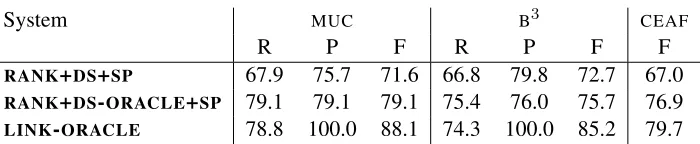
5.3 Oracle results
System MUC B3 CEAF
R P F R P F F
RANK+DS+SP 67.9 75.7 71.6 66.8 79.8 72.7 67.0
[image:9.612.133.483.54.126.2]RANK+DS-ORACLE+SP 79.1 79.1 79.1 75.4 76.0 75.7 76.9 LINK-ORACLE 78.8 100.0 88.1 74.3 100.0 85.2 79.7
Table 7: Recall (R), Precision (P), andf-score (F) results for RANK+DS-ORACLE+SPandLINK-ORACLE on the entireACEcorpus.
possible using a discourse status model that has an accuracy of just 80.8%. Clearly, the performance of the discourse status module has a direct impact on the performance of the entire coreference sys-tem. On the one hand, misclassified anaphors are simply not resolved by the rankers: this limits the recall of the coreference system. On the other hand, misclassified non-anaphors are linked to a previous mention: this limits precision.
In order to further assess the impact of the er-rors made by the discourse status classifier, we build two different oracle systems. The first oracle sys-tem, RANK+DS-ORACLE+SP, uses the specialized rankers in combination with a perfect discourse sta-tus classifier. That is, this system knows for each mention whether it is anaphoric or not: the only er-rors made by such a system are invalid resolutions.
RANK+DS-ORACLE+SP thus provides an upper-bound for theRANK+DS+SPmodel. The results for this oracle are given in Table 7: they show substan-tial improvements over RANK+DS+SP, which sug-gests that the RANK+DS+SP has also the potential to be further improved if used in combination with a more accurate discourse status classifier.
The second oracle system, LINK-ORACLE, uses the discourse status classifier with a perfect corefer-ence resolver. That is, this system has perfect knowl-edge regarding the antecedents of anaphors: the er-rors made by such a system are only erer-rors in the discourse status of mentions. The results forLINK -ORACLEare also reported in Table 7. These figures show that however accurate our models are at pick-ing a correct antecedent for a true anaphor, the best they can achieve in terms off-scores is88.1% with
MUC,85.2% withB3, and79.7% withCEAF.
6 Conclusion
We present and evaluate two straight-forward tac-tics for improving coreference resolution: (i)
rank-ing models, and (ii) separate, specialized models for different types of referring expressions. The specialized rankers are used in combination with a discourse status classifier which determines the mentions that are sent to the rankers. This simple pipeline architecture produces significant improve-ments over various implementations of the standard, classifier-based coreference system. In turn, these strategies could be integrated with the joint infer-ence models we have explored elsewhere (Denis and Baldridge, 2007a; Denis, 2007) and which have ob-tained performance improvements that are orthogo-nal to those obtained here.
This paper’s improvements are consistent across the three main coreference evaluation metrics:MUC,
B3, and CEAF.12 We attribute improvements to: (i)
the better antecedent selection capabilities offered by the ranking approach, and (ii) the division of la-bor between specialized models, allowing each one to better model the corresponding distribution.
Acknowledgments
We would like to thank Nicholas Asher, Andy Kehler, Ray Mooney, and the three anonymous re-viewers for their comments. This work was sup-ported by NSF grant IIS-0535154.
References
M. Ariel. 1988. Referring and accessibility. Journal of Linguistics, pages 65–87.
N. Asher, P. Denis, and B. Reese. 2006. Names and pops and discourse structure. InWorkshop on Constraints in Discourse, Maynooth, Ireland.
A. Bagga and B. Baldwin. 1998. Algorithms for scor-ing coreference chains. InProceedings of LREC 1998, pages 563–566.
E. Charniak and M. Johnson. 2005. Coarse-to-fine n-best parsing and maxent discriminative reranking. In
Proceedings of ACL 2005, Ann Arbor, Michigan. M. Collins and N. Duffy. 2002. New ranking
algo-rithms for parsing and tagging: Kernels over discrete structures and the voted perceptron. InProceedings of ACL 2002, pages 263–270, Philadelphia, PA.
H. Daum´e III and D. Marcu. 2005. A large-scale ex-ploration of effective global features for a joint entity detection and tracking model. InProceedings of HLT-EMNLP 2005, Vancouver, Canada.
P. Denis and J. Baldridge. 2007a. Joint determination of anaphoricity and coreference resolution using integer programming. In Proceedings of HLT-NAACL 2007, Rochester, NY.
P. Denis and J. Baldridge. 2007b. A ranking approach to pronoun resolution. InProceedings of IJCAI 2007, Hyderabad, India.
Pascal Denis. 2007. New Learning Models for Robust Reference Resolution. Ph.D. thesis, The University of Texas at Austin.
R. Elwell and J. Baldridge. 2008. Discourse connec-tive argument identification with connecconnec-tive specific rankers. InProceedings of the International Confer-ence on Semantic Computing, Santa Clara, CA. B. Grosz, A. Joshi, and S. Weinstein. 1995. Centering:
A framework for modelling the local coherence of dis-course.Computational Linguistics, 2(21).
J. K. Gundel, N. Hedberg, and R. Zacharski. 1993. Cog-nitive status and the form of referring expressions in discourse. Language, 69:274–307.
A. Haghighi and D. Klein. 2007. Unsupervised coref-erence resolution in a nonparametric Bayesian model. In Proceedings ACL 2007, pages 848–855, Prague, Czech Republic.
A. Kehler, D. Appelt, L. Taylor, and A. Simma. 2004. The (non)utility of predicate-argument frequencies for pronoun interpretation. In Proceedings of HLT-NAACL 2004.
X. Luo. 2005. On coreference resolution performance metrics. InProceedings of HLT-NAACL 2005, pages 25–32.
R. Malouf. 2002. A comparison of algorithms for max-imum entropy parameter estimation. InProceedings of the Sixth Workshop on Natural Language Learning, pages 49–55, Taipei, Taiwan.
A. McCallum and B. Wellner. 2004. Conditional models of identity uncertainty with application to noun coref-erence. InProceedings of NIPS 2004.
J. F. McCarthy and W. G. Lehnert. 1995. Using deci-sion trees for coreference resolution. InIJCAI, pages 1050–1055.
T. Morton. 2000. Coreference for NLP applications. In
Proceedings of ACL 2000, Hong Kong.
V. Ng and C. Cardie. 2002a. Identifying anaphoric and non-anaphoric noun phrases to improve coreference resolution. InProceedings of COLING 2002.
V. Ng and C. Cardie. 2002b. Improving machine learn-ing approaches to coreference resolution. In Proceed-ings of ACL 2002, pages 104–111.
V. Ng. 2004. Learning noun phrase anaphoricity to im-prove coreference resolution: Issues in representation and optimization. InProceedings of ACL 2004. V. Ng. 2005a. Machine learning for coreference
reso-lution: From local classification to global ranking. In
Proceedings of ACL 2005, pages 157–164, Ann Arbor, MI.
V. Ng. 2005b. Supervised ranking for pronoun resolu-tion: Some recent improvements. InProceedings of AAAI 2005.
V. Ng. 2007. Semantic class induction and coreference resolution. InProceedings of ACL 2007.
M. Osborne and J. Baldridge. 2004. Ensemble-based active learning for parse selection. InProceedings of HLT-NAACL 2004, pages 89–96, Boston, MA. E. F. Prince. 1981. Toward a taxonomy of given-new
information. In P. Cole, editor, Radical Pragmatics, pages 223–255. Academic Press, New York.
D. Ravichandran, E. Hovy, and F. J. Och. 2003. Sta-tistical QA - classifier vs re-ranker: What’s the differ-ence? InProceedings of the ACL Workshop on Mul-tilingual Summarization and Question Answering– Machine Learning and Beyond.
W. M. Soon, H. T. Ng, and D. Lim. 2001. A machine learning approach to coreference resolution of noun phrases.Computational Linguistics, 27(4):521–544. K. Toutanova, P. Markova, and C. Manning. 2004. The
leaf projection path view of parse trees: Exploring string kernels for HPSG parse selection. In Proceed-ings of EMNLP 2004, pages 166–173, Barcelona. O. Uryupina. 2004. Linguistically motivated sample
se-lection for coreference resolution. InProceedings of DAARC 2004, Furnas.
R. van der Sandt. 1992. Presupposition projection as anaphora resolution. Journal of Semantics, 9:333– 377.
M. Vilain, J. Burger, J. Aberdeen, D. Connolly, and L. Hirschman. 1995. A model-theoretic corefer-ence scoring scheme. InProceedings fo the 6th Mes-sage Understanding Conference (MUC-6), pages 45– 52, San Mateo, CA. Morgan Kaufmann.