Proceedings of NAACL-HLT 2016, pages 1012–1018,
Unsupervised Ranking Model for Entity Coreference Resolution
Xuezhe Ma and Zhengzhong Liu and Eduard Hovy
Language Technologies Institute Carnegie Mellon University
Pittsburgh, PA 15213, USA
{xuezhem, liu}@cs.cmu.edu, [email protected]
Abstract
Coreference resolution is one of the first stages in deep language understanding and its impor-tance has been well recognized in the natu-ral language processing community. In this paper, we propose a generative, unsupervised ranking model for entity coreference resolu-tion by introducing resoluresolu-tion mode variables. Our unsupervised system achieves 58.44% F1 score of the CoNLL metric on the English data from the CoNLL-2012 shared task (Pradhan et al., 2012), outperforming the Stanford deter-ministic system (Lee et al., 2013) by 3.01%.
1 Introduction
Entity coreference resolution has become a critical component for many Natural Language Processing (NLP) tasks. Systems requiring deep language un-derstanding, such as information extraction (Wellner et al., 2004), semantic event learning (Chambers and Jurafsky, 2008; Chambers and Jurafsky, 2009), and named entity linking (Durrett and Klein, 2014; Ji et al., 2014) all benefit from entity coreference infor-mation.
Entity coreference resolution is the task of iden-tifying mentions (i.e., noun phrases) in a text or dialogue that refer to the same real-world entities. In recent years, several supervised entity corefer-ence resolution systems have been proposed, which, according to Ng (2010), can be categorized into three classes — mention-pair models (McCarthy and Lehnert, 1995), entity-mention models (Yang et al., 2008a; Haghighi and Klein, 2010; Lee et al., 2011) and ranking models (Yang et al., 2008b;
Durrett and Klein, 2013; Fernandes et al., 2014) — among which ranking models recently obtained state-of-the-art performance. However, the manu-ally annotated corpora that these systems rely on are highly expensive to create, in particular when we want to build data for resource-poor languages (Ma and Xia, 2014). That makes unsupervised ap-proaches, which only require unannotated text for training, a desirable solution to this problem.
Several unsupervised learning algorithms have been applied to coreference resolution. Haghighi and Klein (2007) presented a mention-pair non-parametric fully-generative Bayesian model for un-supervised coreference resolution. Based on this model, Ng (2008) probabilistically induced corefer-ence partitions via EM clustering. Poon and Domin-gos (2008) proposed an entity-mention model that is able to perform joint inference across mentions by using Markov Logic. Unfortunately, these un-supervised systems’ performance on accuracy sig-nificantly falls behind those of supervised systems, and are even worse than the deterministic rule-based systems. Furthermore, there is no previous work exploring the possibility of developing an unsuper-vised ranking model which achieved state-of-the-art performance under supervised settings for entity coreference resolution.
In this paper, we propose an unsupervised genera-tive ranking model for entity coreference resolution. Our experimental results on the English data from the CoNLL-2012 shared task (Pradhan et al., 2012) show that our unsupervised system outperforms the Stanford deterministic system (Lee et al., 2013) by 3.01% absolute on the CoNLL official metric. The
contributions of this work are (i) proposing the first unsupervised ranking model for entity coreference resolution. (ii) giving empirical evaluations of this model on benchmark data sets. (iii) considerably narrowing the gap to supervised coreference reso-lution accuracy.
2 Unsupervised Ranking Model 2.1 Notations and Definitions
In the following, D = {m0, m1, . . . , mn}
repre-sents a generic input document which is a sequence of coreference mentions, including the artificial root mention (denoted by m0). The method to detect
and extract these mentions is discussed later in Sec-tion 2.6. Let C = {c1, c2, . . . , cn} denote the
coreference assignment of a given document, where each mention mi has an associated random
vari-able ci taking values in the set {0, i, . . . , i −1};
this variable specifiesmi’s selected antecedent (ci∈
{1,2, . . . , i−1}), or indicates that it begins a new coreference chain (ci = 0).
2.2 Generative Ranking Model
The following is a straightforward way to build a generative model for coreference:
P(D, C) = P(D|C)P(C) = Qn
j=1P(mj|mcj)
n
Q
j=1P(cj|j)
(1)
where we factorize the probabilities P(D|C) and P(C) into each position j by adopting appropri-ate independence assumptions that given the coref-erence assignment cj and corresponding
corefer-ent mcorefer-ention mcj, the mention mj is independent
with other mentions in front of it. This indepen-dent assumption is similar to that in the IBM 1 model on machine translation (Brown et al., 1993), where it assumes that given the corresponding En-glish word, the aligned foreign word is independent with other English and foreign words. We do not make any independent assumptions among different features (see Section 2.4 for details).
Inference in this model is efficient, because we can computecj separately for each mention:
c∗
j = argmax cj
P(mj|mcj)P(cj|j)
The model is a so-called ranking model because it is able to identify the most probable candidate an-tecedent given a mention to be resolved.
2.3 Resolution Mode Variables
According to previous work (Haghighi and Klein, 2009; Ratinov and Roth, 2012; Lee et al., 2013), antecedents are resolved by different categories of information for different mentions. For example, the Stanford system (Lee et al., 2013) uses string-matching sieves to link two mentions with similar text and precise-construct sieve to link two men-tions which satisfy special syntactic or semantic relations such as apposition or acronym. Moti-vated by this, we introduce resolution mode vari-ables Π = {π1, . . . , πn}, where for each mention
j the variable πj ∈ {str, prec, attr} indicates in
which mode the mention should be resolved. In our model, we define three resolution modes — string-matching (str), precise-construct (prec), and attribute-matching (attr) — and Π is deterministic when D is given (i.e. P(Π|D) is a point distribu-tion). We determineπj for each mention mj in the
following way:
• πj = str, if there exists a mentionmi, i < j
such that the two mentions satisfy the String Matchsieve, the Relaxed String Match sieve, or theStrict Head Match Asieve in the Stanford multi-sieve system (Lee et al., 2013).
• πj =prec, if there exists a mentionmi, i < j
such that the two mentions satisfy theSpeaker Identification sieve, or the Precise Constructs
sieve.
• πj = attr, if there is no mention mi, i < j
satisfies the above two conditions.
Now, we can extend the generative model in Eq. 1 to:
P(D, C) =P(D, C,Π) = Qn
j=1P(mj|mcj, πj)P(cj|πj, j)P(πj|j)
where we defineP(πj|j)to be uniform distribution.
fol-Modeπ Feature Description
prec Mention Type the type of a mention. We use three mention types:P roper, Nominal, P ronoun
str
Mention Type the same as the mention type feature underprecmode.
Exact Match boolean feature corresponding to String Match sieve in Stanford system. Relaxed Match boolean feature corresponding to Relaxed String Match sieve in Stanford system.
Head Match boolean feature corresponding to Strict Head Match A sieve in Stanford system.
attr
Mention Type the same as the mention type feature underprecmode.
Number the number of a mention similarly derived from Lee et al. (2013).
Gender the gender of a mention from Bergsma and Lin (2006) and Ji and Lin (2009).
Person the person attribute from Lee et al. (2013). We assign person attributes to all mentions, not only pronouns. Animacy the animacy attribute same as Lee et al. (2013).
Semantic Class semantic classes derived from WordNet (Soon et al., 2001).
[image:3.612.78.532.58.186.2]Distance sentence distance between the two mentions. This feature is for parameterq(k|j, π)
Table 1:Feature set for representing a mention under different resolution modes. TheDistancefeature is for parameterq, while all other features are for parametert.
Algorithm 1:Learning Model with EM
1 Initialization:Initializeθ0={t0, q0} 2 fort= 0toTdo
3 set all countsc(. . .) = 0
4 foreach documentDdo
5 forj= 1tondo
6 fork= 0toj−1do
7 Ljk= j−t(m1 j|mk,πj)q(k|πj,j)
P
i=0t(mj|mi,πj)q(i|πj,j) 8 c(mj, mk, πj) +=Ljk
9 c(mk, πj) +=Ljk
10 c(k, j, πj) +=Ljk
11 c(j, πj) +=Ljk
// Recalculate the parameters
12 t(m|m0, π) = c(m,mc(m0,π)0,π)
13 q(k, j, π) = c(k,j,π)c(j,π)
lowing way:
P(mj|mcj, πj) =t(mj|mcj, πj)
P(cj|πj, j) =
q(cj|πj, j) πj =attr
1
j otherwise
whereθ={t, q}are parameters of our model. Note that in the attribute-matching mode (πj = attr)
we model P(cj|πj, j) with parameter q, while in
the other two modes, we use the uniform distribu-tion. It makes sense because the position informa-tion is important for coreference resolved by match-ing attributes of two mentions such as resolvmatch-ing pro-noun coreference, but not that important for those resolved by matching text or special relations like two mentions referring the same person and match-ing by the name.
Corpora # Doc # Sent # Word # Entity # Mention Gigaword 3.6M 75.4M 1.6B - -ON-Dev 343 9,142 160K 4,546 19,156 ON-Test 348 9,615 170K 4,532 19,764
Table 2:Corpora statistics. “ON-Dev” and “ON-Test” are the development and testing sets of the OntoNotes corpus.
2.4 Features
In this section, we describe the features we use to represent mentions. Specifically, as shown in Ta-ble 1, we use different features under different reso-lution modes. It should be noted that only the Dis-tance feature is designed for parameterq, all other features are designed for parametert.
2.5 Model Learning
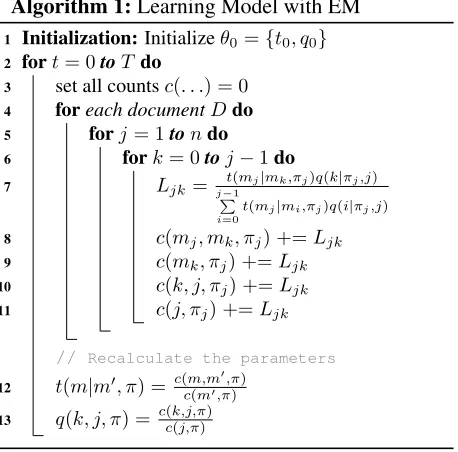
For model learning, we run EM algorithm (Demp-ster et al., 1977) on our Model, treating D as ob-served data and C as latent variables. We run EM with 10 iterations and select the parameters achiev-ing the best performance on the development data. Each iteration takes around 12 hours with 10 CPUs parallelly. The best parameters appear at around the 5th iteration, according to our experiments.The de-tailed derivation of the learning algorithm is shown in Appendix A. The pseudo-code is shown is Algo-rithm 1. We use uniform initialization for all the pa-rameters in our model.
[image:3.612.72.301.235.461.2]uti-CoNLL’12 English development data CoNLL’12 English test data
MUC B3 CEAFm CEAFe Blanc CoNLL MUC B3 CEAFm CEAFe Blanc CoNLL
MIR 65.39 54.89 – 51.36 – 57.21 64.64 52.52 – 49.11 – 55.42
Stanford 64.96 54.49 59.39 51.24 56.03 56.90 64.71 52.26 56.01 49.32 53.92 55.43 Multigraph 66.22 56.41 60.87 52.61 58.15 58.41 65.41 54.38 58.60 50.21 56.03 56.67
Our Model 67.89 57.83 62.11 53.76 60.58 59.83 67.69 55.86 59.66 51.75 57.78 58.44
IMS 67.15 55.19 58.86 50.94 56.22 57.76 67.58 54.47 58.17 50.21 55.41 57.42 Latent-Tree 69.46 57.83 – 54.43 – 60.57 70.51 57.58 – 53.86 – 60.65 Berkeley 70.44 59.10 – 55.57 – 61.71 70.62 58.20 – 54.80 – 61.21 LaSO 70.74 60.03 65.01 56.80 – 62.52 70.72 58.58 63.45 59.40 – 61.63 Latent-Strc 72.11 60.74 – 57.72 – 63.52 72.17 59.58 – 55.67 – 62.47 Model-Stack 72.59 61.98 – 57.58 – 64.05 72.59 60.44 – 56.02 – 63.02 Non-Linear 72.74 61.77 – 58.63 – 64.38 72.60 60.52 – 57.05 – 63.39 Table 3: F1 scores of different evaluation metrics for our model, together with two deterministic systems and one unsupervised system as baseline (above the dashed line) and seven supervised systems (below the dashed line) for comparison on CoNLL 2012 development and test datasets.
lizing the most informative relations and achieved competitive performance with the Stanford system.
2.6 Mention Detection
The basic rules we used to detect mentions are simi-lar to those of Lee et al. (2013), except that their sys-tem uses a set of filtering rules designed to discard instances of pleonastic it, partitives, certain quanti-fied noun phrases and other spurious mentions. Our system keeps partitives, quantified noun phrases and
bare NP mentions, but discards pleonastic it and other spurious mentions.
3 Experiments
3.1 Experimental Setup
Datasets. Due to the availability of readily parsed data, we select the APW and NYT sections of Giga-word Corpus (years 1994-2010) (Parker et al., 2011) to train the model. Following previous work (Cham-bers and Jurafsky, 2008), we remove duplicated documents and the documents which include fewer than 3 sentences. The development and test data are the English data from the CoNLL-2012 shared task (Pradhan et al., 2012), which is derived from the OntoNotes corpus (Hovy et al., 2006). The cor-pora statistics are shown in Table 2. Our system is evaluated with automatically extracted mentions on the version of the data with automatic preprocessing information (e.g., predicted parse trees).
Evaluation Metrics. We evaluate our model on three measures widely used in the literature: MUC (Vilain et al., 1995), B3 (Bagga and
Bald-win, 1998), and Entity-based CEAF (CEAFe) (Luo,
2005). In addition, we also report results on an-other two popular metrics: Mention-based CEAF (CEAFm) and BLANC (Recasens and Hovy, 2011).
All the results are given by the latest version of CoNLL-2012 scorer1
3.2 Results and Comparison
Table 3 illustrates the results of our model together as baseline with two deterministic systems, namely
Stanford: the Stanford system (Lee et al., 2011) andMultigraph: the unsupervised multigraph tem (Martschat, 2013), and one unsupervised sys-tem, namely MIR: the unsupervised system using most informative relations (Moosavi and Strube, 2014). Our model outperforms the three baseline systems on all the evaluation metrics. Specifically, our model achieves improvements of 2.93% and 3.01% on CoNLL F1 score over the Stanford sys-tem, the winner of the CoNLL 2011 shared task, on the CoNLL 2012 development and test sets, respec-tively. The improvements on CoNLL F1 score over the Multigraph model are 1.41% and 1.77% on the development and test sets, respectively. Comparing
1http://conll.cemantix.org/2012/
with the MIR model, we obtain significant improve-ments of 2.62% and 3.02% on CoNLL F1 score.
To make a thorough empirical comparison with previous studies, Table 3 (below the dashed line) also shows the results of some state-of-the-art su-pervised coreference resolution systems — IMS: the second best system in the CoNLL 2012 shared task (Bj¨orkelund and Farkas, 2012); Latent-Tree: the latent tree model (Fernandes et al., 2012) ob-taining the best results in the shared task;Berkeley: the Berkeley system with the final feature set (Dur-rett and Klein, 2013);LaSO: the structured percep-tron system with non-local features (Bj¨orkelund and Kuhn, 2014);Latent-Strc: the latent structure sys-tem (Martschat and Strube, 2015); Model-Stack: the entity-centric system with model stacking (Clark and Manning, 2015); and Non-Linear: the non-linear mention-ranking model with feature represen-tations (Wiseman et al., 2015). Our unsupervised ranking model outperforms the supervised IMS sys-tem by 1.02% on the CoNLL F1 score, and achieves competitive performance with the latent tree model. Moreover, our approach considerably narrows the gap to other supervised systems listed in Table 3.
4 Conclusion
We proposed a new generative, unsupervised rank-ing model for entity coreference resolution into which we introduced resolution mode variables to distinguish mentions resolved by different cate-gories of information. Experimental results on the data from CoNLL-2012 shared task show that our system significantly improves the accuracy on dif-ferent evaluation metrics over the baseline systems.
One possible direction for future work is to dif-ferentiate more resolution modes. Another one is to add more precise or even event-based features to im-prove the model’s performance.
Acknowledgements
This research was supported in part by DARPA grant FA8750-12-2-0342 funded under the DEFT program. Any opinions, findings, and conclusions or recommendations expressed in this material are those of the authors and do not necessarily reflect the views of DARPA.
References
Amit Bagga and Breck Baldwin. 1998. Algorithms for scoring coreference chains. In The first interna-tional conference on language resources and evalu-ation workshop on linguistics coreference, volume 1, pages 563–566. Citeseer.
Shane Bergsma and Dekang Lin. 2006. Bootstrap-ping path-based pronoun resolution. In Proceedings of ACL-2006, pages 33–40, Sydney, Australia, July. Association for Computational Linguistics.
Anders Bj¨orkelund and Rich´ard Farkas. 2012. Data-driven multilingual coreference resolution using re-solver stacking. InProceedings of EMNLP-CoNLL-2012 - Shared Task, pages 49–55, Jeju Island, Korea, July. Association for Computational Linguistics. Anders Bj¨orkelund and Jonas Kuhn. 2014. Learning
structured perceptrons for coreference resolution with latent antecedents and non-local features. In Proceed-ings of ACL-2014, pages 47–57, Baltimore, Maryland, June. Association for Computational Linguistics. Peter F Brown, Vincent J Della Pietra, Stephen A Della
Pietra, and Robert L Mercer. 1993. The mathematics of statistical machine translation: Parameter estima-tion. Computational linguistics, 19(2):263–311. Nathanael Chambers and Dan Jurafsky. 2008.
Unsuper-vised learning of narrative event chains. In Proceed-ings of ACL-2008: HLT, pages 789–797, Columbus, Ohio, June. Association for Computational Linguis-tics.
Nathanael Chambers and Dan Jurafsky. 2009. Unsuper-vised learning of narrative schemas and their partici-pants. InProceedings of ACL-2009, pages 602–610, Suntec, Singapore, August. Association for Computa-tional Linguistics.
Eugene Charniak and Micha Elsner. 2009. EM works for pronoun anaphora resolution. InProceedings of EACL 2009, pages 148–156, Athens, Greece, March. Colin Cherry and Shane Bergsma. 2005. An
Expecta-tion MaximizaExpecta-tion approach to pronoun resoluExpecta-tion. In Proceedings of CoNLL-2005, pages 88–95, Ann Ar-bor, Michigan, June.
Kevin Clark and Christopher D. Manning. 2015. Entity-centric coreference resolution with model stacking. In Proceedings of ACL-IJCNLP-2015, pages 1405–1415, Beijing, China, July. Association for Computational Linguistics.
Arthur P Dempster, Nan M Laird, and Donald B Rubin. 1977. Maximum likelihood from incomplete data via the em algorithm.Journal of the royal statistical soci-ety. Series B (methodological), pages 1–38.
Washington, USA, October. Association for Computa-tional Linguistics.
Greg Durrett and Dan Klein. 2014. A joint model for entity analysis: Coreference, typing, and linking. In Proceedings of the Transactions of the Association for Computational Linguistics.
Eraldo Fernandes, C´ıcero dos Santos, and Ruy Milidi´u. 2012. Latent structure perceptron with feature in-duction for unrestricted coreference resolution. In Proceedings of EMNLP-CoNLL-2012 - Shared Task, pages 41–48, Jeju Island, Korea, July. Association for Computational Linguistics.
Eraldo Rezende Fernandes, C´ıcero Nogueira dos Santos, and Ruy Luiz Milidi´u. 2014. Latent trees for corefer-ence resolution.Computational Linguistics.
Aria Haghighi and Dan Klein. 2007. Unsupervised coreference resolution in a nonparametric bayesian model. InProceedings of ACL-2007, pages 848–855, Prague, Czech Republic, June. Association for Com-putational Linguistics.
Aria Haghighi and Dan Klein. 2009. Simple coreference resolution with rich syntactic and semantic features. In Proceedings of EMNLP-2009, pages 1152–1161, Sin-gapore, August. Association for Computational Lin-guistics.
Aria Haghighi and Dan Klein. 2010. Coreference resolu-tion in a modular, entity-centered model. In Proceed-ings of NAACL-2010, pages 385–393, Los Angeles, California, June. Association for Computational Lin-guistics.
Eduard Hovy, Mitchell Marcus, Martha Palmer, Lance Ramshaw, and Ralph Weischedel. 2006. Ontonotes: The 90% solution. In Proceedings of NAACL-2006, pages 57–60, New York City, USA, June. Association for Computational Linguistics.
Heng Ji and Dekang Lin. 2009. Gender and animacy knowledge discovery from web-scale n-grams for un-supervised person mention detection. InProceedings of PACLIC-2009, pages 220–229.
Heng Ji, HT Dang, J Nothman, and B Hachey. 2014. Overview of tac-kbp2014 entity discovery and linking tasks. InProc. Text Analysis Conference (TAC2014). Heeyoung Lee, Yves Peirsman, Angel Chang, Nathanael
Chambers, Mihai Surdeanu, and Dan Jurafsky. 2011. Stanford’s multi-pass sieve coreference resolution sys-tem at the conll-2011 shared task. InProceedings of CoNLL-2011: Shared Task, pages 28–34, Portland, Oregon, USA, June. Association for Computational Linguistics.
Heeyoung Lee, Angel Chang, Yves Peirsman, Nathanael Chambers, Mihai Surdeanu, and Dan Jurafsky. 2013. Deterministic coreference resolution based on entity-centric, precision-ranked rules. Comput. Linguist., 39(4):885–916, December.
Xiaoqiang Luo. 2005. On coreference resolution per-formance metrics. InProceedings of EMNLP-2005, pages 25–32, Vancouver, British Columbia, Canada, October. Association for Computational Linguistics. Xuezhe Ma and Fei Xia. 2014. Unsupervised
depen-dency parsing with transferring distribution via par-allel guidance and entropy regularization. In Pro-ceedings of ACL-2014, pages 1337–1348, Baltimore, Maryland, June.
Sebastian Martschat and Michael Strube. 2015. Latent structures for coreference resolution. Transactions of the Association for Computational Linguistics, 3:405– 418.
Sebastian Martschat. 2013. Multigraph clustering for unsupervised coreference resolution. In ACL-2013: Student Research Workshop, pages 81–88, Sofia, Bul-garia, August. Association for Computational Linguis-tics.
Joseph F McCarthy and Wendy G Lehnert. 1995. Using decision trees for conference resolution. In Proceed-ings of IJCAI-1995, pages 1050–1055. Morgan Kauf-mann Publishers Inc.
Nafise Sadat Moosavi and Michael Strube. 2014. Unsu-pervised coreference resolution by utilizing the most informative relations. In Proceedings of COLING-2014, pages 644–655.
Vincent Ng. 2008. Unsupervised models for coreference resolution. In Proceedings of EMNLP-2008, pages 640–649, Honolulu, Hawaii, October. Association for Computational Linguistics.
Vincent Ng. 2010. Supervised noun phrase coreference research: The first fifteen years. In Proceedings of ACL-2010, pages 1396–1411, Uppsala, Sweden, July. Association for Computational Linguistics.
Robert Parker, David Graff, Junbo Kong, Ke Chen, and Kazuaki Maeda. 2011. English gigaword fifth edition. Linguistic Data Consortium, LDC2011T07.
Hoifung Poon and Pedro Domingos. 2008. Joint un-supervised coreference resolution with Markov Logic. In Proceedings of EMNLP-2008, pages 650–659, Honolulu, Hawaii, October. Association for Compu-tational Linguistics.
Sameer Pradhan, Alessandro Moschitti, Nianwen Xue, Olga Uryupina, and Yuchen Zhang. 2012. Conll-2012 shared task: Modeling multilingual unrestricted coreference in ontonotes. InProceedings of EMNLP-CoNLL-2012 - Shared Task, pages 1–40, Jeju Island, Korea, July. Association for Computational Linguis-tics.
Marta Recasens and Eduard Hovy. 2011. Blanc: Im-plementing the rand index for coreference evaluation. Natural Language Engineering, 17(04):485–510. Wee Meng Soon, Hwee Tou Ng, and Daniel Chung Yong
Lim. 2001. A machine learning approach to corefer-ence resolution of noun phrases. Computational lin-guistics, 27(4):521–544.
Marc Vilain, John Burger, John Aberdeen, Dennis Con-nolly, and Lynette Hirschman. 1995. A model-theoretic coreference scoring scheme. In Proceed-ings of the 6th conference on Message understanding, pages 45–52. Association for Computational Linguis-tics.
Ben Wellner, Andrew McCallum, Fuchun Peng, and Michael Hay. 2004. An integrated, conditional model of information extraction and coreference with appli-cation to citation matching. InProceedings of the 20th conference on Uncertainty in artificial intelligence, pages 593–601. AUAI Press.
Sam Wiseman, Alexander M. Rush, Stuart Shieber, and Jason Weston. 2015. Learning anaphoricity and an-tecedent ranking features for coreference resolution. In Proceedings of ACL-IJCNLP-2015, pages 1416– 1426, Beijing, China, July. Association for Computa-tional Linguistics.
Xiaofeng Yang, Jian Su, Jun Lang, Chew Lim Tan, Ting Liu, and Sheng Li. 2008a. An entity-mention model for coreference resolution with inductive logic pro-gramming. InProceedings of ACL-2008, pages 843– 851.
Xiaofeng Yang, Jian Su, and Chew Lim Tan. 2008b. A twin-candidate model for learning-based anaphora res-olution. Computational Linguistics, 34(3):327–356.
Appendix A. Derivation of Model Learning
Formally, we iteratively estimate the model parame-tersθ, employing the following EM algorithm:
E-step: Compute the posterior probabilities of C, P(C|D;θ), based on the currentθ.
M-step: Calculate the new θ0 that maximizes
the expected complete log likelihood, EP(C|D;θ)[logP(D, C;θ0)]
For simplicity, we denote:
P(C|D;θ) = ˜P(C|D)
P(C|D;θ0) = P(C|D)
In addition, we useτ(πj|j)to denote the probability
P(πj|j)which is uniform distribution in our model.
Moreover, we use the following notation for conve-nience:
θ(mj, mk, j, k, πj) =t(mj|mk, πj)q(k|πj, j)τ(πj|j)
Then, we have
EP˜(c|D)[logP(D, C)]
= P
C
˜
P(C|D) logP(D, C)
= P
C
˜
P(C|D) Pn
j=1logt(mj|mcj, πj) + logq(cj|πj, j) + logτ(πj|j)
= Pn
j=1
j−1 P
k=0Ljk logt(mj|mk, πj) + logq(k|πj, j) + logτ(πj|j)
Then the parameters t and q that maximize EP˜(c|D)[logP(D, C)]satisfy that
t(mj|mk, πj) = nLjk
P
i=1Lik q(k|πj, j) = j−L1jk
P
i=0Lji
whereLjk can be calculated by
Ljk = P
C,cj=k
˜
P(C|D) = P
C,cj=k ˜ P(C,D)
P
CP˜(C,D)
= P
C,cj=k n
Q
i=1
˜
θ(mi,mci,ci,i,πi)
P
C n
Q
i=1
˜
θ(mi,mci,ci,i,πi)
= ˜
θ(mj,mk,k,j,πj) P
C(−j)
˜
P(C(−j)|D)
j−1
P
i=0
˜
θ(mj,mi,i,j,πj) P
C(−j)
˜
P(C(−j)|D)
= θ(m˜ j,mk,k,j,πj) j−1
P
i=0
˜
θ(mj,mi,i,j,πj)
= t(m˜ j|mk,πj)˜q(k|πj,j)˜τ(πj|j) j−1
P
i=0
˜
t(mj|mi,πj)˜q(i|πj,j)˜τ(πj|j)
= t(m˜ j|mk,πj)˜q(k|πj,j) j−1
P
i=0t(m˜ j|mi,πj)˜q(i|πj,j)
whereC(−j) ={c1, . . . , cj−1, cj+1, . . . , cn}. The