Proceedings of the 2019 Conference on Empirical Methods in Natural Language Processing and the 9th International Joint Conference on Natural Language Processing, pages 1549–1564,
1549
Controlling Text Complexity in Neural Machine Translation
Sweta Agrawal
Department of Computer Science University of Maryland
Marine Carpuat
Department of Computer Science University of Maryland
Abstract
This work introduces a machine translation task where the output is aimed at audiences of different levels of target language proficiency. We collect a high quality dataset of news arti-cles available in English and Spanish, written for diverse grade levels and propose a method to align segments across comparable bilingual articles. The resulting dataset makes it pos-sible to train multi-task sequence-to-sequence models that translate Spanish into English tar-geted at an easier reading grade level than the original Spanish. We show that these multi-task models outperform pipeline approaches that translate and simplify text independently.
1 Introduction
Generating text at the right level of complexity can make machine translation (MT) more useful for a wide range of users. AsXu et al.(2015) note, sim-plifying text makes it possible to develop reading aids for people with low-literacy (Watanabe et al.,
2009;De Belder and Moens,2010), for non-native speakers and language learners (Petersen and Os-tendorf,2007;Allen,2009), for people who suffer from language impairments (Carroll et al., 1999;
Canning et al., 2000; Inui et al., 2003), and for readers lacking expert knowledge of the topic dis-cussed (Elhadad and Sutaria, 2007; Siddharthan and Katsos,2010). Such readers would also ben-efit from MT output that is better targeted to their needs by being easier to read than the original.
Prior work on text complexity has focused on simplifying input text in one language, primar-ily English (Chandrasekar et al., 1996; Coster and Kauchak,2011;Siddharthan,2014;Xu et al.,
2015;Zhang and Lapata,2017;Scarton and Spe-cia,2018;Kriz et al.,2019;Nishihara et al.,2019). Simplification has been used to improve MT by restructuring complex sentences into shorter and
simpler segments that are easier to translate ( Ger-ber and Hovy, 1998;Štajner and Popovic, 2016;
Hasler et al., 2017). Contemporaneously to our work, Marchisio et al. (2019) show that tagging the English side of parallel corpora with automatic readability scores can help translate the same in-put in a simpler or more complex form. Our work shares the goal of controlling translation complex-ity, but considers a broader range of reading grade levels and simplification operations grounded in professionally edited text simplification corpora.
Building a model for this task ideally re-quires rich annotation for evaluation and super-vised training that is not available in bilingual parallel corpora typically used in MT. Control-ling the complexity of Spanish-English translation ideally requires examples of Spanish sentences paired with several English translations that span a range of complexity levels. We collect such a dataset of English-Spanish segment pairs from the Newsela website, which provides professionally edited simplifications and translations. By con-trast with MT parallel corpora, the English and Spanish translations at different grade levels are only comparable. They differ in length and sen-tence structure, reflecting complex syntactic and lexical simplification operations.
We adopt a multi-task approach to con-trol complexity in neural MT and evaluate it on complexity-controlled Spanish-English trans-lation. Our extensive empirical study shows that multitask models produce better and simpler trans-lations than pipelines of independent translation and simplification models. We then analyze the strengths and weaknesses of multitask models, fo-cusing on the degree to which they match the tar-get complexity, and the impact of training data types and reading grade level annotation.1
2 Background
Given corpora of parallel complex-simple seg-ments, text simplification can naturally be framed as a translation task, borrowing and adapting model architectures originally designed for MT.
Xu et al.(2016) provide a thorough study of sta-tistical MT techniques for English text simpli-fication, and introduce novel objectives to mea-sure simplification quality. Interestingly, they in-directly make use of parallel translation corpora to derive simplification paraphrasing rules by bilin-gual pivoting (Callison-Burch,2007). Zhang and Lapata (2017) train sequence-to-sequence mod-els to translate from complex to simple English using reinforcement learning to directly optimize the metrics that evaluate complexity (SARI) and fluency and adequacy (BLEU). Scarton and Spe-cia (2018) address the task of producing text of varying levels of complexity for different target audiences. They show that neural sequence-to-sequence models informed by target-complexity tokens inserted in the input sequence perform well on this task. While the vast majority of text sim-plification work has focused on English, Spanish (Štajner et al.,2015), Italian (Brunato et al.,2016;
Aprosio et al., 2019) and German (Klaper et al.,
2013) have also received some attention.
While most MT approaches only indirectly cap-ture style properties (e.g., via domain adaptation), a growing number of studies share the goal of con-sidering source texts and their translation in their pragmatic context.Mirkin and Meunier(2015) in-troduce personalized MT.Rabinovich et al.(2016) andVanmassenhove et al. (2018) suggest that the gender of the author is implicitly marked in the source text and that dedicated statistical and neu-ral systems better preserve gender traits in MT out-put. Neural MT has enabled more flexible ways to control stylistic properties of MT output.Sennrich et al.(2016) first propose to append a special token to the source that neural MT models can attend to and to select the formal (Sie) or informal (du) version of second person pronouns when trans-lating into German. Niu et al. (2018) show that multi-task models can jointly translate between languages and styles, producing formal and infor-mal translations with broader lexical and phrasal
at https://Newsela.com/data/. Scripts to repli-cate our model configurations and our cross-lingual seg-ment aligner are available at https://github.com/ sweta20/ComplexityControlledMT.
changes than the local pronoun changes in Sen-nrich et al.(2016). Closest to our goal,Marchisio et al.(2019) address the task of producing either simple or complex translations of the same input, using automatic readability scoring of parallel cor-pora. They show that training distinct decoders for simple and complex language allows better com-plexity control than using the target comcom-plexity as a side-constraint. By contrast, our approach ex-ploits text simplification corpora for richer super-vision for both training and evaluation.
3 A Multi-Task Approach to Complexity Controlled MT
Task We definecomplexity controlled MTas a task that takes two inputs: an input language seg-mentsi and a target complexityc. The goal is to
produce a translationsoin the output language that
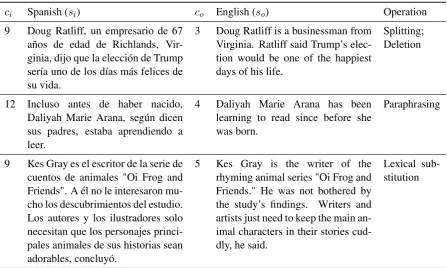
has complexityc. For instance, given input Span-ish sentences in Table 1, complexity controlled MT aims to produce English translations at a spe-cific level of complexity, which might differ from the complexity of the original Spanish.
Model We model P(so|si, c;θ) as a neural
encoder-decoder with attention (Bahdanau et al.,
2015). This architecture has been used success-fully for the two related tasks of text simplifica-tion (Wang et al.,2016;Zhang and Lapata,2017;
Nisioi et al.,2017;Scarton and Specia,2018) and machine translation (Bahdanau et al.,2015). The encoder constructs hidden representation for each word in the input sequence, while the decoder gen-erates the target sequence, conditioned on hidden source representations. We hypothesize that train-ing a strain-ingle encoder-decoder model to perform the two distinct tasks of machine translation and text simplification will yield a model that can perform complexity controlled MT. We adopt the multi-task framework proposed byJohnson et al.(2016) to train multilingual neural MT systems.
translat-ci Spanish (si) co English (so) Operation
9 Doug Ratliff, un empresario de 67 años de edad de Richlands, Vir-ginia, dijo que la elección de Trump sería uno de los días más felices de su vida.
3 Doug Ratliff is a businessman from Virginia. Ratliff said Trump’s elec-tion would be one of the happiest days of his life.
Splitting; Deletion
12 Incluso antes de haber nacido, Daliyah Marie Arana, según dicen sus padres, estaba aprendiendo a leer.
4 Daliyah Marie Arana has been learning to read since before she was born.
Paraphrasing
9 Kes Gray es el escritor de la serie de cuentos de animales "Oi Frog and Friends". A él no le interesaron mu-cho los descubrimientos del estudio. Los autores y los ilustradores solo necesitan que los personajes princi-pales animales de sus historias sean adorables, concluyó.
5 Kes Gray is the writer of the rhyming animal series "Oi Frog and Friends." He was not bothered by the study’s findings. Writers and artists just need to keep the main an-imal characters in their stories cud-dly, he said.
[image:3.595.76.524.61.329.2]Lexical sub-stitution
Table 1: Cross-lingual Newsela examples: the Spanish textsiof complexity, or reading grade level,ciis automat-ically aligned to English textsoofco. Simplification transformations range from sentence splitting and deletions to paraphrasing and lexical substitution.
ing into German (Sennrich et al.,2016), to indi-cate the target language in multilingual MT ( John-son et al.,2016), and to obtain formal or informal translations of the same input (Niu et al.,2018). In monolingual text simplification tasks (Scarton and Specia,2018), the reading grade level has been en-coded as such a special token.
Training Data and Objectives Fully supervised training would ideally require translation samples with outputs representing different levels of com-plexity for the same input segment. However, con-structing such data at the scale required to train deep neural networks is expensive and unrealistic. Our multi-task training configuration lets us ex-ploit different types of training examples to train shared encoder-decoder parametersθ. We use the following samples/tasks:
• Complexity controlled MT samples (si, co, so): These are the closest samples to
the task at hand, but are hard to obtain. They are used to defined the complexity-controlled MT loss
LCM T =
X
(si,co,so)
logP(so|si, co;θ) (1)
• MT samples (si, so): These are sentence
pairs drawn from parallel corpora. They are available in large quantities for many lan-guage pairs (Tiedemann,2012) and are used to define the MT loss
LM T = X
(si,so)
logP(so|si;θ) (2)
• Text simplification samples in the MT target language(so, cs0
o, s 0
o)wheres0ois a simplified
version of complexitycs0
o for inputso, which
are likely to be available in much smaller quantities than MT samples.
LSimplify= X
(so,cs0
o,s
0
o)
logP(so|s0ocs0
o;θ)
(3)
The multi-task loss is simply obtained by sum-ming the losses from individual tasks: LCM T +
LM T +LSimplif y.
4 The Newsela Cross-Lingual Simplification Dataset
The Newsela website provides high quality data to study text simplification. Xu et al. (2015) argue that text simplification research should be grounded in texts that are simplified by profes-sional editors for specific target audiences, rather than more general-purpose crowd-sourced simpli-fications such as those available on Wikipedia. They show that Wikipedia is prone to sen-tence alignment errors, contains a non-negligible amount of inadequate simplifications, and does not generalize well to other text genres. By con-trast, Newsela is an instructional content platform meant to help teachers prepare curriculum that match the language skills required at each grade level. The Newsela corpus consists of English arti-cles in their original form, 4 or 5 different versions rewritten by professionals to suit different grade levels as well as optional translations of original and/or simplified English articles into Spanish re-sulting in 23,130 English and 5,320 Spanish arti-cles with grade annotations respectively.
This section introduces our method to align En-glish and Spanish segments across complexity lev-els, and the resulting bilingual dataset.
4.1 Cross-Lingual Segment Alignment
Extracting training examples from this corpus re-quires aligning segments within documents. This is challenging because text is neither simplified nor translated sentence by sentence, and as a re-sult, equivalent content might move from one sen-tence to the next. Past work has introduced tech-niques to align segments of different complexity within documents of the same language (Xu et al.,
2015;Paetzold et al.,2017;Štajner et al.,2018). Complexity controlled MT requires aligning segments of different complexity in English and Spanish. Existing methods for aligning sentences in English and Spanish parallel corpora are not well suited to this task. For instance, the Gale-Church algorithm (Gale and Church, 1993) as-sumes that aligned sentences should have similar length. This assumption does not hold if the En-glish article is a simplification of the Spanish ar-ticle. Consider the following Spanish text and its English translation in Newsela:
Spanish: LA HAYA, Holanda - Te has tomado alguna vez una selfie?, Hoy en día es muy fácil. Solo necesitas un teléfono inteligente.
Google Translated English: THE HAGUE, Netherlands - Have you ever taken a selfie? Today
is very easy. You only need a smart phone. Original English Version: THE HAGUE, Net-herlands - All you need is a smartphone to take a selfie. It is that easy.
As a result, we adapt a monolingual text simpli-fication aligner for cross-lingual alignment. MAS-SAlign (Paetzold et al., 2017) is a Python li-brary designed to align segments of different length within comparable corpora of the same lan-guage. It employs a vicinity-driven search ap-proach, based on the assumption that the order in which information appears is roughly constant in simple and complex texts. A similarity ma-trix is created between the paragraphs/sentences of aligned documents/paragraphs using a standard bag-of-words TF-IDF model. It finds a starting point to begin the search for an alignment path, allowing long-distance alignment skips, capturing 1-N and N-1 alignments. To leverage this align-ment flexibility, we apply MASSAlign to English articles and Spanish articles machine translated into English by Google translate.2 An important property of Google translated articles is that they are aligned 1-1 at the sentence level. This lets us deterministically find the Spanish replacement for the aligned Google translated English version re-turned by MASSAlign. Translation quality is high for this language pair, and even noisy translated ar-ticles contain enough signal to construct the simi-larity matrix required by MASSAlign.
4.2 Resulting Dataset
We thus create: both samples for complexity con-trolled MT(si, co, so)and traditional monolingual
text simplification samples so, cs0
o, s 0
o
that can be used by the multi-task model (Section3). Since the properties of Newsela monolingual simplifi-cation samples have been studied thoroughly by
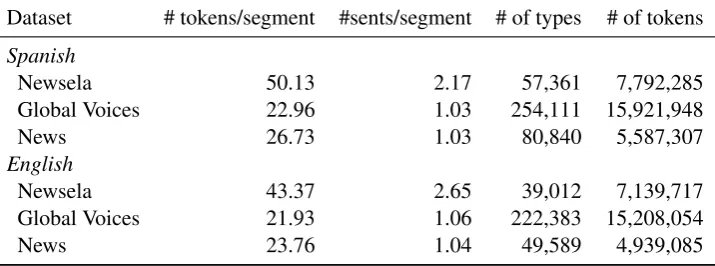
Xu et al.(2015), we present key statistics for the cross-lingual simplification examples only. Ta-ble 2 contrasts Newsela parallel segments with bilingual parallel sentences drawn from the OPUS corpus (Tiedemann,2009). We use Global Voices and News Commentary from OPUS corpus as it has the most similar domain to the Newsela data. Aligned segments in Newsela are about twice as long as segments in parallel corpora, and contain more than two sentences on each side on average. By contrast, parallel corpora samples align sen-tences one-to-one on average.
Dataset # tokens/segment #sents/segment # of types # of tokens
Spanish
Newsela 50.13 2.17 57,361 7,792,285
Global Voices 22.96 1.03 254,111 15,921,948
News 26.73 1.03 80,840 5,587,307
English
Newsela 43.37 2.65 39,012 7,139,717
Global Voices 21.93 1.06 222,383 15,208,054
[image:5.595.121.479.64.197.2]News 23.76 1.04 49,589 4,939,085
Table 2: Comparisons of the English-Spanish Newsela corpus with machine translation corpora from OPUS drawn from Global Voices and News Commentary.
Articles are distributed across reading levels spanning grades 2 to 12 for both English and English-Spanish pairs. Table3highlights the vo-cabulary differences among the different grade levels for the Newsela Spanish-English corpus. The vocabulary size of the corpus correspond-ing to lower grade level is smaller as compared to higher complexity levels. Also, complex sen-tences have more words per sentence on average but fewer sentences per segment compared to their simplified counterparts. Simple sentences differ from complex sentences in various ways, rang-ing from sentence splittrang-ing and content deletion to paraphrasing and lexical substitutions, as illus-trated in Table1.
5 Experiment Settings
We evaluate complexity controlled MT using a subset of the 150k Spanish-English segment pairs extracted from Newsela as described in Sec-tion 4. We select Spanish and English segments that have different reading grade levels, so that given a Spanish input, the task consists in produc-ing an English translation which is simpler (lower reading grade level) than the Spanish input.The train/development/test split ensures that there is no overlap between articles held out for testing and articles used for training. We refer to the corre-sponding training examples asMT+simplifysince it represents the joint task of translation and sim-plification.
5.1 Evaluation Metrics
We evaluate the truecased detokenized output of our models using three automatic evaluation met-rics, drawing from both machine translation and text simplification evaluation.
BLEU (Papineni et al.,2002) estimates transla-tion quality based onn-gram overlap between sys-tem output and references. However it does not separate mismatches due to meaning errors and mismatches due to simplification errors.
SARI (Xu et al., 2016)3 is designed to evalu-ate text simplification systems by comparing sys-tem output against references and against the input sentence. It explicitly measures the goodness of words that are added, deleted and kept by the sys-tems. Xu et al.(2016) showed that BLEU shows high correlation with human scores for grammati-cality and meaning preservation and SARI shows high correlation with human scores for simplic-ity. In the cross-lingual setting, we cannot directly compare the Spanish input with English hypothe-ses and references, therefore we use the baseline machine translation of Spanish into English as a pseudo-source text. The resulting SARI score directly measures the improvement over baseline machine translation.
In addition to BLEU and SARI, we report Pear-son’s correlation coefficient (PCC) to measure the strength of the linear relationship between the complexity of our system outputs and the com-plexity of reference translations. Heilman et al.
(2008) use it to evaluate the performance of read-ing difficulty prediction. Here we estimate the reading grade level complexity of MT outputs and reference translations using the Automatic Read-ability Index (ARI)4 score, which combines evi-dence from the number of characters per word and number of words per sentence using hand-tuned
3
https://github.com/cocoxu/ simplification
4https://github.com/mmautner/
Source (Spanish) Target (English)
Grade word types tokens/segment sents/segment word types tokens/segment sents/segment
2 - - - 3749 34.31 3.76
3 2,628 38.59 3.52 10,615 35.57 3.28
4 8,431 39.33 2.95 10,414 39.38 3.09
5 17,082 40.96 2.59 18,508 42.18 2.87
6 16,945 42.78 2.25 16,613 44.21 2.62
7 22,352 46.65 2.19 23,617 47.54 2.57
8 19,317 47.07 1.96 17,746 46.66 2.24
9 24,846 50.08 1.87 22,230 50.08 2.25
10 482 49.19 1.90 341 38.23 1.70
12 42,355 53.98 1.96 - -
-Table 3: Grade level Statistics of the Newsela Spanish-English corpus. Vocabulary size decreases with the reading grade level. Simpler segments contain fewer sentences and are often shorter that complex segments.
weights (Senter and Smith,1967):
ARI = 4.71(chars
words)+0.5( words
sents)−21.43 (4)
5.2 Training Data
In addition to the NewselaMT+Simplifytraining examples described above, which are of the form (si, co, so), we use monolingual English
simpli-fication data, bilingual parallel training data and Spanish simplification data.
Newsela Simplification provides training ex-amples of the form(so, cs0
o, s 0
o), whereso ands0o
are in the same language. We refer to this data as Simplify data. It is used for training multi-task models and for auxiliary evaluation on En-glish only. Our version of this corpus has 513k English segment pairs extracted using the method by Paetzold and Specia (2016). Similar to Scar-ton and Specia (2018), an original article 0 can be aligned to up to four simplified versions: 1,2,3 and 4. Here 4 denotes the least simplified level and 0 represents the most simplified level. The train split consists of 460k instance pairs whereas the development and test sets consist of roughly 20K instances, drawn from the same articles as the MT+preserve and MT+simplify test set. For Spanish, we have 110k segment pairs, which will be used to train the Spanish simplification base-line.
Bilingual Parallel Data (Newsela) We also extract parallel Spanish-English segments from Newsela based on aligned segments between Spanish and English articles that have the same
reading grade level. We use this dataset to provide in-domain MT training examples which includes roughly 70k instances.
All datasets are pre-processed using Moses tools for normalization, tokenization and true-casing (Koehn et al.,2007). We further segment tokens into subwords using a joint source-target byte pair encoding model with 32,000 operations (Sennrich et al.,2015).
5.3 Sequence-to-Sequence Model Configuration
We use the standard encoder-decoder architecture implemented in the Sockeye toolkit (Hieber et al.,
5.4 Baseline
We contrast the multi-task system with pipeline based approaches, where translation and simpli-fication are treated as independent consecutive steps. We train a neural MT model to perform translation from Spanish to English and other neu-ral MT models to perform monolingual text sim-plification for Spanish and English respectively. In the first pipeline setup, the output from the trans-lation model is fed as input to an English simpli-fication model while in the other, the output from the Spanish simplification model is fed as input to an translation model. As Scarton and Specia
(2018), we simply use grade level tokens as side constraints on English simplification examples to control output complexity.5
6 Evaluation of Complexity Controlled MT
We compare pipeline and multitask models on the Newsela complexity controlled MT task (Ta-ble 4). Overall, results show that compared to pipeline models, multitask models produce com-plexity controlled translations that better match human references according to BLEU. SARI sug-gests that multitask translations are simpler than baseline translations, and their resulting complex-ity correlates better with reference grade levels ac-cording to PCC.
The two pipeline models use the same MT sys-tem, therefore the difference between them comes from text simplification: using English simplifica-tion (first pipeline) outperforms Spanish simplifi-cation (second pipeline) according to BLEU and PCC, but not SARI. This can be explained by the smaller amount of Spanish simplification training data, which yields a model that generalizes poorly. The “All tasks” model highlights the strengths of the multi-task approach: combining train-ing samples from many tasks yields improve-ments over the “Translate and Simplify” multi-task model which is trained on the exact same data as the pipelines. However, even without additional training data, the multitask “Translate and Simpi-fly” model improves over baselines mainly by sim-plifying the output more, which suggests that the simplification component of the multitask model benefits from the additional MT training data.
5Additional constraints based on simplification operations
were also used in that work but did not provide substantial benefits when operations are predicted based on the input.
Qualitative analysis suggests that the multi-task model is capable of distinguishing among differ-ent grade levels and the simplification operations performed for different grade levels are gradual. Table 5 illustrates simplification operations ob-served for a fixed grade 12 Spanish input into En-glish with target grade levels ranging from 9 to 3. When translating to a nearby grade level, for ex-ample 9, the model roughly translates the entire in-put. For lower grade levels such as 7 and 5, lexical simplification and sentence splitting is observed. For the simplest grade level, the model deletes ad-ditional content. More examples are provided in the Appendix ( Table 13).
Complexity cont. MT BLEU SARI PCC
Pipeline Baselines
Translate then Simplify 21.98 30.4 0.436 Simplify then Translate 17.09 37.4 0.275
Multitask Models
Translate and Simplify 22.51 44.8 0.572
All Tasks 22.75 45.0 0.608
Table 4: Compared to pipeline models, multitask mod-els produce complexity controlled translations that bet-ter match human references (BLEU), that are simpler (SARI), and whose resulting complexity correlates bet-ter with the target grade level (PCC). Pipeline mod-els are trained on Newsela Simplification data and MT parallel data from Newsela and OPUS. “Translate and Simplify” uses the exact same data in a multi-task model. The “All tasks” model uses all data available, including Newsla MT+Simplify examples.
7 Analysis
7.1 Output Grade Analysis
12 Ahora el museo Mauritshuis está por inaugurar una exposición dedicada a los autorretratos del siglo XVII, que destaca las similitudes y diferencias entre las fotos modernas y las obras de arte históricas.
9 Now the museum Mauritois is launching an exhibition dedicated to the 18th century author-itations, highlighting the similarities and differences between modern photos and historical artworks.
7 The museum is now set to open an exhibition dedicated to the 18th century authoritations, highlighting the similarities and differences between modern photos and historical artworks. 5 The museum is now set to open an exhibit dedicated to the 18th century. It highlights the
similarities and differences between modern photos and historical artworks.
[image:8.595.77.526.272.365.2]3 The museum is now set to open an exhibit dedicated to the 18th century. Itshowsthe similari-ties and differences between modern photos and art works.
Table 5: Example of multi-task model outputs when translating grade 12 Spanish into increasingly simpler English.
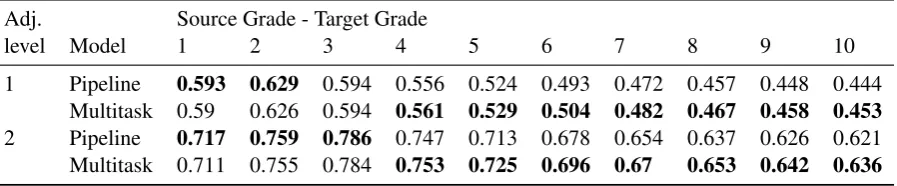
Adj. Source Grade - Target Grade
level Model 1 2 3 4 5 6 7 8 9 10
1 Pipeline 0.593 0.629 0.594 0.556 0.524 0.493 0.472 0.457 0.448 0.444 Multitask 0.59 0.626 0.594 0.561 0.529 0.504 0.482 0.467 0.458 0.453 2 Pipeline 0.717 0.759 0.786 0.747 0.713 0.678 0.654 0.637 0.626 0.621 Multitask 0.711 0.755 0.784 0.753 0.725 0.696 0.67 0.653 0.642 0.636
Table 6: Adjacency ARI accuracy within grade level given by Adjacency level for the system output with respect to the target grade: Multitask model is able to better capture the target grade than the pipeline model when the difference between the source and the target grade is greater than 3.
When the source and target grades are close, roughly 60% of system outputs that are within a ±1 window of the correct grade level. The pipeline model matches the target grade slightly better than the multitask model. However, in the more difficult case where the difference between source and target grades is larger than three, the multitask model outperforms the pipeline. In-creasing the adjacency window to±2 pushes the percentage of matches in the 70s.
Overall these results show that multitask and pipeline models are able to translate and simplify, but that they do not yet fully succeed at precisely controlling the complexity of their output to match a specific target reading grade.
7.2 Ablation Experiments
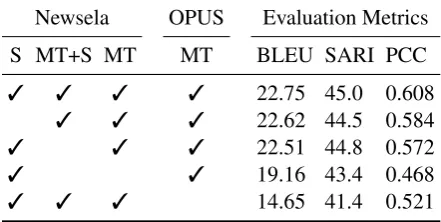
Table 7 shows the impact of different training data types on the multitask model using ablation experiments. OPUS improves BLEU and SARI performance across the board. However, using OPUS without any Newsela MT data (Row 4) hurts the correlation score, indicating the impor-tance of in-domain MT data to control
complex-ity. The difference between the performance when using joint translation and simplification (MT+S) examples (Row 2) vs. simplification only (S in Row 3) is small in terms of BLEU (+0.11) and PCC (0.012), indicating that the monolingual sim-plification dataset can provide simsim-plification su-pervision when MT+Simplify data is unavailable. The overall best performance for the task is ob-tained by using all types of training examples.6
7.3 Evaluation on Auxiliary Tasks
In addition to complexity controlled MT, the multi-task model can be used to simplify English text, and to translate from Spanish-to-English without changing the complexity. For complete-ness, we evaluate on these two auxiliary tasks.
Table 8 summarizes the results: the multitask model slightly outperforms a dedicated simplifica-tion model on English simplificasimplifica-tion, showing the benefits of the additional training data from other tasks. By contrast, on the resource-rich MT task, the standalone translation system performs better.
6A random sample of outputs from the best model
Newsela OPUS Evaluation Metrics
S MT+S MT MT BLEU SARI PCC
3 3 3 3 22.75 45.0 0.608
3 3 3 22.62 44.5 0.584
3 3 3 22.51 44.8 0.572
3 3 19.16 43.4 0.468
3 3 3 14.65 41.4 0.521
Table 7: Data ablation experiments showing the impact of different types of training examples on multi-task model. The OPUS parallel corpus is essential to good performance. Simplification data (S) can be used for simplification supervision when joint translation and simplification examples (MT+S) are unavailable.
This can be explained by the fact that the stan-dalone system is only responsible for text trans-lation, while the multi-task model is exposed to samples of more diverse complexity levels during training which damage its ability to preserve com-plexity.
Task BLEU SARI PCC
English Simplification
Simplify 55.76 41.7 0.736
Translate and Simplify 56.47 41.3 0.730
All Tasks 56.05 42.1 0.736
Machine Translation
Translate 29.09 - 0.769
Translate and Simplify 27.33 - 0.647
All Tasks 27.63 - 0.658
Table 8: Evaluation on auxiliary tasks: Multitask mod-els trained on both the translation and simplification dataset improves the performance for the task of En-glish Simplification.
7.4 Provenance of Reading Grade Level
Our models control complexity using the gold reading grade level assigned by professional Newsela editors. We investigate the impact of re-placing these gold labels by automatic predictions from the ARI metric. ARI can be computed for any English segment, including for MT parallel corpora that are not annotated for complexity.
Table 9 shows that ARI provides an adequate substitute for manually annotated reading grade levels, as BLEU and SARI score remain close when Newsela reading grade levels are replaced by ARI-based tags. However, annotating all data
Complexity cont. MT BLEU SARI PCC
[image:9.595.71.292.64.175.2]Newsela reading grade 22.51 44.80 0.572 ARI on Newsela data 22.26 45.12 0.581 ARI on all data 20.91 44.75 0.577
Table 9: Complexity controlled MT with automatic vs. manual reading grade level tags: ARI provides an ade-quate substitute for manually assigned grade levels.
with ARI grades, including the OPUS parallel cor-pus, hurts BLEU. We attribute this result to the differences in length and number of sentences per segment in OPUS vs. Newsela (Table 2): seg-ments of vastly different lengths can have the same ARI score (Equation4), thus confusing the multi-task model.
8 Conclusion
We introduce a new task that aims to control com-plexity in machine translation output, as a proxy for producing translations targeted at audiences with different reading proficiency levels. We con-struct a Spanish-English dataset drawn from the Newsela corpus for training and evaluation, and adopt a sequence-to-sequence model trained in a multitask fashion.
We show that the multitask model improves performance over translation and simplification pipelines, according to both machine translation and simplification metrics. The reading grade level of the multi-task outputs correlate better with target grade levels than with pipeline outputs. Analysis shows that these benefits come from their ability to combine larger training data from differ-ent tasks. Manual inspection also shows that the multi-task model successfully produces different translations for increasingly lower grades given the same Spanish input.
However, even when simplifying translations, multitask models are not yet able to exactly match the desired complexity level, and the gap between the complexity achieved and the target complex-ity increases with the amount of simplification re-quired. Our datasets and models thus provide a foundation to investigate strategies for a tighter control on output complexity in future work.
References
learn-ers of english. System, 37(4):585–599.
Alessio Palmero Aprosio, Sara Tonelli, Marco Turchi, Matteo Negri, and Mattia A Di Gangi. 2019. Neural text simplification in low-resource conditions using weak supervision. InProceedings of the Workshop on Methods for Optimizing and Evaluating Neural Language Generation, pages 37–44.
Dzmitry Bahdanau, Kyunghyun Cho, and Yoshua Ben-gio. 2015. Neural Machine Translation by Jointly Learning to Align and Translate. In International Conference on Learning Representations (ICLR).
Dominique Brunato, Andrea Cimino, Felice Dell’Orletta, and Giulia Venturi. 2016. Paccss-it: A parallel corpus of complex-simple sentences for automatic text simplification. InProceedings of the 2016 Conference on Empirical Methods in Natural Language Processing, pages 351–361.
Chris Callison-Burch. 2007. Paraphrasing and Trans-lation. Ph.D. thesis, University of Edinburgh.
Yvonne Canning, John Tait, Jackie Archibald, and Ros Crawley. 2000. Cohesive generation of syntactically simplified newspaper text. In International Work-shop on Text, Speech and Dialogue, pages 145–150. Springer.
John Carroll, Guido Minnen, Darren Pearce, Yvonne Canning, Siobhan Devlin, and John Tait. 1999. Sim-plifying text for language-impaired readers. In
Ninth Conference of the European Chapter of the Association for Computational Linguistics.
R. Chandrasekar, Christine Doran, and B. Srinivas. 1996. Motivations and Methods for Text Simpli-fication. In Proceedings of the 16th Conference on Computational Linguistics - Volume 2, COLING ’96, pages 1041–1044, Stroudsburg, PA, USA.
William Coster and David Kauchak. 2011. Simple En-glish Wikipedia: A New Text Simplification Task. In Proceedings of the 49th Annual Meeting of the Association for Computational Linguistics: Human Language Technologies: Short Papers - Volume 2, HLT ’11, pages 665–669, Stroudsburg, PA, USA.
Jan De Belder and Marie-Francine Moens. 2010. Text simplification for children. InProceedings of the SI-GIR workshop on accessible search systems, pages 19–26. ACM Press New York.
Noemie Elhadad and Komal Sutaria. 2007. Mining a lexicon of technical terms and lay equivalents. In Proceedings of the Workshop on BioNLP 2007: Biological, Translational, and Clinical Language Processing, pages 49–56. Association for Compu-tational Linguistics.
William A Gale and Kenneth W Church. 1993. A program for aligning sentences in bilingual corpora.
Computational linguistics, 19(1):75–102.
Laurie Gerber and Eduard Hovy. 1998. Improv-ing Translation Quality by ManipulatImprov-ing Sentence Length. InConference of the Association for Ma-chine Translation in the Americas (AMTA).
Eva Hasler, Adrià de Gispert, Felix Stahlberg, Aurelien Waite, and Bill Byrne. 2017. Source sentence sim-plification for statistical machine translation. Com-puter Speech & Language, 45(Supplement C):221– 235.
Michael Heilman, Kevyn Collins-Thompson, and Maxine Eskenazi. 2008. An analysis of statistical models and features for reading difficulty predic-tion. InProceedings of the third workshop on inno-vative use of NLP for building educational applica-tions, pages 71–79. Association for Computational Linguistics.
Felix Hieber, Tobias Domhan, Michael Denkowski, David Vilar, Artem Sokolov, Ann Clifton, and Matt Post. 2017. Sockeye: A toolkit for neural machine translation.arXiv preprint arXiv:1712.05690.
Kentaro Inui, Atsushi Fujita, Tetsuro Takahashi, Ryu Iida, and Tomoya Iwakura. 2003. Text simplifica-tion for reading assistance: A project note. In Pro-ceedings of the Second International Workshop on Paraphrasing, pages 9–16, Sapporo, Japan.
Melvin Johnson, Mike Schuster, Quoc V. Le, Maxim Krikun, Yonghui Wu, Zhifeng Chen, Nikhil Thorat, Fernanda Viégas, Martin Wattenberg, Greg Corrado, Macduff Hughes, and Jeffrey Dean. 2016. Google’s Multilingual Neural Machine Translation System: Enabling Zero-Shot Translation. arXiv:1611.04558 [cs].
Diederik Kingma and Jimmy Ba. 2014. Adam: A method for stochastic optimization. International Conference on Learning Representations.
David Klaper, Sarah Ebling, and Martin Volk. 2013. Building a german/simple german parallel corpus for automatic text simplification. In Proceedings of the Second Workshop on Predicting and Improv-ing Text Readability for Target Reader Populations, pages 11–19.
Philipp Koehn, Hieu Hoang, Alexandra Birch, Chris Callison-Burch, Marcello Federico, Nicola Bertoldi, Brooke Cowan, Wade Shen, Christine Moran, Richard Zens, Chris Dyer, Ondrej Bojar, Alexandra Constantin, and Evan Herbst. 2007. Moses: Open Source Toolkit for Statistical Machine Translation. In Annual Meeting of the Association for Compu-tational Linguistics (ACL), Demonstration Session, Prague, Czech Republic.
Computational Linguistics: Human Language Tech-nologies, Volume 1 (Long and Short Papers), pages 3137–3147.
Kelly Marchisio, Jialiang Guo, Cheng-I Lai, and Philipp Koehn. 2019. Controlling the reading level of machine translation output. In Proceedings of Machine Translation Summit XVII Volume 1: Re-search Track, pages 193–203.
Shachar Mirkin and Jean-Luc Meunier. 2015. Per-sonalized Machine Translation: Predicting Transla-tional Preferences. InProceedings of the 2015 Con-ference on Empirical Methods in Natural Language Processing, pages 2019–2025, Lisbon, Portugal.
Daiki Nishihara, Tomoyuki Kajiwara, and Yuki Arase. 2019. Controllable text simplification with lexical constraint loss. InProceedings of the 57th Confer-ence of the Association for Computational Linguis-tics: Student Research Workshop, pages 260–266.
Sergiu Nisioi, Sanja Štajner, Simone Paolo Ponzetto, and Liviu P. Dinu. 2017. Exploring neural text sim-plification models. In Proceedings of the 55th An-nual Meeting of the Association for Computational Linguistics (Volume 2: Short Papers), pages 85–91, Vancouver, Canada.
Xing Niu, Sudha Rao, and Marine Carpuat. 2018. Multi-Task Neural Models for Translating Between Styles Within and Across Languages. In27th Inter-national Conference on Computational Linguistics (COLING 2018).
Gustavo Paetzold, Fernando Alva-Manchego, and Lu-cia SpeLu-cia. 2017. Massalign: Alignment and anno-tation of comparable documents. Proceedings of the IJCNLP 2017, System Demonstrations, pages 1–4.
Gustavo Henrique Paetzold and Lucia Specia. 2016. Semeval 2016 task 11: Complex word identification.
Proceedings of SemEval, pages 560–569.
Kishore Papineni, Salim Roukos, Todd Ward, and Wei-Jing Zhu. 2002. BLEU: A method for automatic evaluation of machine translation. In Proceedings of the 40th Annual Meeting of the Association for Computational Linguistics, Philadelphia, PA.
Sarah E Petersen and Mari Ostendorf. 2007. Text sim-plification for language learners: a corpus analysis. In Workshop on Speech and Language Technology in Education.
Ella Rabinovich, Shachar Mirkin, Raj Nath Patel, Lu-cia SpeLu-cia, and Shuly Wintner. 2016. Personalized Machine Translation: Preserving Original Author Traits.arXiv:1610.05461 [cs].
Carolina Scarton and Lucia Specia. 2018. Learning Simplifications for Specific Target Audiences. In
Proceedings of the 56th Annual Meeting of the As-sociation for Computational Linguistics (Volume 2: Short Papers), volume 2, pages 712–718.
Rico Sennrich, Barry Haddow, and Alexandra Birch. 2015. Neural machine translation of rare words with subword units. arXiv preprint arXiv:1508.07909.
Rico Sennrich, Barry Haddow, and Alexandra Birch. 2016. Controlling Politeness in Neural Machine Translation via Side Constraints. pages 35–40.
RJ Senter and Edgar A Smith. 1967. Automated readability index. Technical report, CINCINNATI UNIV OH.
Advaith Siddharthan. 2014. A survey of research on text simplification. ITL - International Journal of Applied Linguistics, 165(2):259–298.
Advaith Siddharthan and Napoleon Katsos. 2010. Re-formulating discourse connectives for non-expert readers. In Human Language Technologies: The 2010 Annual Conference of the North American Chapter of the Association for Computational Lin-guistics, pages 1002–1010. Association for Compu-tational Linguistics.
Sanja Štajner, Iacer Calixto, and Horacio Saggion. 2015. Automatic text simplification for spanish: Comparative evaluation of various simplification strategies. InProceedings of the international con-ference recent advances in natural language pro-cessing, pages 618–626.
Sanja Štajner, Marc Franco-Salvador, Paolo Rosso, and Simone Paolo Ponzetto. 2018. Cats: A tool for customized alignment of text simplification cor-pora. InProceedings of the Eleventh International Conference on Language Resources and Evaluation (LREC-2018).
Sanja Štajner and Maja Popovic. 2016. Can text sim-plification help machine translation? In Proceed-ings of the 19th Annual Conference of the European Association for Machine Translation, pages 230– 242.
Jörg Tiedemann. 2009. News from OPUS-A collection of multilingual parallel corpora with tools and in-terfaces. In Recent Advances in Natural Language Processing, volume 5, pages 237–248.
Jörg Tiedemann. 2012. Parallel data, tools and inter-faces in opus. InProceedings of the Eight Interna-tional Conference on Language Resources and Eval-uation (LREC’12), Istanbul, Turkey.
Eva Vanmassenhove, Christian Hardmeier, and Andy Way. 2018. Getting Gender Right in Neural Ma-chine Translation. InProceedings of the 2018 Con-ference on Empirical Methods in Natural Language Processing, pages 3003–3008.
Willian Massami Watanabe, Arnaldo Candido Junior, Vinícius Rodriguez Uzêda, Renata Pontin de Mat-tos Fortes, Thiago Alexandre Salgueiro Pardo, and Sandra Maria Aluísio. 2009. Facilita: reading as-sistance for low-literacy readers. InProceedings of the 27th ACM international conference on Design of communication, pages 29–36. ACM.
Wei Xu, Chris Callison-Burch, and Courtney Napoles. 2015. Problems in current text simplification re-search: New data can help. Transactions of the As-sociation for Computational Linguistics, 3:283–297.
Wei Xu, Courtney Napoles, Ellie Pavlick, Quanze Chen, and Chris Callison-Burch. 2016. Optimizing statistical machine translation for text simplification.
Transactions of the Association for Computational Linguistics, 4:401–415.
Xingxing Zhang and Mirella Lapata. 2017. Sentence Simplification with Deep Reinforcement Learning.
A Supplemental Material
Table10 and11 provides the statistics of grade pair distribution in the Newsela English and Newsela Spanish-English dataset.
Src / Tgt 2 3 4 5 6 7 8 9 10
3 2652 0 0 0 0 0 0 0 0
4 4984 8212 0 0 0 0 0 0 0
5 2287 19589 23775 0 0 0 0 0 0
6 1914 7625 21022 21380 0 0 0 0 0
7 608 8897 14249 33466 10944 0 0 0 0
8 623 3710 13267 17347 22745 12006 0 0 0
9 130 5058 5031 19834 4684 30929 2144 0 0
10 6 40 224 320 382 289 400 142 0
11 0 0 15 19 11 16 28 0 0
12 1069 6818 18430 34232 28532 41561 29836 31327 97
Table 10: Number of text segments per grade level pair in our Newsela English Corpus
Src / Tgt 2 3 4 5 6 7 8 9 10
3 293 0 0 0 0 0 0 0 0
4 670 1305 0 0 0 0 0 0 0
5 251 3383 1957 0 0 0 0 0 0
6 223 1124 2090 2833 0 0 0 0 0
7 60 1249 926 4986 1244 0 0 0 0
8 96 548 1016 1804 3705 1221 0 0 0
9 16 717 211 3074 189 6135 263 0 0
10 0 3 5 15 26 1 46 0 0
12 189 1288 1902 5312 4708 7796 4995 7077 30
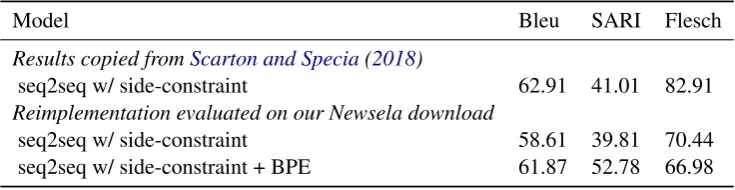
[image:13.595.109.492.121.283.2]Model Bleu SARI Flesch
Results copied fromScarton and Specia(2018)
seq2seq w/ side-constraint 62.91 41.01 82.91
Reimplementation evaluated on our Newsela download
seq2seq w/ side-constraint 58.61 39.81 70.44
[image:14.595.115.483.337.432.2]seq2seq w/ side-constraint + BPE 61.87 52.78 66.98
12 Se estima que 75 personas han expresado interés en alojar al menos a un solicitante de asilo, dijo Cronk. Algunas de estas personas viven en las principales áreas metropolitanas de California y Nueva York. Otros son de zonas remotas y rurales de Montana y Dakota del Norte.
8 An estimated 75 people have expressed interest in hosting at least one asylum-seeker said Cronk. Some of these people live in major California and New York area. Others are from remote and rural areas of Montana and North Dakota.
6 An estimated 75 people have expressed interest in hosting at least one asylum-seeker said Cronk. Some of these people live in major California and New York area. Others are from remote and rural areas of Montana and North Dakota.
4 An estimated 75 people have expressed interest in hosting at least one asylum-seeker said Cronk. Some of these people live in themainareas of California and New York. Others are from remote and rural areas of Montana and North Dakota.
2 Many people live in the United States and New York City. Some are from remote areas of Montana and North Dakota.
12 El gobierno federal realizó un contrato con el centro de detención juvenil en Vicennes, Indiana, desde el año 2004 hasta el año 2010, para que alojara a aquellos niños inmigrantes considerados como los más peligrosos.
9 The federal government conducted a contract with the youth detention center at Vicennes, Indiana, since 2004 to 2010 to host those immigrant children considered as the most dangerous ones. 7 The federal government conducted a contract with the youth detention center at Vicennes,
Indi-ana, since 2004 to 2010, so that they hostedthose immigrant children considered as the most dangerous ones.
5 The federal governmentmadea contract with the youth detention center in Vice-Year.It is in the United States since 2004 to 2010.
3 The government made a deal with the youth detention center in Vice-Year. It is in the United States since 2004 to 2010.It was to hostthose immigrant children as the most dangerous in 2010.
12 Poco después de que el dron despegó durante la prueba de Verizon en Cape May, una "aeronave de seguimiento" salió tras él, para garantizar que el dron pudiera evadir otros aviones en caso de volar dentro de un espacio aéreo designado.
9 Shortly after the drone took off from Verizon in Cape May, a "unmanned aircraft following" came out after him, to ensure that the drone could evade other planes in case of flying inside a designated airspace.
6 Shortly after the drone took off in Cape May, a "unmanned aircraft force" came outbehindhim. They couldensure that the drone could evade other planes in case of flying inside a designated airspace.
2 Not longafter the drone took off from Verizon in Cape May, a "unmanned aircraft help" came out after him. It is to make surethe drone could evade other planes in case of flying inside a air space.
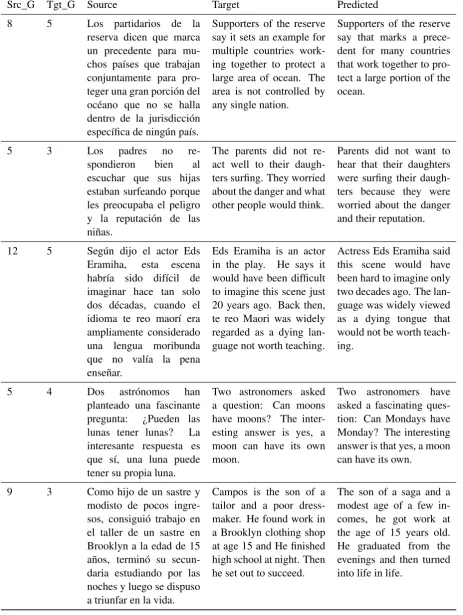
Src_G Tgt_G Source Target Predicted
8 5 Los partidarios de la
reserva dicen que marca un precedente para mu-chos países que trabajan conjuntamente para pro-teger una gran porción del océano que no se halla dentro de la jurisdicción específica de ningún país.
Supporters of the reserve say it sets an example for multiple countries work-ing together to protect a large area of ocean. The area is not controlled by any single nation.
Supporters of the reserve say that marks a prece-dent for many countries that work together to pro-tect a large portion of the ocean.
5 3 Los padres no
re-spondieron bien al escuchar que sus hijas estaban surfeando porque les preocupaba el peligro y la reputación de las niñas.
The parents did not re-act well to their daugh-ters surfing. They worried about the danger and what other people would think.
Parents did not want to hear that their daughters were surfing their daugh-ters because they were worried about the danger and their reputation.
12 5 Según dijo el actor Eds Eramiha, esta escena habría sido difícil de imaginar hace tan solo dos décadas, cuando el idioma te reo maorí era ampliamente considerado una lengua moribunda que no valía la pena enseñar.
Eds Eramiha is an actor in the play. He says it would have been difficult to imagine this scene just 20 years ago. Back then, te reo Maori was widely regarded as a dying lan-guage not worth teaching.
Actress Eds Eramiha said this scene would have been hard to imagine only two decades ago. The lan-guage was widely viewed as a dying tongue that would not be worth teach-ing.
5 4 Dos astrónomos han
planteado una fascinante pregunta: ¿Pueden las lunas tener lunas? La interesante respuesta es que sí, una luna puede tener su propia luna.
Two astronomers asked a question: Can moons have moons? The inter-esting answer is yes, a moon can have its own moon.
Two astronomers have asked a fascinating ques-tion: Can Mondays have Monday? The interesting answer is that yes, a moon can have its own.
9 3 Como hijo de un sastre y modisto de pocos ingre-sos, consiguió trabajo en el taller de un sastre en Brooklyn a la edad de 15 años, terminó su secun-daria estudiando por las noches y luego se dispuso a triunfar en la vida.
Campos is the son of a tailor and a poor dress-maker. He found work in a Brooklyn clothing shop at age 15 and He finished high school at night. Then he set out to succeed.
[image:16.595.71.535.99.715.2]The son of a saga and a modest age of a few in-comes, he got work at the age of 15 years old. He graduated from the evenings and then turned into life in life.