Variational Neural Machine Translation
Biao Zhang1,2, Deyi Xiong1∗, Jinsong Su2, Hong Duan2 and Min Zhang1 Provincial Key Laboratory for Computer Information Processing Technology
Soochow University, Suzhou, China 2150061 Xiamen University, Xiamen, China 3610052
[email protected], {jssu,hduan}@xmu.edu.cn
{dyxiong, minzhang}@suda.edu.cn
Abstract
Models of neural machine translation are of-ten from a discriminative family of encoder-decoders that learn a conditional distribution of a target sentence given a source sentence. In this paper, we propose a variational model to learn this conditional distribution for neu-ral machine translation: a variational encoder-decoder model that can be trained end-to-end. Different from the vanilla encoder-decoder model that generates target translations from hidden representations of source sentences alone, the variational model introduces a con-tinuous latent variableto explicitly model un-derlying semantics of source sentences and to guide the generation of target translations. In order to perform efficient posterior inference and large-scale training, we build a neural posterior approximator conditioned on both the source and the target sides, and equip it with a reparameterization technique to esti-mate the variational lower bound. Experi-ments on both Chinese-English and English-German translation tasks show that the pro-posed variational neural machine translation achieves significant improvements over the vanilla neural machine translation baselines.
1 Introduction
Neural machine translation (NMT) is an emerging translation paradigm that builds on a single and unified end-to-end neural network, instead of us-ing a variety of sub-models tuned in a long trainus-ing pipeline. It requires a much smaller memory than
∗Corresponding author
phrase- or syntax-based statistical machine transla-tion (SMT) that typically has a huge phrase/rule ta-ble. Due to these advantages over traditional SMT system, NMT has recently attracted growing inter-ests from both deep learning and machine transla-tion community (Kalchbrenner and Blunsom, 2013; Cho et al., 2014; Sutskever et al., 2014; Bahdanau et al., 2014; Luong et al., 2015a; Luong et al., 2015b; Shen et al., 2015; Meng et al., 2015; Tu et al., 2016). Current NMT models mainly take a discrimi-native encoder-decoder framework, where a neu-ral encoder transforms source sentence xinto dis-tributed representations, and aneural decoder gen-erates the corresponding target sentenceyaccording to these representations1(Cho et al., 2014; Sutskever
et al., 2014; Bahdanau et al., 2014). Typically, the underlying semantic representations of source and target sentences are learned in an implicit way in this framework, which heavily relies on the atten-tion mechanism (Bahdanau et al., 2014) to iden-tify semantic alignments between source and target words. Due to potential errors in these alignments, the attention-based context vector may be insuffi-cient to capture the entire meaning of a source sen-tence, hence resulting in undesirable translation phe-nomena (Tu et al., 2016).
Unlike the vanilla encoder-decoder framework, we model underlying semantics of bilingual sen-tence pairs explicitly. We assume that there exists a continuous latent variablez from this underlying semantic space. And this variable, together withx,
1In this paper, we use bold symbols to denote variables, and
plain symbols to denote their values. Without specific state-ment, all variables are multivariate.
amssymb amsmath
x y
θ φ
N
z
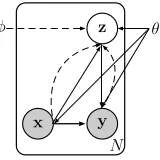
Figure 1: Illustration of VNMT as a directed graph. We use solid lines to denote the generative model
pθ(z|x)pθ(y|z,x), and dashed lines to denote the
varia-tional approximationqφ(z|x)to the intractable posterior
p(z|x,y). Both variational parametersφand generative
model parametersθare learned jointly.
guides the translation process, i.e. p(y|z,x). With this assumption, the original conditional probability evolves into the following formulation:
p(y|x) =
Z
z
p(y, z|x)dz =
Z
z
p(y|z,x)p(z|x)dz (1) This brings in the benefits that the latent variablez can serve as a global semantic signal that is com-plementary to the attention-based context vector for generating good translations when the model learns undesirable attentions. However, although this la-tent variable enables us to explicitly model under-lying semantics of translation pairs, the incorpora-tion of it into the above probabilistic model has two challenges: 1) the posterior inference in this model is intractable; 2) large-scale training, which lays the ground for the data-driven NMT, is accordingly problematic.
In order to address these issues, we propose a vari-ational encoder-decoder model to neural machine translation (VNMT), motivated by the recent suc-cess of variational neural models (Rezende et al., 2014; Kingma and Welling, 2014). Figure 1 illus-trates the graphic representation of VNMT. As deep neural networks are capable of learning highly non-linear functions, we employ them to fit the latent-variable-related distributions, i.e. the prior and pos-terior, to make the inference tractable. The former is modeled to be conditioned on the source side alone
pθ(z|x), because the source and target part of a sen-tence pair usually share the same semantics so that the source sentence should contain the prior infor-mation for inducing the underlying semantics. The latter, instead, is approximated from all observed variablesqφ(z|x,y), i.e. both the source and the
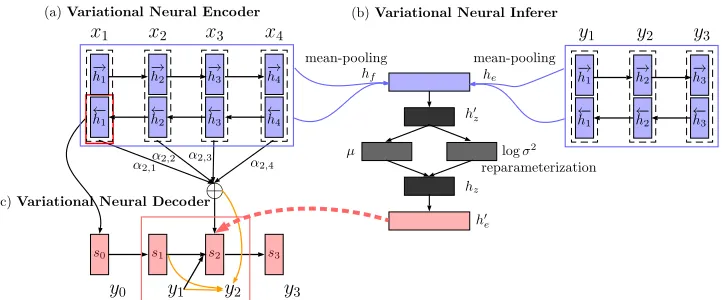
tar-get sides. In order to efficiently train parameters, we apply a reparameterization technique (Rezende et al., 2014; Kingma and Welling, 2014) on the vari-ational lower bound. This enables us to use standard stochastic gradient optimization for training the pro-posed model. Specifically, there are three essential components in VNMT (The detailed architecture is illustrated in Figure 2):
• A variational neural encoder transforms source/target sentence into distributed repre-sentations, which is the same as the encoder of NMT (Bahdanau et al., 2014) (see section 3.1). • A variational neural inferer infers the repre-sentation ofz according to the learned source representations (i.e. pθ(z|x)) together with the target ones (i.e. qφ(z|x,y)), where the repa-rameterization technique is employed (see sec-tion 3.2).
• And avariational neural decoderintegrates the latent representation ofzto guide the genera-tion of target sentence (i.e. p(y|z,x)) together with the attention mechanism (see section 3.3). Augmented with the posterior approximation and reparameterization, our VNMT can still be trained end-to-end. This makes our model not only effi-cient in translation, but also simple in implementa-tion. To train our model, we employ the conven-tional maximum likelihood estimation. Experiments on both Chinese-English and English-German trans-lation tasks show that VNMT achieves significant improvements over several strong baselines.
2 Background: Variational Autoencoder This section briefly reviews the variational autoen-coder (VAE) (Kingma and Welling, 2014; Rezende et al., 2014). Given an observed variablex, VAE in-troduces a continuous latent variablez, and assumes thatxis generated fromz, i.e.,
pθ(x,z) =pθ(x|z)pθ(z) (2)
whereθdenotes the parameters of the model. pθ(z) is the prior, e.g, a simple Gaussian distribution.
pθ(x|z) is the conditional distribution that models the generation procedure, typically estimated via a deep non-linear neural network.
[image:2.612.148.228.63.143.2]reparameterization
hz
h′z
h′e
logσ2 µ
hf
s3 s2 s1 s0
y0 y1 y2 y3
⊕
α2,1
α2,2 α2,3 α 2,4
(a)Variational Neural Encoder
(c)Variational Neural Decoder
(b)Variational Neural Inferer
mean-pooling
−→ h1
←− h1
− → h2
←− h2
− → h3
←− h3 ←h−4
−→ h4
x4 x3 x2 x1
mean-pooling
y1 y2 y3
−→ h3
←− h3 − → h2
←− h2 − → h1
[image:3.612.128.489.56.206.2]←− h1 he
Figure 2: Neural architecture of VNMT. We use blue, gray and red color to indicate the encoder-related (x,y),
under-lying semantic (z) and decoder-related (y) representation respectively. The yellow lines show the flow of information employed for target word prediction. The dashed red line highlights the incorporation of latent variablezinto target prediction.f anderepresent the source and target language respectively.
well as large-scale learning. To tackle these prob-lems, VAE adopts two techniques: neural approxi-mationandreparameterization.
Neural Approximation employs deep neural net-works to approximate the posterior inference model
qφ(z|x), where φ denotes the variational parame-ters. For the posterior approximation, VAE regards
qφ(z|x)as a diagonal GaussianN(µ,diag(σ2)), and parameterizes its meanµand varianceσ2with deep
neural networks.
Reparameterizationreparameterizesz as a func-tion of µ and σ, rather than using the standard
sampling method. In practice, VAE leverages the “location-scale” property of Gaussian distribution, and uses the following reparameterization:
˜
z=µ+σ (3)
where is a standard Gaussian variable that plays a role of introducing noises, and denotes an element-wise product.
With these two techniques, VAE tightly incor-porates both the generative model pθ(x|z) and the posterior inference model qφ(z|x) into an end-to-end neural network. This facilitates its optimiza-tion since we can apply the standard backpropaga-tion to compute the gradient of the following varia-tional lower bound:
LVAE(θ, φ;x) =−KL(qφ(z|x)||pθ(z)) +Eqφ(z|x)[logpθ(x|z)]≤logpθ(x)
(4)
KL(Q||P) is the Kullback-Leibler divergence be-tweenQandP. Intuitively, VAE can be considered
as a regularized version of the standard autoencoder. It makes use of the latent variablez to capture the variationsin the observed variablex.
3 Variational Neural Machine Translation Different from previous work, we introduce a latent variable z to model the underlying semantic space as a global signal for translation. Formally, given the definition in Eq. (1) and Eq. (4), the varia-tional lower bound of VNMT can be formulated as follows:
LVNMT(θ, φ;x,y) =−KL(qφ(z|x,y)||pθ(z|x)) +Eqφ(z|x,y)[logpθ(y|z,x)] (5) wherepθ(z|x)is our prior model,qφ(z|x,y)is our posterior approximator, and pθ(y|z,x) is the de-coder with the guidance from z. Based on this formulation, VNMT can be decomposed into three components, each of which is modeled by a neu-ral network: avariational neural infererthat models
pθ(z|x) andqφ(z|x,y)(see part (b) in Figure 2), a
variational neural decoder that models pθ(y|z,x) (see part (c) in Figure 2), and avariational neural encoderthat provides distributed representations of a source/target sentence for the above two modules (see part (a) in Figure 2). Following the information flow illustrated in Figure 2, we describe part (a), (b) and (c) successively.
3.1 Variational Neural Encoder
. . . , wT) into continuous vectors. In this paper, we adopt the encoder architecture proposed by Bah-danau et al. (2014), which is a bidirectional RNN with a forward and backward RNN. The forward RNN reads the sequence from left to right while the backward RNN in the opposite direction (see the parallel arrows in Figure 2 (a)):
− →
hi =RNN(−→hi−1, Ewi) ←−
hi =RNN(←−hi+1, Ewi)
(6)
where Ewi ∈ Rdw is the embedding for word wi, and−→hi,←−hiare hidden states generated in two direc-tions. Following Bahdanau et al. (2014), we employ the Gated Recurrent Unit (GRU) as our RNN unit due to its capacity in capturing long-distance depen-dencies.
We further concatenate each pair of hidden states at each time step to build a set ofannotation vec-tors(h1,h2, . . . ,hT), hTi =
h−→
hTi ;←−hTi i. In this
way, each annotation vectorhiencodes information about thei-th word with respect to all the other
sur-rounding words in the sequence. Therefore, these annotation vectors are desirable for the following modeling.
We use this encoder to represent both the source sentence {xi}Ti=1f and the target sentence {yi}Ti=1e (see the blue color in Figure 2). Accordingly, our encoder generates both the source annotation vec-tors{hi}Ti=1f ∈ R2df and the target annotation vec-tors{h0i}Te
i=1 ∈ R2de. The source vectors flow into the inferer and decoder while the target vectors the posterior approximator.
3.2 Variational Neural Inferer
A major challenge of variational models is how to model the latent-variable-related distributions. In VNMT, we employ neural networks to model both the prior pθ(z|x) and the posterior qφ(z|x,y), and let them subject to a multivariate Gaussian distri-bution with a diagonal covariance structure.2 As
shown in Figure 1, these two distributions mainly differ in their conditions.
2The reasons of choosing Gaussian distribution are twofold:
1) it is a natural choice for modeling continuous variables; 2) it belongs to the family of “location-scale” distributions, which is required for the following reparameterization.
3.2.1 Neural Posterior Approximator
Exactly modeling the true posteriorp(z|x,y) ex-actly usually intractable. Therefore, we adopt an approximation method to simplify the posterior in-ference. Conventional models typically employ the
mean-fieldapproaches. However, a major limitation of this approach is its inability to capture the true posterior ofzdue to its oversimplification. Follow-ing the spirit of VAE, we use neural networks for better approximation in this paper, and assume the approximator has the following form:
qφ(z|x,y) =N(z;µ(x,y), σ(x,y)2I) (7)
The meanµ and s.d. σ of the approximate
poste-rior are the outputs of neural networks based on the observed variablesxandyas shown in Figure 2 (b). Starting from the variational neural encoder, we first obtain the source- and target-side representa-tion via amean-pooling operation over the annota-tion vectors, i.e.hf = T1f PTifhi,he= T1ePTieh0i. With these representations, we perform a non-linear transformation that projects them onto our con-cerned latent semantic space:
h0z=g(Wz(1)[hf;he] +b(1)z ) (8) whereWz(1) ∈ Rdz×2(df+de), b(1)z ∈ Rdz is the pa-rameter matrix and bias term respectively,dz is the dimensionality of the latent space, and g(·) is an element-wise activation function, which we set to be tanh(·)throughout our experiments.
In this latent space, we obtain the abovementioned Gaussian parametersµandlogσ2through linear re-gression:
µ=Wµh0z+bµ, logσ2 =Wσh0z+bσ (9) whereµ,logσ2are bothd
z-dimension vectors.
3.2.2 Neural Prior Model
Different from the posterior, we model (rather than approximate) the prior as follows:
is capable of inferring the underlying semantics of sentence pairs, i.e., the representation of latent vari-ablez.
The neural model for the prior pθ(z|x) is the same as that (i.e. Eq (8) and (9)) for the posterior
qφ(z|x,y), except for the absence ofhe. Besides, the parameters for the prior are independent of those for the posterior.
To obtain a representation for latent variablez, we employ the same technique as the Eq. (3) and repa-rameterized it ashz=µ+σ,∼ N(0,I). Dur-ing decodDur-ing, however, due to the absence of target sentencey, we sethzto be the mean ofpθ(z|x), i.e.,
µ0. Intuitively, the reparameterization bridges the
gap between the generation model pθ(y|z,x) and the inference model qφ(z|x,y). In other words, it connects these two neural networks. This is impor-tant since it enables the stochastic gradient optimiza-tion via standard backpropagaoptimiza-tion.
We further project the representation of latent variablehzonto the target space for translation:
h0e =g(Wz(2)hz+b(2)z ) (11) where h0e ∈ Rd0e
. The transformed h0e is then in-tegrated into our decoder. Notice that because of the noise from , the representation h0e is not fixed for the same source sentence and model parameters. This is crucial for VNMT to learn to avoid overfit-ting.
3.3 Variational Neural Decoder
Given the source sentencexand the latent variable z, our decoder defines the probability over transla-tionyas a joint probability of ordered conditionals:
p(y|z,x) = Te
Y
j=1
p(yj|y<j,z,x) (12)
where p(yj|y<j,z,x) =g0(yj−1, sj−1, cj) The feed forward modelg0(·)(see the yellow arrows in Figure 2) and context vectorcj =Piαjihi (see the “⊕” in Figure 2) are the same as (Bahdanau et al., 2014). The difference between our decoder and Bahdanau et al.’s decoder (2014) lies in that in ad-dition to the context vector, our decoder integrates the representation of the latent variable, i.e.h0e, into the computation ofsj, which is denoted by the bold dashed red arrow in Figure 2 (c).
Formally, the hidden statesjin our decoder is cal-culated by3
sj = (1−uj)sj−1+ujs˜j, ˜
sj = tanh(W Eyj +U[rjsj−1] +Ccj +Vh0e)
uj =σ(WuEyj+Uusj−1+Cucj +Vuh0e)
rj =σ(WrEyj+Ursj−1+Crcj+Vrh0e)
Here,rj, uj, ˜sj denotes the reset gate, update gate and candidate activation in GRU respectively, and
Eyj ∈R
dw is the word embedding for target word.
W, Wu, Wr∈Rde×dw,U, Uu, Ur∈Rde×de,C, Cu,
Cr ∈Rde×2df, andV, Vu, Vr∈Rde×d0e are parame-ter weights. The initial hidden states0 is initialized in the same way as Bahdanau et al. (2014) (see the arrow tos0in Figure 2).
In our model, the latent variable can affect the rep-resentation of hidden statesj through the gate be-tweenrjanduj. This allows our model to access the semantic information ofz indirectly since the pre-diction ofyj+1depends onsj. In addition, when the model learns wrong attentions that lead to bad con-text vector cj, the semantic representation he0 can help to guide the translation process .
3.4 Model Training
We use the Monte Carlo method to approximate the expectation over the posterior in Eq. (5), i.e. Eqφ(z|x,y)[·]'
1 L
PL
l=1logpθ(y|x,h(l)z ), whereLis the number of samples. The joint training objective for a training instance(x,y)is defined as follows:
L(θ, φ)' −KL(qφ(z|x,y)||pθ(z|x))
+1
L
L
X
l=1 Te
X
j=1
logpθ(yj|y<j,x,h(l)z ) (13)
whereh(l)z =µ+σ(l)and(l)∼ N(0,I)
The first term is the KL divergence between two Gaussian distributions which can be computed and differentiated without estimation (see (Kingma and Welling, 2014) for details). And the second term is the approximate expectation, which is also dif-ferentiable. Suppose that L is 1 (which is used in
our experiments), then our second term will be de-generated to the objective of conventional NMT. In-tuitively, VNMT is exactly a regularized version of
System MT05 MT02 MT03 MT04 MT06 MT08 AVG
[image:6.612.108.505.55.124.2]Moses 33.68 34.19 34.39 35.34 29.20 22.94 31.21 GroundHog 31.38 33.32 32.59 35.05 29.80 22.82 30.72 VNMT w/o KL 31.40 33.50 32.92 34.95 28.74 22.07 30.44 VNMT 32.25 34.50++ 33.78++ 36.72⇑++ 30.92⇑++ 24.41↑++ 32.07
Table 1: BLEU scores on the NIST Chinese-English translation task. AVG= average BLEU scores on test sets. We highlight the best results in bold for each test set. “↑/⇑”: significantly better thanMoses(p <0.05/p <0.01); “+/++”:
significantly better thanGroundHog(p <0.05/p <0.01);
NMT, where the introduced noiseincreases its
ro-bustness, and reduces overfitting. We verify this point in our experiments.
Since the objective function in Eq. (13) is differ-entiable, we can optimize the model parameterθand
variational parameterφjointly using standard
gradi-ent ascgradi-ent techniques.
4 Experiments 4.1 Setup
To evaluate the effectiveness of the proposed VNMT, we conducted experiments on both Chinese-English and Chinese-English-German translation tasks. Our Chinese-English training data4consists of 2.9M
sen-tence pairs, with 80.9M Chinese words and 86.4M English words respectively. We used the NIST MT05 dataset as the development set, and the NIST MT02/03/04/06/08 datasets as the test sets for the Chinese-English task. Our English-German train-ing data5consists of 4.5M sentence pairs with 116M
English words and 110M German words6. We used
the newstest2013 (3000 sentences) as the develop-ment set, and the newstest2014 (2737 sentences) as the test set for English-German translation. We employed the case-insensitive BLEU-4 (Papineni et al., 2002) metric to evaluate translation quality, and paired bootstrap sampling (Koehn, 2004) for signif-icance test.
We compared our model against two state-of-the-art SMT and NMT systems:
• Moses (Koehn et al., 2007): a phrase-based SMT system.
4This corpus consists of LDC2003E14, LDC2004T07,
LDC2005T06, LDC2005T10 and LDC2004T08 (Hong Kong Hansards/Laws/News).
5This corpus is from the WMT’14 training data (Jean et al.,
2015; Luong et al., 2015a)
6The preprocessed data can be found and downloaded from
http://nlp.stanford.edu/projects/nmt/
• GroundHog (Bahdanau et al., 2014): an attention-based NMT system.
Additionally, we also compared with a variant of
VNMT, which does not contain the KL part in the objective (VNMT w/o KL). This is achieved by set-tinghztoµ0.
ForMoses, we adopted all the default settings ex-cept for the language model. We trained a 4-gram language model on the Xinhua section of the English Gigaword corpus (306M words) using the SRILM7
toolkit with modified Kneser-Ney smoothing. Im-portantly, we used all words in the vocabulary.
For GroundHog, we set the maximum length of training sentences to be 50 words, and pre-served the most frequent 30K (Chinese-English) and 50K (English-German) words as both the source and target vocabulary , covering approximately 98.9%/99.2% and 97.3%/93.3% on the source and target side of the two parallel corpora respectively . All other words were represented by a specific to-ken “UNK”. Following Bahdanau et al. (2014), we setdw= 620,df = 1000,de= 1000, andM = 80. All other settings are the same as the default config-uration (forRNNSearch). During decoding, we used the beam-search algorithm, and set beam size to 10. ForVNMT, we initialized its parameters with the trained RNNSearch model. The settings of our model are the same as that of GroundHog, except for some parameters specific to VNMT. Following VAE, we set the sampling number L = 1.
Addi-tionally, we set d0e = dz = 2df = 2000according to preliminary experiments. We used the Adadelta algorithm for model training with ρ = 0.95. With
System MT05 MT02 MT03 MT04 MT06 MT08
[image:7.612.114.495.67.240.2]GroundHog 18.23 22.20 20.19 21.67 19.11 13.41 VNMT 21.31 26.02 23.78 25.81 21.81 15.59
Table 2: BLEU scores on the new dataset. All improvements are significant atp <0.01.
System Architecture BLEU
Existing end-to-end NMT systems
Jean et al. (2015) RNNSearch 16.46
Jean et al. (2015) RNNSearch + unk replace 18.97 Jean et al. (2015) RNNsearch + unk replace + large vocab 19.40 Luong et al. (2015a) LSTM with 4 layers + dropout + local att. + unk replace 20.90
Our end-to-end NMT systems
this work RNNSearchVNMT 16.4017.13++
[image:7.612.101.269.266.400.2]VNMT + unk replace 19.58++
Table 3: BLEU scores on the English-German translation task.
5 15 25 35 45 55
20 23 26 29 32 35
Sentence Length
BLEU
Sco
res
GroundHog Our VNMT
Figure 3: BLEU scores on different groups of source sentences in terms of their length.
GPU. In one hour,GroundHogprocesses about 1100 batches, while ourVNMTprocesses 630 batches.
4.2 Results on Chinese-English Translation Table 1 summarizes the BLEU scores of different systems on the Chinese-English translation tasks. Clearly VNMT significantly improves translation quality in terms of BLEU on most cases, and ob-tains the best average results that gain 0.86 and 1.35 BLEU points over Moses and GroundHog respec-tively. Besides, without the KL objective, VNMT w/o KLobtains even worse results than GroundHog. These results indicate the following two points: 1) explicitly modeling underlying semantics by a latent variable indeed benefits neural machine translation, and 2) the improvements of our model are not from enlarging the network.
https://github.com/DeepLearnXMU/VNMT.
4.3 Results on Long Sentences
We further testify VNMT on long sentence transla-tion where the vanilla NMT usually suffers from at-tention failures (Tu et al., 2016; Bentivogli et al., 2016). We believe that the global latent variable can play an important role on long sentence translation.
Our first experiment is carried out on 6 disjoint groups according to the length of source sentences in our test sets. Figure 3 shows the BLEU scores of two neural models. We find that the performance curve of our VNMT model always appears to be on top of that of GroundHog with a certain margin. Specif-ically, on the final group with the longest source sentences, our VNMT obtains the biggest improve-ment (3.55 BLEU points). Overall, these obvious improvements on all groups in terms of the length of source sentences indicate that the global guidance from the latent variable benefits our VNMT model.
Our second experiment is carried out on a syn-thetic dataset where each new source sentence is a concatenation of neighboring source sentences in the original test sets. As a result, the average length of source sentences in the new dataset (> 50) is
almost twice longer than the original one. Trans-lation results is summarized in Table 2, where our VNMT obtains significant improvements on all new test sets. This further demonstrates the advantage of introducing the latent variable.
sys-Source
两国官员确定了 今后会谈的日程和模式,建立起进行持续对话的机制,此举标 志着巴印对话进程在中断两年后重新启动,为 两国逐步解决包括克什米尔争 端在内的所有悬而未决的问题奠定了基础,体现了双方可贵的和平诚意。
Reference
the officials of the two countrieshave established the mechanism for continued dialogue down the road, including a confirmed schedule and model of the talks. this symbolizes the restart of the dialogue process between pakistan and india after an interruption of two years and has paved a foundation for the two countries to sort out gradually all the questions hanging in the air, including the kashmir dispute.it is also a realization of their precious sincerity for peace.
Moses
officials of the two countries set the agenda for future talks , and the pattern of a continuing dialogue mechanism . this marks a break in the process of dialogue between pakistan and india , two years after the restart of the two countries including kashmir dispute to gradually solve all the outstanding issues have laid the foundation of the two sides showed great sincerity in peace .
GroundHog
the two countrieshave decided to set up a mechanism for conducting continuous dialogue on the agenda and mode of the talks . this indicates that the ongoing dialogue between the two countries has laid the foundation for the gradual settlement of all outstanding issues including the dispute over kashmir .
VNMT
[image:8.612.81.534.53.319.2]the officials of the two countries set up a mechanism for holding a continuous dialogue on the agenda and mode of the future talks, and this indicates that the ongoing dialogue between pakistan and india has laid a foundation for resolving all outstanding issues , including the kashmir disputes ,and this serves as a valuable and sincere peace sincerity .
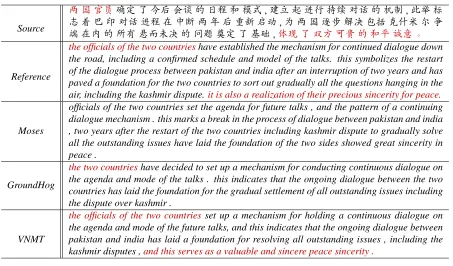
Table 4: Translation examples of different systems. We highlight important parts in red color.
tems that use the same training, development and testing data. The results show that VNMT signifi-cantly outperforms GroundHog and achieves a sig-nificant gain of 0.73 BLEU points (p <0.01). With unknown word replacement (Jean et al., 2015; Lu-ong et al., 2015a), VNMT reaches the performance level that is comparable to the previous state-of-the-art NMT results.
4.5 Translation Analysis
Table 4 shows a translation example that helps un-derstand the advantage of VNMT over NMT . As the source sentence in this example is long (more than 40 words), the translation generated byMoses
is relatively messy and incomprehensible. In con-trast, translations generated by neural models (both
GroundHog andVNMT) are much more fluent and comprehensible. However, there are essential differ-ences betweenGroundHogand ourVNMT. Specifi-cally,GroundHogdoes not translate the phrase “官 员” at the beginning of the source sentence. The translation of the clause “体现了双方可贵的和 平诚意。” at the end of the source sentence is com-pletely lost. In contrast, our VNMT model does not miss or mistake these fragments and can convey the meaning of entire source sentence to the target side. From these examples, we can find that although
attention networks can help NMT trace back to rel-evant parts of source sentences for predicting tar-get translations, capturing the semantics of entire sentences still remains a big challenge for neural machine translation. Since NMT implicitly models variable-length source sentences with fixed-size hid-den vectors, some details of source sentences (e.g., the red sequence of words in Table 4) may not be encoded in these vectors at all. VNMT seems to be able to capture these details through a latent vari-able that explicitly model underlying semantics of source sentences. The promising results suggest that VNMT provides a new mechanism to deal with sen-tence semantics.
5 Related Work
5.1 Neural Machine Translation
NMT that aims at automatically concentrating on relevant source parts for predicting target words dur-ing decoddur-ing. The incorporation of attention mech-anism allows NMT to cope better with long sen-tences, and makes it really comparable to or even superior to conventional SMT.
Following the success of attentional NMT, a num-ber of approaches and models have been proposed for NMT recently, which can be grouped into differ-ent categories according to their motivations: deal-ing with rare words or large vocabulary (Jean et al., 2015; Luong et al., 2015b; Sennrich et al., 2015), learning better attentional structures (Luong et al., 2015a), integrating SMT techniques (Cheng et al., 2015; Shen et al., 2015; Feng et al., 2016; Tu et al., 2016), memory network (Meng et al., 2015), etc. All these models are designed within the discriminative encoder-decoder framework, leaving the explicit ex-ploration of underlying semantics with a variational model an open problem.
5.2 Variational Neural Model
In order to perform efficient inference and learn-ing in directed probabilistic models on large-scale dataset, Kingma and Welling (2014) as well as Rezende et al. (2014) introduce variational neural networks. Typically, these models utilize an neural inference model to approximate the intractable pos-terior, and optimize model parameters jointly with a reparameterized variational lower bound using the standard stochastic gradient technique. This ap-proach is of growing interest due to its success in various tasks.
Kingma et al. (2014) revisit the approach to semi-supervised learning with generative models and fur-ther develop new models that allow effective gen-eralization from a small labeled dataset to a large unlabeled dataset. Chung et al. (2015) incorporate latent variables into the hidden state of a recurrent neural network, while Gregor et al. (2015) combine a novel spatial attention mechanism that mimics the foveation of human eyes, with a sequential varia-tional auto-encoding framework that allows the it-erative construction of complex images. Very re-cently, Miao et al. (2015) propose a generic varia-tional inference framework for generative and con-ditional models of text.
The most related work is that of Bowman et
al. (2015), where they develop a variational autoen-coder for unsupervised generative language model-ing. The major difference is that they focus on the monolingual language model, while we adapt this technique to bilingual translation. Although varia-tional neural models have been widely used in NLP tasks and the variational decoding has been investi-gated for SMT (Li et al., 2009), the adaptation and utilization of variational neural model to neural ma-chine translation, to the best of our knowledge, has never been investigated before.
6 Conclusion and Future Work
In this paper, we have presented a variational model for neural machine translation that incorporates a continuous latent variable to model the underlying semantics of sentence pairs. We approximate the posterior distribution with neural networks and repa-rameterize the variational lower bound. This en-ables our model to be an end-to-end neural network that can be optimized through the stochastic gradi-ent algorithms. Comparing with the convgradi-entional attention-based NMT, our model is better at trans-lating long sentences. It also greatly benefits from a special regularization term brought with this la-tent variable. Experiments on Chinese-English and English-German translation tasks verified the effec-tiveness of our model.
In the future, since the latent variable in our model is at the sentence level, we want to explore more fine-grained latent variables for neural ma-chine translation, such as theRecurrent Latent Vari-able Model(Chung et al., 2015). We are also inter-ested in applying our model to other similar tasks.
Acknowledgments
References
Dzmitry Bahdanau, Kyunghyun Cho, and Yoshua Ben-gio. 2014. Neural machine translation by jointly learning to align and translate. InProc. of ICLR. L. Bentivogli, A. Bisazza, M. Cettolo, and M. Federico.
2016. Neural versus Phrase-Based Machine Transla-tion Quality: a Case Study. ArXiv e-prints, August. S. R. Bowman, L. Vilnis, O. Vinyals, A. M. Dai, R.
Joze-fowicz, and S. Bengio. 2015. Generating Sentences from a Continuous Space. ArXiv e-prints, November. Y. Cheng, S. Shen, Z. He, W. He, H. Wu, M. Sun, and
Y. Liu. 2015. Agreement-based Joint Training for Bidirectional Attention-based Neural Machine Trans-lation. ArXiv e-prints, December.
Kyunghyun Cho, Bart van Merrienboer, Caglar Gulcehre, Dzmitry Bahdanau, Fethi Bougares, Holger Schwenk, and Yoshua Bengio. 2014. Learning phrase represen-tations using rnn encoder–decoder for statistical ma-chine translation. In Proc. of EMNLP, pages 1724– 1734, October.
Junyoung Chung, Kyle Kastner, Laurent Dinh, Kratarth Goel, Aaron C. Courville, and Yoshua Bengio. 2015. A recurrent latent variable model for sequential data. InProc. of NIPS.
S. Feng, S. Liu, M. Li, and M. Zhou. 2016. Implicit Distortion and Fertility Models for Attention-based Encoder-Decoder NMT Model. ArXiv e-prints, Jan-uary.
Karol Gregor, Ivo Danihelka, Alex Graves, and Daan Wierstra. 2015. DRAW: A recurrent neural network for image generation. CoRR, abs/1502.04623. S´ebastien Jean, Kyunghyun Cho, Roland Memisevic, and
Yoshua Bengio. 2015. On using very large target vo-cabulary for neural machine translation. In Proc. of ACL-IJCNLP, pages 1–10, July.
Nal Kalchbrenner and Phil Blunsom. 2013. Recurrent continuous translation models. In Proc. of EMNLP, pages 1700–1709, October.
Diederik P Kingma and Max Welling. 2014. Auto-Encoding Variational Bayes. InProc. of ICLR. Diederik P. Kingma, Shakir Mohamed, Danilo Jimenez
Rezende, and Max Welling. 2014. Semi-supervised learning with deep generative models. In Proc. of NIPS, pages 3581–3589.
Philipp Koehn, Hieu Hoang, Alexandra Birch, Chris Callison-Burch, Marcello Federico, Nicola Bertoldi, Brooke Cowan, Wade Shen, Christine Moran, Richard Zens, Chris Dyer, Ondˇrej Bojar, Alexandra Con-stantin, and Evan Herbst. 2007. Moses: Open source toolkit for statistical machine translation. InProc. of ACL, pages 177–180.
Philipp Koehn. 2004. Statistical significance tests for machine translation evaluation. InProc. of EMNLP.
Zhifei Li, Jason Eisner, and Sanjeev Khudanpur. 2009. Variational decoding for statistical machine transla-tion. InProc. of ACL, pages 593–601, August. Thang Luong, Hieu Pham, and Christopher D. Manning.
2015a. Effective approaches to attention-based neural machine translation. InProc. of EMNLP, pages 1412– 1421, September.
Thang Luong, Ilya Sutskever, Quoc Le, Oriol Vinyals, and Wojciech Zaremba. 2015b. Addressing the rare word problem in neural machine translation. InProc. of ACL-IJCNLP, pages 11–19, July.
F. Meng, Z. Lu, Z. Tu, H. Li, and Q. Liu. 2015. A Deep Memory-based Architecture for Sequence-to-Sequence Learning.ArXiv e-prints, June.
Y. Miao, L. Yu, and P. Blunsom. 2015. Neural Varia-tional Inference for Text Processing. ArXiv e-prints, November.
Kishore Papineni, Salim Roukos, Todd Ward, and Wei-Jing Zhu. 2002. Bleu: a method for automatic eval-uation of machine translation. InProc. of ACL, pages 311–318.
Danilo Jimenez Rezende, Shakir Mohamed, and Daan Wierstra. 2014. Stochastic backpropagation and ap-proximate inference in deep generative models. In Proc. of ICML, pages 1278–1286.
R. Sennrich, B. Haddow, and A. Birch. 2015. Neu-ral Machine Translation of Rare Words with Subword Units. ArXiv e-prints, August.
S. Shen, Y. Cheng, Z. He, W. He, H. Wu, M. Sun, and Y. Liu. 2015. Minimum Risk Training for Neural Ma-chine Translation. ArXiv e-prints, December.
Ilya Sutskever, Oriol Vinyals, and Quoc V. Le. 2014. Sequence to sequence learning with neural networks. CoRR, abs/1409.3215.