A Lucene and Maximum Entropy Model Based Hedge Detection System
Lin Chen
University of Illinois at Chicago Chicago, IL, USA [email protected]
Barbara Di Eugenio University of Illinois at Chicago
Chicago, IL, USA [email protected]
Abstract
This paper describes the approach to hedge detection we developed, in order to participate in the shared task at CoNLL-2010. A supervised learning approach is employed in our implementation. Hedge cue annotations in the training data are used as the seed to build a reliable hedge cue set. Maximum Entropy (MaxEnt) model is used as the learning technique to determine uncertainty. By making use of Apache Lucene, we are able to do fuzzy string match to extract hedge cues, and to incorporate part-of-speech (POS) tags in hedge cues. Not only can our system determine the certainty of the sentence, but is also able to find all the contained hedges. Our system was ranked third on the Wikipedia dataset. In later experi-ments with different parameters, we fur-ther improved our results, with a 0.612 F-score on the Wikipedia dataset, and a 0.802 F-score on the biological dataset.
1 Introduction
A hedge is a mitigating device used to lessen the impact of an utterance1. As a very important way
to precisely express the degree of accuracy and truth assessment in human communication, hedg-ing is widely used in both spoken and written lan-guages. Detecting hedges in natural language text can be very useful for areas like text mining and information extraction. For example, in opinion mining, hedges can be used to assess the degree of sentiment, and refine sentiment classes from
{positive, negative, objective}to{positive,
some-how positive, objective, somesome-how objective, nega-tive, somehow negative}.
1http://en.wikipedia.org/wiki/ Hedge(linguistics)
Hedge detection related work has been con-ducted by several people. Light et al. (2004) started to do annotations on biomedicine article abstracts, and conducted the preliminary work of automatic classification for uncertainty. Medlock and Briscoe (2007) devised detailed guidelines for hedge annotations, and used a probabilistic weakly supervised learning approach to classify hedges. Ganter and Strube (2009) took Wikipedia articles as training corpus, used weasel words’ fre-quency and syntactic patterns as features to clas-sify uncertainty.
The rest of the paper is organized as follows. Section 2 shows the architecture of our system. Section 3 explains how we make use of Apache Lucene to do fuzzy string match and incorporate POS tag in hedge cues and our method to gener-ate hedge cue candidgener-ates. Section 4 describes the details of using MaxEnt model to classify uncer-tainty. We present and discuss experiments and results in section 5, and conclude in section 6.
2 System Architecture
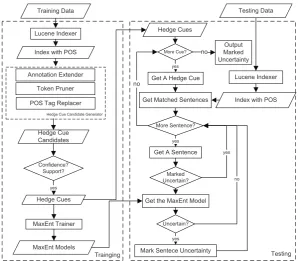
Our system is divided into training and testing modules. The architecture of our system is shown in Figure 1.
In the training module, we use the training cor-pus to learn a reliable hedge cue set with bal-anced support and confidence, then train a Max-Ent model for each hedge cue to classify the un-certainty for sentences matched by that hedge cue. In the testing module, the learned hedge cues are used to match the sentences to classify, then each matched sentence is classified using the cor-responding MaxEnt model. A sentence will be classified as uncertain if the MaxEnt model deter-mines it is. Because of this design, our system is not only able to check if a sentence is uncertain, but also can detect the contained hedges.
Testing Data
Lucene Indexer
Index with POS Hedge Cues
More Cue?
Get A Hedge Cue
Get Matched Sentences
More Sentence?
Marked Uncertain?
Get the MaxEnt Model
Uncertain?
Mark Sentece Uncertainty
yes
no
no
yes
Get A Sentence
yes
yes
Output Marked Uncertainty no
Lucene Indexer Training Data
Index with POS
Hedge Cues Annotation Extender
Token Pruner
POS Tag Replacer
Confidence? Support?
MaxEnt Models MaxEnt Trainer
Hedge Cue Candidate Generator
Hedge Cue Candidates
yes
[image:2.595.146.445.61.322.2]Trainging Testing
Figure 1: System Architecture
3 Learn Hedge Cues
The training data provided by CoNLL-2010 shared task contain “<ccue></ccue>”
tions for uncertain sentences. Most of the annota-tions are either too strict, which makes them hard to use to match other sentences, or too general, which means that most of the matched sentences are not uncertain.
Similar to how Liu (2007) measures the useful-ness of association rules, we use support and con-fidence to measure the usefulness of a hedge cue.
Support is the ratio of sentences containing a hedge cue to all sentences. Because in a train-ing dataset, the number of all the sentences is a fixed constant, we only use the number of sen-tences containing the hedge cue as support, see formula 1. In the other part of this paper, sentences matched by hedge cues means sentences contains hedge cues. We use support to measure the degree of generality of a hedge cue.
sup=count of matched sentences (1)
Confidence is the ratio of sentences which con-tain a hedge cue and are uncercon-tain to all the sen-tences containing the hedge cue, as formula 2. We use confidence to measure the reliability for a word or phrase to be a hedge cue.
conf = count of matched and uncertain count of matched sentences (2)
3.1 Usage of Apache Lucene
Apache Lucene2is a full text indexing Java library
provided as an open source project of Apache Foundation. It provides flexible indexing and search capability for text documents, and it has very high performance. To explain the integra-tion of Lucene into our implementaintegra-tion, we need to introduce several terms, some of which come from McCandless et al. (2010).
• Analyzer: Raw texts are preprocessed before being added to the index: text preprocessing components such as tokenization, stop words removal, and stemming are parts of an ana-lyzer.
• Document: A document represents a collec-tion of fields, it could be a web page, a text file, or only a paragraph of an article.
• Field: A field represents a document or the
meta-data associated with that document, like the author, type, URL. A field has a name and a value, and a bunch of options to control how Lucene will index its value.
• Term: The very basic unit of a search. It
• Query: The root class used to do search upon an index.
In our implementation, Lucene is used for the following 3 purposes:
• Enable quick counting for combinations of words and POS tags.
• Store the training and testing corpus for fast counting and retrieval.
• Allow gap between words or POS tags in hedge cues to match sentences.
Lucene provides the capability to build cus-tomized analyzers for complex linguistics analy-sis. Our customized Lucene analyzer employs to-kenizer and POS tagger from OpenNLP tools3 to
do tokenization and POS tagging. For every word in the sentence, we put two Lucene tokens in the same position, by setting up the second token’s Po-sitionIncremental attribute to be 0.
For example, for sentence it is believed to be very good, our analyzer will make Lucene store it as Figure 2 in its index.
It is believed to be very good
PRP VBZ VBN TO VB RB VBN
6
[image:3.595.77.286.410.448.2]0 1 2 3 4 5
Figure 2: Customized Tokenizer Example
Indexing text in that way, we are able to match sentences cross words and POS tags. For example, the phraseit is believedwill be matched byit is be-lieved,it is VBN,it VBZ believed. This technique enables us to generalize a hedge cue.
In our implementation, all the data for training and testing are indexed. The indexing schema is: a sentence is treated as a Lucene document; the con-tent of the sentence is analyzed by our customized analyzer; other information like sentence id, sen-tence position, uncertainty is stored as fields of the document. In this way, we can query all those fields, and when we find a match, we can easily get all the information out just from the index.
Lucene provides various types of queries to search the indexed content. We use SpanNear-Query and BooleanSpanNear-Query to search the matched sentences for hedge cues. We rely on SpanNear-Query’s feature of allowing positional restriction
3http://opennlp.sourceforge.net
when matching sentences. When building a Span-NearQuery, we can specify the position gap al-lowed among the terms in the query. We build a SpanNearQuery from a hedge cue, put each token as a term of the query, and set the position gap to be 2. Take Figure 3 as an example, because the gap between tokenisandsaidis 1, is less than the specified gap setting 2, soIt is widely said to be goodwill count as a match with hedge cueis said.
Figure 3: SpanNearQuery Matching Example
We use BooleanQuery with nested SpanNear-Query and TermSpanNear-Query to count uncertain sen-tences, then to calculate the confidence of a hedge cue.
3.2 Hedge Cue Candidate Generation
We firstly tried to use the token as the basic unit for hedge cues. However, several pieces of evidence suggest it is not appropriate.
• Low Coverage. We only get 42 tokens in
Wikipedia training data, using 20, 0.4 as the thresholds for support and confidence.
• Irrelevant words or stop words with lower
thresholds. When we use 5, 0.3 as the thresh-olds for coverage and confidence, we get 279 tokens, however, words likeis, his,musical,
voters,makersappear in the list.
We noticed that many phrases with similar structures or fixed collocations appear very often in the annotations, likeit is believed,it is thought,
many of them,many of theseand etc. Based on this observation, we calculated the support and confi-dence for some examples, see table 1.
Hedge Cue Sup. Conf.
it is believed 14 .93
by some 30 .87
[image:3.595.346.487.618.677.2]many of 135 .65
Table 1: Hedge Cue Examples
• High confidence but low coverage: annota-tions that contain proper nouns always have very high confidence, usually 100%, how-ever, they have very low support.
• High coverage but low confidence: annota-tions with only one token are very frequent, but only a few of them result in enough con-fidence.
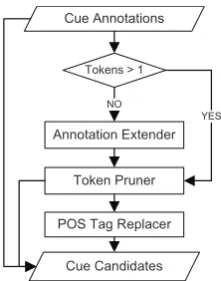
To balance confidence and support, we built our hedge cue candidate generator. Its architecture is presented in Figure 4.
Cue Annotations
Cue Candidates Annotation Extender
Tokens > 1
NO
Token Pruner
POS Tag Replacer
YES
Figure 4: Hedge Cue Candidate Generator
The three main components of the hedge cue candidate generator are described below.
Annotation Extender: When the input hedge
cue annotation contains only 1 token, this compo-nent will be used. It will generate 3 more hedge cue candidates by adding the surrounding tokens. We expect to discover candidates with higher con-fidence.
Token Pruner: According to our observations,
proper nouns rarely contribute to the uncertainty of a sentence, and our Lucene based string match-ing method ensures that the matched sentences re-main matched after we remove tokens from the original cue annotation. So we remove proper nouns in the original cue annotation to generate hedge cue candidates. By using this component, we expect to extract hedge cues with higher sup-port.
POS Tag Replacer: This component is used to
generalize similar phrases, by using POS tags to replace the concrete words. For example, we use the POS tag VBN to replacebelieved init is be-lieved to generateit is VBN. Hence, when a sen-tence contains it is thoughtin the testing dataset, even if it is thought never appeared in the train-ing data set, we will still be able to match it and
classify it against the trained MaxEnt model. We expect that this component will be able to increase support. Due to the O(2n) time complexity, we did
not try the brute force approach to replace every word, only the words with the POS tags in Table 2 are replaced in the process.
POS Description Example
VBN past participle verb it isbelieved
NNS plural common noun somecountries
DT determiner some ofthose
[image:4.595.120.231.231.372.2]CD numeral, cardinal oneof the best
Table 2: POS Tag Replacer Examples
After hedge cue candidates are generated, we convert them to Lucene queries to calculate their confidence and support. We prune those that fall below the predefined confidence and support set-tings.
4 Learn Uncertainty
Not all the learned hedge cues have 100% uncer-tainty confidence, given a hedge cue, we need to learn how to classify whether a matched sentence is uncertain or not. The classification model is, given a tuple of (Sentence, Hedge Cue), in which the sentence contains the hedge cue, we classify it to the outcome set{Certain, Uncertain}.
MaxEnt is a general purpose machine learn-ing technique, it makes no assumptions in addi-tion to what we know from the data. MaxEnt has been widely used in Natural Language Processing (NLP) tasks like POS tagging, word sense disam-biguation, and proved its efficiency. Due to Max-Ent’s capability to combine multiple and depen-dent knowledge sources, we employed MaxEnt as our machine learning model. Features we used to train the model include meta information features and collocation features.
Meta Information Features include three fea-tures:
• Sentence Location: The location of the sen-tence in the article, whether in the title or in the content. We observed sentences in the ti-tle are rarely uncertain.
• Hedge Cue Location: The location of matched tokens in a sentence. We consider them to be in the beginning, if the first token of the matched part is the first token in the sentence; to be at the end, if the last token of the matched part is the last token of the sen-tence; otherwise, they are in the middle. We were trying to use this feature as a simplified version to model the syntactic role of hedge cues in sentences.
Collocation Features include the word and POS tag collocation features:
• Word Collocation: Using a window size of 5, extract all the word within that window, ex-cluding punctuation.
• POS Tag Collocation: Using a window size of 5, extract all the POS tags of tokens within that window, excluding punctuation.
We use the OpenNLP MaxEnt4 Java library as
the MaxEnt trainer and classifier. For each hedge cue, the training is iterated 100 times, with no cut off threshold for events.
5 Experiments and Discussion
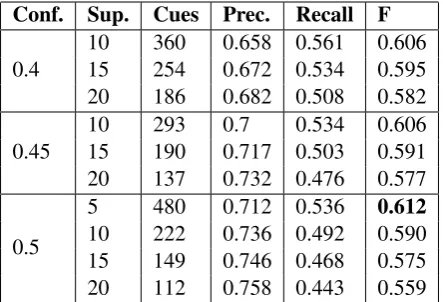
We first ran experiments to evaluate the perfor-mance of the entire system. We used official dataset as training and testing, with different con-fidence and support thresholds. The result on offi-cial Wikipedia dataset is presented in Table 3. Re-sult on the biological dataset is listed in Table 4. In the result tables, the first 2 columns are the con-fidence and support threshold; “Cues” is the num-ber of generated hedge cues; the last 3 columns are standard classifier evaluation measures.
Our submitted result used 0.35, 5 as the thresh-olds for confidence and support. We officially placed third on the Wikipedia dataset, with a 0.5741 F-score, and third from last on the biolog-ical dataset, with a 0.7692 F-score. In later ex-periments, we used different parameters, which re-sulted in a 0.03 F-score improvement. We believe the big difference of ranking on different datasets comes from the incomplete training. Due to incor-rect estimation of running time, we only used the smaller training file in our submitted biological re-sult.
From Table 3 and 4, we can see that a higher confidence threshold gives higher precision, and
4http://maxent.sourceforge.net
Conf. Sup. Cues Prec. Recall F
0.4
10 360 0.658 0.561 0.606 15 254 0.672 0.534 0.595 20 186 0.682 0.508 0.582
0.45 1015 293190 0.70.717 0.5030.534 0.6060.591 20 137 0.732 0.476 0.577
0.5
5 480 0.712 0.536 0.612
[image:5.595.307.529.63.214.2]10 222 0.736 0.492 0.590 15 149 0.746 0.468 0.575 20 112 0.758 0.443 0.559
Table 3: Evaluation Result on Wikipedia Dataset
Conf. Sup. Cues Prec. Recall F
0.4 1015 330229 0.680.681 0.8610.884 0.7690.76 20 187 0.679 0.842 0.752
0.45
10 317 0.689 0.878 0.772 15 220 0.69 0.857 0.764 20 179 0.688 0.838 0.756
0.5
5 586 0.724 0.899 0.802
10 297 0.742 0.841 0.788 15 206 0.742 0.819 0.779 20 169 0.74 0.8 0.769
Table 4: Evaluation Result on Biological Dataset
a lower support threshold leads to higher recall. Since the lower support threshold could generate more hedge cues, it will generate less training in-stances for hedge cues with both low confidence and support, which affects the performance of the MaxEnt classifier. In both datasets, it appears that 0.5 and 5 are the best thresholds for confidence and support, respectively.
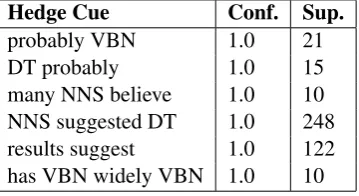
Beyond the performance of the entire system, our hedge cue generator yields very promising re-sults. Using the best parameters we just noted above, our hedge cue generator generates 52 hedge cues with confidence 100% on the Wikipedia dataset, and 332 hedge cues in the biological dataset. Some hedge cue examples are shown in Table 5.
Hedge Cue Sup. Conf. TestSize Prec. Recall F
[image:6.595.145.458.62.146.2]indicated that 63 0.984 6 1.0 1.0 1.0 by some 30 0.867 29 0.966 1.000 0.983 are considered 29 0.724 10 0.750 0.857 0.800 some of NNS 62 0.613 27 1.000 0.778 0.875 the most JJ 213 0.432 129 0.873 0.475 0.615
Table 6: MaxEnt Classifier Performance
Hedge Cue Conf. Sup.
probably VBN 1.0 21
DT probably 1.0 15
[image:6.595.93.273.189.287.2]many NNS believe 1.0 10 NNS suggested DT 1.0 248 results suggest 1.0 122 has VBN widely VBN 1.0 10
Table 5: Generated Hedge Cue Examples
Table 6 shows the results, the hedge cues were manually chosen with relative higher support.
We can see that the performance of the MaxEnt classifier correlates tightly with confidence and support. Higher confidence means a more accu-rate detection for a phrase to be hedge cue, while higher support means more training instances for the classifier: the best strategy would be to find hedge cues with both high confidence and support. While experimenting with the system, we found several potential improvements.
• Normalize words. Take the wordsuggestas an example. In the generated hedge cues, we found that its other forms are everywhere, like it suggested, NNS suggests a, and DT suggesting that. As we put POS tags into Lucene index, we can normalize words to their base forms using a morphology parser, and put base forms into index. After that, the query withsuggestwill match all the forms.
• Use more sophisticated features to train the MaxEnt classifier. Currently we only use shallow linguistics information as features, however we noticed that the role of the phrase could be very important to decide whether it indicates uncertainty. We can deep parse sen-tences, extract the role information, and add it to the feature list of classifier.
6 Conclusion
In this paper, we described the hedge detection system we developed to participate in the shared task of CoNLL-2010. Our system uses a heuristic learner to learn hedge cues, and uses MaxEnt as its machine learning model to classify uncertainty for sentences matched by hedge cues. Hedge cues in our system include both words and POS tags, which make them more general. Apache Lucene is integrated into our system to efficiently run com-plex linguistic queries on the corpus.
Acknowledgments
This work is supported by award IIS-0905593 from the National Science Foundation.
References
Viola Ganter and Michael Strube. 2009. Finding hedges by chasing weasels: Hedge detection using Wikipedia tags and shallow linguistic features. In Proceedings of the ACL-IJCNLP 2009 Conference Short Papers, pages 173–176, Suntec, Singapore, August. Association for Computational Linguistics.
Marc Light, Xin Ying Qiu, and Padmini Srinivasan. 2004. The language of bioscience: Facts, specula-tions, and statements in between. InProceedings of BioLink 2004 Workshop on Linking Biological Lit-erature, Ontologies and Databases: Tools for Users, pages 17–24, Boston, Mass, May.
Bing Liu. 2007. Web data mining: exploring hyper-links, contents, and usage data. Springer.
Michael McCandless, Erik Hatcher, and Otis Gospod-neti. 2010. Lucene in action. Manning Publications Co, 2nd edition.