End-to-end Neural Coreference Resolution
Kenton Lee†, Luheng He†, Mike Lewis‡, and Luke Zettlemoyer†∗
†Paul G. Allen School of Computer Science & Engineering, Univ. of Washington, Seattle, WA ∗ Allen Institute for Artificial Intelligence, Seattle WA
{kentonl, luheng, lsz}@cs.washington.edu ‡Facebook AI Research, Menlo Park, CA
Abstract
We introduce the first end-to-end corefer-ence resolution model and show that it sig-nificantly outperforms all previous work without using a syntactic parser or hand-engineered mention detector. The key idea is to directly consider all spans in a document as potential mentions and learn distributions over possible antecedents for each. The model computes span em-beddings that combine context-dependent boundary representations with a head-finding attention mechanism. It is trained to maximize the marginal likelihood of gold antecedent spans from coreference clusters and is factored to enable aggres-sive pruning of potential mentions. Exper-iments demonstrate state-of-the-art perfor-mance, with a gain of 1.5 F1 on the OntoNotes benchmark and by 3.1 F1 us-ing a 5-model ensemble, despite the fact that this is the first approach to be success-fully trained with no external resources.
1 Introduction
We present the first state-of-the-art coreference resolution model that is learned end-to-end given only gold mention clusters. All recent coref-erence models, including neural approaches that achieved impressive performance gains (Wiseman et al., 2016; Clark and Manning, 2016b,a), rely on syntactic parsers, both for head-word features and as the input to carefully hand-engineered men-tion proposal algorithms. We demonstrate for the first time that these resources are not required, and in fact performance can be improved significantly without them, by training an end-to-end neural model that jointly learns which spans are entity mentions and how to best cluster them.
Our model reasons over the space of all spans up to a maximum length and directly optimizes the marginal likelihood of antecedent spans from gold coreference clusters. It includes a span-ranking model that decides, for each span, which of the previous spans (if any) is a good antecedent. At the core of our model are vector embeddings rep-resenting spans of text in the document, which combine context-dependent boundary representa-tions with a head-finding attention mechanism over the span. The attention component is in-spired by parser-derived head-word matching fea-tures from previous systems (Durrett and Klein,
2013), but is less susceptible to cascading errors. In our analyses, we show empirically that these learned attention weights correlate strongly with traditional headedness definitions.
Scoring all span pairs in our end-to-end model is impractical, since the complexity would be quartic in the document length. Therefore we fac-tor the model over unary mention scores and pair-wise antecedent scores, both of which are sim-ple functions of the learned span embedding. The unary mention scores are used to prune the space of spans and antecedents, to aggressively reduce the number of pairwise computations.
Our final approach outperforms existing models by 1.5 F1 on the OntoNotes benchmark and by 3.1 F1 using a 5-model ensemble. It is not only accu-rate, but also relatively interpretable. The model factors, for example, directly indicate whether an absent coreference link is due to low mention scores (for either span) or a low score from the mention ranking component. The head-finding at-tention mechanism also reveals which mention-internal words contribute most to coreference de-cisions. We leverage this overall interpretability to do detailed quantitative and qualitative analyses, providing insights into the strengths and weak-nesses of the approach.
2 Related Work
Machine learning methods have a long history in coreference resolution (see Ng (2010) for a detailed survey). However, the learning prob-lem is challenging and, until very recently, hand-engineered systems built on top of automatically produced parse trees (Raghunathan et al., 2010) outperformed all learning approaches.Durrett and Klein (2013) showed that highly lexical learning approaches reverse this trend, and more recent neural models (Wiseman et al., 2016; Clark and Manning,2016b,a) have achieved significant per-formance gains. However, all of these models still use parsers for head features and include highly
engineered mention proposal algorithms.1 Such
pipelined systems suffer from two major draw-backs: (1) parsing mistakes can introduce cascad-ing errors and (2) many of the hand-engineered rules do not generalize to new languages or do-mains. We present the first non-pipelined results, while providing further performance gains.
More generally, a wide variety of approaches for learning coreference models have been pro-posed. They can typically be categorized as
(1) mention-pair classifiers (Ng and Cardie,
2002; Bengtson and Roth, 2008), (2) entity-level models (Haghighi and Klein, 2010; Clark and Manning, 2015, 2016b; Wiseman et al.,
2016), (3) latent-tree models (Fernandes et al.,
2012; Bj¨orkelund and Kuhn, 2014; Martschat and Strube, 2015), or (4) mention-ranking mod-els (Durrett and Klein,2013;Wiseman et al.,2015;
Clark and Manning, 2016a). Our span-ranking approach is most similar to mention ranking, but we reason over a larger space by jointly detecting mentions and predicting coreference.
3 Task
We formulate the task of end-to-end coreference resolution as a set of decisions for every possible span in the document. The input is a documentD
containing T words along with metadata such as
speaker and genre information.
LetN = T(T2+1) be the number of possible text spans inD. Denote the start and end indices of a spaniinDrespectively bySTART(i) andEND(i),
for 1 ≤ i ≤ N. We assume an ordering of the
1For example,Raghunathan et al.(2010) use rules to
re-move pleonastic mentions ofitdetected by 12 lexicalized reg-ular expressions over English parse trees.
spans based onSTART(i); spans with the same start
index are ordered byEND(i).
The task is to assign to each span i an
an-tecedentyi. The set of possible assignments for each yi is Y(i) = {,1, . . . , i− 1}, a dummy
antecedent and all preceding spans. True
an-tecedents of spani, i.e. spanjsuch that1≤j ≤
i−1, represent coreference links betweeniandj.
The dummy antecedentrepresents two possible
scenarios: (1) the span is not an entity mention or (2) the span is an entity mention but it is not coref-erent with any previous span. These decisions im-plicitly define a final clustering, which can be re-covered by grouping all spans that are connected by a set of antecedent predictions.
4 Model
We aim to learn a conditional probability distribu-tionP(y1, . . . , yN |D)whose most likely config-uration produces the correct clustering. We use a product of multinomials for each span:
P(y1, . . . , yN |D) = N
Y
i=1
P(yi |D)
=YN
i=1
exp(s(i, yi))
P
y0∈Y(i)exp(s(i, y0))
wheres(i, j)is a pairwise score for a coreference link between spaniand spanjin documentD. We
omit the documentDfrom the notation when the
context is unambiguous. There are three factors for this pairwise coreference score: (1) whether spaniis a mention, (2) whether spanj is a men-tion, and (3) whetherjis an antecedent ofi:
s(i, j) = (
0 j =
sm(i) +sm(j) +sa(i, j) j 6=
Heresm(i)is a unary score for spanibeing a
men-tion, andsa(i, j)is pairwise score for spanjbeing
an antecedent of spani.
By fixing the score of the dummy antecedent
to0, the model predicts the best scoring antecedent if any non-dummy scores are positive, and it ab-stains if they are all negative.
A challenging aspect of this model is that its size isO(T4)in the document length. As we will
General Electric said the Postal Service contacted the company General Electric
+
Electric said the
+
the Postal Service
+
Service contacted the
+
the company
+
Mention score (sm)
Span representation (g)
Span head (xˆ)
Bidirectional LSTM (x∗)
[image:3.595.110.487.63.208.2]Word & character embedding (x)
Figure 1: First step of the end-to-end coreference resolution model, which computes embedding repre-sentations of spans for scoring potential entity mentions. Low-scoring spans are pruned, so that only a manageable number of spans is considered for coreference decisions. In general, the model considers all possible spans up to a maximum width, but we depict here only a small subset.
General Electric the Postal Service the company
s(the company,
General Electric) s(the companythe Postal Service, ) s(the company, ) = 0
Softmax (P(yi|D))
Coreference score (s)
Antecedent score (sa)
Mention score (sm) Span
representation (g)
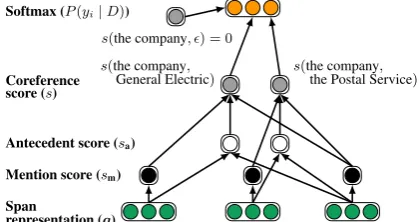
Figure 2: Second step of our model. Antecedent scores are computed from pairs of span represen-tations. The final coreference score of a pair of spans is computed by summing the mention scores of both spans and their pairwise antecedent score.
Scoring Architecture We propose an end-to-end neural architecture that computes the above scores given the document and its metadata.
At the core of the model are vector representa-tions gi for each possible span i, which we de-scribe in detail in the following section. Given these span representations, the scoring functions above are computed via standard feed-forward neural networks:
sm(i) =wm·FFNNm(gi)
sa(i, j) =wa·FFNNa([gi,gj,gi◦gj, φ(i, j)])
where · denotes the dot product, ◦ denotes
element-wise multiplication, and FFNN denotes a
feed-forward neural network that computes a non-linear mapping from input to output vectors.
The antecedent scoring function sa(i, j)
in-cludes explicit element-wise similarity of each
spangi◦gj and a feature vectorφ(i, j)encoding speaker and genre information from the metadata and the distance between the two spans.
Span Representations Two types of informa-tion are crucial to accurately predicting corefer-ence links: the context surrounding the mention span and the internal structure within the span.
We use a bidirectional LSTM (Hochreiter and
Schmidhuber, 1997) to encode the lexical infor-mation of both the inside and outside of each span. We also include an attention mechanism over words in each span to model head words.
We assume vector representations of each word
{x1, . . . ,xT}, which are composed of fixed pre-trained word embeddings and 1-dimensional con-volution neural networks (CNN) over characters (see Section7.1for details)
To compute vector representations of each span, we first use bidirectional LSTMs to encode every word in its context:
ft,δ=σ(Wf[xt,ht+δ,δ] +bi)
ot,δ=σ(Wo[xt,ht+δ,δ] +bo)
e
ct,δ= tanh(Wc[xt,ht+δ,δ] +bc)
ct,δ=ft,δ◦cet,δ+ (1−ft,δ)◦ct+δ,δ
ht,δ=ot,δ◦tanh(ct,δ)
x∗t = [ht,1,ht,−1]
whereδ ∈ {−1,1}indicates the directionality of
each LSTM, and x∗
[image:3.595.75.285.297.408.2]Syntactic heads are typically included as fea-tures in previous systems (Durrett and Klein,
2013;Clark and Manning,2016b,a). Instead of re-lying on syntactic parses, our model learns a task-specific notion of headedness using an attention mechanism (Bahdanau et al.,2014) over words in each span:
αt=wα·FFNNα(x∗t)
ai,t = ENDexp(α(i) t)
X
k=START(i)
exp(αk)
ˆ xi =
ENDX(i)
t=START(i)
ai,t·xt
where xˆi is a weighted sum of word vectors in spani. The weightsai,tare automatically learned and correlate strongly with traditional definitions of head words as we will see in Section9.2.
The above span information is concatenated to produce the final representationgiof spani:
gi = [x∗START(i),x∗END(i),xˆi, φ(i)]
This generalizes the recurrent span representations
recently proposed for question-answering (Lee
et al.,2016), which only include the boundary rep-resentations x∗
START(i) and x∗END(i). We introduce
the soft head word vectorxˆi and a feature vector
φ(i)encoding the size of spani.
5 Inference
The size of the full model described above is
O(T4) in the document length T. To maintain
computation efficiency, we prune the candidate spans greedily during both training and evaluation. We only consider spans with up toLwords and compute their unary mention scoressm(i)(as
de-fined in Section4). To further reduce the number of spans to consider, we only keep up toλT spans with the highest mention scores and consider only
up to K antecedents for each. We also enforce
non-crossing bracketing structures with a simple
suppression scheme.2 We accept spans in
de-creasing order of the mention scores, unless, when considering span i, there exists a previously ac-cepted spanj such thatSTART(i) < START(j) ≤
2The official CoNLL-2012 evaluation only considers
pre-dictions without crossing mentions to be valid. Enforcing this consistency is not inherently necessary in our model.
END(i) < END(j) ∨ START(j) < START(i) ≤ END(j)<END(i).
Despite these aggressive pruning strategies, we maintain a high recall of gold mentions in our ex-periments (over 92% whenλ= 0.4).
For the remaining mentions, the joint distribu-tion of antecedents for each document is computed in a forward pass over a single computation graph. The final prediction is the clustering produced by the most likely configuration.
6 Learning
In the training data, only clustering information is observed. Since the antecedents are latent, we optimize the marginal log-likelihood of all correct antecedents implied by the gold clustering:
logYN
i=1
X
ˆ
y∈Y(i)∩GOLD(i)
P(ˆy)
whereGOLD(i)is the set of spans in the gold
clus-ter containing span i. If span i does not belong to a gold cluster or all gold antecedents have been pruned,GOLD(i) ={}.
By optimizing this objective, the model natu-rally learns to prune spans accurately. While the initial pruning is completely random, only gold mentions receive positive updates. The model can quickly leverage this learning signal for appropri-ate credit assignment to the different factors, such as the mention scoressmused for pruning.
Fixing score of the dummy antecedent to zero removes a spurious degree of freedom in the over-all model with respect to mention detection. It also prevents the span pruning from introducing noise. For example, consider the case where span
ihas a single gold antecedent that was pruned, so
GOLD(i) = {}. The learning objective will only
correctly push the scores of non-gold antecedents lower, and it cannot incorrectly push the score of the dummy antecedent higher.
MUC B3 CEAF φ4
Prec. Rec. F1 Prec. Rec. F1 Prec. Rec. F1 Avg. F1
Our model (ensemble) 81.2 73.6 77.2 72.3 61.7 66.6 65.2 60.2 62.6 68.8
Our model (single) 78.4 73.4 75.8 68.6 61.8 65.0 62.7 59.0 60.8 67.2
Clark and Manning(2016a) 79.2 70.4 74.6 69.9 58.0 63.4 63.5 55.5 59.2 65.7
Clark and Manning(2016b) 79.9 69.3 74.2 71.0 56.5 63.0 63.8 54.3 58.7 65.3
Wiseman et al.(2016) 77.5 69.8 73.4 66.8 57.0 61.5 62.1 53.9 57.7 64.2
Wiseman et al.(2015) 76.2 69.3 72.6 66.2 55.8 60.5 59.4 54.9 57.1 63.4
Clark and Manning(2015) 76.1 69.4 72.6 65.6 56.0 60.4 59.4 53.0 56.0 63.0
Martschat and Strube(2015) 76.7 68.1 72.2 66.1 54.2 59.6 59.5 52.3 55.7 62.5
Durrett and Klein(2014) 72.6 69.9 71.2 61.2 56.4 58.7 56.2 54.2 55.2 61.7
Bj¨orkelund and Kuhn(2014) 74.3 67.5 70.7 62.7 55.0 58.6 59.4 52.3 55.6 61.6
Durrett and Klein(2013) 72.9 65.9 69.2 63.6 52.5 57.5 54.3 54.4 54.3 60.3
Table 1: Results on the test set on the English data from the CoNLL-2012 shared task. The final column (Avg. F1) is the main evaluation metric, computed by averaging the F1 of MUC, B3, and CEAF
φ4. We improve state-of-the-art performance by 1.5 F1 for the single model and by 3.1 F1.
7 Experiments
We use the English coreference resolution data from the CoNLL-2012 shared task (Pradhan et al.,
2012) in our experiments. This dataset contains 2802 training documents, 343 development docu-ments, and 348 test documents. The training doc-uments contain on average 454 words and a maxi-mum of 4009 words.
7.1 Hyperparameters
Word representations The word embeddings are a fixed concatenation of 300-dimensional GloVe embeddings (Pennington et al.,2014) and
50-dimensional embeddings from Turian et al.
(2010), both normalized to be unit vectors. Out-of-vocabulary words are represented by a vector of zeros. In the character CNN, characters are represented as learned 8-dimensional embeddings. The convolutions have window sizes of 3, 4, and 5 characters, each consisting of 50 filters.
Hidden dimensions The hidden states in the LSTMs have 200 dimensions. Each feed-forward neural network consists of two hidden layers with 150 dimensions and rectified linear units (Nair and Hinton,2010).
Feature encoding We encode speaker informa-tion as a binary feature indicating whether a pair of spans are from the same speaker. Following
Clark and Manning(2016b), the distance features are binned into the following buckets [1, 2, 3, 4, 5-7, 8-15, 16-31, 32-63, 64+]. All features (speaker,
genre, span distance, mention width) are repre-sented as learned 20-dimensional embeddings. Pruning We prune the spans such that the maxi-mum span widthL= 10, the number of spans per word λ = 0.4, and the maximum number of
an-tecedentsK = 250. During training, documents
are randomly truncated to up to 50 sentences. Learning We use ADAM (Kingma and Ba,
2014) for learning with a minibatch size of 1. The LSTM weights are initialized with random orthonormal matrices as described in Saxe et al.
(2013). We apply 0.5 dropout to the word embed-dings and character CNN outputs. We apply 0.2 dropout to all hidden layers and feature embed-dings. Dropout masks are shared across timesteps to preserve long-distance information as described inGal and Ghahramani(2016). The learning rate is decayed by 0.1% every 100 steps. The model is trained for up to 150 epochs, with early stopping based on the development set.
All code is implemented in TensorFlow (Abadi et al.,2015) and is publicly available.3
7.2 Ensembling
We also report ensemble experiments using five models trained with different random initializa-tions. Ensembling is performed for both the span pruning and antecedent decisions.
At test time, we first average the mention scores
sm(i) over each model before pruning the spans.
Avg. F1 ∆
Our model (ensemble) 69.0 +1.3
Our model (single) 67.7
−distance and width features 63.9 -3.8
−GloVe embeddings 65.3 -2.4
−speaker and genre metadata 66.3 -1.4
−head-finding attention 66.4 -1.3
−character CNN 66.8 -0.9
−Turian embeddings 66.9 -0.8
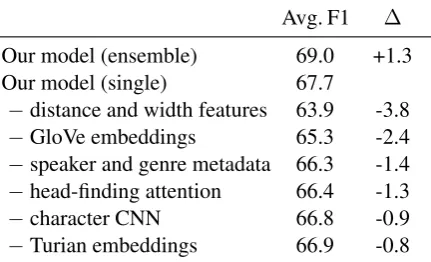
Table 2: Comparisons of our single model on the development data. The 5-model ensemble pro-vides a 1.3 F1 improvement. The head-finding at-tention, features, and all word representations con-tribute significantly to the full model.
Given the same pruned spans, each model then computes the antecedent scoressa(i, j)separately,
and they are averaged to produce the final scores.
8 Results
We report the precision, recall, and F1 for the
stan-dard MUC, B3, and CEAF
φ4metrics using the of-ficial CoNLL-2012 evaluation scripts. The main evaluation is the average F1 of the three metrics. 8.1 Coreference Results
Table 1 compares our model to several
previ-ous systems that have driven substantial improve-ments over the past several years on the OntoNotes benchmark. We outperform previous systems in all metrics. In particular, our single model im-proves the state-of-the-art average F1 by 1.5, and our 5-model ensemble improves it by 3.1.
The most significant gains come from improve-ments in recall, which is likely due to our end-to-end setup. During training, pipelined systems typ-ically discard any mentions that the mention detec-tor misses, which forClark and Manning(2016a) consists of more than 9% of the labeled mentions in the training data. In contrast, we only dis-card mentions that exceed our maximum mention width of 10, which accounts for less than 2% of the training mentions. The contribution of joint men-tion scoring is further discussed in Secmen-tion8.3
8.2 Ablations
To show the importance of each component in our proposed model, we ablate various parts of the ar-chitecture and report the average F1 on the devel-opment set of the data (see Figure2).
Avg. F1 ∆
Our model (joint mention scoring) 67.7
w/ rule-based mentions 66.7 -1.0
[image:6.595.74.290.64.195.2]w/ oracle mentions 85.2 +17.5
Table 3: Comparisons of of various mention pro-posal methods with our model on the develop-ment data. The rule-based develop-mentions are derived from the mention detector fromRaghunathan et al.
(2010), resulting in a 1 F1 drop in performance. The oracle mentions are from the labeled clusters and improve our model by over 17.5 F1.
Features The distance between spans and the width of spans are crucial signals for coreference resolution, consistent with previous findings from other coreference models. They contribute 3.8 F1 to the final result.
Word representations Since our word embed-dings are fixed, having access to a variety of word embeddings allows for a more expressive model without overfitting. We hypothesis that the differ-ent learning objectives of the GloVe and Turian embeddings provide orthogonal information (the former is word-order insensitive while the latter is word-order sensitive). Both embeddings con-tribute to some improvement in development F1.
The character CNN provides morphological information and a way to backoff for out-vocabulary words. Since coreference decisions of-ten involve rare named entities, we see a contribu-tion of 0.9 F1 from character-level modeling.
Metadata Speaker and genre indicators many not be available in downstream applications. We show that performance degrades by 1.4 F1 without them, but is still on par with previous state-of-the-art systems that assume access to this metadata.
0.1 0.2 0.3 0.4 0.5 50
60 70 80 90 100
Spans per wordλ
Recall
(%)
Our model (variousλ) Our model (actualλ)
[image:7.595.75.280.56.221.2]Raghunathan et al.(2010)
Figure 3: Proportion of gold mentions covered in the development data as we increase the num-ber of spans kept per word. Recall is compara-ble to the mention detector of previous state-of-the-art systems given the same number of spans. Our model keeps 0.4 spans per word in our exper-iments, achieving 92.7% recall of gold mentions.
8.3 Comparing Span Pruning Strategies To tease apart the contributions of improved men-tion scoring and improved coreference decisions, we compare the results of our model with alter-nate span pruning strategies. In these experiments, we use the alternate spans for both training and evaluation. As shown in Table3, keeping mention candidates detected by the rule-based system over predicted parse trees (Raghunathan et al., 2010) degrades performance by 1 F1. We also provide oracle experiment results, where we keep exactly the mentions that are present in gold coreference clusters. With oracle mentions, we see an im-provement of 17.5 F1, suggesting an enormous room for improvement if our model can produce better mention scores and anaphoricity decisions.
9 Analysis
To highlight the strengths and weaknesses of our model, we provide both quantitative and qualita-tive analyses. In the following discussion, we use predictions from the single model rather than the ensembled model.
9.1 Mention Recall
The training data only provides a weak signal for spans that correspond to entity mentions, since singleton clusters are not explicitly labeled. As a by product of optimizing marginal likelihood,
1 2 3 4 5 6 7 8 9 10 10
20 30 40 50 60 70 80 90 100
Span width
%
[image:7.595.306.519.59.220.2]Constituency precision Head word precision Frequency
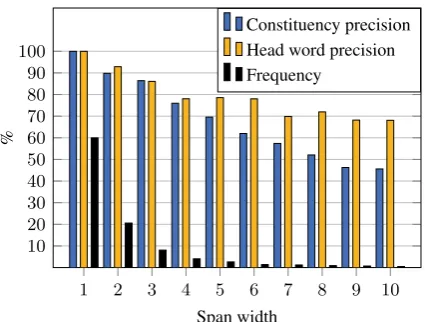
Figure 4: Indirect measure of mention precision using agreement with gold syntax. Constituency precision: % of unpruned spans matching syn-tactic constituents. Head word precision: % of unpruned constituents whose syntactic head word matches the most attended word. Frequency: % of gold spans with each width.
our model automatically learns a useful ranking of spans via the unary mention scores from Section4. The top spans, according to the mention scores, cover a large portion of the mentions in gold clus-ters, as shown in Figure3. Given a similar number of spans kept, our recall is comparable to the rule-based mention detector (Raghunathan et al.,2010) that produces 0.26 spans per word with a recall of 89.2%. As we increase the number of spans per word (λ in Section 5), we observe higher recall but with diminishing returns. In our experiments, keeping 0.4 spans per word results in 92.7% recall in the development data.
9.2 Mention Precision
While the training data does not offer a direct mea-sure of mention precision, we can use the gold syntactic structures provided in the data as a proxy. Spans with high mention scores should correspond to syntactic constituents.
In Figure 4, we show the precision of
1
(A fire in a Bangladeshi garment factory)has left at least 37 people dead and 100 hospitalized. Most
of the deceased were killed in the crush as workers tried to flee(the blaze)in the four-story building.
A fire in(a Bangladeshi garment factory)has left at least 37 people dead and 100 hospitalized. Most
of the deceased were killed in the crush as workers tried to flee the blaze in(the four-story building).
2
We are looking for (a region of central Italy bordering the Adriatic Sea). (The area)is mostly
mountainous and includes Mt. Corno, the highest peak of the Apennines. (It) also includes a lot of
sheep, good clean-living, healthy sheep, and an Italian entrepreneur has an idea about how to make a little money of them.
3 (The flight attendants)crew did so yesterday. have until 6:00 today to ratify labor concessions.(The pilots’)union and ground
4
(Prince Charles and his new wife Camilla)have jumped across the pond and are touring the United
States making(their)first stop today in New York. It’s Charles’ first opportunity to showcase his new
wife, but few Americans seem to care. Here’s Jeanie Mowth. What a difference two decades make. (Charles and Diana)visited a JC Penney’s on the prince’s last official US tour. Twenty years later here’s the prince with his new wife.
5 Also such location devices,will be able to use smoke signals as a way of trying to, let the rescuer locate(some ships)have smoke floats(they)can toss out so the man overboard(them).
Table 4: Examples predictions from the development data. Each row depicts a single coreference cluster predicted by our model. Bold, parenthesized spans indicate mentions in the predicted cluster. The redness of each word indicates the weight of the head-finding attention mechanism (ai,tin Section4).
9.3 Head Agreement
We also investigate how well the learned head preferences correlate with syntactic heads. For each of the top-scoring spans in the development data that correspond to gold constituents, we com-pute the word with the highest attention weight.
We plot in Figure 4 the proportion of these
words that match syntactic heads. Agreement ranges between 68-93%, which is surprisingly high, since no explicit supervision of syntactic heads is provided. The model simply learns from the clustering data that these head words are useful for making coreference decisions.
9.4 Qualitative Analysis
Our qualitative analysis in Table 4highlights the strengths and weaknesses of our model. Each row is a visualization of a single coreference cluster predicted by the model. Bolded spans in paren-theses belong to the predicted cluster, and the red-ness of a word indicates its weight from the head-finding attention mechanism (ai,tin Section4).
Strengths The effectiveness of the attention mechanism for making coreference decisions can be seen in Example 1. The model pays attention to fire in the span A fire in a Bangladeshi gar-ment factory, allowing it to successfully predict
the coreference link with the blaze. For a sub-span of that mention,a Bangladeshi garment fac-tory, the model pays most attention instead to fac-tory, allowing it successfully predict the corefer-ence link withthe four-story building.
The task-specific nature of the attention mecha-nism is also illustrated in Example 4. The model generally pays attention to coordinators more than the content of the coordination, since coordinators, such asand, provide strong cues for plurality.
The model is capable of detecting relatively
long and complex noun phrases, such as a
re-gion of central Italy bordering the Adriatic Sea
in Example 2. It also appropriately pays atten-tion toregion, showing that the attention mecha-nism provides more than content-word classifica-tion. The context encoding provided by the bidi-rectional LSTMs is critical to making informative head word decisions.
predicts a link between The flight attendants and
The pilots’. The predicted head wordsattendants
and pilots likely have nearby word embeddings, which is a signal used—and often overused—by the model. The same type of error is made in Example 4, where the model predicts a
corefer-ence link between Prince Charles and his new
wife Camilla and Charles and Diana, two non-coreferent mentions that are similar in many ways. These mistakes suggest substantial room for im-provement with word or span representations that can cleanly distinguish between equivalence, en-tailment, and alternation.
Unsurprisingly, our model does little in the up-hill battle of making coreference decisions requir-ing world knowledge. In Example 5, the model incorrectly decides thatthem(in the context oflet the rescuer locate them) is coreferent with some ships, likely due to plurality cues. However, an ideal model that uses common-sense reasoning would instead correctly infer that a rescuer is more likely to look for the man overboard rather than the ship from which he fell. This type of reason-ing would require either (1) models that integrate external sources of knowledge with more complex inference or (2) a vastly larger corpus of training data to overcome the sparsity of these patterns.
10 Conclusion
We presented a state-of-the-art coreference reso-lution model that is trained end-to-end for the first time. Our final model ensemble improves perfor-mance on the OntoNotes benchmark by over 3 F1 without external preprocessing tools used by pre-vious systems. We showed that our model implic-itly learns to generate useful mention candidates from the space of all possible spans. A novel head-finding attention mechanism also learns a task-specific preference for head words, which we em-pirically showed correlate strongly with traditional head-word definitions.
While our model substantially pushes the state-of-the-art performance, the improvements are po-tentially complementary to a large body of work on various strategies to improve coreference reso-lution, including entity-level inference and incor-porating world knowledge, which are important avenues for future work.
Acknowledgements
The research was supported in part by DARPA under the DEFT program (FA8750-13-2-0019), the ARO (W911NF-16-1-0121), the NSF (IIS-1252835, IIS-1562364), gifts from Google and Tencent, and an Allen Distinguished Investigator Award. We also thank the UW NLP group for helpful conversations and comments on the work.
References
Martın Abadi, Ashish Agarwal, Paul Barham, Eugene Brevdo, Zhifeng Chen, Craig Citro, Greg S Corrado, Andy Davis, Jeffrey Dean, Matthieu Devin, et al. 2015. TensorFlow: Large-scale Machine Learning
on Heterogeneous Systems. Software available from
tensorflow.org.
Dzmitry Bahdanau, Kyunghyun Cho, and Yoshua Ben-gio. 2014. Neural machine translation by jointly
learning to align and translate. arXiv preprint
arXiv:1409.0473.
Eric Bengtson and Dan Roth. 2008. Understanding the
value of features for coreference resolution. In
Pro-ceedings of the Conference on Empirical Methods in Natural Language Processing, pages 294–303. As-sociation for Computational Linguistics.
Anders Bj¨orkelund and Jonas Kuhn. 2014. Learn-ing structured perceptrons for coreference resolution with latent antecedents and non-local features. In
ACL.
Kevin Clark and Christopher D. Manning. 2015. Entity-centric coreference resolution with model
stacking. InACL.
Kevin Clark and Christopher D. Manning. 2016a. Deep reinforcement learning for mention-ranking
coreference models. InEmpirical Methods on
Nat-ural Language Processing (EMNLP).
Kevin Clark and Christopher D. Manning. 2016b. Im-proving coreference resolution by learning
entity-level distributed representations. InAssociation for
Computational Linguistics (ACL).
Greg Durrett and Dan Klein. 2013. Easy victories and
uphill battles in coreference resolution. InEMNLP.
Greg Durrett and Dan Klein. 2014. A joint model for entity analysis: Coreference, typing, and linking.
TACL, 2:477–490.
Eraldo Rezende Fernandes, C´ıcero Nogueira Dos San-tos, and Ruy Luiz Milidi´u. 2012. Latent structure perceptron with feature induction for unrestricted
coreference resolution. In Joint Conference on
Yarin Gal and Zoubin Ghahramani. 2016. A theoret-ically grounded application of dropout in recurrent
neural networks. InAdvances in Neural Information
Processing Systems, pages 1019–1027.
Aria Haghighi and Dan Klein. 2010. Coreference res-olution in a modular, entity-centered model. In
Human Language Technologies: The 2010 Annual Conference of the North American Chapter of the Association for Computational Linguistics, pages 385–393. Association for Computational Linguis-tics.
Sepp Hochreiter and J¨urgen Schmidhuber. 1997.
Long Short-term Memory. Neural computation,
9(8):1735–1780.
Diederik Kingma and Jimmy Ba. 2014. Adam: A
Method for Stochastic Optimization. arXiv preprint
arXiv:1412.6980.
Kenton Lee, Shimi Salant, Tom Kwiatkowski, Ankur Parikh, Dipanjan Das, and Jonathan Berant. 2016. Learning recurrent span representations for
ex-tractive question answering. arXiv preprint
arXiv:1611.01436.
Sebastian Martschat and Michael Strube. 2015.
La-tent structures for coreference resolution.
Transac-tions of the Association for Computational
Linguis-tics, 3:405–418.
Vinod Nair and Geoffrey E Hinton. 2010. Rectified linear units improve restricted boltzmann machines. InProceedings of ICML.
Vincent Ng. 2010. Supervised noun phrase
corefer-ence research: The first fifteen years. In
Proceed-ings of the 48th annual meeting of the association for computational linguistics, pages 1396–1411. As-sociation for Computational Linguistics.
Vincent Ng and Claire Cardie. 2002. Identifying
anaphoric and non-anaphoric noun phrases to
im-prove coreference resolution. In Proceedings of
the 19th international conference on Computational linguistics-Volume 1, pages 1–7. Association for Computational Linguistics.
Jeffrey Pennington, Richard Socher, and Christopher D Manning. 2014. Glove: Global vectors for word
representation. InProceedings of EMNLP.
Sameer Pradhan, Alessandro Moschitti, Nianwen Xue, Olga Uryupina, and Yuchen Zhang. 2012. Conll-2012 shared task: Modeling multilingual
unre-stricted coreference in ontonotes. In Joint
Confer-ence on EMNLP and CoNLL-Shared Task, pages 1– 40. Association for Computational Linguistics. Karthik Raghunathan, Heeyoung Lee, Sudarshan
Ran-garajan, Nathanael Chambers, Mihai Surdeanu, Dan Jurafsky, and Christopher Manning. 2010. A
multi-pass sieve for coreference resolution. In
Proceed-ings of the 2010 Conference on Empirical Methods in Natural Language Processing, pages 492–501. Association for Computational Linguistics.
Andrew M Saxe, James L McClelland, and Surya Gan-guli. 2013. Exact solutions to the nonlinear
dynam-ics of learning in deep linear neural networks. arXiv
preprint arXiv:1312.6120.
Joseph Turian, Lev Ratinov, and Yoshua Bengio. 2010. Word representations: A Simple and General
Method for Semi-supervised Learning. In
Proceed-ings of the 48th Annual Meeting of the Association for Computational Linguistics.
Sam Wiseman, Alexander M Rush, and Stuart M Shieber. 2016. Learning global features for
corefer-ence resolution.arXiv preprint arXiv:1604.03035.
Sam Wiseman, Alexander M. Rush, Stuart M. Shieber, and Jason Weston. 2015. Learning anaphoricity and antecedent ranking features for coreference