Towards a novel approach to applied research: The role of motor sequence
learning in the process of mastering complex motor procedures
Lida Z. David
Master Thesis
Department of Cognitive Psychology and Ergonomics
Faculty of Behavioral, Management and Social Sciences (BMS) April, 2018
I would like to thank my supervisor, dr. Martin Schmettow, without whom this thesis would not have been possible. His immersive knowledge on programming and statistics, as well as his bright ideas and willingness to share and explain those to me, were invaluable to the composition of this paper.
I would also like to thank dr. Marleen Groenier, for her wide knowledge around laparoscopic research and her valuable feedback that helped me develop, structure, and present my thoughts cohesively throughout this paper. I am also thankful for the opportunity she gave me to perform some laparoscopic simulator tasks and experience myself the demands of laparoscopy (my performance on which proved I am a far better writer than I would ever be a surgeon – hopefully).
Abstract
Background: Research strives for the development of an optimised laparoscopic training
process to help trainees acquire all skills necessary for surgery. Laparoscopic simulator tasks pose a promising alternative to training procedures. Yet the repetitive nature of practice using such tasks runs the risk of exercising only motor sequence learning (MSL); that is, the automation of a specific sequence of movements (Verwey, 1996). Sufficient task variability needs to be ensured, to allow acquisition of holistic, generalizable skills.
Methods: Our research attempted to shed light into the role of MSL on performance, to better understand its implications to skill acquisition, if it were promoted in laparoscopic tasks. We thus introduced the varied-fixed learning (VFL) paradigm, consisting of dexterity tasks with a varied and a fixed part, the former allowing participants to practice holistic skill acquisition blocking the practice of MSL, while the latter allowing them to practice MSL. Both parts were modelled on a two-part exponential learning curve, assessing the learning parameters amplitude, rate, and asymptote for both parts. This paradigm enabled us to capture the proportion of MSL to the general motor learning process involved in mastering a new complex procedure, which was estimated from the difference between the two amplitudes.
Results: Findings suggested little involvement of MSL to general motor learning. The proportion of MSL was not very pronounced in neither of the two tasks (mirror-drawing = 0.10,
95% CI [0.04; 0.22]; clips-and-string = 0.05, 95% CI [0.00; 0.55]), and uncertainty was high in both. However, MSL’s proportion should not be overlooked, since this was only a pilot study with highly uncertain results, implying the possibility of a more pronounced proportion of MSL. Conclusions: Findings suggest that MSL has a small, but still detectable role in improving performance on complex motor procedures. This underlines the importance of variability in simulator tasks, to ensure surgeons master transferable skills in training. Our research affirmed the feasibility of the VFL paradigm and learning curve model to investigate learning, which offers a promising alternative to research in applied settings such as laparoscopy. Having ensured its usefulness, more exhaustive investigation is needed to reach final conclusions on the MSL/general motor learning ratio.
Table of Contents
ABSTRACT ... 1
1. INTRODUCTION ... 4
1.1.THE RESEMBLANCE SPECTRUM ... 4
1.2.EXPLORING LEARNING ... 7
1.2.1. General motor Learning ... 7
1.2.2. Motor sequence learning ... 8
1.2.3. A framework for general motor learning ... 10
1.4.AIM OF THE STUDY ... 10
1.4.1. Proportion of MSL to general motor learning ... 10
1.4.2. Dexterity tasks as psychometric tools ... 11
2. METHODS ... 12
2.1.PARTICIPANTS ... 12
2.2.MATERIALS ... 12
2.2.1. Mirror-drawing task ... 12
2.2.2. Clips-and-string task ... 13
2.2.4. Measures and other materials ... 14
2.3.DESIGN ... 15
2.4.PROCEDURE ... 15
2.3.1. Mirror-drawing ... 15
2.3.2. Clips-and-string ... 16
2.4.DATA ANALYSIS ... 16
2.4.1. Statistical Model and analysis ... 17
3. RESULTS ... 18
3.1.POPULATION-LEVEL EFFECTS WITHIN TASKS ... 19
3.2.PARTICIPANT-LEVEL EFFECTS WITHIN TASKS ... 20
3.2.1. Individual learning curves ... 20
3.2.2. Individual MSL proportions ... 22
3.2.CORRELATION OF LEARNING PARAMETERS ACROSS TASKS ... 23
3.3.MODEL CRITICISM ... 23
4.1.3. Task correlation ... 26
4.2.STUDY LIMITATIONS AND AMENDMENTS FOR FUTURE REPLICATIONS ... 27
4.2.1. Increased number of trials ... 27
4.2.2. Configuration difficulty as a random effect ... 28
4.2.3. Continuous flow of movement, and smaller movement sequences in tasks ... 28
4.2.4. Smaller movement sequences ... 29
4.3.MODEL FEASIBILITY AND IMPLICATIONS ... 29
5. CONCLUSIONS ... 31
REFERENCES ... 33
APPENDIX A ... 37
CONSENT FORM ... 37
APPENDIX B ... 38
INSTRUCTIONS FOR EACH TASK ... 38
1. Mirror-drawing Instructions ... 38
2. Clips-and-string Instructions ... 39
APPENDIX C ... 40
1. Introduction
Laparoscopic skill acquisition has received great attention within the field of medical education. However, there is still considerable ambiguity regarding the processes involved in learning and mastering new skills required for this type of surgery, while training conditions for optimised skill acquisition remain unknown (Cook et al., 2012). Advances in technology have enabled the development of laparoscopic simulators with immense possibilities, since they enable trainees to surpass the classical learning routines of watching procedures, attending lectures, and practicing on actual patients (Nácul, Cavazzola, & Melo, 2015), into performing simulated surgery without risking human lives. Yet, such simulators are currently not incorporated in training procedures. There are still great individual differences observed amongst learning using laparoscopic simulators, with some individuals even failing to acquire all skills necessary for surgery (Grantcharov & Fuch-Jensen, 2009). The medical education society thus faces the challenge of understanding the process of acquiring the complex skills required for laparoscopic surgery. Only then can one develop an optimal way of assessing and adequately training surgeons. Establishing an optimised training process requires the development of effective simulator tasks, whose complexity and variability would foster learning. Thus, this is paper aims to examine the concept and processes comprising learning and how these can be affected by task nature, in an attempt to inform the development of optimised laparoscopic tasks. In the following sections we first introduce the reader to the resemblance spectrum, which depicts the shared similarities of simulator tasks to low-fidelity, complex motor tasks. This forms the groundwork for understanding the importance of researching learning under conditions that closely resemble a real learning environment. We then propose a new framework for learning, derived from observations made during the execution of such tasks. Based on this framework, a novel experimental paradigm and a model for the analysis of learning curves are constructed, both used in our pilot study, aiming to understand learning and encourage experts to move towards research that is more suitable for applied settings.
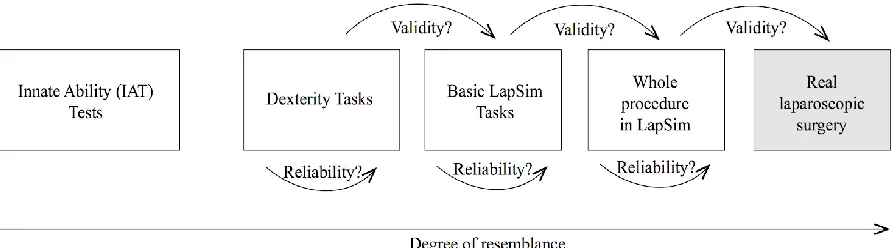
resemblance (see figure 1). Those that are further away from complete resemblance lack features essential to real surgery, and are thus not as predictive of actual laparoscopic performance. For example, early psychometric studies developed surgeon selection tests similar to those used in other skilled professions (Gallagher & Smith, 2003), to assess certain innate abilities considered related to laparoscopic performance, such as visuo-spatial, perceptual, and psychomotor abilities. However, these abilities did not always succeed in predicting performance (Groenier et al., 2014; Huijser, 2015). Examination of the resemblance spectrum explains these findings by suggesting that innate abilities lack the complexity that exists in laparoscopic surgery, and are thus not predictive of performance. On the other hand, low-fidelity dexterity tasks pose a closer resemblance to real laparoscopic surgery since they inter-combine cognitive and psychomotor demands along with manual dexterity abilities, all of whom are entailed in real surgery. Unlike simplified experimental conditions that represent just a building block of all skills required for task execution, learning complex motor procedures needed for the execution of low-fidelity dexterity tasks, permits all properties associated to the complex use of cognitive and other abilities to be captured.
Figure 1. The resemblance spectrum. Test suites placed on a continuum of ascending order (left to right), based on their resemblance to real laparoscopic surgery. The validity of the links between suites that are placed next to each other is stronger than those placed further apart. For example, dexterity tasks have a more valid link to resembling basic tasks than resembling a whole laparoscopic procedure.
2017; Kaschub, 2016). While a strong correlation was initially found in participants’ learning curves across tasks (r = 0.73, Kaschub, 2016), this correlation weakened greatly when the repetitive pattern of the same motor sequence required for task execution was eliminated across trials, by introducing greater demand for movement variability (r = 0.33, Arendt, 2017). This significant drop in learning curve correlation revealed that memorisation of a specific motor sequence, a process known as motor sequence learning (MSL; Verwey, 1996; Willingham, 2001), could be a main reason for individual differences in task learning. This suggests that MSL may be part of one’s general motor learning process, with some tasks promoting its contribution more than others, through being less varied or complex.
1.2. Exploring learning
Different authors use different terminologies for terms surrounding skill acquisition and learning, which are mostly abstract and therefore make it difficult to distinguish between them. We thus go on to explore such terms and provide an unambiguous distinction between them.
1.2.1. General motor Learning
According to Fitts and Posner (1967)’s theory, one of the most cited theories around learning, three main stages are involved in learning: namely a cognitive, an associative, and an autonomous stage. The cognitive stage includes identification and decoding of information at hand, the associative involves formation of links between tied aspects of information, and the autonomous entails task execution with minimal input of conscious processing. Within these stages, a set of internal cognitive, perceptual, motor, and perceptual-motor processes that are related to practice and experience, enable an individual to move through the three stages and achieve skilful performance (Schmidt, 1975). Schmidt’s theory of motor learning states that formation of different representations in memory regarding the relations between the situation at hand, one’s performance and sensations involved, as well as the results obtained, assist in the achievement of skill acquisition. While the above establish a fundamental and prominent picture of how motor learning occurs and what it entails, no answer is provided into what comprises a successful learning process from this description alone.
1.2.2. Holistic skill acquisition
The importance of variability in training is also prominent in other theories such as the Closed Loop Theory (Adams, 1976), which introduces a feedback loop as central to one’s learning. More specifically, facing diverge situations, enable one’s nerve system to learn how to handle discrepancies between actual and expected outcome from one’s actions, and correct movements accordingly. Adam’s theory (1976) can be depicted in applied settings of skill acquisition, such as sports performance. Close investigations of observations in performance have concluded that a set of plateaus, dips, and leaps are required for holistic skill acquisition. The above respectively refer to spurious limits (plateaus), development and implementation of new methods in one’s technique (dips), and subsequent advances in performance (leaps). These finally lead to an individual’s real performance limits; namely one’s performance asymptote (Gray & Lindstedt, 2015). These ‘milestones’ keep the learner active and motivated through the exploration, development, and the implementation of new ways to perform tasks. Exploration and development of different dips in performance are particularly necessary, since they enable the individual to evolve, and become more flexible in discovery and implementation of new techniques, according to the demands of the situation. This active search for ideal methods and approaches is directly related to improvements in performance (Gray & Lindstedt, 2015).
In consideration of the above, Rasmussen (1983) affirmed that a training procedure can only be considered as holistically effective if it includes three behaviour types, referring to skill-, rule-. and knowledge-based behaviourrule-. These behaviour types respectively refer to performing highly automated motor actions without conscious control (skill-based), executing a task based on stored rules or procedures (rule-based), and performing explicitly formulated actions based on general knowledge when faced with abstract or unknown situations (knowledge-based).
1.2.2. Motor sequence learning
little effort and attentional monitoring as possible (Abrahamse, Ruitenberg, de Kleine, & Verwey, 2013). MSL is believed to involve a combination of cognitive and motor processing that optimizes performance by creating links between a small number of movements and merging them into subunits, called ‘motor chunks’ (Abrahamse et al., 2013; Verwey, 1996; Miller, 1956). Such chunks can even be achieved with the pure use of kinaesthetic feedback when simple motor sequences are involved, and are determinant of an individual’s performance (Pinzon, Vega, Sanchez, & Zheng, 2016).
More specifically, MSL functions within the framework of the dual processor model (DPM), which is comprised of the cognitive processor and the motor processor (Abrahamse et al., 2013; Verwey, 2001). During initial performance of a novel sequential task, information is processed in the cognitive processor, which translates every stimulus into a relevant response through the use of higher cognitive functions. The cognitive processor passes individual responses on to the motor buffer, which is integrated into working memory, and then triggers the motor processor to execute the relevant movements according to the information loaded in the motor buffer.
With repetitive practice, a sequence skill is formed, where the aforementioned ‘motor chunks’ are created, and loaded to the motor buffer as single processing steps, leading to improved, more rapid performance. Initially, the cognitive processor remains active in selecting which motor chunk is passed on to the motor buffer, but practice leads to automation of motor chunks involved in a sequence of movements, with the first motor chunk triggering the loading of subsequent chunks; thus engagement of the cognitive processor is minimized (Verwey et al., 2010, 2013). At this point, explicit recognition of the underlying knowledge and abstract rules governing one’s improved performance is less needed or even difficult to access consciously (Maxwell, Masters, & Williams, 2012).
only explored, developed and implemented a method that is ideal for this specific condition, and is thus very context-dependent. Studies have shown that performance of tasks involving MSL is affected by context-dependent information, with impairment of performance when new, conflicting information was introduced while executing the task (Ruitenberg, de Kleine, van der Lubbe, & Verwey, 2012). Moreover, repeating the same sequence of movements mainly achieves great automation of the spatial configuration involved in the execution of a specific task, which may not be challenging enough to provoke higher cognitive processes such as active searching and problem-solving. Through the repetition of the same sequence, individuals do not form diverse representations in memory required for holistic skill acquisition (Schmidt, 1975), but rather involve storing specific patterns of movement. Skill acquisition in MSL is thus rather contextualised, and non-transferable.
1.2.3. A framework for general motor learning
We now develop a model for the process of general motor learning to connect all aforementioned notions under a concise framework. The model comprises two components:
holistic skill acquisition and MSL. The former entails strategies that are developed and employed for the execution of a task, and makes great use of the cognitive processor, while the latter depends on the spatial configuration that is acquired through the repetition of the same sequence, and works almost independently of the cognitive processor (Verwey et al., 2010, 2013). Depending on the extent to which a task includes repetition of the same sequence of movements, learning process has a relatively high or low proportion of MSL and holistic skill acquisition. For example, if a task involves the pure repetition of sequences, then MSL comprises most of the learning process with little practice of holistic acquisition of skills.
1.4. Aim of the study
1.4.1. Proportion of MSL to general motor learning
capabilities under the varied and demanding conditions of real surgery. The exact role of MSL in task performance is not known, and therefore our aim is to explore and estimate the proportion of MSL to the general motor learning process involved in mastering a new task.
No experimental paradigm so far allows the computation of such a proportion while the learner is actively practicing a novel complex task. In this paper, we propose a paradigm for such an analysis, which we name varied-fixed learning paradigm1 (VFL), and is based on the aforementioned notion that a task can promote either holistic skill acquisition or MSL, depending on its variability. The paradigm entails the manipulation of a task’s requirement for either a varied or a repetitive set of movements for its execution, thus allowing us to capture the learning component that comprises each part: holistic skill acquisition and MSL. It thus enables the computation of MSL’s proportion and unveils its role on task performance. The paradigm is modelled on individual learning curves for analysis. Details of the statistical model used are introduced in paragraph 2.4. Data analysis of the Method section.
To test our paradigm, we use low-fidelity dexterity tasks that initially include a varied, and then a fixed part with respect to the set of movements required for execution. Dexterity tasks were chosen because they involve practicing complex fine motor procedures and thus provide a promising framework for exploring the proportion of MSL to general motor learning while an individual executes the complex task. Also, by assessing such tasks, one can capture the entire time it takes for that task to be mastered, which is vital since learning is a continuous time-invested procedure, and the learning process of laparoscopic surgery should be investigated as such.
1.4.2. Dexterity tasks as psychometric tools
Even though this is not our main goal, and as long as our study allows us to, we also attempt to provide some insights on the possibility that such tasks could be used as psychometric tools for the assessment of laparoscopic surgeons, since their nature allows the exploration of the
1 The name varied-fixed learning paradigm derives from the paradigm’s nature, which consists of two parts. The
continuous learning time, instead of focusing on a specific time period as done with cognitive abilities (Groenier et al., 2014). A decomposition of one’s cognitive aptitude into sub-categories, as done so far when testing cognitive aptitude, may not capture the emerging abilities that couple their combined use. Since cognitive aptitude tests have not always been successful in predicting performance (Groenier et al., 2014; Huijser, 2015), dexterity tasks could be determined as a better psychometric tool.
2. Methods
2.1. Participants
A sample of 21 participants, with a mean age of 23.6, (SD=2.73, range 20 to 29) were recruited. Of them, 11 were male and 10 female. Handedness differed, with 18 being right handed and 3 left handed. All participants were university students of various degrees (Degree specialisation: 2 architecture, 4 engineering, 7 social sciences, 8 other).
2.2. Materials
Two tasks were devised for the current study, as described below. Both tasks were made to address fine motor skills, such as pinch prehension and finger flexion, as well as cognitive and visual-perceptual skills, such as alternating and sustained attention, spatial awareness and orientation, and hand-eye coordination. Laparoscopic challenges such as the fulcrum effect2 were taken into account for the construction of the tasks.
2.2.1. Mirror-drawing task
An asymmetrical frame outline extracted from Arendt’s (2017) ‘mirror-drawing’ task, (p. 21) was printed on an A4 piece of paper. The outline of each frame was black, and consisted of two lines with 5mm distance between them. Its mirrored outline was also printed on another Α4
piece of paper. One paper was placed on a tabletop, and reflected on a 30x30 cm mirror that arranged to stand right opposite the chair where the participant would sit. A white surface standing 10 cm higher than the paper was used to block the direct vertical view of the paper from the participant, while allowing the hand to draw on the paper, and the reflected image on the mirror to be visible to the participant. For an illustration see figure 2.
Figure 2. Illustration of the mirror-drawing task. A4 paper with printed frame outline on table. Sheet covering direct view. Mirror opposite participant, reflecting the outline.
2.2.2. Clips-and-string task
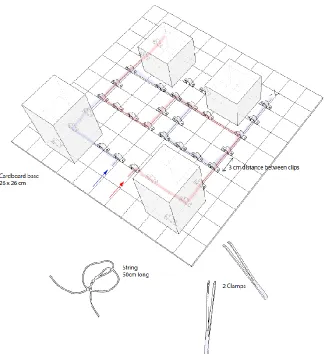
create a strong tip that would be passed through the clips more easily. For an illustration see figure 3.
Figure 3. Clips-and-string task. Clips nailed on a cardboard paper, with two differently-coloured paths outlined. Boxes act as obstacles to respective paths. Tweezers and string provided next to apparatus.
2.2.4. Measures and other materials
2.3. Design
A repeated measures design was used for the study, in which all participants carried out all tasks. Each task was developed to accommodate two separate set of trials, in accordance to the VFL paradigm. More specifically, the first set included a variation in the sequence of movements the participant had to execute, which was achieved through the rotation of the apparatus after the completion of each trial. The varied movements prohibited MSL from playing a role in the learning process, and therefore the part was assumed to capture the process of holistic skill acquisition. The second part of the tasks included the repetition of the same sequence of movements, now entailing MSL. This part captured the learning process that contained both the skill mastered though holistic skill acquisition, and MSL. Thus, the subtraction of the holistic skill acquisition component from the learning process that entail MSL would produce the pure effect of MSL.
2.4. Procedure
One participant was brought in and sat in front of a table. The experimenter handed the consent form, and read out the instructions of first task that the participant was going to complete. Every participant had to undergo the two tasks the one after the other, but the sequence in which they were completed differed across participants, to ensure there were no order effects. Every task began after any questions were answered and the participant stated that he or she was ready to begin. The two tasks consisted of 26 trials, and each trial was timed (starting the moment the experimented said “go” and stopping as soon as the participant said “done”). The time was noted on the observational form by the experimenter after each trial, along with other observations. A reminder on the trials left was announced by the experimenter halfway through the task, and then again two trials before the final one, to maintain participant motivation.
2.3.1. Mirror-drawing
The task consisted of two parts, the first one having 16 trials and the second 10. In the first part, the experimenter placed one frame outline on the table, which was rotated 45o before the beginning of every new trial, until the frame completed a rotation of 360o. Then its mirrored frame was presented and rotated again 45o before the beginning of every new trial, until a 360o was again completed. The sequence the frames were presented differed between participants to control for order effects. Once the first part was completed, the last frame rotation was kept on the table, and a vertical line was noted on one part of the frame. This line was used as the start line, and the participant had to continuously trace the same frame for 10 more trials to complete the second part. The experimenter had to pay attention on when the participant passed the start line, to split the seconds in the stopwatch accordingly.
2.3.2. Clips-and-string
In this task, which was also composed of two parts, the participant was instructed to pass the string through the clips using two tweezers (one in each hand). In the first part, the participant had follow one path till the end. After the completion of each trial, the experimenter removed the string from the clips, and rotated the cardboard 45o. The positioning of the boxes was changed to their respective mirrored positions, and the participant was instructed to follow the other path. The same procedure followed, with the experimenter rotating the cardboard 45o, until 16 trials were completed. For the second part, the cardboard was kept in the same position, and the participant had to pass the string through the clips for another 10 trials, following the same path every time.
2.4. Data analysis
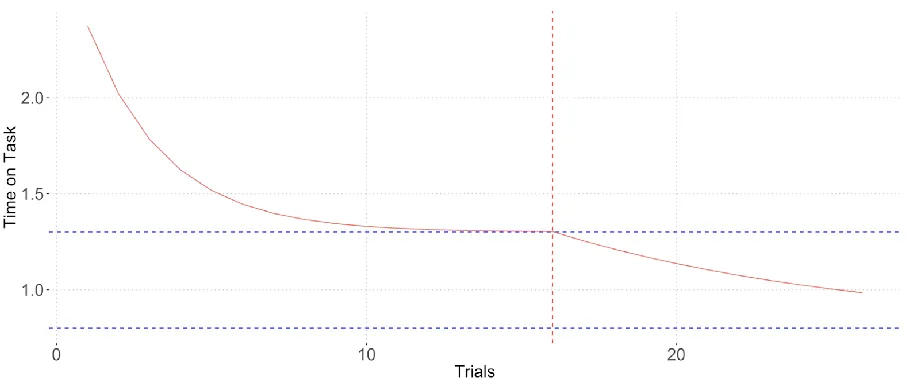
A non-linear mixed effects model with an exponential two-part learning curve as a likelihood function was used to run the regression analysis and estimate each individual learning curve. The exponential model of learning, which we called ARARY3, formed a two-part learning curve that models the two experimental phases of the tasks: holistic skill acquisition, and
Time-on-Task (ToT) when the task’s trials varied, while the second part models the one where the trials were repetitive, thus initially capturing the holistic skill acquisition process isolated from MSL, and the combined processes later on. The random component was captured using the Gamma distribution, since the distribution of learning curves is left-skewed and variance decreases as approaching the asymptote, thus the use of a normal distribution would produce a strong bias.
2.4.1. Statistical Model and analysis
Our model considered three aspects of learning: amount of learning within the study (amplitude,
δ), learning speed (rate, ρ), and maximum learning capacity (asymptote, ω). These aspects make up a exponential function for learning curves that is preferred to power functions frequently used in the past (Heathcote, Brown, & Mewhort, 2000). Since it was a two-part model, the overall structure consisted of five parameters based on these learning aspects, that determined each individual two-part learning curve: δS, δM, ρS, ρM, ω. The number of trial repetition per component tS and tM is also modeled. Thus, the performance over trials (ToT) is represented in the following formula:
performance = 𝜔 + 𝛿𝑆𝑒−𝜌𝑆𝑡𝑆 + 𝛿𝑀𝑒−𝜌𝑀𝑡𝑀
Regression analysis was performed using the package brsm 2.1 (Brunckner, 2017), and the non-linear functions were built using the dedicated library from the package asymptote
(Schmettow, 2017). Population-level effects were estimated for analysis.
used to assess the generalisability of this proportion. Strong dispersion in effects would reveal stronger variation in the proportion of each individual’s MSL, making the average MSL proportion less generalizable.
[image:20.595.77.534.244.434.2]Then, pairwise correlations between task learning curves, along with their estimated 95% credibility intervals were calculated, to examine the internal consistency of such tasks, and explore the possibility of their use as psychometric tests.
Figure 4. Exponential two-part learning curve model (ARARY). Trials and mapped on the x-axis and ToT is mapped on the y-axis. The two-part learning curve models holistic skill acquisition on the first part, and general motor learning on the second, considering amplitude δS and δM, rate ρS and ρM, and asymptote ω.
3. Results
3.1. Population-level effects within tasks
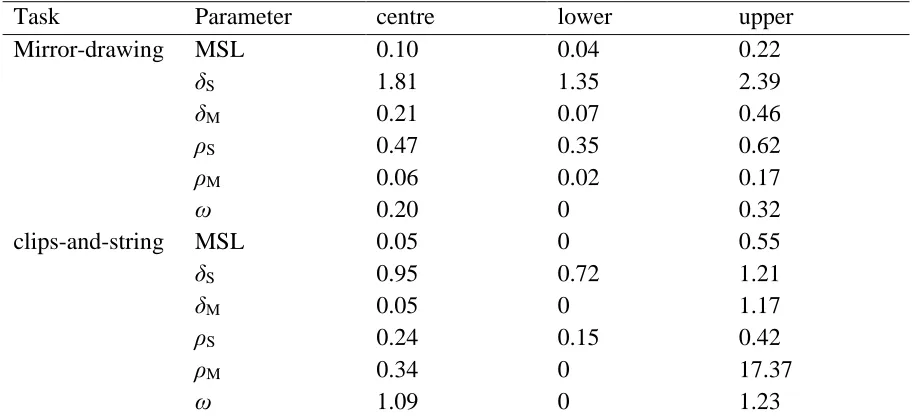
[image:21.595.70.526.527.736.2]Population-level effects for the five parameters were drawn from the posterior distribution. All four parameters and their 95% credibility limits are reported in Table 1. The exact proportion of MSL to general motor learning, even though not a parameter in itself on our model, was created on the posterior and also presented on the table, at the respective row (labelled MSL) for each task. As seen on the table, the proportion of MSL in the mirror-drawing task was almost twice as large (0.10; 95% CI [0.04; 0.22]) as the proportion in the clips-and-string task (0.05; 95% CI [0.00; 0.55]), but uncertainty was high in both. While there is large uncertainty, it is fair to suggest that MSL comprises a small proportion of the general motor learning process. This is also evident by inspecting the δM to δS ratio from the amplitude values of each task, as presented at the respective rows in table 1. In the mirror-drawing task,the amplitude in the first part of the learning curve is approximately eight times larger (δS = 1.81; 95% CI [1.35; 2.39]) than this of the second part (δM= 0.21; 95% CI [0.07; 0.46]), with both values being highly uncertain. For the clips-and-string task, the difference between the two amplitudes is more than twice as large as that of the mirror-drawing, thus yielding a smaller δM to δS ratio. Specifically, the amplitude for the holistic skill acquisition part is almost fourteen times larger (δS = 0.95; 95% CI [0.72; 1.21]) than the general motor learning amplitude (δM = 0.95; 95% CI [0.72; 1.21]). Large uncertainty seems to exist, with credibility limits deviating more than 0.2.
Table 1. Population-level effects for amplitudes and rates per task
Task Parameter centre lower upper
Mirror-drawing MSL 0.10 0.04 0.22
δS 1.81 1.35 2.39
δM 0.21 0.07 0.46
ρS 0.47 0.35 0.62
ρM 0.06 0.02 0.17
ω 0.20 0 0.32
clips-and-string MSL 0.05 0 0.55
δS 0.95 0.72 1.21
δM 0.05 0 1.17
ρS 0.24 0.15 0.42
ρM 0.34 0 17.37
ω 1.09 0 1.23
While the proportion of MSL is based on the two amplitudes within each task, some observations on the rates are also worth noting. More specifically, and especially for the mirror-drawing task, the rate of learning seems to be faster in the first part of the learning curve (ρS = 0.47; 95% CI [0.35; 0.62]), than the second (ρM = 0.06; 95% CI [0.02; 0.17]), with notable, but lower uncertainty than the one observed in amplitudes. This suggests that more trials were needed in the second part to reach maximum performance, since improvement in learning was rather slow compared to the first part.
3.2. Participant-level effects within tasks
3.2.1. Individual learning curves
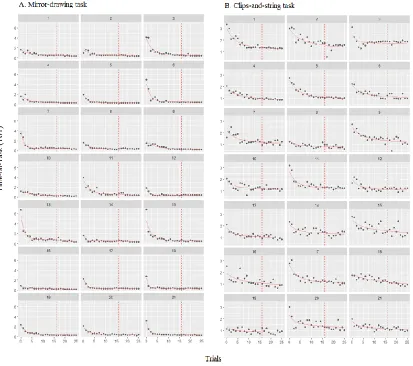
All learning curves generated from both tasks are presented in Figures 3, with the x-axis displaying the trials, while the y-axis displaying the time-on-task (ToT). Overall, the shape of each learning curve seems to differ, stressing the importance to examine individual learning curves rather than an average computed from all of them. A visual inspection of the learning curves for the two tasks follows.
Figure 3. Participant learning Curves (Time-on-Task as a function to task trials) for mirror-drawing (A) and clips-and-string task (B).
3.2.2. Individual MSL proportions
Having discussed the population mean of the MSL proportion in paragraph 3.1., we go on to investigate whether this mean was representative of all individuals. To capture random effects, an ARARY model was created, in which parameters were linearized to run on the same log-scale ranging from -∞ to +∞, and random effects were extracted from the posterior. A caterpillar plot devised using ggplot2 package, plotted participant random effects on the x-axis, ordered according to the magnitude of the effect, depicted on the y-axis. The credibility limits were displayed using lines for every effect, with larger lines reflecting higher uncertainty on the MSL proportion within each individual learning curve. As can be seen, there is large variation in the magnitude of each individual’s MSL proportion with regards to the population mean, which is also highly uncertain, especially in the mirror drawing task,. This variation from the population mean brings about questionable conclusions concerning the generalizability of MSL proportion. Also, the high uncertainty of the random effects highlights the need for more exhaustive research, since current results are too uncertain to suggest final conclusions.
[image:24.595.83.428.407.682.2]3.2. Correlation of learning parameters across tasks
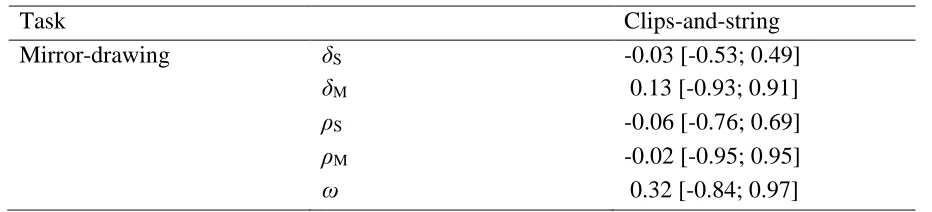
[image:25.595.67.533.292.398.2]An across-task analysis was computed using pairwise correlations to estimate population-level effects for the two amplitudes (δS, δM) and rates (ρS, ρM). Results are reported in Table 2. A weak positive correlation was found between the asymptotes of the two tasks (r = 0.32), but even this has high uncertainty (95% CI [-0.84; 0.97]). This correlation can only suggest the possibility that dexterity tasks could be used as psychometric tests, but no further conclusion can be drawn.
Table 2. Pairwise correlations of population-level parameters
Task Clips-and-string
Mirror-drawing δS -0.03 [-0.53; 0.49]
δM 0.13 [-0.93; 0.91]
ρS -0.06 [-0.76; 0.69]
ρM -0.02 [-0.95; 0.95]
ω 0.32 [-0.84; 0.97]
Estimates with 95% credibility limits
3.3. Model criticism
After checking the prediction intervals (25%, 50% and 75% quartiles) to ensure the certainty of the posterior prediction, it seems that most observations fall within the predicted range. However, it is worth mentioning that there are certain outliers observed, particularly with regards to those falling below our predicted range, that could reflect the effects of difficulty in task variation. Residual plots show large variation, which is expected since the learning curve of each participant had a different shape.
The prediction intervals and residual plots can be found in appendix C, for further examination.
4. Discussion
general motor learning is present but not very pronounced, while estimates were highly uncertain. The presence of MSL, even though small, implies that variability in laparoscopic training tasks is essential, since promotion of MSL through repetitive tasks might lead to better performance that is however not representative of transferable skills. Variability will ensure that skills mastered in training are transferable to real settings. However, the large uncertainty in the proportion of MSL calls for further, more exhaustive investigation to attain more certain results and derive to conclusive arguments with regards to the extent of variation needed. After an initial scan through our findings, our discussion focuses on the limitations of the current study, in an attempt to investigate the possible reasons behind the uncertain findings. Based on these limitations, we proceed to the provision of guidelines for adjustments that need to take place so that future research can move towards an optimised way of exploring MSL and its role when mastering a new complex procedure. Finally, we discuss the feasibility and implications of the proposed paradigm and approach to analysis in the field of applied research.
4.1. Exploration of current findings
The component of MSL was rather low, since its addition to holistic skill acquisition offered minimal extra advance in performance. However, since this research constituted only a pilot exploratory investigation regarding the feasibility of this novel way to analysis and, as mentioned, findings were uncertain, it would be naive to make decisive conclusions on the exact proportion of MSL from this research alone. Before the examination of experimental weaknesses that might have caused uncertainty in the results, we first focus on some observations of the current findings that are rather noteworthy and could inform future research.
4.1.1. Difference in MSL proportion across tasks
hand-eye coordination due to the perceived inversion of movement, motor requirements on that task were not as demanding, since participants knew how to operate a pencil. On the other hand, the clips-and-string task required much more motor effort, since participants had to learn how to handle the tweezers and carefully pass the string through small clips. Cognitive effort was not as demanding as in the mirror-drawing task, since no recreation of the environment was needed.
Trying to further inspect the dependence of MSL on task nature, a more elaborate glance on majority of paradigms used in previous MSL studies provide further insights. For example, types of apparatus used in such studies, such as the discrete sequence production task (DSP; Abrahamse et al., 2013), the m x n task (Hikosaka, Rand, Miyachi, & Miyashita, 1995) or the
serial reaction time task (SRT; Nissen & Bullemer, 1978), include small repetitive sequences of movements, that are timed closely to each other and do not diverge in movement required for execution. Moreover, authors like Sakai, Hikosaka, and Nakamura (2004), have stressed that not only the serial order of a sequence, but also the timing of movement, referred to as rhythm, is determinant of a sequential performance, and this rhythm reflects the underlying chunking process.
Bridging these remarks to our findings, the mirror drawing task favoured continuity much more that the clips-and-string task, since in the latter, movement was occasionally interrupted by confounding obstacles. For example, it was a frequent observation throughout the experiment that the string tangled to clips, and participants had to stop to untangle the string and then continue carrying out the task. This might have impeded the potential for motor chunking of sequences, since conflicting stimuli interrupted the sequence at varying points, preventing the sequence to acquire a patterned serial order or timing.
4.1.2. Difference in MSL proportion across participants
Another insight is provided from differences in MSL proportions across participants. Examination of random effects suggested that there is dispersion of this proportion across individuals, meaning that the population mean of MSL is not as generalizable to everyone, with many individuals diverging from the mean. Specifically, while MSL is promoted via the repetition of the same movements, the extent to which individuals acquire learning of specific motor sequences it is not only task-dependent, but also depends on individual differences. This assertion warns researchers to proceed with caution in future simulator tasks design, since there is a chance of biased performance depending on the variability of individuals’ competence in acquiring MSL. For example, if a laparoscopic task were to be highly repetitive, then a biased increase in performance would be present in individuals with high MSL, that would, however, not reflect their true potential for general motor learning. In other words, individuals with high proportion of MSL would show better performance in repetitive simulator tasks than under realistic, diverse conditions. The chance of such an optimistic bias in learning during training needs to be minimized.
Our estimations of random effects were highly uncertain, but the important insights they provide deem necessary a more exhaustive investigation of random effects in future replications of the study, to get more certain estimates. The root of the current uncertainty, and necessary steps for acquisition of more certain results are explored in paragraph 4.2. Study limitations and amendments for future replications of the discussion section. Given that future replications yield certain random effects that still reveal a great variation in participant-level MSL proportion, researchers could dive into exploring the possible, more theoretically-based explanations to such a variation.
4.1.3. Task correlation
findings, though their potential for psychometric testing is increasingly doubted, since past research has also found highly uncertain weak links (Arendt, 2017; Kaschub, 2016).
4.2. Study limitations and amendments for future replications
Having examined our findings, we now inspect in more detail the experimental paradigm used and the flaws of our pilot study, which possibly account for the high uncertainty in findings. Weaknesses discussed form the basis of our guidelines for better study replications in future research.
The thorough investigation of individual learning curves reported in the results section, showed that the rate of learning from the varied part of our experimental paradigm was almost seven times as fast as that of the fixed part on the mirror-drawing task. This implies that MSL could possibly bring further advance in performance than those noted in our study, but this was not detected within the limited number of trials since maximum performance was possibly not reached. Also, some dissemination on the time taken to complete each trial was noted, especially in the clips-and-string task. One can conclude, then, that the parameters of each learning curve are rather uncertain. For example, inability to reach maximum performance (parameter asymptote) could have led to uncertainty in the amplitude and rate parameters as well, since those are highly interconnected within our model. Large dissemination could also lead to less accurate rate estimation, which would in turn affect the amplitude parameter’s certainty. It is thus important that data collection enables a recording of time-on-task that is as accurate as possible. Below are some key alterations that are believed to bring about improvements to the results’ robustness.
4.2.1. Increased number of trials
times as much trials in the second part of the task. However, such an excessive number of trials would most likely generate participant fatigue, depriving them of further advance in performance. Given that the rate estimates are uncertain, and thus the difference between the two rates could be smaller, we suggest a number of trials that would lay to approximately 20 trials for the first and 30 trials for the second part, to prohibit fatigue and ensure some stability in the asymptote. In case researchers wish to include more trials, introduction of spaced-practice is a possibility, which has also been correlated to advanced motor skill acquisition (Kwon, Kwon, & Lee, 2015; Schreuder, Wolswijk, Zweemer, Schijven, & Verheijen 2011). Researchers could also consider including a second set of fixed trials in each task. In this way, one can also derive correlations between the rate patterns of learning within the learning curve of each participant, and get more robust results with regards to this learning parameter.
4.2.2. Configuration difficulty as a random effect
Researchers should also pay great attention to the configurations of the dexterity tasks employed. In the mirror-drawing task, noise in data was minimal, reflecting a similar difficulty level across varied trials. However, there was high noise in the data generated from the clips-and-string task, which might suggest that some configurations of the apparatus were more challenging, while other were easier to execute. This is also supported by certain data outliers in some learning curves with regards to the Time on Task (ToT), where some trials of highly increased performance lied in-between normal-performance trials. An observation attributed to the fact that certain configurations favoured performance. Therefore, experimenters in future replications should have a defined set of configurations with varied difficulty. Having them identified in the data set would allow configurations to be considered a non-human population
that could also be extracted as a random effect from the random component of the posterior analysis, and provide one with more robust results, by factoring out variance due to difficulty in configuration.
future replications could create an alternative to this task. Promotion of MSL would be more certain in a task that enables the uninterrupted execution of motor sequences. For example, instead of passing a string through clips, nails with heads could be used, to allow participants to pass the string by nails instead of through them. Also, a smaller, less scrambled path would ensure the non-tangling on the string.
4.2.4. Smaller movement sequences
Related to the above, tasks used should also ensure that movement sequences are small enough to allow chunking. Since chunking is directly related to working memory (Seidler, Bo, & Anguera, 2012), which is known for its limited capacity ranging somewhere between five to seven items (Miller, 1956; Cowan, 2001), movement sequences should not be very demanding. The study of Pinzon et al (2016), whose apparatus closely resemblance our tasks in term of the flow of movement required, found that continuous sequences larger than seven turns in reactions (thus with more than seven items to be processed in working memory), were not as successful in following replications. A future apparatus could form a smaller path, or a path whose rhythm is clearly divided in parts.
4.3. Model feasibility and implications
While the study conducted here focused on a within-subject analysis using a repeated measures design, our paradigm and model of analysis enables comparisons across-subjects as well, that can be used for research in other applied disciplines. For example, our model could be used to investigate age differences in MSL proportion. The increasing number of elderly people have turned recent research towards the investigations of elderly’s ability to acquire new motor skills that are necessary for their independent living. Studies have already found differences in chunking between younger and older adults (e.g. Barnhoorn, van Asseldonk, & Verwey, 2017), yet those are still conducted using simplified laboratory conditions like the DSP task. Having identified the advantages of tasks that are closer to real life activities, researchers could use the VFP paradigm to compare aging differences in MSL proportion, while executing a dexterity task like tying one’s shoelaces. The comparison could be performed in the age group of young adults (20 to 30 years old) where cognitive abilities peak, and older adults, ranging from 60 to 70 years of age, since 65 is considered the mean age for cognitive abilities decline, especially in situations where cognition interacts with motor control (see Li & Lindenberger, 2002 for a review).
We also encourage researchers to follow our proposed analysis of learning curves, since it is an exponential model that does not depend on averages across individuals. Other authors have already discussed the limitations of learning curves using power functions (Heathcote, et al., 2000), mainly concerning the great variability that exists across the learning parameters of each individual, favouring against conclusions based on averages. Our exponential model enables one to investigate learning curves at a population level but also at an individual one, offering greater insights into everyone’s learning process, and enabling researchers to make suggestions for improved designs that also consider individual differences. For example, individual learning curves could inform personalised training procedures, which have been suggested as a time-efficient and cost-effective approach to training (Ahmed, Abid, & Bhatti, 2016), by assessing individual trainee needs and enabling an individual-tailored training process.
performance on a complex simulator task, and investigate individual differences that would offer more insights on the need for proper surgeon assessment. Such a task would need to include three different phases. The first one should require referral to instructions for the participant to carry out the task, including enough trials to automate the action and stop referring to instructions. This part would capture rule-based behaviour. The task could later go on to be repeated, capturing the skill-based behaviour, until an unexpected situation would be presented. The participant would then need to use abstract knowledge to complete the task, exercising knowledge-based behaviour. The learning parameters amplitude, rate, and asymptote would be captured in every part of the simulator task, for assessment of individual differences in learning curves using our model. Large individual difference could imply the necessity for good surgeon assessment or more adaptive training.
As can be understood, the analysis of learning proposed in the present paper offers a promising alternative to research in applied settings. The proposed amendments should be viewed as guidelines, so that future replications could move towards more certain results, that could be generalised to laparoscopic and other fields.
5. Conclusions
References
Abrahamse, E. L., Ruitenberg, M. F. L., de Kleine, E., & Verwey, W. B. (2013). Control of automated behaviour: Insights from the discrete sequence production task. Frontiers in Human Neuroscience, 7, 1–16. doi:10.3389/fnhum.2013.00082
Adams, J. A. (1976). Issues for a Closed-Loop Theory of Motor Learning. Motor Control, 87-107. doi:10.1016/b978-0-12-665950-4.50009-2
Ahmed, A., Abid, M. A., & Bhatti, N. (2016). Balancing standardized testing with personalized training in surgery. Advances in Medical Education and Practice,8, 25-29. doi:10.2147/amep.s122312
Arendt (2017). Towards reliable and valid prediction of MIS-performance with basic laparoscopic tasks in the LapSim and low-fi dexterity tasks. (Unpublished master’s thesis). University of Twente, Enschede, Netherlands.
Barnhoorn, J. S., van Asseldonk, E. H. F., & Verwey, W. B. (2017). Differences in chunking behaviour between young and older adults diminish with extended practice.
Psychological research = Psychologische Forschung, 1-11. doi: 10.1007/s00426-017-0963-6
Cook, D. A., Hamstra, S. J., Brydges, R., Zendejas, B., Szostek, J. H., Wang, A. T., . . . Hatala, R. (2012). Comparative effectiveness of instructional design features in simulation-based education: Systematic review and meta-analysis. Medical Teacher, 35(1). doi:10.3109/0142159x.2012.714886
Cowan, N. (2001). The magical number 4 in short-term memory: A reconsideration of mental storage capacity. Behavioral and Brain Sciences, 24(1), 87-114. doi:10.1017/s0140525x01003922
Fitts, P. M., & Posner, M. I. (1967). Learning and skilled performance. In Human performance.
Belmont, California: Brooks-Cole.
Gallagher, A. G., Mcclure, N., Mcguigan, J., Ritchie, K., & Sheehy, N. P. (1998). An Ergonomic Analysis of the Fulcrum Effect in the Acquisition of Endoscopic Skills.
Endoscopy, 30(7), 617-620. doi:10.1055/s-2007-1001366
Gallagher, A. G., & Smith, C. D. (2003). Human-Factors Lessons Learned from the Minimally Invasive Surgery Revolution. Surgical Innovation, 10(3), 127-139. doi:10.1177/107155170301000306
American
Journal of Surgery, 197(4), 447–9. doi:10.1016/j.amjsurg.2008.01.024
Gray, W. D., & Lindstedt, J. K. (2017). Plateaus, dips, and leaps: Where to look for inventions and discoveries during skilled performance. Cognitive Science, 41(7), 1838-1870. Doi: 10.1111/cogs.12412
Groenier, M., Schraagen, J. M. C., Miedema, H. A. T., & Broeders, I. A. J. M. (2014). The role of cognitive abilities in laparoscopic simulator training. Advances in Health Sciences Education: Theory and Practice, 19(2), 203–17. doi:10.1007/s10459-013-9455-7 Heathcote, A., Brown, S., & Mewhort, D. J. (2000). The power law repealed: The case for an
exponential law of practice. Psychonomic Bulletin & Review, 7(2), 185-207. doi:10.3758/bf03212979
Hikosaka, O., Rand, M. K., Miyachi, S., & Miyashita, K. (1995). Learning of sequential movements in the monkey: process of learning and retention of memory. Journal of Neurophysiology, 74(4), 1652-1661. doi:10.1152/jn.1995.74.4.1652
Huijser, S. (2015). Influence of cognitive abilities on laparoscopic simulator trainer performance (Unpublished master's thesis). University of Twente, Enschede, Netherlands.
Kaschub, V. L. (2016). Learning complex motor procedures (Unpublished bachelor’s thesis). University of Twente, Enschede, Netherlands.
Kwon, Y. H., Kwon, J. W., & Lee, M. H. (2015). Effectiveness of motor sequential learning according to practice schedules in healthy adults; distributed practice versus massed practice. Journal of Physical Therapy Science,27(3), 769-772. doi:10.1589/jpts.27.769 Li, K. Z., & Lindenberger, U. (2002). Relations between aging sensory/sensorimotor and
cognitive functions. Neuroscience & Biobehavioral Reviews, 26(7), 777-783. doi:10.1016/s0149-7634(02)00073-8
Maxwell, J. P., Masters, R. S., & Williams, A. M. (2012). Implicit motor learning, reinvestment and movement disruption: what you don’t know won’t hurt you? In N. J. Hodges (Ed.), Skill acquisition in sport: research, theory and practice. London: Routledge.
Moulton, C. A., Regehr, G., Lingard, L., Merritt, C., & MacRae, H. (2010). Slowing down to stay out of trouble in the operating room: remaining attentive in automaticity. Academic Medicine, 8(10), 1571-1577. doi:10.1097/ACM.0b013e3181f073dd
Mylopoulos, M., & Regehr, G. (2011). Putting the expert together again. Medical Education, 45(9), 920-926. doi:10.1111/j.1365-2923.2011.04032.x
Mylopoulos, M., & Woods, N. N. (2017). When I say … adaptive expertise. Medical Education,51(7), 685-686. doi:10.1111/medu.13247
Nácul, M. P., Cavazzola, L. T., & Melo, M. C. (2015). Current status of residency training in laparoscopic surgery in Brazil: A critical review. ABCD. Arquivos Brasileiros De Cirurgia Digestiva (São Paulo),28(1), 81-85. doi:10.1590/s0102-67202015000100020 Nissen, M. J., & Bullemer, P. (1987). Attentional requirements of learning: Evidence from performance measures. Cognitive Psychology, 19(1), 1-32. doi:10.1016/0010-0285(87)90002-8
Pinzon, D., Vega R., Sanchez, Y. P., & Zheng, B. (2016). Skill learning from kinesthetic feedback. American Journal of Surgery, 214(4), 721-725. doi: 10.1016/j.amjsurg.2016.10.018
Rasmussen, J. (1983). Skills, rules, and knowledge; signals, signs and symbols, and other distinctions in human performance models. IEEE Systems, Man, and Cybernetics Society 13(3), 257 – 266. doi: 10.1109/TSMC.1983.6313160
Ruitenberg, M. F. L., de Kleine, E., van der Lubbe, R. H. J., Verwey, W. B., & Abrahamse, E. L.
(2012). Context-dependent motor skill and the role of practice. 76(6), 812-820. doi: 10.1007/s00426-011-0388-6
Sakai, K., Hikosaka, O., & Nakamura, K. (2004). Emergence of rhythm during motor learning.
Trends in Cognitive Sciences, 8(12), 547-553. doi:10.1016/j.tics.2004.10.005
Schmidt, R. A. (1975). A schema theory of discrete motor skill learning. Psychological Review, 82(4), 225-260. doi:10.1037/h0076770
Seidler, R. D., Bo, J., & Anguera, J. A. (2012). Neurocognitive Contributions to Motor Skill Learning: The Role of Working Memory. Journal of Motor Behavior, 44(6), 445-453. doi:10.1080/00222895.2012.672348
Verwey, W. B. (1996). Buffer loading and chunking in sequential keypressing. Journal of Experimental Psychology: Human Perception and Performance, 22(3), 544–562. doi: 10.1037/0096-1523.22.3.544
Appendix A
Consent Form
This study is part of the Master thesis of Lida Z. David, student at the University of Twente. The study consists of two dexterity tasks (= fine motor activities that require good finger and hand to coordination), of 26 brief trials each.
The goal of the study is to explore the extent to which motor sequence learning is involved in learning a task. Simply put, we are trying to see if, after you learn how to perform a task, repeating the same sequences of movement will increase your performance further. This study is a piece of the puzzle that will help make training for laparoscopic surgery better. (Laparoscopic surgery is a type of surgery done through one or more small incisions, using small surgical instruments to operate. A tiny camera is inserted from one of the incisions and projects the area of interest to a flat screen).
The data recorded will be anonymous, so nobody will know your performance. You have the right to withdraw at any moment during the study. By signing below you agree that:
You are 18+
You understand the privacy of your data
You understand you have the right to withdraw
Before signing, please state the details asked below (these will be used only for demographic reasons and will not be crossed with your data scores):
Name: ………. Age: ………….
Handedness (left-handed/right handed/ambidextrous): ……… Occupation: ……….
Appendix B
Instructions for each task
1. Mirror-drawing Instructions
The task you are about to perform is called “Mirror-drawing”. It consists of 2 parts, the first consisting of 16 trials, and the second 10. The goal is to to trace the frame presented to you in the box (point at frame), by looking at the mirror’s reflection instead of the paper. You have to use the pen provided (point at pencil), and draw in between the two black lines of the frame. You have to be as quick and as cautious as possible. Your performance will be timed. As soon as you are done, you have to state “done!”, so I can stop the timer and note your time. For the first part, I will change the positioning of the paper. I will remind you how many trials are left on the 10th and 14th trial. In the second part you’ll have to do the exact same thing for another 10 trials, only this time I will keep the same frame in front of you. You will start from this point (show point) and trace the outline continuously for all ten trials. Don’t worry for shouting done, I will watch you and keep count. I will again remind you how many trials are left on the 6th. If you have any questions, ask me now or in-between the trials, during the moments you are not being timed. Do you have any questions? (answer questions). Please tell what you have to do, so we make sure you understand.
Are you ready to begin?
2. Clips-and-string Instructions
This task is called “clips-and-string”. It consists of two parts, 16 trials each. The goal is to pass this string (point at string) through the clips (point at clips) of either the red or blue path, using these two tweezers (point at tweezers). I will tell you each time which path you have to follow. You have make your way around the boxes, and have to be as quick and as cautious as possible. Your performance will be timed. As soon as you are done, you have to state “done!”, so I can stop the timer and note your time. Then, I will change the position of the cardboard the same procedure will be repeated, until you complete the task 16 times. I will remind you how many trials are left on the 10th and 14th trial. This will be part 1. For part 2, you will have to do exactly the same for another 10 trials, only this time the the cardboard will remain still, and you will have to follow the same path for all 10 trails.. I will again remind you how many trials are left on the 6th trial. If you have any questions, ask me now or in-between the trials, during the moments you are not being timed. Do you have any questions? (answer questions). Please tell what you have to do, so we make sure you understand.
Are you ready to begin?
Appendix C
Syntax used in R
Data analysis protocol Lida David Martin Schmettow
1 March 2018
Reading in data
LD_18 <-
readxl::read_excel("Data Thesis.xlsx") %>%
mutate(trial = as.integer(trial -1)) %>%
rename(trialS = trial) %>%
mutate(Condition = ifelse(Condition == 1, "varied", "fixed"),
trialM = ifelse(Condition == "fixed", trialS - 16, 0),
Part = as.factor(Part)) %>%
gather(key = Task, value = ToT, Clips, Drawing) %>%
mutate(Obs = row_number()) %>%
select(Obs, Part, Task, Condition, trialS, trialM, ToT)
ToT <-
str_split_fixed(LD_18$ToT, "\\:", 3) %>%
as_data_frame() %>%
mutate(minutes = as.numeric(V2) + as.numeric(V3)/60)
LD_18$ToT <- ToT$minutes
LD_18
save(LD_18, file = "LD_18.Rda")
Exploratory data analysis
LD_18 %>%
ggplot(aes(x = ToT)) +
geom_histogram()
LD_18 %>%
ggplot(aes(x = trialS, y = ToT)) +
geom_smooth(se = F) +
geom_vline(xintercept = 16, linetype = 2, col = "red") +
facet_wrap(Task ~ Part, scales = "free_y")
Regression
We estimate a two-component learning curve in asym-rate-ampl parametrization. Performance is composed of two components, that have their own learning trajectory. The skill component (SC) contains general coordination and strategy at the task, which is independent of spatial configuration. The motor component (MC) depends on the spatial configuration and is acquired by repeating the exact same sequence.
With the number of trials per component, 𝑡𝑆 and 𝑡𝑀, and the learning parameters asymptote (maximum performance) 𝜔, rate 𝜌𝑆, 𝜌𝑀 and amplitude 𝛿𝑆, 𝛿𝑀, performance (ToT) takes the following form:
performance = 𝜔 + 𝛿𝑆𝑒−𝜌𝑆𝑡𝑆 + 𝛿𝑀𝑒−𝜌𝑀𝑡𝑀
The following model specifies a separate learning curves per task-by-participants. Correlations across tasks are included. The amplitude - rate - asymptote
parametrization is used, like in the example below:
set.seed(42)
n_S = 15
n_M = 20
n = n_S + n_M
asym = 0.5
rateS = 0.4
amplS = 1.5
rateM = 0.2
amplM = 0.5
Part_1 <-
data_frame(asym = rep(asym, n),
rateS = rep(rateS, n),
amplS = rep(amplS, n),
rateM = rep(rateM, n),
amplM = rep(amplM, n),
trialS = 1:n,
trialM = c(rep(0, n_S),(1:n_M))) %>%
mutate(mu = asymptote::arary(amplS, rateS, amplM, rateM, asym, trialS, t
rialM))
Part_1 %>%
ggplot(aes(x = trialS, y = mu)) +
The following formulas are used for regression, the nonlinear function is from package
asymptote.
lazyeval::f_lhs(ARARY) <- quote(ToT) ARARY
## ToT ~ asym + amplS * exp(-rateS * trialS) + amplM * exp(-rateM * ## trialM)
## <environment: namespace:asymptote>
F_ef_arary <- list(
formula(asym ~ 0 + Task + (0 + Task|corr1|Part)),
formula(rateS ~ 0 + Task + (0 + Task|corr2|Part)),
formula(amplS ~ 0 + Task + (0 + Task|corr3|Part)),
formula(rateM ~ 0 + Task + (0 + Task|corr4|Part)),
formula(amplM ~ 0 + Task + (0 + Task|corr5|Part)))
# measurement scale
F_pr_arary_2 <- c(set_prior("normal(0.5, 10)", nlpar = "asym", lb = 0), set_prior("normal(1, 10)", nlpar = "amplS", lb = 0), set_prior("normal(0.5, 10)", nlpar = "rateS", lb = 0), set_prior("normal(1.5, 10)", nlpar = "amplM", lb = 0), set_prior("normal(0.5, 10)", nlpar = "rateM", lb = 0))
F_pr_arary_gam <- c(set_prior("lognormal(1, 2)", nlpar = "asym", lb = 0), set_prior("lognormal(1.5, 1)", nlpar = "amplS", lb = 0), set_prior("beta(1.2, 1.2)", nlpar = "rateS", lb = 0, ub =
1),
set_prior("lognormal(1.5, 1)", nlpar = "amplM", lb = 0), set_prior("beta(1.2, 1.2)", nlpar = "rateM", lb = 0, ub =
1),
set_prior("cauchy(0, 5)", class = "shape"))
M_5: ARARY with Gamma random component
Here we build the model and compile it with just a few chains.
M_5 <-
brm(bf(ARARY,
flist = F_ef_arary, nl = TRUE),
prior = F_pr_arary_2,
family = Gamma(link = identity),
data = LD_18,
iter = 150, warmup = 120,
init = "0")
Using the compiled model above to run the full chains
M_5 <-
brm(fit = M_5, data = LD_18,
iter = 5000, warmup = 3000,
init = "0",
control = list(adapt_delta = .95))
M_5
P_5 <- posterior(M_5) PP_5 <- post_pred(M_5)
LD_18$M_5 <- predict(M_5)$center
LD_18$M_5_resid <- LD_18$ToT - LD_18$M_5
save(M_5, P_5, PP_5, file = "M_5.Rda")
Results
load("M_5.Rda")
T_fixef <-
P_5 %>% fixef()
T_fixef
Estimates with 95% credibility limits
nonlin fixef center lower upper asym TaskClips 1.1577182 1.0291061 1.2638820 asym TaskDrawing 0.2612140 0.1180004 0.3269353 rateS TaskClips 0.3220994 0.2141153 0.5059187 rateS TaskDrawing 0.5377853 0.3907563 0.7115918 amplS TaskClips 1.0286249 0.7859518 1.3076140 amplS TaskDrawing 2.0981479 1.5331471 2.6884107 rateM TaskClips 10.1972400 0.4392050 26.3571275 rateM TaskDrawing 0.1020007 0.0407116 0.1833435 amplM TaskClips 0.1054591 0.0395542 0.1794875 amplM TaskDrawing 0.1866054 0.0900881 0.3412478
Individual learning curves
LD_18 %>%
filter(Task == "Clips") %>%
ggplot(aes(x = trialS, y = ToT)) +
geom_point(alpha = .5) +
geom_line(aes(y = M_5, color = "M_5")) +
geom_line(aes(y = M_6, color = "M_6")) +
geom_vline(xintercept = 16, linetype = 2, col = "red") +
facet_wrap(~ Part, nrow = 7) +
ggtitle(list(title = "Predicted values (ARARY/Gamma)",