Understanding and Quantifying Creativity in Lexical Composition
Polina Kuznetsova Jianfu Chen Yejin Choi
Department of Computer Science Stony Brook University Stony Brook, NY 11794-4400
{pkuznetsova,jianchen,ychoi}@cs.stonybrook.edu
Abstract
Why do certain combinations of words such
as“disadvantageous peace”or“metal to the
petal”appeal to our minds as interesting
ex-pressions with a sense of creativity, while
other phrases such as “quiet teenager”, or
“geometrical base”not as much? We present
statistical explorations to understand the char-acteristics of lexical compositions that give rise to the perception of being original, inter-esting, and at times even artistic. We first ex-amine various correlates of perceived creativ-ity based on information theoretic measures and the connotation of words, then present ex-periments based on supervised learning that give us further insights on how different as-pects of lexical composition collectively con-tribute to the perceived creativity.
1 Introduction
An essential property of natural language is the gen-erative capacity that makes it possible for people to express indefinitely many thoughts through indef-initely many different ways of composing phrases and sentences (Chomsky, 1965). The possibility of novel, creative expressions never seems to exhaust. Various types of writers, such as novelists, journal-ists, movie script writers, and creatives in adver-tising, continue creating novel phrases and expres-sions that are original while befitting in expressing the desired meaning in the given situation. Consider
unique phrases such as “geological split
personal-ity”, or “intoxicating Shangri-La of shoes”,1 that
1
Examples from New York Times articles in 2013.
continue flowing into the online text drawing atten-tion from readers.
Writers put significant effort in choosing the per-fect words in completing their compositions, as a well-chosen combination of words is impactful in readers’ minds for rendering the precise intended meaning, as well as stimulating an increased level of cognitive responses and attention. Metaphors in particular, one of the quintessential forms of lin-guistic creativity, have been discussed extensively by studies across multiple disciplines, e.g., Cog-nitive Science, Psychology, Linguistics, and Liter-ature (e.g., Lakoff and Johnson (1980), McCurry and Hayes (1992), Goatly (1997)). Moreover, re-cent studies based on fMRI begin to discover bio-logical evidences that support the impact of creative phrases on people’s minds. These studies report that unconventional metaphoric expressions elicit signif-icantly increased involvement of brain processing when compared against the effect of conventional metaphors or literal expressions (e.g., Mashal et al. (2007), Mashal et al. (2009)).
Several linguistic elements, e.g., syntax, seman-tics, and pragmaseman-tics, are likely to be working to-gether in order to lead to the perception of creativ-ity. However, their underlying mechanisms by and large are yet to be investigated. In this paper, as a small step toward quantitative understanding of lin-guistic creativity, we present a focused study on lex-ical composition two content words.
Being creative, by definition, implies qualities such as being unique, novel, unfamiliar or uncon-ventional. But not every unfamiliar combination of words would appeal as creative. For example,
miliar biomedical terms, e.g.,“cardiac glycosides”, are only informative without appreciable creativity. Similarly, less frequent combinations of words, e.g.,
“rotten detergent”or“quiet teenager”, though
de-scribing situations that are certainly uncommon, do not bring about the sense of creativity. Finally, some unique combinations of words can be just
nonsensi-cal , e.g.,“elegant glycosides”.
Different studies assumed different definitions of linguistic creativity depending on their context and end goals (e.g., Chomsky (1976), Zhu et al. (2009), Gerv´as (2010), Maybin and Swann (2007), Carter and McCarthy (2004)). In this paper, as an opera-tional definition, we consider a phrase creative if it is (a) unconventional or uncommon, and (b) expres-sive in an interesting, imaginative, or inspirational way.
A system that can recognize creative expressions could be of practical use for many aspiring writers who are often in need of inspirational help in search-ing for the optimal choice of words. Such a system can also be integrated into automatic assessment of writing styles and quality, and utilized to automat-ically construct a collection of interesting expres-sions from the web, which may be potentially useful for enriching natural language generation systems.
With these practical goals in mind, we aim to un-derstand phrases with linguistic creativity in a broad scope. Similarly as the work of Zhu et al. (2009), our study encompasses phrases that evoke the sense of interestingness and creativity in readers’ minds, rather than focusing exclusively on clearly but
nar-rowly defined figure of speeches such asmetaphors
(e.g., Shutova (2010)), similes (e.g., Veale et al.
(2008), Hao and Veale (2010)), and humors (e.g.,
Mihalcea and Strapparava (2005), Purandare and
Litman (2006)). Unlike the study of Zhu et al.
(2009), however, we concentrate specifically on how combinations of different words give rise to the sense of creativity, as this is an angle that has not been directly studied before. We leave the roles of syntactic elements as future research.
We first examine various correlates of perceived creativity based on information theoretic measures and the connotation of words, then present experi-ments based on supervised learning that give us fur-ther insights on how different aspects of lexical com-position collectively contribute to the perceived
cre-ativity.
2 Theories of Creativity and Hypotheses
Many researchers, from the ancient philosophers to the modern time scientists, have proposed theories that attempt to explain the mechanism of creative process. In this section, we draw connections from some of these theories developed for general human creativity to the problem of quantitatively interpret-ing linterpret-inguistic creativity in lexical composition.
2.1 Divergent Thinking and Composition
Divergent thinking (e.g., McCrae (1987)), which
seeks to generate multiple unstereotypical solutions to an open ended problem has been considered as the key element in creative process, which contrasts
with convergent thinking that find a single,
cor-rect solution (e.g., Cropley (2006)). Applying the same high-level idea to lexical composition, diver-gent composition that explores an unusual, uncon-ventional set of words is more likely to be creative.
Note that the key novelty then lies in the
composi-tionaloperation itself, i.e., the act of putting together a set of words in an unexpected way, rather than the rareness of individual words being used. In recent years there has been a swell of work on composi-tional distribucomposi-tional semantics that captures the com-positional aspects of language understanding, such as sentiment analysis (e.g., Yessenalina and Cardie (2011), Socher et al. (2011)) and language model-ing (e.g., Mitchell and Lapata (2009), Baroni and Zamparelli (2010), Guevara (2011), Clarke (2012), Rudolph and Giesbrecht (2010)). However, none has examined the compositional nature in quantify-ing creativity in lexical composition.
neural networks as an alternative to incorporate
non-linearity in vector composition. (See§5).
2.2 Latent Memory and Creative Semantic
Subspace
Although we expect that unconventional composi-tion has a conneccomposi-tion to creativeness of resulting phrases, that alone does not explain many counter examples where the composition itself is uncommon but the resulting expression is not creative due to
lack of interestingness or imagination, e.g., “room
and water”.2 Therefore, we must consider
addi-tional conditions that give rise to creative phrases.
LetSrepresent the semantic space, i.e., the set of
all possible semantic representation that can be ex-pressed by a phrase that is composed of two content
words.3 Then we hypothesize that some subsets of
semantic space{Si|Si ⊂ S}are semantically futile
regions for appreciable linguistic creativity, regard-less of how novel the composition in itself might be. Such regions may include technical domains such as law or pharmacology. Similarly, we expect seman-tically fruitful subsets of semantic space where cre-ative expressions are more frequently found. For
in-stance, phrases such as“guns and roses”and“metal
to the petal”are semantically close to each other and
yet both can be considered as interesting and cre-ative (as opposed to one of them losing the sense of creativity due to its semantic proximity to the other). This notion of creative semantic subspace con-nects to theories that suggest that latent memories serve as motives for creative ideas and that one’s creativity is largely depending on prior experience and knowledge one has been exposed to (e.g., Freud (1908), Necka (1999), Glaskin (2011), Cohen and Levinthal (1990), Amabile (1997)), a point also
made by Einstein:“The secret to creativity is
know-ing how to hide your sources.”
Figure 5 presents visualized supports for creative
semantic subspace,4 where we observe that phrases
in the neighborhood of legal terms are generally not creative, while the semantic neighborhood of
2
With additional context this example may turn into a cre-ative one, but for simplicity we focus on phrases with two con-tent words considered out of context.
3Investigation on recursive composition of more than two
content words and the influence of syntactic packaging is left as future research.
4
See§6 for more detailed discussion.
Source # of # of Avg
uniq sent sent Entropy
words len
QUOTESraw 29498 49402 28 173.05
[image:3.612.319.534.60.124.2]GLOSSESraw 20869 7745 53 96.79
Table 1: Entropy of word distribution in datasets
Dataset
# of word pairs percentage
total #(-) #(+) #(+)/total %
GLOSSES 1912 149 18 0.94
QUOTES 3298 204 35 1.06
Table 2: Distribution of creative(+)/common(-) word
pairs overGLOSSESandQUOTESdataset.
“kingdom”and“power” is relatively more fruitful
for composingcreative(i.e., unique and uncommon
while being imaginative and interesting, per our
op-erational definition of creativity given in §1) word
pairs, e.g., invisible empire”. In our empirical
in-vestigation, this notion of semantically fruitful and futile semantic subspaces are captured using dis-tributional semantic space models under supervised
learning framework (§5).
2.3 Affective Language
Another angle we probe is the connection between creative expressions and the use of affective
lan-guage. This idea is supported in part by
previ-ous research that explored the connection between figurative languages such as metaphors and senti-ment (e.g., Fussell and Moss (1998), Rumbell et al. (2008), Rentoumi et al. (2012)). The focus of previous work was either on interpretation of the sentiment in metaphors, or the use of metaphors
in the description of affect. In contrast, we aim
to quantify the correlation between creative expres-sions (beyond metaphors) and the use of sentiment-laden words in a more systematic way. This explo-ration has a connection to the creative semantic
sub-space discussed earlier (§2.2), but pays a more direct
attention to the aspect of sentiment and connotation.
3 Creative Language Dataset
spec-less freq more freq
(a) (b) (c)
0 5 10 15 20 25 30
1 5 9 13 17 21 25 29 33 37
%
of
w
or
d
pa
irs
bucket
0 5 10 15 20 25
1 9 17 25 33 41 49 57 65
%
of
w
or
d
pa
irs
bucket
0 10 20 30 40 50 60
1 11 21 31 41 51 61 71 81 91
%
of
w
or
d
pa
irs
bucket
less freq more freq less freq more freq
[image:4.612.79.531.74.214.2]Glosses Quotes All
Figure 1: Distribution ofcreative(double lines in blue) versuscommon(single lines in red) word pairs with varying
ranges of frequencies (x-axis) forGLOSSES,QUOTESand both datasets combined.
lower val higher val
(a) (b) (c)
lower val higher val lower val higher val
0 5 10 15 20
1 5 9 13 17 21 25 29 33 37
%
of
w
or
d
pa
irs
bucket
0 5 10 15 20 25
1 9 17 25 33 41 49 57 65
%
of
w
or
d
pa
irs
bucket
0 10 20 30 40 50
1 11 21 31 41 51 61 71 81 91
%
of
w
or
d
pa
irs
bucket
Glosses Quotes All
Figure 2: Distribution ofcreative(double lines in blue) versuscommon(single lines in red) word pairs with varying
ranges of PMI values (x-axis) forGLOSSES,QUOTESand both datasets combined.
trum of being creative.
QUOTESraw: We crawled inspirational quotes
from “Brainy Quote”.5
GLOSSESraw: We collected glosses from
Ox-ford Dictionary and Merriam-Webster Dictionary.6
Overall we crawled about 8K definitions. Table 1
shows statistics of the dataset.7
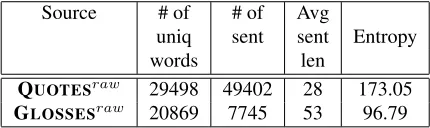
Entropy of word distribution We conjecture that
QUOTES and GLOSSES are different in terms of word variety, which can be quantified by the entropy
5http://www.brainyquote.com/ 6
http://oxforddictionaries.com/ and http://www.merriam-webster.com/. We only consider words appearing in both dic-tionaries to avoid unusual words such as compound words, e.g., “zero-base”.
7
QUOTESrawcontain 30K unique words and GLOSSESraw
has 20K unique words. QUOTESrawhave much arger number of sentences, while its average sentence is shorter.
of word distributions. To compute the entropy for each dataset, we use ngram statistics from the corre-sponding dataset to measure the probability of each
word. As expected, QUOTES dataset has higher
entropy than GLOSSESin Table 1.
3.1 Creative Word Pairs
We extract word pairs corresponding to the follow-ing syntactic patterns: [NN NN], [JJ NN], [NN JJ]
and [JJ JJ]. Not all pairs from QUOTESraw are
cre-ative, and likewise, not all pairs from GLOSSESraw
[image:4.612.82.534.267.406.2]fre-quency buckets each of which containing 400 word pairs, then sample 40 word pairs from each bucket.
We label word pairs using Amazon Mechnical Turk (AMT) (e.g., Snow et al. (2008)). We ask three turkers to score each pair in 1-5 scale, where 1 is the least creative and 5 is the most creative. We then obtain the final creativity scale score by averaging the scores over 3 users. In addition, we ask turkers a series of yes/no questions to help turkers to
deter-mine whether the given pair is creative or not.8 We
determine the final label of a word pair based on two scores, creativity scale score and yes/no question-based score. If creativity scale score is 4 or 5 and question-based score is positive, we label the pair as creative. Similarly, if creativity scale score is 1 or 2 and question-based score is negative, we label the pair as common. We discard the rest from the final dataset. This filtering process is akin to the removal of neural sentiment in the early work of sentiment
analysis (e.g., Pang et al. (2002)).9 Table 2 shows
the statistics of the resulting dataset.
Creative Pairs and their Frequencies: To gain
insights on the stratified sample of word pairs, we
plot the label (∈ {creative, common}) distribution
of word pairs as a function of simple statistics, such as a range (bucket) of bigram frequencies or PMI values of the given pair of words. Both bigram fre-quencies and PMI scores are computed based on Google Web 1T corpus Brants and Franz (2006). Figure 1 shows the results for word frequencies. As expected, word pairs with high frequencies are much more likely to be common, while word pairs with low frequencies can be either of the two. Also as
ex-pected, pairs extracted from QUOTESare relatively
more likely to be creative than those from GLOSSES.
In any case, it is clear that not all rare pairs are cre-ative.
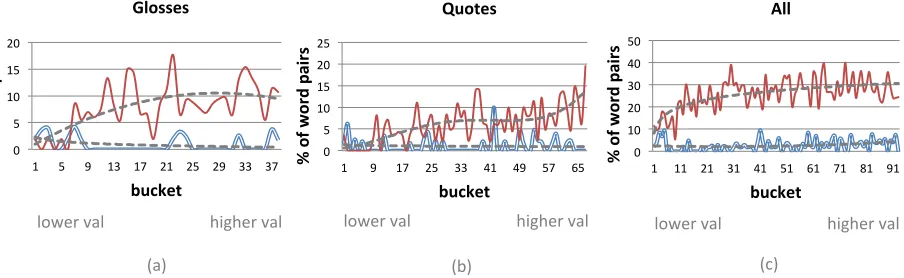
Creative Pairs and their PMI Scores: Similarly
as above, Figure 2 plots the relation between the distribution of labels of word pairs and their corre-sponding PMI. As expected, pairs with high PMI are more likely to be common, though the trend is not as
8E.g.,“is this word combination boring and not original?”
or“does it provoke unusual imagination?”.
9
Cohen’s Kappa and Pearson Correlation on the filtered data are 0.69 and 0.72 respectively. Corresponding scores for the un-filtered data drop to 0.26 and 0.29 respectively. All the experi-ments are performed on the filtered data.
Common Creative
quiet teenager inglorious success
constant longitude thorny existence
watery juice relaxed symmetry
noble political sardonic destiny
diet cooking dispassionate history
verbal interpretation poetical enthusiasm
unwelcome situation verbal beauty
migratory tuna earth breathe
lousy businessman disadvantageous peace
terrific marriage alchemical marriage
[image:5.612.330.526.62.208.2]solved issue deep nonsense
Table 3: Sample Creative / Common Word Pairs
skewed as before.
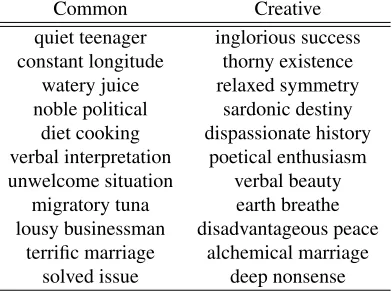
Final Dataset: From our initial annotation study,
it became apparent to us that creative pairs are very rare, perhaps not surprisingly, even among infre-quent pairs. In order to build the word pair corpus with as many creative pairs as possible, we focus on infrequent word pairs for further annotation, from which we construct a larger and balanced set of cre-ative and common word pairs, with 394 word pairs for each class. The specific construction procedure is as follows: first combine all of the word pairs
extracted from both QUOTESraw and GLOSSESraw
as a single dataset, sort them by bigram frequency, group them into consecutive frequency buckets each of which has 40 word pairs; finally balance each fre-quency bucket, by discarding word pairs with higher frequency value from the larger class in that bucket. Examples of labeled word pairs are shown in Ta-ble 3. Hereafter we use this balanced dataset of word
pairs for all experiments.10
4 Creativity Measures
4.1 Information Measures
In this section we explore information theoretic
measures to quantify thesurprisalaspect of creative
word pairs, relating to the divergent, compositional
nature of creativity discussed in§2.1.
Entropy of Context Seeing a wordwchanges our
expectation on what might follow next. Some words have stronger selective preference (higher entropy) than others.
10The resulting dataset is available athttp://www.cs.
10 30 50 70 90
0 2 4 6 8 10 12 14 16 18 20 22
%
of
w
or
d
pa
irs
bucket MI(w1,w2)
30 40 50 60 70 80
0 2 4 6 8 10 12 14 16 18 20 22
%
of
w
or
d
pa
irs
bucket Lconn(w1,w2)
20 30 40 50 60 70 80
0 2 4 6 8 10 12 14 16 18 20 22
%
of
w
or
d
pa
irs
bucket Lsubj(w1,w2)
10 30 50 70 90
0 2 4 6 8 10 12 14 16 18 20 22
%
of
w
or
d
pa
irs
bucket H(w1w2)
10 30 50 70 90
0 2 4 6 8 10 12 14 16 18 20 22
%
of
w
or
d
pa
irs
bucket RH(w1,w2)
10 30 50 70 90
0 2 4 6 8 10 12 14 16 18 20 22
% of w or dp ai rs
bucket KL(w1w2,w2)
(a) (b) (c)
(d) (e) (f)
[image:6.612.79.531.66.334.2]diff diff
Figure 3: Distribution ofcreative(double lines in blue) versuscommon(single lines in red) word pairs with varying
ranges of information or polarity measures (x-axis).
0 0.01 0.02 0.03 0.04 0.05 0.06
Mi
lto
n as
be
st
busy cl ear common cool de
ep
ear
ly
en
d
ex
pen
si
ve
fin al gl ad har
d
ho
t
in
go
t
las
t
lik
ely
m
an
y
ne
xt
ow
n
pl eas ed pr of es si on al rar el
y
ro
le
se
riously
slow
sp
ec
ial
succe
ss to
val uab le wel co
[image:6.612.75.304.387.513.2]me
Figure 4: Conditional probability of neighboring words for “inglorious” (filled / red) and “very” (unfilled / blue).
For instance, the entropy after seeing “very”
would be higher than that after seeing“inglorious”,
as the former can be used in a wider variety of
con-text than the later. Figure 4 visualizes relatively
more skewed distribution of“inglorious”. We
com-pute the entropy of future context conditioning on
w1, w2 and w1w2, which we denote as H(w1),
H(w2), H(w1w2) respectively, latter is shown in
Figure 3 – a.11
11
As before, language models are drawn from Google Web
Relative Entropy Transformation In order to
fo-cus more directly on the relative change of entropy as a result of composition, we compute Relative En-tropy Transformation:
RH(w1, w2) =
|H(w1)−H(w1w2)|
H(w1) +H(w1w2)
(1)
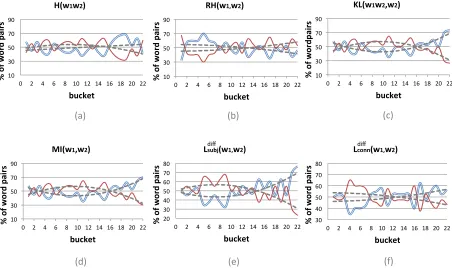
As expected (Figure 3 – b and Table 4), this relative quantity captures creativity better than the absolute
measureH(w1w2) computed above. The idea
be-hind this measure has a connection to uncertainty reduction in psycholinguistic literature (e.g., Frank (2010), Hale (2003), Hale (2006)).
KL divergence To capture unusual combinations
of words, we compare the difference between the
distributional contexts ofw1andw1w2so that
KL(w1w2, w1) =
X
wi∈V
P(wi|w1, w2) log
P(wi|w1, w2)
P(wi|w1)
(2)
Figure (3 – c) shows thatKL(w1w2, w1)12is among
1T corpus Brants and Franz (2006).
12We also compute KL(w
the effective measures in capturing creative pairs.
Mutual Information Finally, we consider mutual
information (Figure 3 – d):
M I(w1, w2) =
X
wi∈V
P(wi|w1, w2)×
log P(wi|w1, w2)
P(wi|w1)·P(wi|w2)
(3)
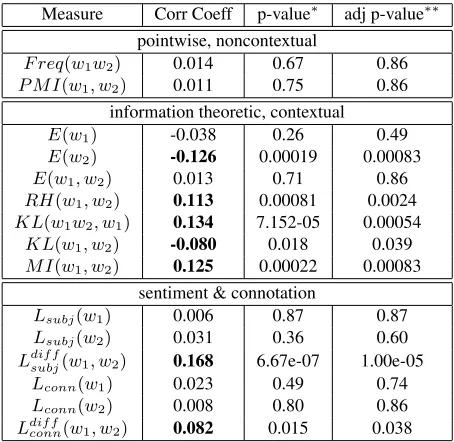
Correlation coefficients Pearson coefficients for
all measures are shown in Table 4. Interestingly, in-formation theoretic measures that compare the
dis-tribution of word’s context, such as RH(w1, w2),
KL(w1w2, w1) and M I(w1, w2), capture the
sur-prisal aspect of creativity better than simple frequen-cies or PMI scores that do not consider contextual changes. But even for those cases when the corre-lation is statistically significant, the values are not too high. We conjecture that there are two reasons for this. First, Pearson assumes linear correlations, hence not sensitive enough to capture non-linear cor-relations that are evident in graphs shown in Fig-ure 3. Second, these measFig-ures only captFig-ure the sur-prisal aspect of creativity, missing the other impor-tant qualities: interestingness or imaginativeness.
4.2 Sentiment and Connotation
Next we investigate the connection between
creativ-ity and sentiment, as illustrated in §2.3. We
con-sider both sentiment (more explicit) and connotation
(more implicit) words,13 and consider them with
or without distinguishing the polarity (i.e., positive, negative). To determine sentiment and connotation, we use lexicons provided by OpinionFinder (Wilson et al. (2005)) and Feng et al. (2013) respectively. We
denote polarity of a wordwi asL(wi).14 Whenwi
has a negative polarityL(wi)is assigned a value of
-1, and whenwi is positiveL(wi)is equal to 1. We
assume that a word is neutral when it is not in the
lexicon, assigning 0 toL(wi). For a word pairw1w2
we compute absolute differenceLdif f(w1, w2)
be-tween polarities of tokens in a word pair in order to
catch examples such as“inglorious success”.
13E.g., expressions such as“blue sky”or“white sand”are
not sentiment-laden, but do have positive connotation.
14We denote polarity from OpinionFinder asL
subjand
con-notation asLconn
Measure Corr Coeff p-value∗ adj p-value∗∗ pointwise, noncontextual
F req(w1w2) 0.014 0.67 0.86
P M I(w1, w2) 0.011 0.75 0.86
information theoretic, contextual
E(w1) -0.038 0.26 0.49
E(w2) -0.126 0.00019 0.00083
E(w1, w2) 0.013 0.71 0.86 RH(w1, w2) 0.113 0.00081 0.0024 KL(w1w2, w1) 0.134 7.152-05 0.00054
KL(w1, w2) -0.080 0.018 0.039 M I(w1, w2) 0.125 0.00022 0.00083
sentiment & connotation
Lsubj(w1) 0.006 0.87 0.87
Lsubj(w2) 0.031 0.36 0.60
Ldif fsubj(w1, w2) 0.168 6.67e-07 1.00e-05 Lconn(w1) 0.023 0.49 0.74
Lconn(w2) 0.008 0.80 0.86
Ldif f
[image:7.612.313.540.59.280.2]conn(w1, w2) 0.082 0.015 0.038
Table 4: Pearson correlation between various measures and creativity of word pairs. Boldface denotes statistical
significance (p≤0.05).
note *: Two-tailed p-value, 394 word pairs per class note **: We used Benjamini-Hochberg method to adjust p-values for multiple tests
Table 4 shows Pearson coefficient for sentiment and connotation based measures. It turns out that polarity of each word on its own does not have a high impact on the creativity of a word pair. Rather, it is the difference between the two words that gives rise the sense of creativity.
4.3 Learning to Recognize Creativity
Now we put together all measures explored in§4.1
and 4.2 in a supervised-learning framework. As ex-pected, rather than either one alone, the combination of various measures leads to the best performance:
~
F12 = [RH(w1, w2);KL(w1, w2);H(w1w2);
Ldif fconn(w1, w2);P M I(w1, w2);
H(w2);KL(w1w2, w1);KL(w2, w1);
Ldif fsubj(w1, w2);M I(w1, w2);
F req(w1w2);H(w1)]
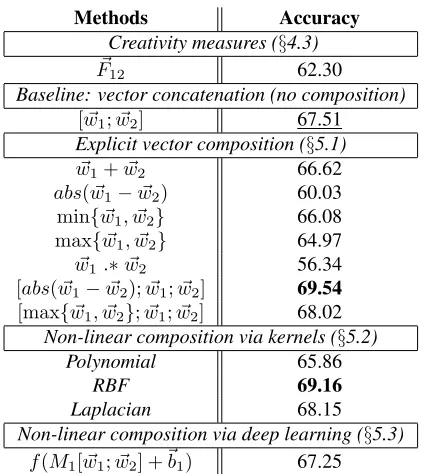
Table 5 shows the performance of the above fea-ture vector with 12 feafea-tures using libsvm (Chang and Lin, 2011). We use C-Support Vector Classification (C-SVC). Performance is reported in accuracy using
5-fold cross validation.15
15
5 Learning Creative Pairs with Distributional Semantic Vectors
The measures explored in §4 were largely
unin-formed of distributional semantic dimensions of each word. However, in order to pursue the
concep-tual aspect of creativity illustrated in§2.2, that is, the
notion of semantic subspaces that are inherently fu-tile or fruitful for creativity, we need to incorporate semantic representations more directly. We there-fore explore the use of distributional vector space models. Another goal of this section will be addi-tional learning-based investigation to the composi-tional nature of creative word pairs, complementing
the investigation in§4, which focused on the
com-positional aspect of creativity described in§2.1.
With above goals in mind, in what follows, we ex-plore three different ways to learn compositional as-pect of creative word pairs: (1) learning with explicit
compositional vector operations (§5.1), (2) learning
nonlinear composition via kernels (§5.2), (3)
learn-ing nonlinear composition via deep learnlearn-ing (§5.3).
Note that in all these approaches, the notion of cre-ative semantic subspace is integrated indirectly, as the feature representation always incorporates the resulting (composed) vector representations.
Baseline & Configuration We consider the
con-catenation of two word vectors[w~1;w~2]as the
base-line, since it can be viewed as what simple bag-of-word features would be. Since the size of creative pair dataset is not at scale yet, we choose to work with vector space models that are in reduced dimen-sions. We experimented with both Non-Negative Sparse Embedding (Murphy et al. (2012)) and neu-ral semantic vectors of Huang et al. (2012), but re-port experiments with the latter only as those gave us slightly better results.
5.1 Compositional Vector Operations
We consider the following compositional vector op-erations inspired by recent studies for composi-tional distribucomposi-tional semantics (e.g., Guevara (2011), Clarke (2012), Mitchell and Lapata (2008), Wid-dows (2008)).
• ADD:w~1+w~2
• DIFF:abs(w~1−w~2)
of Chen and Lin (2005) determines that the most two important ones areRH(w1, w2)andKL(w1, w2).
• MULT:w~1.∗w~2
• MIN:min{w~1, ~w2}
• MAX:max{w~1, ~w2}
All operations take two input vectors ∈ Rn, and
output a vector ∈ Rn. Each operation is applied
element-wise. We then perform binary classifica-tion over the composed vectors using linear SVM. Besides using features based on the composed vec-tors, we also experiment with features based on con-catenating multiple composed vectors, in the hope to capture more diverse compositional operations. See Table 5 for more details and experimental results.
5.2 Learning Nonlinear Composition via
Kernels
As an alternative to explicit vector compositions, we also probe implicit operations based on non-linear combinations of semantic dimensions using kernels (e.g., Sch¨olkopf and Smola (2002), Shawe-Taylor and Cristianini (2004)), in particular:
• Polynomial:K(x, y) = (γxTy+r)d, γ >0
• RBF:K(x, y) = exp(−γkx−yk2), γ >0
• Laplacian:K(x, y) = exp(−γkx−yk), γ >0
5.3 Learning Non-linear Composition via Deep
Learning
Yet another alternative to model non-linear com-position is deep learning. To learn the non-linear transformation of a pair of semantic vectors, we ex-plore the use of autoencoders (e.g., Pollack (1990), Voegtlin and Dominey (2005)). We follow the for-mulation of vector composition proposed by Socher et al. (2011) except that we do not stack autoen-coders for recursion. More specifically, given the
two input words w~1, ~w2 ∈ Rn, we want to learn
a vector space representation of their combination
~
p ∈ Rn. The recursive auto encoder (RAE) of
Socher et al. (2011) models the composition of a word pair as a non-linear transformation of their
concatenation[w~1;w~2]:
~
p=f(M1[w~1;w~2] +~b1) (4)
where M1 ∈ Rn×2n. After adding a bias term
~b1 ∈ Rn, a nonlinear element-wise function f such
astanhis applied to the resulting vector. The
repre-sentation~pof the word pair is then fed into a
Methods Accuracy
Creativity measures (§4.3)
~
F12 62.30
Baseline: vector concatenation (no composition)
[w~1;w~2] 67.51
Explicit vector composition (§5.1)
~
w1+w~2 66.62
abs(w~1−w~2) 60.03
min{w~1, ~w2} 66.08
max{w~1, ~w2} 64.97
~
w1.∗w~2 56.34
[abs(w~1−w~2);w~1;w~2] 69.54
[max{w~1, ~w2};w~1;w~2] 68.02
Non-linear composition via kernels (§5.2)
Polynomial 65.86
RBF 69.16
Laplacian 68.15
Non-linear composition via deep learning (§5.3)
[image:9.612.80.292.57.294.2]f(M1[w~1;w~2] +~b1) 67.25
Table 5: Performance comparison of creativity classifiers.
Incorrectly predicted y∗ Semantically close y∗
word pairs word pairs
CONFUSION DUE TO WORD SIMILARITY(20/42)
“entire carton” - “whole angst” +
“outdated tax” - “graconian tax” +
“dismissive way” - “amorous way” +
“insidious part” + “leather part”
-CONFUSION DUE TO SUBJECTIVE LABELING(8/42)
“independent + “wonderful
-religion” religion”
WORD SENSE DISAMBIGUATION PROBLEMS(2/42)
“fiscal cliff ” - “winding lake” +
“opera window” + “work-shop floor”
-Table 6: Error analysis: y∗ denotes the true label. For
each incorrectly predicted word pair (left column), we show an example of semantically close word pairs (right column) with the opposite true label that might have con-fused learning.
and a softmax layer to predict the probability of the word pair being creative and not creative. We ini-tialize the word vectors using the pre-learned vector space representations in Huang et al. (2012).
5.4 Experimental Results
Table 5 shows the performance comparison of
dif-ferent features sets and algorithms. In all cases,
parameters are tuned from the training portion of the data. We see that simple vector composition
alone does not perform better than vector
concate-nation[w~1;w~2]. However, combiningabs(w~1−w~2)
ormax{w~1;w~2} with[w~1;w~2]perform better than
concatenation. Kernels with non-linear transforma-tion of feature space generally improve performance over linear SVM, suggesting that kernels capture some of the interesting compositional aspect of cre-ativity that is not covered by some of the explicit
vector compositions considered in§5.1. We also
ex-perimented with additional features driven from the
creativity measures explored in§4, but we omit their
results as those did not help improving the perfor-mance. Unfortunately learning nonlinear composi-tion with deep learning did not yield better results. We conjecture that it is due to the small dataset we were able to obtain for this study, which may have not been enough to learn the rich parameter space of the nonlinear transformation matrix.
6 Analysis and Insight
Error analysis We manually inspected a
ran-domly chosen 42 error cases, and characterize the potential causes of those errors. Examples of three types of errors are shown in Table 6. For each incor-rectly predicted word pair, we also show a seman-tically close word pair with the opposite true label that might have confused the learning algorithm.
Visualization To gain additional insight, we
project word pairs represented in their vec-tor concatenations onto 2-dimensional space us-ing t-Distributed Stochastic Neighbor Embeddus-ing
(van der Maaten and Hinton (2008)). Figure 5
shows some of the interesting regions of the pro-jection: some regions are relatively futile in hav-ing creative phrases (e.g., regions involvhav-ing simple
adjectives such as “good”, “bad”, regions
corre-sponding to legal terms), while some regions are rel-atively more fruitful (e.g., regions involving abstract
adjectives such as“infinite”, “universal”,
“funda-mental”). There are also many other regions (e.g., in
the vicinity of“true”,“perfect”or“intelligent”in
• infinite promise
• infinite leisure
• universal aspiration • perfect disorder
• absolute barbarism
• fundamental soul
• theoretical wisdom
• fundamental key
• technological refinement
• good marathon
• good custodian
• universal anguish • pure phenomenology
• logical market • true perversion
• perfect fire
• perfect land
• true ambition
• true golfer
• normal professor
• normal adulthood
• bad profession
• bad motivation
• intelligent manipulation
• intelligent vocabulary
• honest coward • human spark • human architecture
• human masterpiece
• human incompetence
• legal slavery • legal corporation
• legal trading
• legal progress
• judicial verdict • --- ---
• --- ---
• --- ---
• --- ---
• --- ---
• --- ---
• --- ---
• --- ---
• --- --- • --- ---
• --- ---
• --- ---
• --- ---
• --- ---
• --- ---
• --- ---
• --- ---
• --- ---
• invisible empire
• omnipotent realm • finite realm
• --- --- • --- ---
• --- --- • --- --- • --- ---
• --- ---
• --- ---
• --- ---
• --- ---
• --- ---
• --- ---
• --- ---
• --- ---
• --- ---
[image:10.612.79.527.73.291.2]• --- --- • --- ---
Figure 5: Creative (blue bold) and not creative (red italic) word pairs graph.
7 Related Work
Among computational approaches that touch on
lin-guistic creativity, many focused on metaphor(e.g.,
Dunn (2013), Krishnakumaran and Zhu (2007), Mashal et al. (2007), Rumbell et al. (2008), Ren-toumi et al. (2012), Mashal et al. (2009)). Other lin-guistic devices and phenomena related to creativity
includeirony(e.g., Davidov et al. (2010),
Gonz´alez-Ib´a˜nez et al. (2011), Filatova (2012)), neologism
(e.g., Cartoni (2008)), humor (e.g., Mihalcea and
Strapparava (2005), Purandare and Litman (2006)),
andsimiles(e.g., Hao and Veale (2010)).
Veale (2011) proposed the new task of creative text retrieval to harvest expressions that potentially convey the same meaning as the query phrase in a fresh or unusual way. Our work contributes to the retrieval process of recognizing more creative
phrases. Ozbal and Strapparava (2012) explored
automatic creative naming of commercial products and services, focusing on the generation of creative phrases within a specific domain. Costello (2002) investigated the cognitive process that guides peo-ple’s choice of words when making up a novel noun-noun compound. In contrast, we present a data-driven investigation to quantifying creativity in lex-ical composition. Memorability is loosely related to
linguistic creativity (Danescu-Niculescu-Mizil et al. (2012)) as some of the creative quotes may be more memorable, but not all creative phrases are memo-rable and vice versa.
8 Conclusion
We presented the first study that focuses on learn-ing and quantifylearn-ing creativity in lexical composi-tions, exploring statistical techniques motivated by three different theories and hypotheses of creativ-ity, ranging from divergent thinking, compositional structure, creative semantic subspace, and the con-nection to sentiment and connotation. Our experi-mental results suggest the viability of learning cre-ative language, and point to promising directions for future research.
Acknowledgments This research was supported in part by the Stony Brook University Office of the Vice President for Research, and in part by gift from Google. We thank anonymous reviewers for insight-ful comments and suggestions.
References
T. Amabile. 1997. Motivating creativity in organiza-tions: On doing what you love and loving what you
Marco Baroni and Roberto Zamparelli. 2010. Nouns
are vectors, adjectives are matrices: representing
adjective-noun constructions in semantic space. In
Proceedings of the 2010 Conference on
Empiri-cal Methods in Natural Language Processing, pages
1183–1193, Stroudsburg, PA, USA.
Thorsten Brants and Alex Franz. 2006. Web 1t 5-gram
corpus version 1.1. Google Inc.
Ronald Carter and Michael McCarthy. 2004. Talking, creating: interactional language, creativity, and
con-text. Applied Linguistics, 25(1):62–88.
Bruno Cartoni. 2008. Lexical resources for automatic translation of constructed neologisms: the case study
of relational adjectives. InLREC.
Chih-Chung Chang and Chih-Jen Lin. 2011. Libsvm:
a library for support vector machines. ACM
Trans-actions on Intelligent Systems and Technology (TIST),
2(3):27.
Yi-Wei Chen and Chih-Jen Lin. 2005. Combining svms
with various feature selection strategies. In Taiwan
University. Springer-Verlag.
Noam Chomsky. 1965. Aspects of the Theory of Syntax,
volume 11. The MIT press.
Carol Chomsky. 1976. Creativity and innovation in child
language.Journal of Education, Boston.
Daoud Clarke. 2012. A context-theoretic framework for
compositionality in distributional semantics.
Compu-tational Linguistics, 38(1):41–71.
W.M. Cohen and D.A. Levinthal. 1990. Absorptive Ca-pacity: A New Perspective on Learning and
Innova-tion. Administrative Science Quarterly, 35(1).
Fintan J. Costello. 2002. Investigating creative language: People’s choice of words in the production of novel
noun-noun compounds. In Proceedings of the 24th
Annual Conference of the Cognitive Science Society.
Arthur Cropley. 2006. In praise of convergent thinking.
Creativity Research Journal, 18(3):391–404.
Cristian Danescu-Niculescu-Mizil, Justin Cheng, Jon
Kleinberg, and Lillian Lee. 2012. You had me at
hello: How phrasing affects memorability. In
Pro-ceedings of the 50th Annual Meeting of the Association for Computational Linguistics: Long Papers-Volume
1, pages 892–901. Association for Computational
Lin-guistics.
Dmitry Davidov, Oren Tsur, and Ari Rappoport. 2010. Semi-supervised recognition of sarcastic sentences in
twitter and amazon. In Proceedings of the
Four-teenth Conference on Computational Natural
Lan-guage Learning, pages 107–116. Association for
Computational Linguistics.
Jonathan Dunn. 2013. What metaphor
identifica-tion systems can tell us about metaphor-in-language.
Meta4NLP 2013, page 1.
Song Feng, Jun Sak Kang, Polina Kuznetsova, and Yejin Choi. 2013. Connotation lexicon: A dash of
senti-ment beneath the surface meaning. InProceedings of
the 51th Annual Meeting of the Association for
Com-putational Linguistics (Volume 2: Short Papers), Sofia,
Bulgaria, Angust. Association for Computational Lin-guistics.
Elena Filatova. 2012. Irony and sarcasm: Corpus
gen-eration and analysis using crowdsourcing. In LREC,
pages 392–398.
Stefan L Frank. 2010. Uncertainty reduction as a
mea-sure of cognitive processing effort. InProceedings of
the 2010 workshop on cognitive modeling and
com-putational linguistics, pages 81–89. Association for
Computational Linguistics.
Sigmund Freud. 1908. Creative writers and
day-dreaming. Standard edition, 9:143–153.
Susan R. Fussell and Mallie M. Moss. 1998. Figurative
language in descriptions of emotional states. InSocial
and cognitive approaches to interpersonal
communi-cation.
Pablo Gerv´as. 2010. Engineering linguistic
creativ-ity: Bird flight and jet planes. In Proceedings of
the NAACL HLT 2010 Second Workshop on
Computa-tional Approaches to Linguistic Creativity, pages 23–
30. Association for Computational Linguistics. Katie Glaskin. 2011. Dreams, memory, and the
ances-tors: creativity, culture, and the science of sleep.
Jour-nal of the royal anthropological institute, 17(1):44–62.
Andrew Goatly. 1997. The language of metaphors.
Routledge.
Roberto Gonz´alez-Ib´a˜nez, Smaranda Muresan, and Nina Wacholder. 2011. Identifying sarcasm in twitter: A
closer look. InACL (Short Papers), pages 581–586.
Citeseer.
Emiliano Guevara. 2011. Computing semantic
composi-tionality in distributional semantics. InProceedings of
the Ninth International Conference on Computational
Semantics (IWCS 2011), pages 135–144. Citeseer.
John Hale. 2003. The information conveyed by words
in sentences. Journal of Psycholinguistic Research,
32(2):101–123.
John Hale. 2006. Uncertainty about the rest of the
sen-tence. Cognitive Science, 30(4):643–672.
Yanfen Hao and Tony Veale. 2010. An ironic fist
in a velvet glove: Creative mis-representation in the
construction of ironic similes. Minds and Machines,
20(4):635–650.
Eric H. Huang, Richard Socher, Christopher D. Manning, and Andrew Y. Ng. 2012. Improving Word Represen-tations via Global Context and Multiple Word
Proto-types. InAnnual Meeting of the Association for
Saisuresh Krishnakumaran and Xiaojin Zhu. 2007. Hunting elusive metaphors using lexical resources. In Proceedings of the Workshop on Computational
ap-proaches to Figurative Language, pages 13–20.
Asso-ciation for Computational Linguistics.
George Lakoff and Mark Johnson. 1980. Metaphors we
Live by. University of Chicago Press, Chicago.
N. Mashal, M. Faust, T Hendler, and M. Jung-Beeman. 2007. An fmri investigation of the neural correlates underlying the processing of novel metaphoric
expres-sions. Brain and Language, pages 115 – 126.
N Mashal, M Faust, T Hendler, and M Jung-Beeman. 2009. An fmri study of processing novel metaphoric
sentences. Laterality, (1):30–54.
Janet Maybin and Joan Swann. 2007. Everyday creativ-ity in language: Textualcreativ-ity, contextualcreativ-ity, and critique.
Applied Linguistics, 28(4):497–517.
Robert R McCrae. 1987. Creativity, divergent thinking,
and openness to experience. Journal of personality
and social psychology, 52(6):1258.
Susan M. McCurry and Steven C. Hayes. 1992. Clinical and experimental perspectives on metaphorical talk.
Clinical Psychology Review, 12(7):763 – 785.
Rada Mihalcea and Carlo Strapparava. 2005.
Mak-ing computers laugh: Investigations in automatic
hu-mor recognition. InProceedings of Human Language
Technology Conference and Conference on Empirical
Methods in Natural Language Processing, pages 531–
538, Vancouver, British Columbia, Canada, October. Association for Computational Linguistics.
Jeff Mitchell and Mirella Lapata. 2008. Vector-based
models of semantic composition. InIn Proceedings of
ACL-08: HLT, pages 236–244.
Jeff Mitchell and Mirella Lapata. 2009. Language
mod-els based on semantic composition. InProceedings of
the 2009 Conference on Empirical Methods in
Natu-ral Language Processing: Volume 1-Volume 1, pages
430–439. Association for Computational Linguistics.
Brian Murphy, Partha Pratim Talukdar, and Tom
Mitchell. 2012. Learning effective and interpretable semantic models using non-negative sparse
embed-ding. InCOLING, pages 1933–1950.
Edward Necka. 1999. Memory and creativity.
Ency-clopedia of creativity, ed. by MA Runco, SR Pritzker,
2:193–99.
Gozde Ozbal and Carlo Strapparava. 2012. A compu-tational approach to the automation of creative
nam-ing. InProceedings of the 50th Annual Meeting of the
Association for Computational Linguistics (Volume 1:
Long Papers), pages 703–711, Jeju Island, Korea, July.
Association for Computational Linguistics.
Bo Pang, Lillian Lee, and Shivakumar Vaithyanathan. 2002. Thumbs up?: sentiment classification using
ma-chine learning techniques. InProceedings of the
ACL-02 conference on Empirical methods in natural
lan-guage processing-Volume 10, pages 79–86.
Associa-tion for ComputaAssocia-tional Linguistics.
J. B. Pollack. 1990. Recursive distributed representation.
Artificial Intelligence, 46:77–105.
Amruta Purandare and Diane Litman. 2006. Humor: Prosody analysis and automatic recognition for f* r* i*
e* n* d* s*. InProceedings of the 2006 Conference on
Empirical Methods in Natural Language Processing,
pages 208–215. Association for Computational Lin-guistics.
Vassiliki Rentoumi, George A. Vouros, Vangelis
Karkaletsis, and Amalia Moser. 2012. Investigating metaphorical language in sentiment analysis: A
sense-to-sentiment perspective. ACM Trans. Speech Lang.
Process., 9(3):6:1–6:31, November.
Sebastian Rudolph and Eugenie Giesbrecht. 2010.
Com-positional matrix-space models of language. In
Pro-ceedings of the 48th Annual Meeting of the Association
for Computational Linguistics, pages 907–916.
Asso-ciation for Computational Linguistics.
Tim Rumbell, John Barnden, Mark Lee, and Alan Wallington. 2008. Affect in metaphor: Developments with wordnet.
Bernhard Sch¨olkopf and Alexander J Smola. 2002.
Learning with kernels. The MIT Press.
John Shawe-Taylor and Nello Cristianini. 2004. Kernel
methods for pattern analysis. Cambridge university
press.
Ekaterina Shutova. 2010. Models of metaphor in nlp.
In Proceedings of the 48th Annual Meeting of the
Association for Computational Linguistics, ACL ’10,
pages 688–697, Stroudsburg, PA, USA. Association for Computational Linguistics.
Rion Snow, Brendan O’Connor, Daniel Jurafsky, and An-drew Y Ng. 2008. Cheap and fast—but is it good?: evaluating non-expert annotations for natural language
tasks. InProceedings of the conference on empirical
methods in natural language processing, pages 254–
263. Association for Computational Linguistics. Richard Socher, Jeffrey Pennington, Eric H Huang,
An-drew Y Ng, and Christopher D Manning. 2011. Semi-supervised recursive autoencoders for predicting
sen-timent distributions. InProceedings of the Conference
on Empirical Methods in Natural Language
Process-ing, pages 151–161. Association for Computational
Linguistics.
L.J.P. van der Maaten and G.E. Hinton. 2008. Visualiz-ing high-dimensional data usVisualiz-ing t-sne.
Tony Veale, Yanfen Hao, and Guofu Li. 2008.
Multilin-gual harvesting of cross-cultural stereotypes. InACL,
Tony Veale. 2011. Creative language retrieval: A ro-bust hybrid of information retrieval and linguistic
cre-ativity. In Proceedings of the 49th Annual Meeting
of the Association for Computational Linguistics:
Hu-man Language Technologies, pages 278–287,
Port-land, Oregon, USA, June. Association for Computa-tional Linguistics.
Thomas Voegtlin and Peter F. Dominey. 2005. Linear
recursive distributed representations. Neural Netw.,
18(7):878–895, September.
Dominic Widdows. 2008. Semantic vector products:
Some initial investigations. InProceedings of the
Sec-ond AAAI Symposium on Quantum Interaction.
Theresa Wilson, Paul Hoffmann, Swapna Somasun-daran, Jason Kessler, Janyce Wiebe, Yejin Choi, Claire Cardie, Ellen Riloff, and Siddharth Patwardhan. 2005. Opinionfinder: A system for subjectivity analysis. In Proceedings of HLT/EMNLP on Interactive
Demon-strations, pages 34–35. Association for Computational
Linguistics.
Ainur Yessenalina and Claire Cardie. 2011. Composi-tional matrix-space models for sentiment analysis. In Proceedings of the Conference on Empirical Methods
in Natural Language Processing, pages 172–182.
As-sociation for Computational Linguistics.
Xiaojin Zhu, Zhiting Xu, and Tushar Khot. 2009. How creative is your writing? a linguistic creativity mea-sure from computer science and cognitive psychology
perspectives. InProceedings of the Workshop on
Com-putational Approaches to Linguistic Creativity, pages