Target-Bidirectional Neural Models for Machine Transliteration
Andrew Finch and Lemao Liu and Xiaolin Wang and Eiichiro Sumita National Institute of Information and Communications Technology (NICT)
Advanced Translation Technology Laboratory 3-5 Hikaridai
Keihanna Science City 619-0289 JAPAN
{andrew.finch,lmliu,xiaolin.wang,eiichiro.sumita}@nict.go.jp
Abstract
Our purely neural network-based system represents a paradigm shift away from the techniques based on phrase-based statisti-cal machine translation we have used in the past. The approach exploits the agree-ment between a pair of target-bidirectional LSTMs, in order to generate balanced tar-gets with both good suffixes and good prefixes. The evaluation results show that the method is able to match and even surpass the current state-of-the-art on most language pairs, but also ex-poses weaknesses on some tasks moti-vating further study. The Janus toolkit that was used to build the systems used in the evaluation is publicly available at https://github.com/lemaoliu/Agtarbidir.
1 Introduction
Our primary system for the NEWS shared eval-uation on transliteration generation is different in character from all our previous systems. In past years, all our systems have been based on phrase-based statistical machine translation (PB-SMT) techniques, stemming from the system pro-posed in (Finch and Sumita, 2008). This year’s system is a pure end-to-end neural network trans-ducer. In (Finch et al., 2012) auxiliary neural network language models (both monolingual and bilingual (Li et al., 2004)) were introduced as fea-tures to augment the log-linear model of a phrase-based transduction system, and led to modest gains in system performance. In the NEWS 2015 work-shop (Finch et al., 2015) neural transliteration sys-tems using attention-based sequence-to-sequence neural network transducers (Bahdanau et al., 2014) were applied to transliteration generation. In iso-lation, the performance was found to be lower than that of the phrase-based system on all of the
tasks, however we observed that the neural net-work transducer was very effective when used as a model for re-scoring the output of the phrase-based transduction process, and this led to re-spectable improvements relative to previous sys-tems on most of the tasks.
Our focus this year has been on the development of an end-to-end purely neural network-based sys-tem capable of competitive performance. The changes and improvements over the sequence-to-sequence neural transducer used in NEWS2015 are as follows:
• A target-bidirectional agreement model was employed.
• Ensembles of neural networks were used rather than just a single network.
• The ensembles were selected from different training runs and different training epochs ac-cording to their performance on development (and test) data.
In all our experiments we have taken a strictly language independent approach. Each of the lan-guage pairs was processed automatically from the character sequence representation supplied for the shared tasks, with no language specific treatment for any of the language pairs. Furthermore no pre-processing was performed on any of the data with the exception of uppercasing the English to ensure consistency among the data sets.
2 System Description
2.1 Target-bidirectional Models
Our system uses the target-bidirectional approach proposed in (Liu et al., 2016), and the reader is referred to this paper for a full description of the method we employ. In brief, we use pairs of LSTM RNN sequence-to-sequence transducers that first
20 40 60 80 100
Epoch
0.1 0.2 0.3 0.4 0.5 0.6 0.7 0.8 0.9
Accuracy
En-Hi
12-ensemble (dev) dev set
[image:2.595.310.523.64.236.2]train set
Figure 1: En-Hi training performance.
20 40 60 80 100
Epoch
0.25 0.30 0.35 0.40 0.45 0.50 0.55 0.60
Accuracy
En-Ja
12-ensemble (dev) dev set
train set
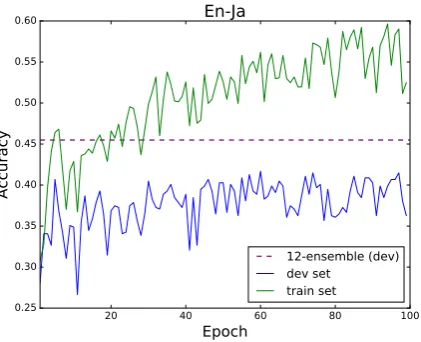
Figure 2: En-Ja training performance.
encodethe input sequence into a fixed length vec-tor, and thendecodefrom this to produce the tar-get. The method mitigates a fundamental short-coming in neural sequence-to-sequence transduc-tion, in which errors in prediction accumulate in the context vectors used to make the predictions, leading to progressively worse performance as the generation process proceeds. The result is unbal-anced output which has high quality prefixes that degrade to lower quality suffixes. Our bidirec-tional agreement model overcomes this by using a pair of RNNs that generate from both left-to-right and right-to-left, producing 2 k-bests lists which are combined1in order to encourage agreement be-tween the models. In (Liu et al., 2016) it is shown that the resulting output is both more balanced and of substantially higher quality than that resulting from either unidirectional model. Furthermore it
1
In all experiments reported here we used the jointk-best approximation method.
20 40 60 80 100
Epoch
0.1 0.2 0.3 0.4 0.5 0.6 0.7 0.8 0.9 1.0
Accuracy
En-He
12-ensemble (dev) dev set
[image:2.595.77.288.64.235.2]train set
Figure 3: En-He training performance.
is shown that the gains from this method cannot be obtained from larger ensembles of unidirectional models. The approach was shown to be effective in both grapheme-to-phoneme conversion (where it set a new state-of-the-art benchmark), and in English-Japanese transliteration. This paper eval-uates the method on a much wider variety of tasks highlighting some of the strengths and weaknesses of the new approach.
2.2 Ensembles
Multiple neural networks were combined into en-sembles. This was done by linear interpolation (with equal weights) of the probability distribu-tions produced by the networks over the target vo-cabulary during the beam search decoding.
3 Experimental Methodology
3.1 Corpora
The neural networks were trained on all of the data for each task, with the exception of 500 pairs which were used for development. The development data was used in order to determine whether or not the networks had fully trained, and also as a means of selecting the neural network models that com-prised the ensembles.
[image:2.595.77.288.279.450.2]In addition, in order to observe the performance of the models on the training set during training, a sample of 1000 pairs was taken from the training data.
3.2 Training
Each of the systems was trained for 100 epochs. For all language pairs the accuracy on the devel-opment set appeared to stop improving after ap-proximately 50 epochs. Graphs showing the per-formance of the systems during training are shown in Figure 1 which represent typical training runs, together with interesting exceptions in Figures 3 and 2. The green (upper) solid line on the graphs represents the accuracy on training data, the blue (lower) solid line represents the accuracy on un-seen development data, and the dashed purple line represents the performance of an ensemble com-posed of the best performing 12 neural networks on the development set.
The curves in Figure 1 are typical, with the performance of the system on training data still steadily increasing at epoch 100, but with the per-formance on development data reaching its maxi-mum value often by epoch 20, and almost always by epoch 50. We therefore conclude that the net-works are all fully trained after 50 epochs. Fur-thermore, we did not observe any noticable degra-dation in performance after epoch 50 due to over-fitting.
The curves in Figures 2 and 3 are atypical. On En-Ja the variance in accuracy from epoch to epoch was unusually high. The gains from using ensembles of networks were also larger than for other language pairs. In addition, the accuracy on training data remained lower than most language pairs. The curves for En-He show the opposite be-havior. The accuracy on training data is 1.0 af-ter about 35 epochs indicating that the neural net-work has effectively memorized the training data. At this point the variance in accuracy from epoch to epoch falls to almost zero. The gains from using ensembles for this language pair are very small.
We were unable to train a neural network with high accuracy on the Ar-En dataset, and as a conse-quence did not enter a system on this task this year. The reasons for this are not yet clear, but the sys-tem had reasonably good f-scores with very low accuracy. The networks seemed able to produce plausible output, that was rarely an exact match with the reference. We believe the neural network may have been able to generalize from the data, but was not able to memorize it well.
Training times were dependent on the language pair. Most language pairs completed the 100-epoch training on a single Tesla K40m GPU in un-der a day. Training for the Arabic-English task was around 10 times longer due to the larger training set.
3.3 Ensemble Selection
In order to form ensembles we need to select the ensemble size, and also the neural networks that will comprise the ensemble. In pilot experiments, we found that it is possible to obtain respectable improvement by building ensembles from the net-works at different epochs during training. Our strategy was to train 5 target-bidirectional RNNs for each language pair, and select the ensemble from the epochs within these 5 runs.
In this year’s workshop, 15 evaluations were permitted on test data for each task. We used 12 of these to evaluate the target-bidirectional RNNs, and 3 to select the ensemble size from{4,8,12}. The ensembles of size 12 were selected using de-velopment data only as follows: the best 2 target-bidirectional RNNs were selected from epochs of each of the 5 training runs, then the best 2 target-bidirectional RNNs were chosen from the remain-ing epochs/runs. Ensembles of 4 and 8 were lected from the candidate set of 12 (that were se-lected using the development set), according to their accuracy on the test data. We found a mod-erate positive correlation between training and de-velopment set accuracy at each epoch of the train-ing. This suggests that the variance in the accuracy of networks from epoch to epoch during training is not simply random noise, but that ‘good’ and ‘bad’ networks exist at different epochs, and this motivated our strategy to select them based on de-velopment set accuracy.
3.4 Architecture and Parameters
The network architecture for all of the networks used in all tasks was the same, and was chosen be-cause it has proven to be effective in other experi-ments. The computational expense associated with working with neural networks on this task prohib-ited us from running experiments to select the op-timal architecture, and therefore it is possible that architectures that are considerably better than the one we have chosen exist.
Language Pair 2012 2015 2016 2016 2016
system system Baseline 12-ensemble Primary
English to Bengali (EnBa) 0.460 0.483 0.287 0.498 0.498
Chinese to English (ChEn) 0.203 0.184 0.098 0.211 0.214
English to Chinese (EnCh) 0.311 0.313 0.193 0.309 0.316
English to Hebrew (EnHe) 0.154 0.179 0.109 0.184 0.189
English to Hindi (EnHi) 0.668 0.696 0.270 0.709 0.715
English to Japanese Katakana (EnJa) 0.401 0.407 0.209 0.464 0.465
English to Kannada (EnKa) 0.546 0.562 0.196 0.570 0.583
English to Korean Hangul (EnKo) 0.384 0.363 0.218 0.348 0.352
English to Persian (EnPe) 0.655 0.697 0.482 0.691 0.696
English to Tamil (EnTa) 0.592 0.626 0.258 0.613 0.629
English to Thai (EnTh) 0.122 0.157 0.068 0.179 0.187
English to Japanese Kanji (JnJk) 0.513 0.610 0.461 0.327 0.327
[image:4.595.85.521.59.267.2]Thai to English (ThEn) 0.140 0.154 0.091 0.194 0.196
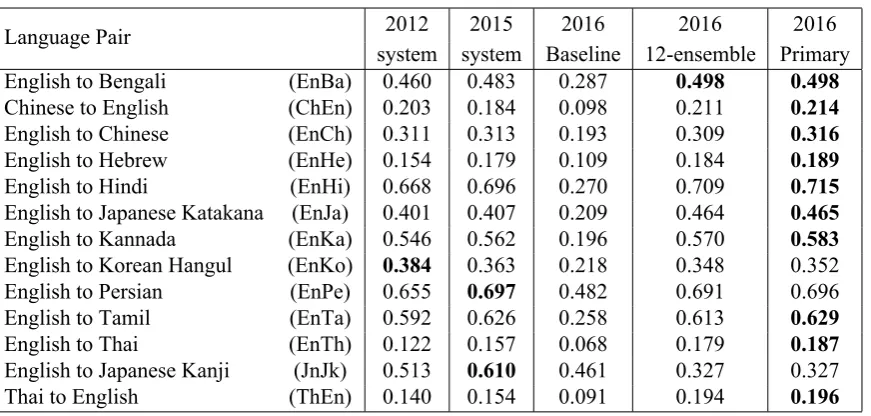
Table 1: The official evaluation results in terms of the top-1 accuracy.
search with beam width 12 was used to obtain the
k-best hypotheses. Decoding was aborted, and a null hypothesis output when a target sequence was generated that was three times longer than the source (sequences of length less than 6 were not aborted).
4 Evaluation Results
The official scores for our system are given in Ta-ble 1, alongside the scores of our previous sys-tems on the same test set, and the scores of the official baseline system. The highest scores are highlighted in bold, and it is clear that this year’s system has attained higher accuracy than the sys-tems from previous years on most of the lan-guage pairs. For some pairs, such as English-Katakana, English-Thai and Thai-English, the im-provement is substantial. However, there are also tasks in which the neural system was not able to match the performance of the previous system, no-tably English-Japanese Kanji, English-Hangul and Arabic-English. The first two of these tasks have quite large vocabularies on the target side, and this may make them less suitable for a neural approach. The Arabic-English task has no such issues, and furthermore has a far larger training corpus avail-able which ought to favor the neural method, how-ever it differs from the other tasks in that short vowels are not represented in written Arabic, but must still be generated on the target side. Further research is necessary to determine the true cause, but our conjecture is that phrase-based systems, which effectively memorize the training data in a piecewise manner, are consequently more
suc-cessful on this task than neural networks which are geared more towards generalization rather than memorization.
5 Conclusion
The system used for this year’s shared evaluation signals a paradigm shift away from the phrase-based systems phrase-based on machine translation tech-nology used by our group in earlier years. Our end-to-end neural machine transliteration system lever-ages the agreement between target-bidirectional RNN ensembles to improve its performance. On most of the transliteration tasks the system has shown itself to be capable of matching and even surpassing the current state-of-the-art. We believe neural networks have a bright future in the field of transliteration generation, and the experiments on the NEWS Workshop datasets have uncovered outstanding issues that will make interesting topics for future research as this technology matures.
Acknowledgements
For the English-Japanese, English-Korean and Arabic-English datasets, the reader is referred to the CJK website: http://www.cjk.org. For English-Hindi, English-Tamil, and English-Kannada, and English-Bangla the data sets originated from the work of (Kumaran and Kellner, 2007) 2. The Chinese language corpora came from the Xinhua news agency (Xinhua News Agency, 1992). The English Persian corpus originates from the work of (Karimi et al., 2006; Karimi et al., 2007).
References
Dzmitry Bahdanau, Kyunghyun Cho, and Yoshua Ben-gio. 2014. Neural machine translation by jointly learning to align and translate. CoRR.
Andrew Finch and Eiichiro Sumita. 2008. Phrase-based machine transliteration. InProceedings of the 3rd International Joint Conference on Natural Lan-guage Processing (IJCNLP), volume 1, Hyderabad, India.
Andrew Finch, Paul Dixon, and Eiichiro Sumita. 2012. Rescoring a phrase-based machine transliteration system with recurrent neural network language mod-els. InProceedings of the 4th Named Entity Work-shop (NEWS) 2012, pages 47–51, Jeju, Korea, July. Association for Computational Linguistics.
Andrew Finch, Lemao Liu, Xiaolin Wang, and Eiichiro Sumita. 2015. Neural network transduction models in transliteration generation. InProceedings of the Fifth Named Entity Workshop, pages 61–66, Beijing, China, July. Association for Computational Linguis-tics.
Sarvnaz Karimi, Andrew Turpin, and Falk Scholer. 2006. English to persian transliteration. InSPIRE, pages 255–266.
Sarvnaz Karimi, Andrew Turpin, and Falk Scholer. 2007. Corpus effects on the evaluation of automated transliteration systems. Proceedings of the 45th An-nual Meeting of the Association of Computational Linguistics.
A. Kumaran and Tobias Kellner. 2007. A generic framework for machine transliteration. InSIGIR’07, pages 721–722.
Haizhou Li, Min Zhang, and Jian Su. 2004. A joint source-channel model for machine transliteration. In ACL ’04: Proceedings of the 42nd Annual Meeting on Association for Computational Linguistics, page 159, Morristown, NJ, USA. Association for Compu-tational Linguistics.
Lemao Liu, Andrew Finch, Masao Utiyama, and Ei-ichiro Sumita. 2016. Agreement on target-bidirectional lstms for sequence-to-sequence learn-ing. InThirtieth AAAI Conference on Artificial In-telligence.
Xinhua News Agency. 1992. Chinese transliteration of foreign personal names. The Commercial Press.