Classifying Message Board Posts with an Extracted Lexicon of Patient
Attributes
Ruihong Huang and Ellen Riloff
School of Computing University of Utah Salt Lake City, UT 84112
{huangrh, riloff}@cs.utah.edu
Abstract
The goal of our research is to distinguish vet-erinary message board posts that describe a case involving a specific patient from posts that ask a general question. We create a text classifier that incorporates automatically gen-erated attribute lists for veterinary patients to tackle this problem. Using a small amount of annotated data, we train an information extrac-tion (IE) system to identify veterinary patient attributes. We then apply the IE system to a large collection of unannotated texts to pro-duce a lexicon of veterinary patient attribute terms. Our experimental results show that us-ing the learned attribute lists to encode pa-tient information in the text classifier yields improved performance on this task.
1 Introduction
Our research focuses on the problem of classify-ing message board posts in the domain of veterinary medicine. Most of the posts in our corpus discuss a case involving a specific patient, which we will call patient-specific posts. But there are also posts that ask a general question, for example to seek advice about different medications, information about new procedures, or how to perform a test. Our goal is to distinguish the patient-specific posts from general posts so that they can be automatically routed to dif-ferent message board folders.
Distinguishing patient-specific posts from general posts is a challenging problem for two reasons. First, virtually any medical topic can appear in either type of post, so the vocabulary is very similar. Second,
a highly skewed distribution exists between patient-specific posts and general posts. Almost 90% of the posts in our data are about specific patients.
With such a highly skewed distribution, it would seem logical to focus on recognizing instances of the minority class. But the distinguishing characteristic of a general post is the absence of a patient. Two nearly identical posts belong in different categories if one mentions a patient and the other does not. Consequently, our aim is to create features that iden-tify references to a specific patient and use these to more accurately distinguish the two types of posts.
Our research explores the use of information ex-traction (IE) techniques to automatically identify common attributes of veterinary patients, which we use to encode patient information in a text classifier. Our approach involves three phases. First, we train a conditional random fields (CRF) tagger to iden-tify seven common types of attributes that are of-ten ascribed to veterinary patients:SPECIES/BREED, NAME, AGE, GENDER, WEIGHT, POSSESSOR, and DISEASE/SYMPTOM. Second, we apply the CRF tagger to a large set of unannotated message board posts, collect its extractions, and harvest the most frequently extracted terms to create a Veterinary Pa-tient Attribute (VPA) Lexicon.
Finally, we define three types of features that ex-ploit the harvested VPA lexicon. These features rep-resent the patient attribute terms, types, and com-binations of them to help the classifier determine whether a post is discussing a specific patient. We conduct experiments which show that the extracted patient attribute information improves text classifi-cation performance on this task.
2 Related Work
Our work demonstrates the use of information ex-traction techniques to benefit a text classification ap-plication. There has been a great deal of research on text classification (e.g., (Borko and Bernick, 1963; Hoyle, 1973; Joachims, 1998; Nigam et al., 2000; Sebastiani, 2002)), which most commonly has used bag-of-word features. Researchers have also inves-tigated clustering (Baker and McCallum, 1998), La-tent Semantic Indexing (LSI) (Zelikovitz and Hirsh, 2001), Latent Dirichlet Allocation (LDA) (Br et al., 2008) and string kernels (Lodhi et al., 2001). Infor-mation extraction techniques have been used previ-ously to create richer features for event-based text classification (Riloff and Lehnert, 1994) and web page classification (Furnkranz et al., 1998). Se-mantic information has also been incorporated for text classification. However, most previous work re-lies on existing semantic resources, such as Wordnet (Scott and Stan, 1998; Bloehdorn and Hotho, 2006) or Wikipedia (Wang et al., 2009).
There is also a rich history of automatic lexicon induction from text corpora (e.g., (Roark and Char-niak, 1998; Riloff and Jones, 1999; McIntosh and Curran, 2009)), Wikipedia (e.g., (Vyas and Pantel, 2009)), and the Web (e.g., (Etzioni et al., 2005; Kozareva et al., 2008; Carlson et al., 2010)). The novel aspects of our work are in using an IE tagger to harvest a domain-specific lexicon from unanno-tated texts, and using the induced lexicon to encode domain-specific features for text classification.
3 Text Classification with Extracted Patient Attributes
This resesarch studies message board posts from the Veterinary Information Network (VIN), which is a web site (www.vin.com) for professionals in veteri-nary medicine. VIN hosts forums where veterinar-ians discuss medical issues, challenging cases, etc. We observed that patient-specific veterinary posts almost always include some basic facts about the patient, such as the animal’s breed, age, or gender. It is also common to mention the patient’s owner (e.g., “a new client’s cat”) or a disease or symptom that the patient has (e.g., “a diabetic cat”). General posts almost never contain this information.
Although some of these terms can be found in
existing resources such as Wordnet (Miller, 1990), our veterinary message board posts are filled with informal and unconventional vocabulary. For ex-ample, one might naively assume that “male” and “female” are sufficient to identify gender. But the gender of animals is often revealed by describing their spayed/neutered status, often indicated with shorthand notations. For example, “m/n” means male and neutered, “fs” means female spayed, “cas-trated” means neutered and implies male. Short-hand terms and informal jargon are also frequently used for breeds (e.g., “doxy” for dachsund, “labx” for labrador cross, “gshep” for German Shepherd) and ages (e.g., “3-yr-old”, “3yo”, “3mo”). A par-ticularly creative age expression describes an animal as (say) “a 1999 model” (i.e., born in 1999). To rec-ognize the idiosyncratic vocabulary in these texts, we use information extraction techniques to identify terms corresponding to seven attributes of veterinary patients: SPECIES/BREED, NAME, AGE, WEIGHT, GENDER,POSSESSOR, andDISEASE/SYMPTOM.
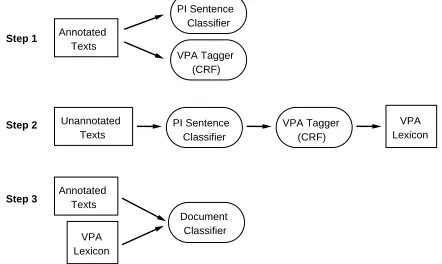
Figure 1 illustrates our overall approach, which consists of three steps. First, we train a sequential IE tagger to label veterinary patient attributes using supervised learning. Second, we apply the tagger to 10,000 unannotated message board posts to auto-matically create a Veterinary Patient Attribute (VPA) Lexicon. Third, we use the VPA Lexicon to encode patient attribute features in a document classifier.
Unannotated Texts
PI Sentence Classifier
VPA Tagger (CRF)
VPA Lexicon Step 2
PI Sentence Classifier
VPA Tagger (CRF) Annotated
Texts Step 1
Annotated Texts
VPA Lexicon
[image:2.612.316.537.465.597.2]Document Classifier Step 3
Figure 1: Flowchart for Creating a Patient-Specific vs. General Document Classifier
3.1 Patient Attribute Tagger
The message board posts can be long and tedious to read (i.e., they are often filled with medical his-tory and test results), so manually annotating every word would be arduous. However, the patient is usu-ally described at the beginning of a post, most com-monly in 1-2 “introductory” sentences. Therefore we adopted a two stage process, both for manual and automatic tagging of patient attributes.
First, we created annotation guidelines to iden-tify “patient introductory” (PI) sentences, which we defined as sentences that introduce a patient to the reader by providing a general (non-medical) descrip-tion of the animal (e.g., “I was presented with a m/n Siamese cat that is lethargic.”) We randomly se-lected 300 posts from our text collection and asked two human annotators to manually identify the PI sentences. We measured their inter-annotator agree-ment using Cohen’s kappa (κ) and their agreement was κ=.93. The two annotators then adjudicated their differences to create our gold standard set of PI sentence annotations. 269 of the 300 posts contained at least one PI sentence , indicating that 89.7% of the posts mention a specific patient. The remaining 31 posts (10.3%) are general in nature.
Second, the annotators manually labeled the words in these PI sentences with respect to the 7 vet-erinary patient attributes. On 50 randomly selected texts, the annotators achieved an inter-annotator agreement ofκ= .89. The remaining 250 posts were then annotated with patient attributes (in the PI sen-tences), providing us with gold standard attribute an-notations for all 300 posts. To illustrate, the sentence below would have the following labels:
Daisynameis a 10yrageoldagelabspecies
We used these 300 annotated posts to train both a PI sentence classifier and a patient attribute tag-ger. The PI sentence classifier is a support vector machine (SVM) with a linear kernel (Keerthi and DeCoste, 2005), unigram and bigram features, and binary feature values. The PI sentences are the posi-tive training instances, and the sentences in the gen-eral posts are negative training instances.
For the tagger, we trained a single conditional ran-dom fields (CRF) model to label all 7 types of pa-tient attributes using the CRF++ package (Lafferty et al., 2001). We defined features for the word string and the part-of-speech tags of the targeted word, two
words on its left, and two words on its right.
Given new texts to process, we first apply the PI sentence classifier to identify sentences that intro-duce a patient. These sentences are given to the pa-tient attribute tagger, which labels the words in those sentences for the 7 patient attribute categories.
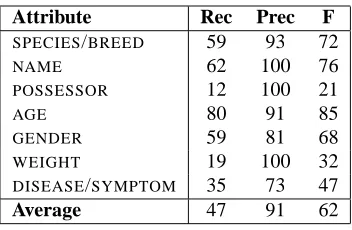
To evaluate the performance of the patient at-tribute tagger, we randomly sampled 200 of the 300 annotated documents to use as training data and used the remaining 100 documents for testing. For this experiment, we only applied the CRF tagger to the gold standard PI sentences, to eliminate any con-founding factors from the PI sentence classifier. Ta-ble 1 shows the performance of the CRF tagger in terms of Recall (%), Precision (%), and F Score (%). Its precision is consistently high, averaging 91% across all seven attributes. But the average recall is only 47%, with only one attribute (AGE) achieving recall≥80%. Nevertheless, the CRF’s high preci-sion justifies our plan to use the CRF tagger to har-vest additional attribute terms from a large collection of unannotated texts. As we will see in Section 4, the additional terms harvested from the unannotated texts provide substantially more attribute informa-tion for the document classifier to use.
Attribute Rec Prec F
SPECIES/BREED 59 93 72
NAME 62 100 76
POSSESSOR 12 100 21
AGE 80 91 85
GENDER 59 81 68
WEIGHT 19 100 32
DISEASE/SYMPTOM 35 73 47
[image:3.612.339.515.402.517.2]Average 47 91 62
Table 1: Patient Attribute Tagger Evaluation
3.2 Creating a Veterinary Patient Attribute (VPA) Lexicon
The patient attribute tagger was trained with super-vised learning, so its ability to recognize important words is limited by the scope of its training set. Since we had an additional 10,000 unannotated vet-erinary message board posts, we used the tagger to acquire a large lexicon of patient attribute terms.
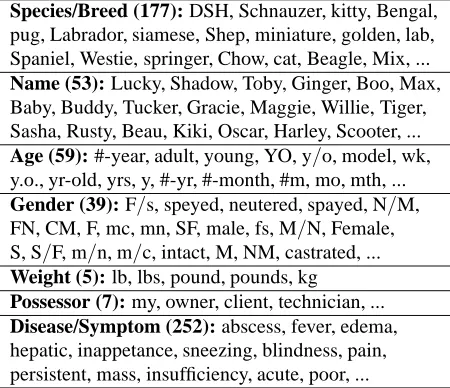
perfect, so we assumed that words tagged with the same attribute value at least five times1 are most likely to be correct and harvested them to create a veterinary patient attribute (VPA) lexicon. This pro-duced a VPA lexicon of 592 words. Table 2 shows examples of learned terms for each attribute, with the total number of learned words in parentheses.
[image:4.612.73.298.164.358.2]Species/Breed (177): DSH, Schnauzer, kitty, Bengal, pug, Labrador, siamese, Shep, miniature, golden, lab, Spaniel, Westie, springer, Chow, cat, Beagle, Mix, ... Name (53): Lucky, Shadow, Toby, Ginger, Boo, Max, Baby, Buddy, Tucker, Gracie, Maggie, Willie, Tiger, Sasha, Rusty, Beau, Kiki, Oscar, Harley, Scooter, ... Age (59): #-year, adult, young, YO, y/o, model, wk, y.o., yr-old, yrs, y, #-yr, #-month, #m, mo, mth, ... Gender (39): F/s, speyed, neutered, spayed, N/M, FN, CM, F, mc, mn, SF, male, fs, M/N, Female, S, S/F, m/n, m/c, intact, M, NM, castrated, ... Weight (5): lb, lbs, pound, pounds, kg Possessor (7): my, owner, client, technician, ... Disease/Symptom (252): abscess, fever, edema, hepatic, inappetance, sneezing, blindness, pain, persistent, mass, insufficiency, acute, poor, ...
Table 2: Examples from the Induced VPA Lexicon
3.3 Text Classification with Patient Attributes
Our ultimate goal is to incorporate patient attribute information into a text classifier to help it distinguish between patient-specific posts and general posts. We designed three sets of features:
Attribute Types: We create one feature for each attribute type, indicating whether a word of that at-tribute type appeared or not.
Attribute Types with Neighbor: For each word la-beled as a patient attribute, we create two features by pairing its Attribute Type with a preceding or fol-lowing word. For example, given the sentence: “The tiny Siamese kitten was lethargic.”, if “Siamese” has attribute type SPECIES then we create two features:
<tiny,SPECIES>and<SPECIES, kitten>.
Attribute Pairs: We create features for all pairs of patient attribute words that occur in the same sen-tence. For each pair, we create one feature
repre-1
After our text classification experiments were done, we re-ran the experiments with the unigrams+lexicon classifier using thresholds ranging from 1 to 10 for lexicon creation, just to see how much difference this threshold made. We found that values ≥5 produced nearly identical classification results.
senting the words themselves and one feature repre-senting the attribute types of the words.
4 Evaluation
To create a blind test set for evaluation, our anno-tators labeled an additional 500 posts as patient-specific or general. Specifically, they labeled those 500 posts with PI sentences. The absence of a PI sentence meant that the post was general. Of the 500 texts, 48 (9.6%) were labeled as general posts. We evaluated the performance of the PI sentence classi-fier on this test set and found that it achieved 88% ac-curacy at identifying patient introductory sentences. We then conducted a series of experiments for the document classification task: distinguishing patient-specific message board posts from general posts. All of our experiments used support vector machine (SVM) classifiers with a linear kernel, and ran 10-fold cross validation on our blind test set of 500 posts. We report Recall (%), Precision (%), and F score (%) results for the patient-specific posts and general posts separately, and for the macro-averaged score across both classes. For the sake of complete-ness, we also show overall Accuracy (%) results. However, we will focus attention on the results for the general posts, since our main goal is to improve performance at recognizing this minority class.
As a baseline, we created SVM classifiers using unigram features.2 We tried binary, frequency, and tf-idf feature values. The first three rows of Table 3 show that binary feature values performed the best, yielding a macro-averaged F score of 81% but iden-tifying only 54% of the general posts.
The middle section of Table 3 shows the perfor-mance of SVM classifiers using our patient attribute features. We conducted three experiments: apply-ing the CRF tagger to PI sentences (per its design), and labeling words with the VPA lexicon either on all sentences or only on PI sentences (as identi-fied by the PI sentence classifier). The CRF fea-tures produced extremely low recall and precision on the general posts. The VPA lexicon performed best when applied only to PI sentences and pro-duced much higher recall than all of the other clas-sifiers, although with lower precision than the two
2
Patient-Specific Posts General Posts Macro Avg
Method Rec Prec F Rec Prec F Rec Prec F Acc
Unigram Features
Unigrams (freq) 96 96 96 58 60 59 77 76 77 92
Unigrams (tf-idf) 99 93 96 33 84 48 66 89 76 93
Unigrams (binary) 98 95 97 54 79 64 76 87 81 94
Patient Attribute Features
CRF Features (PI Sents) 99 91 95 02 25 04 51 58 54 90
VPA Lexicon Features (All Sents) 96 96 96 60 63 62 78 79 79 93 VPA Lexicon Features (PI Sents) 96 98 97 81 66 73 88 82 85 94
Unigram & Patient Attribute Features
CRF Features (PI Sents) 97 96 97 60 71 65 79 83 81 94
[image:5.612.84.527.56.216.2]VPA Lexicon Features (PI Sents) 98 98 98 79 78 78 88 88 88 96
Table 3: Experimental Results
best unigram-based SVMs.
The bottom section of Table 3 shows results for classifiers with both unigrams (binary) and patient attribute features. Using the CRF features increases recall on the general posts from 54 → 60, but de-creases precision from 79→71. Using the patient attribute features from the VPA lexicon yields a sub-stantial improvement. Recall improves from 54→ 79 and precision is just one point lower. Overall, the macro-averaged F score across the two categories jumps from 81% to 88%.
We performed paired bootstrap testing (Berg-Kirkpatrick et al., 2012)) to determine whether the SVM with unigrams and VPA lexicon features is statistically significantly better than the best SVM with only unigram features (binary). The SVM with unigrams and VPA lexicon features produces sig-nificantly better F scores at thep < 0.05 level for general post classification as well as the macro av-erage. The F score for patient-specific classification and overall accuracy are statistically significant at thep <0.10level.
Attribute CRF VPA
Tagger Lexicon SPECIES/BREED 270 1045
NAME 36 43
POSSESSOR 12 233
AGE 545 1773
GENDER 153 338
WEIGHT 27 83
DISEASE/SYMPTOM 220 2673
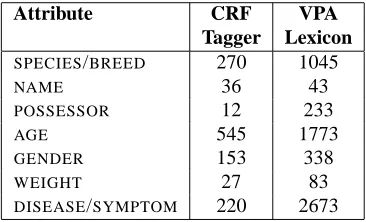
Table 4: Number of Attributes Labeled in Test Set
Finally, we did an analysis to understand why the VPA lexicon was so much more effective than the CRF tagger when used to create features for text classification. Table 4 shows the number of words in PI sentences (identified by the classifier) of the test set that were labeled as patient attributes by the CRF tagger or the VPA lexicon. The VPA lexicon clearly labeled many more terms, and the additional coverage made a big difference for the text classifier.
5 Conclusions
This work demonstrated how annotated data can be leveraged to automatically harvest a domain-specific lexicon from a large collection of unannotated texts. Our induced VPA lexicon was then used to create patient attribute features that improved the ability of a document classifier to distinguish between patient-specific message board posts and general posts. We believe that this approach could also be used to cre-ate specialized lexicons for many other domains and applications. A key benefit of inducing lexicons from unannotated texts is that they provide addi-tional vocabulary coverage beyond the terms found in annotated data sets, which are usually small.
6 Acknowledgements
[image:5.612.94.277.578.689.2]References
D. Baker and A. McCallum. 1998. Distributional cluster-ing of words for text classification. In Proceedcluster-ings of
the 21st annual international ACM SIGIR conference on Research and development in information retrieval.
T. Berg-Kirkpatrick, D. Burkett, and D. Klein. 2012. An Empirical Investigation of Statistical Significance in NLP. In Proceedings of the 2012 Conference on
Em-pirical Methods in Natural Language Processing.
S. Bloehdorn and A. Hotho. 2006. Boosting for text classification with semantic features. In Advances in
Web mining and Web usage Analysis.
H. Borko and M. Bernick. 1963. Automatic Document Classification. J. ACM, 10(2):151–162.
I. Br, J. Szab, and A. Benczr. 2008. Latent dirichlet allo-cation in web spam filtering. In Proceedings of the 4th
international workshop on Adversarial information re-trieval on the web.
A. Carlson, J. Betteridge, B. Kisiel, B. Settles, R. Es-tevam, J. Hruschka, and T. Mitchell. 2010. Toward an Architecture for Never-Ending Language Learning. In Proceedings of the Twenty-Fourth National
Confer-ence on Artificial IntelligConfer-ence.
O. Etzioni, M. Cafarella, A. Popescu, T. Shaked, S. Soderland, D. Weld, and A. Yates. 2005. Unsuper-vised Named-Entity Extraction from the Web: An Ex-perimental Study. Artificial Intelligence, 165(1):91– 134.
J. Furnkranz, T. Mitchell, and E. Riloff. 1998. A Case Study in Using Linguistic Phrases for Text Catego-rization from the WWW. In Working Notes of the
AAAI/ICML Workshop on Learning for Text Catego-rization.
W. Hoyle. 1973. Automatic Indexing and Generation of Classification Systems by Algorithm. Information
Storage and Retrieval, 9(4):233–242.
T. Joachims. 1998. Text categorization with support vec-tor machines: Learning with many relevant features. In Proceedings of the European Conference on
Ma-chine Learning (ECML).
S. Keerthi and D. DeCoste. 2005. A Modified Finite Newton Method for Fast Solution of Large Scale Lin-ear SVMs. Journal of Machine LLin-earning ResLin-earch. Z. Kozareva, E. Riloff, and E. Hovy. 2008. Semantic
Class Learning from the Web with Hyponym Pattern Linkage Graphs. In Proceedings of the 46th Annual
Meeting of the Association for Computational Linguis-tics: Human Language Technologies (ACL-08).
J. Lafferty, A. McCallum, and F. Pereira. 2001. Condi-tional Random Fields: Probabilistic Models for Seg-menting and Labeling Sequence Data. In Proceedings
of the Eighteenth International Conference on Ma-chine Learning.
H. Lodhi, J. Shawe-Taylor, N. Christianini, and C. Watkins. 2001. Text classification using string ker-nels. In Advances in Neural Information Processing
Systems (NIPS).
T. McIntosh and J. Curran. 2009. Reducing Semantic Drift with Bagging and Distributional Similarity. In
Proceedings of the 47th Annual Meeting of the Associ-ation for ComputAssoci-ational Linguistics.
G. Miller. 1990. Wordnet: An On-line Lexical Database.
International Journal of Lexicography, 3(4).
K. Nigam, A. McCallum, S. Thrun, and T. Mitchell. 2000. Text Classification from Labeled and Unla-beled Documents using EM. Machine Learning, 39(2-3):103–134, May.
E. Riloff and R. Jones. 1999. Learning Dictionaries for Information Extraction by Multi-Level Bootstrapping. In Proceedings of the Sixteenth National Conference
on Artificial Intelligence.
E. Riloff and W. Lehnert. 1994. Information Ex-traction as a Basis for High-Precision Text Classifi-cation. ACM Transactions on Information Systems, 12(3):296–333, July.
B. Roark and E. Charniak. 1998. Noun-phrase Co-occurrence Statistics for Semi-automatic Semantic Lexicon Construction. In Proceedings of the 36th
Annual Meeting of the Association for Computational Linguistics, pages 1110–1116.
S. Scott and M. Stan. 1998. Text classification using WordNet hypernyms. In In Use of WordNet in
Natu-ral Language Processing Systems: Proceedings of the Conference.
F. Sebastiani. 2002. Machine learning in automated text categorization. In ACM computing surveys (CSUR). V. Vyas and P. Pantel. 2009. Semi-automatic entity set
refinement. In Proceedings of North American
Asso-ciation for Computational Linguistics / Human Lan-guage Technology (NAACL/HLT-09).
P. Wang, J. Hu, H. Zeng, and Z. Chen. 2009. Using Wikipedia knowledge to improve text classification. In Knowledge and Information Systems.
S. Zelikovitz and H. Hirsh. 2001. Using LSI for text classication in the presence of background text. In