Acquisition of Noncontiguous Class Attributes from Web Search Queries
Marius Pas¸ca
Google Inc.
1600 Amphitheatre Parkway Mountain View, California 94043
Abstract
Previous methods for extracting attributes (e.g., capital, population) of classes (Em-pires) from Web documents or search queries assume that relevant attributes oc-cur verbatim in the source text. The ex-tracted attributes are short phrases that correspond to quantifiable properties of various instances (ottoman empire, ro-man empire, mughal empire) of the class. This paper explores the extraction of non-contiguous class attributes (manner (it) claimed legitimacy of rule), from fact-seeking and explanation-fact-seeking queries. The attributes cover properties that are not always likely to be extracted as short phrases from inherently-noisy queries.
1 Introduction
Motivation: Resources such as Wikipedia (Remy, 2002) and Freebase (Bollacker et al., 2008) aim at organizing knowledge around classes (Food in-gredients, Astronomical objects, Religions) and their instances (wheat flower, uranus, hinduism). Due to inherent limitations associated with main-taining and expanding human-curated resources, their content may be incomplete. For example, attributes representing the energy (or energy per 100g) or solubility in water are available in both Wikipedia and Freebase for many instances of Food ingredients (e.g., for olive oil, honey, fennel). But the attributes are missing for some instances (e.g., cornmeal). Moreover, structured informa-tion about how long (it) lasts unopened or manner (it) helps in weight loss is generally missing for Food ingredients, from both resources. Such in-formation is also often absent from among the at-tributes acquired from either documents or queries by previous extraction methods (Pas¸ca et al., 2007; Van Durme et al., 2008). Previously extracted at-tributes tend to be short, often nominal, phrases
like nutritional value and taste. Even when ex-tracted attributes are not nominal (Pas¸ca, 2012), they remain relatively short phrases such as good for skin. As such, previous attributes have limited ability to capture the finer-grained properties be-ing asked about in queries such as “how long does olive oil last unopened” and “how does honey help in weight loss”. The presence of such queries suggests that such information is relevant to Web users. Identifying noncontiguous properties, or attributes of interest to Web users, helps filling some of the gaps in existing knowledge resources, which otherwise could not be filled by attributes extracted with previous methods.
Contributions: The contributions of this paper are twofold. First, it introduces a method for the acquisition of noncontiguous class attributes, from fact or explanation-seeking Web search queries like “how long does olive oil last unopened” or “how does honey help in weight loss”. The re-sulting attributes are more diverse than, and there-fore subsume, the scope of attributes extracted by previous methods. Indeed, previous meth-ods are unlikely to extract attributes as specific as length/duration (it) lasts unopened and man-ner (it) helps in weight loss, for the instances olive oil and honey of the class Food ingredients. Con-versely, previously extracted attributes like nutri-tional value and solubility in water are roughly equivalent to the finer-grained nutritional value (it) has and reason (it) dissolves in water, ex-tracted from the queries “what nutritional value does honey have” and “why does glucose dissolve in water” respectively. Second, the noncontiguous attributes can be simultaneously interpreted as bi-nary relations pertaining to instances and classes. The relations (helps in weight loss) connect an in-stance (honey) or, more generally, a class (Food ingredients), on one hand; and a loosely-typed un-known argument (manner) whose value is of in-terest to Web users, on the other hand. Because
Web users already inquire about the value of one of their arguments, the extracted relations are more likely to be relevant for the respective instances and classes, than relations extracted from arbitrary document sentences (Fader et al., 2011).
2 Noncontiguous Attributes
Intuitions: Users tend to formulate their Web search queries based on knowledge that they al-ready possess at the time of the search (Pas¸ca, 2007). Therefore, search queries play two roles simultaneously: in addition to requesting new in-formation, they indirectly convey knowledge in the process. In particular, attributes correspond to quantifiable properties of instances and their classes. The extraction of attributes from queries starts from the intuition that, if an attributeAis rel-evant for a classC, then users are likely to ask for the value of the attribute A, for various instances I of the classC. If nutritional value and diameter are relevant attributes of the classes Food ingre-dients and Astronomical objects respectively, it is likely that users submit queries to inquire about the values of the attributes for instances of the two classes. Such queries could take the form “what is the (nutritional value)A of (olive oil)I” and “what is the (diameter)A of (jupiter)I”; or the more compact “(nutritional value)A of (olive oil)I” and “(diameter)A of (jupiter)I”. In this case, the attributes are relatively short phrases (nutritional value, diameter), and are expected to appear as contiguous phrases within queries. Pre-vious methods on attribute extraction from queries specifically target this type of attributes. In fact, some methods apply dedicated extraction patterns (e.g., A of I) over either queries (Pas¸ca et al., 2007) or documents (Tokunaga et al., 2005). Other methods expand manually-provided seed sets of attributes, with other phrases that co-occur with instances within queries, in similar contexts as the seed attributes do (Pas¸ca, 2007).
While simpler properties are often mentioned in queries as short, contiguous phrases, finer-grained properties often are not. Queries seeking the rea-son for solidification for some Food ingredients could, but rarely do, contain the attribute ver-batim (“what is the reason for the solidification of honey”). Instead, queries are more likely to inquire about the expected value, while specify-ing the instance and the properties encoded by the attribute (“(why)Adoes (honey)I (solidify)A”).
Readable descriptions (names) of the attributes can be recovered from the queries, by assembling the type of the expected value and the proper-ties together (reason (it) solidifies). Thus, fact and explanation-seeking queries are an intriguing source of noncontiguous attributes that are not re-stricted to short phrases, and are not required to occur as contiguous phrases in queries.
Acquisition from Queries: The extraction
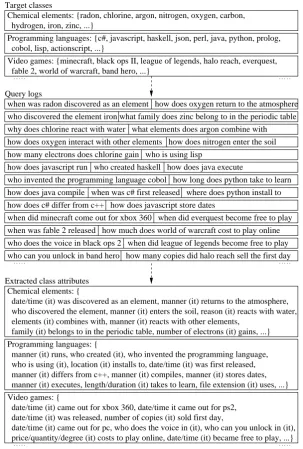
method proposed in this paper takes as input a set of target classes, each of which is available as a set of instances that belong to the class; and a set of anonymized queries independent from one an-other. As illustrated in Figure 1, the method se-lects queries that contain an instance of a class together with what is deemed to be likely a non-contiguous attribute, and outputs ranked lists of attributes for each class. The extraction consists in several stages:
• selection of a subset of queries that contain an instance in a form that suggests the queries ask for the value of a noncontiguous attribute of the instance;
• extraction of noncontiguous attributes, from query fragments that describe the property of in-terest and the type of its expected value;
• aggregation and ranking of attributes of in-dividual instances of a class, into attributes of a class.
Extraction Patterns: In order to determine
associ-Query logs
who discovered the element iron what family does zinc belong to in the periodic table when was radon discovered as an element how does oxygen return to the atmosphere
why does chlorine react with water what elements does argon combine with
how does javascript run who created haskell how does java execute
who invented the programming language cobol how long does python take to learn how does java compile when was c# first released where does python install to how does c# differ from c++ how does javascript store dates
when did minecraft come out for xbox 360 when did everquest become free to play
who does the voice in black ops 2 when did league of legends become free to play when was fable 2 released how much does world of warcraft cost to play online
Extracted class attributes Chemical elements: {
who can you unlock in band hero how many copies did halo reach sell the first day
date/time (it) was discovered as an element, manner (it) returns to the atmosphere, who discovered the element, manner (it) enters the soil, reason (it) reacts with water, elements (it) combines with, manner (it) reacts with other elements,
family (it) belongs to in the periodic table, number of electrons (it) gains, ...} Target classes
Programming languages: {
manner (it) executes, length/duration (it) takes to learn, file extension (it) uses, ...} manner (it) differs from c++, manner (it) compiles, manner (it) stores dates, who is using (it), location (it) installs to, date/time (it) was first released, manner (it) runs, who created (it), who invented the programming language,
date/time (it) was released, number of copies (it) sold first day, Video games: {
date/time (it) came out for xbox 360, date/time it came out for ps2,
price/quantity/degree (it) costs to play online, date/time (it) became free to play, ...} date/time (it) came out for pc, who does the voice in (it), who can you unlock in (it), Chemical elements: {radon, chlorine, argon, nitrogen, oxygen, carbon,
hydrogen, iron, zinc, ...}
cobol, lisp, actionscript, ...}
Video games: {minecraft, black ops II, league of legends, halo reach, everquest, fable 2, world of warcraft, band hero, ...}
Programming languages: {c#, javascript, haskell, json, perl, java, python, prolog,
how many electrons does chlorine gain who is using lisp
[image:3.595.147.451.61.511.2]how does oxygen interact with other elements how does nitrogen enter the soil
Figure 1: Overview of extraction of noncontiguous attributes from Web search queries
ated with pointers to knowledge base entries with a disambiguated meaning (Java (programming lan-guage)). In the first case, the matching of a query fragment, on one hand, to the portion of an ex-traction pattern corresponding to an instanceI, on the other hand, consists in simple string match-ing. In the second case, the matching requires that the disambiguation of the query fragment, in the context of the query, matches the desired dis-ambiguated meaning of I from the pattern. The subset of queries matching any of the extraction patterns, for any instancesI of a classC, are the queries that contribute to extracting noncontigu-ous attributes of the classC.
Collecting Attributes of Individual Instances:
Extraction Pattern
→Examples of Matched Queries
when [does|did|do|was|were] [a|an|the|<nothing>]I A
→when did everquest become free to play
why [does|did|do|was|were] [a|an|the|<nothing>]I A
→why does chlorine interact with water
where [does|did|do|was|were] [a|an|the|<nothing>]I A
→where does radon occur naturally
how [does|did|do|was|were] [a|an|the|<nothing>]I A
→how does nitrogen enter the soil
who [does|did|do|was|were] [a|an|the|<nothing>]I A
→who did claude monet study under
howA[does|did|do|was|were] [a|an|the|<nothing>]I A
→how fast does oxygen dissolve in water whoA I
→who invented the programming language cobol (Note:Adoes not start with [is|are|was|were])
whatA[does|did|do|was|were] [a|an|the|<nothing>]I A
→what elements does argon combine with
whichA[does|did|do|was|were] [a|an|the|<nothing>]I A
[image:4.595.69.294.58.280.2]→which ports does minecraft use
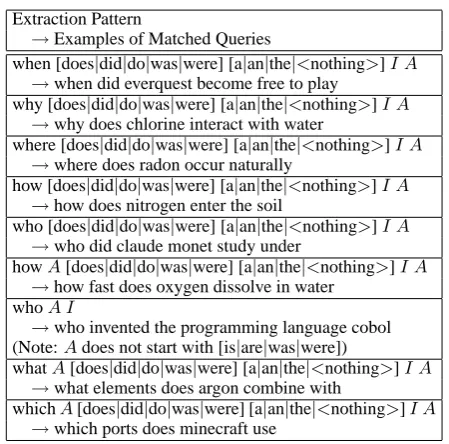
Table 1: The extraction patterns match queries that are likely to inquire about the value of a noncon-tiguous attribute of an instance (I=a required in-stance;A=a required non-empty sequence of arbi-trary tokens)
attribute is constructed from the concatenation of the wh-prefix or expected type (date/time); the slot pronoun it, in lieu of the instance (date/time (it)); and the query remainder after tense conver-sion (date/time (it) came out for xbox 360). If the linking verb following the wh-prefix is a form of be (e.g., was), then the linking verb is also re-tained after the slot pronoun, to form a more co-herent attribute (date/time (it) was first released). Since constructed attributes are noun phrases, they are more consistent with, and can be more eas-ily inserted among, existing attributes in struc-tured data repositories (infobox entries of articles in Wikipedia, or property names or topics in Free-base).
Aggregation into Class Attributes: Attributes of a class C are aggregated from attributes of indi-vidual instances I of the class. An attribute A is deemed more relevant for C if the attribute is extracted for more of the instances I of the class C, and for fewer instancesI that do not belong to the class C. Concretely, the score of an attribute for a class is the lower bound of the Wilson score interval (Brown et al., 2001) where the number of positive observations is the number of queries for which the attributeAis extracted for some in-stanceI in the classC,|{Query(I, A)}I∈C|; and the number of negative observations is the
num-ber of queries for which the attribute A is ex-tracted for some instances I outside of the class C,|{Query(I, A)}I /∈C|. The scores are internally computed at 95% confidence. Attributes of each class are ranked in decreasing order of their scores. Reduction of Near-Duplicate Attributes: Due to lexical variations across queries from which at-tributes are extracted, some of the atat-tributes are equivalent or nearly equivalent to one another. For example, gained independence, won its indepen-dence and gained its freedom of the class Coun-tries are roughly equivalent, although they employ distinct tokens. The diversity and potential useful-ness of a ranked list of attributes can be increased, if groups of near-duplicate attributes are identified in the list, and merged together.
A lower-ranked attribute is marked as a near-duplicate of a higher-ranked (i.e., earlier) attribute from the list, if all tokens from the lower-ranked attribute match either tokens from the higher-ranked attribute (gained independence vs. won its independence), or tokens from synonyms of phrases from the earlier attribute (gained indepen-dence vs. won its indepenindepen-dence; or takes to show symptoms vs. takes to come out). Stop words, which include linking verbs, pronouns, determin-ers, conjunctions, wh-prefixes and prepositions, are not required to match. Synonyms may be ei-ther derived from existing lexical resources (e.g., WordNet (Fellbaum, 1998)), or mined from large document collections (Madnani and Dorr, 2010). Lower-ranked near-duplicate attributes are merged with the higher-ranked ones from the ranked list, thus improving the diversity of the list.
3 Experimental Setting
Textual Data Sources: The experiments rely
on a random sample of around 1 billion fully-anonymized queries in English, submitted to a general-purpose Web search engine. Each query is available independently from other queries, and is accompanied by its frequency of occurrence in the query logs.
Ter-Class (Examples of Instances)
Actors (keanu reeves, milla jovovich, ben affleck), Air-craft (boeing 737, bombardier crj200, embraer 170), An-imated characters (bugs bunny, pink panther (character), yosemite sam), Association football clubs (a.s. roma, flu-minense football club, real madrid), Astronomical objects (alpha centauri, jupiter, delta corvi), Automobiles (nis-san gt-r, tesla model s, toyota prius), Awards (grammy award, justin winsor prize (library), palme d’or), Battles and operations of world war ii (battle of midway, opera-tion postmaster, battle of milne bay), Chemical elements (plutonium, radon, hydrogen), Cities (rio de janeiro, os-aka, chiang mai), Companies (best buy, aveeno, pep-sico), Countries (costa rica, rwanda, south korea), Cur-rencies by country (japanese yen, swiss franc, korean won), Digital cameras (canon eos 400d, nikon d3000, pentax k10d), Diseases and disorders (anorexia nervosa, hyperlysinemia, repetitive strain injury), Drugs (flutica-sone propionate, phentermine, tramadol), Empires (ot-toman empire, roman empire, mughal empire), Films (the fifth element, mockingbird don’t sing, ten thousand years older), Flowers (trachelospermum jasminoides, lavandula stoechas, evergreen rose), Food ingredients (carrot, olive oil, fennel), Holidays (good friday, easter, halloween), Hurricanes in North America (hurricane katrina, hurri-cane wilma, hurrihurri-cane dennis), Internet search engines (google, baidu, lycos), Mobile phones (nokia n900, htc desire, samsung s5560), Mountains (mount rainier, cerro san luis obispo, steel peak), National Basketball Associa-tion teams (los angeles lakers, cleveland cavaliers, indiana pacers), National parks (yosemite national park, orang na-tional park, tortuguero nana-tional park), Newspapers (the economist, corriere del trentino, seattle medium), Organi-zations designated as terrorist (taliban, shining path, eta), Painters (claude monet, domingo antonio velasco, tarci-sio merati), Programming languages (javascript, prolog, obliq), Religious faiths traditions and movements (con-fucianism, fudoki, omnism), Rivers (danube, pingo river, viehmoorgraben), Skyscrapers (taipei 101, 15 penn plaza, eqt plaza), Sports events (tour de france, 1984 scottish cup final, rotlewi versus rubinstein), Stadiums (fenway park, chengdu longquanyi, stade geoffroy-guichard), Treaties (treaty of versailles, franco-indian alliance, treaty of cor-doba), Universities and colleges (cornell university, nu-gaal university, gale college), Video games (minecraft, league of legends, everquest), Wine (madeira wine, yel-low tail (wine), port wine)
Table 2: Set of 40 Wikipedia categories used as target classes in the evaluation of attributes
roristGroup from (Pas¸ca, 2007) are mapped into the Wikipedia categories Aircraft, Films, Religious faiths traditions and movements and Organiza-tions designated as terrorist respectively. The name of the Wikipedia category only serves as a convenience label for its target class, and is not otherwise exploited in any way during the evalua-tion. Instead, a target class consists in a set of titles of Wikipedia articles, of which sample titles (e.g., the Wikipedia article titled nissan gt-r) are shown in lowercase for each class (e.g., Automobiles) in Table 2. The set of instances of a class is selected from all articles listed under the respective
cate-Label Examples of Attributes
vital Astronomical objects: manner (it) generates its energy
Food ingredients: temperature (it) solidifies Religion: date/time (it) became a religion okay Astronomical objects: manner (it) became a
constellation
Food ingredients: reason (it) sparks in the mi-crowave
Religion: manner (it) feels about abortion wrong Astronomical objects: reason (it) has arms
[image:5.595.309.526.59.198.2]Food ingredients: manner (it) cleans pennies Religion: who owns (it)
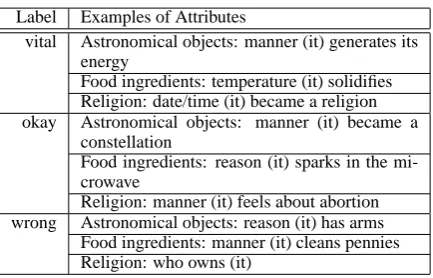
Table 3: Correctness labels manually assigned to attributes extracted for various classes
gory in Wikipedia, or listed under sub-categories of the respective category.
The target classes contain between 41 (for Na-tional Basketball Association teams) and 66,934 (for Films) instances, with an average of 10,730 instances per class.
Synonym Repository: A synonym repository ex-tracted separately from Web documents contains mappings from each of around 60,000 phrases in English, to lists of their synonym phrases. For ex-ample, the top synonyms available for the phrases turn off and contagious are [switch off, extinguish, turn out, ..] and [infectious, catching, communica-ble, ..] respectively.
Parameter Settings: Queries that match any of the extraction patterns from Table 1 are syntac-tically parsed (Petrov et al., 2010). As a pre-requisite, the portion I of the patterns from the table must match a disambiguated instance from a query.
A variation of the tagger introduced
in (Cucerzan, 2007) maps query fragments to their disambiguated, corresponding Wikipedia instances (i.e., to Wikipedia articles). The tagger is simplified to select the longest instance men-tions, and does not use gazetteers or queries for training. Depending on the sources of textual data available for training, any taggers (Cucerzan, 2007; Ratinov et al., 2011; Pantel et al., 2012) that disambiguate text fragments relative to Wikipedia entries can be employed.
4 Evaluation Results
Class Precision of Extracted Attributes %vital %okay %wrong Score
Awards 29 14 7 0.72
Chemical elements 46 2 2 0.94
Companies 42 1 7 0.85
Food ingredients 31 9 10 0.71 Programming languages 31 7 12 0.69
Stadiums 42 5 3 0.89
Video games 33 14 3 0.80 ...
[image:6.595.308.526.61.299.2]Avg-All-Classes 33 10 7 0.76
Table 4: Accuracy of top 50 class attributes ex-tracted from fact-seeking and explanation-seeking queries, over the evaluation set of 40 target classes
class; okay, if it provides useful but non-essential information; and wrong, if it is incorrect (Pas¸ca, 2007). For example, the attributes manner (it) gen-erates its energy, manner (it) became a constella-tion and reason (it) has arms are annotated as vital, okay and wrong respectively for the class Astro-nomical objects. To compute the precision score over a set of attributes, the correctness labels are converted to numeric values: vital to 1.0, okay to 0.5, and wrong to 0.0. Precision is the sum of the correctness values of the attributes, divided by the number of attributes.
Table 4 summarizes the precision scores over the evaluation set of target classes. The scores vary from one class to another, for example 0.71 for Food ingredients but 0.94 for Chemical el-ements. The average score is 0.76, indicating that attributes extracted from fact and explanation-seeking queries have encouraging levels of accu-racy. The results already take into account the detection of near-duplicate attributes. More pre-cisely, the highest-ranked attribute in each group of near-duplicate attributes, examples of which are shown in Table 5, is retained and evaluated; the lower-ranked attributes from each group are not considered in the evaluation. Attributes like num-ber of passengers (it) can hold, numnum-ber of pas-sengers it fits and number of paspas-sengers it seats are nearly equivalent, but are still not marked as near-duplicates for the class Aircraft, when they should. Conversely, the attribute location (it) lives is marked as a near-duplicate of location (it) lives in new york, when it should not. Never-theless, a significant number of near-duplicates, which would otherwise crowd the ranked lists of attributes with redundant information, are identi-fied and discarded.
Target Class: Group of Near-Duplicate Attributes Actors: movies (it) plays in, played in, acts in, acted in, played, played on
Automobiles: date (it) was first manufactured, first pro-duced, first made
Battles and operations of World War II: reason (it) hap-pened, took place, occurred
Chemical elements: manner (it) returns to the sphere, gets back into the atmosphere, got into the atmo-sphere, gets into the atmoatmo-sphere, enters the environment, enters the atmosphere
Companies: location (it) makes its products, manufac-tures its products, produces its products, gets its products, makes its products, manufactures their products
Companies: date/time (it) began outsourcing, started out-sourcing, outsourced
Countries: date (it) got its independence, gained indepen-dence, gained its indepenindepen-dence, got indepenindepen-dence, got their independence, won its independence, achieved inde-pendence, received its indeinde-pendence, gained its freedom Diseases and disorders: length/duration (it) takes to show symptoms, takes to show up, takes to show, takes to ap-pear, takes to manifest, takes to come out
Table 5: Groups of near-duplicate attributes iden-tified for various classes. Attributes within a group are ranked according to their individual scores. Removing all but the first attribute of each group, from the ranked list of attributes of the respective class, improves the diversity of the list
Discussion: The set of patterns shown in Table 1 is extensible. Moreover, the patterns are subject to errors. They may cause false matches, resulting in erroneous extractions. The extent to which this occurs is indirectly measured in the overall preci-sion results. The modification of some of the pat-terns, or the addition of new ones, would likely af-fect the expected coverage and precision of the ex-tracted attributes. If a pattern is particularly noisy, it is likely to cause systematic errors, and therefore produce attributes of lower quality.
[image:6.595.73.291.62.181.2]Run: [Ranked Attributes for a Sample of Classes] Class: Automobiles:
D: [(it) goes on sale, (it) will go on sale, (it) is an en-gineering playground, (it) will be available in japan, (it) shows up in japan, (it) is a technical tour de force, (it) un-veiled at tas 2008, (it) runs a 7:38, (it) is a unique car, (it) uses a premium midship package, (it) features an all-new 3.8-litre, (it) is one of the fastest cars, (it) made a quick drive-by, ..]
Q: [price/quantity/degree (it) weights, year (it) was banned from bathurst, manner (it) launch control works, engine (it) has, kind of engine (it) has, price/quantity/degree (it) costs in japan, number of horse-power (it) has, price/quantity/degree horsehorse-power (it) has, number of seats (it) has, speed (it) goes, who designed (it), ..]
Class: Mobile phones:
D: [(it) was announced on september 17 2008, (it) ceased with version, (it) was scheduled to be released in late 2010, (it) also supports qt (toolkit), (it) supports hardware capable, (it) can synchronize with microsoft outlook, (it) also supports python (programming language), ..] Q: [date/time (it) came out in australia, who carries (it), reason (it) keeps rebooting, colours (it) comes in, video format (it) supports, date/time (it) was released, date/time (it) came out in the uk, length/duration (it)’s battery lasts, who sells (it), how much (it) costs, ..]
Class: Mountains:
D: [(it) is an active volcano, (it) is in the distance, (it) is the highest peak in cascade range, (it) is 14,410 feet, (it) was established in 1899, (it) comes into view, (it) was established as a national park, ..]
[image:7.595.75.289.62.434.2]Q: [date/time (it) last erupted, manner (it) erupted in 1882, manner (it) formed, date/time (it) first became active, manner (it) got its name, number of eruptions (it) had, type of magma (it) has, reason (it) became a national park, kind of animals (it) has, ..]
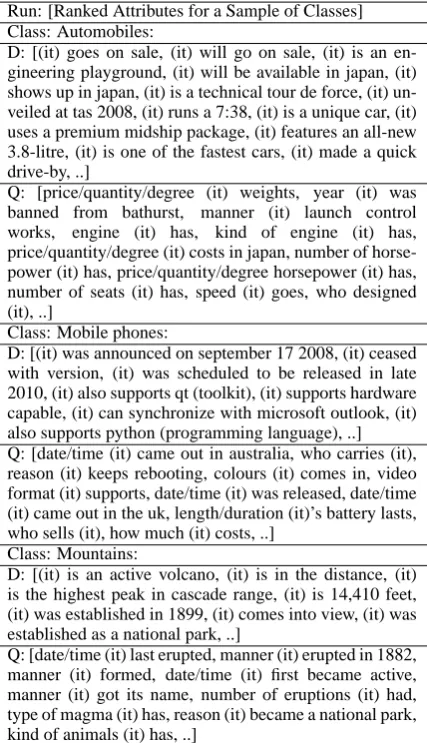
Table 6: Top relations extracted for a sample of target classes via open-domain relations from doc-uments (D) or via attributes from queries (Q)
like vegan, healthy or gluten free (Van Durme et al., 2008; Pas¸ca, 2012). In comparison, attributes extracted in this paper accommodate properties that are sometimes awkward or even impossible to express through short phrases.
Noncontiguous Attributes as Relations: Non-contiguous attributes extracted from fact-seeking queries are embodiments of relations linking the instances mentioned in the queries, on one hand, and the values being requested by the queries, on the other hand. Therefore, the method proposed in this paper can also be regarded as a method for the acquisition of relevant relations of various classes. The extracted relations specify the left argument (i.e., the instance) and the linking relation name (i.e., the attribute). They only specify the type of the, but not the actual, right argument (i.e., the value being requested).
An additional experiment compares the
accu-racy of relations extracted as noncontiguous at-tributes from queries, vs. relations extracted by a previous open-domain method (Fader et al., 2011) from 500 million Web documents. The previous method, including its extraction patterns and its ranking scheme, is designed with instances rather than classes in mind. For fairness to the method in (Fader et al., 2011), the evaluation procedure is slightly adjusted. The set of instances associ-ated with each target class, over which the two methods are evaluated, is reduced to a single repre-sentative instance selected a-priori. The instances are shown as the first instances in parentheses for each class in the earlier Table 2. Thus, the class attributes are extracted using only the instances keanu reeves, boeing 737 and bugs bunny in the case of the classes Actors, Aircraft and Animated characters respectively.
Table 6 suggests that noncontiguous attributes extracted from queries tend to capture higher-quality relations than arbitrary relations extracted from documents. Because fact-seeking queries in-quire about the value of some relations (attributes) of an instance, the relations themselves tends to be more relevant than relations extracted from ar-bitrary document sentences. Nevertheless, rela-tions derived from queries likely serve as a useful complement, rather than replacement, of relations from documents. The former only discover what relations may be relevant; the latter also identify their occurrences within text.
5 Related Work
2010) attributes, from instances to the classes to which the instances belong. The role of Web search queries, as an alternative textual data source to Web documents in open-domain information extraction, has been investigated in the tasks of at-tribute extraction (Pas¸ca, 2007; Pas¸ca, 2012), as well as in collecting sets of related instances (Jain and Pennacchiotti, 2010).
To increase diversity within a ranked list of at-tributes, the extraction method in this paper em-ploys a synonym vocabulary to approximately identify groups of near-duplicate attributes. As reported for previous methods, the resulting lists may still contain lexically different but semanti-cally equivalent attributes. Scenarios where de-tecting all equivalent attributes is important may benefit from other techniques for paraphrase ac-quisition (Madnani and Dorr, 2010).
Sophisticated techniques are sometimes em-ployed to identify the type of the expected an-swers of open-domain questions (Pinchak et al., 2009). In comparison, the loose typing of the values of our noncontiguous attributes is mostly coarse-grained. It relies on wh-prefixes (when, how long, where, how) and possibly subsequent words (what nutritional value) from the queries, to determine whether the values are expected to be a date/time, length/duration, location, manner, nutritional value etc.
Relations extracted from document sentences (e.g., “Claude Monet was born in Paris”) are tu-ples of an instance (claude monet), a text fragment acting as the lexicalized relation (was born in), and another instance (paris) (cf. (Fader et al., 2011; Mausam et al., 2012)). For convenience, the re-lation and second instance may be concatenated, as in was born in paris for claude monet. But document sentences mentioning an instance do not necessarily refer to properties of the instance that people other than the author of the document are likely to inquire about. Consequently, even top-ranked extracted relations occasionally include less informative ones, such as comes into view for mount rainier, is on the table for madeira wine, or allows for features for javascript (Fader et al., 2011). Comparatively, relations extracted via non-contiguous attributes from queries tend to refer to properties that have values that Web users inquire about in their search queries. Therefore, the rela-tions extracted from queries are more likely to re-fer to salient properties, such as date/time (it) had
its last eruption for mount rainier; length/duration (it) lasts for madeira wine; and manner (it) stores date information for javascript.
6 Conclusion
By requesting values for attributes of individual instances, fact-seeking and explanation-seeking queries implicitly assert the relevance of the prop-erties encoded by the attributes, for the respec-tive instances and their classes. The extracted at-tributes are not required to take the form of con-tiguous short phrases in the source queries, thus allowing for the acquisition of a broader range of attributes than those extracted by previous meth-ods. Furthermore, since Web users are interested in their values, the relations to which the ex-tracted attributes refer tend to be more relevant than relations extracted from arbitrary documents using previous methods. Current work explores the role of distributional similarities in expanding extracted attributes for narrow classes; and the ex-traction of noncontiguous attributes and relations from natural-language queries without a wh-prefix (e.g., cars driven by james bond).
Acknowledgments
The author would like to thank Efrat Farkash and Michael Kleyman for assistance with the synonym repository.
References
K. Bollacker, C. Evans, P. Paritosh, T. Sturge, and J. Taylor. 2008. Freebase: A collaboratively created graph database for structuring human knowledge. In Proceedings of the 2008 International Conference on Management of Data (SIGMOD-08), pages 1247–1250, Vancouver, Canada.
L. Brown, T. Cai, and A. DasGupta. 2001. Interval es-timation for a binomial proportion. Statistical Science, 16(2):101–117.
M. Cafarella, A. Halevy, D. Wang, E. Wu, and Y. Zhang. 2008. WebTables: Exploring the power of tables on the Web. In Proceedings of the 34th Conference on Very Large Data Bases (VLDB-08), pages 538–549, Auckland, New Zealand.
A. Carlson, J. Betteridge, R. Wang, E. Hruschka, and T. Mitchell. 2010. Coupled semi-supervised learning for information extraction. In Proceedings of the 3rd ACM Conference on Web Search and Data Mining (WSDM-10), pages 101–110, New York.
S. Dumais, M. Banko, E. Brill, J. Lin, and A. Ng. 2002. Web question answering: Is more always better? In Pro-ceedings of the 24th ACM Conference on Research and Development in Information Retrieval (SIGIR-02), pages 207–214, Tampere, Finland.
A. Fader, S. Soderland, and O. Etzioni. 2011. Identifying relations for open information extraction. In Proceedings of the 2011 Conference on Empirical Methods in Natu-ral Language Processing (EMNLP-11), pages 1535–1545, Edinburgh, Scotland.
C. Fellbaum, editor. 1998. WordNet: An Electronic Lexical Database and Some of its Applications. MIT Press.
J. Hoffart, F. Suchanek, K. Berberich, and G. Weikum. 2013. YAGO2: a spatially and temporally enhanced knowledge base from Wikipedia. Artificial Intelligence Journal. Spe-cial Issue on ArtifiSpe-cial Intelligence, Wikipedia and Semi-Structured Resources, 194:28–61.
A. Jain and M. Pennacchiotti. 2010. Open entity extrac-tion from Web search query logs. In Proceedings of the 23rd International Conference on Computational Linguis-tics (COLING-10), pages 510–518, Beijing, China.
N. Lao, T. Mitchell, and W. Cohen. 2011. Random walk in-ference and learning in a large scale knowledge base. In Proceedings of the 2011 Conference on Empirical Meth-ods in Natural Language Processing (EMNLP-11), pages 529–539, Edinburgh, Scotland.
N. Madnani and B. Dorr. 2010. Generating phrasal and sentential paraphrases: a survey of data-driven methods. Computational Linguistics, 36(3):341–387.
Mausam, M. Schmitz, S. Soderland, R. Bart, and O. Etzioni. 2012. Open language learning for information extraction. In Proceedings of the 2012 Joint Conference on Empirical Methods in Natural Language Processing and Computa-tional Natural Language Learning (EMNLP-CoNLL-12), pages 523–534, Jeju Island, Korea.
V. Nastase and M. Strube. 2008. Decoding Wikipedia cat-egories for knowledge acquisition. In Proceedings of the 23rd National Conference on Artificial Intelligence (AAAI-08), pages 1219–1224, Chicago, Illinois.
M. Pas¸ca, B. Van Durme, and N. Garera. 2007. The role of documents vs. queries in extracting class attributes from text. In Proceedings of the 16th International Conference on Information and Knowledge Management (CIKM-07), pages 485–494, Lisbon, Portugal.
M. Pas¸ca. 2007. Organizing and searching the World Wide Web of facts - step two: Harnessing the wisdom of the crowds. In Proceedings of the 16th World Wide Web Con-ference (WWW-07), pages 101–110, Banff, Canada.
M. Pas¸ca. 2012. Attribute extraction from conjectural queries. In Proceedings of the 24th International Confer-ence on Computational Linguistics (COLING-12), Mum-bai, India.
P. Pantel, T. Lin, and M. Gamon. 2012. Mining entity types from query logs via user intent modeling. In Proceedings of the 50th Annual Meeting of the Association for Compu-tational Linguistics (ACL-12), pages 563–571, Jeju Island, Korea.
S. Petrov, P. Chang, M. Ringgaard, and H. Alshawi. 2010. Uptraining for accurate deterministic question parsing. In Proceedings of the 2010 Conference on Empirical Meth-ods in Natural Language Processing (EMNLP-10), pages 705–713, Cambridge, Massachusetts.
C. Pinchak, D. Lin, and D. Rafiei. 2009. Flexible answer typing with discriminative preference ranking. In Pro-ceedings of the 12th Conference of the European Chapter of the Association for Computational Linguistics (EACL-09), pages 666–674, Athens, Greece.
S. Raju, P. Pingali, and V. Varma. 2008. An unsupervised ap-proach to product attribute extraction. In Proceedings of the 31st International Conference on Research and Devel-opment in Information Retrieval (SIGIR-08), pages 35–42, Singapore.
L. Ratinov, D. Roth, D. Downey, and M. Anderson. 2011. Local and global algorithms for disambiguation to Wikipedia. In Proceedings of the 49th Annual Meeting of the Association for Computational Linguistics (ACL-11), pages 1375–1384, Portland, Oregon.
M. Remy. 2002. Wikipedia: The free encyclopedia. Online Information Review, 26(6):434.
P. Talukdar and F. Pereira. 2010. Experiments in graph-based semi-supervised learning methods for class-instance ac-quisition. In Proceedings of the 48th Annual Meeting of the Association for Computational Linguistics (ACL-10), pages 1473–1481, Uppsala, Sweden.
K. Tokunaga, J. Kazama, and K. Torisawa. 2005. Automatic discovery of attribute words from Web documents. In Proceedings of the 2nd International Joint Conference on Natural Language Processing (IJCNLP-05), pages 106– 118, Jeju Island, Korea.
B. Van Durme, T. Qian, and L. Schubert. 2008. Class-driven attribute extraction. In Proceedings of the 22nd International Conference on Computational Linguistics (COLING-08), pages 921–928, Manchester, United King-dom.
T. Wong, W. Lam, and T. Wong. 2008. An unsuper-vised framework for extracting and normalizing product attributes from multiple Web sites. In Proceedings of the 31st International Conference on Research and Develop-ment in Information Retrieval (SIGIR-08), pages 35–42, Singapore.
F. Wu and D. Weld. 2010. Open information extraction using Wikipedia. In Proceedings of the 48th Annual Meeting of the Association for Computational Linguistics (ACL-10), pages 118–127, Uppsala, Sweden.
N. Yoshinaga and K. Torisawa. 2007. Open-domain attribute-value acquisition from semi-structured texts. In Proceedings of the 6th International Semantic Web Con-ference (ISWC-07), Workshop on Text to Knowledge: The Lexicon/Ontology Interface (OntoLex-2007), pages 55– 66, Busan, South Korea.