A Summariser based on Human Memory Limitations and
Lexical Competition
Yimai Fang
Computer Laboratory University of Cambridge
15 JJ Thomson Avenue, CB3 0FD, UK
Simone Teufel
Computer Laboratory University of Cambridge 15 JJ Thomson Avenue, CB3 0FD, UK
Abstract
Kintsch and van Dijk proposed a model of human comprehension and summarisa-tion which is based on the idea of pro-cessing propositions on a sentence-by-sentence basis, detecting argument over-lap, and creating a summary on the basis of the best connected propositions. We present an implementation of that model, which gets around the problem of identi-fying concepts in text by applying coref-erence resolution, named entity detection, and semantic similarity detection, imple-mented as a two-step competition. We evaluate the resulting summariser against two commonly used extractive summaris-ers using ROUGE, with encouraging re-sults.
1 Introduction
Kintsch and van Dijk (1978) (henceforth KvD) present a model of human comprehension and memory retention which is based on research in ar-tificial intelligence, experimental psychology and discourse linguistics. It models the processing of incoming text or speech by human memory lim-itations, and makes verifiable predictions about which propositions in a text will be recalled by subjects later. It has been very influential, particu-larly in the 1980 and 1990s in educational (Palin-scar and Brown, 1984; King, 1992) and cognitive (Paivio, 1990) psychology, and is still today used as a theoretical model of reading and comprehen-sion (Baddeley, 2007; Zwaan, 2003; DeLong et al., 2005; Smith, 2004). It has also been used for improving education, particularly for the produc-tion of better instrucproduc-tional text (Britton and Gul-goz, 1991; Pressley, 2006), and for teaching hu-mans how to read for deep comprehension (Coiro
and Dobler, 2007; Duke and Pearson, 2002; Koda, 2005; Driscoll, 2005) and to summarise (Hidi, 1986; Brown et al., 1983).
In the summarisation community, the model has been commended for its elegant and explana-tory “deep” treatment of the summarisation pro-cess (Lehnert, 1981; Sp¨arck Jones, 1993; Endres-Niggemeyer, 1998), but has not lead to any prac-tical prototypes, mainly due the impossibility of implementing the knowledge- and inference-based aspects the model relies on.
We present here an implementation of the model, which attempts to circumvent some of these prob-lems by the application of distributional seman-tics, and by modelling the construction of the co-herence tree as a double competition (firstly of concept partners for word forms, secondly of at-tachment sites for propositions).
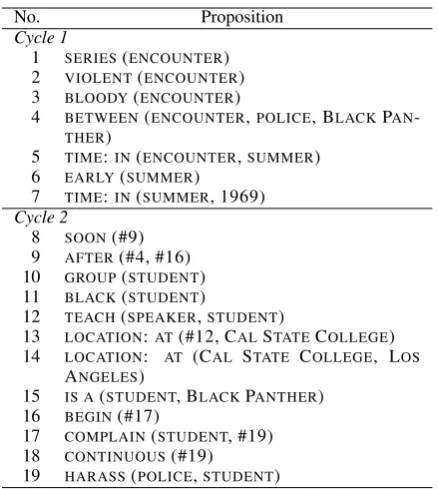
In the KvD model, a text (e.g. Figure 1) is con-verted into propositions (see Table 1) which have one functor and one or more arguments. The func-tor can be taken either from a fixed list of gram-matical relations (e.g. IS A; AT; BETWEEN; OR)
or an open class-set of so-called concepts, (e.g.
BLOODY; TEACH). Arguments can be concepts
or proposition numbers. Proposition numbers ex-press embedded semantic structures (e.g. #9 in Table 1). Kintsch et al. (1979) assumed that this tranformation is performed manually; they were able to train humans to do so consistently.
A series of violent, bloody encounters between police and Black Panther members punctuated the early sum-mer days of 1969. Soon after, a group of black students I teach at California State College, Los Angeles, who were members of the Panther Party, began to complain of continuous harassment by law enforcement officers.
Figure 1: First two sentences from the example paragraphBumperstickersby KvD (1978).
No. Proposition Cycle 1
1 SERIES(ENCOUNTER)
2 VIOLENT(ENCOUNTER) 3 BLOODY(ENCOUNTER)
4 BETWEEN(ENCOUNTER,POLICE, BLACKPAN
-THER)
5 TIME:IN(ENCOUNTER,SUMMER) 6 EARLY(SUMMER)
7 TIME:IN(SUMMER, 1969) Cycle 2
8 SOON(#9)
9 AFTER(#4, #16)
10 GROUP(STUDENT)
11 BLACK(STUDENT)
12 TEACH(SPEAKER,STUDENT)
13 LOCATION:AT(#12, CALSTATECOLLEGE) 14 LOCATION: AT (CAL STATE COLLEGE, LOS
ANGELES)
15 IS A(STUDENT, BLACKPANTHER) 16 BEGIN(#17)
17 COMPLAIN(STUDENT, #19) 18 CONTINUOUS(#19)
[image:2.595.71.291.59.304.2]19 HARASS(POLICE,STUDENT)
Table 1: Propositions for Figure 1.
The KvD algorithm is manually simulated in their work, but is described in a mechanistic manner that should in principle lend itself to implemen-tation, once propositions are created. Propositions form a tree where a proposition is attached to an-other proposition with which they share at least one argument; attachment higher in the tree is pre-ferred. The tree is built incrementally; blocks of propositions, each of which roughly correspond-ing to one sentence, are processed in cycles. Af-ter each cycle, a process of “forgetting” is sim-ulated by copying only the most salient proposi-tions to the short-term memory (STM). This se-lection is performed by the so-called leading edge strategy (LES), which prefers propositions that are attached more recently and those attached at higher positions. This algorithms mirrors van Dijk’s (1977) model of textual coherence.
When choosing an attachment site for proposition, arguments which are currently in STM are pre-ferred. A resource-consuming search in long-term memory (LTM) is only triggered if a proposition cannot be attached in STM; in that case a bridging proposition is reintroduced into the tree.
The KvD model can be used to explain human re-call of stories, and can also to create a summary of a text. The most natural way for a human to sum-marise from scratch is to replace propositions with so-called macropropositions, and the KvD model prefers this style of summary creation. An
exam-ple for macroproposition is a statement that gen-eralises over other propositions. This results in a more abstract version of the text. However if for any reason it is not possible to create macropropo-sitions (for instance due to lack of deep knowledge representation), a summary can also be created in a simpler way based only on the propositions con-tained in the text. In that case, the selection cri-terion is the number of cycles a proposition has remained in STM.
There are three main stumbling blocks in the way of an implementation of the KvD model:
1. The automatic creation of propositions from text, and of summary text from summary propositions;
2. The automatic creation of concepts from words (including coreference resolution); 3. The creation of macropropositions, which
would require sophisticated knowledge rep-resentation and reasoning.
We present a fully automatic version of the KvD model based on the following assumptions:
1. Current parser technology allows us to recon-struct the compositional semantics of the text well enough to make the KvD model opera-tional, both in terms of creating propositions from text, and in terms of creating reasonably understandable output text from propositions (even if not fully grammatical).
2. We model the lexical variation of how a con-cept is expressed in a text probabilistically by semantic similarity and coreference reso-lution. This creates a competition between plausible expressions for argument overlap. 3. Our core algorithm is modelled as two
com-petitions: (a) the competition between con-cept matches as mentioned in the point above; and (b) the competition between pos-sible positions in a tree where a proposition could attach.
co-herent, particularly if they are longer and less linearly structured than the examples used by KvD. We therefore experiment with more flexible root choice strategies.
We have nothing to say on the third and biggest obstacle, the creation of macropropositions. Nev-ertheless, the experiments presented here test whether our hypotheses 1 – 4 are strong enough to provide our summariser with useful informa-tion concerning the discourse structure of the texts. We test this by comparing its performance to that of two current state-of-the-art summarisers, which instead rely on the sole use of lexical informa-tion. A psychologically-motivated summariser such as ours should be evaluated by compari-son to abstractive, i.e., reformulated human sum-maries, rather than by comparison to extractive summaries. We do so using ROUGE, an evalu-ation framework that supports such comparisons (Lin and Hovy, 2003).
The structure of the paper is as follows. In the next section, we will detail our implementation of the KvD model, with particular emphasis on the creation of propositions, probabilistic concepts, proposition attachment, and root choice. In Sec-tion 4, we will present experiments comparing our summariser against two research extractive sum-marisers, MEAD and LexRank. We also test how our inventions including similarity-based concept matching and root choice strategy contribute to performance. We compare to related work in Sec-tion 3, and draw our conclusions in SecSec-tion 5.
2 Our implementation of KvD
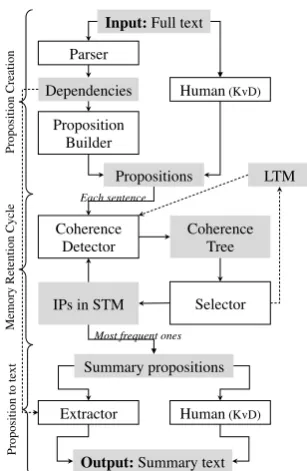
Figure 2 shows the structure of our summariser. TheProposition Creationmodule transforms sur-face text to propositions with the aid of a grammat-ical parser. Recall that in the original KvD model (shown as “Human (KvD)”), propositions are gen-erated manually. Apart from such, our implemen-tation follows the KvD algorithm as closely as possible. The core of this algorithm is the Mem-ory Retention Cyclein the centre of the figure. A cycle begins with the detection of coherence be-tween the new propositions and the current STM content. This results in a hierarchy of all so-far processed propositions called theCoherence Tree. Propositions are attached to the tree by a variety of strategies, as explained in Subsection 2.2.
Input: Full text
Parser
Proposition Builder
Dependencies Human (KvD)
Propositions
Coherence Detector
Coherence Tree
Selector IPs in STM
Summary propositions
Extractor Human (KvD)
Output: Summary text
Each sentence
Most frequent ones
P
ropos
it
ion Cre
at
ion
M
em
ory Re
te
nt
ion Cyc
le
P
ropos
it
ion t
o t
ext
[image:3.595.339.493.58.294.2]LTM
Figure 2: Framework of the summariser.
At the end of each cycle, important propositions (IPs) are selected by theSelector, stored in STM, and thus retained for the next cycle, where they are available for new incoming propositions to attach to. The selector is a full implementation of KvD’s LES, which also updates the recency of proposi-tions reinstantiated from the LTM.1 Less impor-tant propositions leave the cycle and go into the LTM, which is conceptually a secondary reposi-tory of propositions to provide the “missing links” when no coherence between the STM and the in-coming propositions can be established.
After the text is consumed, a propositional repre-sentation of the summary is created by recalling the propositions that were retained in STM most frequently. The summary text is then either cre-ated manually (in the KvD model), or in our im-plementation, as a prototype, automatically by ex-tracting words from the parser’s dependencies.
2.1 Proposition builder
We aim to create propositions of comparable se-mantic weight to each other. This is a consequence of our decision to recast KvD as a competition model (as will become clear in subsection 2.2), because by defining propositions as blocks of ar-guments they should contain a similar number of 1KvD implied this in the last cycle of the
meaningful arguments to ensure similar potential for overlap.
To achieve suitable granularity of propositions, we aggregate information spread out over several grammatical dependencies, and exclude semanti-cally empty words from participating in argument overlap. We use Stanford Parser (Klein and Man-ning, 2003), and aggregate subjects and comple-ments of a predicate into a single proposition. Ac-tive and passive voices are unified; clauses are treated as embedded propositions; controlling sub-jects of open clausal complements are recovered. Some predicates are not verbs, but nominalised verbs or coordination. For instance, KvD model the phrase “encounters between police and Black Panther Party members ” as BETWEEN (EN -COUNTER, POLICE, BLACKPANTHER).
Produc-ing such a proposition instead of two separate ones BETWEEN (ENCOUNTER, POLICE) andBE -TWEEN (ENCOUNTER, BLACKPANTHER) is
ad-vantageous, because this single proposition pro-vides a strong connection between POLICE and
BLACK PANTHER which cannot be derived from
other dependencies.
However we lack a subcategorisation lexicon that provides information about how many arguments a preposition like “between” takes. Therefore we scan conjoined prepositional phrases, aggregate the objects, and attach them to the governors of the prepositional phrases. In this example, the result-ing preposition is ENCOUNTER (POLICE, MEM -BER). The word “between” is excluded because it
is semantically empty and may interfere with over-lap detection.
We take care to detect and exclude semantically empty material. For instance, theempty semantic headsin noun phrases such as “a series of” and “a group of” are detected using a list of of 21 words we collected, and treated by redirecting the depen-dencies involving the empty heads to the corre-sponding content heads. In this treatment, the rela-tion between an empty head and its content head is not entirely erased, but encoded as a general mod-ifier relation.
2.2 Probabilistic concept matching
The notion of argument overlap in KvD’s model is sophisticated in that it “knows” which surface
expressions (pronouns, synonyms, etc) in text re-fer to the same concept. Concept mapping is the task of forming equivalence classes of surface ex-pressions; each concept then corresponds to one such equivalence class. The KvD model, because it simulates concept mapping and proposition at-tachment in parallel, conceals some of the choices that a fully automatic model has to make.
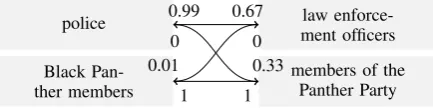
Given current technology, concept mapping can only be performed probabilistically. We use the Stanford coreference resolution, named-entity de-tection (to extend coreference dede-tection to non-same-head references, e.g. mapping “the tech giant” to “Apple Inc.”2); and to find synonymy or at least semantic relatedness, we use a well-known measure of semantic similarity, namely Lin’s Dependency-Based Thesaurus (Lin, 1998). We are not committed to this particular measure, but it empirically performed best out of the 11 we tried; especially it outperformed WordNet path-based measures. Note however that only the 200 most similar words for each word are provided by this tool. The similarity measure is normalised by relative ranking to provide the probability that an expression refers to the same concept as another expression. We use WordNet (Miller, 1995) for derivationally related forms (to solve e.g. nomi-nalisation). This establishes the first competition, the one between concept matches.
police
Black Pan-ther members
law enforce-ment officers members of the
Panther Party
1 1
[image:4.595.310.528.474.527.2]1 1
Figure 3: KvD’s concept matching.
police
Black Pan-ther members
law enforce-ment officers members of the
Panther Party 0.99 0.67
0
0.33
1 1
0.01
0
Figure 4: Probabilistic concept matching.
Modelling concepts probabilistically has its impli-cation for the next task: finding the best attach-ment site for a proposition. Let us explain this with an example. Notice that in the example text in Fig-ure 1, “police” (from #4, in the first sentence) and 2A WordNet synset is defined for each named-entity type;
[image:4.595.310.527.569.623.2]“law enforcement officer” (from #19, in the sec-ond sentence) refer to the same concept POLICE.
Figure 3 illustrates how this is handled in KvD’s model, where intelligent concept matching estab-lishes with 100% certainty that the two strings re-fer to the same concept. Certainty about the ar-gument overlap then enables them to later attach #19 to #4. In their model it is important whether a matching proposition is found in STM or LTM: If the only proposition that mentions “police” (#4) is no longer in STM when the proposition contain-ing “law enforcement officer” (#19) is processed, and for any reason the other arguments in #19 (i.e.
STUDENT) cannot find overlaps either, KvD find
no concept match in STM and know therefore, again with full certainty, that an LTM search must be triggered3, which in this case leads to the suc-cessful recall of #19 for #4 to attach to.
Figure 4 illustrates the corresponding situation in our model, where #4 with “police” is in LTM, the probability of a concept match between “law en-forcement officer” and “police” is 66.7%, whereas that of a match with “members”, which is in STM, is 33.3%. The probabilistic concept matching can-not provide enough certainty to single out #4 be-cause of full argument overlap. The probabilities of concept match have to act as a much weaker filter in our model, and all previous propositions have to be considered as potential landing sites for #19. In particular, we do not know whether a concept match within STM is “good enough”, or whether a LTM search is needed. There is, in this case, a competition between a weak match in STM (the direct vicinity) and a strong match in LTM (further away), which will hopefully result in a successful match between “police” and “law enforcement officer”. In other words, we always have to search for matches in both repositories. After obtaining the graph of interrelated expres-sions, the competition between landing sites for each proposition takes place, whereby higher po-sitions are preferred. This double competition is a core aspect of our model.
2.3 Choice of root
The KvD model almost always maintains the root determined in the first cycle (either by overlap 3KvD only mentioned retrieving embedded propositions
as LTM search rarely happens, but the goal is the same as here: to establish overlap.
with title concepts or by coverage of the main clause of the first sentence). The model intro-duces multiple roots if a text is totally incoher-ent, namely when propositions cannot be attached anywhere and therefore a forest of disjoint trees has to be developed. This strategy does not gen-eralise well to longer texts with topic changes, for example newspaper texts with anecdotal leads. Although these texts are perfectly coherent, KvD cannot treat them appropriately.4
Our more flexible rooting strategy is run once in each cycle, assessing whether any of the cur-rent root’s children in the working memory would make a better root. In case of a root change, the edge between the old and the new root is reversed, and the old root becomes a child of the new root. Then we perform the same strategy on the new tree until no root change is needed.
We denote the current root as i, and a new root candidate (a child ofi)j. J is the set of descen-dants ofj(inclusive ofj), andIthe set of all nodes V excludingJ, i.e. I =V \J. Then nodes inJ will be promoted after the root change, while those inI will go one level deeper. Since edge weights, i.e. attachment strengths, are asymmetric, we de-note the weight forjbeing a child ofiaswi,j, and
wj,ifor the reversed attachment. Each nodevalso
carries a weight xv = mv ·adv, wheremv is a
memory status factor (e.g.mv = 1ifvis in STM,
0.5 if otherwise),0< a≤1is an attenuation fac-tor, anddv is depth ofvin the tree. To decide, we
evaluate
s=wj,i
X
v∈J
xv−wi,j
X
v∈I
xv (1)
Ifs >0, the root change is permitted.5 This evalu-ation makes root change easier if the edge in ques-tion favoursibeing a child ofj, or there are more important nodes that can benefit from the change, and vice versa.
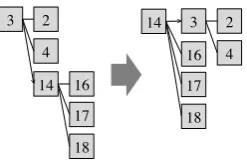
An example of such a root change taken from the
Bumperstickers is given in Figure 5 (refer to Ta-ble 1 for proposition contents). As the central topic of the text changes from the encounters to 4In our scenario the situation can barely ever arise where
absolutely no proposition attachment is possible, as the prob-abilistic concept mapping is usually able suggest some con-cept match, albeit with small probability.
5In case when multiple candidates are permitted, the one
that the identity of Panther Party members are ac-tually the author’s students, the summariser recog-nises this change after reading one more sentence, by flipping the edge connecting #3 and #14.
3 2
4
14 16
17
18
3 2
4 14
16
17
[image:6.595.121.245.127.208.2]18
Figure 5: Tree before and after a root change.
3 Related Work
One of the dilemmas in summarisation research is how “deep”, i.e. semantics-oriented, a summariser should be. Shallow analysis of lexical similarity between sentences and/or the keywords contained in sentences has lead to summarisers that are ro-bust and perform very well for most texts (Radev et al., 2004; Dorr and Zajic, 2003; Carbonell and Goldstein, 1998). The methods applied include a random-surfer model (Mihalcea and Tarau, 2004; Radev, 2004), a model of attraction and repul-sion of similar summary sentences (Carbonell and Goldstein, 1998). There are statistical models of sentence shortening (Knight and Marcu, 2002). While much work in summarisation has concen-trated on multi-document summarisation, where the main challenge is the detection of redundant information, the summariser presented here is a single-document summariser.
However, researchers have been attracted by deeper, more symbolic and thus more explana-tory summarisation models that use semantic rep-resentations of some form (Radev and McKe-own, 1998) and often rely on explicit discourse modelling (Lehnert, 1981; Kintsch and van Dijk, 1978; Cohen, 1984). The problem with template-based summarisers is that they tend to be domain-dependent; the problem with discourse structure-based summarisers is in general that they require knowledge modelling and reasoning far beyond the capability of today’s state of the art in arti-ficial intelligence. Rhetorical Structure Theory (Mann and Thompson, 1987) provides a domain-independent framework that takes local discourse structure into account, which has lead to a suc-cessful prototype summariser (Marcu, 2000). This
summarisation strategy does not however look at the lexical content of the propositions or clause-like units it connects, only at the way how the con-nection is performed.
The summariser presented here is a hybrid: its core algorithm is symbolic, but its limited powers of generalisation come from a semantic similarity metric that is defined via distributionally derived probabilities. Because its core processing is sym-bolic and based on a simple semantic representa-tion, it is possible to derive an explanation based on the coherence tree and the propositions selected from it. There are some similarities to the idea of summarisation via lexical chains (Barzilay and El-hadad, 1997), as both methods trace concepts (as representatives of topics) across a document. The KvD model arguably uses more informative mean-ing units, as it is based on the combination of con-cepts within propositions, rather than on concept repetition alone.
A different, related stream of research looked at the automatic detection of coherence in text. Graesser et al (2004) present a coherence checker based on over 200 coherence metrics, including argument overlap as in KvD. Barzilay and Lap-ata (2008) use a profiling of texts akin to Centering theory to rank texts according to their coherence. It would be interesting to combine their notion of entity-based coherence with KvD’s notion of ar-gument overlap.
4 Experiments
We now perform two experiments. The first tests the contribution of our concept matcher and root change strategy on a small document set we have collected, and compares against two research sum-marisers. In the second experiment, we test the performance of our summariser on a much larger and standard dataset.
The next question is how the gold standard sum-maries used in ROUGE are defined. Because our summariser is deep and has a fine granularity, it should be compared against human-written sum-maries on a variety of texts.
For the first experiment, we have collected from volunteers 8 human abstractive summaries for each of the 4 short scientific articles or stories we found in Kintsch and Vipond (1979) (average length: 120 words), and 4 for each of 2 longer po-litical news texts (average length: 523 words). The volunteers were instructed to condense the text to 1/3 of its length for the short texts, and to 100 words for the longer ones. They were also in-structed not to paraphrase, but to use the words in the text as much as possible. This was because no summariser in this experiment has a paraphrasing ability. Nevertheless, not all subjects followed this instruction strictly.
For the second experiment, we use the DUC 2002 dataset (Over and Liggett, 2002). There are 827 texts from news media, of a variety of topics and lengths, among which our script is able to extract titles and contents of 822 documents. We use the provided single document abstractive summaries, which are of 100 words in length each, as gold standard summaries. A few of the documents are selected in multiple clusters and therefore have multiple summaries; all of them are used in evalu-ation.
We compare our summariser against a baseline constructed with the firstnwords from the origi-nal text, wherenis the summary length as defined above, and two summarisers: MEAD (Radev et al., 2004) is a research summariser which uses a centroid-based paradigm and is known to perform generally well over a range of texts. LexRank (Radev, 2004) uses lexically derived similarities in its similarity graph of sentences, sharing the same idea of sentence similarity with MEAD. Note that both summarisers are extractive.
We illustrate what our summaries look like in Ta-ble 2, where we asked the summariser to give us summaries as close to 20 and 50 word summaries as possible, with Table 3 showing the underlying propositions. In contrast, MEAD can only extract sentences as-is (thus not as flexible in length), and does not have meaning blocks like our proposi-tions.
Encounters between police and Black Panther members. Students to complain of harassment. Automobiles Panther Party signs glued to bumpers.
Bloody encounters between police and Black Panther members punctuated the summer days of 1969. Students to complain of continuous harassment by law enforcement officers. They receiving many traffic citations. Automo-biles with Panther Party signs glued to their bumpers. I to determine whether we were hearing the voice of paranoia or reality.
Table 2: Summaries produced by our summariser.
3 encounters (between: police; between: Black Pan-ther members)
16 to complain (students; of: harassment) 34 with: Panther Party signs (automobiles) 35 glued (#34; to: bumpers)
Table 3: Summary propositions for the first sum-mary above.
We create summaries for all three summarisers following this procedure: We provide sentence-split texts and their headlines (not needed by LexRank), and run the summarisers in such a way as to produce a summary of the same length as stipulated for the standard summaries. Our sum-mariser controls word count precisely; we require MEAD to produce summaries close to the length (allowing variations), and for LexRank we allow it to go beyond the limit by less than one sentence and then discard the exceeding part in the sentence with the lowest salience.
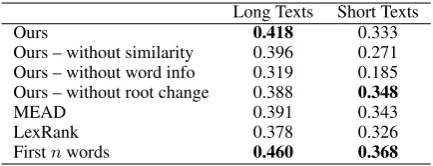
The results of Experiment 1 are summarised in Ta-ble 4. As is well-known from similar experiments, it is hard beating the firstnbaseline due to the fact that journalistic style (in the long texts) already puts a summary of each text first. It is slightly surprising that this effect also holds for the short texts (literary style). It is of note that our KvD summariser beats both MEAD and LexRank on this dataset, which is shelved away during devel-opment, with statistical significance on the long texts: the 95%-confidence interval of ours is 0.403 – 0.432, and that of MEAD is 0.370 – 0.411.
Long Texts Short Texts Ours 0.418 0.333 Ours – without similarity 0.396 0.271 Ours – without word info 0.319 0.185 Ours – without root change 0.388 0.348
MEAD 0.391 0.343
LexRank 0.378 0.326
[image:7.595.307.524.660.743.2]Firstnwords 0.460 0.368
Precision Recall F-measure Our summariser 0.361 0.332 0.344
MEAD 0.366 0.355 0.358
[image:8.595.80.279.62.105.2]Firstnwords 0.403 0.395 0.399
Table 5: ROUGE-L scores for Experiment 2.
We test whether concept matching is beneficial by switching off similarity derived from distribu-tional semantics, or switching off all “word infor-mation” which includes distributional semantics, lemmatisation, and coreference detection, i.e. to consider matching only for the same word. Per-formance deteriorates when concept matching is switched off, substantially if all word information is off. This confirms our hypothesis that one of the cornerstones of KvD, concept matching, can be at least partially simulated using today’s distri-butional semantics methods. As for root change, turning it off seems to hurt performance on the longer texts, but not so on the shorter ones, which matches our speculation that root change is useful for longer texts, which have some focus shifts. The result of Experiment 2 is shown in Table 5. This experiment on a large dataset demonstrates that our summariser performs in the ballpark of typical results of extractive summarisers, although it is still statistically a little worse than the state-of-the-art MEAD (whose F-measure 95%-confidence interval is 0.349 – 0.367). Our summariser is good at precision because many summaries pro-duced have not used up the 100-word limit, mak-ing the average summary length smaller than that of MEAD’s. This indicates that our summariser might be good at very short summaries, or we could improve the memory selection to allow for a more diversified important proposition set. Con-sidering this, and the fact that we have many pa-rameters not tuned for the task, and we have not utilised the structural / positional features (whose importance is shown in the first-n baseline), the result is still encouraging.
5 Conclusions
We present here a first prototype of the feasibility of basing a summarisation algorithm on Kintsch and van Dijk’s (1978) model. Our implemen-tation successfully creates flexible-length sum-maries, highly compressed if desired, and provides some explanation for why certain meaning units appear in the summary. We have avoided some of
the hardest aspects of KvD’s model, which have to do with the generation of macropropositions and with keeping closer track of larger discourse struc-tures, but we show that some core aspects of the model can be approximated with today’s parsing and lexical semantics technology. Although the output summaries are not yet in all cases grammat-ical, we show that our system performs compara-bly with extractive state-of-the-art summarisers. During the implementation, we had to solve sev-eral practical problems that the KvD did not give enough procedural detail about, or skipped over in their manual simulation. For instance, we have turned the distinction between LTM and STM to two parallel salience levels from KvD’s two dis-joint stages, formalised the tree building process and improved KvD’s root choice strategy.
The KvD model does not keep track of unique events, but would profit from doing so, for in-stance in texts where more than one event of the same type is referred to. It has no explicit model of time, but would profit from one. It does not even use information about which entities in a text form the same concept or individual, for selecting all information about that concept into the sum-mary. There are also many interesting ways how the memory cycle could be modified by giving more weight to particular events, concepts and in-dividuals.
On the implementational side, much remains to be tried. Anything that improves the proposition builder should bear direct fruit in the quality of the summaries. The limitations of our proposi-tion builder come from the limitaproposi-tions of parsing technology as well as the fact that semantics is not entirely determined by syntax. For instance, we noticed some problems caused by incorrect prepo-sitional phrase attachment. A better coreference system would also improve this summariser im-mensely, reducing much uncertainty in the con-cept matching. The deep nature of the summariser also enables natural language generation to im-prove the readability of our textual summary.
Acknowledgement
References
A Baddeley. 2007. Working memory, thought, and ac-tion. Oxford University Press.
Regina Barzilay and Michael Elhadad. 1997. Us-ing lexical chains for text summarization. In Inderjeet Mani and Mark T. Maybury, editors,Proceedings of the ACL/EACL-97 Workshop on Intelligent Scalable Text Summarization.
Regina Barzilay and Mirella Lapata. 2008. Modeling local coherence: An entity-based approach. Computa-tional Linguistics, 34(1):1–34.
BK Britton and S Gulgoz. 1991. Using kintsch’s computational model to improve instructional text: Ef-fects of repairing inference calls on recall and cognitive structures.Journal of Educational Psychology. Ann L. Brown, Jeanne D. Day, and Jones R. S. 1983. The development of plans for summarizing text. Child development. was in press in 1983.
Jaime Carbonell and Jade Goldstein. 1998. The use of MMR, diversity-based reranking for reordering doc-uments and producing summaries. In Proceedings of the 21th (SIGIR-98), pages 335–336, Melbourne, Aus-tralia.
Robin Cohen. 1984. A computational theory of the function of clue words in argument understanding. In
Proceedings of the 10th (COLING-84), pages 251–255. J Coiro and E Dobler. 2007. Exploring the online reading comprehension strategies used by sixthgrade skilled readers to search for and locate information on the internet. Reading research quarterly.
KA DeLong, TP Urbach, and M Kutas. 2005. Prob-abilistic word pre-activation during language compre-hension inferred from electrical brain activity. Nature neuroscience.
Bonnie Dorr and David Zajic. 2003. Hedge trimmer: A parse-and-trim approach to headline generation. In
in Proceedings of Workshop on Automatic Summariza-tion, pages 1–8.
MP Driscoll. 2005.Psychology of learning for instruc-tion. Allyn and Bacon.
NK Duke and PD Pearson. 2002. Effective practices for developing reading comprehension. In Alan E. Farstrup and S. Jay Samuels, editors, What research has to say about reading instruction.
Brigitte Endres-Niggemeyer. 1998. Summarizing In-formation. Springer-Verlag, New York, NY.
Arthur C. Graesser, Danielle S. McNamara, Max M. Louwerse, and Zhiqiang Cai. 2004. Coh-metrix: Analysis of text on cohesion and language. Behav-ior Research Methods, Instruments, & Computers, 36(2):193–202.
V Anderson Hidi. 1986. Producing written sum-maries: Task demands, cognitive operations, and impli-cations for instruction. Review of educational research.
A King. 1992. Comparison of self-questioning, sum-marizing, and notetaking-review as strategies for learn-ing from lectures. American Educational Research Journal.
Walter Kintsch and Teun A. van Dijk. 1978. Toward a model of text comprehension and production. Psycho-logical review, 85(5):363–394.
Walter Kintsch and Douglas Vipond. 1979. Read-ing comprehension and readability in educational prac-tice and psychological theory. In Lars-G¨oran Nilsson, editor, Perspectives on Memory Research: Essays in Honor of Uppsala’s 500th Anniversary, pages 329– 365. Erlbaum Associates.
Dan Klein and Christopher D Manning. 2003. Ac-curate unlexicalized parsing. In Proceedings of the 41st Annual Meeting on Association for Computational Linguistics-Volume 1, pages 423–430. Association for Computational Linguistics.
Kevin Knight and Daniel Marcu. 2002. Summariza-tion beyond sentence extracSummariza-tion: A probabilistic ap-proach to sentence compression.Artificial Intelligence, 139(1).
Keiko Koda. 2005. Insights into second language reading: A cross-linguistic approach. Cambridge Uni-veristy Press.
Wendy G Lehnert. 1981. Plot units and narrative sum-marization.Cognitive Science, 5(4):293–331.
Chin-Yew Lin and Eduard Hovy. 2003. Automatic evaluation of summaries using n-gram co-occurrence statistics. InProceedings of the 2003 Conference of the North American Chapter of the Association for Compu-tational Linguistics on Human Language Technology-Volume 1, pages 71–78. Association for Computational Linguistics.
Dekang Lin. 1998. Automatic retrieval and clustering of similar words. InProceedings of the 17th interna-tional conference on Computainterna-tional linguistics-Volume 2, pages 768–774. Association for Computational Lin-guistics.
Chin-Yew Lin. 2004. ROUGE: A package for
auto-matic evaluation of summaries. InText Summarization Branches Out: Proceedings of the ACL-04 Workshop, pages 74–81.
William C. Mann and Sandra A. Thompson. 1987. Rhetorical Structure Theory: Description and construc-tion of text structures. In Gerard Kempen, editor, Natu-ral Language Generation: New Results in Artificial In-telligence, Psychology, and Linguistics, pages 85–95. Marinus Nijhoff Publishers, Dordrecht, NL.
for english. Communications of the ACM, 38(11):39– 41.
Paul Over and W Liggett. 2002. Introduction to duc: An intrinsic evaluation of generic news text sum-marization systems. In Proc. DUC. http://www-nlpir.nist.gov/projects/duc/guidelines/2002.html. A Paivio. 1990. Mental representations. Oxford Sci-ence Publications.
Aannemarie Sullivan Palinscar and Ann L. Brown. 1984. Reciprocal teaching of comprehension-fostering and comprehension-monitoring activities. Cognition and Instruction, 1:117–175.
Michael Pressley. 2006. Reading instruction that works: The case for balanced teaching. Guildford Press.
Dragomir R. Radev and Kathleen R. McKeown. 1998. Generating natural language summaries from multiple on-line sources. 24(3):469–500.
Dragomir Radev, Timothy Allison, Sasha Blair-Goldensohn, John Blitzer, Arda Celebi, Stanko Dim-itrov, Elliott Drabek, Ali Hakim, Wai Lam, Danyu Liu, Jahna Otterbacher, Hong Qi, Horacio Saggion, Simone Teufel, Michael Topper, Adam Winkel, and Zhu Zhang. 2004. Mead – a platform for multidocument multilin-gual text summarization. InProceedings of LREC-04. Dragomir R. Radev. 2004. Lexrank: Graph-based lex-ical centrality as salience in text summarization. Jour-nal of Artificial Intelligence Research.
F Smith. 2004. Understanding reading: A psy-cholinguistic analysis of reading and learning to read. Lawrence Erlbaum.
Karen Sp¨arck Jones. 1993. What might be in a sum-mary? Technical report, Computer Laboratory, Uni-versity of Cambridge.
Teun A. van Dijk. 1977. Text and Context: Explo-rations in the Semantics and Pragmatics of Discourse. Longman, London, UK.