Improving a Strong Neural Parser with Conjunction-Specific Features
Jessica Ficler
Computer Science Department Bar-Ilan University
Israel
Yoav Goldberg
Computer Science Department Bar-Ilan University
Israel
Abstract
While dependency parsers reach very high overall accuracy, some dependency relations are much harder than others. In particular, dependency parsers per-form poorly in coordination construction (i.e., correctly attaching theconjrelation). We extend a state-of-the-art dependency parser with conjunction-specific features, focusing on the similarity between the conjuncts head words. Training the ex-tended parser yields an improvement in
conj attachment as well as in overall de-pendency parsing accuracy on the Stan-ford dependency conversion of the Penn TreeBank.
1 Introduction
Advances in dependency parsing result in impres-sive overall parsing accuracy. For the most part, the advances are due to general improvements in parsing technology or feature representation, and do not explicitly target any specific language or syntactic construction. However, despite the high overall accuracy, parsers are still persistently wrong in attaching certain relations. In the at-tachments predicted by BIST-parser (Kiperwasser and Goldberg, 2016), the F1 score for the labels
nn, nsubj, pobj, and others is 95% and above; while the F1 scores for advmod, conj and prep
are 83.3%, 82.5% and 87.4% respectively. Con-junction holds the lowest F1 score, ignoring rare labels,depandpunct. Other parsers behave simi-larly. Conjunction mistakes occurs also in simple sentences such as:
(1) “Those machines are still considered novelties, with keyboards only a munchkin could love and screens to match.”
(2) “In the year-earlier period, CityFed had net income of$485,000, but no per-share earnings.”
BIST-parser (Kiperwasser and Goldberg, 2016) at-taches screens and love instead screens and key-boardsin (1); andearningsandhadinstead earn-ingsandincomein (2).
The parsers low performance on conjunction is disappointing given that conjunction is a common and important syntactic phenomena, appearing in almost 40% of the sentences in the Penn Tree-Bank (Marcus et al., 1993), as well constitutes 2.82% of the Stanford dependency conversion of the Penn TreeBank (De Marneffe and Manning, 2008) edges.
In this work we focus on improvingconj attach-ment accuracy by extending a dependency parser with features that specifically target the coordinat-ing conjunction structures. Similar efforts were done for constituency parsing in previous work (Hogan, 2007; Charniak and Johnson, 2005).
As previously explored, conjuncts tend to be semantically related and have a similar syntac-tic structure (Shimbo and Hara, 2007; Hara et al., 2009; Hogan, 2007; Ficler and Goldberg, 2016; Charniak and Johnson, 2005; Johnson et al., 1999). For example: “for China and for India”,
“1.86 marks and 139.75 yen”, “owns 33 % of Moleculons stocks and holds 27.5 % of Datapoints shares”. Such cases are common but still there are many cases where symmetry between conjuncts is less straightforward such as in (1), which includes the conjuncts “keyboards only a munchkin could love”and“screens to match”; and (2), which in-cludes “net income of $ 485,000” and “no per-share earnings”. For many cases of this type, the head words of the conjuncts are similar, e.g.
(keyboards,screens) in (1) and (income,earnings)
in (2).
We extend BIST-parser, the Bi-LSTM based
parser by Kipwasser and Goldberg (2016), by adding explicit features that target the conjunction relation and focus on various aspects of symmetry between the potential conjuncts’ head words. We show improvement in dependency parsing scores and inconjattachment.
2 Symmetry between Conjuncts
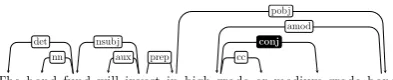
It is well known that conjuncts tend to be seman-tically related and often have a similar syntactic structure. This property of coordination was used as a guiding principle in previous work on coordi-nation disambiguation (Hara et al., 2009; Hogan, 2007; Shimbo and Hara, 2007; Ficler and Gold-berg, 2016). While these focus on symmetry be-tween conjuncts in constituency structures, we use the symmetry assumption for the purpose of im-proving dependency parsing. Here is a simple ex-ample of dependency tree that include conjunc-tion:
The bond fund will invest in high-grade or medium-grade bonds
det nn
nsubj aux prep
amod
cc
conj
pobj
The edge labeled withconjconnects the first con-junct head to the heads of the other concon-juncts. In more complex conjuncts, the subtrees under the nodes connected byconjare often similar such as the following examples:
to a stockfund , anannuityand a money-marketfund
pobj det nn
conj
cc
det
conj
det nn
handledfour World Series teams and nowhandlesthe Gold Coast Suns
dobj cc advmod
conj
num nn
nn
dobj det
nn nn
However, there are also cases where the conjuncts structures are non-similar such as in:
Hani Zayadi was appointedpresidentand chief executiveofficerof ...
nn
nsubjpass
auxpass xcomp cc
conj prep
amod nn
[image:2.595.316.522.63.203.2]Yet, some form of symmetry (or anti-symmetry) usually holds between the conjuncts head words. Table 1 lists the most common coordinated words in the PTB.
(Head,Modifier)
1. ($,$) 13. (chairman,executive)
2. ($,cents) 14. (on,on)
3. (president,officer) 15. (by,by)
4. (%,%) 16. (at,at)
5. (chairman,officer) 17. ($,%) 6. (securities,exchange) 18. (marks,yen) 7. (in,in) 19. (president,executive) 8. (standard,poor) 20. (savings,association) 9. (to,to) 21. (chairman,president) 10. (buy,sell) 22. (inc.,inc.) 11. (for,for) 23. (from,from) 12. (corp.,corp.) 24. (shares,%) Table 1: The most common conj attachments in the Penn TreeBank dependency conversion.
3 Conjunction Features
[image:2.595.81.278.354.394.2]We suggest a set of features that are designed specifically for the conjunction relation, and tar-get the symmetry aspect of the head words. The features look at a pair of head and modifier words, and are based on properties that appear frequently in conjunctions in the Stanford Dependencies ver-sion of the PTB. The features are summarized in Table 2, and are detailed below:
CAP– The case where both conjuncts head words start with a capital letter is much more common (> 3×) than the case where only one of the head words starts with a capital letter. These cases are usually names of people, countries and organi-zations; and common phrases such as “Mac and Cheese”. This property is rare in other labels ex-ceptnn. We capture this property with a boolean feature that indicates whether both conjuncts head words start with a capital letter.
SUF – In some of the conjunctions, the head words have a similar form, as in (codification, clarification), (demographic, geographic), (high-grade, medium-grade), (backwards, forwards). The cases where the longest common suffix be-tween the words is at least 3 is 8% in the case of
conjand much lower for the other labels. We cap-ture this tendency using a numeric feacap-ture that in-dicated the length of the common suffix between the head words.
[image:2.595.79.289.489.612.2]Description Type Examples
CAP Whether both words start with a capital letter boolean (Corp.,Inc.), (Poland,Hungary)
SUF The length of the longer common suffix between the words numeric (men,women), (three-month,six-month )
LEM Whether the words lemmas are identical boolean (say,said), (handled,handles)
SYM The cosine distance between the words embeddings numeric (reported,said), (president,director)
SENT-H Whether the head word sentiment is positive, negative or neutral 1,-1, or 0 (up,down), (confirmed,declined)
SENT-M Whether the modifier word sentiment is positive, negative or neutral 1,-1, or 0
Table 2: Summary of the conjunction-specific features.
the conjuncts head words are identical. Lemmas are obtained using the NLTK (Bird, 2006) inter-face to WordNet (Miller, 1995).
SYM– The conjuncts head words usually have a strong semantic relation. For example (fund, an-nuity), (same, similar), (buy, sell), (dishes, glass).
SYM is a numeric feature that scores the similar-ity between the conjuncts heads words. The score is computed as the cosine-similarity between word embeddings of the head words (these embeddings are initialized with pre-trained vector from Dyer et al. (2015)).
SENT – In some cases, both conjunct’s head words sentiments are not neutral. Here are some examples from the PTB where both words are with positive sentiments: (enjoyable,easy), (comple-mentary,interesting), (calm,rational); where both words are with negative sentiments: (slow,dump), (insulting,demeaning), (injury,death); and where one word is positive and the other is neg-ative: (winners,losers), (crush,recover), (suc-ceeded,failed). Having non-neutral sentiment for both words is not very common for conjrelation (2.3% of the cases), but it much less common for the other relations. Therefore we add features that indicate the sentiment (positive, negative or neu-tral) for each of the coordinated words. We use lists of positive and negative words from work on airline consumer sentiment (Breen, 2012).
4 Incorporating conjunction features
We incorporate the above features in the freely available BIST-parser (Kiperwasser and Gold-berg, 2016). This parser is a greedy transition-based parser, using the archybrid transition system (Kuhlmann et al., 2011). At each step of the pars-ing process, the parser chooses one of2∗|labels|+ 1 possible transitions: SHIFT, RIGHT(rel) and
LEFT(rel). The LEFTand RIGHTtransitions add a
dependency edge with the labelrel. At each step, all transitions are scored, and the highest scoring transition is applied.
The Stanford Dependencies scheme specifies
that theconjrelation appears as a right edge, and so it can only be produced by a RIGHT(conj)
tran-sition. We compute a scoreSconj which is added
to the score of the RIGHT(conj)transition that was produced by the parser. Sconj is computed by an
MLP that receives a feature vector that is a con-catenation of the original parser’s features and the conjunction specific features. The scoring MLP and the parser are trained jointly.
5 Experiments
We evaluate the extended parsing model on the Stanford Dependencies (De Marneffe and Man-ning, 2008) version of the Penn Treebank. We adapt BIST-parser code to run with the DyNet toolkit1 and add our changes. We follow the
setup of Kiperwasser and Goldberg (2016): (1) A word is represented as the concatenation of randomly initialized vector and pre-trained vector (taken from Dyer et al. (2015)); (2) The word and POS embeddings are tuned during training; (3) Punctuation symbols are not considered in the evaluation; (4) The hyper-parameters values are as in Kiperwasser and Goldberg paper (2016), Table 2; (5) We use the same seed and do not perform hyper-parameter tuning. We train the parser with the conjunction features for up to 10 iterations, and choose the best model according to the LAS accu-racy on the development set.
General Parsing Results Table 3 compares our results to the unmodified BIST parser. The ex-tended parser achieves 0.1 points improvement in UAS and 0.2 points in LAS comparing to Kiper-wasser and Goldberg (2016). This is a strong base-line, which so far held the highest results among greedy transition based parsers that were trained on the PTB only, including e.g. the parsers of Weiss et al (2015), Dyer et al (2015) and Balles-teros et al (2016). Stronger absolute parsing num-bers are reported by Andor et al (2016) (using a beam); and Kuncoro et al (2016) and Dozat
and Manning (2016) (using an arc-factored global parsers). All those parsers rely on broadly the same kind of features, and while we did not test this, it is likely the conjunction features would benefit them as well.2
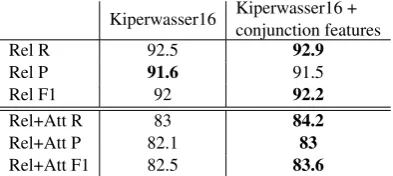
Parsing Results forconjLabel We evaluate our model specifically forconjlabel, and compare to the results achieved by the parser without the con-junction features. We measure Rel (correctly iden-tifying modifiers that participate in a conj rela-tion, regardless of correctly attaching the parent) and Rel+Att (correctly identifying both the head and the modifier in a conj relation). The results are in Table 4. The improvement in Rel score is relatively small while there is an improvement of 1.1 points in Rel+Att F1 score, suggesting that the parser was already effective at identifying the modifiers in a conj relation and that our model’s benefit is mainly on attaching the correct parent node.
Analysis We would like to examine to what extent the improvement we achieve over Kiper-wasser and Goldberg (2016) onconjattachments corresponds to the coordination features we de-signed. To do that, we analyze theconjcases in the dev-set that were correctly predicted by our model and were not predicted by the original BIST-parser and vice versa. The following table shows the per-centage of cases where conjunction features ap-pear in each of these lists:
Features +Our,−K&G −Our,+K&G
LEM+CAP+SUF 7.5 0
LEM+SUF 3 0
SENTIMENT+SUF 1.5 0
LEM/CAP/SENTIMENT/SUF 29.9 24
Total 41.9 24
The percentage of cases that include conjunction features is much higher in the list of cases that were correctly predicted only by our model. More than that, there are no cases that include more than one conjunction feature in the list of cases that were correctly predicted only by BIST-parser (Kiperwasser and Goldberg, 2016).
2A reviewer of this work suggested that our baseline
model is oblivious to the word’s morphology, and that a neu-ral parsing architecture that explicitly models the words’ mor-phology through character-based LSTMs, such as the model of (Ballesteros et al., 2015), could capture some of the in-formation in our features automatically, and thus would be a better baseline. While we were skeptical, we tried this sug-gestion, and found that it indeed does not change the results in a meaningful way.
System UAS LAS
Kiperwasser16 93.9 91.9
[image:4.595.310.507.145.233.2]Kiperwasser16 + conjunction features 94 92.1 Table 3: Parsing scores on the PTB test-set (Stan-ford Dependencies).
Kiperwasser16 Kiperwasser16 +conjunction features
Rel R 92.5 92.9
Rel P 91.6 91.5
Rel F1 92 92.2
Rel+Att R 83 84.2
Rel+Att P 82.1 83
[image:4.595.75.296.501.569.2]Rel+Att F1 82.5 83.6
Table 4: Test-set results forconjlabel only.
The above table does not include theSYM fea-ture since unlike the other feafea-tures there is no ab-solute way to determine whether the feature takes place on a specific example. To give a sense of the contribution of theSYMfeature, we show some ex-amples where our model attaches aconjlabel be-tween similar words, while the unmodified BIST parser attaches conj parent which is clearly less similar to the modifier (The word in bold is the attached modifier; the word marked with continu-ous line is the node’s parent in our prediction; the word marked with dashed line is the node’s parent in BIST’s prediction):
• Koop, who rattled liberals andconservatives alike with his outspoken views on ...
• ... dropped in response to gains in the stock market andlossesin Treasury securities.
• Died: Cornel Wilde, 74 ,actor anddirector ,in Los Angeles ,of leukemia ...
• ... investment firms advising clients to boost their stock holdings andreducethe ,,.
In the cases that were correctly predicted by BIST-parser only, we could not find examples where the words in the correct attachment are clearly more similar than the attachment predicted by our model. We could find a few examples where both models attached words that are simi-lar, such as:
• ML & Co.’s net income dropped 37%, while BS Cos. posted a 7.5% gain in net, and PG Inc.’s profit fell, but would haverisen...
6 Conclusions
While most recent work in parsing attempt to im-prove results using ”general” architectures and feature sets, targeted feature engineering is still beneficial. We demonstrate that a linguistically motivated and data-driven feature-set for a specific syntactic relation (coordinating conjunction) im-proves a strong baseline parser.
The features we propose explicitly model the symmetry between the head words in coordina-tion construccoordina-tions. While we demonstrated their effectiveness in a greedy transition-based parser, the information our features capture is not cur-rently captured also by other dependency pars-ing architectures (includpars-ing first-order graph based parsers, higher-order graph-based parsers, beam-based transition parsers). These features will be straightforward to integrate into such parsers, and we expect them to be effective for them as well.
Acknowledgments
This work was supported by The Israeli Sci-ence Foundation (grant number 1555/15) as well as the German Research Foundation via the German-Israeli Project Cooperation (DIP, grant DA 1600/1-1).
References
Daniel Andor, Chris Alberti, David Weiss, Aliaksei Severyn, Alessandro Presta, Kuzman Ganchev, Slav Petrov, and Michael Collins. 2016. Globally nor-malized transition-based neural networks. InProc. of ACL.
Miguel Ballesteros, Chris Dyer, and Noah A. Smith. 2015. Improved transition-based parsing by mod-eling characters instead of words with LSTMs. In Proceedings of the 2015 Conference on Empirical Methods in Natural Language Processing, pages 349–359, Lisbon, Portugal, September. Association for Computational Linguistics.
Miguel Ballesteros, Yoav Goldberg, Chris Dyer, and Noah A Smith. 2016. Training with exploration im-proves a greedy stack-LSTM parser. Inproceedings of Short Papers EMNLP.
Steven Bird. 2006. NLTK: the natural language toolkit. InProceedings of the COLING/ACL on In-teractive presentation sessions, pages 69–72. Asso-ciation for Computational Linguistics.
Jeffrey Oliver Breen. 2012. Mining twitter for airline consumer sentiment. Practical text mining and sta-tistical analysis for non-structured text data appli-cations, 133.
Eugene Charniak and Mark Johnson. 2005. Coarse-to-fine n-best parsing and maxent discriminative reranking. InProc. of ACL, pages 173–180, Ann Ar-bor, Michigan, June. Association for Computational Linguistics.
Marie-Catherine De Marneffe and Christopher D. Manning. 2008. Stanford typed dependencies man-ual. Technical report, Technical report, Stanford University.
Timothy Dozat and Christopher D. Manning. 2016. Deep biaffine attention for neural dependency pars-ing. InarXiv preprint arXiv:1611.01734.
Chris Dyer, Miguel Ballesteros, Wang Ling, Austin Matthews, and Noah A. Smith. 2015. Transition-based dependency parsing with stack long short-term memory. In Proceedings of the 53rd Annual Meeting of the Association for Computational Lin-guistics and the 7th International Joint Conference on Natural Language Processing (Volume 1: Long Papers), pages 334–343, Beijing, China, July. Asso-ciation for Computational Linguistics.
Jessica Ficler and Yoav Goldberg. 2016. A neural net-work for coordination boundary prediction. In Pro-ceedings of the 2016 Conference on Empirical Meth-ods in Natural Language Processing, pages 23–32, Austin, Texas, November. Association for Computa-tional Linguistics.
Kazuo Hara, Masashi Shimbo, Hideharu Okuma, and Yuji Matsumoto. 2009. Coordinate structure analy-sis with global structural constraints and alignment-based local features. In Proceedings of the Joint Conference of the 47th Annual Meeting of the ACL and the 4th International Joint Conference on Natu-ral Language Processing of the AFNLP, pages 967– 975, Suntec, Singapore, August. Association for Computational Linguistics.
Deirdre Hogan. 2007. Coordinate noun phrase disam-biguation in a generative parsing model. In Proceed-ings of Association for Computational Linguistics, pages 680–687.
Mark Johnson, Stuart Geman, Stephen Canon, Zhiyi Chi, and Stefan Riezler. 1999. Estimators for stochastic ”unification-based” grammars. In Proc. of ACL, pages 535–541, College Park, Maryland, USA, June. Association for Computational Linguis-tics.
Eliyahu Kiperwasser and Yoav Goldberg. 2016. Sim-ple and accurate dependency parsing using bidirec-tional LSTM feature representations. Transactions of the Association for Computational Linguistics, 4:313–327.
Adhiguna Kuncoro, Miguel Ballesteros, Lingpeng Kong, Chris Dyer, and Noah A. Smith. 2016. Dis-tilling an ensemble of greedy dependency parsers into one MST parser. In Proc. of EMNLP, pages 1744–1753, Austin, Texas, November. Association for Computational Linguistics.
Mitchell P. Marcus, Mary Ann Marcinkiewicz, and Beatrice Santorini. 1993. Building a large anno-tated corpus of english: The Penn Treebank. Com-putational linguistics, 19(2):313–330.
George A. Miller. 1995. WordNet: a lexical database for english. Communications of the ACM, 38(11):39–41.
Masashi Shimbo and Kazuo Hara. 2007. A discrimi-native learning model for coordinate conjunctions. In Proceedings of the 2007 Joint Conference on Empirical Methods in Natural Language Process-ing and Computational Natural Language LearnProcess-ing (EMNLP-CoNLL), pages 610–619, Prague, Czech Republic, June. Association for Computational Lin-guistics.