Using Discourse Information for Paraphrase Extraction
Michaela Regneri
Dept. of Computational Linguistics Saarland University
Saarbrücken, Germany
Rui Wang
Language Technology Lab DFKI GmbH Saarbrücken, Germany [email protected]
Abstract
Previous work on paraphrase extraction us-ing parallel or comparable corpora has gener-ally not considered the documents’ discourse structure as a useful information source. We propose a novel method for collecting para-phrases relying on the sequential event or-der in the discourse, using multiple sequence alignment with a semantic similarity measure. We show that adding discourse information boosts the performance of sentence-level para-phrase acquisition, which consequently gives a tremendous advantage for extracting phrase-level paraphrase fragments from matched sen-tences. Our system beats an informed baseline by a margin of 50%.
1 Introduction
It is widely agreed that identifying paraphrases is a core task for natural language processing, including applications like document summarization (Barzilay et al., 1999), Recognizing Textual Entailment (Da-gan et al., 2005), natural language generation (Zhao et al., 2010; Ganitkevitch et al., 2011), and machine translation (Marton et al., 2009). As a consequence, many methods have been proposed for generating large paraphrase resources (Lin and Pantel, 2001; Szpektor et al., 2004; Dolan et al., 2004). One of the intuitively appropriate data sources for such col-lections are parallel or comparable corpora: if two texts are translations of the same foreign document, or if they describe the same underlying scenario, they should contain a reasonable number of sentence pairs that convey the same meaning.
Most approaches that extract paraphrases from parallel texts employ some type of pattern
match-ing: sentences with the same meaning are assumed to share many n-grams (Barzilay and Lee, 2003; Callison-Burch, 2008, among others), many words in their context (Barzilay and McKeown, 2001) or certain slots in a dependency path (Lin and Pantel, 2001; Szpektor et al., 2004). Discourse structure has only marginally been considered for this task: For example, Dolan et al. (2004) extract the first sentences from comparable articles and take them as paraphrases. Another approach (Deléger and Zweigenbaum, 2009) matches similar paragraphs in comparable texts, creating smaller comparable doc-uments for paraphrase extraction.
We believe that discourse structure delivers im-portant information for the extraction of para-phrases. Sentences that play the same role in a cer-tain discourse and have a similar discourse context can be paraphrases, even if a semantic similarity model does not consider them very similar. This ex-tends the widely applied distributional hypothesis to the discourse level: According to the distributional hypothesis, entities are similar if they share similar contexts. In our case, entities are whole sentences, and contexts are discourse units.
Based on this assumption, we propose a novel method for collecting paraphrases from parallel texts using discourse information. We create a new type of parallel corpus by collecting multiple summaries for several TV show episodes. The discourse struc-tures of those summaries are easy to compare: they all contain the events in the same order as they have appeared on the screen. This allows us to take sentence order as event-based discourse struc-ture, which is highly parallel for recaps of the same episode.
In its first step, our system uses a sequence
ment algorithm combined with a state-of-the-art similarity measure. The approach outperforms in-formed baselines on the task of sentential paraphrase identification. The usage of discourse information even contributes more to the final performance than the sentence similarity measure.
As second step, we extract phrase-level para-phrase fragments from the matched sentences. This step relies on the alignment algorithm’s output, and we show that discourse information makes a big dif-ference for the precision of the extraction. We then add more discourse-based information by prepro-cessing the text with a coreference resolution sys-tem, which results in additional performance im-provement.
The paper is structured as follows: first we sum-marize related work (Sec. 2), and then we give an overview over our perspective on the task and sketch our system pipeline (Sec. 3). The following two sec-tions describe the details of the sentence matching step (Sec. 4) and the subsequent paraphrase frag-ment extraction (Sec. 5). We present both automatic and manual evaluation of the two system compo-nents (Sec. 6). Finally, we conclude the paper and give some hints for future work (Sec. 7).
2 Related Work
Previous paraphrase extraction approaches can be roughly characterized under two aspects: 1) data source and 2) granularity of the output.
Both parallel corpora and comparable corpora have been quite well studied. Barzilay and McK-eown (2001) use different English translations of the same novels (i.e., monolingual parallel corpora), while others (Quirk et al., 2004) experiment on mul-tiple sources of the same news/events, i.e., mono-lingual comparable corpora. Commonly used (can-didate) comparable corpora are news articles writ-ten by different news agencies within a limited time window (Wang and Callison-Burch, 2011). Other studies focus on extracting paraphrases from large bilingual parallel corpora, which the machine trans-lation (MT) community provides in many varieties. Bannard and Callison-Burch (2005) as well as Zhao et al. (2008) take one language as the pivot and match two possible translations in the other lan-guages as paraphrases if they share a common pivot
phrase. As parallel corpora have many alternative ways of expressing the same foreign language con-cept, large quantities of paraphrase pairs can be ex-tracted.
The paraphrasing task is also strongly related to cross-document event coreference resolution, which is tackled by similar techniques used by the available paraphrasing systems (Bagga and Baldwin, 1999; Tomadaki and Salway, 2005).
Most work in paraphrase acquisition has dealt with sentence-level paraphrases, e.g., (Barzilay and McKeown, 2001; Barzilay and Lee, 2003; Dolan et al., 2004; Quirk et al., 2004). Our approach for sen-tential paraphrase extraction is related to the one in-troduced by Barzilay and Lee (2003), who also em-ploy multiple sequence alignment (MSA). However, they use MSA at the sentence level rather than at the discourse level.
We take some core ideas from our previous work on mining script information (Regneri et al., 2010). In this earlier work, we focused on event structures and their possible realizations in natural language. The corpus used in those experiments were short crowd-sourced descriptions of everyday tasks writ-ten in bullet point style. We aligned them with a hand-crafted similarity measure that was specifically designed for this text type. In this current work, we target the general task of extracting paraphrases for events rather than the much more specific script-related task. The current approach uses a domain-independent similarity measure instead of a specific hand-crafted similarity score and is thus applicable to standard texts.
From an applicational point of view, senten-tial paraphrases are difficult to use in other NLP tasks. At the phrasal level, interchangeable patterns (Shinyama et al., 2002; Shinyama and Sekine, 2003) or inference rules (Lin and Pantel, 2001) are ex-tracted. In both cases, each pattern or rule contains one or several slots, which are restricted to certain type of words, e.g., named entities (NE) or content words. They are quite successful in NE-centered tasks, like information extraction, but their level of generalization or coverage is insufficient for appli-cations like Recognizing Textual Entailment (Dinu and Wang, 2009).
on phrase pair extraction techniques from the MT literature. Munteanu and Marcu (2006) extract sub-sentential translation pairs from comparable corpora using the log-likelihood-ratio of word translation probability. Quirk et al. (2007) extract fragments using a generative model of noisy translations. Our own work (Wang and Callison-Burch, 2011) extends the first idea to paraphrase fragment extraction on monolingual parallel and comparable corpora. Our current approach also uses word-word alignment, however, we use syntactic dependency trees to com-putegrammaticalfragments. Our use of dependency trees is inspired by the constituent-tree-based exper-iments of Callison-Burch (2008).
3 Paraphrases and Discourse
Previous approaches have shown that comparable texts provide a good basis for paraphrase extrac-tion. We want to show that discourse structure is highly useful for precise and high-yield paraphrase collection from such corpora. Consider the follow-ing (made-up) example:
(1) [House keeps focusing on his aching leg.1.1.] [The psychiatrist suggests him to get a hobby
1.2.] [House joins a cooking class.1.3]
(2) [He tells him that the Ibuprofen is not helping with the pain.2.1.] [Nolan tells House to take up a hobby.2.2] [Together with Wilson he goes to a cookery course.2.3]
Read as a whole, it is clear that the two texts de-scribe the same three events, in the same order, and thus, e.g., 1.2 and 2.2 are paraphrases. However, they share very few n-grams, nor named entities. We determine three factors that can help to identify such paraphrases:
1. Consider the sequence of events. A system which recognizes that the three sentence pairs occur in the same sequential event order would have a chance of actually matching the sen-tences.
2. Do coreference resolution. To determine which sentence parts actually carry the same meaning, pronoun resolution is essential (e.g., to match “suggest him” and “tells House”).
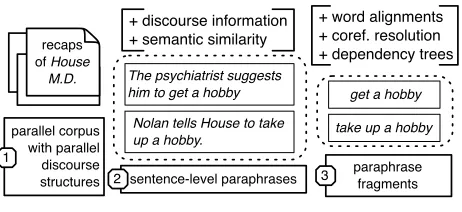
recaps of House
M.D.
parallel corpus with parallel discourse structures
The psychiatrist suggests him to get a hobby
Nolan tells House to take up a hobby.
sentence-level paraphrases + discourse information + semantic similarity
+ word alignments + coref. resolution + dependency trees
get a hobby take up a hobby
paraphrase fragments 1
[image:3.612.317.548.57.163.2]2 3
Figure 1: System pipeline
3. Try a genericsentence similarity model. Pat-tern matching or n-gram overlap might not be sufficient to solve this problem.
Our system pipeline is sketched in Fig. 1:
1. Create a corpus: First, we create a compara-ble corpus of texts withhighly comparable dis-course structures. Complete discourse struc-tures like in the RST Discourse Treebank (Carl-son et al., 2002) may be very useful for para-phrase computation, however, they are hard to obtain. Discourse annotation is difficult and work-intensive, and full-blown automatic dis-course parsers are neither robust nor very pre-cise. To circumvent this problem, we assemble documents that have parallel discourse struc-tures by default: We compile multiple plot summaries of TV show episodes. The textual order of those summaries typically mirrors the underlying event order of the episodes, in the same sequence they happened on screen. We take sentence sequences of recaps as parallel discourse structures.
2. Extract sentence-level paraphrases:Our sys-tem finds sentence pairs that are either phrases themselves, or at least contain para-phrase fragments. This procedure crucially re-lies on discourse knowledge: A Multiple Se-quence Alignment (MSA) algorithm matches sentences if both their inherent semantic sim-ilaritiesand the overall similarity score of their
discourse contextsare high enough.
row recap 1 recap 2 recap 3 recap 4 recap 5
34 She gives Fore-man one shot.
Cuddy tells Fore-man he has one chance to prove to her he can run the team.
Cuddy agrees
to give him one chance to prove himself.
Foreman insists he de-serves a chance and Cuddy gives in, warn-ing him he gets one shot.
35
Foreman, Hadley, and Taub get the conference room ready and Foreman explains that he’ll be in charge.
Foreman gives the news to Thirteen and Taub and they unpack the conference room and go with a diagnosis of CRPS.
36
They decide that it might be CRPS and Foreman or-ders a spinal stim-ulation.
Foreman says to treat him for com-plex regional pain syndrome with a spinal stimulation.
[image:4.612.74.544.60.285.2]
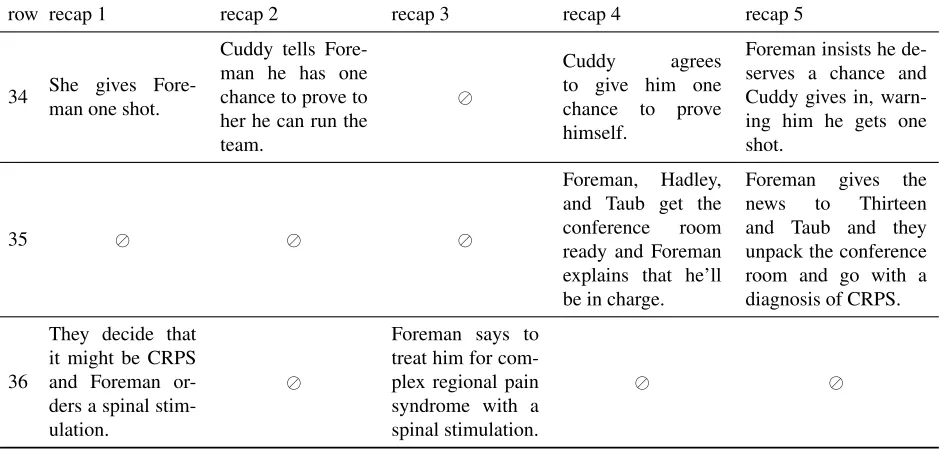
Figure 2: Excerpt from an alignment table for 5 exemplary recaps of Episode 2 (Season 6).
contain specific NEs (e.g. “House”) or time ref-erences. Thus we take a necessary second step and extract finer-grained paraphrasefragments
from the sentence pairs matched in step 2. The resulting matched phrases should be grammat-ical and interchangeable regardless of context. We propose and compare different fragment ex-traction algorithms.
The remainder of the paper shows how both of the paraphrasing steps benefit from using a corpus with highly parallel discourse structures: The sys-tem components employ discourse information ei-ther directly by using MSA (step 1) or coreference resolution (step 2), or indirectly, because using MSA in step 1 results in a high precision gain for the sub-sequent second step.
4 Sentence Matching with MSA
This section explains how we apply MSA to ex-tract sentence-level paraphrases from a comparable corpus. As our input data, we manually collect re-caps forHouse M.D.episodes from different sources on the web1. House episodes have an intermediate
length (∼45 min), which results in recaps of a
con-1
e.g.http://house.wikia.com– for a detailed list of URLs, please check the supplementary material or contact the authors.
venient size (40 to 150 sentences). The result is one comparable document collection per episode. We applied a sentence splitter (Gillick, 2009) to the doc-uments and treat them as sequences of sentences for further processing.
Sequence alignment takes as its input two se-quences consisting of elements of some alphabet, and an alphabet-specific score function cm over
pairs of sequence elements. For insertions and dele-tions, the algorithm additionally takes gap costs (cgap). Multiple Sequence Alignment generalizes
pairwise alignment to arbitrarily many sequences. MSA has its main application area in bioinformat-ics, where it is used to identify equivalent parts of DNA (Durbin et al., 1998). Our alphabet consists of sentences, and a sequence is an ordered sentence list constituting a recap.
score is the sum of all scores for each pair of cells
(c1, c2), ifc1andc2are in the same row. If eitherc1 orc2 is a gap, the pair’s score iscgap. If both cells
contain sentences, the score iscm(c1, c2).
Fern and Stevenson (2009) showed that sophis-ticated similarity measures improve paraphrasing, so we apply a state-of-the-art vector space model (Thater et al., 2011) as our score function. The vec-tor space model provides contextualized similarities of words, i.e. the vector of each word is disam-biguated by the context the current instance occurs in. cm(c1, c2) returns the model’s similarity score forc1andc2.
We re-implement a standard MSA algorithm (Needleman and Wunsch, 1970) which approxi-mates the best MSA given the input sequences,cm
andcgap. This algorithm recursively aligns two
se-quences at a time, treating the resulting alignment as a new sequence. This does not necessarily result in the globally optimal alignment, because the order in which sequences are aligned can change the final output. Given this constraint, the algorithm finds the best alignment, which - in our case - is the alignment with the maximal score. Intuitively, we are looking for the alignment where the most similar sentences with the most similar preceding and trailing contexts end up as paraphrases.
5 Paraphrase Fragment Extraction
Taking the output of the sentence alignment as in-put, we next extract shorter phrase-level paraphrases (paraphrase fragments) from the matched sentence pairs. We try different algorithms for this step, all relying on word-word alignments.
5.1 Preprocessing
Before extracting paraphrase fragments, we first pre-process all documents as follows:
Stanford CoreNLP 2provides a set of natural lan-guage analysis tools. We use the part-of-speech (POS) tagger, the named-entity recog-nizer, the parser (Klein and Manning, 2003), and the coreference resolution system (Lee et al., 2011). In particular, the dependency struc-tures of the parser’s output are used for
VP-2http://nlp.stanford.edu/software/
corenlp.shtml
fragment extraction (Sec. 5.3). The output from the coreference resolution system is used to cluster all mentions referring to the same en-tity and to select one as therepresentative men-tion. If the representative mention is not a pro-noun, we modify the original texts by replac-ing all pronoun mentions in the cluster with the syntactic head of the representative mention. Note that the coreference resolution system is applied to each recap as a whole.
GIZA++ (Och and Ney, 2003) is a widely used word aligner for MT systems. We amend the input data by copying identical word pairs 10 times and adding them as additional ‘sentence’ pairs (Byrne et al., 2003), in order to emphasize the higher alignment probability between iden-tical words. We run GIZA++ for bi-directional word alignment and obtain a lexical translation table.
5.2 Fragment Extraction
As mentioned in Sec. 2, we choose to use alignment-based approaches to this task, which allows us to use many existing MT techniques and tools. We mainly follow our previous approach (Wang and Callison-Burch, 2011), which is a modified version of an ap-proach by Munteanu and Marcu (2006) on trans-lation fragment extraction. We briefly review the three-step procedure here and refer the reader to the original paper for more details:
1. Establish word-word alignment between each sentence pair using GIZA++;
2. Smooth the alignment based on lexical occur-rence likelihood;
3. Extract fragment pairs using different heuris-tics, e.g., non-overlapping n-grams, chunk boundaries, or dependency trees.
words instead of letters as input. Smoothing (step 2) is done for each word by taking the average score of it and its four neighbor words. All the word align-ments (excluding stop-words) with positive scores are selected as candidate fragment elements.
Provided with the candidate fragment elements, we previously (Wang and Callison-Burch, 2011) used a chunker3 to finalize the output fragments, in order to follow the linguistic definition of a(para-) phrase. We extend this step in the current system by applying a dependency parser to constrain the boundary of the fragments (Sec. 5.3). Finally, we filter out trivial fragment pairs, such as identical or the original sentence pairs.
5.3 VP-fragment Extraction
To obtain more grammatical output fragments, we add another layer of linguistic information to our input sentences. Based on the dependency parses produced during preprocessing, we extract phrases containing verbs and their complements. More pre-cisely, we match two phrases if their respective sub-treest1andt2satisfy the following conditions:
• The subtrees mirror a complete subset of the GIZA++ word alignment, i.e., all words aligned to a given word int1 are contained in
t2, and vice versa. For empty alignments, we require an overlap of at least one lemma (ig-noring stop words).
• The root nodes of t1 and t2 have the same roles within their trees, e.g., we match clauses with anxcomp-label only with other xcomp -labelled clauses.
• Botht1 andt2 contain at least one verb with at least one complement. To enhance recall, we additionally extract complete prepositional phrases.
• We exclude trivial fragment pairs that are pre-fixes or sufpre-fixes of each other (or identical).
The main advantage of this approach lies in the out-put’s grammaticality, because the subtrees always match complete phrases. This method also functions as a filtering mechanism for mistakenly aligned sen-tences: If only the two sentence nodes are returned
3We use the same OpenNLP chunker (http:
//opennlp.sourceforge.net/) for consistency.
as possible matching partners, the pair is discarded from the results.
6 Evaluation
We evaluate both sentential paraphrase matching and paraphrase fragment extraction using manually labelled gold standards (provided in the supplemen-tary material). We collect recaps for all 20 episodes of season 6 ofHouse M.D., taking 8 summaries per episode (the supplementary material contains a list of all URLs). This results in 160 documents con-taining 14735 sentences. For evaluation, we use all episodes except no. 2, which is held out for parame-ter optimizations and other development purposes.
6.1 Sentential Paraphrase Evaluation
To evaluate sentence matching, we adapt the base-lines from our earlier work (Regneri et al., 2010) and create a new gold standard. We compute precision, recall and accuracy of our main system and suggest baselines that separately show the influence of both the MSA and the semantic scoring function.
Gold-Standard
We aim to create an evaluation set that contains a sufficient amount of genuine paraphrases. Find-ing such sentence pairs with random samplFind-ing and manual annotation is infeasible: There are more than
200,000,000 possible sentence pairs, and we ex-pect less than 1% of them to be paraphrases. We thus sample pairs that either the system or the base-lines recognized as paraphrases and try to create an evaluation set that is not biased towards the actual system or any of the baselines. The evaluation set consists of 2000 sentence pairs: 400 that the system recognized as paraphrases, 400 positively labelled pairs for each of the three baselines (described in the following section) and 400 randomly selected pairs. For the final evaluation, we compute precision, re-call, f-score and accuracy for our main system and each baseline on this set.
Two annotators labelled each sentence pair
(S1, S2)with one of the following labels:
1. paraphrases: S1 and S2 refer to exactly the same event(s).
one additional event, or vice versa.
3. related:S1andS2overlap in at least one event reference, but both refer to at least one addi-tional event.
4. unrelated:S1andS2do not overlap at all.
This scheme has a double purpose: The main objec-tive is judging whether two sentences contain para-phrases (1-3) or if they are unrelated (4). We use this coarser distinction for system evaluation by col-lapsing the categories 1-3 in oneparaphrasecoll
cat-egory. Secondly, the annotation shows how well the sentences fit each other’s content (1 vs. 2&3), and how much work needs to be done to extract the sen-tence parts with the same meaning (2 vs. 3).
The inter-annotator agreement according to Co-hen’s Kappa (Cohen, 1960) is κ = 0.55 (“mod-erate agreement”). The distinction between unre-lated cases and elements ofparaphrasecoll reaches
κ = 0.71 (“substantial agreement”). For the final gold standard, a third annotator resolved all conflict cases.
Among all gold standard sentence pairs, we find 158 paraphrases, 238 containment cases, 194 re-latedones and 1402unrelated. We had to discard 8 sentence pairs because one of the items was invalid or empty. The high proportion of ’unrelated’ cases results from the 400 random pairs and the low pre-cision of the baselines. Looking at the paraphrases,
27%of the 590 instances in theparaphrasecoll cate-gory are proper paraphrases, and73%of them con-tain additional information that does not belong to the paraphrased part.
Experimental Setup
We compute precision, recall and f-score with re-spect to the gold standard (paraphrases are members ofparaphrasecoll), taking f-score as follows:
f-score= 2∗precision∗recall precision+recall
We also compute accuracy as the overall fraction of correct labels (negative and positive ones).
Our main system uses MSA (denoted byMSA
af-terwards) with vector-based similarities (VEC) as a
scoring function. The gap costs are optimized for f-score, resulting incgap= 0.4
To show the contribution of MSA’s structural component and compare it to the vector model’s contribution, we create a second MSA-based sys-tem that uses MSA with BLEU scores (Papineni et al., 2002) as scoring function (MSA+BLEU). BLEU establishes the average 1-to-4-gram overlap of two sentences. The gap costs for this baseline were opti-mized separately, ending up withcgap= 1.
In order to quantify the contribution of the align-ment, we create a discourse-unaware baseline by dropping the MSA and using a state-of-the-art clus-tering algorithm (Noack, 2007) fed with the vec-tor space model scores (CLUSTER+VEC). The algo-rithm partitions the set of sentences into paraphrase clusters such that the most similar sentences end up in one cluster. This does not require any parameter tuning.
We also show a baseline that uses the cluster-ing algorithm with BLEU scores (CLUSTER+BLEU).
The comparison of this baseline with the other clustering-baseline that uses vector similarities helps to underline the sentence similarities’ advantage compared to pure word overlap. Note that theCLUS
-TER+BLEUsystem resembles popular n-gram over-lap measures for paraphrase classification.
We also show the results completely random label assignment, which constitutes a lower bound for the baselines and the system.
Results
Overall, our system extracts 20379 paraphrase pairs. Tab. 1 shows the evaluation results on our gold-standard.
The MSA based system variants outperform the two clustering baselines significantly (all levels refer top = 0.01 and were tested with a resampling test (Edgington, 1986)).
The clustering baselines perform significantly better than a random baseline, especially consider-ing recall. The more elaborated vector-space mea-sure even gives 10% more in precision and accu-racy, and overall14% more in f-score. This is
al-4Gap costs directly influence precision and recall: “cheap”
System Prec. Recall F-score Acc.
RANDOM 0.30 0.49 0.37 0.51
CLUSTER+BLEU 0.35 0.63 0.45 0.54 CLUSTER+VEC 0.40 0.68 0.51 0.61
MSA+BLEU 0.73 0.74 0.73 0.84
MSA+VEC 0.79 0.66 0.72 0.85
Table 1: Results for sentence matching.
ready a remarkable improvement compared to the random baseline, and still a significant one com-pared toCLUSTER+BLEU.
Adding structural knowledge with MSA im-proves the clustering’s accuracy performance by
24% (CLUSTER+VEC vs. MSA+VEC), precision
even goes up by39%.
Intuitively we expected the MSA-based systems to end up with a higher recall than the clustering baselines, because sentences can be matched even if their similarity is moderate or low, but their dis-course context is highly similar. However, this is only the case for the system using BLEU scores, but not for the system based on the vector space model. One possible explanation lies in picking f-score as objective for the optimization of the gap costs for MSA: For the naturally more restrictive word over-lap measure, this leads to a more recall-oriented system with a low threshold for aligning sentences, whereas the gap costs for the vector-based system favors a more restrictive alignment with more pre-cise results.
The comparison of the two MSA-based sys-tems highlights the great benefit of using structural knowledge: Both MSA+BLEU andMSA+VEC have
comparable f-scores and accuracy. The advantage from using the vector-space model that is still obvi-ous for the clustering baselines is nearly evened out when adding discourse knowledge as a backbone. However, the vector model still results in nominally higher precision and accuracy.
It is hard to do a direct comparison with state-of-the-art paraphrase recognition systems, because most are evaluated on different corpora, e.g., the Microsoft paraphrase corpus (Dolan and Brockett, 2005, MSR). We cannot apply our system to the MSR corpus, because we take complete texts as
in-put, while the MSR corpus solely delivers sentence pairs. While the MSR corpus is larger than our collection, the wording variations in its paraphrase pairs are usually lower than for our examples. Thus the final numbers of previous approaches might be vaguely comparable with our results: Das and Smith (2009) present two systems reaching f-scores of 0.82 and 0.83, with a precision of 0.75 and 0.80. Both precision and f-scores of our msa-based systems lie within the same range. Heilman and Smith (2010) introduce a recall-oriented system, which reaches an f-score of 0.81 by a precision of 0.76. Compared to this system, our approach results in better precision values.
All further computations bases on the system us-ing MSA and the vector space model (MSA+VEC), because it achieves the highest precision and accu-racy values.
6.2 Paraphrase Fragment Evaluation
We also manually evaluate precision on paraphrase fragments, and additionally describe the productiv-ityof the different setups, providing some intuition about the methods’ recall.
Gold-Standard
We randomly collect 150 fragment pairs for each of the five system configurations (explained in the following section). Each fragment pair (f1, f2) is annotated with one of the following categories:
1. paraphrases: f1 and f2 convey the same meaning, i.e., they are well-formed and good matches on the content level.
2. related:f1andf2overlap in their meaning, but one or both phrases have additional unmatched information.
3. irrelevant:f1 andf2are unrelated.
This labeling scheme again assesses precision as well as paraphrase granularity. For precision rating, we collapse categories 1&2 into oneparaphrasecoll
distinction between the paraphrasecoll categories andirrelevantinstances reaches a level ofκ= 0.88
(also “substantial agreement”). All conflicts were again adjudicated by a third annotator. Overall, the gold standard contains 190 paraphrases, 258related
pairs and 302 irrelevant instances. Unlike previ-ous approaches to fragment extraction, we do not evaluategrammaticality, given that the VP-fragment method implicitly constrains the output fragments to be complete phrases.
Configurations & Results
We take the output of the sentence matching sys-temMSA+VECas input for paraphrase fragment
ex-traction. As detailed in Sec. 5, our core fragment module uses the word-word alignments provided by GIZA++ and uses a chunker for fragment extrac-tion. We successively enrich this core module with more information, either by longest common sub-string (LCS) matching or by operating on
depen-dency trees (VP). In addition, we evaluate the in-fluence of coreference resolution by preprocessing the input to the best performing configuration with pronoun resolution (COREF).
We mainly compute precision for this task, as the recall of paraphrase fragments is difficult to define. However, we do include a measure we call produc-tivityto indicate the algorithm’s completeness. It is defined as the ratio between the number of result-ing fragment pairs and the number of sentence pairs used as input.
Extraction Method Precision Productivity
MSA 0.57 0.76
MSA+LCS 0.45 0.30
MSA+VP 0.81 0.42
[image:9.612.77.292.489.579.2]MSA+VP+COREF 0.84 0.45
Table 2: Results of paraphrase fragment extraction.
Tab. 2 shows the evaluation results. We reach our best precision by using the VP-fragment heuris-tics, which is still more productive than the LCS method. The grammatical filter gives us a higher precision compared to the purely alignment-based approaches. Enhancing the system with corefer-ence resolution raises the score even further. We
cannot directly compare this performance to other systems, as all other approaches have different data sources. However, precision is usually manually evaluated, so the figures are at least indicative for a comparison with previous work: One state-of-the-art system introduced by Zhao et al. (2008) extracts paraphrase fragments from bilingual parallel cor-pora and reaches a precision of 0.67. We found the same number using our previous approach (Wang and Callison-Burch, 2011), which is roughly equiv-alent to our core module. Our approach outperforms both by 17% with similar estimated productivity.
As a final comparison, we show how the perfor-mance of the sentence matching methods directly af-fects the fragment extraction. We use the VP-based fragment extraction system (VP), and compare the
performances by using either the outputs from our main system (MSA+VP) or alternatively the base-line that replaces MSA with a clustering algorithm (CLUSTER+VP). Both variants use the vector-based semantic similarity measure.
Sentence matching Precision Productivity
CLUSTER+VP 0.31 0.04
MSA+VP 0.81 0.42
Table 3: Impact of MSA on fragment extraction
As shown in Tab. 3, the precision gain from using MSA becomes tremendous during further process-ing: We beat the baseline by 50% here, and produc-tivity increases by a factor of 10. This means that the baseline produces on average 0.01 good fragment pairs per matched sentence pair, and the final sys-tem extracts 0.3 of them. Those numbers show that for any application that acquires paraphrases of arbi-trary granularity, sequential event information pro-vides an invaluable source to achieve a lean para-phrasing method with high precision.
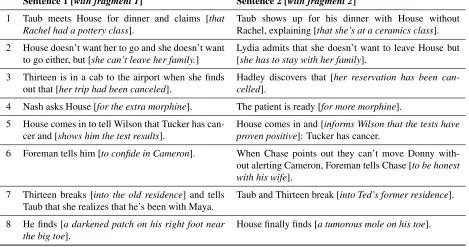
6.3 Example output
Fig. 3 shows exemplary results from our system pipeline, using the VP–FRAGMENTS method with
de-Sentence 1 [with fragment 1] Sentence 2 [with fragment 2]
1 Taub meets House for dinner and claims [that Rachel had a pottery class].
Taub shows up for his dinner with House without Rachel, explaining [that she’s at a ceramics class].
2 House doesn’t want her to go and she doesn’t want to go either, but [she can’t leave her family.]
Lydia admits that she doesn’t want to leave House but [she has to stay with her family].
3 Thirteen is in a cab to the airport when she finds out that [her trip had been canceled].
Hadley discovers that [her reservation has been can-celled].
4 Nash asks House [for the extra morphine]. The patient is ready [for more morphine].
5 House comes in to tell Wilson that Tucker has can-cer and [shows him the test results].
House comes in and [informs Wilson that the tests have proven positive]: Tucker has cancer.
6 Foreman tells him [to confide in Cameron]. When Chase points out they can’t move Donny with-out alerting Cameron, Foreman tells Chase [to be honest with his wife].
7 Thirteen breaks [into the old residence] and tells Taub that she realizes that he’s been with Maya.
Taub and Thirteen break [into Ted’s former residence].
8 He finds [a darkened patch on his right foot near the big toe].
[image:10.612.72.541.66.316.2]House finally finds [a tumorous mole on his toe].
Figure 3: Example results; fragments extracted from aligned sentences are bracketed andemphasized.
pendency patterns (e.g., Example 4) or sharing many n-grams (6-8). Additionally, the coreference resolu-tion allows us to matchRachel(1) andWilson(5) to the correct corresponding pronouns. All examples show that this technique of matching sentence could even help to make coreference resolution better, be-cause we can easily identifyCameronwithhis wife,
Lydiawith the respective pronouns, Nashwith The Patient or the nickname Thirteen with Hadley, the character’s actual name.
7 Conclusion and Future Work
We presented our work on paraphrase extraction us-ing discourse information, on a corpus consistus-ing of recaps of TV show episodes. Our approach first uses MSA to extract sentential paraphrases, which are then further processed to compute finer-grained paraphrase fragments using dependency trees and pronoun resolution. The experimental results show great advantages from using discourse information, beating informed baselines and performing compet-itively with state-of-the-art systems.
For future work, we plan to use MSA to align single clauses rather than whole sentences. This can also help to define the fragment boundaries more clearly. Additionally, we plan to generalize
the method for other parallel texts by preprocessing them with a temporal classifier. In a more advanced step, we will also use the aligned paraphrases to help resolving discourse structure, e.g. for coreference resolution, which could lead to a high-performance bootstrapping system. In a long-term view, it would be interesting to see how aligned discourse trees could help to extract paraphrases from arbitrary par-allel text.
Acknowledgements
References
Amit Bagga and Breck Baldwin. 1999. Cross-document event coreference: annotations, experiments, and ob-servations. InProceedings of the Workshop on Coref-erence and its Applications.
Colin Bannard and Chris Callison-Burch. 2005. Para-phrasing with bilingual parallel corpora. In Proceed-ings of ACL 2005.
Regina Barzilay and Lillian Lee. 2003. Learning to paraphrase: An unsupervised approach using multiple-sequence alignment. InProc. of HLT-NAACL 2003. Regina Barzilay and Kathleen R. McKeown. 2001.
Ex-tracting paraphrases from a parallel corpus. InProc. of ACL 2001.
Regina Barzilay, Kathleen McKeown, and Michael El-hadad. 1999. Information fusion in the context of multi-document summarization. In Proceedings of ACL 1999.
W. Byrne, S. Khudanpur, W. Kim, S. Kumar, P. Pecina, P. Virga, P. Xu, and D. Yarowsky. 2003. The Johns Hopkins University 2003 Chinese-English machine translation system. InProceedings of the MT Summit IX.
Chris Callison-Burch. 2008. Syntactic constraints on paraphrases extracted from parallel corpora. In Pro-ceedings of EMNLP 2008.
Lynn Carlson, Daniel Marcu, and Mary Ellen Okurowski. 2002. RST Discourse Treebank. LDC.
J. Cohen. 1960. A Coefficient of Agreement for Nominal Scales. Educational and Psychological Measurement, 20(1):37.
Ido Dagan, Oren Glickman, and Bernardo Magnini. 2005. The pascal recognising textual entailment chal-lenge. InMLCW, pages 177–190.
D. Das and N. A. Smith. 2009. Paraphrase identifica-tion as probabilistic quasi-synchronous recogniidentifica-tion. In
Proceedings of ACL-IJCNLP 2009.
Louise Deléger and Pierre Zweigenbaum. 2009. Extract-ing lay paraphrases of specialized expressions from monolingual comparable medical corpora. In Pro-ceedings of the ACL-IJCNLP BUCC-2009 Workshop. Georgiana Dinu and Rui Wang. 2009. Inference rules
and their application to recognizing textual entailment. InProceedings of EACL 2009.
W. B. Dolan and C. Brockett. 2005. Automatically con-structing a corpus of sentential paraphrases. In Pro-ceedings of the third International Workshop on Para-phrasing.
Bill Dolan, Chris Quirk, and Chris Brockett. 2004. Un-supervised construction of large paraphrase corpora: Exploiting massively parallel news sources. In Pro-ceedings of COLING 2004.
Richard Durbin, Sean Eddy, Anders Krogh, and Graeme Mitchison. 1998. Biological Sequence Analysis. Cambridge University Press.
Eugene S Edgington. 1986. Randomization tests. Mar-cel Dekker, Inc., New York, NY, USA.
Samuel Fern and Mark Stevenson. 2009. A semantic similarity approach to paraphrase detection. In Pro-ceedings of the Computational Linguistics UK (CLUK 2008) 11th Annual Research Colloquium.
Juri Ganitkevitch, Chris Callison-Burch, Courtney Napoles, and Benjamin Van Durme. 2011. Learning sentential paraphrases from bilingual parallel corpora for text-to-text generation. InProceedings of EMNLP 2011.
Dan Gillick. 2009. Sentence boundary detection and the problem with the u.s. InProceedings of HLT-NAACL 2009: Companion Volume: Short Papers.
Michael Heilman and Noah A. Smith. 2010. Tree edit models for recognizing textual entailments, para-phrases, and answers to questions. InProceedings of NAACL-HLT 2010.
Dan Klein and Christopher D. Manning. 2003. Accurate unlexicalized parsing. InProceedings of ACL 2003. Heeyoung Lee, Yves Peirsman, Angel Chang, Nathanael
Chambers, Mihai Surdeanu, and Dan Jurafsky. 2011. Stanford’s multi-pass sieve coreference resolution sys-tem at the conll-2011 shared task. InProceedings of the CoNLL-2011 Shared Task.
Dekang Lin and Patrick Pantel. 2001. DIRT - Discovery of Inference Rules from Text. InProceedings of the ACM SIGKDD.
Yuval Marton, Chris Callison-Burch, and Philip Resnik. 2009. Improved Statistical Machine Translation Using Monolingually-Derived Paraphrases. InProceedings of EMNLP 2009.
Dragos Stefan Munteanu and Daniel Marcu. 2006. Ex-tracting Parallel Sub-Sentential Fragments from Non-Parallel Corpora. InProceedings of ACL 2006. Saul B. Needleman and Christian D. Wunsch. 1970. A
general method applicable to the search for similarities in the amino acid sequence of two proteins. Journal of molecular biology, 48(3), March.
Andreas Noack. 2007. Energy models for graph cluster-ing. Journal of Graph Algorithms and Applications, 11(2):453–480.
Franz Josef Och and Hermann Ney. 2003. A system-atic comparison of various statistical alignment mod-els. Computational Linguistics, 29(1).
Chris Quirk, Chris Brockett, and William B. Dolan. 2004. Monolingual machine translation for paraphrase generation. InProceedings of EMNLP 2004.
Chris Quirk, Raghavendra Udupa, and Arul Menezes. 2007. Generative models of noisy translations with applications to parallel fragment extraction. In Pro-ceedings of MT Summit XI, Copenhagen, Denmark. Michaela Regneri, Alexander Koller, and Manfred
Pinkal. 2010. Learning Script Knowledge with Web Experiments. InProceedings of ACL 2010.
Yusuke Shinyama and Satoshi Sekine. 2003. Paraphrase acquisition for information extraction. InProceedings of the ACL PARAPHRASE ’03 Workshop.
Yusuke Shinyama, Satoshi Sekine, and Kiyoshi Sudo. 2002. Automatic paraphrase acquisition from news ar-ticles. InProceedings of HLT 2002.
Idan Szpektor, Hristo Tanev, Ido Dagan, and Bonaven-tura Coppola. 2004. Scaling Web-based Acquisition of Entailment Relations. In Proceedings of EMNLP 2004.
Stefan Thater, Hagen Fürstenau, and Manfred Pinkal. 2011. Word Meaning in Context: A Simple and Effec-tive Vector Model. InProceedings of IJCNLP 2011. Eleftheria Tomadaki and Andrew Salway. 2005.
Match-ing verb attributes for cross-document event corefer-ence. InProc. of the Interdisciplinary Workshop on the Identification and Representation of Verb Features and Verb Classes.
Rui Wang and Chris Callison-Burch. 2011. Para-phrase fragment extraction from monolingual compa-rable corpora. InProc. of the ACL BUCC-2011 Work-shop.
Shiqi Zhao, Haifeng Wang, Ting Liu, and Sheng Li. 2008. Pivot Approach for Extracting Paraphrase Pat-terns from Bilingual Corpora. InProceedings of ACL 2008.