Lime mortars for masonry repair: Analytical science
and laboratory testing versus practical experience.
S. Pavía
Doctor in Applied Geology. Department of Civil, Structural and Environmental Engineering, University of Dublin. Trinity College Dublin. Ireland. [email protected]
S. Caro
Doctor in Applied Geology. Museo Paleontológico. C/Portillo, nº3. 26586 Enciso. La Rioja. Spain.
SUMMARY: This paper addresses the decay and performance of lime mortars used for repairs to masonry fabrics. It sets out how analytical science, laboratory testing and practical experience contribute to the diagnosis of mortar failure and decay, and how these also contribute to the formulation of conservation and repair solutions. It compares data obtained from the petrographic analysis of historic and traditional lime mortars with laboratory testing of new repair mixes and practical experience. This paper demonstrates that the best conservation theories can be formulated and the best conservation practice achieved when both analytical science and laboratory testing are coupled to the practical experience arising from the exercise of craft and material technology.
KEY-WORDS: lime mortar decay and conservation, petrographic analysis, laboratory testing, practical experience.
INTRODUCTION
Most historic masonry mortars were made with lime. Due to their nature and function, historic lime mortars weather and often need to be replaced. Mortars are an essential part of a built structure and play a protective role preventing the decay of buildings.
Lime mortars fell into disuse as a result of the extensive use of artificial cement mortar after 1824. Mortars made with artificial cements were faster to settle, harden and develop strength. They were mechanically stronger and more resistant to weather than lime mortars. In this context, limes began to be considered old fashioned and were superseded by artificial cements which were extensively used for both new building and repairs to historic fabrics.
analytical techniques and laboratory testing with theoretical concepts and practical experience. The papers demonstrates that both analytical material science and laboratory testing contribute to the formulation of conservation theories as well as to the principles of conservation practice, and that the best conservation theories can be formulated and the best conservation practice achieved when both analytical science and laboratory testing are coupled to the practical experience arising from the exercise of craft and material technology.
MATERIALS AND METHODS
This paper is based on experimental and analytical results as well as practical experience obtained over a number of years. The analytical technique used in this study is petrographic microscopy while laboratory methods include both capillary suction and compressive strength tests.
The petrographic microscope is an important tool in geology and archaeometry which can be used to identify sources of raw materials and to attribute stone artefacts to their geological source (Clough et al. [1]). It is also an essential tool in building material science in order to study the composition, size and shape of mineral grains and matrices; their relationships and arrangement; their decay and the presence of pores, cracks, cements and directional textures (Pavía et al. [2]). The petrographic microscope has become a standard technique for the study of lime mortars (Charola et al. [3]).
Determination of capillary suction. The capillary tests were conducted in accordance with EN 480-5: 1996 and BS EN 1925:1999 [4,5]. The specimens were placed on thin supports in a shallow water basin and their bases submerged to a depth of 3±1mm. At time intervals, each test specimen was removed from the basin, its base blotted dry and its mass noted to the nearest 0.01g. As the mortar was assumed to be highly absorbent, measurements at 1, 3, 5, 10, 15, 20, 30, 45 minutes were deemed satisfactory.
Determination of compressive strength. The load per unit area under which the new repair mortars failed was determined according to BS EN 1926:1999 [6]. In lime mortars, the compressive strength is related to the amount of hydraulic set which in turn relates to the mortar durability. A uniaxial, unconfined, uniformly-distributed load was manually applied at a slow pace and continuously increased until failure occurred. The strength was calculated with the equation below, where A is the cross sectional area and F the failure stress.
A
F
CONTRIBUTION OF ANALYTICAL SCIENCE, LABORATORY
TESTING AND PRACTICAL EXPERIENCE TO THE DIAGNOSIS
OF LIME MORTAR FAILURE AND SOLUTIONS TO AVOID IT.
The case studies below illustrate mortar failure due to an excess of lime, fracturing due to porous substrates with excessive or rapid suction, lack of bonding with masonry units, fracturing due to harsh environmental conditions, weathering due to an excess of mixing water, microstructural failure due to dissolution of carbonated lime binders and mortar damage by salt crystallization. Through these examples, this paper sets out how analytical science, laboratory testing and practical experience contribute to ascertain how and why mortars weather and how they also contribute to the formulation of remedial actions that can be followed in order avoid weathering.
Lime mortars weather often due either to microstructural failure or to a defective bonding with the masonry units, and weathering is often associated to the repeated action of moisture and salt but can also be related to failures in execution or adverse environmental conditions (Pavía et al. [2]). The causes and mechanisms of weathering have been studied by the aforementioned authors. It has been evidenced that water removes soluble materials in the mortar and, when slightly acidic (e.g. containing carbon dioxide in solution) water can lead to dissolution of the lime binder causing granular disintegration. Furthermore, impurities contained in water, the ground, the atmosphere or adjacent materials may form soluble salts and crystallize within the pores stressing and eventually fracturing the mortars and adjacent masonry.
Microstructural failure due to an excess of lime and how to avoid
it.
Petrographic analysis allows us to determine that fracturing of lime binders is often due to an excess of lime (non-hydraulic), which enhances lime retraction subsequently inducing fracturing (Pavía [7]). Petrographic microscope has evidenced that fractured lime lumps are very common in historic lime mortars. See figures 1 and 2 below. These have been reported throughout Europe in countries including Britain, Finland, Ireland, Italy and Spain and are the result of unslaked lime, or weakly burned lime, or lime which has already hardened prior to use (Perander et al. [8]). Their presence therefore indicates a short slaking, an incomplete calcination or a poor mixing. Consequently, the results from analytical science suggest that limes that have been calcined and slaked correctly should be used in order to avoid fracturing.
excess of lime will occur. Therefore, according to laboratory experiments, we need to use soft-burned, highly reactive lime in order to avoid fracturing due to an excess of lime.
Figure 1- Microphotograph of petrographic microscope showing a fractured lime lump in a medieval masonry mortar from St Brendan’s Cathedral, Clonfert, Co. Galway. 2X natural light.
Figure 2- Microphotograph of petrographic microscope showing a fractured lime lump in a medieval masonry mortar from Ardfert Cathedral, Co. Kerry. 2X natural light.
Practical experience has also contributed to the production of quality lime. For example, Roman records advice on how lime should be correctly calcined in order to avoid fracturing. Cato (Hooper et al. [10]) states how the fire needs to burn constantly: ‘do not let it die down at night or at any other time’. Cato also refers to keeping the kiln temperature constant protecting it from the wind: In building the kiln, make a bed so as to give it the greatest possible depth and the least exposure to wind. If you lack a spot for building a kiln of sufficient depth, run up the top with brick, or face the top on the outside with field stone set in mortar. When it is fired, if the flame comes out at any point but the circular top, stop the orifice with mortar. Keep the wind, and specially the south wind, from reaching the door.
Fracturing due to porous, highly sorptive substrates with
excessive or rapid suction and how to avoid it.
Figure 3- Microscope photograph of a new lime mortar repair applied as pointing over a highly sorptive substrate. X2 natural light.
Figure 4- Detail of fractured lime binder in previous photograph. X10 polarised light.
Fracturing due to harsh environmental conditions and how to
avoid it
Practical experience has also evidenced that harsh environmental conditions such as frost or overly strong solar radiation cause lime mortar to fail. When water freezes in the fresh, water-saturated mortars, the expansion coupled to freezing induces strong fracturing and separation from substrate. Furthermore, if moisture is driven off a wet mortar too fast due to evaporation induced by strong solar radiation, the mortar will fracture through shrinkage and water expansion. According to these, practical experience strongly suggests to become aware of fluctuating environmental conditions and follow a seasonal planning when working with building limes.
Figures 5-Detail of soft wood or straw in a
17th century lime plaster. 10X natural light. Figure 6- Detail of charcoal added as a pozzolan in an external, 17th century,
render basecoat. 10X natural light.
Weathering due to an excess of water with mixing and how to
avoid it.
[image:6.612.116.478.427.558.2]It has been demonstrated through laboratory testing that an excess of water with mixing strongly affects the mechanical properties of mortars undermining compressive strength (Pavía et al. [11]). For example, magnesian lime mortars mixed with an excess of water (Trail Magnesian Lime in Figure 7 below) approximately halve their compressive strength when compared to the strength values shown by a magnesian lime mortar correctly mixed. This suggests that an excess of water with mixing should be avoided, consequently, when mixing lime mortars the amount of water needs to be consistent and accurately measured.
Figure 7- Compressive strength of natural, fleebly-hydraulic lime (NHL 2) and magnesian lime mortars correctly mixed and incorporating an excess of water (Trail Magnesian Lime). (Average of 6 samples).
0.597 0.316
2.18
0 0 .5 1 1.52 2 .53
Trail Magnesian Lime
NHL 2 Magnesian Lime
MPa
Mortar failure due to dissolution of carbonated lime binders and
how to avoid it.
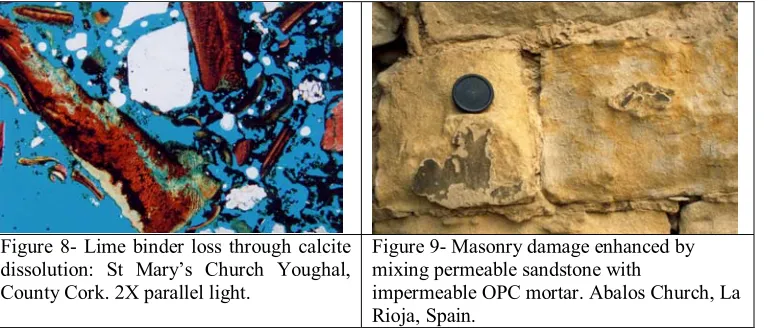
Practical experience and analytical science suggest that a good mortar must act as a conduit for the moisture in the wall, preserving the stone or brick from the decay induced by percolating water, moisture and salt solutions. The solution of lime binders leading to mortar loss together with the fact that, in order to preserve the adjacent masonry, this decay process affecting the mortar should not be avoided have been previously reported and demonstrated (Ashurst et al. [12]; [Pavía et al.[2]). These authors evidenced through site and experimental work that the movement of water within masonry is an important factor in the onset of decay processes, and that when the stone or brick is more permeable than the mortar, water movement through the masonry increases and therefore decay induced by percolating water, moisture and salt solutions will also increase. According to Pavía et al., when slightly acidic (e.g. containing CO2 in solution) water dissolves the calcium carbonate binding the
aggregate together and giving the lime mortar cohesion, leading to material loss through granular disintegration. The authors conclude that a lime mortar must be the primary route of passage for moisture and solutions, making a structure permeable and protecting the adjacent masonry units from the harmful effect of salts and moisture, thus acting sacrificially to protect the overall structure. Therefore, mortar failure due to dissolution of carbonated lime binders should not be avoided but it is necessary in order to preserve the adjacent masonry.
[image:7.612.127.511.357.521.2]Figure 8- Lime binder loss through calcite dissolution: St Mary’s Church Youghal, County Cork. 2X parallel light.
Figure 9- Masonry damage enhanced by mixing permeable sandstone with
impermeable OPC mortar. Abalos Church, La Rioja, Spain.
Mortar damage by salt crystallization and how to avoid it
atmospheric pollution and alkali-bearing OPC mortars has also been evidenced through petrographic analysis (Pavía [7]). Alkali-bearing OPC mortars are capable of forming highly disruptive salts such as gysum and alkali sulphates. In order to avoid mortar sulphation due to alkali-bearing OPC mortars, these materials are not advisable for use with historical and traditional fabrics. Science and experience suggest the use of compatible materials in order to avoid sulphur and alkali-sulphate attack.
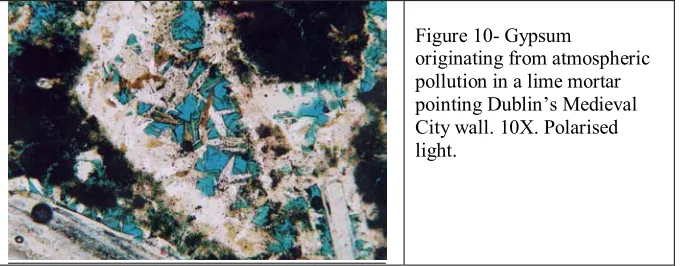
[image:8.612.109.450.226.359.2]Mortar sulphation by atmospheric sulphur emissions also causes strong damage to lime mortars. An example of this is shown in Figure 10. However, this decay process is difficult to avoid in urban areas, as pollution due to atmospheric emissions is rising continuously.
Figure 10- Gypsum
originating from atmospheric pollution in a lime mortar pointing Dublin’s Medieval City wall. 10X. Polarised light.
CONCLUSION
This paper concludes that the best conservation theories can be formulated and the best conservation practice achieved when both analytical science and laboratory testing are coupled to practical experience arising from the exercise of craft and material technology.
Analytical science and laboratory experiments together with practical experience suggest that reactive limes that have been soft-burned and slaked correctly should be used in order to avoid fracturing of mortar binders. Analytical and experimental work also advice on the use of compatible materials in order to avoid sulphur and alkali-sulphate attack and avoid an excess of water with mixing to prevent mortar damage.
the moisture in the wall, preserving the stone or brick from the decay induced by percolating water, moisture and salt solutions.
Bibliographic references
[1]. Clough T.K and Wooley A.R., Petrography and stone implements, World Archaeology (17) (1), 1985.
[2] Pavía S. and Bolton J., Stone, Brick and Mortar, Wordwell, Bray, 2000.
[3] Charola, E.; Dupas, M.; Sheryll, R.P.; Freund, G.F. Characterization of ancient mortars: chemical and instrumental methods. Proc. Symp. on Sci. method. App. to works of Art, Florence,1984.
[4] BS EN 1925:1999 Natural stone test methods. Determination of Water Absorption Coefficient by Capillarity.
[5] EN 480-5:1996 Determination of capillary absorption. Admixtures for concrete, mortar and grout- Test methods.
[6] BS EN 1926:1999 Natural stone test methods. Determination of compressive strength.
[7] Pavía S., Petrographic examination of historic lime mortars, Research and professional reports, unpublished, 1990-2006.
[8] Perander, T. and Råman, T. Ancient and modern mortars in the restoration of historical buildings. Valtion Teknillinen Tutkimuskeskus (VTT), Helsinki,1985.
[9] Boynton R. S., Chemistry and Technology of lime and limestone, Wiley & Sons, New York, 1980.
[10] Hooper W.D and Ash H.B., Marcus Porcius Cato and Marcus Terentius Varro, De Re Rustica,William Heinemann Ltd., Harvard University Press, London, 1939.
[11] Pavía S., Fitzgerald B. and Howard R. Evaluation of properties of magnesian lime mortar. In: Structural Studies, Repair and Maintenance of Heritage Architecture IX. Malta, June 2005. Vol 83 WIT Transactions on The Built Environment. C.A. Brebbia and A. Torpiano eds. WIT Press, 2005, p. 375-384.
[12] Ashurst, J., and Ashurst, N. English Heritage Technical Handbook, Vol. 3: Mortars, Plasters and Resins. Gower Technical Press, 1998.
[13] Winkler E.M. Stone: properties, durability in man's environment. Springer-Verlag. Wier N.Y., 1973.
[14] Arnold, A. Determination of mineral salts from monuments. Studies in Conservation 29, 1984, p.129-138.