University of South Carolina
Scholar Commons
Theses and Dissertations
1-1-2013
A Study of the Intersections of Race, Schooling,
and Family Life in a Rural Black Community
Michele Evonne MyersUniversity of South Carolina
Follow this and additional works at:https://scholarcommons.sc.edu/etd Part of theEducation Commons
This Open Access Dissertation is brought to you by Scholar Commons. It has been accepted for inclusion in Theses and Dissertations by an authorized administrator of Scholar Commons. For more information, please [email protected].
Recommended Citation
A Study of the Intersections of Race, Schooling, and Family Life in a Rural Black
Community
by
Michele Evonne Gillens Myers
Bachelor of Arts Clemson University, 1994
Master of Administration and Supervision Charleston Southern University, 1999
Education Specialist in Teaching University of South Carolina, 2002
Submitted in Partial Fulfillment of the Requirements
For the Degree of Doctor of Philosophy in
Language and Literacy
College of Education
University of South Carolina
2013
Accepted by:
Amy Donnelly, Major Professor
Susi Long, Committee Member
Michelle Bryan, Committee Member
Jerome Morris, Committee Member
© Copyright by Michele Evonne Gillens Myers, 2013
DEDICATION
I dedicate the work of this dissertation to the teachers who dare to dream of a
world that validates all children, regardless of their race, ethnicity, social class, gender, culture, or religious beliefs. This work is also dedicated to families, like mine, who really
ACKNOWLEDGEMENTS
First, I would be remiss if I did not take this opportunity to express sincere
gratitude to all who were involved in the process, whether great or small. I would like to
thank my committee members. Thank you Dr. Amy Donnelly for the many rounds of
revisions and for keeping me focused and on task. I could not have done this without
you. I appreciate you believing in me and the power of this work. Thanks to Dr. Morris
for allowing me to be a part of your writing community and for our Skype sessions on
Tuesdays. I also thank you for the mentorship during the 2010-2012 Cultivating New
Voices Fellowship Program through National Council Teachers of English (NCTE).
Thanks Dr. Michelle Bryan for the resources and advice to assist with this work. Dr. Susi
Long, simply saying thank you does not even begin to capture the immense gratitude that
I have for you. I know that our paths were meant to cross, and I am glad that they did.
You have been an inspiration to me, and I have learned so much under your tutelage.
Know that I am forever indebted to you.
My gratitude goes out to the many professional colleagues who lived this journey
with me, particularly, Beverly Stroman, Mary Williams, Desiree Lewis, Latoya Williams,
and Gail Richardson. I also express gratitude to the teachers and families who took a part
in this study. You know who you are.
Dr. Valerie Kinloch, I appreciate your guidance and the opportunity to learn from
2010-2012 Cultivating New Voices of Minority Fellows Program (Danny Martinez, Tim
San Pedro, Kim Parker, Yolanda Sealey-Ruiz, Elizabeth Sybil Durand, Limarys
Caraballo, Meneka Brooks, Sandra Quiñones Rosado, Melody Zoch, Margarita
Zisselsberger and Latrise Johnson) your work will change the field of education. It is
such an honor to be a part of this group.
My two BFFL, Diamond and Richia, you were so understanding and encouraging
throughout this process. Your prayers and words of affirmation came at exactly the right
time. It is good to have friends who want the best for you. I love both of you immensely.
The gratitude that I have for my family cannot be explained. Each of you
championed me. This dissertation is a part of all of our lives. Thanks for taking on
different responsibilities at different times so that I could attend school and write for
extended periods of time. Virginia, thanks for keeping the girls and making sure they
were fed. Michael and Karen, thanks for allowing the girls to stay with you while I
attended classes. Daisha and Drikus, thanks for being their chauffer when I could not.
To my grandparents, Maebel, Elijah Sr. and Elouise, thank each of you for dreaming big
dreams for me and supporting me financially to make those dreams a reality. I accept this
degree as a part of the legacy of excellence that you have instilled in me. I carry this
torch for the family.
Thanks to my parents, Elijah and Sandra Gillens for your unwavering
commitment to me. Your love is the foundation for who I am and aspire to be. Thank
you for loving me past my imperfections. Ma, you have been my rock, always there for
Donnie, you are one of a kind. Because of you, I found the energy and willingness
to persevere to the very end. You were indeed the fuel that motivated me. Thanks for
pushing me to this next level in life.
Finally, Summer and Zoya, this work has been a part of our lives for a very long
time. You witnessed the many phases of this dissertation. You saw me at my best and at
my worst, and you still loved me despite all of that. We made many sacrifices knowing
that this moment would come. You encouraged me and prayed to God on my behalf.
For this, I am eternally grateful. So with my humble heart I offer this prayer, “Lord, I
pray that the paths that my girls choose in life will lead to true joy.” Thank you for being
ABSTRACT
In doing this work, I sought to shed light on the ways that schools and parents
interact while challenging stereotypes and misperceptions that may be preventing such
collaboration. I conducted and exploratory study that used qualitative methods to better
understand the ways that Black families demonstrate involvement in their children’s
schooling—ways that often go unnoticed or are not legitimized within the school setting.
I spent 13 months with nine Black families and interviewed and surveyed teachers in the
schools in those communities. This work makes visible the experiences of those Black
families, their children, and the schools in a community rarely studied—a poor, rural
Black community in the southern United States (US). Findings in this study challenge
schools’ definitions of parental and family involvement by uncovering resources and
TABLE OF CONTENTS
DEDICATION ... iii
ACKNOWLEDGEMENTS ... iv
ABSTRACT ... vii
LIST OF TABLES ...x
LIST OF FIGURES ... xi
CHAPTER ONE: INTRODUCTION TO STUDY ...1
CHAPTER TWO: REVIEW OF THE LITERATURE ...21
CHAPTER THREE: RESEARCH METHODOLOGY ...45
CHAPTER FOUR: DATA ANALYSIS AND FINDINGS ...85
CHAPTER FIVE: DISSCUSSION, IMPLICATIONS, AND NEW QUESTIONS ...178
REFERENCES ...234
APPENDIX A: INFORM CONSENT LETTER FOR SUPERINTENDENT ...254
APPENDIX B: TEACHER SURVEY...256
APPENDIX C: INTERVIEW PROTOCOL FOR PARENTS ...261
APPENDIX D: FOCUSED CONVERSATION PROTOCOL FOR TEACHERS ...264
APPENDIX E: INFORM CONSENT FOR PARTICIPANTS ...265
APPENDIX F: WELCOME LETTER TO PARENTS ...267
APPENDIX H: CHILD ASSENT FORM ...270
APPENDIX I: LEARNING OUR NAMES ...272
LIST OF TABLES
Table 3.1 Alignment of Data Methods to Research Questions ...52
Table 3.2 Family Participant Information ...66
Table 3.3 Teacher Focused Group Participant Information ...68
Table 3.4 Timeline for the Study ...69
Table 3.5 Four Block Frame for Data Organization and Analysis ...71
Table 3.6 Coding Categories ...74
Table 4.1 Themes from Parent and Teacher Data Sets ...87
Table 4.2 Categories within the Theme: Parental Involvement as Relationships Parent and Teacher Data Sets ...90
Table 4.3 Categories within the Theme: Parental Involvement as Communication Parent and Teacher Data Sets ...117
Table 5.1 Suggested Text and Articles for Professional Book Clubs ...199
Table 5.2 Resources for Administrators ...206
LIST OF FIGURES
Figure 1.1 Integrated Model of Sociocultural Theory and Critical Race Theory ...11
Figure 3.1 Sample Index Card for Data Analysis ...75
Figure 3.2 Parent Concept Map ...76
Figure 3.3 Teacher Concept Map ...76
Figure 4.1 Parental Involvement as Relationship: Parent Perspectives ...91
Figure 4.2 Parental Involvement as Relationship: Teachers’ Perspectives ...100
Figure 4.3 Roadblocks that Circumvent Pathways to Relationships ...111
Figure 4.4 Parental Involvement as Communication: Parents’ Perspectives ...118
Figure 4.5 Behavior Calendar ...119
Figure 4.6 Parent Letter ...120
Figure 4.7 Parental Involvement as Communication: Teachers’ Perspectives ...137
Figure 4.8 Modes of Communication Used by Teachers: Survey Results ...138
Figure 4.9 Oops Form ...139
Figure 4.10 Good News Form ...139
Figure 4.11 Roadblocks that Circumvented Pathways to Relationships ...156
Figure 4.12 Categories within the Theme Parental Involvement as Networks of Support ...163
Figure 4.13 Nutcracker Performance ...170
CHAPTER ONE
INTRODUCTION TO THE STUDY
The year is 1978, and I am a second grader at Galliard Elementary School, the
only elementary school in Eutawville, South Carolina. Galliard has an all-Black student
body and an all-Black teaching force and administrative team. This school is reminiscent
of communally bonded schools documented in the research by scholars such as Jerome
Morris (1999) and Vanessa Siddle-Walker (1996). Mrs. Dukes, my 2nd-grade teacher,
sparked a love of reading in me. I wanted to read lots of books, because Mrs. Dukes said
reading would make me smarter and take me to faraway places that I may not get to see
otherwise. Mrs. Dukes, like many of the Black educators of the time, was very influential
in the lives of her students. She was the embodiment of the type of educators Jacqueline
Jordan Irvine (2003), and Geneva Gay, (2010) captured in their scholarship on Black
teachers who have been successful in working with Black children. Mrs. Dukes believed
in me, my family, and community. She understood the dedication my mother had in
supporting me academically, spiritually, and personally. Mrs. Dukes understood that my
mother supported me in ways that may not have been understood as support by other
teachers. She took the time to get to know me and my family as individuals and worked
Each Thursday evening, I relentlessly begged my mother to take me to the
bookmobile that came to Eutawville. Our town of less than 1000 people had no library of
its own, so each Thursday evening, children anxiously waited in line outside the
bookmobile, library cards in hand. As we entered the bus, lined with shelves instead of
windows, benches for us to sit on, and carpet on the floor, we were offered places and
people beyond our town, neighborhood, and the people we knew. My mother never said
no when I begged her to take me because she believed in what Mrs. Dukes wanted for
me. My mother was deeply involved and supportive of my academic development
outside of school. She always made time to take me to the bookmobile, the local
museum, zoos, and historic parks. And although she supported me in ways that are very
familiar to teachers, there were other unfamiliar ways that she also supported me. For
instance, she taught me lessons about negotiating integrated worlds. One lesson in
particular that I explicitly remember is that she helped me understand that I had to work
twice as hard as my non Black classmates at everything that I did. Another lesson she
instilled in me was that my attitude would affect the ways that others perceived me. My
mother reveled in my accomplishments and always stressed the importance of education
to my brother and me. The things that she taught me helped me understand the unfairness
of life, but equipped me with the knowledge necessary for negotiating my way.
My family was a strong support network for me, and yet I can only recall three
instances when they came to my school or talked with my teachers. The first was when
my brother - a very bashful child who rarely talked in school – was in the first grade.
Midyear, his teacher sent home a notice announcing her plans to retain him. According
this will set him back in life. I am going to have to meet that woman.” During the
meeting, my mother listened intently to what the teacher had to say, and in a pleasant but
stern voice, my mother told my brother’s teacher that Michael would not repeat first
grade or any grade for that matter. At the end of the year, my brother was promoted to
second grade. The other two times that I remember my parents visiting the schools were
during my high school graduation in 1990 and during my brother’s high school
graduation. He graduated on time with a diploma in 1994. By the standard, middle class
definition of parental involvement that is espoused in many schools, my family would not
measure up; however, they were involved and continue to be.
Fast forward to the present. I am the principal at a Title I school in rural South
Carolina, very much like the school I attended as a child. Sandra, a Black, middle-class
third grade teacher walks into my office looking frustrated. She has just had a retention
conference with Devonte’s mother and does not know how to proceed. “His mom never
darkened these doors to even come and check on Devonte. That’s why he is getting all
F's. I don’t think the woman even cares.”
I ask, “What do you know about this family?”
She pauses, then replies, “Until today, I never even met the woman.”
Over the years I have heard many teachers like Sandra blame a child's academic
failures on what they believe is a lack of care, concern, and involvement by a child's
family. They vocalize the same negative beliefs about parents, detailing a litany of
pathologies and deficits, or views that are narrowly defined, presumptuous, and
judgmental (Dantas & Manyak, 2010). Sandra continued: “His mom doesn’t care;
action; he lives in the projects; they never come to the school when you call” and on and
on and on. She said, “Michele, why do people not care about their children?” To this I
respond, “How can you be sure that they do not care?”
Statement of the Problem
The issues described in the opening to this dissertation are not isolated to me, to
Eutawville, SC, or to the rural South. Across the country, we see teachers misinterpreting,
misunderstanding, and being misinformed about the networks of support that actually
exist in homes and communities of children from backgrounds different from their own.
Across the country, we see children being under-served in schools, primarily Black,
Latino, low-income, and rural children. I am not the only educator troubled by deficit
practices and perspectives that stereotype children and families, or blame the student and
family rather than blaming the bias that leads to poor treatment, low expectations, and
low standards (Kohli, 2009).
Researchers have long established the importance and benefits of parents being
involved in their children’s education (Jordan, et al., 2001; Henderson & Mapp, 2002;
and Clark, 2002). However, Black families often demonstrate ways of being involved
that are not valued or accepted as standard practices by classroom teachers, particularly
teachers from socioeconomic and racial backgrounds different from their students. Given
that the recent trends with enrollment in public education in the South offer evidence that
the racial and ethnic composition of the student population is becoming increasingly
more diverse. According to the New Diverse Majority Report (2010), “the South is now
the first and only region in the nation’s history to have both a majority of low income
in the ethnic and racial composition of the student body presents continued challenges for
educational systems (Villegas and Lucas, 2002). The New Diverse Majority Report
(2010) helps us understand that the students in this new majority are scoring the lowest
on state and national assessments and graduating at the lowest rates. The report also
points out that per pupil funding in many Southern states lag behind the nation’s per pupil
expenditures. The Diverse Majority Report calls for transformation of the educational
system and warns that without this transformation, “the impact on the region’s and
national economy, global competitiveness, quality of life, and democratic institutions,
will be catastrophic” (2010, pg. 3).
As described above, the chasm that exists between homes and schools certainly
plays a role in the perpetual undeserving of children of Color from low income, rural
communities. This is not just a Southern problem or a rural problem; it is a national
problem. The nation cannot continue on this path if it wants to produce citizens who are
able to compete in the global economy. Education for children of color demands
transformation. Many Black scholars within the American Education Research
Association (AERA) believe that transforming Black education is the precondition for
global social justice (King, 2005). In addressing what this transformative education
entails, King writes, “a goal of transformative education and research practice in Black
education is the production of knowledge and understanding people need to rehumanize
the world by dismantling hegemonic structures that impede such knowledge” (2005, pg.
Type of Study and Research Questions
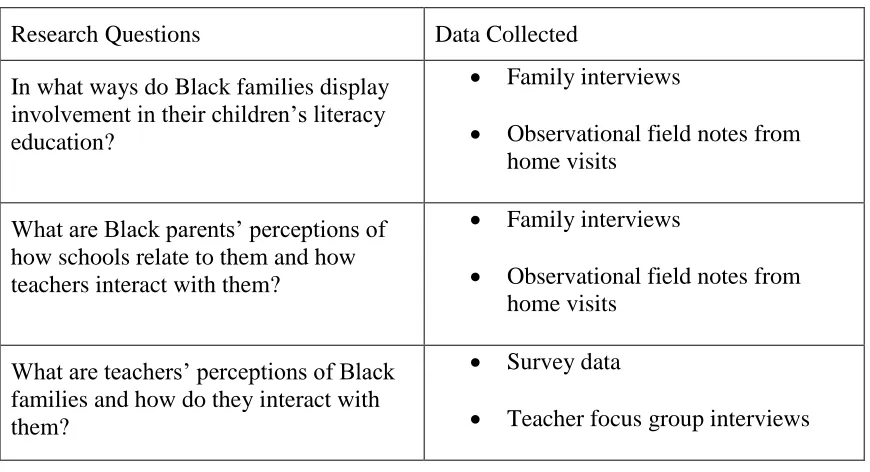
Using qualitative methods of data collection, I set out to explore the ways that
Black families demonstrate involvement in their children’s schooling—ways that often
go unnoticed or are not legitimized within the school setting. To do so, I spent 13 months
with nine Black families and interviewed and surveyed teachers in the schools in those
communities. By looking closely at Black families’ involvement in their children’s
education and teachers’ (both Black and White) interactions with families, I addressed
the following questions:
In what ways do nine Black families in the rural South describe involvement in their children’s literacy education?
What are those Black parents’ perceptions of how schools relate to them and how teachers interact with them with regard to the issue of parental involvement?
What are teachers’ perceptions of Black parents’ involvement in their children’s literacy education? What are their perceptions of their interactions with Black parents?
In doing this work I sought to shed light on the ways that schools and parents
interact while challenging stereotypes and misperceptions that may be preventing such
collaboration. It makes visible the experiences of families, students, and schools in
communities rarely studied—poor, rural Black communities in the southern United States
(US). In the process, it challenges schools’ definitions of parental and family
involvement by uncovering resources and support structures that exist in homes and
communities.
There is a body of research situated in urban areas that documents educational
practices for Black children (Compton-Lilly, 2003; Taylor and Dorsey-Gaines, 1988;
educational inequities that Black children encounter daily, a more comprehensive body of
research situated in a variety of settings is essential. This study, like that of
Siddle-Walker (1996), is important because it adds to the field research situated in rural
communities conducted by researchers who currently or recently lived in those
communities.
A final purpose for this work is that it provides data that helps teachers become
cognizant of their vital roles as active members in family networks. In addition, because
time and place are crucial in understanding lived experiences, a study like this adds to the
body of research on school reform and family involvement by helping teachers conceive
of and appreciate the supportive roles that these nine Black families living in the rural
South had in the literacy learning of their children.
Significance of the Study
This dissertation study addresses several problems. First, researchers (Morris,
2009; Semke and Sheridan, 2012; and Sherwood, 2000) have impressed upon us that
there is a need for more qualitative and quantitative research in rural communities as
there exists a dearth from this context. They acknowledge that there is an increase in the
literature on family school partnerships, but point out that much of that research is
situated in urban and suburban settings. Morris (2009) even asserts the need for such
research to be conducted by researchers who currently or recently lived in those
communities. As a researcher who currently resides in the community under
investigation, and as an educator who works with Black children from low
socioeconomic conditions, I am at an advantage in that I understand the community of
of rural communities not only through my readings of scholars, namely Anderson (1988),
Siddle-Walker (1996), Gadsden (1992, 1993, 1998, 1999, and 2000), and Johnson (2010),
and Johnson and Cowles (2009), but also on a personal level through my lived
experiences.
According to Morris and Monroe (2009), access to and opportunities for
education are dynamically different in various places throughout the nation. The place
where a person lives has significant impact on his or her educational outcomes. I know
through experiences that access and opportunities for children who grow up in rural,
economically strained areas of the US South are considerably different from children who
grow up in inner cities or suburbs. The beginnings of this understanding can be found in
the work of Heath (1983). Heath’s work laid the foundation for our understanding of the
significance of the cultural ways in which children learn and use language. Heath posits
that it is important for teachers to understand the differences in language and culture that
their children bring into the classroom each day. Her work points out the importance of
the cultural and structural ways that children learn language and learn to use language.
She posits that learning cannot be separated from the context in which it occurs. From
this, it can be inferred that a family’s ways of being and doing critically shape how
children learn. Children never enter schools and classrooms void of rich experiences that
are embedded in their families. Pedagogy and curricular designs that draw on cultural
ways of being and doing validate to children that their families matter.
Asserting that the influence of race is ever present, Morris and Monroe (2009),
posit that discourses that consider the interconnectedness of race and place are necessary.
nation’s Black population resides in this area. Scholars such as Gadsden (1992), Heath
(1983), Johnson and Cowles (2009), and Johnson (2010) are addressing this absence by
focusing their research in rural areas of the US South. Their work laid the foundation on
which this study builds. Like these scholars, this researcher seeks to add to the field
literature that attempts to explain the interconnectedness of race, culture, place, and
schooling.
A second problem that this researcher attempts to address is the absence of the
voices of Black teachers in educational discourse. Siddle-Walker (1996) and Morris
(2009) posit that the stories and lives of children, teachers, principals, and families who
were involved in segregated Black schools during and after the historical landmark case,
Brown v. the Board of Education of Topeka, Kansas, are often absent from the discourse
about how best to educate Black children. Those voices and stories provide essential
contexts and must be heard. Accordingly, the dissertation study, like the work of
Michelle Foster (1997), Jacqueline Jordan Irvine (2003), and Gloria Ladson-Billings
(1994) seeks to bring those unheard voices to the educational discourse. Ladson-Billings
and Tate (1995) contend that the voices of people of Color are necessary for a complete
analysis of the current educational system. The narratives and experiences of the
participants in this study can only be understood through the oppressive racist and
historical contexts in which they occurred and how those participants made meaning of
them.
This dissertation study foregrounds issues of race in the discussion of how to best
educate Black students. It is intentionally focused on race and issues of racial oppression
whether historical or contemporary, is symbolically linked to schooling and research
institutions.
Theoretical Framework
The key theories that guided my thinking in the development, implementation,
analysis, and writing of this study are (a) sociocultural theory and (b) critical race theory.
I draw a range of beliefs from these bodies of work including the beliefs that: (a) learning
is a dynamic process, (b) learning cannot be separated from the context in which it
occurs, (c) cultural tools and artifacts influence learning, (d) social interaction and social
others have key roles in learning, (e) race or racism is endemic in American life, (f) race
advantages some groups, while disadvantaging others, (g) nothing is ever neutral or
objective, but always situated in the subjectivities of others, (h) hard work and
determination do not always ensure equitable access, (i) economic disparities often
plague poor people, and (j) there is a need for social justice. A discussion of these beliefs
is embedded in the broader discussion of sociocultural and critical race theories that
follow.
Figure 1.1provides a visual of my interpretation of the integration of sociocultural
theory and critical race theory. At the center of this model is the child who is surrounded
by all of the cultural tools and learning contexts that shape the child’s identity. The
cultural tools are the social actors, languages, community affiliations, music, and
interactions that affect the child. The learning contexts are all of the spaces in which the
child engages in learning. Those could be in the community, the classroom, the family,
or any other space in which the child learns from or with a social actor. The cultural
herself in a variety of ways. The circle for the social and cultural forces is broken to
demonstrate that the relationships, actors, tools, and artifacts that influence the child are
dynamic, meaning that they change with each learning engagement or interaction. The
social and cultural forces are surrounded by the social class to which the child belongs.
This circle is also broken in an effort to demonstrate that children can move from one
social class to another. The outer circle signifies race. This circle is solid in that the
child’s race will never change and remains highly influential in determining the level of
access he or she is given. The funnel is symbolic of the views or ideologies that greater
society uses to see the child, often rendering poor, minority children as less than they
really are or have the potentials of becoming.
In the explanation that I share here, I am not making broad generalizations about
society as a whole, but I am presenting realities that many poor, children of color face as
a result of their skin color, language, or social class being viewed as inferior. Take the
following example. When one sees a child, in many cases, the first thing that one notices
is the child’s race. If the child in a child of color, in my case, Black, there are certain
stereotypical views that one may have. If the child is Black and comes from a low income
household, societal views of that child are different than if the child was a Black child
from a middle class or upper class household. If the child is Black, from a low income
household and has limited experiences with academic English, societal views about that
child are far different from a child who is Black, middle class, and uses academic English
when necessary. This model can also work for a White child. The point that I am
making here is that race, culture, and class matter. These constructs matter because they
impact a child’s access to a fair equitable education. And when you are a child of color
from an economically strained background and whose cultural ways of being are not
recognized as legitimate by the school and society, and who has limited knowledge of
academic English, then societal views often render you as inferior.
In order to transform the educational system for poor children of color, we have to
transform societal views as a whole. Understanding the link between culture and learning
has been at the core of educational research for quite some time; however, it has only
been in recent years that mainstream researchers have begun to pay attention to the
historical issues of race critically. Researchers have helped us to understand that social
and cultural processes are essential to learning, and that learning cannot be understood
Saxe, 1999). Nasir and Hand (2006) point out, “Understanding learning requires a focus
on how individuals participate in particular activities, and how they draw on artifacts,
tools, and social others to help solve local problems” (pg. 450). The problem, however,
is that any attention to race in sociocultural theory has often been implicit rather than
explicit. Thus using only sociocultural framework as a lens for analysis pays little
attention to issues of race and power which are essential in fully understanding learning
in America’s schools (Ladson-Billings and Tate, 2005).
Nasir and Hand (2006) contend that there is little overlap in the bodies of
literature in education on race and culture, with a few notable exceptions, namely
Gutiérreza, Baquedano‐López & Tejeda, 1999; Gutstein, 2005; and Lee and
Slaughter-Defoe, 1995. Nasir and Hand (2006) suggest that one possible reason for the absence of
the overlap of race and culture is due to the way that culture is conceptualized. They
argue that much of the research about minority students tends to treat culture as static
beliefs, values, and traditions that an individual possesses. However, socioculturalists
(Rogoff, 2003; Moll et al., 1992; Heath 1983; and Nieto, 2003) tend to believe that
culture is dynamic and created as social actors interact with one another.
Race and racism are endemic to American life (Bell, 1992; Delgado, 1995; and
Lynn & Parker, 2006). There exist US cultures of dominance and power that often
marginalize people who do not have political, social, or economic capital. Banks (1974)
argues that when a student’s sociocultural ways of being are rejected and devalued by the
perceived dominant society, the student feels dehumanized and alienated. Asa Hilliard
(2000) argues that we must examine the intersection of culture and power if we are to
theories are intertwined, they are separated in the following sections, so that I can discuss
each as they impact my theoretical framework in this study.
Sociocultural Theories of Learning
Grounding the proposed study are sociocultural theories of learning. I am guided
by theorists and researchers who assert that every child deserves to have an education
where his or her cultural identity is acknowledged and respected (Kohli, 2009).
Sociocultural theorists view the culture in which one is reared as an asset to learning.
Sociocultural theories draw on the strengths and funds of knowledge (Moll, Amanti,
Neff, and Gonzalez, 1992) that exist in a culture. This is in contrast to deficit models that
view certain cultural ways of being (Black, for example) as an impediment to learning
(Holt, 1990). Nieto (2002) states that learning cannot be separated from the context in
which it takes place, and that learning is significantly influenced by the values of those
cultures. She defines culture as the ever-changing values, traditions, social and political
relationships, and worldviews created and transformed by those who share them. Nieto
contends that negative perceptions of cultural differences put children at risk
educationally. She extends the work of researchers like Heath, 1983; Taylor and
Dorsey-Gaines, 1988; Moll 1992; and Delpit, 2002 who help us understand the importance of
culture—ours and our students’—as we consider children’s learning and our teaching.
Moll (1992) argues that children possess vast funds of knowledge or historically
accumulated and culturally developed bodies of knowledge and skills that they bring to
school. Delpit (2002) contends that teachers are cultural transmitters and own the
responsibility of making visible the worlds of children whose cultures are decidedly
Another concept that informs my sociocultural thinking comes from the work of
Gregory, Long, and Volk, (2004) who use the concept of syncretism to describe the
sociocultural nature of learning. These researchers contend that it is through the process
of syncretism that people transform culture as they draw on diverse resources, both
familiar and new. They assert that as learners interact with each other, they draw on their
own cultural knowledge and use it to create new spaces for interaction and, thus, for
learning. They aver that the space for learning is not the sole possession of one person’s
world or the other’s, but a new space created syncretically, and because of this, the
potential for learning expands. All of the research cited leads to a growing awareness that
children’s literacy learning cannot be understood apart from the cultural and historical
contexts that shape their lives.
My beliefs are also guided by the understanding that culture is dynamic, children
cannot be separated from the culture in which they are accustomed, and that funds of
knowledge (Moll, 1992) exist in every home. The purpose of this dissertation study was
to better understand the cultural practices that nine Black families employed as they
involve themselves in their children’s literacy lives in and out of school. Through
invitations into their home spaces and lives, I learned the unique and individual ways that
these nine families demonstrated practices of involvement that varied from those
practices that may be considered standard forms of involvement by schools.
My view of sociocultural theory is also heavily informed by work in the area of
culturally relevant pedagogies. Ladson-Billings (1992) coined the term
culturally-relevant pedagogy. Culturally-culturally-relevant pedagogy, according to Ladson-Billings, involves
worlds outside of the school. Ladson-Billings (1995) writes that children excel
academically, demonstrate cultural competence, and understand and critique the social
order when culturally relevant pedagogy is situated in a more critical paradigm.
According to Irvine (2003) culturally relevant teachers have equitable and reciprocal
relationships with their students. She termed this connectedness “cultural
synchronization”. She explains that cultural synchronization must exist between teachers
and students to maximize learning. Further she asserts that culturally-relevant teachers
understand that families are educative resources and capitalize on those resources to
educate children successfully.
Critical Race Theory
My work is guided by Critical Race Theory, which has its origins in critical legal
studies (Crenshaw, Gotanda, Peller, & Thomas, 1995). Legal scholars of color such as
Derrick Bell (1992) and Richard Delgado (1995) did not feel that critical legal theory
adequately addressed issues of race and racial oppression in legal matters in society as a
whole. They conceptualized a discourse that would foreground race and racism. This
dissertation is informed by the work of scholars such as Lynn and Parker (2006) who
identified several basic principles that defined the CRT movement. They assert that
Critical Race Theory (1) recognizes racism as endemic to American life; (2) challenges
legal claims of neutrality, objectivity, colorblindness, and meritocracy; (3) insists on a
contextual and historical analysis of the law; (4) demands the recognition of the
experiential knowledge of people of color in analyzing law and society; (5) is
interdisciplinary; and (6) works to end racial oppression. Lynn and Parker (2006)
framework to address educational inequalities, much of the literature that dealt with
inequalities was based on gender or class. They explain that blatant forms of racism have
subsided; however, they warn that everyday racism, meaning those institutional policies
and practices that may appear fair on the surface but are actually detrimental to minority
groups, are on the rise. In explaining this further, Lynn and Parker write, “The actions
associated with everyday racism are also subtle, automatic, non-verbal exchanges that are
seen as derogatory slights by persons of color” (2006, pg. 260). Critical race theorists
demand that these policies and practices be dismantled. CRT has evolved from its focus
on people from African decent to include issues of gender, language, origin, and
nationality (Lynn and Parker, 2006).
Critical race theory in education came to prominence in 1990s. Before scholars
began using CRT in education, much of the literature addressed issues of class (Bowles
& Gintis, 1976) or gender (Weiler, 1988). In their foundational article on CRT in
educational research, Ladson-Billings and Tate (1995) explained inequities that exist in
the education of minority groups. They put forth the idea that class and gender-based
explanations alone were not powerful enough to detail educational inequities; therefore,
they advocated race as a significant factor that must be considered as well. Their work
helped to lay the foundation for using CRT as an analytic approach to explain the
connection between race and class in schools and how some schools fail to properly
educate minority populations. Ladson-Billings and Tate (1995) inform this dissertation
by pointing out how racism is a persistent historical construct that could account for
educational inequalities that Blacks and Latinos experience. Their work drew from
lens for assessing the social inequities that Blacks experienced. Other researchers such as
Edward Taylor (1998) have helped to inform me by discussing how Critical Race Theory
can operate as a counter-narrative and challenge the myth of white normativity. Taylor’s
work (1998) identifies CRT as a discourse that originated and remains in communities of
color. Many CRT scholars in education interrogate race in their work and urge others to
continue in this regard.
I am also aware that there is a growing body of research that uses cultural
centered frameworks for analysis; however, there is a growing debate as to whether
cultural centered frameworks alone are significant enough in explaining inequities in
education (Ladson-Billings, 2003). With this in mind, I use a cultural centered framework
and a framework that acknowledges race when exploring issues relating to minority
groups—specifically Blacks, in my case. Using a critical race theory as a theoretical lens
in this study is necessary in that it will help us learn ways to better serve poor, Black
children who are often marginalized and underserved in school systems that do not
capitalize on the cultural resources that they bring to each learning engagement. Further
it will help us critique the practices that we employ when teaching children from diverse
racial groups, in hopes that we will begin to employ practices that are more equitable for
all children and dismantle institutional structures of power that disadvantages and set apart certain racial groups as “others”. Banks and Banks (1995) assert that equity
pedagogy refers to “teaching strategies and classroom environments that help students
from diverse, racial, ethnic, and cultural groups attain the knowledge, skills, and attitudes
needed to function effectively within, and help create and perpetuate, a just, humane, and
Definitions
Throughout this dissertation, key concepts, ideas, and terms will be discussed. In
an effort to establish a clear understanding of these concepts, ideas, and terms, the next
section is written to offer my intended meaning for the readers.
Culturally Relevant Teaching. Ladson-Billings defined culturally relevant teaching as, “A pedagogy that empowers students intellectually, socially, emotionally,
and politically by using cultural and historical referents to convey knowledge, to impart
skills, and to change attitudes” (Ladson-Billings, 1994, pg. 13).
Culturally Responsive Teaching. I draw on the work of Gay. Gay (2002)
defined culturally responsive teaching as, “using the cultural characteristics, experiences,
and perspectives of ethnically diverse students as conduits for teaching them more
effectively”, (pg. 106).
Networks of Support. I drew on the work of Moll (1992) to craft a definition of the types of social networks that families form with relatives and nonrelatives. Networks
of support refer to the thick, multi-stranded networks that are flexible, adaptive, and
active. These networks involve multiple relationships with the same person for different
purposes or can involve various persons. These networks are reciprocal in nature.
Parents. Throughout this dissertation, I use the terms parent and family interchangeably. By parent or family, it is my intended meaning to include all of the
adults in a child’s life who are responsible for the child’s personal, physical, mental,
People of Color, Black, African American and White. The terms People of Color, Black, African American and White are used throughout the dissertation to
foreground issues of race.
Conclusion to Chapter One
This chapter laid the foundation for the dissertation study. In it I shared both my
personal and professional reasons for engaging in a study. This work was driven by my
beliefs in the vibrancy of Black families and my growing concerns that many schools
continue to underserve children of color. In addition, my professional obligations to assist
the teachers and families with whom I work made the study an inevitable part of my
trajectory. In conducting this study, I spent 13 months conducting interviews and
collecting field notes to explore ways that Black families demonstrate involvement in
their children’s lives—ways that often go unrecognized or are not legitimized in many
school settings. To gain various perspectives about this phenomenon, nine Black
families from three communities were interviewed. I also interviewed and surveyed
teachers who taught in those communities. My work is grounded in critical race and
sociocultural theories. In the Chapter Two, I will present the literature that informed this
CHAPTER TWO
REVIEW OF THE LITERATURE
The questions presented in Chapter One sought to explain how nine Black
families in the rural South describe involvement in their children’s literacy education,
how schools related to them, and how teachers interacted with them with regard to the
issue of parental involvement. Further, the questions sought to explain the perceptions
that teachers have of Black parents’ involvement in their children’s literacy education and
teacher’s perceptions of their interactions with Black parents. To consider these
questions, I used sociocultural and critical race theories as theoretical foundations for the
work. This chapter is written to present the four bodies of literature that informed this
study. To gain a better understanding of the inquires under investigation, this review
focused on (a) the schooling of Blacks in the US South, (b) rural education, (c) parental
involvement, and (d) culturally responsive teaching.
This chapter is divided into four sections. The first section takes a historical look
at schooling for Blacks in the US South. Much of the literature detailed the educational
inequities and struggles that many Blacks faced in an attempt to gain equitable education.
The second section looks closely at the condition of education research in rural
characteristics and challenges that are associated with education in rural contexts. Section
three, provides a review of the literature on parental involvement. From that review, it is
unquestionable the astronomical benefits of parents being involved in their children’s
education. In the final section, I will highlight the review of the literature on culturally
relevant pedagogy. This review was necessary to helped me to understand the ways that
schools continue to underserve many minority populations and what must be done to
provide more equitable education for them. The chapter ends with a conclusion of these
four bodies of literature.
Studying the Education of African American Students in the US South
There are many scholars (Woodson, 1933; Butchart, 1980; Anderson, 1988
King, 2005; and Siddle Walker, 1996) who documented the history of education for
Black people. In their scholarship, one theme abounds. Their scholarship captured the
persistent struggle that Black, formerly enslaved people endured to ensure quality,
equitable education. Anderson (1988) detailed and reinterpreted the educational history
for southern Blacks in his book titled, The Education of Blacks in the South, 1860-1935.
Repressing Education for Blacks
For Blacks, education represented liberation— liberation from a system designed
to continuously offer them second class citizenry. Legislation was enacted that made it
illegal to teach enslaved people to read and write. After the enslaved Blacks were
emancipated, organized campaigns were formed in many southern states to deny Blacks
rights of first class citizenry. According to Anderson (1988), despite the many tactics that
were enacted to deny formerly enslaved Blacks economic and political power, Black
systems that Blacks were forced into resulted because of the lack of economic and
political power Blacks had—power held by white elites. He posited, “the education of
blacks in the South reveals that various contending forces sought either to repress the
development of black education or to shape it in ways that contradicted blacks’ interests
in intellectual development” (1988, p. 285).
Anderson argued that because education symbolized emancipation, newly freed
persons emerged from slavery with a strong desire to learn to read and write. During
their enslavement, many risked losing their lives or disfigurement in an effort to learn to
read and write. Anderson contended that enslaved persons and free persons of Color
started schools that predated the Civil War; many of those schools increased their
activities after the Civil War started. Anderson wrote that John W. Alvord, national
superintendent for the Freedman’s Bureau, reported finding at least 500 such schools
existing before 1886; one such school existed in Savannah from 1833 to 1865. Further,
Anderson argued that historical records document that the first school for Blacks started
by slaves and freed Black people opened at Fort Monroe, Virginia, in September 1861.
These facts support Anderson’s position that Black people were always committed to an
educational system that would meet their own needs and desires.
Siddle Walker (1996) also detailed the horrendous obstacles that many Black
schools in the rural, segregated South faced in educating their children. She pointed out
that poor funding, dilapidated buildings, meager transportation, and insufficient resources
were just a few of the obstacles that prevented many Black school systems from
providing the type of education that they envisioned for their children. She argued,
accomplished the mission. This was done through the personal sacrifices of parents, a
dedicated and committed administration and faculty, and more importantly, through the
unwavering support from the Black community. Siddle Walker told of one such school,
Caswell County Training School, which operated from 1934 until 1969. Her work
detailed the communal bonding that existed between the Black schools and the
communities in which they were situated. The community provided financial support for
the school, and the school provided education for the children.
Philosophical Figures of the Time
In reading and synthesizing the works of James Anderson (1988), Robert
Williams (2004), Lewis Gordon (2000), Lucius Outlaw (2000) and Carol Lee (2009), I
note two historical figures cited in this literature who were instrumental in shaping the
education of Blacks: W.E. Du Bois and Booker T. Washington. Du Bois and
Washington held opposing philosophical views about the education of Blacks. Booker T.
Washington advocated an industrial education as the solution because an industrial
education would train students for the kinds of practical jobs that they could indeed have.
Washington was a proponent of The Hampton Model of education. According to
Anderson, “The Hampton model was organized around a conservative sociopolitical
ideology that advocated the political disfranchisement and economic subordination of the
black race” (1988, pg. 67). On the other hand, W. E. Du Bois contested an industrial
education, seeing it as a blueprint for the subordination of Blacks. Du Bois maintained
that industrial education supported the established social order and did not improve the
conditions in which Blacks found themselves. Du Bois averred a broad education that
included a college curriculum that could be used by teachers to educate other teachers.
He advocated a system that offered Blacks the same rights and privileges enjoyed by
others.
Segregated Education
The emergence of Black common schools resulted because enslaved Blacks
desired to promote individual and collective liberation (Anderson, 1988). According to
Anderson, Blacks resisted, “infringement that threatened to undermine their own
initiative and self-reliance” (p. 15). Despite the prevalence of overt racism,
comprehensive systems of segregated education were created and sustained (Siddle
Walker, 2000). In describing segregated schools, Siddle Walker (2000) identified four
themes that were critical for the success of schools: exemplary teachers, curriculum and
extracurricular activities, parental support, and leadership of the school principal.
Exemplary teachers. Crucial to these systems were teachers. Siddle Walker averred, “the African American teacher is a critical figure in a web of caring adults who
placed the needs of African American children at the center of the school’s mission”
(2001, pg. 752). Much of the literature does not often capture Black teachers in positive
ways, depicting themes of inadequate training, low salaries, and limited job opportunities.
However a few notable exceptions exist. Warren (1989), for instance, depicted Black
teachers as respected leaders. Siddle Walker(2001) argued that there are two contrasting
views of Black teachers in the literature— one in which teachers are presented as caring
with a minimalistic depiction of the obstacles or difficulties they faced in educating Black
children, and the other view in which difficulties are emphasized and teacher agency is
historiography of Black teachers in the South from 1940-1960, Siddle Walker pointed out
five key principles that Black teachers held about their roles: (a) Teachers should develop
a relationship with the community; (b) Teachers should be committed to professional
ideals; (c) Teachers should care about students; (d) Teachers should relate the curriculum
to students’ needs; and (e) Teachers would receive community and school forms of
support. Siddle Walker espoused a belief that Black teachers, “existed in a complex
system where the needs of African American children were formulated and
communicated in systematic and purposeful ways” (2001, pg. 773). She further
explained:
African American teachers worked in dismal, unfair discriminatory positions, but
did not allow themselves to become victims of their environment. Rather, they
viewed themselves as trained professionals who embraced a series of ideas about
how to teach African American children that were consistent with their
professional discussions and their understanding of the African American
community (Siddle Walker, 2001, pg. 773).
From this portrait of Black teachers during segregation, we can see that many
Black teachers of that time had vested interest in their communities, the children they
taught, and their profession.
Curriculum and extracurricular activities. A second theme in the literature details the curriculum and extracurricular activities that were offered in Black schools. A
central message evidenced in the curriculum was meritocracy, meaning teachers and
administrators emphasized to children that if they worked hard, they could become
schools of the time had inferior resources to their White counterparts, there were
concerted efforts by Black teachers, principals, families, and community members to
ensure that the curriculum presented was similar to that offered to White boys and girls.
These efforts, however, were limited due to financial constraints, class sizes, and the
concerted efforts of some White school boards to prevent Black schools from offering the
same courses that were being taught in White schools. Central to the curriculum were
extracurricular activities that were designed to develop the interest of Black students.
Many of the extracurricular activities mirrored those that occurred in White schools.
Parental support. Parental support was another principle theme in Black education of this era. Parental support was motivated by the needs of the school. Many
of the schools during this period were heavily supported through the personal finances of
the parents and community (Anderson, 1988 and Siddle Walker, 2000). Siddle Walker
identified seven forms of parental involvement that were utilized by Blacks between 1866
and 1930. These forms of support included, “founding new schools, providing financial
and other support to existing schools, organizing institutions and using existing
institutions to support education, petitioning governmental agencies, convening
conventions, participating in demonstrations and school boycotts, and using law suits to
achieve educational equity” (Siddle Walker, 2000 , pg. 257-258). One can reason that the
support that parents offered to the school was linked to the evolving needs that existed in
the community. Education was a communal bond that everyone felt obligated to support
as it would result in racial uplift.
principal assumed various important roles to ensure the needs of the school were
communicated to the community. The principal was very visible in the community and
served as a role model for the staff and students. Having autonomy over the school, the
principal was the building manager who not only served as a professional liaison with the
white community, but also served as an advocate on behalf of the school.
Segregated schools during this time served an important role in the Black
communities. These schools served as a means of liberation for a people who had been
denied their basic civil right for so long. The school was an extension of the community
and the members of the community sought ways to ensure that their children received the
best education that they could offer in a time when overt racism ruled the land.
Desegregation
History records the end of segregation with the landmark case of Brown v. Board
of Education of Topeka, Kansas.Brown consisted of five district court cases from around
the country—Bolling v. Sharpe (Washington D.C.), Briggs v. Elliott (South Carolina),
Brown v. Board of Education of Topeka, Kansas, Davis v. Prince Edward County
(Virginia), and Gebhart v. Belton (Delaware). All of the cases were significant in
desegregation. Because of the Briggs v. Elliott case, South Carolina had direct
involvement in the Brown decision.
The case of Briggs v. Elliott began in 1947 as an inequality in transportation case.
Black parents in Clarendon County did not have bus transportation for their children to
attend the local school for Blacks. Many students had to walk eight miles one way to the
nearest school. These parents asked the National Association for the Advancement of
demanding it provide equal transportation for Black students. The suit was thrown out of
the local courts due to technicalities. Despite this, local leaders decided to sue the school
district under the “separate but equal” provision arguing that schools segregated by race
could never be equal. The panel of three judges made the decision that the school must
be equal but not integrated. Judge Warring provided the dissenting opinion in which he
argued that segregation is inequality. This decision allowed Briggs to be appealed to the
Supreme Court where it was combined with four other cases to become the Brown v. the
Board of Education of Topeka, Kansas. The court declared state laws establishing
separate public schools for Blacks and Whites was unconstitutional.
Effects of desegregation. Desegregation resulted in many Black students being bused to their neighboring White schools. In many cases, Whites resisted desegregation.
Not only did desegregation affect the Black student body, but it also affected Black
teachers and Black communities. With desegregation, there was also a widespread
dismissal and demotion of Black teachers and administrators from the profession (Milner
and Howard, 2004). Milner and Howard asserted that qualified teachers were forced to
teach in integrated schools. Siddle Walker (2001) avers that well educated Black
teachers who knew more about teaching Black children than their White counterparts
were the ones who were dismissed during desegregation. As Milner and Howard
maintain, “The loss of African American educators had a significant effect on the quality
of education that African American students received in public schools (2004, pg. 286).
As these scholars point out, Black teachers had an insider’s perspective and could bring
cultural understanding of the children they taught. Milner and Howard also maintained
community. The Black school served as a hub for the community in which important
events were centered. When some of these schools closed, there was a sense of loss.
Changes in the schools were directly felt in the community. It has been more than 50
years since the landmark ruling in the Brown v. Board of Education case, and yet the
struggle to provide equitable educational opportunities for Black children continues
(Perry, Moses, Wynne, Cortes, and Delpit, 2010).
Rural Education
The goal of the review of literature on rural education was to better understand the
condition of rural research and to better understand key issues in rural education. What
follows are key points from that review.
Until recently there was a dearth in the literature on rural education. Many
educators and researchers are now focusing their work in this area (King, 2005).
Journals, namely Journal of Research in Rural Education, Rural Special Education
Quarterly, and the Rural Educator, have made a commitment to disseminate rural
research (Coladarci, 2007). Special interest groups organize sessions at the American
Education Research Association annual meetings to help facilitate communication among
rural education researchers.
Condition of Rural Education Research
In a review of rural research, Arnold and colleagues (2005) found that there were
two ways that research is conducted in rural settings: (a) research that investigates rural
topics, and (b) research that is situated in rural contexts. They also found that there were
no experimental studies conducted. Their review identified that the strongest research
research that can reliably be used to inform policy and practice in rural education. In their
words, “the results of the literature review described in this report confirm that the
condition of rural education research is poor” (Arnold, et. al., 2005, pg. 16.). Arnold and
colleagues (2005) argued that
The apparent lack of high-quality rural research, limited funding for rural
education research, and inconsistent definitions of “rural” have led many to
conclude that rural education research is limited and of poor quality, but to date
no systematic investigation has been conducted to support such an assertion,” (pg.
2.).
Many of the studies included in their review occurred prior to 2004.
Coladarci (2007) wrote that after 2004, there has been a steady increase in the
amount of research situated in rural contexts. This is due in part to the creation of the
National Research Center on Rural Education Support and three journals committed to
the dissemination of rural education research. Although there is an increase in the yield
of rural research, Coladarci (2007) posited that rural research continues to be a small
enterprise. This is of significance in that one-third of all schools are located in rural areas
(Johnson & Strange, 2005). Coladarci, like Arnold and colleagues, identified several
shortcomings with rural research. These scholars agreed that there is no clear definition
of rural. According to Coladarci, the term ‘rural’ can be described in research according
to population size, proximity to a metropolitan area, or economic activity. He did not call
for a single definition of rural, but cautions researchers to clearly describe their research
contexts. He also warned that researchers cannot make generalities about rural education
the rural researcher must, “provide a clear argument that establishes the inherently rural
nature of the phenomenon” (pg. 3). When a phenomenon is not necessarily rural in
nature, Coladarci explained that the researcher must then offer a descriptive contrast
between rural and the nonrural contexts in order to make a case for the rurality of the
phenomenon.
Impact Relating to the Dearth of Rural Education
As mentioned, the lack of rural education research greatly impacts what the
research community knows about rural education and the strategies that practitioners can
and should use to improve the learning conditions for children in these contexts. This is
unfortunate given the large number of students, particularly students of color, who attend
rural schools. Sherwood (2000) maintained that this scarcity in rural research limits
policymakers’ ability to know the effect of federal, state, and local programs on rural
schools. Sherwood (2005) also maintained that rural education research has suffered
from a lack of consistent financial support by government and academic institutions.
Until more funding is directed to addressing rural education research, policies, and school
reforms designed to improve the conditions of rural education will be impeded.
Parental Involvement
The goal for reviewing the parental involvement literature was to help me develop
a better understanding of the many documented ways that the term is defined in the
literature and to help me get a clearer understanding of the actions that parents and
teachers associate as standard. In this review, I used a lot of classic citations because
educators are still guided by them. What this review revealed was that parental
(2005) posited two perspectives of parental involvement—those initiated by the school
and those initiated by parents. As Driessen and colleagues contended, in school-initiated
parental involvement, the school sponsors the relevant activities (volunteering, tutoring,
etc...), and the activities mainly occur at the school. In contrast, parent-initiated parental
involvement activities (helping with homework, talking to children about school, etc.)
occur in the homes and are parent sponsored activities. When discussing the effects of
involvement on school achievement, the research does not adequately distinguish
between the two general types (Ho Sui-Chu & Willms, 1996). Baker and Stevenson
(1986) asserted that many forms of school, family and community relationships, but they
contended that the dominant model centers on parents who are involved in the cognitive
development of their children.
Social Class and Parental Involvement
Drawing on Pierre Bourdieu’s theoretical concept of cultural capital, Lareau
(1987) explained the varying levels of parental participation. She pointed out that the
research on parental involvement documents that the varying levels of involvement
largely depends on the socio-economic status of the parents. Lareau (1987) asserted that
class position provides parents with unequal resources to comply with the school’s
request for parental participation. She asserted that parents’ educational capabilities, their
views of the division of labor between teachers and parents, the information they have
about their child’s education, the time, money, and other material resources all mediate
their participation in schooling. She posited that parental networks are a central
Stanton-Salazar (1997) explained that there are various forms of capital (social,
economic, and cultural capital) that individuals have available to them; however,
dominant institutions at particular moments in time revere some forms over others. He
maintained that the more closely connected a person’s cultural capital is to the dominant
institution, the more success that person finds in those institutions. However, when a
person is not an insider to the sociocultural world that is legitimized by institutions, he or
she may find that becoming an insider is very stressful and problematic.
Lareau (1987) conducted a qualitative study to understand how social class
influences the process through which parents participate in their child’s schooling. She
chose to focus on white working-class and middle-class communities. Her study revealed
that participants believe that the integration of school and home lives are ideal in school,
home and community relationships. Consequently, she noted startling differences in the
architecture and purposes of the networks of support that families from the different
socioeconomic groups establish. For instance, working-class families were reluctant to
contact the school, tended to intervene over nonacademic matters, and were
uncomfortable interacting in the school. In contrast, middle class families frequently
contacted the schools to discuss their children’s academic progress and provided varying
levels of supervision. Horvat and colleagues (2003) present similar data. They noted that
working-class parents develop networks that were organized on the basis of scarcity and
conservation of resources, whereas, the networks that middle-class families developed
were oriented toward maximizing individual and group access to the mainstream
marketplace. Further, their data implied that middle-class networks are more likely to