Noisy Or-based model for Relation Extraction using Distant Supervision
Ajay Nagesh1,2,3
1IITB-Monash Research Academy
Gholamreza Haffari
2Faculty of IT, Monash University
Ganesh Ramakrishnan
3Dept. of CSE, IIT Bombay
Abstract
Distant supervision, a paradigm of rela-tion extracrela-tion where training data is cre-ated by aligning facts in a database with a large unannotated corpus, is an attractive approach for training relation extractors. Various models are proposed in recent lit-erature to align the facts in the database to their mentions in the corpus. In this paper, we discuss and critically analyse a popular alignment strategy called the “at least one” heuristic. We provide a sim-ple, yet effective relaxation to this strat-egy. We formulate the inference proce-dures in training as integer linear program-ming (ILP) problems and implement the relaxation to the “at least one ” heuris-tic via a soft constraint in this formulation. Empirically, we demonstrate that this sim-ple strategy leads to a better performance under certain settings over the existing ap-proaches.
1 Introduction
Although supervised approaches to relation ex-traction (GuoDong et al., 2005; Surdeanu and Cia-ramita, 2007) achieve very high accuracies, they do not scale as they are data intensive and the cost of creating annotated data is quite high. To alle-viate this problem, Mintz et al. (2009) proposed relation extraction in the paradigm of distant su-pervision. In this approach, given a database of facts (e.g. Freebase1) and an unannotated docu-ment collection, the goal is to heuristically align the facts in the database to the sentences in the corpus which contain the entities mentioned in the fact. This is done to create weakly labeled train-ing data to train a classifier for relation extraction. The underlying assumption is that all mentions of
1www.freebase.com
an entity pair2 (i.e. sentences containing the en-tity pair) in the corpus express the same relation as stated in the database.
The above assumption is a weak one and is often violated in natural language text. For in-stance, the entity pair, (Barack Obama, United States) participate in more than one relation: citizenOf,presidentOf,bornInand every
men-tion expresses either one of these fixed set of rela-tions or none of them.
Consequently, a number of models have been proposed in literature to provide better heuristics for the mapping between the entity pair in the database and its mentions in the sentences of the corpus. Riedel et al. (2010) tightens the assump-tion of distant supervision in the following man-ner: “Given a pair of entities and their mentions in sentences from a corpus, at least one of the men-tions express the relation given in the database”. In other words, it models the problem as that of multi-instance (mentions) single-label (relation) learning. Following this, Hoffmann et al. (2011) and Surdeanu et al. (2012) propose models that consider the mapping as that of multi-instance multi-label learning. The instances are the men-tions of the entity pair in the sentences of the cor-pus and the entity pair can participate in more than one relation.
Although, these models work very well in prac-tice, they have a number of shortcomings. One of them is the possibility that during the align-ment, a fact in the database might not have an in-stantiation in the corpus. For instance, if our cor-pus only contains documents from the years 2000 to 2005, the fact presidentOf(Barack Obama, United States)will not be present in the corpus.
In such cases, the distant supervision assumption fails to provide a mapping for the fact in the cor-pus.
In this paper, we address this situation with a
2In this paper we restrict ourselves to binary relations
noisy-or model (Srinivas, 2013) in training the re-lation extractor by relaxing the “at least one” as-sumption discussed above. Our contributions in this paper are as follows: (i) We formulate the ference procedures in the training algorithm as in-teger linear programming (ILP) problems, (ii) We introduce a soft-constraint in the ILP objective to model noisy-or in training, and (iii) Empirically, our algorithm performs better than Hoffmann et al. (2011) procedure under certain settings on two benchmark datasets.
Our paper is organized as follows. In Section 2, we discuss our methodology. We review the ap-proach of Hoffmann et al. (2011) and explain our modifications to it. In Section 3, we discuss re-lated work. In Section 4, we discuss the experi-mental setup and our preliminary results. We con-clude in Section 4.
2 Methodology
Our work extends the work of Hoffmann et al. (2011). So, we recapitulate Hoffmann’s model in the following subsection. Following which our ad-ditions to this model is explained in detail.
Hoffmann’s model
Hoffmann et al. (2011) present a multi-instance multi-label model for relation extraction through distant supervision. In this model, a pair of enti-ties have multiple mentions (sentence containing the entity pair) in the corpus. An entity pair can have one or more relation labels (obtained from the database).
Objective function
Consider an entity pair(e1, e2)denoted by the in-dex i. The set of sentences containing the entity pair is denotedxiand the set of relation labels for the entity pair from the database is denoted byyi. The mention-level labels are denoted by the latent variable z (there is one variable zj for each sen-tencej).
To learn the parametersθ, the training objective to maximize is the likelihood of the facts observed in the database conditioned on the sentences in the text corpus.
θ∗= arg max θ
Y
i
P r(yi|xi;θ)
= arg max
θ
Y
i
X
z
P r(yi,z|xi;θ)
The expression P r(yi,z|xi) for a given entity pair is defined by two types of factors in the factor graph. They are extract factors for each mention and mention factors between a relation label and all the mentions.
The extract factors capture the local signal for each mention and consists of a bunch of lexical and syntactic features like POS tags, dependency path between the entities and so on (Mintz et al., 2009).
The mention factors capture the dependency be-tween relation label and its mentions. Here, the at least one assumption that was discussed in Section 1 is modeled. It is implemented as a simple deter-ministic OR operator as given below:
fmention(yr,z) =
1 ifyris true∧∃i:zi=r
0 otherwise
Training algorithm
The learning algorithm is a perceptron-style parameter update scheme with 2 modifications: i) online learning ii) Viterbi approximation. The inference is shown to reduce to the well-known weighted edge-cover problem which can be solved exactly, although Hoffmann et al. (2011) provide an approximate solution.
Algorithm 1: Hoffmann et al. (2011) :
Train-ing
Input : i)Σ: set of sentences, ii)E: set of entities
mentioned in the sentences, iii)R: set of
relation labels, iv)∆: database of facts
Output: Extraction model :Θ begin
fort←1 toT ; /* training iterations */ do
fori←1 toN; /* No. of entity pairs */ do
b
y,bz,= arg max
y,z P r y,z
xi; Θ
ifyb! =yithen
z∗= arg max
z P r z
yi,xi; Θ
Θnew= Θold+Φ(xi,z∗)−Φ(xi,bz)
end
Our additions to Hoffmann’s model
have formulated these as ILP problems. As a re-sult of this, the approximate inference therein is replaced by an exact inference procedure. Sec-ondly, we replace the deterministic-or by a noisy-or which provides a soft-constraint instead of the hard-constraint of Hoffmann. (“at least one” as-sumption)
ILP formulations
Some notations:
zji : The mention variable zj (or jth sen-tence) taking the relation valuei
sji: Score forzj taking the value ofi. Scores
are computed from the extract factors
yi: relation label beingi
m : number of mentions (sentences) for the
given entity pair
R: total number of relation labels (excluding
the nil label)
Deterministic OR
The following is the ILP formulation for the exact inferencearg maxP r(y,z|xi)in the model based on the deterministic-or:
max
Z,Y
( m
X
j=1
X
i∈{R,nil} h
zjisji i)
s.t 1. X
i∈{R,nil}
zji= 1 ∀j
2. zji≤yi ∀j,∀i
3. yi≤
m X
j=1
zji ∀i
where zji∈ {0,1}, yi∈ {0,1}
The first constraint restricts a mention to have only one label. The second and third constraints impose the at least one assumption. This is the same formulation as Hoffmann but expressed as an ILP problem. However, posing the inference as an ILP allows us to easily add more constraints to it.
Noisy OR
As a case-study, we add the noisy-or soft-constraint in the above objective function. The idea is to model the situation where a fact is present in the database but it is not instantiated in the text. This is a common scenario, as the facts populated in the database and the text of the corpus
can come from different domains and there might not be a very good match.
max
Z,Y,ǫ
( m
X
j=1
X
i∈{R,nil} h
zjisji i!
− X
i∈R
ǫi !)
s.t 1. X
i∈{R,nil}
zji= 1 ∀j
2. zji≤yi ∀j,∀i
3. yi≤
m X
j=1
zji+ǫi ∀i
where zji∈ {0,1}, yi∈ {0,1}, ǫi∈ {0,1}
In the above formulation, the objective function is augmented with a soft penalty. Also the third constraint is modified with this penalty term. We call this new termǫi and it is a binary variable to model noise. Through this term we encourage at least one type of configuration but will not disal-low a configuration that does not conform to this. Essentially, the consequence of this is to allow the case where a fact is present in the database but is not instantiated in the text.
3 Related Work
Relation Extraction in the paradigm of distant su-pervision was introduced by Craven and Kum-lien (1999). They used a biological database as the source of distant supervision to discover rela-tions between biological entities. The progression of models for information extraction using distant supervision was presented in Section 1.
Surdeanu et al. (2012) discuss a noisy-or method for combining the scores of various sen-tence level models to rank a relation during evalu-ation. In our approach, we introduce the noisy-or mechanism in the training phase of the algorithm. Our work is inspired from previous works like Roth and tau Yih (2004). The use of ILP for this problem facilitates easy incorporation of different constraints and to the best of our knowl-edge, has not been investigated by the community.
4 Experiments
The experimental runs were carried out using the publicly available Stanford’s distantly supervised slot-filling system3 (Surdeanu et al., 2011) and Hoffmann et al. (2011) code-base4.
3
http://nlp.stanford.edu/software/ mimlre.shtml
4http://www.cs.washington.edu/ai/
Datasets and Evaluation
We report results on two standard datasets used as benchmarks by the community namely KBP and Riedel datasets. A complete description of these datasets is provided in Surdeanu et al. (2012).
The evaluation setup and module is the same as that described in Surdeanu et al. (2012). We also use the same set of features used by the var-ious systems in the package to ensure that the ap-proaches are comparable. As in previous work, we report precision/recall (P/R) graphs to evaluate the various techniques.
We used the publicly available lp solve pack-age5to solve our inference problems.
Performance of ILP
Use of ILP raises concerns about performance as it is NP-hard. In our problem we solve a separate ILP for every entity pair. The number of variables is limited by the number of mentions for the given entity pair. Empirically, on the KBP dataset (larger of the two datasets), Hoffmann takes around 1hr to run. Our ILP formulation takes around 8.5hrs. However, MIMLRE algorithm (EM-based) takes around 23hrs to converge.
Results
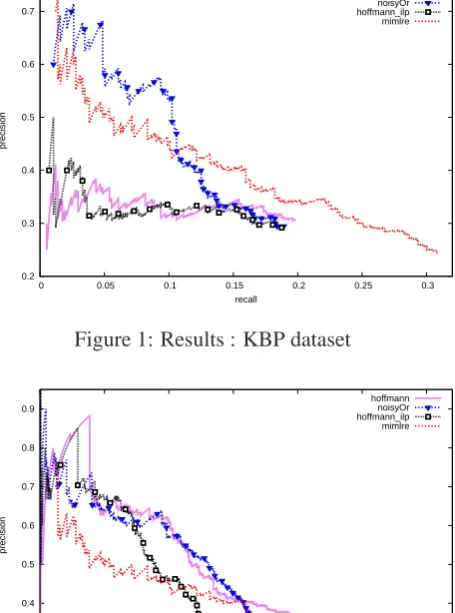
We would primarily like to highlight two settings on which we report the P/R curves and contrast it with Hoffmann et al. (2011). Firstly, we re-place the approximate inference in that work with our ILP-based exact inference; we call this set-ting the hoffmann-ilp. Secondly, we replace the deterministic-or in the model with a noisy-or, and call this setting the noisy-or. We further compare our approach with Surdeanu et al. (2012). The P/R curves for the various techniques on the two datasets are shown in Figures 1 and 2.
[image:4.595.311.539.65.230.2]We further report the highest F1 point in the P/R curve for both the datasets in Tables 1 and 2.
Table 1 : Highest F1 point in P/R curve : KBP Dataset Precision Recall F1
Hoffmann 0.306451619 0.197916672 0.2405063349 MIMLRE 0.28061223 0.286458343 0.2835051518 Noisy-OR 0.297002733 0.189236104 0.2311770916 Hoffmann-ilp 0.293010741 0.189236104 0.2299577976
Discussion
We would like to discuss the results in the above two scenarios.
5http://lpsolve.sourceforge.net/5.5/
0.2 0.3 0.4 0.5 0.6 0.7
0 0.05 0.1 0.15 0.2 0.25 0.3
precision
recall
hoffmann noisyOr hoffmann_ilp mimlre
Figure 1: Results : KBP dataset
0.2 0.3 0.4 0.5 0.6 0.7 0.8 0.9
0 0.05 0.1 0.15 0.2 0.25 0.3
precision
recall
hoffmann noisyOr hoffmann_ilp mimlre
Figure 2: Results : Riedel dataset
1. Performance of hoffmann-ilp
On the KBP dataset, we observe that hoffmann-ilp has higher precision in the range of 0.05 to 0.1 at lower recall (0 to 0.04). In other parts of the curve it is very close to the baseline (although hoffmann’s algorithm is slightly better). In Table 1, we notice that recall of hoffmann-ilp is lower in comparison with hoffmann’s algorithm.
On the Riedel dataset, we observe that hoffmann-ilp has better precision (0.15 to 0.2) than MIMLRE within recall of 0.1. At recall > 0.1, precision drops drastically. This is because, hoffmann-ilp predicts signif-icantly more nil labels. However, nil labels are not part of the label-set in the P/R curves reported in the community. In Table 2, we see that hoffmann-ilp has higher precision (0.04) compared to Hoffmann’s algorithm.
[image:4.595.310.538.76.383.2]Table 2 : Highest F1 point in P/R curve : Riedel Dataset Precision Recall F1 Hoffmann 0.32054795 0.24049332 0.27480916 MIMLRE 0.28061223 0.28645834 0.28350515 Noisy-OR 0.317 0.18139774 0.23075178 Hoffmann-ilp 0.36701337 0.12692702 0.18862161
In Figure 1 we see that there is a big jump in precision (around 0.4) of noisy-or com-pared to Hoffmann’s model in most parts of the curve on the KBP dataset. However, in Figure 2 (Riedel dataset), we do not see such a trend. Although, we do perform better than MIMLRE (Surdeanu et al., 2012) (precision
>0.15 for recall<0.15).
On both datasets, noisy-or has higher preci-sion than MIMLRE, as seen from Tables 1 and 2. However, the recall reduces. More in-vestigation in this direction is part of future work.
5 Conclusion
In this paper we described an important addition to Hoffmann’s model by the use of the noisy-or soft constraint to further relax the at least one assump-tion. Since we posed the inference procedures in Hoffmann using ILP, we could easily add this con-straint during the training and inference.
Empirically, we showed that the resulting P/R curves have a significant performance boost over Hoffmann’s algorithm as a result of this newly added constraint. Although our system has a lower recall when compared to MIMLRE (Surdeanu et al., 2012), it performs competitively w.r.t the pre-cision at low recall.
As part of immediate future work, we would like to improve the system recall. Our ILP for-mulation provides a good framework to add new type of constraints to the problem. In the future, we would like to experiment with other constraints like modeling the selectional preferences of entity types.
References
Mark Craven and Johan Kumlien. 1999. Constructing biological knowledge bases by extracting informa-tion from text sources. In Proceedings of the
Sev-enth International Conference on Intelligent Systems for Molecular Biology, pages 77–86. AAAI Press.
Zhou GuoDong, Su Jian, Zhang Jie, and Zhang Min. 2005. Exploring various knowledge in relation ex-traction. In Proceedings of the 43rd Annual Meeting
on Association for Computational Linguistics, ACL
’05, pages 427–434, Stroudsburg, PA, USA. Associ-ation for ComputAssoci-ational Linguistics.
Raphael Hoffmann, Congle Zhang, Xiao Ling,
Luke Zettlemoyer, and Daniel S. Weld. 2011. Knowledge-based weak supervision for information extraction of overlapping relations. In
Proceed-ings of the 49th Annual Meeting of the Association for Computational Linguistics: Human Language Technologies - Volume 1, HLT ’11, pages 541–550,
Stroudsburg, PA, USA. Association for Computa-tional Linguistics.
Mike Mintz, Steven Bills, Rion Snow, and Dan Ju-rafsky. 2009. Distant supervision for relation ex-traction without labeled data. In Proceedings of the
Joint Conference of the 47th Annual Meeting of the ACL and the 4th International Joint Conference on Natural Language Processing of the AFNLP: Vol-ume 2 - VolVol-ume 2, ACL ’09, pages 1003–1011,
Stroudsburg, PA, USA. Association for Computa-tional Linguistics.
Sebastian Riedel, Limin Yao, and Andrew McCal-lum. 2010. Modeling relations and their men-tions without labeled text. In Proceedings of the
2010 European conference on Machine learning and knowledge discovery in databases: Part III,
ECML PKDD’10, pages 148–163, Berlin, Heidel-berg. Springer-Verlag.
Dan Roth and Wen tau Yih. 2004. A linear program-ming formulation for global inference in natural lan-guage tasks. In In Proceedings of CoNLL-2004, pages 1–8.
Sampath Srinivas. 2013. A generalization of the noisy-or model. CoRR, abs/1303.1479.
Mihai Surdeanu and Massimiliano Ciaramita. 2007. Robust information extraction with perceptrons. In
Proceedings of the NIST 2007 Automatic Content Extraction Workshop (ACE07), March.
Mihai Surdeanu, Sonal Gupta, John Bauer, David Mc-Closky, Angel X. Chang, Valentin I. Spitkovsky, and Christopher D. Manning. 2011. Stanford’s distantly-supervised slot-filling system. In
Proceed-ings of the Fourth Text Analysis Conference (TAC 2011), Gaithersburg, Maryland, USA, November.
Mihai Surdeanu, Julie Tibshirani, Ramesh Nallapati, and Christopher D. Manning. 2012. Multi-instance multi-label learning for relation extraction. In
Pro-ceedings of the 2012 Joint Conference on Empirical Methods in Natural Language Processing and Com-putational Natural Language Learning,