Automatic Editing in a Back-End Speech-to-Text System
Maximilian Bisani Paul Vozila Olivier Divay Jeff Adams
Nuance Communications One Wayside Road Burlington, MA 01803, U.S.A.
{maximilian.bisani,paul.vozila,olivier.divay,jeff.adams}@nuance.com
Abstract
Written documents created through dictation differ significantly from a true verbatim tran-script of the recorded speech. This poses an obstacle in automatic dictation systems as speech recognition output needs to undergo a fair amount of editing in order to turn it into a document that complies with the cus-tomary standards. We present an approach that attempts to perform this edit from recog-nized words to final document automatically by learning the appropriate transformations from example documents. This addresses a number of problems in an integrated way, which have so far been studied independently, in particular automatic punctuation, text seg-mentation, error correction and disfluency re-pair. We study two different learning methods, one based on rule induction and one based on a probabilistic sequence model. Quantitative evaluation shows that the probabilistic method performs more accurately.
1 Introduction
Large vocabulary speech recognition today achieves a level of accuracy that makes it useful in the produc-tion of written documents. Especially in the medical and legal domains large volumes of text are tradi-tionally produced by means of dictation. Here docu-ment creation is typically a “back-end” process. The author dictates all necessary information into a tele-phone handset or a portable recording device and is not concerned with the actual production of the document any further. A transcriptionist will then
listen to the recorded dictation and produce a well-formed document using a word processor. The goal of introducing speech recognition in this process is to create a draft document automatically, so that the transcriptionist only has to verify the accuracy of the document and to fix occasional recognition errors. We observe that users try to spend as little time as possible dictating. They usually focus only on the content and rely on the transcriptionist to compose a readable, syntactically correct, stylistically accept-able and formally compliant document. For this rea-son there is a considerable discrepancy between the final document and what the speaker has said liter-ally. In particular in medical reports we see differ-ences of the following kinds:
• Punctuation marks are typically not verbalized.
• No instructions on the formatting of the report are dictated. Section headings are not identified as such.
• Frequently section headings are only implied. (“vitals are” → “PHYSICAL EXAMINATION: VITALSIGNS:”)
• Enumerated lists. Typically speakers use phrases like “number one . . . next number . . . ”, which need to be turned into “1. . . . 2. . . . ”
• The dictation usually begins with a preamble (e.g. “This is doctorXyz ...”) which does not appear in the report. Similarly there are typ-ical phrases at the end of the dictation which should not be transcribed (e.g. “End of dicta-tion. Thank you.”)
• There are specific standards regarding the use of medical terminology. Transcriptionists fre-quently expand dictated abbreviations (e.g. “CVA” → “cerebrovascular accident”) or oth-erwise use equivalent terms (e.g. “nonicteric sclerae”→“no scleral icterus”).
• The dictation typically has a more narrative style (e.g. “She has no allergies.”, “I examined him”). In contrast, the report is normally more impersonal and structured (e.g. “ALLERGIES: None.”, “he was examined”).
• For the sake of brevity, speakers frequently omit function words. (“patient” → “the pa-tient”, “denies fever pain” → “he denies any fever or pain”)
• As the dictation is spontaneous, disfluencies are quite frequent, in particular false starts, correc-tions and repeticorrec-tions. (e.g. “22-year-old fe-male, sorry, male 22-year-old male” → “22-year-old male”)
• Instruction to the transcriptionist and so-called normal reports, pre-defined text templates in-voked by a short phrase like “This is a normal chest x-ray.”
• In addition to the above, speech recognition output has the usual share of recognition errors some of which may occur systematically.
These phenomena pose a problem that goes beyond the speech recognition task which has traditionally focused on correctly identifying speech utterances. Even with a perfectly accurate verbatim transcript of the user’s utterances, the transcriptionist would need to perform a significant amount of editing to obtain a document conforming to the customary standards. We need to look for what the user wants rather than what he says.
Natural language processing research has ad-dressed a number of these issues as individual prob-lems: automatic punctuation (Liu et al., 2005), text segmentation (Beeferman et al., 1999; Matusov et al., 2003) disfluency repair (Heeman et al., 1996) and error correction (Ringger and Allen, 1996; Strzalkowski and Brandow, 1997; Peters and Drexel,
2004). The method we present in the following at-tempts to address all this by a unified transforma-tion model. The goal is simply stated as transform-ing the recognition output into a text document. We will first describe the general framework of learn-ing transformations from example documents. In the following two sections we will discuss a rule-induction-based and a probabilistic transformation method respectively. Finally we present experimen-tal results in the context of medical transcription and conclude with an assessment of both methods.
2 Text transformation
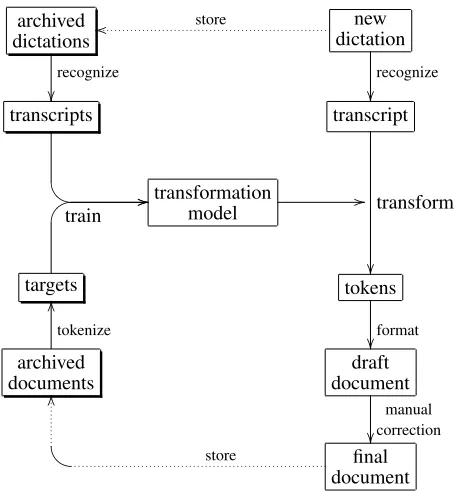
In dictation and transcription management systems corresponding pairs of recognition output and edited and corrected documents are readily available. The idea of transformation modeling, outlined in fig-ure 1, is to learn to emulate the transcriptionist. To this end we first process archived dictations with the speech recognizer to create approximate verbatim transcriptions. For each document this yields the spoken or source word sequence S = s1. . . sM, which is supposed to be a word-by-word transcrip-tion of the user’s utterances, but which may actu-ally contain recognition errors. The corresponding final reports are cleaned (removal of page headers etc.), tagged (identification of section headings and enumerated lists) and tokenized, yielding the text or
target token sequence T = t1...tN for each docu-ment. Generally, the token sequence corresponds to the spoken form. (E.g. “25mg” is tokenized as “twenty five milligrams”.) Tokens can be ordinary words or special symbols representing line breaks, section headings, etc. Specifically, we represent each section heading by a single indivisible token, even if the section name consists of multiple words. Enumerations are represented by special tokens, too. Different techniques can be applied to learn and ex-ecute the actual transformation fromS to T. Two options are discussed in the following.
archived dictations
recognize
new dictation
recognize
store
oo
transcripts
@A
train //
transcript
transform
transformation
model //
targets
GF //
tokens
format
archived documents
tokenize
OO
draft document
manual correction
final document @A
store
[image:3.612.71.298.69.316.2]OO
Figure 1: Illustration of how text transformation is inte-grated into a speech-to-text system.
inverse of tokenization and includes conversion of number words to digits, rendition of paragraphs and section headings, etc.
Before we turn to concrete transformation tech-niques, we can make two general statements about this problem. Firstly, in the absence of observa-tions to the contrary, it is reasonable to leave words unchanged. So, a priori the mapping should be the identity. Secondly, the transformation is mostly monotonous. Out-of-order sections do occur but are the exception rather than the rule.
3 Transformation based learning
Following Strzalkowski and Brandow (1997) and Peters and Drexel (2004) we have implemented a transformation-based learning (TBL) algorithm (Brill, 1995). This method iteratively improves the match (as measured by token error rate) of a col-lection of corresponding source and target token se-quences by positing and applying a sequence of sub-stitution rules. In each iteration the source and tar-get tokens are aligned using a minimum edit dis-tance criterion. We refer to maximal contiguous subsequences of non-matching tokens as error
re-gions. These consist of paired sequences of source and target tokens, where either sequence may be empty. Each error region serves as a candidate sub-stitution rule. Additionally we consider refinements of these rules with varying amounts of contiguous context tokens on either side. Deviating from Peters and Drexel (2004), in the special case of an empty target sequence, i.e. a deletion rule, we consider deleting all (non-empty) contiguous subsequences of the source sequence as well. For each candi-date rule we accumulate two counts: the number of exactly matching error regions and the number of false alarms, i.e. when its left-hand-side matches a sequence of already correct tokens. Rules are ranked by the difference in these counts scaled by the number of errors corrected by a single rule ap-plication, which is the length of the corresponding error region. This is an approximation to the to-tal number of errors corrected by a rule, ignoring rule interactions and non-local changes in the mini-mum edit distance alignment. A subset of the top-ranked non-overlapping rules satisfying frequency and minimum impact constraints are selected and the source sequences are updated by applying the se-lected rules. Again deviating from Peters and Drexel (2004), we consider two rules as overlapping if the left-hand-side of one is a contiguous subsequence of the other. This procedure is iterated until no ad-ditional rules can be selected. The initial rule set is populated by a small sequence of hand-crafted rules (e.g. “impression colon”→“IMPRESSION:”). A user-independent baseline rule set is generated by applying the algorithm to data from a collec-tion of users. We construct speaker-dependent mod-els by initializing the algorithm with the speaker-independent rule set and applying it to data from the given user.
4 Probabilistic model
The canonical approach to text transformation fol-lowing statistical decision theory is to maximize the text document posterior probability given the spoken document.
T∗ = argmax
T
p(T|S) (1)
cor-respondence between source and target words. We use a 1-to-n alignment scheme. This means each source word is assigned to a sequence of zero, one or more target words. We denote the target words assigned to source wordsiasτi. Each replacement
τi is a possibly empty sequence of target words. A source word together with its replacement sequence will be called asegment. We constrain the set of pos-sible transformations by selecting a relatively small set of allowable replacements A(s) to each source word. This means we requireτi ∈ A(si). We use the usualm-gram approximation to model the joint probability of a transformation:
p(S, T) =
M Y
i=1
p(si, τi|si−m+1, τi−m+1, . . . si−1, τi−1)
(2) The work of Ringger and Allen (1996) is similar in spirit to this method, but uses a factored source-channel model. Note that the decision rule (1) is over whole documents. Therefore we processes complete documents at a time without prior segmen-tation into sentences.
To estimate this model we first align all training documents. That is, for each document, the tar-get word sequence is segmented into M segments
T =τ1^. . .^τM. The criterion for this alignment
is to maximize the likelihood of a segment unigram model. The alignment is performed by an expec-tation maximization algorithm. Subsequent to the alignment step, m-gram probabilities are estimated by standard language modeling techniques. We cre-ate speaker-specific models by linearly interpolating anm-gram model based on data from the user with a speaker-independent background m-gram model trained on data pooled from a collection of users.
To select the allowable replacements for each source word we count how often each particular tar-get sequence is aligned to it in the training data. A source target pair is selected if it occurs twice or more times. Source words that were not observed in training are immutable, i.e. the word itself is its only allowable replacementA(s) = {(s)}. As an example suppose “patient” was deleted 10 times, left unchanged 105 times, replaced by “the patient” 113 times and once replaced by “she”. The word patient would then have three allowables: A(patient) =
{(),(patient),(the,patient)}.)
The decision rule (1) minimizes the document er-ror rate. A more appropriate loss function is the number of source words that are replaced incor-rectly. Therefore we use the following minimum word risk (MWR) decision strategy, which mini-mizes source word loss.
T∗= (argmax
τ1∈A(si)
p(τ1|S))^. . .^( argmax
τM∈A(sM)
p(τM|S))
(3) This means for each source sequence position we choose the replacement that has the highest poste-rior probability p(τi|S) given the entire source se-quence. To compute the posterior probabilities, first a graph is created representing alternatives “around” the most probable transform using beam search. Then the forward-backward algorithm is applied to compute edge posterior probabilities. Finally edge posterior probabilities for each source position are accumulated.
5 Experimental evaluation
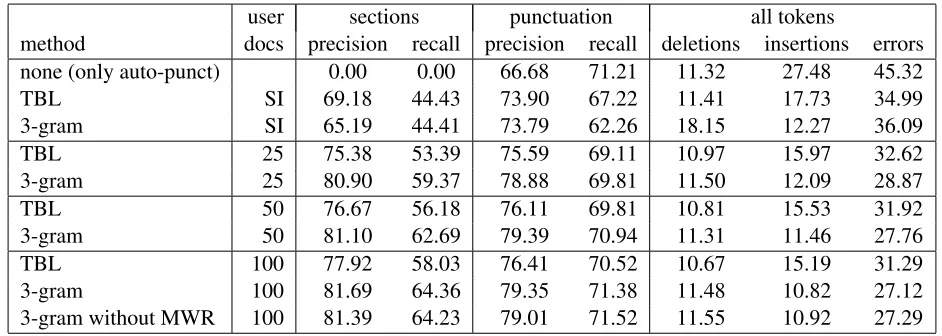
Table 1: Experimental evaluation of different text transformation techniques with different amounts of user-specific data. Precision, recall, deletion, insertion and error rate values are given in percent and represent the average of 51 users, where the results for each user are the ratios of sums over 30 reports.
user sections punctuation all tokens
method docs precision recall precision recall deletions insertions errors none (only auto-punct) 0.00 0.00 66.68 71.21 11.32 27.48 45.32
TBL SI 69.18 44.43 73.90 67.22 11.41 17.73 34.99
3-gram SI 65.19 44.41 73.79 62.26 18.15 12.27 36.09
TBL 25 75.38 53.39 75.59 69.11 10.97 15.97 32.62
3-gram 25 80.90 59.37 78.88 69.81 11.50 12.09 28.87
TBL 50 76.67 56.18 76.11 69.81 10.81 15.53 31.92
3-gram 50 81.10 62.69 79.39 70.94 11.31 11.46 27.76 TBL 100 77.92 58.03 76.41 70.52 10.67 15.19 31.29 3-gram 100 81.69 64.36 79.35 71.38 11.48 10.82 27.12 3-gram without MWR 100 81.39 64.23 79.01 71.52 11.55 10.92 27.29
reader of the document.) For each doctor a back-ground transformation model was constructed using 100 reports from each of theotherusers. This is re-ferred to as the speaker-independent (SI) model. In the case of the probabilistic model, all models were 3-gram models. User-specific models were created by augmenting the SI model with 25, 50 or 100 re-ports. One report from the test set is shown as an example in the appendix.
5.1 Evaluation metric
The output of the text transformation is aligned with the corresponding tokenized report using a mini-mum edit cost criterion. Alignments between sec-tion headings and non-secsec-tion headings are not per-mitted. Likewise no alignment of punctuation and non-punctuation tokens is allowed. Using the align-ment we compute precision and recall for sections headings and punctuation marks as well as the over-all token error rate. It should be noted that the so de-rived error rate is not comparable to word error rates usually reported in speech recognition research. All missing or erroneous section headings, punctuation marks and line breaks are counted as errors. As pointed out in the introduction the reference texts do not represent a literal transcript of the dictation. Fur-thermore the data were not cleaned manually. There are, for example, instances of letter heads or page numbers that were not correctly removed when the text was extracted from the word processor’s file
for-mat. The example report shown in the appendix features some of the typical differences between the produced draft and the final report that may or may not be judged as errors. (For example, the date of the report was not given in the dictation, the sec-tion names “laboratory data” and “laboratory evalu-ation” are presumably equivalent and whether “sta-ble” is preceded by a hyphen or a period in the last section might not be important.) Nevertheless, the numbers reported do permit a quantitative compari-son between different methods.
5.2 Results
supe-rior ability to remove utterances that are not typi-cally part of the report. On the other hand the prob-abilistic model suffers from a slightly higher dele-tion rate due to being overzealous in this regard. In speaker independent mode, however, the deletion rate is excessively high and leads to inferior overall performance. Interestingly the precision of the au-tomatic punctuation is increased by the transforma-tion step, without compromising on recall, at least when enough user specific training data is available. The minimum word risk criterion (3) yields slightly better results than the simpler document risk crite-rion (1).
6 Conclusions
Automatic text transformation brings speech recog-nition output much closer to the end result desired by the user of a back-end dictation system. It au-tomatically punctuates, sections and rephrases the document and thereby greatly enhances transcrip-tionist productivity. The holistic approach followed here is simpler and more comprehensive than a cas-cade of more specialized methods. Whether or not the holistic approach is also more accurate is not an easy question to answer. Clearly the outcome would depend on the specifics of the specialized methods one would compare to, as well as the complexity of the integrated transformation model one applies. The simple models studied in this work admittedly have little provisions for targeting specific transfor-mation problems. For example the typical length of a section is not taken into account. However, this is not a limitation of the general approach. We have observed that a simple probabilistic sequence model performs consistently better than the transformation-based learning approach. Even though neither of both methods is novel, we deem this an important finding since none of the previous publications we know of in this domain allow this conclusion. While the present experiments have used a separate auto-punctuation step, future work will aim to eliminate it by integrating the punctuation features into the transformation step. In the future we plan to inte-grate additional knowledge sources into our statis-tical method in order to more specifically address each of the various phenomena encountered in spon-taneous dictation.
References
Beeferman, Doug, Adam Berger, and John Lafferty. 1999. Statistical models for text segmentation.
Machine Learning, 34(1-3):177 – 210.
Brill, Eric. 1995. Transformation-based error-driven learning and natural language processing: A case study in part-of-speech tagging. Computational Linguistics, 21(4):543 – 565.
Heeman, Peter A., Kyung-ho Loken-Kim, and James F. Allen. 1996. Combining the detec-tion and correcdetec-tion of speech repairs. In Proc. Int. Conf. Spoken Language Processing (ICSLP), pages 362 – 365. Philadelphia, PA, USA.
Liu, Yang, Andreas Stolcke, Elizabeth Shriberg, and Mary Harper. 2005. Using conditional random fields for sentence boundary detection in speech. InProc. Annual Meeting of the ACL, pages 451 – 458. Ann Arbor, MI, USA.
Matusov, Evgeny, Jochen Peters, Carsten Meyer, and Hermann Ney. 2003. Topic segmentation using markov models on section level. In Proc. IEEE Workshop on Automatic Speech Recogni-tion and Understanding (ASRU), pages 471 – 476. IEEE, St. Thomas, U.S. Virgin Islands.
Peters, Jochen and Christina Drexel. 2004. Transformation-based error correction for speech-to-text systems. InProc. Int. Conf. Spoken Lan-guage Processing (ICSLP), pages 1449 – 1452. Jeju Island, Korea.
Ringger, Eric K. and James F. Allen. 1996. A fertil-ity channel model for post-correction of continu-ous speech recognition. InProc. Int. Conf. Spoken Language Processing (ICSLP), pages 897 – 900. Philadelphia, PA, USA.