Semantic Parsing as Machine Translation
Jacob Andreas
Computer Laboratory University of Cambridge
Andreas Vlachos
Computer Laboratory University of Cambridge
Stephen Clark
Computer Laboratory University of Cambridge
Abstract
Semantic parsing is the problem of de-riving a structured meaning representation from a natural language utterance. Here we approach it as a straightforward ma-chine translation task, and demonstrate that standard machine translation com-ponents can be adapted into a semantic parser. In experiments on the multilingual GeoQuery corpus we find that our parser is competitive with the state of the art, and in some cases achieves higher accu-racy than recently proposed purpose-built systems. These results support the use of machine translation methods as an infor-mative baseline in semantic parsing evalu-ations, and suggest that research in seman-tic parsing could benefit from advances in machine translation.
1 Introduction
Semantic parsing (SP) is the problem of trans-forming a natural language (NL) utterance into a machine-interpretable meaning representation (MR). It is well-studied in NLP, and a wide va-riety of methods have been proposed to tackle it, e.g. rule-based (Popescu et al., 2003), super-vised (Zelle, 1995), unsupersuper-vised (Goldwasser et al., 2011), and response-based (Liang et al., 2011). At least superficially, SP is simply a machine translation (MT) task: we transform an NL ut-terance in one language into a statement of an-other (un-natural) meaning representation lan-guage (MRL). Indeed, successful semantic parsers often resemble MT systems in several impor-tant respects, including the use of word align-ment models as a starting point for rule extrac-tion (Wong and Mooney, 2006; Kwiatkowski et al., 2010) and the use of automata such as tree transducers (Jones et al., 2012) to encode the re-lationship between NL and MRL.
The key difference between the two tasks is that in SP, the target language (the MRL) has very dif-ferent properties to an NL. In particular, MRs must conform strictly to a particular structure so that they are machine-interpretable. Contrast this with ordinary MT, where varying degrees of wrongness are tolerated by human readers (and evaluation metrics). To avoid producing malformed MRs, al-most all of the existing research on SP has focused on developing models with richer structure than those commonly used for MT.
In this work we attempt to determine how ac-curate a semantic parser we can build by treating SP as a pure MT task, and describe pre- and post-processing steps which allow structure to be pre-served in the MT process.
Our contributions are as follows: We develop a semantic parser using off-the-shelf MT compo-nents, exploring phrase-based as well as hierarchi-cal models. Experiments with four languages on the popular GeoQuery corpus (Zelle, 1995) show that our parser is competitve with the state-of-the-art, in some cases achieving higher accuracy than recently introduced purpose-built semantic parsers. Our approach also appears to require substantially less time to train than the two best-performing semantic parsers. These results sup-port the use of MT methods as an informative baseline in SP evaluations and show that research in SP could benefit from research advances in MT.
2 MT-based semantic parsing
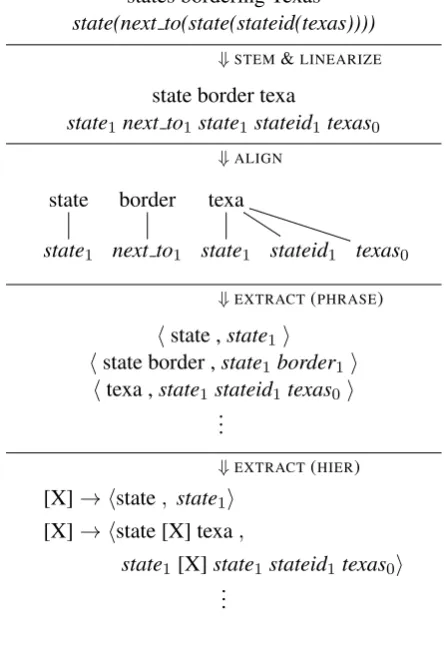
The input is a corpus of NL utterances paired with MRs. In order to learn a semantic parser using MT we linearize the MRs, learn alignments be-tween the MRL and the NL, extract translation rules, and learn a language model for the MRL. We also specify a decoding procedure that will re-turn structured MRs for an utterance during pre-diction.
states bordering Texas
state(next to(state(stateid(texas)))) ⇓STEM&LINEARIZE
state border texa
state1next to1state1 stateid1texas0
⇓ALIGN
state border texa
state1 next to1 state1 stateid1 texas0
⇓EXTRACT(PHRASE)
hstate ,state1i
hstate border ,state1border1i
htexa ,state1stateid1 texas0i
...
⇓EXTRACT(HIER) [X]→ hstate, state1i
[X]→ hstate [X] texa,
state1[X]state1stateid1 texas0i
[image:2.595.69.292.69.392.2]...
Figure 1: Illustration of preprocessing and rule ex-traction.
Linearization We assume that the MRL is variable-free (that is, the meaning representation for each utterance is tree-shaped), noting that for-malisms with variables, like the λ-calculus, can be mapped onto variable-free logical forms with combinatory logics (Curry et al., 1980).
In order to learn a semantic parser using MT we begin by converting these MRs to a form more similar to NL. To do so, we simply take a preorder traversal of every functional form, and label every function with the number of arguments it takes. After translation, recovery of the function is easy: if the arity of every function in the MRL is known, then every traversal uniquely specifies its corre-sponding tree. Using an example from GeoQuery, given an input function of the form
answer(population(city(cityid(‘seattle’, ‘wa’))))
we produce a “decorated” translation input of the form
answer1 population1city1 cityid2seattle0wa0
where each subscript indicates the symbol’s arity (constants, including strings, are treated as zero-argument functions). Explicit zero-argument number
labeling serves two functions. Most importantly, it eliminates any possible ambiguity from the tree reconstruction which takes place during decod-ing: given any sequence of decorated MRL to-kens, we can always reconstruct the correspond-ing tree structure (if one exists). Arity labelcorrespond-ing ad-ditionally allows functions with variable numbers of arguments (e.g. cityid, which in some training examples is unary) to align with different natural language strings depending on context.
Alignment Following the linearization of the MRs, we find alignments between the MR tokens and the NL tokens using the IBM Model 4 (Brown et al., 1993). Once the alignment algorithm is run in both directions (NL to MRL, MRL to NL), we symmetrize the resulting alignments to obtain a consensus many-to-many alignment (Och and Ney, 2000; Koehn et al., 2005).
Rule extraction From the many-to-many align-ment we need to extract a translation rule ta-ble, consisting of corresponding phrases in NL and MRL. We consider a phrase-based transla-tion model (Koehn et al., 2003) and a hierarchi-cal translation model (Chiang, 2005). Rules for the phrase-based model consist of pairs of aligned source and target sequences, while hierarchical rules are SCFG productions containing at most two instances of a single nonterminal symbol.
Note that both extraction algorithms can learn rules which a traditional tree-transducer-based ap-proach cannot—for example the right hand side
[X]river1all0traverse1 [X]
corresponding to the pair of disconnected tree fragments:
[X]
traverse
river
[X]
all
(where eachXindicates a gap in the rule).
structures; it encodes, for example, the preferences of predicates of the MRL for certain arguments.
Prediction Given a new NL utterance, we need to find the n best translations (i.e. sequences of decorated MRL tokens) that maximize the weighted sum of the translation score (the prob-abilities of the translations according to the rule translation table) and the language model score, a process usually referred to as decoding. Standard decoding procedures for MT produce ann-best list of all possible translations, but here we need to restrict ourselves to translations corresponding to well-formed MRs. In principle this could be done by re-writing the beam search algorithm used in decoding to immediately discard malformed MRs; for the experiments in this paper we simply filter the regularn-best list until we find a well-formed MR. This filtering can be done with time linear in the length of the example by exploiting the argu-ment label numbers introduced during lineariza-tion. Finally, we insert the brackets according to the tree structure specified by the argument num-ber labels.
3 Experimental setup
Dataset We conduct experiments on the Geo-Query data set. The corpus consists of a set of 880 natural-language questions about U.S. geog-raphy in four languages (English, German, Greek and Thai), and their representations in a variable-free MRL that can be executed against a Prolog database interface. Initial experimentation was done using 10 fold cross-validation on the 600-sentence development set and the final evaluation on a held-out test set of 280 sentences. All seman-tic parsers for GeoQuery we compare against also makes use of NP lists(Jones et al., 2012), which contain MRs for every noun phrase that appears in the NL utterances of each language. In our exper-iments, the NP list was included by appending all entries as extra training sentences to the end of the training corpus of each language with 50 times the weight of regular training examples, to ensure that they are learned as translation rules.
Evaluation for each utterance is performed by executing both the predicted and the gold standard MRs against the database and obtaining their re-spective answers. An MR is correct if it obtains the same answer as the gold standard MR, allow-ing for a fair comparison between systems usallow-ing different learning paradigms. Following Jones et
al. (2012) we report accuracy, i.e. the percent-age of NL questions with correct answers, and F1,
i.e. the harmonic mean of precision (percentage of correct answers obtained).
Implementation In all experiments, we use the IBM Model 4 implementation from the GIZA++ toolkit (Och and Ney, 2000) for alignment, and the phrase-based and hierarchical models imple-mented in the Moses toolkit (Koehn et al., 2007) for rule extraction. The best symmetrization algo-rithm, translation and language model weights for each language are selected using cross-validation on the development set. In the case of English and German, we also found that stemming (Bird et al., 2009; Porter, 1980) was hepful in reducing data sparsity.
4 Results
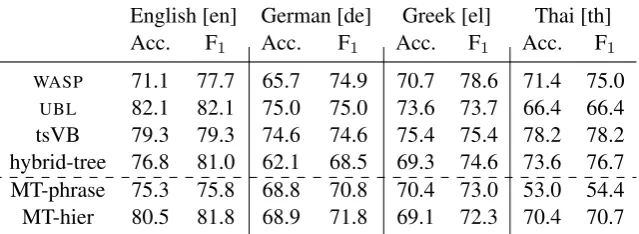
We first compare the results for the two translation rule extraction models, phrase-based and hierar-chical (“MT-phrase” and “MT-hier” respectively in Table 1). We find that the hierarchical model performs better in all languages apart from Greek, indicating that the long-range reorderings learned by a hierarchical translation system are useful for this task. These benefits are most pronounced in the case of Thai, likely due to the the language’s comparatively different word order.
We also present results for both models with-out using the NP lists for training in Table 2. As expected, the performances are almost uniformly lower, but the parser still produces correct output for the majority of examples.
As discussed above, one important modifica-tion of the MT paradigm which allows us to pro-duce structured output is the addition of structure-checking to the beam search. It is not evident,
a priori, that this search procedure is guaran-teed to find any well-formed outputs in reasonable time; to test the effect of this extra requirement on
en de el th
MT-phrase 75.3 68.8 70.4 53.0
MT-phrase (-NP) 63.4 65.8 64.0 39.8
MT-hier 80.5 68.9 69.1 70.4
MT-hier (-NP) 62.5 69.9 62.9 62.1
English [en] German [de] Greek [el] Thai [th]
Acc. F1 Acc. F1 Acc. F1 Acc. F1
WASP 71.1 77.7 65.7 74.9 70.7 78.6 71.4 75.0
UBL 82.1 82.1 75.0 75.0 73.6 73.7 66.4 66.4
tsVB 79.3 79.3 74.6 74.6 75.4 75.4 78.2 78.2
hybrid-tree 76.8 81.0 62.1 68.5 69.3 74.6 73.6 76.7
MT-phrase 75.3 75.8 68.8 70.8 70.4 73.0 53.0 54.4
[image:4.595.140.460.65.182.2]MT-hier 80.5 81.8 68.9 71.8 69.1 72.3 70.4 70.7
Table 1: Accuracy and F1 scores for the multilingual GeoQuery test set. Results for other systems as
reported by Jones et al. (2012).
the speed of SP, we investigate how many MRs the decoder needs to generate before producing one which is well-formed. In practice, increasing search depth in then-best list from 1 to 50 results in a gain of no more than a percentage point or two, and we conclude that our filtering method is appropriate for the task.
We also compare the MT-based semantic parsers to several recently published ones: WASP (Wong and Mooney, 2006), which like the hier-archical model described here learns a SCFG to translate between NL and MRL; tsVB (Jones et al., 2012), which uses variational Bayesian infer-ence to learn weights for a tree transducer; UBL (Kwiatkowski et al., 2010), which learns a CCG lexicon with semantic annotations; and hybrid-tree (Lu et al., 2008), which learns a synchronous generative model over variable-free MRs and NL strings.
In the results shown in Table 1 we observe that on English GeoQuery data, the hierarchical trans-lation model achieves scores competitive with the state of the art, and in every language one of the MT systems achieves accuracy at least as good as a purpose-built semantic parser.
We conclude with an informal test of training speeds. While differences in implementation and factors like programming language choice make a direct comparison of times necessarily impre-cise, we note that the MT system takes less than three minutes to train on the GeoQuery corpus, while the publicly-available implementations of tsVB andUBLrequire roughly twenty minutes and five hours respectively on a 2.1 GHz CPU. So in addition to competitive performance, the MT-based parser also appears to be considerably more efficient at training time than other parsers in the literature.
5 Related Work
WASP, an early automatically-learned SP system, was strongly influenced by MT techniques. Like the present work, it uses GIZA++ alignments as a starting point for the rule extraction procedure, and algorithms reminiscent of those used in syn-tactic MT to extract rules.
tsVB also uses a piece of standard MT ma-chinery, specifically tree transducers, which have been profitably employed for syntax-based ma-chine translation (Maletti, 2010). In that work, however, the usual MT parameter-estimation tech-nique of simply counting the number of rule oc-currences does not improve scores, and the au-thors instead resort to a variational inference pro-cedure to acquire rule weights. The present work is also the first we are aware of which uses phrase-based rather than tree-phrase-based machine translation techniques to learn a semantic parser. hybrid-tree (Lu et al., 2008) similarly describes a generative model over derivations of MRL trees.
The remaining system discussed in this paper, UBL(Kwiatkowski et al., 2010), leverages the fact that the MRL does not simply encode trees, but ratherλ-calculus expressions. It employs resolu-tion procedures specific to theλ-calculus such as splitting and unification in order to generate rule templates. Like other systems described, it uses GIZA alignments for initialization. Other work which generalizes from variable-free meaning rep-resentations toλ-calculus expressions includes the natural language generation procedure described by Lu and Ng (2011).
multi-level rules composed from smaller rules, a process similar to the one used for creating phrase tables in a phrase-based MT system.
6 Discussion
Our results validate the hypothesis that it is possi-ble to adapt an ordinary MT system into a work-ing semantic parser. In spite of the compara-tive simplicity of the approach, it achieves scores comparable to (and sometimes better than) many state-of-the-art systems. For this reason, we argue for the use of a machine translation baseline as a point of comparison for new methods. The results also demonstrate the usefulness of two techniques which are crucial for successful MT, but which are not widely used in semantic parsing. The first is the incorporation of a language model (or com-parable long-distance structure-scoring model) to assign scores to predicted parses independent of the transformation model. The second is the use of large, composed rules (rather than rules which trigger on only one lexical item, or on tree portions of limited depth (Lu et al., 2008)) in order to “memorize” frequently-occurring large-scale structures.
7 Conclusions
We have presented a semantic parser which uses techniques from machine translation to learn map-pings from natural language to variable-free mean-ing representations. The parser performs com-parably to several recent purpose-built semantic parsers on the GeoQuery dataset, while training considerably faster than state-of-the-art systems. Our experiments demonstrate the usefulness of several techniques which might be broadly applied to other semantic parsers, and provides an infor-mative basis for future work.
Acknowledgments
Jacob Andreas is supported by a Churchill Schol-arship. Andreas Vlachos is funded by the Eu-ropean Community’s Seventh Framework Pro-gramme (FP7/2007-2013) under grant agree-ment no. 270019 (SPACEBOOK project www. spacebook-project.eu).
References
Steven Bird, Edward Loper, and Edward Klein. 2009. Natural Language Processing with Python. O’Reilly Media, Inc.
Peter F. Brown, Vincent J. Della Pietra, Stephen A. Della Pietra, and Robert L. Mercer. 1993. The mathematics of statistical machine translation: parameter estimation. Computational Linguistics, 19(2):263–311.
David Chiang. 2005. A hierarchical phrase-based model for statistical machine translation. In Pro-ceedings of the 43rd Annual Meeting on Association for Computational Linguistics, pages 263–270, Ann Arbor, Michigan.
H.B. Curry, J.R. Hindley, and J.P. Seldin. 1980. To H.B. Curry: Essays on Combinatory Logic, Lambda Calculus, and Formalism. Academic Press.
Dan Goldwasser, Roi Reichart, James Clarke, and Dan Roth. 2011. Confidence driven unsupervised se-mantic parsing. In Proceedings of the 49th An-nual Meeting of the Association for Computational Linguistics: Human Language Technologies, pages 1486–1495, Portland, Oregon.
Bevan K. Jones, Mark Johnson, and Sharon Goldwater. 2012. Semantic parsing with bayesian tree transduc-ers. InProceedings of the 50th Annual Meeting of the Association of Computational Linguistics, pages 488–496, Jeju, Korea.
Philipp Koehn, Franz Josef Och, and Daniel Marcu. 2003. Statistical phrase-based translation. In Pro-ceedings of the 2003 Human Language Technology Conference of the North American Chapter of the Association for Computational Linguistics, pages 48–54, Edmonton, Canada.
Philipp Koehn, Amittai Axelrod, Alexandra Birch-Mayne, Chris Callison-Burch, Miles Osborne, and David Talbot. 2005. Edinburgh System Descrip-tion for the 2005 IWSLT Speech TranslaDescrip-tion Evalu-ation. InProceedings of the International Workshop on Spoken Language Translation.
Philipp Koehn, Hieu Hoang, Alexandra Birch, Chris Callison-Burch, Marcello Federico, Nicola Bertoldi, Brooke Cowan, Wade Shen, Christine Moran, Richard Zens, Chris Dyer, Ondˇrej Bojar, Alexandra Constantin, and Evan Herbst. 2007. Moses: open source toolkit for statistical machine translation. In Proceedings of the 45th Annual Meeting of the As-sociation for Computational Linguistics Companion Volume Proceedings of the Demo and Poster Ses-sions, pages 177–180, Prague, Czech Republic.
Tom Kwiatkowski, Luke Zettlemoyer, Sharon Goldwa-ter, and Mark Steedman. 2010. Inducing proba-bilistic ccg grammars from logical form with higher-order unification. InProceedings of the 2010 Con-ference on Empirical Methods in Natural Language Processing, pages 1223–1233, Cambridge, Mas-sachusetts.
the Association for Computational Linguistics: Hu-man Language Technologies, pages 590–599, Port-land, Oregon.
Wei Lu and Hwee Tou Ng. 2011. A probabilistic forest-to-string model for language generation from typed lambda calculus expressions. InProceedings of the Conference on Empirical Methods in Natu-ral Language Processing, EMNLP ’11, pages 1611– 1622. Association for Computational Linguistics.
Wei Lu, Hwee Tou Ng, Wee Sun Lee, and Luke Zettle-moyer. 2008. A generative model for parsing nat-ural language to meaning representations. In Pro-ceedings of the 2008 Conference on Empirical Meth-ods in Natural Language Processing, pages 783– 792, Edinburgh, UK.
Andreas Maletti. 2010. Survey: Tree transducers in machine translation. In Proceedings of the 2nd Workshop on Non-Classical Models for Automata and Applications, Jena, Germany.
Franz Josef Och and Hermann Ney. 2000. Improved statistical alignment models. InProceedings of the 38th Annual Meeting of the Association for Com-putational Linguistics, pages 440–447, Hong Kong, China.
Ana-Maria Popescu, Oren Etzioni, and Henry Kautz. 2003. Towards a theory of natural language inter-faces to databases. InProceedings of the 8th Inter-national Conference on Intelligent User Interfaces, pages 149–157, Santa Monica, CA.
M. Porter. 1980. An algorithm for suffix stripping. Program, 14(3):130–137.
Yuk Wah Wong and Raymond Mooney. 2006. Learn-ing for semantic parsLearn-ing with statistical machine translation. InProceedings of the 2006 Human Lan-guage Technology Conference of the North Amer-ican Chapter of the Association of Computational Linguistics, pages 439–446, New York.