Learning Stochastic OT Grammars: A Bayesian approach
using Data Augmentation and Gibbs Sampling
Ying Lin∗
Department of Linguistics University of California, Los Angeles
Los Angeles, CA 90095 [email protected]
Abstract
Stochastic Optimality Theory (Boersma, 1997) is a widely-used model in linguis-tics that did not have a theoretically sound learning method previously. In this pa-per, a Markov chain Monte-Carlo method is proposed for learning Stochastic OT Grammars. Following a Bayesian frame-work, the goal is finding the posterior dis-tribution of the grammar given the rela-tive frequencies of input-output pairs. The Data Augmentation algorithm allows one to simulate a joint posterior distribution by iterating two conditional sampling steps. This Gibbs sampler constructs a Markov chain that converges to the joint distribu-tion, and the target posterior can be de-rived as its marginal distribution.
1 Introduction
Optimality Theory (Prince and Smolensky, 1993) is a linguistic theory that dominates the field of phonology, and some areas of morphology and syn-tax. The standard version of OT contains the follow-ing assumptions:
• A grammar is a set of ordered constraints({Ci:
i= 1,· · · , N}, >);
• Each constraint Ci is a function: Σ∗ →
{0,1,· · · }, whereΣ∗is the set of strings in the language;
∗
The author thanks Bruce Hayes, Ed Stabler, Yingnian Wu, Colin Wilson, and anonymous reviewers for their comments.
• Each underlying form u corresponds to a set of candidates GEN(u). To obtain the unique surface form, the candidate set is successively filtered according to the order of constraints, so that only the most harmonic candidates remain after each filtering. If only 1 candidate is left in the candidate set, it is chosen as the optimal output.
The popularity of OT is partly due to learning al-gorithms that induce constraint ranking from data. However, most of such algorithms cannot be ap-plied to noisy learning data. Stochastic Optimality Theory (Boersma, 1997) is a variant of Optimality Theory that tries to quantitatively predict linguis-tic variation. As a popular model among linguists that are more engaged with empirical data than with formalisms, Stochastic OT has been used in a large body of linguistics literature.
In Stochastic OT, constraints are regarded as independent normal distributions with unknown means and fixed variance. As a result, the stochastic constraint hierarchy generates systematic linguistic variation. For example, consider a grammar with 3 constraints, C1 ∼ N(µ1, σ2), C2 ∼ N(µ2, σ2),
C3 ∼N(µ3, σ2), and 2 competing candidates for a
given inputx:
p(.) C1 C2 C3 x ∼ y1 .77 0 0 1
x ∼ y2 .23 1 1 0
Table 1: A Stochastic OT grammar with 1 input and 2 outputs
The probabilities p(.) are obtained by repeatedly sampling the 3 normal distributions, generating the winning candidate according to the ordering of con-straints, and counting the relative frequencies in the outcome. As a result, the grammar will assign non-zero probabilities to a given set of outputs, as shown above.
The learning problem of Stochastic OT involves fitting a grammar G ∈ RN to a set of candidates with frequency counts in a corpus. For example, if the learning data is the above table, we need to find an estimate of G = (µ1, µ2, µ3)1 so that the
following ordering relations hold with certain prob-abilities:
max{C1, C2}> C3; with probability.77 max{C1, C2}< C3; with probability.23 (1)
The current method for fitting Stochastic OT mod-els, used by many linguists, is the Gradual Learn-ing Algorithm (GLA) (Boersma and Hayes, 2001). GLA looks for the correct ranking values by using the following heuristic, which resembles gradient descent. First, an input-output pair is sampled from the data; second, an ordering of the constraints is sampled from the grammar and used to generate an output; and finally, the means of the constraints are updated so as to minimize the error. The updating is done by adding or subtracting a “plasticity” value that goes to zero over time. The intuition behind GLA is that it does “frequency matching”, i.e. look-ing for a better match between the output frequen-cies of the grammar and those in the data.
As it turns out, GLA does not work in all cases2, and its lack of formal foundations has been ques-tioned by a number of researchers (Keller and Asudeh, 2002; Goldwater and Johnson, 2003). However, considering the broad range of linguistic data that has been analyzed with Stochastic OT, it seems unadvisable to reject this model because of the absence of theoretically sound learning meth-ods. Rather, a general solution is needed to eval-uate Stochastic OT as a model for linguistic varia-tion. In this paper, I introduce an algorithm for learn-ing Stochastic OT grammars uslearn-ing Markov chain Monte-Carlo methods. Within a Bayesian
frame-1Up to translation by an additive constant. 2
Two examples included in the experiment section. See 6.3.
work, the learning problem is formalized as find-ing the posterior distribution of rankfind-ing values (G) given the information on constraint interaction based on input-output pairs (D). The posterior contains all the information needed for linguists’ use: for exam-ple, if there is a grammar that will generate the exact frequencies as in the data, such a grammar will ap-pear as a mode of the posterior.
In computation, the posterior distribution is sim-ulated with MCMC methods because the likeli-hood function has a complex form, thus making a maximum-likelihood approach hard to perform. Such problems are avoided by using the Data
Aug-mentation algorithm (Tanner and Wong, 1987) to
make computation feasible: to simulate the pos-terior distribution G ∼ p(G|D), we augment the parameter space and simulate a joint distribution
(G, Y) ∼ p(G, Y|D). It turns out that by setting Y as the value of constraints that observe the de-sired ordering, simulating from p(G, Y|D) can be achieved with a Gibbs sampler, which constructs a Markov chain that converges to the joint posterior distribution (Geman and Geman, 1984; Gelfand and Smith, 1990). I will also discuss some issues related to efficiency in implementation.
2 The difficulty of a maximum-likelihood approach
Naturally, one may consider “frequency matching” as estimating the grammar based on the maximum-likelihood criterion. Given a set of constraints and candidates, the data may be compiled in the form of (1), on which the likelihood calculation is based. As an example, given the grammar and data set in Table 1, the likelihood ofd=“max{C1, C2} > C3” can be written asP(d|µ1, µ2, µ3)=
1−R−∞0 R−∞0 2πσ12 exp
½
−fxy~ ·Σ·f~xyT
2
¾
dx dy
wheref~xy = (x−µ1+µ3, y−µ2+µ3), andΣ
is the identity covariance matrix. The integral sign follows from the fact that bothC1 −C2, C2 −C3
are normal, since each constraint is independently normally distributed.
methods3, yet it appears to be desirable to avoid like-lihood calculations altogether.
3 The missing data scheme for learning Stochastic OT grammars
The Bayesian approach tries to explore p(G|D), the posterior distribution. Notice if we take the usual approach by using the relationshipp(G|D)∝
p(D|G)·p(G), we will encounter the same prob-lem as in Section 2. Therefore we need a feasible way of sampling p(G|D) without having to derive the closed-form ofp(D|G).
The key idea here is the so-called “missing data” scheme in Bayesian statistics: in a complex model-fitting problem, the computation can sometimes be greatly simplified if we treat part of the unknown parameters as data and fit the model in successive stages. To apply this idea, one needs to observe that Stochastic OT grammars are learned from ordinal
data, as seen in (1). In other words, only one
as-pect of the structure generated by those normal dis-tributions — the ordering of constraints — is used to generate outputs.
This observation points to the possibility of treating the sample values of constraints ~y =
(y1, y2,· · ·, yN) that satisfy the ordering relations as missing data. It is appropriate to refer to them as “missing” because a language learner obviously cannot observe real numbers from the constraints, which are postulated by linguistic theory. When the observed data are augmented with missing data and become a complete data model, computation be-comes significantly simpler. This type of idea is of-ficially known as Data Augmentation (Tanner and Wong, 1987). More specifically, we also make the following intuitive observations:
• The complete data model consists of 3 random variables: the observed ordering relations D, the grammar G, and the missing samples of constraint values Y that generate the ordering
D.
• GandY are interdependent:
– For each fixedd, values ofY that respectd can be obtained easily onceGis given: we just sample from p(Y|G) and only keep
3
Notice even computing the gradient is non-trivial.
those that observe d. Then we letdvary with its frequency in the data, and obtain a sample ofp(Y|G, D);
– Once we have the values ofY that respect the ranking relations D, G becomes in-dependent ofD. Thus, samplingGfrom
p(G|Y, D)becomes the same as sampling fromp(G|Y).
4 Gibbs sampler for the joint posterior —
p(G, Y|D)
The interdependence ofGandY helps design iter-ative algorithms for sampling p(G, Y|D). In this case, since each step samples from a conditional distribution (p(G|Y, D)orp(Y|G, D)), they can be combined to form a Gibbs sampler (Geman and Ge-man, 1984). In the same order as described in Sec-tion 3, the two condiSec-tional sampling steps are imple-mented as follows:
1. Sample an ordering relation d according to the prior p(D), which is simply normalized frequency counts; sample a vector of con-straint valuesy ={y1,· · ·, yN}from the nor-mal distributionsN(µ(1t), σ2),· · ·, N(µ(Nt), σ2) such thatyobserves the ordering ind;
2. Repeat Step 1 and obtainM samples of miss-ing data: y1,· · ·, yM; sample µ(it+1) from
N(Pjyij/M, σ2/M).
The grammar G = (µ1,· · · , µN), and the su-perscript (t) represents a sample of G in iteration
t. As explained in 3, Step 1 samples missing data fromp(Y|G, D), and Step 2 is equivalent to sam-pling fromp(G|Y, D), by the conditional indepen-dence of GandD givenY. The normal posterior distributionN(Pjyji/M, σ2/M) is derived by us-ingp(G|Y) ∝p(Y|G)p(G), wherep(Y|G)is nor-mal, andp(G)∼N(µ0, σ0)is chosen to be an
non-informative prior withσ0→ ∞.
M (the number of missing data) is not a crucial parameter. In our experiments,M is set to the total number of observed forms4. Although it may seem
thatσ2/M is small for a largeM and does not play
4
a significant role in the sampling ofµ(it+1), the vari-ance of the sampling distribution is a necessary in-gredient of the Gibbs sampler5.
Under fairly general conditions (Geman and Ge-man, 1984), the Gibbs sampler iterates these two steps until it converges to a unique stationary dis-tribution. In practice, convergence can be monitored by calculating cross-sample statistics from multiple Markov chains with different starting points (Gel-man and Rubin, 1992). After the simulation is stopped at convergence, we will have obtained a perfect sample of p(G, Y|D). These samples can be used to derive our target distributionp(G|D) by simply keeping all theGcomponents, sincep(G|D) is a marginal distribution of p(G, Y|D). Thus, the sampling-based approach gives us the advantage of doing inference without performing any integration.
5 Computational issues in implementation
In this section, I will sketch some key steps in the implementation of the Gibbs sampler. Particular at-tention is paid to samplingp(Y|G, D), since a direct implementation may require an unrealistic running time.
5.1 Computingp(D)from linguistic data
The prior probabilityp(D) determines the number of samples (missing data) that are drawn under each ordering relation. The following example illustrates how the orderingD and p(D) are calculated from data collected in a linguistic analysis. Consider a data set that contains 2 inputs and a few outputs, each associated with an observed frequency in the lexicon:
C1 C2 C3 C4 C5 Freq.
x1 y11 0 1 0 1 0 4
y12 1 0 0 0 0 3
y13 0 1 1 0 1 0
y14 0 0 1 0 0 0
x2 y21 1 1 0 0 0 3
[image:4.612.319.530.56.197.2]y22 0 0 1 1 1 0
Table 2: A Stochastic OT grammar with 2 inputs
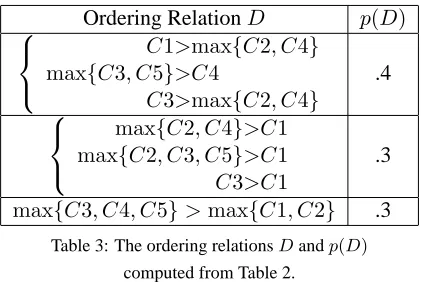
The three ordering relations (corresponding to 3 attested outputs) andp(D)are computed as follows:
5
As required by the proof in (Geman and Geman, 1984).
Ordering RelationD p(D)
C1>max{C2, C4} max{C3, C5}>C4
C3>max{C2, C4}
.4
max{C2, C4}>C1 max{C2, C3, C5}>C1
C3>C1
.3
max{C3, C4, C5}>max{C1, C2} .3
Table 3: The ordering relationsDandp(D)
computed from Table 2.
Here each ordering relation has several conjuncts, and the number of conjuncts is equal to the number of competing candidates for each given input. These conjuncts need to hold simultaneously because each winning candidate needs to be more harmonic than all other competing candidates. The probabilities
p(D)are obtained by normalizing the frequencies of the surface forms in the original data. This will have the consequence of placing more weight on lexical items that occur frequently in the corpus.
5.2 Samplingp(Y|G, D)under complex ordering relations
A direct implementation p(Y|G, d) is straightfor-ward: 1) first obtainN samples from N Gaussian distributions; 2) check each conjunct to see if the ordering relation is satisfied. If so, then keep the sample; if not, discard the sample and try again.
However, this can be highly inefficient in many cases. For example, ifm constraints appear in the ordering relationd and the sample is rejected, the
N−mrandom numbers for constraints not appear-ing indare also discarded. Whendhas several con-juncts, the chance of rejecting samples for irrelevant constraints is even greater.
In order to save the generated random numbers, the vector Y can be decom-posed into its 1-dimensional components
(Y1, Y2,· · ·, YN). The problem then becomes samplingp(Y1,· · ·, YN|G, D). Again, we may use conditional sampling to drawyi one at a time: we keepyj6=i anddfixed6, and drawyi so thatdholds fory. There are now two cases: ifdholds regardless of yi, then any sample from N(µ(it), σ2) will do; otherwise, we will need to drawyifrom a truncated
6
Here we useyj6=ifor all components ofyexcept thei-th
normal distribution.
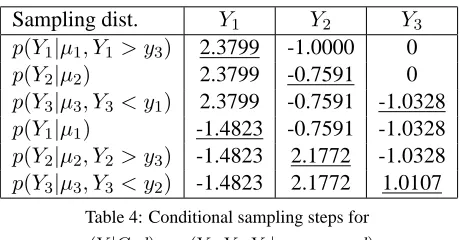
To illustrate this idea, consider an example used earlier whered=“max{c1, c2} > c3”, and the
ini-tial sample and parameters are (y(0)1 , y(0)2 , y3(0)) =
(µ(0)1 , µ(0)2 , µ(0)3 ) = (1,−1,0).
Sampling dist. Y1 Y2 Y3
p(Y1|µ1, Y1 > y3) 2.3799 -1.0000 0
p(Y2|µ2) 2.3799 -0.7591 0
p(Y3|µ3, Y3 < y1) 2.3799 -0.7591 -1.0328
p(Y1|µ1) -1.4823 -0.7591 -1.0328
p(Y2|µ2, Y2 > y3) -1.4823 2.1772 -1.0328
[image:5.612.69.299.144.264.2]p(Y3|µ3, Y3 < y2) -1.4823 2.1772 1.0107
Table 4: Conditional sampling steps for
p(Y|G, d) =p(Y1, Y2, Y3|µ1, µ2, µ3, d)
Notice that in each step, the sampling density is either just a normal, or a truncated normal distribu-tion. This is because we only need to make sure that
dwill continue to hold for the next sample y(t+1), which differs fromy(t)by just 1 constraint.
In our experiment, sampling from truncated nor-mal distributions is realized by using the idea of
re-jection sampling: to sample from a truncated
nor-mal7πc(x) = Z1(c)·N(µ, σ)·I{x>c}, we first find an
envelope density functiong(x)that is easy to sam-ple directly, such thatπc(x)is uniformly bounded by
M·g(x)for some constantM that does not depend onx. It can be shown that once each samplexfrom
g(x)is rejected with probabilityr(x) = 1−Mπc·g(x(x)), the resulting histogram will provide a perfect sample forπc(x). In the current work, the exponential dis-tributiong(x) = λexp{−λx}is used as the enve-lope, with the following choices forλand the rejec-tion ratior(x), which have been optimized to lower the rejection rate:
λ = c+ √
c+ 4σ2 2σ2
r(x) = exp
½
(x+c)2
2 +λ0(x+c)−
σ2λ2 0 2
¾
Putting these ideas together, the final version of Gibbs sampler is constructed by implementing Step 1 in Section 4 as a sequence of conditional sam-pling steps for p(Yi|Yj6=i, d), and combining them
7
Notice the truncated distribution needs to be re-normalized in order to be a proper density.
with the sampling ofp(G|Y, D). Notice the order in whichYiis updated is fixed, which makes our imple-mentation an instance of the systematic-scan Gibbs sampler (Liu, 2001). This implementation may be improved even further by utilizing the structure of the ordering relationd, and optimizing the order in whichYiis updated.
5.3 Model identifiability
Identifiability is related to the uniqueness of solu-tion in model fitting. GivenN constraints, a gram-mar G ∈ RN is not identifiable because G +C will have the same behavior asG for any constant
C= (c0,· · · , c0). To remove translation invariance,
in Step 2 the average ranking value is subtracted fromG, such thatPiµi = 0.
Another problem related to identifiability arises when the data contains the so-called “categorical domination”, i.e., there may be data of the follow-ing form:
c1 > c2 with probability1.
In theory, the mode of the posterior tends to infin-ity and the Gibbs sampler will not converge. Since having categorical dominance relations is a com-mon practice in linguistics, we avoid this problem by truncating the posterior distribution8 by I|µ|<K, where K is chosen to be a positive number large enough to ensure that the model be identifiable. The role of truncation/renormalization may be seen as a strong prior that makes the model identifiable on a bounded set.
A third problem related to identifiability occurs when the posterior has multiple modes, which sug-gests that multiple grammars may generate the same output frequencies. This situation is common when the grammar contains interactions between many constraints, and greedy algorithms like GLA tend to find one of the many solutions. In this case, one can either introduce extra ordering relations or use informative priors to samplep(G|Y), so that the in-ference on the posterior can be done with a relatively small number of samples.
5.4 Posterior inference
Once the Gibbs sampler has converged to its station-ary distribution, we can use the samples to make
var-8
ious inferences on the posterior. In the experiments reported in this paper, we are primarily interested in the mode of the posterior marginal9p(µi|D), where
i= 1,· · ·, N. In cases where the posterior marginal is symmetric and uni-modal, its mode can be esti-mated by the sample median.
In real linguistic applications, the posterior marginal may be a skewed distribution, and many modes may appear in the histogram. In these cases, more sophisticated non-parametric methods, such as kernel density estimation, can be used to estimate the modes. To reduce the computation in identifying multiple modes, a mixture approximation (by EM algorithm or its relatives) may be necessary.
6 Experiments
6.1 Ilokano reduplication
The following Ilokano grammar and data set, used in (Boersma and Hayes, 2001), illustrate a complex type of constraint interaction: the interaction be-tween the three constraints: ∗COMPLEX-ONSET, ALIGN, andIDEN TBR([long]) cannot be factored into interactions between 2 constraints. For any given candidate to be optimal, the constraint that prefers such a candidate must simultaneously dom-inate the other two constraints. Hence it is not im-mediately clear whether there is a grammar that will assign equal probability to the 3 candidates.
/HRED-bwaja/ p(.) ∗
C-ONS AL IBR
bu:.bwa.ja .33 1 0 1
bwaj.bwa.ja .33 2 0 0
bub.wa.ja .33 0 1 0
Table 5: Data for Ilokano reduplication.
Since it does not address the problem of identifi-ability, the GLA does not always converge on this data set, and the returned grammar does not always fit the input frequencies exactly, depending on the choice of parameters10.
In comparison, the Gibbs sampler converges quickly11, regardless of the parameters. The result suggests the existence of a unique grammar that will
9
NoteG = (µ1,· · ·, µN), andp(µi|D)is a marginal of
p(G|D).
10B &H reported results of averaging many runs of the algo-rithm. Yet there appears to be significant randomness in each run of the algorithm.
11
Within 1000 iterations.
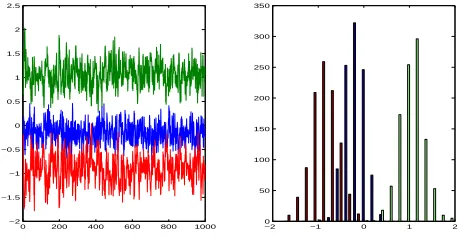
assign equal probabilities to the 3 candidates. The posterior samples and histograms are displayed in Figure 1. Using the median of the marginal posteri-ors, the estimated grammar generates an exact fit to the frequencies in the input data.
0 200 400 600 800 1000 −2
−1.5 −1 −0.5 0 0.5 1 1.5 2 2.5
−2 −1 0 1 2
[image:6.612.310.539.142.261.2]0 50 100 150 200 250 300 350
Figure 1: Posterior marginal samples and histograms for Experiment 2.
6.2 Spanish diminutive suffixation
The second experiment uses linguistic data on Span-ish diminutives and the analysis proposed in (Arbisi-Kelm, 2002). There are 3 base forms, each as-sociated with 2 diminutive suffixes. The gram-mar consists of 4 constraints: ALIGN(TE,Word,R), MAX-OO(V), DEP-IO and BaseTooLittle. The data presents the problem of learning from noise, since no Stochastic OT grammar can provide an exact fit to the data: the candidate [ubita] violates an extra constraint compared to [liri.ito], and [ubasita] vio-lates the same constraint as [liryosito]. Yet unlike [lityosito], [ubasita] is not observed.
Input Output Freq. A M D B
[image:6.612.314.533.480.579.2]/uba/ [ubita] 10 0 1 0 1
[ubasita] 0 1 0 0 0
/mar/ [marEsito] 5 0 0 1 0
[marsito] 5 0 0 0 1
/liryo/ [liri.ito] 9 0 1 0 0
[liryosito] 1 1 0 0 0
Table 6: Data for Spanish diminutive suffixation.
In the results found by GLA, [marEsito] always has a lower frequency than [marsito] (See Table 7). This is not accidental. Instead it reveals a problem-atic use of heuristics in GLA12: since the constraint
B is violated by [ubita], it is always demoted
when-ever the underlying form /uba/ is encountered dur-ing learndur-ing. Therefore, even though the expected
12
model assigns equal values to µ3 and µ4
(corre-sponding to D and B, respectively), µ3 is always
less thanµ4, simply because there is more chance
of penalizing D rather than B. This problem arises precisely because of the heuristic (i.e. demoting the constraint that prefers the wrong candidate) that GLA uses to find the target grammar.
The Gibbs sampler, on the other hand, does not depend on heuristic rules in its search. Since modes of the posteriorp(µ3|D)andp(µ4|D)reside in
neg-ative infinity, the posterior is truncated by Iµi<K, with K = 6, based on the discussion in 5.3. Re-sults of the Gibbs sampler and two runs of GLA13
are reported in Table 7.
Input Output Obs Gibbs GLA1 GLA2
/uba/ [ubita] 100% 95% 96% 96%
[ubasita] 0% 5% 4% 4%
/mar/ [marEsito] 50% 50% 38% 45%
[marsito] 50% 50% 62% 55%
/liryo/ [liri.ito] 90% 95% 96% 91.4%
[liryosito] 10% 5% 4% 8.6%
Table 7: Comparison of Gibbs sampler and GLA
7 A comparison with Max-Ent models
Previously, problems with the GLA14have inspired other OT-like models of linguistic variation. One such proposal suggests using the more well-known
Maximum Entropy model (Goldwater and Johnson,
2003). In Max-Ent models, a grammar G is also parameterized by a real vector of weights w = (w1,· · · , wN), but the conditional likelihood of an outputygiven an inputxis given by:
p(y|x) = exp{
P
iwifi(y, x)} P
zexp{ P
iwifi(z, x)}
(2)
where fi(y, x) is the violation each constraint as-signs to the input-output pair(x, y).
Clearly, Max-Ent is a rather different type of model from Stochastic OT, not only in the use of constraint ordering, but also in the objective function (conditional likelihood rather than likeli-hood/posterior). However, it may be of interest to compare these two types of models. Using the same
13The two runs here both use 0.002 and 0.0001 as the final plasticity. The initial plasticity and the iterations are set to 2 and 1.0e7. Slightly better fits can be found by tuning these pa-rameters, but the observation remains the same.
14
See (Keller and Asudeh, 2002) for a summary.
data as in 6.2, results of fitting Max-Ent (using con-jugate gradient descent) and Stochastic OT (using Gibbs sampler) are reported in Table 8:
Input Output Obs SOT ME MEsm
/uba/ [ubita] 100% 95% 100% 97.5%
[ubasita] 0% 5% 0% 2.5%
/mar/ [marEsito] 50% 50% 50% 48.8%
[marsito] 50% 50% 50% 51.2%
/liryo/ [liri.ito] 90% 95% 90% 91.4%
[liryosito] 10% 5% 10% 8.6%
Table 8: Comparison of Max-Ent and Stochastic OT models
It can be seen that the Max-Ent model, in the ab-sence of a smoothing prior, fits the data perfectly by assigning positive weights to constraints B and D. A less exact fit (denoted by MEsm) is obtained when the smoothing Gaussian prior is used withµi = 0,
σ2
i = 1. But as observed in 6.2, an exact fit is im-possible to obtain using Stochastic OT, due to the difference in the way variation is generated by the models. Thus it may be seen that Max-Ent is a more powerful class of models than Stochastic OT, though it is not clear how the Max-Ent model’s descriptive power is related to generative linguistic theories like phonology.
Although the abundance of well-behaved opti-mization algorithms has been pointed out in favor of Max-Ent models, it is the author’s hope that the MCMC approach also gives Stochastic OT a sim-ilar underpinning. However, complex Stochastic OT models often bring worries about identifiability, whereas the convexity property of Max-Ent may be viewed as an advantage15.
8 Discussion
From a non-Bayesian perspective, the MCMC-based approach can be seen as a randomized strategy for learning a grammar. Computing resources make it possible to explore the entire space of grammars and discover where good hypotheses are likely to occur. In this paper, we have focused on the frequently vis-ited areas of the hypothesis space.
It is worth pointing out that the Graduate Learning Algorithm can also be seen from this perspective. An examination of the GLA shows that when the plasticity term is fixed, parameters found by GLA also form a Markov chainG(t) ∈RN,t= 1,2,· · ·. Therefore, assuming the model is identifiable, it
15
seems possible to use GLA in the same way as the MCMC methods: rather than forcing it to stop, we can run GLA until it reaches stationary distribution, if it exists.
However, it is difficult to interpret the results found by this “random walk-GLA” approach: the stationary distribution of GLA may not be the target distribution — the posterior p(G|D). To construct a Markov chain that converges top(G|D), one may consider turning GLA into a real MCMC algorithm by designing reversible jumps, or the Metropolis
al-gorithm. But this may not be easy, due to the
diffi-culty in likelihood evaluation (including likelihood ratio) discussed in Section 2.
In contrast, our algorithm provides a general solu-tion to the problem of learning Stochastic OT gram-mars. Instead of looking for a Markov chain inRN, we go to a higher dimensional spaceRN ×RN, us-ing the idea of data augmentation. By takus-ing advan-tage of the interdependence ofGandY, the Gibbs sampler provides a Markov chain that converges to
p(G, Y|D), which allows us to return to the original subspace and derivep(G|D) — the target distribu-tion. Interestingly, by adding more parameters, the computation becomes simpler.
9 Future work
This work can be extended in two directions. First, it would be interesting to consider other types of OT grammars, in connection with the linguistics lit-erature. For example, the variances of the normal distribution are fixed in the current paper, but they may also be treated as unknown parameters (Nagy and Reynolds, 1997). Moreover, constraints may be parameterized as mixture distributions, which rep-resent other approaches to using OT for modeling linguistic variation (Anttila, 1997).
The second direction is to introduce informative priors motivated by linguistic theories. It is found through experimentation that for more sophisticated grammars, identifiability often becomes an issue: some constraints may have multiple modes in their posterior marginal, and it is difficult to extract modes in high dimensions16. Therefore, use of priors is needed in order to make more reliable inferences. In addition, priors also have a linguistic appeal, since
16
Notice that posterior marginals do not provide enough in-formation for modes of the joint distribution.
current research on the “initial bias” in language ac-quisition can be formulated as priors (e.g.
Faithful-ness Low (Hayes, 2004)) from a Bayesian
perspec-tive.
Implementing these extensions will merely in-volve modifyingp(G|Y, D), which we leave for fu-ture work.
References
Anttila, A. (1997). Variation in Finnish Phonology and
Mor-phology. PhD thesis, Stanford University.
Arbisi-Kelm, T. (2002). An analysis of variability in Spanish diminutive formation. Master’s thesis, UCLA, Los Angeles. Boersma, P. (1997). How we learn variation, optionality, prob-ability. In Proceedings of the Institute of Phonetic Sciences
21, pages 43–58, Amsterdam. University of Amsterdam.
Boersma, P. and Hayes, B. P. (2001). Empirical tests of the Gradual Learning Algorithm. Linguistic Inquiry, 32:45–86. Gelfand, A. and Smith, A. (1990). Sampling-based approaches
to calculating marginal densities. Journal of the American
Statistical Association, 85(410).
Gelman, A. and Rubin, D. B. (1992). Inference from iterative simulation using multiple sequences. Statistical Science,
7:457–472.
Geman, S. and Geman, D. (1984). Stochastic relaxation, Gibbs distributions, and the Bayesian restoration of images.
IEEE Trans. on Pattern Analysis and Machine Intelligence,
6(6):721–741.
Goldwater, S. and Johnson, M. (2003). Learning OT constraint rankings using a Maximum Entropy model. In Spenader, J., editor, Proceedings of the Workshop on Variation within
Optimality Theory, Stockholm.
Hayes, B. P. (2004). Phonological acquisition in optimality the-ory: The early stages. In Kager, R., Pater, J., and Zonneveld, W., editors, Fixing Priorities: Constraints in Phonological
Acquisition. Cambridge University Press.
Keller, F. and Asudeh, A. (2002). Probabilistic learning algorithms and Optimality Theory. Linguistic Inquiry,
33(2):225–244.
Liu, J. S. (2001). Monte Carlo Strategies in Scientific
Com-puting. Number 33 in Springer Statistics Series.
Springer-Verlag, Berlin.
Nagy, N. and Reynolds, B. (1997). Optimality theory and vari-able word-final deletion in Faetar. Language Variation and
Change, 9.
Prince, A. and Smolensky, P. (1993). Optimality Theory:
Con-straint Interaction in Generative Grammar. Forthcoming.
Tanner, M. and Wong, W. H. (1987). The calculation of poste-rior distributions by data augmentation. Journal of the