Sentence Level Dialect Identification
for Machine Translation System Selection
Wael Salloum, Heba Elfardy, Linda Alamir-Salloum, Nizar Habash and Mona Diab†
Center for Computational Learning Systems, Columbia University, New York, USA {wael,heba,habash}@ccls.columbia.edu
†Department of Computer Science, The George Washington University, Washington DC, USA
Abstract
In this paper we study the use of sentence-level dialect identification in optimizing machine translation system selection when translating mixed dialect input. We test our approach on Arabic, a prototypical diglossic language; and we optimize the combination of four different machine translation systems. Our best result im-proves over the best single MT system baseline by 1.0% BLEU and over a strong system selection baseline by 0.6% BLEU on a blind test set.
1 Introduction
A language can be described as a set of dialects, among which one "standard variety" has a spe-cial representative status.1 Despite being increas-ingly ubiquitous in informal written genres such as social media, most non-standard dialects are resource-poor compared to their standard variety. For statistical machine translation (MT), which re-lies on the existence of parallel data, translating from non-standard dialects is a challenge. In this paper we study the use of sentence-level dialect identification together with various linguistic fea-tures in optimizing the selection of outputs of four different MT systems on input text that includes a mix of dialects.
We test our approach on Arabic, a prototypi-cal diglossic language (Ferguson, 1959) where the standard form of the language, Modern Standard Arabic (MSA) and the regional dialects (DA) live side-by-side and are closely related. MSA is the language used in education, scripted speech and official settings while DA is the primarily spoken
1This paper presents work supported by the Defense
Ad-vanced Research Projects Agency (DARPA) contract No. HR0011-12-C-0014. Any opinions, findings and conclusions or recommendations expressed in this paper are those of the authors and do not necessarily reflect the views of DARPA.
native vernacular. We consider two DAs: Egyp-tian and Levantine Arabic in addition to MSA. Our best system selection approach improves over our best baseline single MT system by 1.0% absolute BLEU point on a blind test set.
2 Related Work
Arabic Dialect Machine Translation. Two ap-proaches have emerged to alleviate the problem of DA-English parallel data scarcity: using MSA as a bridge language (Sawaf, 2010; Salloum and Habash, 2011; Salloum and Habash, 2013; Sajjad et al., 2013), and using crowd sourcing to acquire parallel data (Zbib et al., 2012). Sawaf (2010) and Salloum and Habash (2013) used hybrid so-lutions that combine rule-based algorithms and re-sources such as lexicons and morphological ana-lyzers with statistical models to map DA to MSA before using MSA-to-English MT systems. Zbib et al. (2012) obtained a 1.5M word parallel corpus of DA-English using crowd sourcing. Applied on a DA test set, a system trained on their 1.5M word corpus outperformed a system that added 150M words of MSA-English data, as well as outper-forming a system with oracle DA-to-MSA pivot.
In this paper we use four MT systems that trans-late from DA to English in different ways. Similar to Zbib et al. (2012), we use DA-English, MSA-English and DA+MSA-MSA-English systems. Our DA-English data includes the 1.5M words created by Zbib et al. (2012). Our fourth MT system uses ELISSA, the DA-to-MSA MT tool by Salloum and
Habash (2013), to produce an MSA pivot.
Dialect Identification. There has been a num-ber of efforts on dialect identification (Biadsy et al., 2009; Zaidan and Callison-Burch, 2011; Ak-bacak et al., 2011; Elfardy et al., 2013; Elfardy and Diab, 2013). Elfardy et al. (2013) performed token-level dialect ID by casting the problem as a code-switching problem and treating MSA and Egyptian as two different languages. They later
used features from their token-level system to train a classifier that performs sentence-level dialect ID (Elfardy and Diab, 2013). In this paper, we use AIDA, the system of Elfardy and Diab (2013), to
provide a variety of dialect ID features to train classifiers that select, for a given sentence, the MT system that produces the best translation.
System Selection and Combination in Machine Translation. The most popular approach to MT system combination involves building confusion networks from the outputs of different MT sys-tems and decoding them to generate new transla-tions (Rosti et al., 2007; Karakos et al., 2008; He et al., 2008; Xu et al., 2011). Other researchers explored the idea of re-ranking the n-best output of MT systems using different types of syntactic models (Och et al., 2004; Hasan et al., 2006; Ma and McKeown, 2013). While most researchers use target language features in training their re-rankers, others considered source language fea-tures (Ma and McKeown, 2013).
Most MT system combination work uses MT systems employing different techniques to train on the same data. However, in this paper, we use the same MT algorithms for training, tuning, and test-ing, but vary the training data, specifically in terms of the degree of source language dialectness. Our approach runs a classifier trained only on source language features to decide which system should translate each sentence in the test set, which means that each sentence goes through one MT system only. Since we do not combine the output of the MT systems on the phrase level, we call our ap-proach "system selection" to avoid confusion. 3 Machine Translation Experiments In this section, we present our MT experimental setup and the four baseline systems we built, and we evaluate their performance and the potential of their combination. In the next section we present and evaluate the system selection approach. MT Tools and Settings. We use the open-source Moses toolkit (Koehn et al., 2007) to build four Arabic-English phrase-based statistical machine translation systems (SMT). Our systems use a standard phrase-based architecture. The parallel corpora are word-aligned using GIZA++ (Och and Ney, 2003). The language model for our systems is trained on English Gigaword (Graff and Cieri, 2003). We use SRILM Toolkit (Stolcke, 2002) to build a 5-gram language model with modified
Kneser-Ney smoothing. Feature weights are tuned to maximize BLEU on tuning sets using Mini-mum Error Rate Training (Och, 2003). Results are presented in terms of BLEU (Papineni et al., 2002). All evaluation results are case insensi-tive. The English data is tokenized using simple punctuation-based rules. The MSA portion of the Arabic side is segmented according to the Arabic Treebank (ATB) tokenization scheme (Maamouri et al., 2004; Sadat and Habash, 2006) using the MADA+TOKANmorphological analyzer and
tok-enizer v3.1 (Roth et al., 2008), while the DA por-tion is ATB-tokenized with MADA-ARZ(Habash
et al., 2013). The Arabic text is also Alif/Ya nor-malized. For more details on processing Arabic, see (Habash, 2010).
MT Train/Tune/Test Data. We have two par-allel corpora. The first is a DA-English corpus of 5M tokenized words of Egyptian (∼3.5M) and Levantine (∼1.5M). This corpus is part of BOLT data. The second is anMSA-English cor-pus of 57M tokenized words obtained from sev-eral LDC corpora (10 times the size of the DA-English data). We work with eight standard MT test sets: three MSA sets from NIST MTEval with four references (MT06, MT08, and MT09), four Egyptian sets from LDC BOLT data with two ref-erences (EgyDevV1, EgyDevV2, EgyDevV3, and EgyTestV2), and one Levantine set from BBN (Zbib et al., 2012) with one reference which we split into LevDev and LevTest. We used MT08 and EgyDevV3 to tune SMT systems while we di-vided the remaining sets among classifier training data (5,562 sentences), dev (1,802 sentences) and blind test (1,804 sentences) sets to ensure each of these new sets has a variety of dialects and genres (weblog and newswire).
MT Systems. We build four MT systems. (1)DA-Only.This system is trained on the DA-English data and tuned on EgyDevV3.
(2) MSA-Only. This system is trained on the MSA-English data and tuned on MT08.
(3) DA+MSA. This system is trained on the combination of both corpora (resulting in 62M to-kenized2 words on the Arabic side) and tuned on
2Since theDA+MSAsystem is intended for DA data and
DA morphology, as far as tokenization is concerned, is more complex, we tokenized the training data with dialect aware-ness (DA with MADA-ARZ and MSA with MADA) since
MADA-ARZ does a lot better than MADA on DA (Habash
et al., 2013). Tuning and Test data, however, are tokenized by MADA-ARZsince we do not assume any knowledge of
EgyDevV3.
(4) MSA-Pivot. This MSA-pivoting system uses Salloum and Habash (2013)’s DA-MSA MT system followed by an Arabic-English SMT sys-tem which is trained on both corpora augmented with the DA-English where the DA side is prepro-cessed with the same DA-MSA MT system then tokenized with MADA-ARZ. The result is 67M
tokenized words on the Arabic side. EgyDevV3 was similarly preprocessed with the DA-MSA MT system and MADA-ARZand used for tuning the
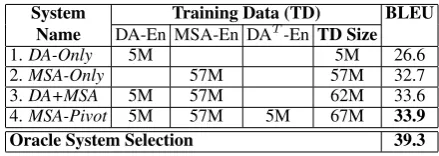
system parameters. Test sets are similarly prepro-cessed before decoding with the SMT system. Baseline MT System Results. We report the re-sults of our dev set on the four MT systems we built in Table 1. TheMSA-Pivotsystem produces the best singleton result among all systems. All differences in BLEU scores between the four sys-tems are statistically significant above the 95% level. Statistical significance is computed using paired bootstrap re-sampling (Koehn, 2004).
System Training Data (TD) BLEU Name DA-En MSA-En DAT-En TD Size
1.DA-Only 5M 5M 26.6
2.MSA-Only 57M 57M 32.7
3.DA+MSA 5M 57M 62M 33.6
[image:3.595.70.290.359.437.2]4.MSA-Pivot 5M 57M 5M 67M 33.9 Oracle System Selection 39.3
Table 1:Results from the baseline MT systems and their or-acle system selection. The training data west used in different MT systems are also indicated. DAT (in the fourth column)
is the DA part of the 5M word DA-En parallel data processed with the DA-MSA MT system.
Oracle System Selection. We also report in Ta-ble 1 an oracle system selection where we pick, for each sentence, the English translation that yields the best BLEU score. This oracle indicates that the upper bound for improvement achievable from system selection is 5.4% BLEU. Excluding dif-ferent systems from the combination lowered the overall score between 0.9% and 1.8%, suggesting the systems are indeed complementary.
4 MT System Selection
The approach we take in this paper benefits from the techniques and conclusions of previous papers in that we build different MT systems similar to those discussed above but instead of trying to find which one is the best, we try to leverage the use of all of them by automatically deciding what sen-tences should go to which system. Our hypothesis
is that these systems complement each other in in-teresting ways where the combination of their se-lections could lead to better overall performance stipulating that our approach could benefit from the strengths while avoiding the weaknesses of each individual system.
4.1 Dialect ID Binary Classification
For baseline system selection, we use the clas-sification decision of Elfardy and Diab (2013)’s sentence-level dialect identification system to de-cide on the target MT system. Since the deci-sion is binary (DA or MSA) and we have four MT systems, we considered all possible configurations and determined empirically that the best configu-ration is to selectMSA-Onlyfor the MSA tag and MSA-Pivotfor the DA tag. We do not report other configuration results due to space restrictions. 4.2 Feature-based Four-Class Classification For our main approach, we train a four-class clas-sifier to predict the target MT system to select for each sentence using only source-language fea-tures. We experimented with different classifiers in the Weka Data Mining Tool (Hall et al., 2009) for training and testing our system selection ap-proach. The best performing classifier was Naive Bayes (with Weka’s default settings).
Training Data Class Labels. We run the 5,562 sentences of the classification training data through our four MT systems and produce sentence-level BLEU scores (with length penalty). We pick the name of the MT system with the high-est BLEU score as the class label for that sen-tence. When there is a tie in BLEU scores, we pick the system label that yields better overall BLEU scores from the systems tied.
Training Data Source-Language Features. We use two sources of features extracted from untokenized sentences to train our four-class classifiers:basicandextended features.
A. Basic Features
These are the same set of features that were used by the dialect ID tool together with the class label generated by this tool.
i. Token-Level Features. These features rely on language models, MSA and Egyptian morphologi-cal analyzers and a Highly Dialectal Egyptian lex-icon to decide whether each word is MSA, Egyp-tian, Both, or Out of Vocabulary.
two language models: MSA and Egyptian. iii. Meta Features. Features that do not di-rectly relate to the dialectalness of words in the given sentence but rather estimate how informal the sentence is and include: percentage of kens, punctuation, and Latin words, number of to-kens, average word length, whether the sentence has any words that have word-lengthening effects or not, whether the sentence has any diacritized words or not, whether the sentence has emoticons or not, whether the sentence has consecutive re-peated punctuation or not, whether the sentence has a question mark or not, and whether the sen-tence has an exclamation mark or not.
iv. The Dialect-Class Feature. We run the sen-tence through the Dialect ID binary classifier and we use the predicted class label (DA or MSA) as a feature in our system. Since the Dialect ID system was trained on a different data set, we think its de-cision may provide additional information to our classifiers.
B. Extended Features
We add features extracted from two sources. i. MSA-Pivoting Features.Salloum and Habash (2013) DA-MSA MT system produces interme-diate files used for diagnosis or debugging pur-poses. We exploit one file in which the sys-tem identifies (or, "selects") dialectal words and phrases that need to be translated to MSA. We ex-tract confidence indicating features. These fea-tures are: sentence length (in words), percent-age of selected words and phrases, number of se-lected words, number of sese-lected phrases, num-ber of words morphologically selected as dialec-tal by a mainly Levantine morphological analyzer, number of words selected as dialectal by the tool’s DA-MSA lexicons, number of OOV words against the MSA-Pivot system training data, number of words in the sentences that appeared less than 5 times in the training data, number of words in the sentences that appeared between 5 and 10 times in the training data, number of words in the sen-tences that appeared between 10 and 15 times in the training data, number of words that have spelling errors and corrected by this tool (e.g., word-lengthening), number of punctuation marks, and number of words that are written in Latin script.
ii. MT Training Data Source-Side LM Perplex-ity Features. The second set of features uses per-plexity against language models built from the source-side of the training data of each of the four
baseline systems. These four features may tell the classifier which system is more suitable to trans-late a given sentence.
4.3 System Selection Evaluation
Development Set. The first part of Table 2 re-peats the best baseline system and the four-system oracle combination from Table 1 for convenience. The third row shows the result of running our sys-tem selection baseline that uses the Dialect ID bi-nary decision on the Dev set sentences to decide on the target MT system. It improves over the best single system baseline (MSA-Pivot) by a statisti-cally significant 0.5% BLEU. Crucially, we should note that this is a deterministic process.
System BLEU Diff. Best Single MT System Baseline 33.9 0.0 Oracle 39.3 5.4 Dialect ID Binary Selection Baseline 34.4 0.5 Four-Class Classification
Basic Features 35.1 1.2
Extended Features 34.8 0.9
[image:4.595.309.522.271.357.2]Basic + Extended Features 35.2 1.3
Table 2: Results of baselines and system selection systems on the Dev set in terms of BLEU. The best single MT system baseline isMSA-Pivot.
The second part of Table 2 shows the results of our four-class Naive Bayes classifiers trained on the classification training data we created. The first column shows the source of sentence level features employed. As mentioned earlier, we use the Basic features alone, the Extended features alone, and then their combination. The classifier that uses both feature sources simultaneously as feature vectors is our best performer. It improves over our best baseline single MT system by 1.3% BLEU and over the Dialect ID Binary Classifica-tion system selecClassifica-tion baseline by 0.8% BLEU. Im-provements are statistically significant.
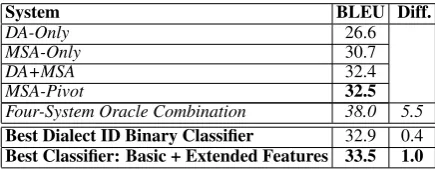
System BLEU Diff.
DA-Only 26.6
MSA-Only 30.7
DA+MSA 32.4
MSA-Pivot 32.5
[image:4.595.307.525.587.672.2]Four-System Oracle Combination 38.0 5.5 Best Dialect ID Binary Classifier 32.9 0.4 Best Classifier: Basic + Extended Features 33.5 1.0
Table 3: Results of baselines and system selection systems on the Blind test set in terms of BLEU.
System All Dialect MSA
DA-Only 26.6 19.3 33.2
MSA-Only 32.7 14.7 50.0
DA+MSA 33.6 19.4 46.3
MSA-Pivot 33.9 19.6 46.4
[image:5.595.80.286.62.137.2]Four-System Oracle Combination 39.3 24.4 52.1 Best Performing Classifier 35.2 19.8 50.0
Table 4:Dialect breakdown of performance on the Dev set for our best performing classifier against our four baselines and their oracle combination. Our classifier does not know of these subsets, it runs on the set as a whole; therefore, we repeat its results in the second column for convenience.
MSA-Pivotis also the best performer. The differ-ences in BLEU are statistically significant. The second part shows the four-system oracle combi-nation which shows a 5.5% BLEU upper bound on improvements. The third part shows the re-sults of the Dialect ID Binary Classification which improves by 0.4% BLEU. The last row shows the four-class classifier results which improves by 1.0% BLEU over the best single MT system base-line and by 0.6% BLEU over the Dialect ID Bi-nary Classification. Results on the Blind Test set are consistent with the Dev set results.
5 Discussion and Error Analysis
DA versus MSA Performance. In Table 4, col-umnAllillustrates the results over the entire Dev set, while columns DA and MSA show system performance on the DA and MSA subsets of the Dev set, respectively. The best single baseline MT system for DA isMSA-Pivothas a large room for improvement given the oracle upper bound (4.8% BLEU absolute). However, our best system selec-tion approach improves overMSA-Pivotby a small margin of 0.2% BLEU absolute only, albeit a sta-tistically significant improvement. The MSA col-umn oracle shows a smaller improvement of 2.1% BLEU absolute over the best singleMSA-OnlyMT system. Furthermore, when translating MSA with our best system selection performer we get the same results as the best baseline MT system for MSA even though our system does not know the dialect of the sentences a priori. If we consider the breakdown of the performance in our best overall (33.9% BLEU) single baseline MT system (MSA-Pivot), we observe that the performance on MSA is about 3.6% absolute BLEU points below our best results; this suggests that most of the system selection gain over the best single baseline is on MSA selection.
Manual Error Analysis. We performed manual error analysis on a Dev set sample of 250
sen-tences distributed among the different dialects and genres. Our best performing classifier selected the best system in 48% of the DA cases and 52% of the MSA cases. We did a detailed manual error analysis for the cases where the classifier failed to predict the best MT system. The sources of errors we found cover 89% of the cases. In 21% of the error cases, our classifier predicted a better trans-lation than the one considered gold by BLEU due to BLEU bias, e.g., severe sentence-level length penalty due to an extra punctuation in a short sen-tence. Also, 3% of errors are due to bad refer-ences, e.g., a dialectal sentence in an MSA set that the human translators did not understand.
A group of error sources resulted from MSA sentences classified correctly asMSA-Only; how-ever, one of the other three systems produced bet-ter translations for two reasons. First, since the MSA training data is from an older time span than the DA data, 10% of errors are due to MSA sen-tences that use recent terminology (e.g., Egyp-tian revolution 2011: places, politicians, etc.) that appear in the DA training data. Also, web writing styles in MSA sentences such as blog style (e.g., rhetorical questions), blog punctuation marks (e.g., "..", "???!!"), and formal MSA forum greetings resulted in 23%, 16%, and 6% of the cases, respectively.
Finally, in 10% of the cases our classifier is con-fused by a code-switched sentence, e.g., a dialec-tal proverb in an MSA sentence or a weak MSA literal translation of dialectal words and phrases. Some of these cases may be solved by adding more features to our classifier, e.g., blog style writ-ing features, while others need a radical change to our technique such as word and phrase level di-alect identification for MT system combination of code-switched sentences.
6 Conclusion and Future Work
References
Murat Akbacak, Dimitra Vergyri, Andreas Stolcke,
Nicolas Scheffer, and Arindam Mandal. 2011.
Effective arabic dialect classification using diverse
phonotactic models. InINTERSPEECH, volume 11,
pages 737–740.
Fadi Biadsy, Julia Hirschberg, and Nizar Habash. 2009. Spoken arabic dialect identification using
phonotactic modeling. InProceedings of the
Work-shop on Computational Approaches to Semitic Lan-guages at the meeting of the European Associa-tion for ComputaAssocia-tional Linguistics (EACL), Athens, Greece.
Heba Elfardy and Mona Diab. 2013. Sentence Level Dialect Identification in Arabic. In Proceedings of the 51th Annual Meeting of the Association for Com-putational Linguistics (ACL-13), Sofia, Bulgaria. Heba Elfardy, Mohamed Al-Badrashiny, and Mona
Diab. 2013. Code switch point detection in arabic. InProceedings of the 18th International Conference on Application of Natural Language to Information Systems (NLDB2013), MediaCity, UK.
Charles F Ferguson. 1959. Diglossia. Word,
15(2):325–340.
David Graff and Christopher Cieri. 2003. English Gi-gaword, LDC Catalog No.: LDC2003T05. Linguis-tic Data Consortium, University of Pennsylvania. Nizar Habash, Ryan Roth, Owen Rambow, Ramy
Es-kander, and Nadi Tomeh. 2013. Morphological Analysis and Disambiguation for Dialectal Arabic. InProceedings of the 2013 Conference of the North American Chapter of the Association for Computa-tional Linguistics: Human Language Technologies (NAACL-HLT), Atlanta, GA.
Nizar Habash. 2010. Introduction to Arabic Natural
Language Processing. Morgan & Claypool Publish-ers.
Mark Hall, Eibe Frank, Geoffrey Holmes, Bernhard Pfahringer, Peter Reutemann, and Ian H. Witten. 2009. The WEKA data mining software: an update.
SIGKDD Explorations, 11(1):10–18.
S. Hasan, O. Bender, and H. Ney. 2006. Rerank-ing translation hypotheses usRerank-ing structural
proper-ties. InEACL’06 Workshop on Learning Structured
Information in Natural Language Applications. Xiaodong He, Mei Yang, Jianfeng Gao, Patrick
Nguyen, and Robert Moore. 2008. Indirect-hmm-based hypothesis alignment for combining outputs
from machine translation systems. InProceedings
of the Conference on Empirical Methods in Natu-ral Language Processing, pages 98–107. Associa-tion for ComputaAssocia-tional Linguistics.
Damianos Karakos, Jason Eisner, Sanjeev Khudanpur, and Markus Dreyer. 2008. Machine translation system combination using itg-based alignments. In
Proceedings of the 46th Annual Meeting of the As-sociation for Computational Linguistics on Human Language Technologies: Short Papers, pages 81–84. Association for Computational Linguistics.
Philipp Koehn, Hieu Hoang, Alexandra Birch, Christo-pher Callison-Burch, Marcello Federico, Nicola Bertoldi, Brooke Cowan, Wade Shen, Christine Moran, Richard Zens, Christopher Dyer, Ondrej Bo-jar, Alexandra Constantin, and Evan Herbst. 2007. Moses: open source toolkit for statistical machine translation. InProceedings of the 45th Annual Meet-ing of the Association for Computational LMeet-inguistics Companion Volume Proceedings of the Demo and Poster Sessions, pages 177–180, Prague, Czech Re-public.
Philipp Koehn. 2004. Statistical significance tests for
machine translation evaluation. In Proceedings of
EMNLP 2004, pages 388–395, Barcelona, Spain, July. Association for Computational Linguistics. Wei-Yun Ma and Kathleen McKeown. 2013. Using
a supertagged dependency language model to select
a good translation in system combination. In
Pro-ceedings of NAACL-HLT, pages 433–438.
Mohamed Maamouri, Ann Bies, Tim Buckwalter, and Wigdan Mekki. 2004. The Penn Arabic Treebank: Building a Large-Scale Annotated Arabic Corpus. In NEMLAR Conference on Arabic Language Re-sources and Tools, pages 102–109, Cairo, Egypt. F. J. Och and H. Ney. 2003. A systematic comparison
of various statistical alignment models.
Computa-tional Linguistics, 29(1):19–51.
Franz Josef Och, Daniel Gildea, Sanjeev Khudanpur, Anoop Sarkar, Kenji Yamada, Alex Fraser, Shankar Kumar, Libin Shen, David Smith, Katherine Eng, Viren Jain, Zhen Jin, and Franz Josef Och. 2004. A smorgasbord of features for statistical machine translation. InMeeting of the North American chap-ter of the Association for Computational Linguistics.
Franz Josef Och. 2003. Minimum Error Rate Train-ing for Statistical Machine Translation. In Proceed-ings of the 41st Annual Conference of the Associa-tion for ComputaAssocia-tional Linguistics, pages 160–167, Sapporo, Japan.
Kishore Papineni, Salim Roukos, Todd Ward, and Wei-Jing Zhu. 2002. BLEU: a Method for Automatic
Evaluation of Machine Translation. In
Proceed-ings of the 40th Annual Meeting of the Associa-tion for ComputaAssocia-tional Linguistics, pages 311–318, Philadelphia, PA.
Antti-Veikko Rosti, Spyros Matsoukas, and Richard Schwartz. 2007. Improved word-level system
com-bination for machine translation. In Proceedings
of the 45th Annual Meeting of the Association of Computational Linguistics, pages 312–319, Prague, Czech Republic, June. Association for Computa-tional Linguistics.
Ryan Roth, Owen Rambow, Nizar Habash, Mona Diab, and Cynthia Rudin. 2008. Arabic Morphological Tagging, Diacritization, and Lemmatization Using
Lexeme Models and Feature Ranking. In
Proceed-ings of ACL-08: HLT, Short Papers, pages 117–120, Columbus, Ohio.
ma-chine translation. In Proceedings of the 21st In-ternational Conference on Computational Linguis-tics and 44th Annual Meeting of the Association for Computational Linguistics, pages 1–8, Sydney, Aus-tralia, July. Association for Computational Linguis-tics.
Hassan Sajjad, Kareem Darwish, and Yonatan Be-linkov. 2013. Translating dialectal arabic to en-glish. InThe 51st Annual Meeting of the Association for Computational Linguistics - Short Papers (ACL Short Papers 2013), Sofia, Bulgaria.
Wael Salloum and Nizar Habash. 2011. Dialectal to Standard Arabic Paraphrasing to Improve
Arabic-English Statistical Machine Translation. In
Pro-ceedings of the First Workshop on Algorithms and Resources for Modelling of Dialects and Language Varieties, pages 10–21, Edinburgh, Scotland. Wael Salloum and Nizar Habash. 2013. Dialectal
Arabic to English Machine Translation: Pivoting
through Modern Standard Arabic. InProceedings of
the 2013 Conference of the North American Chap-ter of the Association for Computational Linguistics: Human Language Technologies (NAACL-HLT), At-lanta, GA.
Hassan Sawaf. 2010. Arabic dialect handling in hybrid
machine translation. InProceedings of the
Confer-ence of the Association for Machine Translation in the Americas (AMTA), Denver, Colorado.
Andreas Stolcke. 2002. SRILM an Extensible
Lan-guage Modeling Toolkit. InProceedings of the
In-ternational Conference on Spoken Language Pro-cessing.
Daguang Xu, Yuan Cao, and Damianos Karakos. 2011. Description of the jhu system combination scheme
for wmt 2011. InProceedings of the Sixth Workshop
on Statistical Machine Translation, pages 171–176. Association for Computational Linguistics.
Omar F Zaidan and Chris Callison-Burch. 2011. The arabic online commentary dataset: an annotated dataset of informal arabic with high dialectal
con-tent. In Proceedings of the 49th Annual
Meet-ing of the Association for Computational LMeet-inguistics (ACL-11), pages 37–41.
Rabih Zbib, Erika Malchiodi, Jacob Devlin, David Stallard, Spyros Matsoukas, Richard Schwartz, John Makhoul, Omar F. Zaidan, and Chris Callison-Burch. 2012. Machine Translation of Arabic
Di-alects. In Proceedings of the 2012 Conference of