Descending-Path Convolution Kernel for Syntactic Structures
Chen Lin1, Timothy Miller1, Alvin Kho1, Steven Bethard2,
Dmitriy Dligach1,Sameer Pradhan1andGuergana Savova1,
1Children’s Hospital Boston Informatics Program and Harvard Medical School {firstname.lastname}@childrens.harvard.edu
2Department of Computer and Information Sciences, University of Alabama at Birmingham [email protected]
Abstract
Convolution tree kernels are an efficient and effective method for comparing syntac-tic structures in NLP methods. However, current kernel methods such as subset tree kernel and partial tree kernel understate the similarity of very similar tree structures. Although soft-matching approaches can im-prove the similarity scores, they are corpus-dependent and match relaxations may be task-specific. We propose an alternative ap-proach called descending path kernel which gives intuitive similarity scores on compa-rable structures. This method is evaluated on two temporal relation extraction tasks and demonstrates its advantage over rich syntactic representations.
1 Introduction
Syntactic structure can provide useful features for many natural language processing (NLP) tasks such as semantic role labeling, coreference resolu-tion, temporal relation discovery, and others. How-ever, the choice of features to be extracted from a tree for a given task is not always clear. Convolu-tion kernels over syntactic trees (tree kernels) offer a potential solution to this problem by providing relatively efficient algorithms for computing sim-ilarities between entire discrete structures. These kernels use tree fragments as features and count the number of common fragments as a measure of similarity between any two trees.
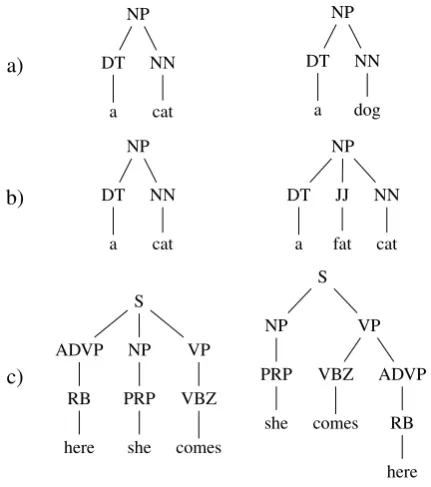
However, conventional tree kernels are sensitive to pattern variations. For example, two trees in Fig-ure 1(a) sharing the same structFig-ure except for one terminal symbol are deemed at most 67% similar by the conventional tree kernel (PTK) (Moschitti, 2006). Yet one might expect a higher similarity given their structural correspondence.
The similarity is further attenuated by trivial structure changes such as the insertion of an
ad-jective in one of the trees in Figure 1(a), which would reduce the similarity close to zero. Such an abrupt attenuation would potentially propel a model to memorize training instances rather than generalize from trends, leading towards overfitting.
In this paper, we describe a new kernel over syntactic trees that operates on descending paths through the tree rather than production rules as used in most existing methods. This representation is reminiscent of Sampson’s (2000) leaf-ancestor paths for scoring parse similarities, but here it is generalized over all ancestor paths, not just those from the root to a leaf. This approach assigns more robust similarity scores (e.g., 78% similarity in the above example) than other soft matching tree ker-nels, is faster than the partial tree kernel (Moschitti, 2006), and is lessad hocthan the grammar-based convolution kernel (Zhang et al., 2007).
2 Background
2.1 Syntax-based Tree Kernels
Syntax-based tree kernels quantify the similarity between two constituent parses by counting their common sub-structures. They differ in their defini-tion of the sub-structures.
Collins and Duffy (2001) use a subset tree (SST) representation for their sub-structures. In the SST representation, a subtree is defined as a subgraph with more than one node, in which only full pro-duction rules are expanded. While this approach is widely used and has been successful in many tasks, the production rule-matching constraint may be un-necessarily restrictive, giving zero credit to rules that have only minor structural differences. For example, the similarity score between the NPs in Figure 1(b) would be zero since the production rule is different (the overall similarity score is above-zero because of matching pre-terminals).
The partial tree kernel (PTK) relaxes the defi-nition of subtrees to allow partial production rule
a)
NP
DT
a NN
cat
NP
DT
a NN
dog
b)
NP
DT
a NN
cat
NP
DT
a JJ
fat NN
cat
c)
S
ADVP
RB
here NP
PRP
she VP
VBZ
comes
S
NP
PRP
she
VP
VBZ
comes
ADVP
RB
[image:2.595.69.285.63.307.2]here
Figure 1: Three example tree pairs.
matching (Moschitti, 2006). In the PTK, a subtree may or may not expand any child in a production rule, while maintaining the ordering of the child nodes. Thus it generates a very large but sparse feature space. To Figure 1(b), the PTK generates fragments (i) [NP [DT a] [JJ fat]]; (ii) [NP [DT a] [NN cat]]; and (iii) [NP [JJ fat] [NN cat]], among others, for the second tree. This allows for partial matching – substructure (ii) – while also generating some fragments that violate grammatical intuitions.
Zhang et al. (2007) address the restrictiveness of SST by allowing soft matching of production rules. They allow partial matching of optional nodes based on the Treebank. For example, the ruleNP →DT JJ NN indicates a noun phrase consisting of a determiner, adjective, and common noun. Zhang et al.’s method designates the JJ as optional, since the Treebank contains instances of a reduced version of the rule without the JJ node (NP →DT NN). They also allow node match-ing among similar preterminals such as JJ, JJR, and JJS, mapping them to one equivalence class.
Other relevant approaches are the spectrum tree (SpT) (Kuboyama et al., 2007) and the route kernel (RtT) (Aiolli et al., 2009). SpT uses a q-gram – a sequence of connected vertices of length q –
as their sub-structure. It observes grammar rules by recording the orientation of edges: a←b→c is different from a→b→c. RtT uses a set of routes as basic structures, which observes grammar rules by
NP
DT
a
NN
cat
l=0: [NP],[DT],[NN]
l=1: [NP-DT],[NP-NN], [DT-a],[NN-cat]
l=2: [NP-DT-a],[NP-NN-cat]
Figure 2: A parse tree (left) and its descending paths according to Definition 1 (l- length).
recording the index of a neighbor node.
2.2 Temporal Relation Extraction
Among NLP tasks that use syntactic informa-tion, temporal relation extraction has been draw-ing growdraw-ing attention because of its wide applica-tions in multiple domains. As subtasks in Tem-pEval 2007, 2010 and 2013, multiple systems were built to create labeled links from events to events/timestamps by using a variety of fea-tures (Bethard and Martin, 2007; Llorens et al., 2010; Chambers, 2013). Many methods exist for synthesizing syntactic information for temporal relation extraction, and most use traditional tree kernels with various feature representations. Mir-roshandel et al. (2009) used the path-enclosed tree (PET) representation to represent syntactic informa-tion for temporal relainforma-tion extracinforma-tion on the Time-Bank (Pustejovsky et al., 2003) and the AQUAINT TimeML corpus1. The PET is the smallest subtree
that contains both proposed arguments of a relation. Hovy et al. (2012) used bag tree structures to rep-resent the bag of words (BOW) and bag of part of speech tags (BOP) between the event and time in addition to a set of baseline features, and improved the temporal linking performance on the TempEval 2007 and Machine Reading corpora (Strassel et al., 2010). Miller at al. (2013) used PET tree, bag tree, and path tree (PT, which is similar to a PET tree with the internal nodes removed) to represent syntactic information and improved the temporal relation discovery performance on THYME data2
(Styler et al., 2014). In this paper, we also use syntactic structure-enriched temporal relation dis-covery as a vehicle to test our proposed kernel.
3 Methods
Here we decribe the Descending Path Kernel (DPK).
Definition 1 (Descending Path): Let T be a parse tree, v any non-terminal node in T, dv a descendant ofv, including terminals. A descending path is the sequence of indexes of edges connecting
vanddv, denoted by [v− · · · −dv]. The lengthl
of a descending path is the number of connecting edges. Whenl= 0, a descending path is the non-terminal node itself, [v]. Figure 2 illustrates a parse tree and its descending paths of different lengths.
Suppose that all descending paths of a treeT are indexed1,· · ·, n, andpathi(T)is the frequency
of thei-th descending path inT. We representTas a vector of frequencies of all its descending paths:
Φ(T) = (path1(T),· · · , pathn(T)).
The similarity between any two treesT1andT2
can be assessed via the dot product of their respec-tive descending path frequency vector representa-tions:K(T1, T2) =hΦ(T1),Φ(T2)i.
Compared with the previous tree kernels, our descending path kernel has the following advan-tages: 1) the sub-structures are simplified so that they are more likely to be shared among trees, and therefore the sparse feature issues of previous kernels could be alleviated by this representation; 2) soft matching between two similar structures (e.g., NP→DT JJ NN versus NP→DT NN) have high similarity without reference to any corpus or grammar rules;
Following Collins and Duffy (2001), we derive a recursive algorithm to compute the dot product of the descending path frequency vector represen-tations of two treesT1 andT2:
K(T1, T2) =hΦ(T1),Φ(T2)i =X
i
pathi(T1)·pathi(T2)
= X
n1∈N1
X
n2∈N2
X
i
Ipathi(n1)·Ipathi(n2)
= X
n1∈N1
n2∈N2
C(n1, n2)
(1) whereN1 andN2 are the sets of nodes inT1and T2respectively,iindexes the set of possible paths, Ipathi(n)is an indicator function that is 1 iff the descendingpathi is rooted at node nor 0
other-wise. C(n1, n2) counts the number of common
descending paths rooted at nodesn1andn2:
C(n1, n2) =
X
i
Ipathi(n1)·Ipathi(n2)
C(n1, n2)can be computed in polynomial time by
the following recursive rules:
Rule 1: Ifn1 andn2 have different labels (e.g.,
”DT” versus “NN”), thenC(n1, n2) = 0;
Rule 2: Else ifn1 andn2 have the same labels
and are both pre-terminals (POS tags), then
C(n1, n2) = 1 +
(
1 ifterm(n1) =term(n2) 0 otherwise.
whereterm(n)is the terminal symbol undern; Rule 3: Else ifn1 andn2 have the same labels
and they are not both pre-terminals, then:
C(n1, n2) = 1 +
X
ni∈children(n1)
nj∈children(n2)
C(ni, nj)
wherechildren(m)are the child nodes ofm. As in other tree kernel approaches (Collins and Duffy, 2001; Moschitti, 2006), we use a discount parameterλto control for the disproportionately large similarity values of large tree structures. Therefore, Rule 2 becomes:
C(n1, n2) = 1 +
(
λ ifterm(n1) =term(n2) 0 otherwise.
and Rule 3 becomes:
C(n1, n2) = 1 +λ
X
ni∈children(n1)
nj∈children(n2)
C(ni, nj)
Note that Eq. (1) is a convolution kernel under the kernel closure properties described in Haus-sler (1999). Rules 1-3 show the equivalence be-tween the number of common descending paths rooted at nodes n1 and n2, and the number of
matching nodes belown1andn2.
In practice, there are many non-matching nodes, and most matching nodes will have only a few matching children, so the running time, as in SST, will be approximated by the number of matching nodes between trees.
3.1 Relationship with other kernels
Kernel ID #Frag Sim N(Sim)
SST a 9 3 0.50
O ρ|N1||N2| b 15 2 0.25
c 63 7 0.20
DPK a 11 7 0.78
O ρ2|N1||N2| b 13 9 0.83
c 31 22 0.83
PTK a 20 10 0.67
O ρ3|N
1||N2| b 36 15 0.65
[image:4.595.74.291.61.204.2]c 127 34 0.42
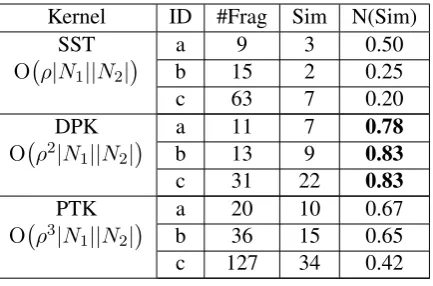
Table 1: Comparison of the worst case computa-tional complexicity (ρ- the maximum branching factor) and kernel performance on the 3 examples from Figure 1.#F ragis the number of fragments,
N(Sim)is the normalized similarity. Please see the online supplementary note for detailed frag-ments of example (a).
possible that DPK≤SST≤PTK. In Table 1, given
λ= 1, we compare the performance of 3 kernels on the three examples in Figure 1. Note that for more complicated structures, i.e., examples b and c, DPK generates fewer fragments than SST and PTK, with more shared fragments among trees.
The complexity for all three kernels are at least
O |N1||N2|since they share the pairwise
summa-tion at the end of Equasumma-tion 1. SST, due to its re-quirement of exact production rule matching, only takes one pass in the inner loop which adds a factor ofρ (the maximum branching factor of any pro-duction rule). DPK does a pairwise summation of children, which adds a factor ofρ2to the
com-plexity. Finally, the efficient algorithm for PTK is proved by Moschitti (2006) to contain a con-stant factor ofρ3. Table 1 orders the tree kernels
according by their listed complexity.
It may seem that the value of DPK is strictly in its ability to evaluate all paths, which is not explicitly accounted for by other kernels. However, another view of the DPK is possible by thinking of it as cheaply calculating rule production similarity by taking advantage of relatively strict English word ordering. Like SST and PTK, the DPK requires the root category of two subtrees to be the same for the similarity to be greater than zero. Unlike SST and PTK, once the root category comparison is successfully completed, DPK looks at all paths that go through it and accumulates their similarity scores independent of ordering – in other words, it will ignore the ordering of the children in its
pro-duction rule. This means, for example, that if the rule production NP→NN JJ DT were ever found in a tree, to DPK it would be indistinguishable from the common production NP→DT JJ NN, despite having inverted word order, and thus would have a maximal similarity score. SST and PTK would assign this pair a much lower score for having com-pletely different ordering, but we suggest that cases such as these are very rare due to the relatively strict word ordering of English. In most cases, the determiner of a noun phrase will be at the front, the nouns will be at the end, and the adjectives in the middle. So with small differences in production rules (one or two adjectives, extra nominal modifier, etc.) the PTK will capture similarity by compar-ing every possible partial rule completion, but the DPK can obtain higher and faster scores by just comparing one child at a time because the ordering is constrained by the language. This analysis does lead to a hypothesis for the general viability of the DPK, suggesting that in languages with freer word order it may give inflated scores to structures that are syntactically dissimilar if they have the same constituent components in different order.
Formally, Moschitti (2006) showed that SST is a special case of PTK when only the longest child sequence from each tree is considered. On the other end of the spectrum, DPK is a special case of PTK where the similarity between rules only considers child subsequences of length one.
4 Evaluation
We applied DPK to two published temporal relation extraction systems: (Miller et al., 2013) in the clinical domain and Cleartk-TimeML (Bethard, 2013) in the general domain respectively.
4.1 Narrative Container Discovery
The task here as described by Miller et al. (2013) is to identify the CONTAINSrelation between a time expression and a same-sentence event from clinical notes in the THYME corpus, which has 78 notes of 26 patients. We obtained this corpus from the authors and followed their linear composite kernel setting:
KC(s1, s2) =τ
P
X
p=1
KT(tp1, tp2)+KF(f1, f2) (2)
wheresi is an instance object composed of flat
can have multiple representations, as in Bag Tree (BT), Path-enclosed Tree (PET), and Path Tree (PT). For the tree kernelKT, subset tree (SST)
ker-nel was applied on each tree representationp. The final similarity score between two instances is the
τ-weighted sum of the similarities of all representa-tions, combined with the flat feature (FF) similarity as measured by a feature kernelKF (linear or
poly-nomial). Here we replaced the SST kernel with DPK and tested two feature combinations FF+PET and FF+BT+PET+PT. To fine tune parameters, we used grid search by testing on the default develop-ment data. Once the parameters were tuned, we tested the system performance on the testing data, which was set up by the original system split. 4.2 Cleartk-TimeML
We tested one sub-task from TempEval-2013 – the extraction of temporal relations between an event and time expression within the same sen-tence. We obtained the training corpus (Time-Bank + AQUAINT) and testing data from the au-thors (Bethard, 2013). Since the original features didn’t contain syntactic features, we created a PET tree extractor for this system. The kernel setting was similar to equation (2), while there was only one tree representation, PET tree,P=1. A linear kernel was used asKF to evaluate the exact same
flat features as used by the original system. We used the built-in cross validation to do grid search for tuning the parameters. The final system was tested on the testing data for reporting results. 4.3 Results and Discussion
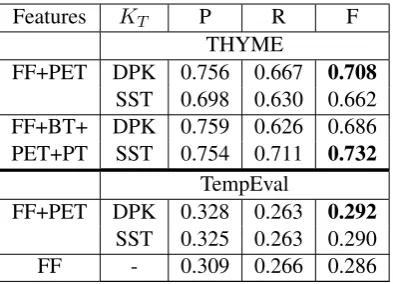
Results are shown in Table 2. The top section shows THYME results. For these experiments, the DPK is superior when a syntactically-rich PET representation is used. Using the full feature set of Miller et al. (2013), SST is superior to DPK and obtains the best overall performance. The bottom section shows results on TempEval-2013 data, for which there is little benefit from either tree kernel. Our experiments with THYME data show that DPK can capture something in the linguistically richer PET representation that the SST kernel can-not, but adding BT and PT representations decrease the DPK performance. As a shallow representation, BT does not have much in the way of descending paths for DPK to use. PT already ignores the pro-duction grammar by removing the inner tree nodes. DPK therefore cannot get useful information and may even get misleading cues from these two
rep-Features KT P R F
THYME
FF+PET DPK 0.756 0.667 0.708
SST 0.698 0.630 0.662 FF+BT+ DPK 0.759 0.626 0.686
PET+PT SST 0.754 0.711 0.732
TempEval
FF+PET DPK 0.328 0.263 0.292
SST 0.325 0.263 0.290
[image:5.595.308.505.61.203.2]FF - 0.309 0.266 0.286
Table 2: Comparison of tree kernel performance for temporal relation extraction on THYME and TempEval-2013 data.
resentations. These results show that, while DPK should not always replace SST, there are represen-tations in which it is superior to existing methods. This suggests an approach in which tree representa-tions are matched to different convolution kernels, for example by tuning on held-out data.
For TempEval-2013 data, adding syntactic fea-tures did not improve the performance significantly (comparing F-score of 0.290 with 0.286 in Ta-ble 3). Probably, syntactic information is not a strong feature for all types of temporal relations on TempEval-2013 data.
5 Conclusion
In this paper, we developed a novel convolution tree kernel (DPK) for measuring syntactic similar-ity. This kernel uses a descending path represen-tation in trees to allow higher similarity scores on partially matching structures, while being simpler and faster than other methods for doing the same. Future work will explore 1) a composite kernel which uses DPK for PET trees, SST for BT and PT, and feature kernel for flat features, so that different tree kernels can work with their ideal syntactic rep-resentations; 2) incorporate dependency structures for tree kernel analysis 3) applying DPK to other relation extraction tasks on various corpora.
6 Acknowledgements
References
Fabio Aiolli, Giovanni Da San Martino, and Alessan-dro Sperduti. 2009. Route kernels for trees. In
Proceedings of the 26th Annual International Con-ference on Machine Learning, pages 17–24. ACM. Steven Bethard and James H Martin. 2007. Cu-tmp:
temporal relation classification using syntactic and semantic features. In Proceedings of the 4th Inter-national Workshop on Semantic Evaluations, pages 129–132. Association for Computational Linguis-tics.
Steven Bethard. 2013. Cleartk-timeml: A minimalist
approach to TempEval 2013. InSecond Joint
Con-ference on Lexical and Computational Semantics (*
SEM), volume 2, pages 10–14.
Nate Chambers. 2013. Navytime: Event and time
or-dering from raw text. In Second Joint Conference
on Lexical and Computational Semantics (*SEM), Volume 2: Proceedings of the Seventh International Workshop on Semantic Evaluation (SemEval 2013), pages 73–77, Atlanta, Georgia, USA, June. Associa-tion for ComputaAssocia-tional Linguistics.
Michael Collins and Nigel Duffy. 2001. Convolution kernels for natural language. InNeural Information Processing Systems.
David Haussler. 1999. Convolution kernels on discrete structures. Technical report, University of Califor-nia in Santa Cruz.
Dirk Hovy, James Fan, Alfio Gliozzo, Siddharth Pat-wardhan, and Chris Welty. 2012. When did that happen?: linking events and relations to timestamps. In Proceedings of the 13th Conference of the Euro-pean Chapter of the Association for Computational Linguistics, pages 185–193. Association for Compu-tational Linguistics.
Tetsuji Kuboyama, Kouichi Hirata, Hisashi Kashima, Kiyoko F Aoki-Kinoshita, and Hiroshi Yasuda.
2007. A spectrum tree kernel. Information and
Me-dia Technologies, 2(1):292–299.
Hector Llorens, Estela Saquete, and Borja Navarro. 2010. Tipsem (english and spanish): Evaluating
CRFs and semantic roles in TempEval-2. In
Pro-ceedings of the 5th International Workshop on Se-mantic Evaluation, pages 284–291. Association for Computational Linguistics.
Timothy Miller, Steven Bethard, Dmitriy Dligach, Sameer Pradhan, Chen Lin, and Guergana Savova. 2013. Discovering temporal narrative containers
in clinical text. In Proceedings of the 2013
Work-shop on Biomedical Natural Language Processing, pages 18–26, Sofia, Bulgaria, August. Association for Computational Linguistics.
Seyed Abolghasem Mirroshandel, M Khayyamian, and GR Ghassem-Sani. 2009. Using tree kernels for classifying temporal relations between events. Proc. of the PACLIC23, pages 355–364.
Alessandro Moschitti. 2006. Efficient convolution ker-nels for dependency and constituent syntactic trees. InMachine Learning: ECML 2006, pages 318–329. Springer.
James Pustejovsky, Patrick Hanks, Roser Sauri, An-drew See, Robert Gaizauskas, Andrea Setzer, Dragomir Radev, Beth Sundheim, David Day, Lisa
Ferro, et al. 2003. The TimeBank corpus. In
Cor-pus linguistics, volume 2003, page 40.
Geoffrey Sampson. 2000. A proposal for improving
the measurement of parse accuracy. International
Journal of Corpus Linguistics, 5(1):53–68.
Stephanie Strassel, Dan Adams, Henry Goldberg, Jonathan Herr, Ron Keesing, Daniel Oblinger, Heather Simpson, Robert Schrag, and Jonathan
Wright. 2010. The DARPA machine reading
program-encouraging linguistic and reasoning re-search with a series of reading tasks. InLREC. William Styler, Steven Bethard, Sean Finan, Martha
Palmer, Sameer Pradhan, Piet de Groen, Brad Er-ickson, Timothy Miller, Lin Chen, Guergana K. Savova, and James Pustejovsky. 2014. Temporal
annotations in the clinical domain. Transactions
of the Association for Computational Linguistics, 2(2):143−154.