University of Warwick institutional repository: http://go.warwick.ac.uk/wrap
This paper is made available online in accordance with publisher policies. Please scroll down to view the document itself. Please refer to the repository record for this item and our policy information available from the repository home page for further information.
To see the final version of this paper please visit the publisher’s website. Access to the published version may require a subscription.
Author(s): Andreas Rasche
Article Title: “A Necessary Supplement”: What the United Nations Global Compact Is and Is Not
Year of publication: 2009 Link to published article:
“A
N
ECESSARY
S
UPPLEMENT
”
–
W
HAT THE
U
NITED
N
ATIONS
G
LOBAL
C
OMPACT
I
S AND
I
S
N
OT
Dr Andreas Rasche
Assistant Professor of Business in Society Warwick Business School, University of Warwick
Social Studies Building Coventry, CV4 7AL
United Kingdom
E-Mail: [email protected]
Keywords: United Nations Global Compact, regulation, public-private partnerships, stakeholder management
Bio: Andreas Rasche is Assistant Professor of Business in Society at Warwick Business School. He received his PhD in Strategic Management from European Business School, Germany. His research focuses on global governance and transnational organizational regulation as well as the practice of strategic
"A Necessary Supplement"
What the United Nations Global Compact Is and Is Not
Abstract
Since its operational launch in 2000, the United Nations Global Compact has attracted both a lot of support and criticism. The Compact represents the world’s largest network-based voluntary corporate citizenship initiative (Hemphill, 2005). The term “corporate citizenship” is adopted here from the literature as a descriptor for a voluntary change of business practices to meet the responsibilities imposed on firms by their stakeholders (Norman & Néron, 2008). It is, however, outside the scope of this article to undertake a careful delineation of the similarities and differences with “corporate responsibility”. Although having made progress in terms of the large number of business and non-business participants (now numbering 6,000) and its likely impact on business practices (McKinsey (2007) concludes that nine out of ten participants are doing more towards the Compact’s principles than they did five years ago), this progress also brought about a lot of criticism, largely from non-governmental organizations (NGOs), academics and the wider press. Thérien and Pouliot (2006, p. 67), for instance, argue that the Compact fosters a “pro-market spin” that breaks with the UN’s traditional position and thus is eroding its legitimacy in the long run. Amnesty International (2003) complains about the missing accountability of the initiative and asks for a more rigorous assessment of whether participants are really complying with the principles. In a more radical way, Sethi (2003, p. 2) argues that the Compact “provides a venue for opportunistic companies to make grandiose statements of corporate citizenship without worrying about being called to account for their actions.”
underlying core idea of the initiative, which is long-term learning experience and not regulation, and (b) address the constraints of the institutional framework in which the initiative is embedded. So far, there has been no systematic assessment of the critical voices that are raised, let alone attempts to clarify some of the misconceptions upon which they are based. Given the rise in the number of articles that criticize the Compact (Deva, 2006; Nolan, 2005; Rizvi, 2004; Thérien & Pouliot, 2006; Zammit, 2003), there is a need to clarify what the initiative is and is not.
This article has three main research objectives. First, it aims at structuring existing critiques of the Compact and offers an alternative perspective on the demands they place on the initiative. The article intends to show that much of the criticism is based on a misunderstanding of the nature and mandate of the Compact. Second, the article delineates a perspective that classifies the Compact as a necessary supplement to more regulative undertakings within the sphere of corporate citizenship (e.g., auditable standards for workplace conditions such as SA 8000 or regulation by governments). This discussion illustrates what the Compact is and, most of all, what it is not and how future critical assessments, although much welcome to further spur its expansion by providing needed expertise, should identify the initiative. Third, the article outlines future challenges for the Compact and thus highlights the remaining actions that need to be taken in order to secure its continued success.
United Nations. The third section classifies the Compact as a necessary supplement to regulatory approaches and thus highlights what the initiative is about and on which grounds it should to be judged. This discussion helps future criticism to be presented in a way that is more compatible with the nature of the Compact and also allows for a better understanding of the relationship between the Compact and other initiatives (e.g., SA 8000). While the fourth section discusses existing challenges that the initiative has to address in order to achieve future growth and continued relevance, the fifth section provides a brief conclusion, including suggestions for further research.
The United Nations Global Compact
What Is the Nature and Mission of the Global Compact?
On January 31, 1999 United Nations Secretary-General Kofi Annan outlined the need for what he then called a “global compact” while speaking at the World Economic Forum in Davos. Annan proposed that “you, the business leaders gathered in Davos, and we, the United Nations, initiate a global compact of shared values and principles, which will give a human face to the global market” (United Nations, 1999, p. 1). This speech would mark the birth of a global corporate citizenship initiative which was formally launched on July 26, 2000 at UN headquarters in New York with the support of multinational companies, UN agencies, global trade unions and a variety of NGOs.
joint values around the global economy; a web that is based on ten universal principles (see Figure 1). The goals of the Compact are thus based on the distinction between a macro and micro-level: on the macro-level the Compact facilitates cooperation, long-term learning and collective problem solving among a full cast of stakeholders, whereas on the micro-level it wants participants to internalize its principles into their strategy and daily operations.
--- Put Figure 1 About Here ---
The Compact is not designed as a certification instrument or tool to regulate and sanction its participants, but instead to foster a dialogue among a diverse set of actors in a non-bureaucratic way. Participating companies are required to be transparent about their engagement by reporting on progress and action with regards to their implementation efforts. The change model that underlies the Compact is based on the idea that corporations, through dialogue and partnership projects, can show responsibility and make a difference once they learn from each other and other actors (e.g., UN agencies). This is not to imply that binding regulations are not needed, but that regulations must be complemented by a dialogue-based approach that gives reference to the fact that most companies still have a lot to learn when it comes to managing social, environmental and governance issues. The initiative is based on the idea of “principled pragmatism” which reflects the need to balance what is ideally expected to exist in the sphere of regulation with what is achievable given the current political environment.
There are many reasons why a globally-valid initiative that fosters the development and dissemination of shared values and their integration into the conduct of corporations makes sense. Some advocates of the Compact argue from a moral perspective. Williams (2004, p. 760), for instance, states that the Compact is needed because corporations have to respect (and cannot simply neglect) that they have a moral purpose as long as they want to be seen as a legitimate part of national societies and the emerging global order. Others, like Ruggie (2001, 2002), underline the business case by arguing that some corporations, by learning from other participants, avoid costly mistakes that their peers have committed.
This article highlights another dimension of reasoning that is often neglected when it comes to looking at why initiatives such as the Global Compact are needed. When focusing on changes in the global economic order, characterized in part by a globalization of problems facing mankind (e.g., climate change and poverty) and the increased politicized role of multinational corporations (Palazzo & Scherer, 2006; Windsor, 2007), one must recognize that these changes can only be addressed once businesses, civil society, and governments devise for the global
economy the kind of institutional equilibrium that existed in the postwar international economic order (Kell & Ruggie, 1999, p. 103). In other words, a stable institutional framework is needed for doing business under the conditions of globalization. The need for such a framework creates two key challenges; on the macro-level there is the challenge to embed the global market in a network of shared values, whereas on the micro-level these values have to be implemented in the conduct of (multinational) businesses.
comprehensive mandate (Cohen, 2001, p. 185), provides the right framework to address these gaps. Although the Compact is by no means a substitute for national or international regulations and also not an all-inclusive framework for global governance, it is at least a first pragmatic response to government governance failures and defines an agenda for discussing issues of global governance (Kell, 2005, p. 78). Compact participants acknowledge that there is neither the time nor the need to wait until national governments “get it right” and international law sets binding regulations. The communicative, learning-based framework of the initiative needs to be understood as a supplement to existing and emerging regulatory efforts in the global business environment. Understanding the Compact as a supplement reflects the conviction that the governance battle cannot be won until it is based on new forms of social engagement that connect all relevant social actors (Ruggie, 2002, p. 298). Learning about macro-level governance problems is even more important when considering that the Compact has attracted a variety of major firms from emerging markets like China (Nash, 2003). Since these companies often lack knowledge on the relevance of social and environmental responsibility, they can, as Compact participants, start developing that kind of knowledge.
The complexity of global governance problems requires taking multiple levels (e.g. national and international), as well as a variety of actors from different domains (e.g., the economy, politics and civil society) into account (Dingwert & Pattberg, 2006). Learning mechanisms and a set of shared values, as promoted by the Compact, help to establish a ground upon which solutions for complex governance problems can be discussed and advanced. In addition, learning mechanisms also allow spreading already available solutions across levels and actors (Kell, 2005).
On the micro-level, the Compact is needed to deal with the challenge of implementing and acting upon the values that are defined on the macro-level. Even though the Compact does not sanction or monitor but instead relies upon the enlightened self-interest of corporations to give specific meaning to its underlying principles within their day-to-day conduct, another reason for its existence is to help change corporate behavior. This goal reflects a specific perspective on corporate responsibility in general and corporate citizenship in particular. Participants are asked to move beyond a philanthropic understanding of citizenship, dominated by charitable donations and other forms of community actions (Carroll, 1991) and to instead change their core-business practices (Birch, 2001). Such an expansionist definition of corporate citizenship (Norman & Néron, 2008) assumes that businesses promote and participate in multi-stakeholder partnerships in order to identify and learn about their constituencies (Poncelet, 2003).
How Does the Global Compact Work?
Office) sets the administrative frame, provides strategic direction and performs quality control tasks. In addition, six UN agencies (i.e. the UN High Commissioner for Human Rights, the International Labour Organization, the UN Environmental Programme, the UN Development Programme, the UN Industrial Development Organization, and the UN Office on Drugs and Crime) offer expertise in special areas in order to set up and steer particular UN-business partnership projects that are created under the umbrella of the initiative.
Second, businesses are at the heart of the Compact. With currently over 4,700 corporate participants from developing and developed countries, businesses are encouraged to actively participate in dialogue and integrate the ten principles in their operations. Participating firms are required to not only publicly advocate the Global Compact (e.g., via press releases and speeches) but also to disclose annually how the ten principles are implemented and what progress has been achieved by submitting a so-called Communication on Progress (COP) report. Third,
governments facilitate the ten principles by setting up regulatory frameworks on a national and supra-national level. The legal environment created acts as an enabling force that underpins and strengthens the ten principles.
national or regional context is taken into account. Furthermore, NGOs act as watchdog institutions that speak up if business participants violate any of the principles.
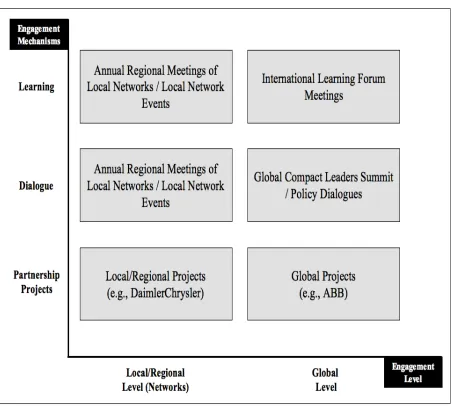
The Compact links these actors through three engagement mechanisms; learning events, dialogue events and partnership projects. The three mechanisms serve the two major goals of the Compact (see above) since they (a) enable business and non-business actors to create, discuss, modify and extend a set of shared values within the global marketplace and (b) allow corporations to implement these values into their operations by sharing ideas and best practices. The engagement mechanisms are designed to function both at the global and national/regional level. On the national/regional level engagement is ensured through so-called local networks, which have been established in over 70 countries thus far. Local networks serve as a platform to create a close link between contextualized problems on the local level and the more abstract ideas and commitments that are developed at the global level. Networks are “translators” of the created global solutions and, at the same time, “innovators” looking for ways to implement the ten principles given the constraints and opportunities of a local context. In the following, the three engagement mechanisms are introduced and their role on the global and national/regional level described (see Figure 2).
--- Put Figure 2 About Here ---
combine and leverage available skills and resources on both sides. Often partnerships occur in direct support of issues discussed at the different loci for dialogue. DaimlerChrysler, for instance, has set up a project together with the German Development Agency (GTZ) to tackle the rise of HIV/AIDS in South Africa. This project is in direct support of the 2003 Global Compact Policy Dialogue on this topic. Whereas some partnership projects are embedded in a local context, others have a more global reach. Deutsche Telekom, for example, has started a Global Communication Initiative that aims to bridge the digital divide across different parts of the world.
Dialogue events are about identifying new and emergent issues that relate to any of the ten principles. However, it also attempts to build relationships and trust with other actors (e.g., by entering into partnership projects). On the global level, the Compact has created a variety of Policy Dialogues that focus on specific issues (e.g., the role of the private sector in conflict zones). These meetings act as an international platform to discuss problems and to gain mutual understanding about possible solutions. Another form of global dialogue is the triennial Global Compact Leaders Summit which brings together executives from business and non-business participants to chart the strategic course of the Compact itself. On the local level, networks are encouraged to facilitate dialogue on issues that are relevant to them and share the ideas developed at regional network conferences. Dialogue at the local level is especially valuable as it allows previously unconnected actors (such as SMEs) to enter into partnerships with other business and non-business participants.
practices and thus follow notable examples that were developed under consideration of their region and sector. On the global level, learning occurs through direct interaction, such as at the International Learning Forum Meeting and also the Global Compact website. Corporations are asked to submit case studies and descriptions of best practices to the web portal to enable other participants to replicate and thus propagate available solutions. The Compact Office has also published a case study series that cluster examples (Global Compact, 2003a, 2003b, 2003c, 2004, 2006). At the local level, network meetings serve as a basis for learning and dissemination of best practices. Networks enable participants to learn from one another taking into account the constraints and opportunities of their region and/or sector. The UK network, for instance, has set up a peer review process of submitted COPs which allows participants to learn how to improve the quality of their COPs.
The three engagement mechanisms work together (e.g., projects also create learning effects) as indicated by the arrows in Figure 2. Engagement mechanisms alone do not ensure that a participant fulfills the two goals that the Compact serves. Rather, engagement by participating in learning, dialogue and partnership projects needs to be backed up by implementation of the principles throughout a participant’s value chain.
The Global Compact and its Critics – An Assessment
underlying institutional framework. Other, less frequently-mentioned criticisms include an observed “non-seriousness” of participants (Deva, 2006, p. 113) and an over-focus on the participation of Western MNCs compared to SMEs from the developing world (Transnational Resource and Action Center, 2000).
Allegation 1: The Compact Supports the “Capture” of the UN by Big Business
One common allegation raised by critical parties is that the Compact opens a window of opportunity for business to capture the UN. Zammit (2003, p. xxi), for example, argues that there is a basic inconsistency between the policy interests of developing countries and those promoted by the UN’s corporate partners. The fear is that big business will pursue its policy interests within the UN more directly by signing up to initiatives like the Global Compact. Such a view is also adopted by Nolan (2005, p. 465) who states that “[c]lose relations between the UN and big business provides ample scope for ‘capture’ such that the UN, the supposed rule setter, wittingly or otherwise begins to adopt the agenda of business partners without debate or true democratic procedure.” Thérien and Pouliot (2006, p. 67) thus conclude that the creation of the Global Compact has fuelled concerns about a break in the UN’s traditional, non-business position on economic issues. Furthermore it raises concerns that the institution adopts a “pro-market spin” that could, in time, lead to its silent privatization.
the solution to foster peace and development. However, owing to increasing media coverage, most partnerships have only recently entered the wider public consciousness. For instance, at the 2002 Johannesburg World Summit for Sustainable Development (WSSD) over 240 partnerships were announced, most of which were in the field of water and energy use (James, 2002). UN-business partnerships are neither a new nor exclusive feature of the Global Compact, however they have increased in number over the last decade. This increase may be due to the fact that many UN agencies have undergone an ideological change from confrontation to cooperation with regard to partnerships (Cohen, 2001; Kell, 2005). There is, of course, the question of why this change has occurred and whether it reflects a “capture” of the UN by business or whether it is simply in response to the rise of global markets and growing governance gaps at the local and global level. This question brings us to the second point.
without collaboration with business (Bigge, 2004, p. 10; Kell, 2005, p. 71). In a world of growing interdependencies, neglecting and devaluing UN-business partnerships can only come at the price of sticking to existing ideologies. There is no basic inconsistency between the goals of business and the UN; both are interested in the existence of a stable global market that is sustainable and based on a social consensus of shared values. Neglecting this relationship may be possible in the short run but will go against the UN’s mission over a longer timeframe.
UN-business partnerships are, of course, not without problems. It is not the direct capture of the UN by businesses but instead the ability of the latter to use the Compact as a means to position a specific idea of what corporate citizenship is about (i.e. learning not regulation) that needs to be watched carefully. As discussed below, learning is a supplement, but not a substitute, for regulation. For corporations, the UN is particularly attractive in this context as influencing the public understanding of what “good” corporate citizenship is about requires discursive legitimacy (among other things) which the UN clearly offers (Levy, 2008; Levy & Prakash, 2003). Since the majority of Compact participants are businesses or business associations, the initiative needs to ensure that the perspectives of multiple stakeholders are taken into consideration when shaping and framing the public understanding and expectation towards corporate citizenship.
Allegation 2: The Compact’s Principles are Vague and Thus Hard to Implement
(2006, p. 129) further argues that “the language of these principles is so general that insincere corporations can easily circumvent or comply with them without doing anything.” Similarly, Nolan (2005, p. 460) and Bigge (2004, p. 11) claim that the Compact is surrounded by a lack of precision in content that does not even attempt to clarify its principles for its participants. Murphy (2005, p. 389) thus concludes that the Compact is at best a minimalist code of corporate conduct.
First of all, one must recognize that many of these critics want the Compact to be a clearly structured code of conduct against which compliance can be measured. However, as already mentioned, the very idea of the Compact is the creation of a long-term learning network that is used by business and non-business participants to share innovative ideas and best practices as to how the ten principles can be implemented. These principles provide a yardstick for the exchange of ideas, learning and discussion and are not meant to be a benchmark against which to assess compliance. The goal is to establish consensus and best practices on what, for instance “a precautionary approach to environmental challenges” means within a firm’s respective region and sector. Over-specified principles could even turn out to be counterproductive as they would limit the scope of possible solutions right from the beginning. The ten principles rather provide corporations with the opportunity and highlight the need to “fill” their general character with context specific meaning.
available resources of participating companies does not allow for the introduction of clear-cut principles. For instance, a “precautionary approach to environmental challenges” has a different meaning for a large MNC operating in the chemical sector, compared to an Indian SME doing business in the IT industry. It is in this spirit that the UNDP-sponsored handbook for implementing the Global Compact recognizes that “company approaches [toward the ten principles] are very different. It highlights the flexibility of the Compact and the fact that there is considerable scope for adapting the initiative to the specific needs and situation of the individual participant.” (UNDP, 2005, p. 8)
It is the very idea of the Compact acting as a moral compass for participants (Kell, 2003, p. 47); a compass that addresses corporate diversity through a learning-based approach which allows firms to contextualize the general principles within their respective business context. The bottom line is that there are a variety of ways to implement the ten principles: The Compact’s values need to be translated into action, a task (like any other management task) that can be approached from different angles.
Allegation 3: The Compact Is Not Accountable Due to Missing Verification
verification fosters the misuse of the Compact as a marketing tool (Deva, 2006; Rizvi, 2004). In the eyes of these critics the Compact is a public relations smokescreen without substance that allows powerful MNCs to “bluewash” their damaged image. In other words, they seek to associate their operations with the blue UN flag in order to gain legitimacy. Ultimately, the fear is that such a lack of accountability can lead to adverse selection in that those companies most eager to join are the ones in need of a good public image (Williams, 2004, p. 762).
In order to address this allegation in a comprehensive way, two issues need to be discussed and understood. First, one cannot and should not criticize the Compact for something it has never pretended or intended to be; a compliance-based mechanism that verifies and measures corporate behavior. From its inception, the initiative was never designed as a seal of approval for participating companies as certification would require far more resources than are currently available. The Compact instead expects proactive behavior from its participants. Its learning approach is advantageous insofar as a code of conduct (that would be needed for monitoring) is always static and thus does not allow participants to react flexibly to varying environmental circumstances (Ruggie, 2002, p. 304). Without a doubt, it should be in the enlightened self-interest of the Compact to prevent free-riders from misusing the initiative. However, the prevention of opportunistic behavior does not ultimately require close monitoring of corporate actions. The decision faced by rule-setters is not between fully monitoring corporate behavior or
not monitoring at all. Rather, there is something in between.
encourages its participants to follow the recently released G3-guidelines of the Global Reporting Initiative (Global Reporting Initiative, 2007). Since COPs are primarily aimed at participants’ stakeholders, they foster a social vetting mechanism that is intended to increase report content and quality over time. Social vetting means that other parties (e.g., NGOs) are asked to use submitted COPs as grounds to judge corporate behavior and file complaints that the Compact can use as a basis for investigations. If a company fails to submit a COP report within a year it is labeled “non-communicating”, while after a second year of non-reporting the firm is labeled “inactive” and completely delisted after yet another year of non-communication. This policy has already led to 945 participants being labeled “non-communicating”, 263 as “inactive” and 630 being permanently delisted (data as of July 2008). The case for ensuring accountability by demanding COPs is a good one as its content needs to be publicized in prominent documents (e.g., the annual report) which usually are approved by a company’s board.
A second issue that deserves attention here is the question of whether verification, although not the aim of the Compact, would be achievable at all. Three points are important in this context: (1) the development of indicators; (2) the issuance of a mandate and (3) the accessibility of resources.
(1) First, even if desired by the Compact, monitoring of participants would be nearly impossible as it requires performance indicators relevant to all companies in all
(2) Second, the Global Compact currently has no mandate to monitor or verify compliance with its principles. Since the initiative is embedded within the UN system, the establishment of legally-binding regulations would require the support of the UN General Assembly, which is unlikely given the current international political climate (Ruggie, 2002, p. 303). Even if such a compromise were to be established, it would reflect the “lowest common denominator” of the currently 193 UN Member States and thus echo a weak mandate. Attempts to transform the Compact into a code of conduct would not only miss political support but also not fit the current climate of cooperation and collaboration between the UN and business.
(3) Third, the logistical and financial resources to effectively and efficiently monitor MNCs and their supply chains, let alone SMEs around the world are simply not available. Given that there are currently over 4,700 business participants, annual (or even biannual) monitoring of corporate behavior would require personal, logistical and financial resources that are way beyond the Compact’s current capacity. Nike, for instance, has over 750 direct suppliers in 52 countries. It is precisely for this reason that certification standards such as SA 8000 award certificates for just one production facility but never for an entire corporation and/or supply chain (Gilbert & Rasche, 2007). The addressees of the Compact, however, are entire corporations and not single production facilities.
accountability. However on their own they do not reflect a compliance mechanism in the narrow sense.
This in-depth discussion of the three allegations demonstrates that there is need to clarify the intent of the Compact. Discussing these allegations should not indicate that these critical voices do not deserve to be heard. The tensions they create can lead to productive discussions and even innovations to the initiative. Instead this article argues that there is need to be more careful when judging the initiative for something it never pretended or intended to be. In the following section, the role of the Compact as a supplement to national/international regulation and voluntary regulative standards (e.g., SA 8000) is outlined. This discussion is intended to lead future critical assessments in a more fruitful direction; a direction that enables the initiative to learn from and leverage the suggestions made by its critics.
The Global Compact as a
Necessary
Supplement
national and international regulatory systems. Instead it is useful where (1) corporations are willing but have trouble putting regulations into practice and thus need to learn about implementation and (2) where regulations fail or are ineffective and need further development. Both of these situations will be explained further.
First, the Compact supplements regulation by national governments, intergovernmental institutions and compliance-based voluntary CSR-standards because it enables a learning process within corporations – a learning process that allows firms to establish compliance with these regulations in the first place. Regulation by itself is often limited in its potential because those who are regulated need to learn how to implement and “live” the letter of law. The myriad of corporate scandals around the globe shows that regulation by itself is in no way sufficient. Regulated parties need to find out what the letter of law means, how it can be implemented and, most of all, they need to be willing to carry out serious implementation efforts. The Compact helps corporations to address these issues by providing a forum that disseminates best practices and thus translates existing regulations (e.g., international law with regard to human rights issues) into real-life actions. Furthermore, it can also positively stimulate the motivation to comply with regulations by identifying notable best practices and thus exercise peer-pressure on competitors.
course, the Compact does not define a regulatory framework to tackle climate change, however offers a forum where this issue can be discussed to develop measures that can act as a temporary
solution until binding regulations emerge. The recently launched Caring for Climate platform shows that Compact participants (e.g., Deutsche Telekom and Unilever) have come up with a variety of innovative ways to address climate change within their business operations. Setting up the Caring for Climate platform does not indicate that there is no need for regulation to fight climate change, but that preliminary results are possible even in the absence of binding rules. Kofi Annan recognized this when referring to the Compact as a pragmatic interim solution with regard to existing governance gaps (United Nations, 2004). Talking about pragmatic solutions, of course, does not indicate that learning and the formulation of shared values solely fill the omnipresent governance gaps, nor does it mean that global governance can do without regulation. It merely stresses the fact that (a) interim solutions are necessary as long as binding global regulations are not in sight and (b) regulations always should be supplemented, not replaced, by a learning-based approach towards governance.
towards inflexibility and over-formality (Bardach & Kagan, 1982) which can lead to adversarial “going by the book” attitudes to compliance (Coglianese & Nash, 2001). The Compact is necessary in this context because it adds flexibility to existing regulations and thus allows for the inclusion of emerging topics (e.g., climate change).
To conclude, in order to appreciate the nature of the Compact there is a need to leave the dichotomy of “effective regulation by law” versus “ineffective voluntary commitment to non-regulating learning tools”. The choice is not one of an either/or-type but should reflect a both/and way of thinking. That is why this article characterizes the Compact as a supplement – something that adds-itself-to regulation but always requires further actions. The International Chamber of Commerce (2004, p. 1) echoes this by claiming that “the Global Compact’s greatest strength lies in its voluntary nature, which acts as a powerful complement to the necessary action by governments themselves to safeguard and advance its principles.”
Moving Ahead – Perspectives and Challenges
Although this article shows that some of the critical voices are based on a misunderstanding of the nature of the Compact and/or demand changes that are unlikely to occur in the current political climate of the UN, there are a variety of challenges that the Compact needs to address in order to maintain or even increase its relevance. This article highlights four issues which represent key success factors for the development of the initiative; (1) the management of growth, (2) the management of diversity, (3) the continued strengthening of
with governments to strengthen the ten principles with binding regulations or the more active consideration of problems that relate to international supply chains. Hence, the following four issues do not represent an exclusive list but are indicative of future challenges, the discussion of which is beyond the scope of this article.
Managing Growth. The first major challenge results from the tension that is created
between the continued expansion of the initiative – from 50 participants in 2000 to over 6,000 in 2008 – and the constraints of managing such a fast-growing and flexible network of actors within a rather rigid organization such as the UN. It is no secret that the UN system is overly-characterized by a bureaucratic and hierarchical way of management that is not always in a position to provide quick responses to the emerging needs of a proliferating initiative such as the Global Compact. In particular, inter-agency collaboration and also collaboration of UN agencies with non-state actors cannot rely on the rather sticky UN-procedures for issuing mandates. Instead it needs to be driven by shared incentives, a decentralized decision-making style and commitment towards the Compact’s ten principles.
There is also a danger that the Compact may become politicized in the sense that the UN demands intergovernmental oversight. Although the current mandate, backed by a General Assembly resolution (United Nations, 2001), gives the UN Secretariat clear responsibility for the Compact, this status needs to be maintained, especially when bearing in mind the expected further growth. The achievements of the Compact and its steady growth are based on its pragmatism and the network-based governance model underlying its operations; politicizing the initiative would put these two success factors at risk.
Managing Diversity. A second challenge deals with achieving greater diversity in terms of
participants. Although some areas of the world have not yet attracted a lot of participants (e.g., the Middle East), it is especially remarkable that North American companies only comprise a small portion of the overall share of the Compact’s business participants (i.e. around 200; Global Compact, 2007). This number is particularly striking because North American (especially US) companies represent a much larger percentage of the world’s largest corporations according to the Fortune Global 500 index than their participation rate in the Compact indicates. One major reason is that North America is a more litigious society than Europe or Latin America. Companies are afraid of lawsuits that are filed by adversaries, accusing US participants of not complying with the principles (Hemphill, 2005, p. 312; Williams, 2004, p. 758). As Ziegler’s (2007) empirical study reveals, US participants often cite fear of litigation as an obstacle against membership in the Compact. This participation barely improved even after the Compact, together with the American Bar Association, developed a litigation-proof letter in 2004 which shields US participants from lawsuits based on claims that they failed to comply with the principles. Even though there is no evidence whether this letter holds the force of law, other reasons must also play a role.
Since the US hosts many MNCs, increased participation is not only desirable but also necessary to address issues related to global supply chains.
Ensuring Accountability. A third challenge deals with further strengthening the
accountability of the initiative in order to protect its integrity and ensure sustainable growth. Accountability is, among other things, directly linked to an organization’s ability to provide transparency of its operations and an evaluation of the progress and results against its goals and objectives (Blagescu & Lloyd, 2006; Rasche & Esser, 2006). To assess the accountability of the Compact, one needs to look at two inter-related issues; on the one hand information communicated by participants about their progress in implementing the principles and on the other, information regarding the impact communicated by the Compact itself. Concerning corporate reporting, there is a challenge to not only demand annual Communication on Progress, but also to ensure comparable quality of the submitted reports. Although the Compact has no authority to judge the actions of corporations, an industry-specific benchmarking system for the annually-submitted reports would help (a) to provide incentives for participants to submit improved reports as well as a guide to do so and (b) to increase the comparability of report content and thus foster learning and dialogue among participants. Achieving such a benchmarking system means to strengthen the already existing relationship with the Global Reporting Initiative to come up with a selection of mandatory core indicators for COP reports. In addition, the currently existing categories for failed COP reporting (i.e. non-communicating, inactive, delisted) should be merged into one category. This shortens the “grace period” for non-reporters and thus provides incentives to submit a report on time.
the 2007 Leaders Summit in Geneva) includes specific and comprehensive data on the overall progress of implementing the ten principles throughout the world. The challenge is to make this information more reliable by supplementing the (so far) quantitative survey-based data with more detailed qualitative interview-based data. For first attempts of this approach see Cetindamar & Husoy, (2007) and McKinsey & Company (2004). To date, a systematic effort to assess the impact of the Compact in a comprehensive manner has not been attempted, mostly due to the high costs of gathering and evaluating information at different levels of aggregation (Kell, 2005, p. 63). The accountability of the initiative could be strengthened if a comprehensive impact assessment can be produced and disseminated on a regular basis. Impact assessments also need to show whether Compact-related projects by business participants are integrated into core-business practices, as indicated by the initiative’s understanding of corporate citizenship (see above), or whether such projects reflect philanthropy and are thus isolated from a participant’s business. After all, positive results of impact assessments could also prove that the flexibility inherent in the ten principles “pays off”.
Including Financial Markets. Finally, there is the challenge of winning financial markets
contribute to better market performance. The Compact, by promoting the Principles for Responsible Investment (PRI), can help to set the right institutional framework for responsible investment-decisions. If institutional investors start acknowledging the PRI as a guideline for their decisions, the business case for the Compact will become more obvious. Of course, participation in the Compact should never be limited to the business case. However, future growth of the initiative will depend on the environment that is set by financial markets. Responsible investment decisions can lead to stable, accountable and thus profitable market conditions which should be in the enlightened self-interest of all market players – especially when considering the recent turbulence of mortgage markets around the world.
Conclusions
Christian Science Monitor (2000), for example, praised the Compact as being “the most creative reinvention” of the United Nations to date.
Future conceptual and empirical research can and should support the evolution of the Compact. First, researchers can add expertise and insights to develop a more systemic and comprehensive impact assessment. Whereas there are a number of conceptual studies that introduce the content and governance structure of the Compact (Deva, 2006; Nolan, 2005; Thérien & Pouliot, 2006; Williams, 2004), there are almost no empirical insights on the implementation of the ten principles in corporations. The academic community can add much-needed information by conducting studies about the impact of the Compact on existing business practices. One key question is, for instance, whether and how participating firms have changed existing routines (e.g., with regard to supplier relations).
raised in this article to present arguments that consider the nature of the Compact together with its institutional setting to a greater extent.
References
Amnesty International (2003). Letter to Louise Fréchette raising concerns on UN Global Compact. Retrieved July 20, 2007, from http://web.amnesty.org.
Aupperle, K. E., Carroll, A. B., & Hatfield, J. (1985). An Empirical Examination of the Relationship Between Corporate Social Responsibility and Profitability. Academy of Management Journal, 28(2), 446-463.
Baldwin, R., Scott, C., & Hood, C. (1998). A reader on regulation. Oxford: Oxford University Press.
Bardach, E., & Kagan, R. A. (1982). Going by the book: The problem of regulatory unreasonableness. Philadelphia: Temple University Press.
Bigge, D. M. (2004). Bring on the Bluewash – A Social Constructivist Argument Against Using Nike v. Kasky to Attack the UN Global Compact. International Legal Perspectives, 14, 6-21.
Birch, D. (2001). Corporate citizenship: Rethinking business beyond corporate social responsibility. In J. Andriof & M. Mcintosh (Eds.), Perspectives on corporate citizenship
(pp. 53-65). Sheffield: Greenleaf.
Blagescu, M., & Lloyd, R. (2006). 2006 Global accountability report: Holding power to account. London: One World Trust.
Carroll, A. B. (1991). The Pyramid of Corporate Social Responsibility: Toward the Moral Management of Organizational Stakeholders. Business Horizons, 34(4), 39-48.
Centindamar, D., & Husoy, K. (2007). Corporate Social Responsibility Practices and Environmentally Responsible Behavior: The Case of the United Nations Global Compact.
Journal of Business Ethics, 76, 163-176.
Christian Science Monitor (2000). A new Global Compact. Retrieved July 20, 2007, from http://www.csmonitor.com/2000/0908/p10s1.html.
Cohen J. (2001). The world’s business: The United Nations and the globalization of corporate citizenship. In J. Andriof & M. Macintosh (Eds.), Perspectives on corporate citizenship
(pp. 185-197). Sheffield: Greenleaf.
Coglianese, C., & Nash, J. (2001). Regulating from the inside: Can environmental management systems achieve policy goals. Washington: Resources for the Future.
Deva, S. (2006). Global Compact: A Critique of the UN’s ‘Public-Private’ Partnership for Promoting Corporate Citizenship. Syracuse Journal of International Law and Communication, 34, 107-151.
Dingwert, K., & Pattberg, P. (2006). Global Governance as a Perspective on World Politics.
Global Governance, 12, 185-203.
Engardio, P. (2004). Global Compact, little impact. Business Week, 12 July 2004, 86-87.
Fort, T. L., & Schipani, C. A. (2002). The Role of the Corporation in Fostering Sustainable Peace. Vanderbilt Journal of Transnational Law, 35, 389-435..
Gilbert, D. U., & Rasche, A. (2007). Discourse Ethics and Social Accountability: The Ethics of SA 8000. Business Ethics Quarterly, 17, 187-216.
Global Compact (2003b). Experiences in management for sustainability. New York: Global Compact Office.
Global Compact (2003c). From principles to practice. New York: Global Compact Office. Global Compact (2004). Embedding human rights in business practice. New York: Global
Compact Office.
Global Compact (2006). Business against corruption: Case stories and examples. New York: Global Compact Office.
Global Compact (2007). UN Global Compact annual review. New York: Global Compact Office.
Global Reporting Initiative (GRI) (2007). Sustainability reporting guidelines on economic, environmental, and social performance v3. Boston: GRI.
Goldman Sachs (2007). Introducing GS sustain. London: The Goldman Sachs Group Inc.
Hemphill, T. A. (2005). The United Nations Global Compact. International Journal of Business Governance and Ethics, 1, 303-316.
International Chamber of Commerce (2004, 24 June). The Global Compact: A business perspective, [Press release]. Paris: International Chamber of Commerce.
James. B. (2002, 2 September). Partnerships stressed at the summit: Many companies find an opportunity. International Herald Tribune. Retrieved 28 January, 2009, from http://www.iht.com/articles/2002/09/02/joburg_ed3_.php
Kell, G. (2003). The Global Compact: Origins, Operations, Progress, Challenges. Journal of Corporate Citizenship, 11, 35-49.
Kell, G., & Ruggie, J. G. (1999). Global Markets and Social Legitimacy: The Case for the ‘Global Compact’. Transnational Corporations, 8, 101-120.
Kell, G., & Levin, D. (2003). The Global Compact Network: An Historic Experiment in Learning and Action. Business and Society Review, 108, 151-181.
Levy, D. L. (2008). Political Contestation in Global Production Networks. Academy of Management Review, 33(4), 943-963.
Levy, D. L., & Prakash, A. (2003). Bargains Old and New: Multinational Corporations in Global Governance. Business and Politics, 5(2), 131-150.
McIntosh, M., Thomas, R., Leipziger, D., & Coleman, G. (2003). Living corporate citizenship: Strategic routes to socially responsible business. London et al.: FT Prentice Hall.
McKinsey & Company (2004). Assessing the Global Compact’s impact. New York: Global Compact Office.
McKinsey & Company (2007). Shaping the new rules of competition: UN Global Compact participant mirror. London: McKinsey & Company.
Murphy, S. D. (2005). Taking Multinational Corporate Codes of Conduct to the Next Level.
Columbia Journal of Transnational Law, 43, 388-433.
Nash, P. (2003). Global Compact challenges firms. Business Weekly. Retrieved 29 January, 2009, from http://www.chinadaily.com.cn/en/doc/2003-04/08/content_162162.htm. Nolan, J. (2005). The United Nations Global Compact With Business: Hindering or Helping the
Protection of Human Rights?The University of Queensland Law Journal, 24, 445-466. Norman, W., & Néron, P. Y. (2008). Citizenship Inc.: Do we Really Want Businesses to Be
Orlitzky, M., Schmidt, F. L., & Rynes, S. (2003). Corporate Social and Financial Performance: A Meta-Analysis. Organization Studies, 24(3), 403-441.
Palazzo, G., & Scherer, A. G. (2006). Corporate Legitimacy as Deliberation: A Communicative Framework. Journal of Business Ethics, 66, 71-88.
Poncelet, E. (2003). Resisting Corporate Citizenship: Business-NGO Relations in Multistakeholder Environmental Partnerships. Journal of Corporate Citizenship, 9, 97-115.
Rasche, A. (2009). Toward a Model to Compare and Analyze Accountability Standards: The Case of the UN Global Compact. International Journal of Innovation and Sustainable Development (in press).
Rasche, A., & Esser, D. E. (2006). From Stakeholder Management to Stakeholder Accountability: Applying Habermasian Discourse Ethics to Accountability Research. Journal of Business Ethics, 65, 251–67.
Rizvi, H. (2004). UN pact with business lacks accountability. Global Policy Forum. Retrived 20 July, 2007, from http://www.globalpolicy.org.
Rosenau, J. N. (1992). Governance, order and change in world politics. In J. N. Rosenau & E. O. Czempiel (Eds.), Governance without government: Order and change in world politics
(pp. 1-29). Cambridge: Cambridge University Press.
Ruggie. J. G. (2001). Global_governance.net: The Global Compact as Learning Network. Global Governance, 7, 371-378.
Scherer, A. G., Palazzo, G., & Baumann, D. (2006). Global Rules and Private Actors: Toward a New Role of the Transnational Corporation in Global Governance. Business Ethics Quarterly, 16, 505-532.
Sethi, S. P. (2003). Global Compact is another exercise in futility. Financial Express. Retrieved 20 July, 2007, from http://www.financialexpress.com/news/global-compact-is-another-exercise-in-futility/91447.
Selznick, P. (1985). Focusing organizational research on regulation. In R. Noll (Ed.), Regulatory policy and the social sciences (pp. 363-367). Berkeley: University of California Press. Thérien, J. P., & Pouliot, V. (2006). The Global Compact: Shifting the Politics of International
Development. Global Governance, 12, 55-75.
Transnational Resource and Action Center (TRAC) (2000). Tangled up in blue: Corporate partnerships at the United Nations. San Francisco: TRAC.
United Nations (1999, 1 February). Secretary-General address to the World Economic Forum in Davos, [Press Release SG/SM/6881]. New York: United Nations.
United Nations (2001, 3 December). Towards global partnerships, [General Assembly Resolution A/56/L.33]. New York: United Nations.
United Nations (2004, 24 June). Global compact participants on ‘Common Historic Journey’ to fairer, more stable world says Secretary-General at UN Summit, [Press Release SG/SM/9383, ECO/69]. New York: United Nations.
United Nations Development Program (UNDP) (2005). Implementing the Global Compact: A booklet for inspiration. Copenhagen: UNDP.
Webb, K. (2004). Understanding the voluntary code phenomenon. In K. Webb (Ed.), Voluntary Codes: Private governance, the public interest and innovation (pp. 3-32). Ottawa, CA: Carleton University Press.
Williams, O. F. (2004). The UN Global Compact: The challenge and the promise. Business Ethics Quarterly, 14, 755-774.
Windsor, D. (2007). Toward a Global Theory of Cross-Border and Multilevel Corporate Political Activity. Business and Society, 46(2), 253-278.
Zammit, A. (2003). Development at risk: Rethinking UN-Business partnerships. New York: The South Centre and United Nations Research Institute for Social Development.