Minimum Cut Model for Spoken Lecture Segmentation
Igor Malioutov and Regina Barzilay
Computer Science and Artificial Intelligence Laboratory Massachusetts Institute of Technology
{igorm,regina}@csail.mit.edu
Abstract
We consider the task of unsupervised lec-ture segmentation. We formalize segmen-tation as a graph-partitioning task that op-timizes the normalized cut criterion. Our approach moves beyond localized com-parisons and takes into account long-range cohesion dependencies. Our results demonstrate that global analysis improves the segmentation accuracy and is robust in the presence of speech recognition errors.
1 Introduction
The development of computational models of text structure is a central concern in natural language processing. Text segmentation is an important in-stance of such work. The task is to partition a text into a linear sequence of topically coherent segments and thereby induce a content structure of the text. The applications of the derived rep-resentation are broad, encompassing information retrieval, question-answering and summarization.
Not surprisingly, text segmentation has been ex-tensively investigated over the last decade. Fol-lowing the first unsupervised segmentation ap-proach by Hearst (1994), most algorithms assume that variations in lexical distribution indicate topic changes. When documents exhibit sharp varia-tions in lexical distribution, these algorithms are likely to detect segment boundaries accurately. For example, most algorithms achieve high per-formance on synthetic collections, generated by concatenation of random text blocks (Choi, 2000). The difficulty arises, however, when transitions between topics are smooth and distributional vari-ations are subtle. This is evident in the perfor-mance of existing unsupervised algorithms on less
structured datasets, such as spoken meeting tran-scripts (Galley et al., 2003). Therefore, a more refined analysis of lexical distribution is needed.
Our work addresses this challenge by casting text segmentation in a graph-theoretic framework. We abstract a text into a weighted undirected graph, where the nodes of the graph correspond to sentences and edge weights represent the pair-wise sentence similarity. In this framework, text segmentation corresponds to a graph partitioning that optimizes the normalized-cut criterion (Shi and Malik, 2000). This criterion measures both the similarity within each partition and the dissimilar-ity across different partitions. Thus, our approach moves beyond localized comparisons and takes into account long-range changes in lexical distri-bution. Our key hypothesis is that global analysis yields more accurate segmentation results than lo-cal models.
We tested our algorithm on a corpus of spo-ken lectures. Segmentation in this domain is chal-lenging in several respects. Being less structured than written text, lecture material exhibits digres-sions, disfluencies, and other artifacts of sponta-neous communication. In addition, the output of speech recognizers is fraught with high word er-ror rates due to specialized technical vocabulary and lack of in-domain spoken data for training. Finally, pedagogical considerations call for fluent transitions between different topics in a lecture, further complicating the segmentation task.
Our experimental results confirm our hypothe-sis: considering long-distance lexical dependen-cies yields substantial gains in segmentation
per-formance. Our graph-theoretic approach
com-pares favorably to state-of-the-art segmentation al-gorithms and attains results close to the range of human agreement scores. Another attractive
erty of the algorithm is its robustness to noise: the accuracy of our algorithm does not deteriorate sig-nificantly when applied to speech recognition out-put.
2 Previous Work
Most unsupervised algorithms assume that frag-ments of text with homogeneous lexical distribu-tion correspond to topically coherent segments. Previous research has analyzed various facets of lexical distribution, including lexical weighting, similarity computation, and smoothing (Hearst, 1994; Utiyama and Isahara, 2001; Choi, 2000; Reynar, 1998; Kehagias et al., 2003; Ji and Zha, 2003).
The focus of our work, however, is on an or-thogonal yet fundamental aspect of this analysis — the impact of long-range cohesion dependen-cies on segmentation performance. In contrast to previous approaches, the homogeneity of a seg-ment is determined not only by the similarity of its words, but also by their relation to words in other segments of the text. We show that optimizing our global objective enables us to detect subtle topical changes.
Graph-Theoretic Approaches in Vision Seg-mentation Our work is inspired by
minimum-cut-based segmentation algorithms developed for im-age analysis. Shi and Malik (2000) introduced the normalized-cut criterion and demonstrated its practical benefits for segmenting static images.
Our method, however, is not a simple applica-tion of the existing approach to a new task. First, in order to make it work in the new linguistic framework, we had to redefine the underlying rep-resentation and introduce a variety of smoothing
and lexical weighting techniques. Second, the
computational techniques for finding the optimal partitioning are also quite different. Since the
min-imization of the normalized cut isN P-complete
in the general case, researchers in vision have to
approximate this computation. Fortunately, we
can find an exact solution due to the linearity con-straint on text segmentation.
3 Minimum Cut Framework
[image:2.595.308.525.63.271.2]Linguistic research has shown that word repeti-tion in a particular secrepeti-tion of a text is a device for creating thematic cohesion (Halliday and Hasan, 1976), and that changes in the lexical distributions usually signal topic transitions.
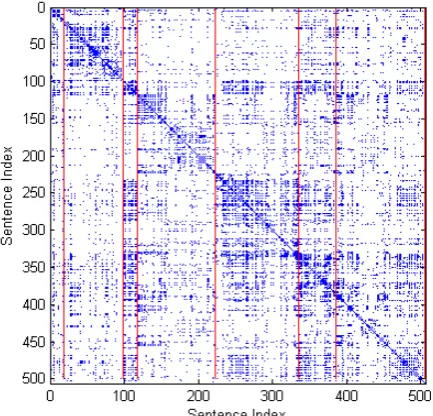
Figure 1: Sentence similarity plot for a Physics lecture, with vertical lines indicating true segment boundaries.
Figure 1 illustrates these properties in a lec-ture transcript from an undergraduate Physics class. We use the text Dotplotting representation by (Church, 1993) and plot the cosine similar-ity scores between every pair of sentences in the
text. The intensity of a point(i, j)on the plot
in-dicates the degree to which the i-th sentence in
the text is similar to thej-th sentence. The true
segment boundaries are denoted by vertical lines. This similarity plot reveals a block structure where true boundaries delimit blocks of text with high inter-sentential similarity. Sentences found in dif-ferent blocks, on the other hand, tend to exhibit low similarity.
[image:2.595.315.520.546.606.2]u1 u2 u3 un
Figure 2: Graph-based Representation of Text
Formalizing the Objective Whereas previous
maxi-mally different from each other.
Let G = {V, E} be an undirected, weighted
graph, where V is the set of nodes
correspond-ing to sentences in the text and E is the set of
weighted edges (See Figure 2). The edge weights,
w(u, v), define a measure of similarity between
pairs of nodes u and v, where higher scores
in-dicate higher similarity. Section 4 provides more details on graph construction.
We consider the problem of partitioning the
graph into two disjoint sets of nodesAandB. We
aim to minimize the cut, which is defined to be the sum of the crossing edges between the two sets of nodes. In other words, we want to split the sen-tences into two maximally dissimilar classes by
choosingAandB to minimize:
cut(A, B) = X u∈A,v∈B
w(u, v)
However, we need to ensure that the two parti-tions are not only maximally different from each other, but also that they are themselves homoge-neous by accounting for intra-partition node simi-larity. We formulate this requirement in the frame-work of normalized cuts (Shi and Malik, 2000), where the cut value is normalized by the volume of the corresponding partitions. The volume of the partition is the sum of its edges to the whole graph:
vol(A) = X u∈A,v∈V
w(u, v)
The normalized cut criterion (N cut) is then
de-fined as follows:
N cut(A, B) = cut(A, B)
vol(A) +
cut(A, B)
vol(B)
By minimizing this objective we simultane-ously minimize the similarity across partitions and maximize the similarity within partitions. This formulation also allows us to decompose the ob-jective into a sum of individual terms, and formu-late a dynamic programming solution to the mul-tiway cut problem.
This criterion is naturally extended to a k-way normalized cut:
N cutk(V) =cut(A1, V −A1)
vol(A1)
+. . .+cut(Ak, V −Ak)
vol(Ak)
where A1. . . Ak form a partition of the graph,
andV−Akis the set difference between the entire
graph and partitionk.
Decoding Papadimitriou proved that the
prob-lem of minimizing normalized cuts on graphs is
N P-complete (Shi and Malik, 2000). However,
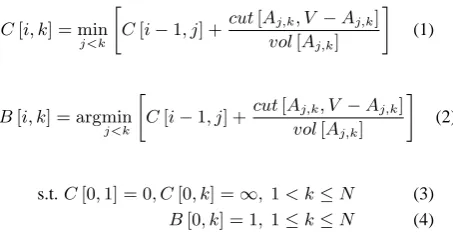
in our case, the multi-way cut is constrained to preserve the linearity of the segmentation. By seg-mentation linearity, we mean that all of the nodes between the leftmost and the rightmost nodes of a particular partition have to belong to that par-tition. With this constraint, we formulate a dy-namic programming algorithm for exactly finding the minimum normalized multiway cut in polyno-mial time:
C[i, k] = min
j<k
C[i−1, j] +cut[Aj,k, V −Aj,k]
vol[Aj,k]
(1)
B[i, k] = argmin
j<k
C[i−1, j] +cut[Aj,k, V −Aj,k]
vol[Aj,k]
(2)
s.t.C[0,1] = 0, C[0, k] =∞,1< k≤N (3)
B[0, k] = 1,1≤k≤N (4)
C[i, k] is the normalized cut value of the
op-timal segmentation of the first ksentences into i
segments. Thei-th segment,Aj,k, begins at node
[image:3.595.308.535.244.360.2]ujand ends at nodeuk.B[i, k]is the back-pointer
table from which we recover the optimal sequence of segment boundaries. Equations 3 and 4 capture respectively the condition that the normalized cut value of the trivial segmentation of an empty text into one segment is zero and the constraint that the first segment starts with the first node.
The time complexity of the dynamic
program-ming algorithm isO(KN2), whereKis the
num-ber of partitions andN is the number of nodes in
the graph or sentences in the transcript.
4 Building the Graph
Clearly, the performance of our model depends on the underlying representation, the definition of the pairwise similarity function, and various other model parameters. In this section we provide fur-ther details on the graph construction process.
Preprocessing Before building the graph, we
Graph Topology As we noted in the
previ-ous section, the normalized cut criterion considers long-term similarity relationships between nodes. This effect is achieved by constructing a fully-connected graph. However, considering all pair-wise relations in a long text may be detrimen-tal to segmentation accuracy. Therefore, we dis-card edges between sentences exceeding a certain threshold distance. This reduction in the graph size also provides us with computational savings.
Similarity Computation In computing
pair-wise sentence similarities, sentences are repre-sented as vectors of word counts. Cosine sim-ilarity is commonly used in text segmentation
(Hearst, 1994). To avoid numerical precision
issues when summing a series of very small scores, we compute exponentiated cosine similar-ity scores between pairs of sentence vectors:
w(si, sj) =e si·sj ||si||×||sj||
We further refine our analysis by smoothing the similarity metric. When comparing two sentences, we also take into account similarity between their
immediate neighborhoods. The smoothing is
achieved by adding counts of words that occur in adjoining sentences to the current sentence feature vector. These counts are weighted in accordance to their distance from the current sentence:
˜
si = i+k
X
j=i
e−α(j−i)sj,
where si are vectors of word counts, and α is a
parameter that controls the degree of smoothing. In the formulation above we use sentences as our nodes. However, we can also represent graph nodes with non-overlapping blocks of words of fixed length. This is desirable, since the lecture transcripts lack sentence boundary markers, and short utterances can skew the cosine similarity scores. The optimal length of the block is tuned on a heldout development set.
Lexical Weighting Previous research has
shown that weighting schemes play an important role in segmentation performance (Ji and Zha, 2003; Choi et al., 2001). Of particular concern are words that may not be common in general En-glish discourse but that occur throughout the text for a particular lecture or subject. For example, in a lecture about support vector machines, the oc-currence of the term “SVM” is not going to con-vey a lot of information about the distribution of
Segments per Total Word ASR WER Corpus Lectures Lecture Tokens Accuracy
Physics 33 5.9 232K 19.4%
[image:4.595.312.522.62.108.2]AI 22 12.3 182K ×
Table 1: Lecture Corpus Statistics
sub-topics, even though it is a fairly rare term in general English and bears much semantic con-tent. The same words can convey varying degrees of information across different lectures, and term weighting specific to individual lectures becomes important in the similarity computation.
In order to address this issue, we introduce a variation on the tf-idf scoring scheme used in the information-retrieval literature (Salton and
Buck-ley, 1988). A transcript is split uniformly intoN
chunks; each chunk serves as the equivalent of documents in the tf-idf computation. The weights are computed separately for each transcript, since topic and word distributions vary across lectures.
5 Evaluation Set-Up
In this section we present the different corpora used to evaluate our model and provide a brief overview of the evaluation metrics. Next, we de-scribe our human segmentation study on the cor-pus of spoken lecture data.
5.1 Parameter Estimation
A heldout development set of three lectures is-used for estimating the optimal word block length for representing nodes, the threshold distances for discarding node edges, the number of uniform chunks for estimating tf-idf lexical weights, the alpha parameter for smoothing, and the length of the smoothing window. We use a simple greedy search procedure for optimizing the parameters.
5.2 Corpora
We evaluate our segmentation algorithm on three sets of data. Two of the datasets we use are new segmentation collections that we have compiled
for this study,1 and the remaining set includes a
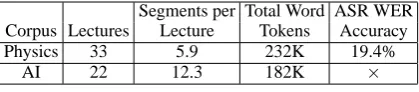
standard collection previously used for evaluation of segmentation algorithms. Various corpus statis-tics for the new datasets are presented in Table 1. Below we briefly describe each corpus.
Physics Lectures Our first corpus consists of
spoken lecture transcripts from an undergraduate
1Our materials are publicly available athttp://www.
Physics class. In contrast to other segmentation datasets, our corpus contains much longer texts. A typical lecture of 90 minutes has 500 to 700
sentences with8500words, which corresponds to
about 15 pages of raw text. We have access both to manual transcriptions of these lectures and also output from an automatic speech recognition
sys-tem. The word error rate for the latter is 19.4%,2
which is representative of state-of-the-art perfor-mance on lecture material (Leeuwis et al., 2003).
The Physics lecture transcript segmentations were produced by the teaching staff of the intro-ductory Physics course at the Massachusetts In-stitute of Technology. Their objective was to fa-cilitate access to lecture recordings available on the class website. This segmentation conveys the high-level topical structure of the lectures. On av-erage, a lecture was annotated with six segments, and a typical segment corresponds to two pages of a transcript.
Artificial Intelligence Lectures Our second
lecture corpus differs in subject matter, lecturing style, and segmentation granularity. The gradu-ate Artificial Intelligence class has, on average, twelve segments per lecture, and a typical segment is about half of a page. One segment roughly cor-responds to the content of a slide. This time the segmentation was obtained from the lecturer her-self. The lecturer went through the transcripts of lecture recordings and segmented the lectures with the objective of making the segments correspond to presentation slides for the lectures.
Due to the low recording quality, we were un-able to obtain the ASR transcripts for this class. Therefore, we only use manual transcriptions of these lectures.
Synthetic Corpus Also as part of our
anal-ysis, we used the synthetic corpus created by Choi (2000) which is commonly used in the eval-uation of segmentation algorithms. This corpus consists of a set of concatenated segments
ran-domly sampled from the Brown corpus. The
length of the segments in this corpus ranges from three to eleven sentences. It is important to note that the lexical transitions in these concatenated texts are very sharp, since the segments come from texts written in widely varying language styles on completely different topics.
2A speaker-dependent model of the lecturer was trained
on 38 hours of lectures from other courses using the SUM-MIT segment-based Speech Recognizer (Glass, 2003).
5.3 Evaluation Metric
We use thePkand WindowDiff measures to
eval-uate our system (Beeferman et al., 1999; Pevzner
and Hearst, 2002). ThePkmeasure estimates the
probability that a randomly chosen pair of words
within a window of length k words is
inconsis-tently classified. The WindowDiff metric is a
vari-ant of thePkmeasure, which penalizes false
posi-tives on an equal basis with near misses.
Both of these metrics are defined with re-spect to the average segment length of texts and
exhibit high variability on real data. We
fol-low Choi (2000) and compute the mean segment
length used in determining the parameter k on
each reference text separately.
We also plot the Receiver Operating Character-istic (ROC) curve to gauge performance at a finer level of discrimination (Swets, 1988). The ROC plot is the plot of the true positive rate against the false positive rate for various settings of a decision criterion. In our case, the true positive rate is the fraction of boundaries correctly classified, and the false positive rate is the fraction of non-boundary positions incorrectly classified as boundaries. In computing the true and false positive rates, we vary the threshold distance to the true boundary within which a hypothesized boundary is consid-ered correct. Larger areas under the ROC curve of a classifier indicate better discriminative perfor-mance.
5.4 Human Segmentation Study
Spoken lectures are very different in style from other corpora used in human segmentation studies (Hearst, 1994; Galley et al., 2003). We are inter-ested in analyzing human performance on a corpus of lecture transcripts with much longer texts and a less clear-cut concept of a sub-topic. We define a segment to be a sub-topic that signals a prominent shift in subject matter. Disregarding this sub-topic change would impair the high-level understanding of the structure and the content of the lecture.
O A B C
MEANSEG. COUNT 6.6 8.9 18.4 13.8
[image:6.595.308.524.73.267.2]MEANSEG. LENGTH 69.4 51.5 24.9 33.2 SEG. LENGTH DEV. 39.6 37.4 34.5 39.4
Table 2: Annotator Segmentation Statistics for the first ten Physics lectures.
REF/HYP O A B C
O 0 0.243 0.418 0.312
A 0.219 0 0.400 0.355
B 0.314 0.337 0 0.332
C 0.260 0.296 0.370 0
Table 3: Pkannotation agreement between
differ-ent pairs of annotators.
[image:6.595.74.289.185.255.2]that would identify most of the prominent topical transitions necessary for a summary of the lecture. The annotators used the NOMOS annotation software toolkit, developed for meeting segmenta-tion (Gruenstein et al., 2005). They were provided with recorded audio of the lectures and the corre-sponding text transcriptions. We intentionally did not provide the subjects with the target number of boundaries, since we wanted to see if the annota-tors would converge on a common segmentation granularity.
Table 2 presents the annotator segmentation
statistics. We see two classes of segmentation
granularities. The original reference (O) and anno-tator A segmented at a coarse level with an average of 6.6 and 8.9 segments per lecture, respectively. Annotators B and C operated at much finer levels of discrimination with 18.4 and 13.8 segments per lecture on average. We conclude that multiple lev-els of granularity are acceptable in spoken lecture segmentation. This is expected given the length of the lectures and varying human judgments in se-lecting relevant topical content.
Following previous studies, we quantify the
level of annotator agreement with thePkmeasure
(Gruenstein et al., 2005).3 Table 3 shows the
an-notator agreement scores between different pairs
of annotators. Pkmeasures ranged from0.24and
0.42. We observe greater consistency at similar
levels of granularity, and less so across the two
3Kappa measure would not be the appropriate measure in
this case, because it is not sensitive to near misses, and we cannot make the required independence assumption on the placement of boundaries.
EDGECUTOFF
10 25 50 100 200 NONE
PHYSICS(MANUAL)
PK 0.394 0.373 0.341 0.295 0.311 0.330
WD 0.404 0.383 0.352 0.308 0.329 0.350 PHYSICS(ASR)
PK 0.440 0.371 0.343 0.330 0.322 0.359
WD 0.456 0.383 0.356 0.343 0.342 0.398 AI
PK 0.480 0.422 0.408 0.416 0.393 0.397
WD 0.493 0.435 0.420 0.440 0.424 0.432
CHOI
PK 0.222 0.202 0.213 0.216 0.208 0.208
WD 0.234 0.222 0.233 0.238 0.230 0.230
Table 4: Edges between nodes separated beyond a certain threshold distance are removed.
classes. Note that annotator A operated at a level of granularity consistent with the original
refer-ence segmentation. Hrefer-ence, the 0.24 Pk measure
score serves as the benchmark with which we can compare the results attained by segmentation al-gorithms on the Physics lecture data.
As an additional point of reference we note that the uniform and random baseline segmentations
attain 0.469and0.493Pk measure, respectively,
on the Physics lecture set.
6 Experimental Results
0 0.1 0.2 0.3 0.4 0.5 0
0.1 0.2 0.3 0.4 0.5 0.6 0.7 0.8
False Positive Rate
True Positive Rate
Cutoff=5 Cutoff=100
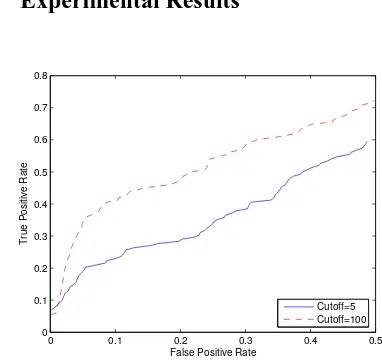
Figure 3: ROC plot for the Minimum Cut Seg-menter on thirty Physics Lectures, with edge cut-offs set at five and hundred sentences.
Benefits of global analysis We first determine
the impact of long-range pairwise similarity
[image:6.595.315.506.478.660.2]CHOI UI MINCUT
PHYSICS(MANUAL)
PK 0.372 0.310 0.298
WD 0.385 0.323 0.311
PHYSICS(ASRTRANSCRIPTS)
PK 0.361 0.352 0.322
WD 0.376 0.364 0.340
AI
PK 0.445 0.374 0.383
WD 0.478 0.420 0.417
CHOI
PK 0.110 0.105 0.212
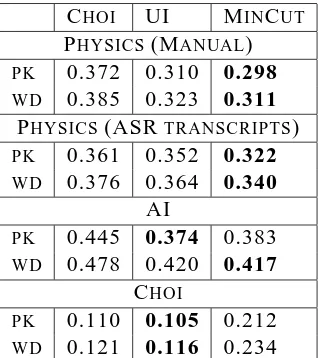
[image:7.595.102.261.72.251.2]WD 0.121 0.116 0.234
Table 5: Performance analysis of different
algo-rithms using the Pk and WindowDiff measures,
with three lectures heldout for development.
key hypothesis is that considering long-distance lexical relations contributes to the effectiveness of the algorithm. To test this hypothesis, we discard edges between nodes that are more than a cer-tain number of sentences apart. We test the sys-tem on a range of data sets, including the Physics and AI lectures and the synthetic corpus created by Choi (2000). We also include segmentation results on Physics ASR transcripts.
The results in Table 4 confirm our hypothesis — taking into account non-local lexical dependencies helps across different domains. On manually tran-scribed Physics lecture data, for example, the
al-gorithm yields 0.394Pkmeasure when taking into
account edges separated by up to ten sentences. When dependencies up to a hundred sentences are considered, the algorithm yields a 25% reduction
in Pk measure. Figure 3 shows the ROC plot
for the segmentation of the Physics lecture data with different cutoff parameters, again demon-strating clear gains attained by employing long-range dependencies. As Table 4 shows, the im-provement is consistent across all lecture datasets. We note, however, that after some point increas-ing the threshold degrades performance, because it introduces too many spurious dependencies (see the last column of Table 4). The speaker will oc-casionally return to a topic described at the begin-ning of the lecture, and this will bias the algorithm to put the segment boundary closer to the end of the lecture.
Long-range dependencies do not improve the
performance on the synthetic dataset. This is ex-pected since the segments in the synthetic dataset are randomly selected from widely-varying doc-uments in the Brown corpus, even spanning dif-ferent genres of written language. So, effectively, there are no genuine long-range dependencies that can be exploited by the algorithm.
Comparison with local dependency models
We compare our system with the state-of-the-art similarity-based segmentation system developed by Choi (2000). We use the publicly available im-plementation of the system and optimize the sys-tem on a range of mask-sizes and different param-eter settings described in (Choi, 2000) on a held-out development set of three lectures. To control for segmentation granularity, we specify the num-ber of segments in the reference (“O”) segmen-tation for both our system and the baseline. Ta-ble 5 shows that the Minimum Cut algorithm con-sistently outperforms the similarity-based baseline on all the lecture datasets. We attribute this gain to the presence of more attenuated topic transi-tions in spoken language. Since spoken language is more spontaneous and less structured than writ-ten language, the speaker needs to keep the liswrit-tener abreast of the changes in topic content by intro-ducing subtle cues and references to prior topics in the course of topical transitions. Non-local depen-dencies help to elucidate shifts in focus, because the strength of a particular transition is measured with respect to other local and long-distance con-textual discourse relationships.
Our system does not outperform Choi’s algo-rithm on the synthetic data. This again can be at-tributed to the discrepancy in distributional prop-erties of the synthetic corpus which lacks coher-ence in its thematic shifts and the lecture corpus of spontaneous speech with smooth distributional variations. We also note that we did not try to ad-just our model to optimize its performance on the synthetic data. The smoothing method developed for lecture segmentation may not be appropriate for short segments ranging from three to eleven sentences that constitute the synthetic set.
implemen-tation of the system that does not require parame-ter tuning on a heldout development set.
Again, our method achieves favorable perfor-mance on a range of lecture data sets (See Ta-ble 5), and both algorithms attain results close to the range of human agreement scores. The attrac-tive feature of our algorithm, however, is robust-ness to recognition errors — testing it on the ASR transcripts caused only 7.8% relative increase in
Pk measure (from 0.298 to 0.322), compared to
a 13.5% relative increase for the UI system. We attribute this feature to the fact that the model is less dependent on individual recognition errors, which have a detrimental effect on the local seg-ment language modeling probability estimates for the UI system. The block-level similarity func-tion is not as sensitive to individual word errors, because the partition volume normalization factor dampens their overall effect on the derived mod-els.
7 Conclusions
In this paper we studied the impact of long-range dependencies on the accuracy of text segmenta-tion. We modeled text segmentation as a graph-partitioning task aiming to simultaneously opti-mize the total similarity within each segment and dissimilarity across various segments. We showed that global analysis of lexical distribution im-proves the segmentation accuracy and is robust in the presence of recognition errors. Combin-ing global analysis with advanced methods for smoothing (Ji and Zha, 2003) and weighting could further boost the segmentation performance.
Our current implementation does not automati-cally determine the granularity of a resulting seg-mentation. This issue has been explored in the past (Ji and Zha, 2003; Utiyama and Isahara, 2001), and we will explore the existing strategies in our framework. We believe that the algorithm has to produce segmentations for various levels of granularity, depending on the needs of the appli-cation that employs it.
Our ultimate goal is to automatically generate
tables of content for lectures. We plan to
in-vestigate strategies for generating titles that will succinctly describe the content of each segment. We will explore how the interaction between the generation and segmentation components can im-prove the performance of such a system as a whole.
8 Acknowledgements
The authors acknowledge the support of the National Sci-ence Foundation (CAREER grant 0448168, grant IIS-0415865, and the NSF Graduate Fellowship). Any opinions, findings, conclusions or recommendations expressed in this publication are those of the author(s) and do not necessar-ily reflect the views of the National Science Foundation. We would like to thank Masao Utiyama for providing us with an implementation of his segmentation system and Alex Gru-enstein for assisting us with the NOMOS toolkit. We are grateful to David Karger for an illuminating discussion on the Minimum Cut algorithm. We also would like to acknowl-edge the MIT NLP and Speech Groups, the three annotators, and the three anonymous reviewers for valuable comments, suggestions, and help.
References
D. Beeferman, A. Berger, J. D. Lafferty. 1999. Statistical models for text segmentation. Machine Learning, 34(1-3):177–210.
F. Choi, P. Wiemer-Hastings, J. Moore. 2001. Latent se-mantic analysis for text segmentation. In Proceedings of
EMNLP, 109–117.
F. Y. Y. Choi. 2000. Advances in domain independent linear text segmentation. In Proceedings of the NAACL, 26–33. K. W. Church. 1993. Char align: A program for aligning
parallel texts at the character level. In Proceedings of the
ACL, 1–8.
M. Galley, K. McKeown, E. Fosler-Lussier, H. Jing. 2003. Discourse segmentation of multi-party conversation. In
Proceedings of the ACL, 562–569.
J. R. Glass. 2003. A probabilistic framework for segment-based speech recognition. Computer Speech and Lan-guage, 17(2–3):137–152.
A. Gruenstein, J. Niekrasz, M. Purver. 2005. Meeting struc-ture annotation: Data and tools. In Proceedings of the
SIGdial Workshop on Discourse and Dialogue, 117–127.
M. A. K. Halliday, R. Hasan. 1976. Cohesion in English. Longman, London.
M. Hearst. 1994. Multi-paragraph segmentation of exposi-tory text. In Proceedings of the ACL, 9–16.
X. Ji, H. Zha. 2003. Domain-independent text segmentation using anisotropic diffusion and dynamic programming. In
Proceedings of SIGIR, 322–329.
A. Kehagias, P. Fragkou, V. Petridis. 2003. Linear text seg-mentation using a dynamic programming algorithm. In
Proceedings of the EACL, 171–178.
E. Leeuwis, M. Federico, M. Cettolo. 2003. Language mod-eling and transcription of the ted corpus lectures. In
Pro-ceedings of ICASSP, 232–235.
L. Pevzner, M. Hearst. 2002. A critique and improvement of an evaluation metric for text segmentation.
Computa-tional Linguistics, 28(1):pp. 19–36.
M. F. Porter. 1980. An algorithm for suffix stripping.
Pro-gram, 14(3):130–137.
J. Reynar. 1998. Topic segmentation: Algorithms and
appli-cations. Ph.D. thesis, University of Pennsylvania.
G. Salton, C. Buckley. 1988. Term weighting approaches in automatic text retrieval. Information Processing and
Management, 24(5):513–523.
J. Shi, J. Malik. 2000. Normalized cuts and image segmenta-tion. IEEE Transactions on Pattern Analysis and Machine
Intelligence, 22(8):888–905.
J. Swets. 1988. Measuring the accuracy of diagnostic sys-tems. Science, 240(4857):1285–1293.
M. Utiyama, H. Isahara. 2001. A statistical model for domain-independent text segmentation. In Proceedings of