Prototype-Driven Grammar Induction
Aria Haghighi Computer Science Division University of California Berkeley [email protected]
Dan Klein
Computer Science Division University of California Berkeley
Abstract
We investigate prototype-driven learning for pri-marily unsupervised grammar induction. Prior knowledge is specified declaratively, by providing a few canonical examples of each target phrase type. This sparse prototype information is then propa-gated across a corpus using distributional similar-ity features, which augment an otherwise standard PCFG model. We show that distributional features are effective at distinguishing bracketlabels, but not determining bracketlocations. To improve the qual-ity of the induced trees, we combine our PCFG in-duction with the CCM model of Klein and Manning (2002), which has complementary stengths: it iden-tifies brackets but does not label them. Using only a handful of prototypes, we show substantial im-provements over naive PCFG induction for English and Chinese grammar induction.
1 Introduction
There has been a great deal of work on unsuper-vised grammar induction, with motivations rang-ing from scientific interest in language acquisi-tion to engineering interest in parser construc-tion (Carroll and Charniak, 1992; Clark, 2001). Recent work has successfully induced unlabeled grammatical structure, but has not successfully learned labeled tree structure (Klein and Manning, 2002; Klein and Manning, 2004; Smith and Eis-ner, 2004) .
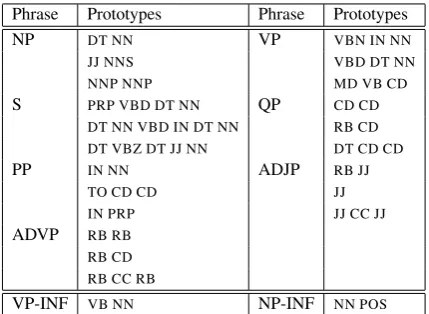
In this paper, our goal is to build a system capa-ble of producing labeled parses in a target gram-mar with as little total effort as possible. We in-vestigate aprototype-drivenapproach to grammar induction, in which one supplies canonical ex-amples of each target concept. For example, we might specify that we are interested in trees which use the symbol NP and then list several examples of prototypical NPs (determiner noun, pronouns, etc., see figure 1 for a sample prototype list). This prototype information is similar to specifying an annotation scheme, which even human annotators
must be provided before they can begin the con-struction of a treebank. In principle, prototype-driven learning is just a kind of semi-supervised learning. However, in practice, the information we provide is on the order of dozens of total seed in-stances, instead of a handful of fully parsed trees, and is of a different nature.
The prototype-driven approach has three strengths. First, since we provide a set of target symbols, we can evaluate induced trees using standard labeled parsing metrics, rather than the far more forgiving unlabeled metrics described in, for example, Klein and Manning (2004). Second, knowledge is declaratively specified in an inter-pretable way (see figure 1). If a user of the system is unhappy with its systematic behavior, they can alter it by altering the prototype information (see section 7.1 for examples). Third, and related to the first two, one does not confuse the ability of the system to learn a consistent grammar with its ability to learn the grammar a user has in mind.
In this paper, we present a series of experiments in the induction of labeled context-free trees us-ing a combination of unlabeled data and sparse prototypes. We first affirm the well-known re-sult that simple, unconstrained PCFG induction produces grammars of poor quality as measured against treebank structures. We then augment a PCFG with prototype features, and show that these features, when propagated to non-prototype se-quences using distributional similarity, are effec-tive at learning bracket labels on fixed unlabeled trees, but are still not enough to learn good tree structures without bracketing information. Finally, we intersect the feature-augmented PCFG with the CCM model of Klein and Manning (2002), a high-quality bracketing model. The intersected model is able to learn trees with higher unlabeledF1than those in Klein and Manning (2004). More
tantly, its trees are labeled and can be evaluated according to labeled metrics. Against the English Penn Treebank, our final trees achieve a labeledF1 of 65.1 on short sentences, a 51.7% error reduction over naive PCFG induction.
2 Experimental Setup
The majority of our experiments induced tree structures from the WSJ section of the English Penn treebank (Marcus et al., 1994), though see section 7.4 for an experiment on Chinese. To fa-cilitate comparison with previous work, we ex-tracted WSJ-10, the 7,422 sentences which con-tain 10 or fewer words after the removal of punc-tuation and null elements according to the scheme detailed in Klein (2005). We learned models on all or part of this data and compared their predictions to the manually annotated treebank trees for the sentences on which the model was trained. As in previous work, we begin with the part-of-speech (POS) tag sequences for each sentence rather than lexical sequences (Carroll and Charniak, 1992; Klein and Manning, 2002).
Following Klein and Manning (2004), we report unlabeled bracket precision, recall, andF1. Note that according to their metric, brackets of size 1 are omitted from the evaluation. Unlike that work, all of our induction methods produce trees labeled with symbols which are identified with treebank categories. Therefore, we also report labeled pre-cision, recall, and F1, still ignoring brackets of size 1.1
3 Experiments in PCFG induction
As an initial experiment, we used the inside-outside algorithm to induce a PCFG in the straightforward way (Lari and Young, 1990; Man-ning and Sch¨utze, 1999). For all the experiments in this paper, we considered binary PCFGs over the nonterminals and terminals occuring in WSJ-10. The PCFG rules were of the following forms:
• X →Y Z, for nonterminal typesX, Y,and
Z, withY 6=XorZ6=X
• X →t Y,X →Y t, for each terminalt
• X →t t0, for terminalstandt0
For a given sentence S, our CFG generates la-beled treesToverS.2Each tree consists of binary
1
In cases where multiple gold labels exist in the gold trees, precision and recall were calculated as in Collins (1999).
2Restricting our CFG to a binary branching grammar
re-sults in an upper bound of 88.1% on unlabeledF1.
productions X(i, j) → α over constituent spans
(i, j), where α is a pair of non-terminal and/or terminal symbols in the grammar. The generative probability of a treeTforSis:
PCF G(T, S) =
Y
X(i,j)→α∈T P(α|X)
In the inside-outside algorithm, we iteratively compute posterior expectations over production occurences at each training span, then use those expectations to re-estimate production probabili-ties. This process is guaranteed to converge to a local extremum of the data likelihood, but initial production probability estimates greatly influence the final grammar (Carroll and Charniak, 1992). In particular, uniform initial estimates are an (unsta-ble) fixed point. The classic approach is to add a small amount of random noise to the initial prob-abilities in order to break the symmetry between grammar symbols.
We randomly initialized 5 grammars using tree-bank non-terminals and trained each to conver-gence on the first 2000 sentences of WSJ-10. Viterbi parses were extracted for each of these 2000 sentences according to each grammar. Of course, the parses’ symbols have nothing to anchor them to our intended treebank symbols. That is, an NP in one of these grammars may correspond to the target symbol VP, or may not correspond well to any target symbol. To evaluate these learned grammars, we must map the models’ phrase types to target phrase types. For each grammar, we fol-lowed the common approach of greedily mapping model symbols to target symbols in the way which maximizes the labeledF1. Note that this can, and does, result in mapping multiple model symbols to the most frequent target symbols. This experi-ment, labeledPCFG×NONEin figure 4, resulted in an average labeledF1of 26.3 and an unlabeledF1 of 45.7. The unlabeledF1is better than randomly choosing a tree (34.7), but not better than always choosing a right branching structure (61.7).
Phrase Prototypes Phrase Prototypes
NP DT NN VP VBN IN NN
JJ NNS VBD DT NN
NNP NNP MD VB CD
S PRP VBD DT NN QP CD CD DT NN VBD IN DT NN RB CD DT VBZ DT JJ NN DT CD CD
PP IN NN ADJP RB JJ
TO CD CD JJ
IN PRP JJ CC JJ
ADVP RB RB RB CD RB CC RB
[image:3.595.74.289.61.218.2]VP-INF VB NN NP-INF NN POS
Figure 1: English phrase type prototype list man-ually specified (The entire supervision for our sys-tem). The second part of the table is additional prototypes discussed in section 7.1.
eliminate the structural uncertainty since we are inducing binary trees and the gold trees are flat-ter than binary in many cases. This approach of course achieved the upper bound on unlabeledF1, because of the gold bracket constraints. However, it only resulted in an average labeled F1 of 52.6 (experimentPCFG×GOLDin figure 4). While this labeled score is an improvement over thePCFG× NONE experiment, it is still relatively disappoint-ing.
3.1 Encoding Prior Knowledge with Prototypes
Clearly, we need to do something more than adding structural bias (e.g. bracketing informa-tion) if we are to learn a PCFG in which the sym-bols have the meaning and behaviour we intend. How might we encode information about our prior knowledge or intentions?
Providing labeled trees is clearly an option. This approach tells the learner how symbols should re-cursively relate to each other. Another option is to provide fully linearized yields as prototypes. We take this approach here, manually creating a list of POS sequences typical of the 7 most frequent categories in the Penn Treebank (see figure 1).3 Our grammar is limited to these 7 phrase types plus an additional type which has no prototypes and is unconstrained.4 This list grounds each
sym-3A possible objection to this approach is the introduction
of improper reasearcher bias via specifying prototypes. See section 7.3 for an experiment utilizing an automatically gen-erated prototype list with comparable results.
4In our experiments we found that adding prototypes for
more categories did not improve performance and took more
bol in terms of an observable portion of the data, rather than attempting to relate unknown symbols to other unknown symbols.
Broadly, we would like to learn a grammar which explains the observed data (EM’s objec-tive) but also meets our prior expectations or re-quirements of the target grammar. How might we use such a list to constrain the learning of a PCFG with the inside-outside algorithm? We might require that all occurences of a prototype sequence, say DT NN, be constituents of the cor-responding type (NP). However, human-elicited prototypes are not likely to have the property that, when they occur, they are (nearly) always con-stituents. For example, DT NN is a perfectly rea-sonable example of a noun phrase, but is not a con-stituent when it is part of a longerDT NN NN con-stituent. Therefore, when summing over trees with the inside-outside algorithm, we could require a weaker property: whenever a prototype sequence is a constituent it must be given the label specified in the prototype file.5 This constraint is enough to break the symmetry between the model labels, and therefore requires neither random initialization for training, nor post-hoc mapping of labels for eval-uation. Adding prototypes in this way and keep-ing the gold bracket constraint gave 59.9 labeled
F1. The labeledF1 measure is again an improve-ment over naive PCFG induction, but is perhaps less than we might expect given that the model has been given bracketing information and has proto-types as a form of supervision to direct it.
In response to a prototype, however, we may wish to conclude something stronger than a con-straint on thatparticularPOS sequence. We might hope that sequences which are similar to a proto-type in some sense are generally given the same label as that prototype. For example,DT NN is a noun phrase prototype, the sequenceDT JJ NN is another good candidate for being a noun phrase. This kind of propagation of constraints requires that we have a good way of defining and detect-ing similarity between POS sequences.
3.2 Phrasal Distributional Similarity
A central linguistic argument for constituent types
issubstitutability: phrases of the same type appear
time. We note that we still evaluate against all phrase types regardless of whether or not they are modeled by our gram-mar.
5Even this property is likely too strong: prototypes may
Yield Prototype Skew KL Phrase Type Skew KL
DT JJ NN DT NN 0.10 NP 0.39
IN DT VBG NN IN NN 0.24 PP 0.45
DT NN MD VB DT NNS PRP VBD DT NN 0.54 S 0.58
CC NN IN NN 0.43 PP 0.71
MD NNS PRP VBD DT NN 1.43 NONE
-Figure 2: Yields along with most similar proto-types and phrase proto-types, guessed according to (3).
in similar contexts and are mutually substitutable (Harris, 1954; Radford, 1988). For instance, DT JJ NN and DT NN occur in similar contexts, and are indeed both commonNPs. This idea has been repeatedly and successfully operationalized using various kinds of distributional clustering, where we define a similarity measure between two items on the basis of their immediate left and right con-texts (Sch¨utze, 1995; Clark, 2000; Klein and Man-ning, 2002).
As in Clark (2001), we characterize the distribu-tion of a sequence by the distribudistribu-tion of POS tags occurring to the left and right of that sequence in a corpus. Each occurence of a POS sequence α
falls in a contextx α y, wherexandyare the ad-jacent tags. The distribution over contexts x−y
for a givenαis called itssignature, and is denoted by σ(α). Note thatσ(α) is composed of context counts from all occurences, constitiuent and dis-tituent, of α. Let σc(α) denote the context
dis-tribution forαwhere the context counts are taken only from constituent occurences ofα. For each phrase type in our grammar,X, defineσc(X)to be
the context distribution obtained from the counts of all constituent occurences of typeX:
σc(X) =Ep(α|X)σc(α) (1)
wherep(α|X)is the distribution of yield types for phrase typeX. We compare context distributions using the skewed KL divergence:
DSKL(p, q) =DKL(pkγp+ (1−γ)q)
whereγcontrols how much of the source distribu-tions is mixed in with the target distribution.
A reasonable baseline rule for classifying the phrase type of a POS yield is to assign it to the phrase from which it has minimal divergence:
type(α) = arg min
X DSKL(σc(α), σc(X)) (2)
However, this rule is not always accurate, and, moreover, we do not have access to σc(α) or σc(X). We chose to approximate σc(X)
us-ing the prototype yields for X as samples from
p(α|X). Lettingproto(X)denote the (few) pro-totype yields for phrase typeX, we define˜σ(X):
˜
σ(X) = 1
|proto(X)| X
α∈proto(X)
σ(α)
Note σ˜(X) is an approximation to (1) in sev-eral ways. We have replaced an expectation over
p(α|X) with a uniform weighting of proto(X), and we have replaced σc(α) with σ(α) for each
term in that expectation. Because of this, we will rely only on high confidence guesses, and allow yields to be given aNONEtype if their divergence from each˜σ(X)exceeds a fixed thresholdt. This gives the following alternative to (2):
type(α) = (3)
(
NONE, ifminXDSKL(σ(α),σ˜(X))< t
arg minXDSKL(σ(α),σ˜(X)), otherwise
We built a distributional model implementing the rule in (3) by constructingσ(α) from context counts in the WSJ portion of the Penn Treebank as well as the BLIPP corpus. Eachσ˜(X)was ap-proximated by a uniform mixture ofσ(α)for each ofX’s prototypesαlisted in figure 1.
This method of classifying constituents is very precise if the threshold is chosen conservatively enough. For instance, using a threshold of t = 0.75andγ = 0.1, this rule correctly classifies the majority label of a constituent-type with 83% pre-cision, and has a recall of 23% over constituent types. Figure 2 illustrates some sample yields, the prototype sequence to which it is least divergent, and the output of rule (3).
We incorporated this distributional information into our PCFG induction scheme by adding a
pro-totype featureover each span (i, j)indicating the
output of (3) for the yieldα in that span. Asso-ciated with each sentence S is a feature map F
specifying, for each(i, j), a prototype featurepij.
These features are generated using an augmented CFG model,CFG+, given by:6
PCF G+(T, F) =
Y
X(i,j)→α∈T
P(pij|X)P(α|X)
= Y
X(i,j)→α∈T
φCF G+(X→α, pij)
6
[image:4.595.73.289.62.114.2]P(S|ROOT)¯
ROOT
S
P(NP VP|S)
P(P= NONE|S)
XX XXX
X
P(NN NNS|NP)
P(P= NP|NP)
ff
NP
H HH
NNN
payrolls
NN
Factory
VP
P(VBD PP|VP)
P(P= VP|VP)
aa aa ! ! ! ! VBD
fell
PP
P(IN NN|PP)
P(P= PP|PP)
! ! !
a a
a NN
November
IN
[image:5.595.80.275.71.181.2]in
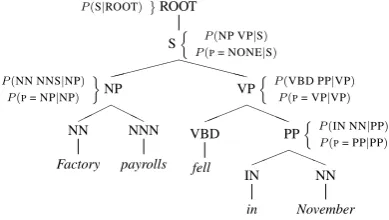
Figure 3: Illustration of PCFG augmented with prototype similarity features.
whereφCF G+(X → α, pij)is the local factor for
placingX → α on a span with prototype feature
pij. An example is given in figure 3.
For our experiments, we fixedP(pij|X)to be:
P(pij|X) =
(
0.60, ifpij =X
uniform, otherwise
Modifying the model in this way, and keeping the gold bracketing information, gave 71.1 labeledF1 (see experiment PROTO × GOLD in figure 4), a 40.3% error reduction over naive PCFG induction in the presence of gold bracketing information. We note that the our labeledF1 is upper-bounded by 86.0 due to unary chains and more-than-binary configurations in the treebank that cannot be ob-tained from our binary grammar.
We conclude that in the presence of gold bracket information, we can achieve high labeled accu-racy by using a CFG augmented with distribu-tional prototype features.
4 Constituent Context Model
So far, we have shown that, given perfect per-fect bracketing information, distributional proto-type features allow us to learn tree structures with fairly accurate labels. However, such bracketing information is not available in the unsupervised case.
Perhaps we don’t actually need bracketing con-straints in the presence of prototypes and distri-butional similarity features. However this exper-iment, labeled PROTO ×NONE in figure 4, gave only 53.1 labeledF1 (61.1 unlabeled), suggesting that some amount of bracketing constraint is nec-essary to achieve high performance.
Fortunately, there are unsupervised systems which can induce unlabeled bracketings with rea-sonably high accuracy. One such model is
the constituent-context model (CCM) of Klein and Manning (2002), a generative distributional model. For a given sentenceS, theCCMgenerates a bracket matrix,B, which for each span(i, j), in-dicates whether or not it is a constituent (Bij =c)
or a distituent (Bij =d). In addition, it generates
a feature mapF0, which for each span(i, j) inS
specifies a pair of features, Fij0 = (yij, cij),where yij is the POS yield of the span, andcij is the
con-text of the span, i.e identity of the conjoined left and right POS tags:
PCCM(B, F0) =P(B)
Y
(i,j)
P(yij|Bij)P(cij|Bij)
The distributionP(B)only places mass on brack-etings which correspond to binary trees. We can efficiently compute PCCM(B, F0) (up to
a constant) depending on F0 using local fac-torsφCCM(yij, cij)which decomposes over
con-stituent spans:7
PCCM(B, F0)∝
Y
(i,j):Bij=c
P(yij|c)P(cij|c) P(yij|d)P(cij|d)
= Y
(i,j):Bij=c
φCCM(yij, cij)
TheCCMby itself yields an unlabeledF1of 71.9 on WSJ-10, which is reasonably high, but does not produce labeled trees.
5 Intersecting CCM and PCFG
The CCM andPCFGmodels provide complemen-tary views of syntactic structure. TheCCM explic-itly learns the non-recursive contextual and yield properties of constituents and distituents. The
PCFG model, on the other hand, does not explic-itly model properties of distituents but instead fo-cuses on modeling the hierarchical and recursive properties of natural language syntax. One would hope that modeling both of these aspects simulta-neously would improve the overall quality of our induced grammar.
We therefore combine theCCMwith our feature-augmented PCFG, denoted by PROTO in exper-iment names. When we run EM on either of the models alone, at each iteration and for each training example, we calculate posteriors over that
model’s latent variables. ForCCM, the latent vari-able is a bracketing matrixB(equivalent to an un-labeled binary tree), while for theCFG+ the latent
variable is a labeled tree T. While these latent variables aren’t exactly the same, there is a close relationship between them. A bracketing matrix constrains possible labeled trees, and a given la-beled tree determines a bracketing matrix. One way to combine these models is to encourage both models to prefer latent variables which are com-patible with each other.
Similar to the approach of Klein and Manning (2004) on a different model pair, we intersectCCM
andCFG+ by multiplying their scores for any
la-beled tree. For each possible lala-beled tree over a sentenceS, our generative model for a labeled tree
T is given as follows:
P(T, F, F0) = (4)
PCF G+(T, F)PCCM(B(T), F
0
)
whereB(T)corresponds to the bracketing ma-trix determined by T. The EM algorithm for the product model will maximize:
P(S,F, F0) = X
T∈T(S)
PCCM(B, F0)PCF G+(T, F)
=X
B
PCCM(B, F0)
X
T∈T(B,S)
PCF G+(T, F)
where T(S) is the set of labeled trees consistent with the sentenceS andT(B, S)is the set of la-beled trees consistent with the bracketing matrix
Band the sentenceS. Notice that this quantity in-creases as theCCMandCFG+models place
proba-bility mass on compatible latent structures, giving an intuitive justification for the success of this ap-proach.
We can compute posterior expectations over
(B, T)in the combined model (4) using a variant of the inside-outside algorithm. The local factor for a binary ruler=X → Y Z, over span(i, j),
withCCM featuresFij0 = (yij, cij)and prototype
featurepij, is given by the product of local factors
for theCCMandCFG+models:
φ(r,(i, j)) =φCCM(yij, cij)φCF G+(r, pij)
From these local factors, the inside-outside al-gorithm produces expected counts for each binary rule,r, over each span(i, j)and split pointk, de-noted byP(r,(i, j), k|S, F, F0). These posteriors are sufficient to re-estimate all of our model pa-rameters.
Labeled Unlabeled Setting Prec. Rec. F1 Prec. Rec. F1
No Brackets
PCFG×NONE 23.9 29.1 26.3 40.7 52.1 45.7
PROTO×NONE 51.8 62.9 56.8 59.6 76.2 66.9 Gold Brackets
PCFG×GOLD 47.0 57.2 51.6 78.8 100.0 88.1
PROTO×GOLD 64.8 78.7 71.1 78.8 100.0 88.1 CCM Brackets
CCM - - - 64.2 81.6 71.9
PCFG×CCM 32.3 38.9 35.3 64.1 81.4 71.8
PROTO×CCM 56.9 68.5 62.2 68.4 86.9 76.5
BEST 59.4 72.1 65.1 69.7 89.1 78.2
[image:6.595.308.530.62.223.2]UBOUND 78.8 94.7 86.0 78.8 100.0 88.1
Figure 4: English grammar induction results. The upper bound on labeled recall is due to unary chains.
6 CCM as a Bracketer
We tested the product model described in sec-tion 5 on WSJ-10 under the same condisec-tions as in section 3. Our initial experiment utilizes no protoype information, random initialization, and greedy remapping of its labels. This experiment,
PCFG ×CCM in figure 4, gave 35.3 labeled F1, compared to the 51.6 labeledF1 with gold brack-eting information (PCFG×GOLDin figure 4).
Next we added the manually specified proto-types in figure 1, and constrained the model to give these yields their labels if chosen as constituents. This experiment gave 48.9 labeledF1 (73.3 unla-beled). The error reduction is 21.0% labeled (5.3% unlabeled) overPCFG×CCM.
We then experimented with adding distributional prototype features as discussed in section 3.2 us-ing a threshold of 0.75 andγ = 0.1. This experi-ment,PROTO×CCMin figure 4, gave 62.2 labeled
F1 (76.5 unlabeled). The error reduction is 26.0% labeled (12.0% unlabeled) over the experiment us-ing prototypes without the similarity features. The overall error reduction fromPCFG×CCMis 41.6% (16.7%) in labeled (unlabeled)F1.
7 Error Analysis
The most common type of error by our PROTO× CCM system was due to the binary grammar re-striction. For instance commonNPs, such asDT JJ NN, analyzed as [NP DT[NP JJ NN] ], which
S XXXX X NP NNP France VP XXXXX X MD can VP hhhhhhh ( ( ( ( ( ( ( VB boast NP XXXXX NP a aaa ! ! ! ! NP a aa ! ! ! DT the NN lion POS ’s NN share PP
PPPP IN of NP H HH JJ high-priced NNS bottles S hhhhhh hhh ( ( ( ( ( ( ( ( ( NNP France VP hhhhhh hh ( ( ( ( ( ( ( ( VP XXXX X VP Z Z MD can VB boast NP aa aa ! ! ! ! NP ll , , DT the NN lion PP Z Z POS ’s NN share PP
PPPP IN of NP H HH JJ high-priced NNS bottles S hhhhhh hhh ( ( ( ( ( ( ( ( ( NNP France VP hhhhhh hhhh ( ( ( ( ( ( ( ( ( ( VP
PPPP MD can VP XXXX X VB boast NP
PPPP NP b bb " " " DT the NP cc # # NN lion POS ’s NN share PP
PPPP IN of NP H HH JJ high-priced NNS bottles
[image:7.595.87.526.62.168.2]a) b) c)
Figure 5: Examples of corrections from addingVP-INFandNP-POSprototype categories. The tree in (a) is the Treebank parse, (b) is the parse withPROTO×CCMmodel, and c) is the parse with theBESTmodel (added prototype categories), which fixes the possesive NP and infinitival VP problems, but not the PP attachment.
given our grammar restriction.
Figure 5(b) demonstrates three other errors. Pos-sessiveNPs are analyzed as [NP NN[PP POS NN]
], with the POS element treated as a preposition and the possessed NP as its complement. While labeling the POS NN as a PP is clearly incorrect, placing a constituent over these elements is not unreasonable and in fact has been proposed by some linguists (Abney, 1987). Another type of error also reported by Klein and Manning (2002) is MD VBgroupings in infinitivalVPs also some-times argued by linguists (Halliday, 2004). More seriously, prepositional phrases are almost always attached “high” to the verb for longerNPs.
7.1 Augmenting Prototypes
One of the advantages of the prototype driven ap-proach, over a fully unsupervised apap-proach, is the ability to refine or add to the annotation specifica-tion if we are not happy with the output of our sys-tem. We demonstrate this flexibility by augment-ing the prototypes in figure 1 with two new cate-gories NP-POS and VP-INF, meant to model pos-sessive noun phrases and infinitival verb phrases, which tend to have slightly different distributional properties from normal NPs and VPs. These new sub-categories are used during training and then stripped in post-processing. This prototype list gave 65.1 labeledF1(78.2 unlabeled). This exper-iment is labeledBESTin figure 4. Looking at the
CFG-learned rules in figure 7, we see that the basic structure of the treebank grammar is captured.
7.2 Parsing with only the PCFG
In order to judge how well the PCFG component of our model did in isolation, we experimented with training ourBESTmodel with theCCM com-ponent, but dropping it at test time. This
experi-Label Prec. Rec. F1
S 79.3 80.0 79.7
NP 49.0 74.4 59.1
VP 80.4 73.3 76.7
PP 45.6 78.6 57.8
QP 36.2 78.8 49.6
ADJP 29.4 33.3 31.2
ADVP 25.0 12.2 16.4
Figure 6: Precision, recall, andF1 for individual phrase types in theBESTmodel
Rule Probability Rule Probability
S→NP VP 0.51 VP→VBZ NP 0.20 S→PRP VP 0.13 VP→VBD NP 0.15 S→NNP VP 0.06 VP→VBP NP 0.09 S→NNS VP 0.05 VP→VB NP 0.08 NP→DT NN 0.12 ROOT→S 0.95 NP→NP PP 0.09 ROOT→NP 0.05 NP→NNP NNP 0.09
NP→JJ NN 0.07
PP→IN NP 0.37 QP→CD CD 0.35 PP→CC NP 0.06 QP→CD NN 0.30 PP→TO VP 0.05 QP→QP PP 0.10 PP→TO QP 0.04 QP→QP NNS 0.05 ADJP→RB VBN 0.37 ADVP→RB RB 0.25 ADJP→RB JJ 0.31 ADVP→ADJP PRP 0.15 ADJP→RBR JJ 0.09 ADVP→RB CD 0.10
Figure 7: Top PCFG Rules learned byBESTmodel
ment gave 65.1 labeledF1 (76.8 unlabeled). This demonstrates that while our PCFG performance degrades without the CCM, it can be used on its own with reasonable accuracy.
7.3 Automatically Generated Prototypes
[image:7.595.350.483.240.348.2]appro-priate, indeed the point, the latter is not. In or-der to guard against the second type of bias, we experimented with automatically extracted gener-ated prototype lists which would not be possible without labeled data. For each phrase type cat-egory, we extracted the three most common yield associated with that category that differed in either first or last POS tag. Repeating ourPROTO×CCM
experiment with this list yielded 60.9 labeled F1 (76.5 unlabeled), comparable to the performance of our manual prototype list.
7.4 Chinese Grammar Induction
In order to demonstrate that our system is some-what language independent, we tested our model on CTB-10, the 2,437 sentences of the Chinese Treebank (Ircs, 2002) of length at most 10 af-ter punctuation is stripped. Since the authors have no expertise in Chinese, we automatically ex-tracted prototypes in the same way described in section 7.3. Since we did not have access to a large auxiliary POS tagged Chinese corpus, our distri-butional model was built only from the treebank text, and the distributional similarities are presum-ably degraded relative to the English. OurPCFG ×CCMexperiment gave 18.0 labeledF1(43.4 un-labeled). ThePROTO×CCM model gave 39.0 la-beled F1 (53.2 unlabeled). Presumably with ac-cess to more POS tagged data, and the expertise of a Chinese speaker, our system would see increased performance. It is worth noting that our unlabeled
F1 of 53.2 is the best reported from a primarily unsupervised system, with the next highest figure being 46.7 reported by Klein and Manning (2004).
8 Conclusion
We have shown that distributional prototype fea-tures can allow one to specify a target labeling scheme in a compact and declarative way. These features give substantial error reduction in labeled
F1measure for English and Chinese grammar in-duction. They also achieve the best reported un-labeled F1 measure.8 Another positive property of this approach is that it tries to reconcile the success of distributional clustering approaches to grammar induction (Clark, 2001; Klein and Man-ning, 2002), with the CFG tree models in the su-pervised literature (Collins, 1999). Most impor-tantly, this is the first work, to the authors’
knowl-8The next highest results being 77.1 and 46.7 for English
and Chinese respectively from Klein and Manning (2004).
edge, which has learned CFGs in an unsupervised or semi-supervised setting and can parse natural language language text with any reasonable accu-racy.
Acknowledgments We would like to thank the anonymous reviewers for their comments. This work is supported by a Microsoft / CITRIS grant and by an equipment donation from Intel.
References
Stephen P. Abney. 1987. The English Noun Phrase in its Sentential Aspect. Ph.D. thesis, MIT.
Glenn Carroll and Eugene Charniak. 1992. Two experiments on learning probabilistic dependency grammars from cor-pora. Technical Report CS-92-16.
Alexander Clark. 2000. Inducing syntactic categories by con-text distribution clustering. InCoNLL, pages 91–94, Lis-bon, Portugal.
Alexander Clark. 2001. The unsupervised induction of stochastic context-free grammars using distributional clus-tering. InCoNLL.
Michael Collins. 1999.The Unsupervised learning of Natural Language Structure. Ph.D. thesis, University of Rochester. M.A.K Halliday. 2004. An introduction to functional
gram-mar. Edward Arnold, 2nd edition.
Zellig Harris. 1954. Distributional Structure. University of Chicago Press, Chicago.
Nianwen Xue Ircs. 2002. Building a large-scale annotated chinese corpus.
Dan Klein and Christopher Manning. 2002. A generative constituent-context model for improved grammar induc-tion. InACL.
Dan Klein and Christopher Manning. 2004. Corpus-based induction of syntactic structure: Models of dependency and constituency. InACL.
Dan Klein. 2005.The unsupervised learning of Natural Lan-guage Structure. Ph.D. thesis, Stanford University. Karim Lari and Steve Young. 1990. The estimation of
stochastic context-free grammars using the insideoutside algorithm.Computer Speech and Language, 2(4):35–56. Christopher D. Manning and Hinrich Sch¨utze. 1999.
Foun-dations of Statistical Natural Language Processing. The MIT Press.
Mitchell P. Marcus, Beatrice Santorini, and Mary Ann Marcinkiewicz. 1994. Building a large annotated corpus of english: The penn treebank.Computational Linguistics, 19(2):313–330.
Fernando C. N. Pereira and Yves Schabes. 1992. Inside-outside reestimation from partially bracketed corpora. In
Meeting of the Association for Computational Linguistics, pages 128–135.
Andrew Radford. 1988. Transformational Grammar. Cam-bridge University Press, CamCam-bridge.
Hinrich Sch¨utze. 1995. Distributional part-of-speech tagging. InEACL.
Noah A. Smith and Jason Eisner. 2004. Guiding unsuper-vised grammar induction using contrastive estimation. In