
ISSN Online: 2327-5227 ISSN Print: 2327-5219
DOI: 10.4236/jcc.2019.79001 Sep. 4, 2019 1 Journal of Computer and Communications
Copy-Move Forgeries Detection and
Localization Using Two Levels of
Keypoints Extraction
Soad Samir
*, Eid Emary, Khaled Elsayed, Hoda Onsi
Faculty of Computers and Information, Cairo University, Giza, Egypt
Abstract
Copy-move offense is considerably used to conceal or hide several data in the digital image for specific aim, and onto this offense some portion of the genuine image is reduplicated and pasted in the same image. Therefore, Copy-Move forgery is a very significant problem and active research area to check the confirmation of the image. In this paper, a system for Copy Move Forgery detection is proposed. The proposed system is composed of two stages: one is called the detection stages and the second is called the refine detection stage. The detection stage is executed using Speeded-Up Robust Feature (SURF) and Binary Robust Invariant Scalable Keypoints (BRISK) for feature detection and in the refine detection stage, image registration using non-linear trans-formation is used to enhance detection efficiency. Initially, the genuine image is picked, and then both SURF and BRISK feature extractions are used in pa-rallel to detect the interest keypoints. This gives an appropriate number of interest points and gives the assurance for finding the majority of the mani-pulated regions. RANSAC is employed to find the superior group of matches to differentiate the manipulated parts. Then, non-linear transformation be-tween the best-matched sets from both extraction features is used as an opti-mization to get the best-matched set and detect the copied regions. A number of numerical experiments performed using many benchmark datasets such as, the CASIA v2.0, MICC-220, MICC-F600 and MICC-F2000 datasets. With the proposed algorithm, an overall average detection accuracy of 95.33% is ob-tained for evaluation carried out with the aforementioned databases. Forgery detection achieved True Positive Rate of 97.4% for tampered images with ob-ject translation, different degree of rotation and enlargement. Thus, results from different datasets have been set, proving that the proposed algorithm can individuate the altered areas, with high reliability and dealing with mul-tiple cloning.
How to cite this paper: Samir, S., Emary, E., Elsayed, K. and Onsi, H. (2019) Copy-Move Forgeries Detection and Localization Using Two Levels of Keypoints Extraction. Jour-nal of Computer and Communications, 7, 1-18.
https://doi.org/10.4236/jcc.2019.79001
Received: August 8, 2019 Accepted: September 1, 2019 Published: September 4, 2019
Copyright © 2019 by author(s) and Scientific Research Publishing Inc. This work is licensed under the Creative Commons Attribution International License (CC BY 4.0).
DOI: 10.4236/jcc.2019.79001 2 Journal of Computer and Communications
Keywords
Copy Move Forgery Detection, Keypoint Based Methods, SURF, BRISK, Bi-Cubic Interpolation
1. Introduction
Recently, due to the augmentation in the image processing software applications like Photoshop, GIMP [1] (GNU Image Manipulation Program), NIK collection [2] (offered by Google) and many others software and the simplicity of using these applications, the probability of maleficent modification on the images has also en-larged. The aim of the digital images editing can be to secrete or conceal some data from the genuine image, to raise the image quality, and to pick the more data from two or more images into one image. Three forgeries classes can be recog-nized on the base of the technique took on to do the forgery [3]. Digital images can be processed in a neatness way, which makes forgery cannot be recognized by human eyes. As a result, the security interest of the digital images information has become apparent a long time ago and many several techniques have been improved to check the authentication of the digital image [4]. Digital image for-geries can be grouped into three major categories and described below:
1) Copy-Move Forgery: a method where a certain part of the genuine image is copied and pasted into the target place in the same image [5].
2) Image Splicing: a method which utilizes cut and paste techniques from different images to create a new fake image [5].
3) Image Retouching: a method that is the least dangerous techniques as compared to the other forgery techniques. Some enhancement of some features of the genuine image is done, and the content of the image stays almost the same [6].
In a copy-move forgery (CMF), one region is simply copied and pasted over the other regions in the same image for manipulating the image. This copy-move is considered as one of the highly popular techniques, in which an area is copied one or more times to give diverse information about the same image, which can be treated as a problem of information fidelity. Figure 1 shows an example of how to apply CMF in digital images [7]. For the examples presented in the first column, the plant is multiplied to generate contents that do not exist in the ge-nuine image. In the second instance, an area is regenerated to secrete undesira-ble object (large size stone) in the genuine image. The tampered areas shown in Figure 1 are well intermingled at the required positions, and get extremely hard to distinguish through the one eye.
DOI: 10.4236/jcc.2019.79001 3 Journal of Computer and Communications
Figure 1. Image forgery examples [8].
find CMF, it may create false detection results when the cloned regions of test image are too small or too smooth, because it is difficult to detect keypoints from such regions with the keypoint-based technology. This issue seriously lim-its the applications of keypoint-based technology and leads to the lack of author-ity for detection results because it is difficult to make sure that the test image is not the CMF one, when none of cloned region is pointed out by keypoint-based technology. There are already several feature detection algorithms that have been recommended but the SIFT (Scale Invariant Feature Transform), SURF, BRIEF (Binary Robust Independent Elementary Features), and BRISK are the most aus-picious since they perform better and are already used by many researchers and applied in many applications.
The core problem is that the keypoints in small or smooth cloned regions are insufficient or even none. The technique used in [9] can dramatically increase the number of keypoints detected in the entire image by adapting the detection variables of keypoint-based technique. Overall; keypoint-matching consumes a lot of time and memory.
DOI: 10.4236/jcc.2019.79001 4 Journal of Computer and Communications forged areas. We then compare the performance of the proposed scheme with another similar work using the same keypoints extractions features (BRISK and SURF). Experimental results show that the accuracy of our proposed algorithm is 3% more accurate than similar work presented. Its score is also outperformed the similar work by 2.5%. The results also show that the proposed algorithm doesn’t degrade the quality of the detected region and has a low false detection rate comparing to the similar work.
The rest of the paper is organized as follows. In Section 2, we discuss the re-lated work which has been proposed yet with their merits and demerits. In Sec-tion 3, the proposed technique is discussed in details. Then we present the de-tailed experimentation results in Section 4. In Section 5, we draw the conclusion of the paper and future work.
2. Related Work
The key-point based techniques use two step procedures of detecting and de-scribing the interest keypoints. In the first step, localization is carried out and the interest keypoints are described in the second step. Robust descriptors must be invariant to affine transformations. Keypoints based method’s execution is comparatively higher than the block based and brute force methods in terms of computational efficiency, complexity, and robustness against various transfor-mations like scaling, rotation, cropping, illuminations, trimming, variations etc.
There are many keypoints based techniques have been proposed to detect the CMF in the tampered image. Some of them are listed below to summarize lite-rature about the keypoints extraction and detection in CMF forged images.
The SURF algorithm had been proposed and deployed by Bay et al. [10] in 2006 to enhance the efficiency of SIFT. SURF is fast and robust feature detector. SURF speed is increased due to the integral image. SURF is invariant to scaling and rotation transformations. SURF detector algorithm is not proper for disco-vering the regions’ repetition in case of extremely compressed JPEG images and smooth copied regions. It is proper for non-flat regions. SURF algorithm is one of the major commonly used feature extraction algorithms because it can provide stable visual points called interest points, which are scale invariant and robust un-der a broad area of view and illustration changes. SURF provides comparable keypoints performance extraction and increased operating speed. Thus; SURF has been pulling a lot of concern in these days. They explained that SURF can minim-ize the false match specifically for the highly resolution images, whilst robust to specific transformation and post processing processes. However; SURF cannot detect a tiny copied area in the image. It was later shown that the SURF-based tech-nique reduced the accuracy although it improves the processing time in copy-move detection.
DOI: 10.4236/jcc.2019.79001 5 Journal of Computer and Communications Sunil Kumar [12] proposed a technique to detect forgery in images where SURF features are used for keypoints detection and BRISK is used for keypoints descrip-tion. The proposed technique is invariant to rotation, translation, scaling and geometrical transformations. The matching step is carried out using KNN search hamming distance. The keypoints are detected by SURF, and then extract BRISK features at these keypoints. The KNN search is used for the similarity matching of the BRISK binary features. The nearest neighbor is found using the hamming distance. Thedisadvantagesofthismethod are:
1) Itcannot workperfectlyatthe smoothforgedregions, so itcannot detect theseregionscorrectly.
2) Thismethodalsogivesanover-detection ratewhichgives ahighfalse de-tectionrate.
Joseph A. Ojeniyi [13] proposed a technique to detect copy move by hybri-dizing block-based DCT technique and, a keypoint-based SURF technique. In this technique, DCT is applied to the forged image with the main objective of enhancing the detection rate accuracy of the forged image, and then SURF is ap-plied to the generating image with the core objective of detecting forged regions that have been tampered in the image. Efficiency of the hybridized technique had been shown that its detection rate and accuracy is far higher than the pre-viously available methods. The goal of hybridizing both techniques is to be able to compensate the lapses found in each of the techniques. The hybridize tech-nique has a better accuracy rate and it is robust to most of the attacks and pre-processing techniques that are associated with CMF.
Neema Antony etal. [14] proposed a method to detect copy move by adaptive over segmentation. The method splits the input forged image into non-overlapping and infrequent blocks adaptively. Using SIFT, the feature key-points are ex-tracted from each blocks. After that, the feature keypoints are matched with one another using brute force matching method. The leading advantage of this me-thod is that it merges block-based and keypoint based meme-thods. So; it enhances the performance of the copy-move image forgery detection and overcomes the limitations of existing block based methods. Experimental result shows that proposed method was effectively detected the copy-move forgery with minimum false match.
Pooja Devi etal. [15] proposed a technique to detect picture replica circulate forgery that is depended on SIFT feature. Clustering algorithm is used for clus-tering of key points in images. This method is a robust method in detecting the copymove forgery quickly and withstands certain transformations.
3. The Proposed Technique
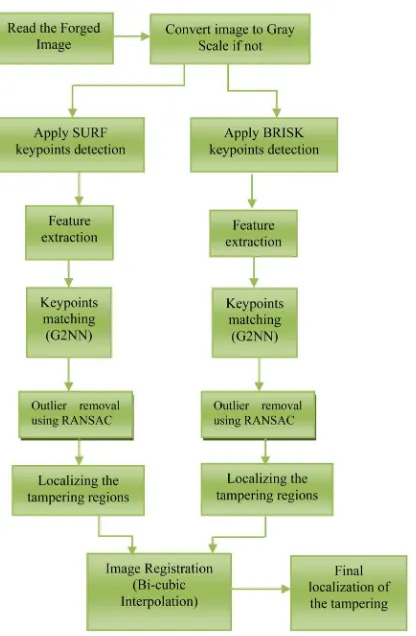
In this section, the CMFD (Copy Move Forgery Detection) has been matured. An efficient keypoint based CMFD technique is proposed. The proposed tech-nique is executed by two stages of detection:
DOI: 10.4236/jcc.2019.79001 6 Journal of Computer and Communications In the detection stage, the detection is done by the parallelism of two com-monly used CMFD, which are BRISK and SURF techniques. The goal of the par-allelism of both techniques is to enhance the detection accuracy of CMF from the issues of scaling, rotation, smoothed flat regions for both better detection performance.
In the refine detection stage, we used image registration using bi-cubic in-terpolation between the results from SURF and BRISK that is done in the detec-tion stage with a view to make hybridizadetec-tion between SURF and BRISK to en-hance the detection results and its efficiency.
The results obtained from the proposed technique is been compared with other related work results obtained. We first present the detailed description of the keypoints extraction techniques exploited in this paper, followed by the algo-rithm framework of the proposed technique for image copy move forgery detec-tion. The flow chart of the whole technique is presented in Figure 2.
3.1. The Detection Stage
[image:6.595.273.481.390.708.2]In the Detection Stage, we are using SURF keypoints detection in parallel with BRISK keypoint detection. Both algorithms are supported by RANSAC as an outliers’ removal to minimize the false detection of forgeries. In the next subsec-tions we will discuss how to use SURF and BRISK as a keypoints feature extrac-tors of forgery detection algorithm.
DOI: 10.4236/jcc.2019.79001 7 Journal of Computer and Communications 3.1.1. SURF Keypoints Detection
SURF algorithm is also computationally faster compared to other feature keypoints extraction methods. The first step is to convert the forged image into grayscale im-age as SURF algorithm runs over grayscale imim-ages. Commonly, classic SURF al-gorithm has two major steps:
1) Keypoints detection and description. 2) Keypoints Matching.
Todetectthekeypoints, SURF uses:
• an approximation to the Hessian matrix along with box filters, • integral images,
• and non-maximum suppression. Onthedescriptorside:
• Given a set of keypoints, each one is described by using Haar Wavelet coeffi-cients on vertical and horizontal directions from a circular region around them.
• The coefficient values are weighted by a Gaussian window. • And compose the final 64-d descriptor for a specific keypoint.
1) Keypoints Detector
The detector is based on Hessian matrix. An integral Image decreases the com-putation speed increases the performance and reduces the time complexity [10]. An Integral image of an image I at a given point X =
(
x y,)
is described as the summation of all pixels’ intensities in an image I formed by the point X from the origin as in (1).( )
( )
0 0 ,
y x
i j
I XΣ I i j
= =
=
∑∑
(1)KeyPoint Detection requires scale space building for the keypoints’ extraction. To detect the keypoints’ locations, they are where the determinant is maximum. In SURF algorithm, LOG (Laplacian of Gaussian) is estimated by a box filter. Con-volution is applied to the image with a box filter of varying size for constructing the scale space. After building the scale space, the Hessian matrix’s determinant is calculated for detecting the ultimate point. If the determinant is positive that means, both the Eigenvalues are of the same sign either both are negative or both are positive. In a situation of the positive result, points will be taken as an ex-treme; otherwise, it will be discarded. The Hessian matrix is defined as H x
(
,σ)
for a given point X =
(
x y,)
in an image I as follows:(
,)
xx(
(
,,)
)
xy(
(
,,)
)
xy yy
L L
L
x x
H x
x L x
σ σ σ σ σ
= (2)
where, L xxx
(
,σ)
is the convolution of the Gaussian second order derivative with the image I in point x, and, similarly, L xxy(
,σ)
and L xyy(
,σ)
. The 9 × 9DOI: 10.4236/jcc.2019.79001 8 Journal of Computer and Communications
(
)
20.9
xx yy xy
H =D D − D (3)
where: 0.9 represents the weights applied to the rectangular regions are simple for computational efficiency, Dxx, Dxy, and Dyy are the second order Gaus-sian derivatives approximations in x, xy and y direction respectively. The ap-proximated determinant of the Hessian represents the keypoint in the image at the specified location.
2) Keypoints Descriptor
SURF keypoints descriptors are built after finding the keypoints. This is done using Haar-wavelet coefficients in the x and y directions, at the scale the key point was detected. The dominant orientation is estimated by summing all of the res-ponses in a sliding window. Next, the region is divided into smaller sub-regions and some features are computed (weighted Haar wavelet responses in both direc-tions, sum of the absolute values of the responses). After assembling the keypoints and descriptors, we calculate likeness among them. We specify that a keypoint has one matching only over the image. To assure this, we use the Generalized 2 Near-est Neighbor policy among the descriptors of each keypoint to identify similar areas in the forged image.
The idea of G2NN is that if the ratio of
1
i
i d d+
is less than a threshold T and k
(where 1≤k n ) is the value in which the procedure stops, each keypoint in correspondence to a distance in
{
d d1, , ,2 dk}
is considered as a match for theinspected keypoint. Our approach uses the Hamming Distance between de-scriptors to evaluate similarities. To minimize the false positives number, we ap-ply one more threshold over the distances, banning close keypoints to be incor-rectly matched.
If the distance length between two closed keypoints is very small, these matched keypoints probably is a mismatch. In this paper if the distance between two keypoints is less than threshold Dismin, they will be deleted. Next, to
iden-tify the prospective cloned areas, hierarchical cluster is executed on locations of the matched keypoints. After clustering, we also apply the RANdom SAmple Consensus algorithm (RANSAC) [16] to delete mismatched points. At the final step, if the number of matching between clusters is greater than three pairs, the image is considered tampered. Then the copied and pasted regions are localized by joining the matched keypoints using line.
3.1.2. BRISK Keypoints Detection
BRISK algorithm is dramatically the least computational complication. This al-gorithm is faster than SURF. The BRISK keypoint feature vector is built as an assembly of bit-string vector. This binary keypoint vector is composed of three parts:
a) A sampling pattern: where to sample neighborhoods in the region around the keypoint.
DOI: 10.4236/jcc.2019.79001 9 Journal of Computer and Communications c) Sampling pairs: which pairs are used to compare when constructing the final keypoints’ vector.
1) Computing Orientation
For computing the orientation of the keypoint, BRISK uses local gradients between the sampling pairs which are defined by as in (4):
(
,) (
) ( )
I x I y( )
2g X Y X Y
X Y
′ − ′
= −
− (4)
where: g X Y
(
,)
is the local gradient between the sampling pair (X, Y), I′ isthe smoothed intensity value.
By using two thresholds δmin and δmax, the pair points are divided into two groups
S (short) andL (long). Long pairs are used in BRISK to determine orientation and short pairs are used for the intensity comparisons that build the descriptor as in Equation (5):
(
)
{
, max}
and{
(
,)
min}
S= X Y X Y− <δ L= X Y X Y− >δ (5)
To compute orientation, summing up all the local gradients between all the long pairs only and take arctan y
x
g
g —the arctangent of the y component of the gradient divided by the x component of the gradient. This gives the angle of the keypoint. BRISK only uses long pairs for computing orientation based on the assumption that local gradients eliminate each other thus, it is unnecessary in the global gradient determination.
2) Keypoints Vector Construction
Constructing the descriptor is done by performing intensity comparisons. BRISK takes the set of short pairs, rotate the pairs by the orientation computed earlier and makes comparisons of the form in (6):
( ) ( )
1 if
0 otherwise
I Y I X
b α α ′ ′ = (6)
(
X Yα, α)
S∀ ∈ . The result is a bit vector of length 512 keypoints.
Meaning that for each short pair it takes the smoothed intensity of the sam-pling points and checked whether the smoothed intensity of the first point in the pair is larger than that of the second point. If it does, then it writes 1 in the con-gruous bit of the descriptor and otherwise it will be 0. Remember that BRISK uses only the short pairs for building the descriptor.
The binary features resulted from BRISK are matched for similarity using G2NN search. Hamming distance is used to find the nearest neighbor. Ham-ming distance is the difference of the number of bits in two compared bit strings. Similarly, as done with SURF keypoints feature, RANSAC is also used to remove outliers or inconsistent matches. It is usually used to minimize the false detec-tion rate and eliminate the outlier keypoints.
3.2. The Refine Detection Stage
DOI: 10.4236/jcc.2019.79001 10 Journal of Computer and Communications aligns pixels in one view of an area with corresponding pixels in another view of that area. The inputs of registration are the two views to be registered; the output is a geometrical transformation, which is merely a mathematical mapping from pixels in one view to pixels in the second. To the extent that corresponding pix-els are mapped together, the registration is successful. This mathematical map-ping is done here in this paper by using the bi-cubic interpolation between the corresponding pixels.
Bi-cubic mapping performs a better job of preserving fine details and is usually used in commercial image editing programs e.g. adobe Photoshop [17]. Using bi-cubic mapping gives more smooth results and fewer artifacts. It takes into account the nearest neighbor 16 pixels (4 × 4) of a specific pixel. It can be calcu-lated as in (7):
( )
3 30 0
, i j
ij i j
I x y a x y
= =
=
∑∑
(7)where: aij is the interpolation coefficient. xi is the extracted keypoint at po-sition i by using SURF, and similarly yj is the extracted keypoint at position j
by using BRISK. I x y
(
,)
is consisting of multiplying the 16 interpolation coef-ficients by the dot product of xi and yj.To summarize the steps of bi-cubic mapping for a certain position:
1) Identify the 16th neighbors of this position in vector of BRISK and the
cor-responding one in vector of SURF.
2) Determine the value of the 16th interpolation coefficients.
3) Cross product the value of each neighbor in BRISK by the corresponding one in SURF and then multiply the result by the corresponding value of the in-terpolation coefficient.
4) Repeat step 3 over the 16th neighbors.
5) Sum the resulting value over the 16th neighbor to get the bi-cubic mapping.
4. Experimental Results
In this section, we extensively discuss the experimental environment. The pro-posed technique use an amalgamation of SURF and BRISK as a feature extraction techniques and bi-cubic interpolation to merge the results’ outcome from the both features, to increase the forgery detection accuracy. Four different standard well known dataset are used to run the experiment to check the accuracy and efficiency of the proposed technique. This will efficiently prove the validation of the pro-posed technique. The propro-posed technique parameters are set optimally based on previous best practices. Performance evaluation and numerical analysis of the proposed forgery detection technique are examined comparatively to one of the previously published technique [12], which is based as well on SURF and BRISK feature extraction techniques.
4.1. Experimental Setup
DOI: 10.4236/jcc.2019.79001 11 Journal of Computer and Communications types of forgery is required. In this experimental study, we have used realistic datasets to evaluate the performance of the proposed technique, the CASIA tampered image detection evaluation database V2.0 (CASIA, 2010) [18] is one of them. The datasets include samples of copy-move and copy-paste digital forge-ries applied on images of varied sizes. The image region selected for duplication can be transformed before copying them by applying scaling, rotation, reflection, or distortion. The duplicated area varies in size. An example of forged image and the original image from the CASIA dataset is shown in Figure 3. The algorithm is coded in MATLAB R2014 on a machine equipped with Intel i5 2.00 GHz pro-cessor with 3GB DDR3 RAM.
4.2. Evaluation Metrics
For evaluating all the techniques, we chose the three following metrics, in ac-cordance to the ones used in the 1st IEEE Intl. Image Forensics Challenge in 2013 (IFC):
• True Positive Rate (TPR): indicates the percentage of correctly located re-duplicated regions. It is calculated as in (8):
TPR
clone
TP R
= (8)
where TP (True Positive) represents the number of pixels correctly classified as cloned in the detection map, and Rclone represents the number of real
cloned pixels in the reference map.
• False Positive Rate (FPR): indicates the percentage of incorrectly located reduplicated regions. It is calculated as in (9):
FPR
clone
FP R
= (9)
where FP (False Positive) represents the number of pixels wrongly classified as copied in the detection map, and Rclone represents the number of pixels, in
the reference map, that do not belong to the copied regions.
• Accuracy (ACC): gives the total quality of detection based on True Positive Rate and True Negative Rate, which indicates the percentage of correctly lo-cated non-cloned regions. It is calculated as in (10):
(
)
TPR 1 FPR ACC
2
+ −
= (10)
4.3. Performance Evaluation and Its Analysis
DOI: 10.4236/jcc.2019.79001 12 Journal of Computer and Communications (a) Original Image (b) Forged Image
Figure 3. A sample of images and the ground truth in the CASIA dataset [18].
1) Extracting SURF keypoints; 2) Extract BRISK keypoints;
3) Matching descriptors to locate the forged regions using image registration by bi-cubic interpolation.
Results show that the SURF descriptors are invariant to geometrical transfor-mations. It has been also observed that it is quite suited in detecting the image region duplication consisting of additive noise and blurring.
The time taken by the proposed algorithm is much comparing to the tech-nique in [12], because our supposed techtech-nique using more computations:
1) In the detection stage by:
Using G2NN instead of KNN.
The execution of SURF and BRISK individually and in a parallel way instead of using SURF as a prior to BRISK.
2) In the refine stage by using bi-cubic interpolation, and there is no refine stage in technique proposed in [12].
The time comparison is provided in Table 1 for descriptor extraction. The technique is evaluated for stability by correct detection ratio, which is a ratio of the keypoints in the forged region to the total keypoints detected.
To analyze the performance of evaluating copy-move forgery detection algo-rithms at image level, we use the following error measures provided to the ones previously mentioned above in Equations (8) (9) and (10). It concentrates on whether the truth that an image has been faked or not to be detected. So; both the measures of precision and recall should be calculated to verify the validity of the techniques. Precision and recall can be calculated as in 11 and 12 respectively:
Precision p
p p
T
T F
=
+ (11)
Recall p
p N
T
T +F
= (12)
DOI: 10.4236/jcc.2019.79001 13 Journal of Computer and Communications
Table 1. Comparison of average detection with existing technique.
Technique Average Detection Time per Seconds Existing Technique in [12] 5.4
Proposed Technique 8.2
FP—The number of images that have been mistakenly detected as forged.
FN—Incorrectly missed forgery images.
Precision denotes the probability a detected tampered image being a truly tampered image; while Recall shows the probability of a truly tampered image being detected as tampered. Recall is usually called true positive rate as well. Score as a comprehensive measure which merges precision and recall in one measure.
Score 2 P R P R ∗ ∗
+
= (13)
where P represents precision and R represents recall.
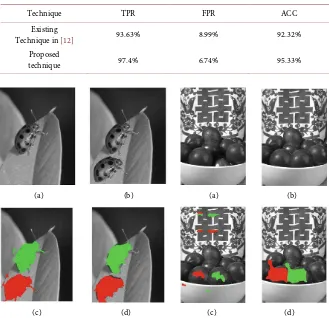
The experiment is carried out on image datasets with different size images. Fig-ure 4 and FigFig-ure 5 show the detection results for different kinds of processing operations inclusive rotation and scaling. The time taken to detect forgery is not directly dependent upon the image size; actually it depends upon the duplicated area size. The number of keypoints generated and the corresponding descriptors processed are proportional to the duplicated region and brightness variations. Table 2 and Table 3 show high stability of the method in terms of correct detec-tion ratio.
Technique in [12] used SURF as a prior to BRISK which means that if there are any interesting keypoint lost in SURF detection will be as well in applying BRISK to the image resultant from the SURF feature extraction. Thus; the effi-ciency of technique in [12] is not the quite perfect because of the missing of some keypoints and the SURF extraction stage and cannot be considered again in BRISK extraction as it is already doesn’t include in the image passed to BRISK. In our proposed technique, we aimed to solve this challenge faced the authors in [12]. We work on both features extraction in parallel way to fully utilizing the keypoints extracted from the both features. By using the interpolation between the two extracted feature, the most interesting common keypoints are resulted which enrich the efficiency of the forgery detection.
5. Conclusion and Future Work
DOI: 10.4236/jcc.2019.79001 14 Journal of Computer and Communications
Table 2. Comparison of precision, recall and score for copy-move attack.
Technique Precision Recall Score Existing
Technique in [12] 91.49% 89.58% 90.53% Proposed
[image:14.595.209.538.184.502.2]technique 94.03% 92.31% 93.01%
Table 3. Comparison of TPR, FPR and ACC for copy-move attack.
Technique TPR FPR ACC
Existing
Technique in [12] 93.63% 8.99% 92.32% Proposed
technique 97.4% 6.74% 95.33%
(a) (b) (a) (b)
(c) (d) (c) (d)
Figure 4. Detection of image forgery, (a) Original image, (b) Forged image, (c) Detected forged region using [12] and (d) Detected region using the proposed technique.
[image:14.595.222.527.545.739.2]DOI: 10.4236/jcc.2019.79001 15 Journal of Computer and Communications (c) (d)
(a) (b) (c) (d)
(a) (b)
[image:15.595.208.538.70.633.2](c) (d)
Figure 5. (a) Original image, (b) Forged image, (c) Detection result using technique in
[12], and (d) Detection result using the proposed technique.
DOI: 10.4236/jcc.2019.79001 16 Journal of Computer and Communications such as rotation and scaling as well as other post-processing operations like JPEG compression and Gaussian noise addition. Compared with other key point-based techniques published, the proposed technique almost requires two steps, namely the parallel execution of SURF and BRISK, and the bi-cubic interpolation esti-mation refinement. SURF has a minimal feature keypoint descriptor dimension-al length. Thus, matching process applied on SURF keypoints is faster and de-creases the computation speed as well. The Haar wavelets that are used for fea-ture descriptors computation from each keypoint result in that these descriptors are robust to illumination changes. The experimental results demonstrate the ef-ficacy the proposed technique has in detecting the flat duplication regions with various post-processing operations within a reasonable detection time.
Certainly, there is no gold bullet to solve completely the whole problems and we are aware that the proposed technique is just a step toward solving the clon-ing detection problem. However, we believe our technique presents several con-tributions that will provide the literature with new ways to cope with this chal-lenging problem. Finally, with the low false-positive rates found and high relia-bility regardless the testing scenario (low deviations across different testing con-ditions), we also think our contribution may be very useful in a real-world fo-rensics scenario, providing an investigator with a set of suspect cloning regions to be visually checked in the image, as one of the prior steps in determining its authenticity.
The proposed technique overcame the problem of false detection comparing to the technique proposed in [12]. The proposed technique gives a high accuracy of detection because it is fully utilizing the keypoints extracted from both SURF and BRISK, additionally it combined them using the bi-cubic interpolation which enriched the score of detection and decreased the false detection rate. While, this process enhanced the accuracy but it was a more time consuming than the tech-nique in [12]. The proposed techtech-nique overcame as well the problem of smooth and flat regions detections as indicated in experimental results and Figure 4 and Figure 5.
In the future, we will try to improve the detection speed of the proposed tech-nique by using parallel programming. Additionally, we can enhance the detec-tion performance in handling very small and very smoothed forged regions us-ing a different matchus-ing method in both SURF and BRISK.
Conflicts of Interest
The authors declare no conflicts of interest regarding the publication of this pa-per.
References
[1] GIMP. https://www.gimp.org
[2] NIK Collection. https://nikcollection.dxo.com/download
DOI: 10.4236/jcc.2019.79001 17 Journal of Computer and Communications International Journal of Computer Science and Information Technology & Security, 6, 249-253.
[4] Bhalla, C. and Gupta, S. (2016) A Review on Splicing Image Forgery Detection Techniques. IRACST International Journal of Computer Science and Information Technology & Security, 6, 262-269.
[5] Kaur, H., Saxena, J. and Singh, S. (2015) Simulative Comparison of Copy-Move Forgery Detection Methods for Digital Images. The International Journal of Elec-tronics, Electrical & Computational, 4, 62-66.
https://doi.org/10.17577/IJERTV4IS061110
[6] Mohmood, T. (2015) A Survey on Block Based Copy-Move Image Forgery Detec-tion Techniques. Proceeding of the International Conference on Emerging Tech-nologies, Peshawar, 19-20 December 2015, 1-6.
[7] Mahmood, T., Mehmood, Z., Shah, M. and Saba, T. (2018) A Robust Technique for Copy-Move Forgery Detection and Localization in Digital Images via Stationary Wavelet and Discrete Cosine Transform. Journal of Visual Communication and Image Representation, 53, 202-214.https://doi.org/10.1016/j.jvcir.2018.03.015 [8] Tralic, D., Zupancic, I., Grgic, S. and Grgic, M. (2013) CoMoFoD—New Database
for Copy-Move Forgery Detection. The Proceeding of the ELMAR, Zadar, 10-12 September 2014, 49-54.
[9] Shi, W.C., Zhao, F., Qin, B., etal. (2016) Improving Image Copy-Move Forgery De-tection with Particle Swarm Optimization Techniques. Journal of China Commu-nication, 13, 139-149.https://doi.org/10.1109/CC.2016.7405711
[10] Bay, H., Ess, A., Tuytelaars, T. and Gool, L.V. (2008) Speeded-Up Robust Features (SURF). Journal of Computer Vision and Image Understanding, 10, 346-359.
https://doi.org/10.1016/j.cviu.2007.09.014
[11] Leutenegger, S. and Chli, M. (2011) BRISK: Binary Robust Invariant Scalable Key-points. Proceeding of the IEEE International Conference on Computer Vision, Bar-celona, 6-13 November 2011, 2548-2555.
https://doi.org/10.1109/ICCV.2011.6126542
[12] Kumar, S. and Desai, J.V. (2015) A Fast Keypoint Hybrid Method for Copy Move Forgery Detection. International Journal of Computing and Digital Systems, 4, 91-99.https://doi.org/10.12785/ijcds/040203
[13] Ojeniyi, J.A. (2018) Hybridized Technique for Copy-Move Forgery Detection Using Discrete Cosine Transform and Speeded-Up Robust Feature Techniques. Interna-tional Journal of Image, Graphics and Signal Processing, 10, 22-30.
https://doi.org/10.5815/ijigsp.2018.04.03
[14] Antony, N. and Devassy, B.R. (2018) Copy-Move Image Forgery Detection Using Adaptive Over-Segmentation and Brute-Force Matching. International Journal of Advanced Research Trends in Engineering and Technology, 5, 25-30.
[15] Devi, P. and Deswal, S. (2018) Clustering Based Feature Extraction for Image For-gery Detection. International Journal of Computer Sciences and Engineering, 6, 22-27.https://doi.org/10.26438/ijcse/v6i7.2227
[16] Fischler, M.A. and Bolles, R.C. (1981) Random Sample Consensus: A Paradigm for Model Fitting with Applications to Image Analysis and Automated Cartography.
The Journal of Communications of the ACM, 24, 381-395.
https://doi.org/10.1145/358669.358692
Del-DOI: 10.4236/jcc.2019.79001 18 Journal of Computer and Communications
hi, 16-18 March 2016, 3909-3912.
![Figure 1. Image forgery examples [8].](https://thumb-us.123doks.com/thumbv2/123dok_us/8985018.395106/3.595.242.505.69.335/figure-image-forgery-examples.webp)
![Figure 3. A sample of images and the ground truth in the CASIA dataset [18].](https://thumb-us.123doks.com/thumbv2/123dok_us/8985018.395106/12.595.233.514.70.241/figure-sample-images-ground-truth-casia-dataset.webp)

![Figure 5. (a) Original image, (b) Forged image, (c) Detection result using technique in [12], and (d) Detection result using the proposed technique](https://thumb-us.123doks.com/thumbv2/123dok_us/8985018.395106/15.595.208.538.70.633/figure-original-forged-detection-technique-detection-proposed-technique.webp)
