764
DocRED: A Large-Scale Document-Level Relation Extraction Dataset
Yuan Yao1∗, Deming Ye1∗, Peng Li2, Xu Han1, Yankai Lin1, Zhenghao Liu1, Zhiyuan Liu1†, Lixin Huang1, Jie Zhou2, Maosong Sun1
1Department of Computer Science and Technology, Tsinghua University, Beijing, China
Institute for Artificial Intelligence, Tsinghua University, Beijing, China
State Key Lab on Intelligent Technology and Systems, Tsinghua University, Beijing, China
2Pattern Recognition Center, WeChat AI, Tencent Inc.
{yuan-yao18,ydm18}@mails.tsinghua.edu.cn
Abstract
Multiple entities in a document generally ex-hibit complex inter-sentence relations, and cannot be well handled by existing relation extraction (RE) methods that typically fo-cus on extracting intra-sentence relations for single entity pairs. In order to accelerate the research on document-level RE, we in-troduce DocRED, a new dataset constructed from Wikipedia and Wikidata with three fea-tures: (1) DocRED annotates both named en-tities and relations, and is the largest human-annotated dataset for document-level RE from plain text; (2) DocRED requires reading mul-tiple sentences in a document to extract en-tities and infer their relations by synthesiz-ing all information of the document; (3) along with the human-annotated data, we also of-fer large-scale distantly supervised data, which enables DocRED to be adopted for both su-pervised and weakly susu-pervised scenarios. In order to verify the challenges of document-level RE, we implement recent state-of-the-art methods for RE and conduct a thorough eval-uation of these methods on DocRED. Empir-ical results show that DocRED is challeng-ing for existchalleng-ing RE methods, which indicates that document-level RE remains an open prob-lem and requires further efforts. Based on the detailed analysis on the experiments, we dis-cuss multiple promising directions for future research. We make DocRED and the code for our baselines publicly available athttps: //github.com/thunlp/DocRED.
1 Introduction
The task of relation extraction (RE) is to iden-tify relational facts between entities from plain text, which plays an important role in large-scale knowledge graph construction. Most existing RE
∗
indicates equal contribution †
Corresponding author: Z.Liu([email protected])
[1] Kungliga Hovkapellet (The Royal Court Orchestra) is a
Swedishorchestra, originally part of theRoyal CourtinSweden's capitalStockholm.[2]The orchestra originally consisted of both musicians and singers.[3]It had only male members until1727, whenSophia Schröder and Judith Fischer were employed as vocalists; in the1850s, the harpistMarie Pauline Åhmanbecame the first female instrumentalist.[4]From1731, public concerts were performed atRiddarhuset inStockholm.[5]Since 1773, when theRoyal Swedish Operawas founded byGustav IIIof
Sweden, theKungliga Hovkapellethas been part of the opera's company.
Kungliga Hovkapellet
Subject: Kungliga Hovkapellet; Royal Court Orchestra
Object: Royal Swedish Opera
Relation: part_of
Subject: Riddarhuset
Object: Sweden
Relation: country
Supporting Evidence: 5
Supporting Evidence: 1, 4
Figure 1: An example from DocRED. Each document in DocRED is annotated with named entity mentions, coreference information, intra- and inter-sentence re-lations, and supporting evidence. 2out of the19 re-lation instances annotated for this example document are presented, with named entity mentions involved in these instances colored in blue and other named entity mentions underlined for clarity. Note that mentions of the same subject (e.g.,Kungliga HovkapelletandRoyal Court Orchestra) are identified as shown in the first re-lation instance.
work focuses on sentence-level RE, i.e., extract-ing relational facts from a sextract-ingle sentence. In recent years, various neural models have been explored to encode relational patterns of entities for sentence-level RE, and achieve state-of-the-art performance (Socher et al., 2012;Zeng et al.,
2014,2015;dos Santos et al.,2015;Xiao and Liu,
2016;Cai et al.,2016;Lin et al.,2016;Wu et al.,
2017;Qin et al.,2018;Han et al.,2018a).
Despite these successful efforts, sentence-level RE suffers from an inevitable restriction in prac-tice: a large number of relational facts are ex-pressed in multiple sentences. Taking Figure 1
order to identify the relational fact (Riddarhuset,
country, Sweden), one has to first identify the fact thatRiddarhusetis located inStockholmfrom Sentence 4, then identify the facts Stockholm is the capital of Sweden and Sweden is a country from Sentence 1, and finally infer from these facts that the sovereign state of Riddarhuset is Swe-den. The process requires reading and reason-ing over multiple sentences in a document, which is intuitively beyond the reach of sentence-level RE methods. According to the statistics on our human-annotated corpus sampled from Wikipedia documents, at least40.7%relational facts can only be extracted from multiple sentences, which is not negligible. Swampillai and Stevenson(2010) and
Verga et al.(2018) have also reported similar ob-servations. Therefore, it is necessary to move RE forward from sentence level to document level.
The research on document-level RE requires a large-scale annotated dataset for both training and evaluation. Currently, there are only a few datasets for document-level RE. Quirk and Poon
(2017) and Peng et al. (2017) build two dis-tantly supervised datasets without human anno-tation, which may make the evaluation less re-liable. BC5CDR (Li et al., 2016) is a human-annotated document-level RE dataset consisting of 1,500 PubMed documents, which is in the specific domain of biomedicine considering only the “chemical-induced disease” relation, making it unsuitable for developing general-purpose meth-ods for document-level RE.Levy et al.(2017) ex-tract relational facts from documents by answering questions using reading comprehension methods, where the questions are converted from entity-relation pairs. As the dataset proposed in this work is tailored to the specific approach, it is also unsuitable for other potential approaches for document-level RE. In summary, existing datasets for document-level RE either only have a small number of manually-annotated relations and en-tities, or exhibit noisy annotations from distant supervision, or serve specific domains or ap-proaches. In order to accelerate the research on document-level RE, we urgently need a large-scale, manually-annotated, and general-purpose document-level RE dataset.
In this paper, we present DocRED, a large-scale human-annotated document-level RE dataset con-structed from Wikipedia and Wikidata (Erxleben et al.,2014;Vrandeˇci´c and Kr¨otzsch,2014).
Do-cRED is constructed with the following three features: (1) DocRED contains 132,375 enti-ties and 56,354 relational facts annotated on
5,053Wikipedia documents, making it the largest human-annotated document-level RE dataset. (2) As at least 40.7% of the relational facts in Do-cRED can only be extracted from multiple tences, DocRED requires reading multiple sen-tences in a document to recognize entities and in-ferring their relations by synthesizing all informa-tion of the document. This distinguishes DocRED from those sentence-level RE datasets. (3) We also provide large-scale distantly supervised data to support weakly supervised RE research.
To assess the challenges of DocRED, we imple-ment recent state-of-the-art RE methods and con-duct thorough experiments on DocRED under var-ious settings. Experimental results show that the performance of existing methods declines signifi-cantly on DocRED, indicating the task document-level RE is more challenging than sentence-document-level RE and remains an open problem. Furthermore, detailed analysis on the results also reveals multi-ple promising directions worth pursuing.
2 Data Collection
Our ultimate goal is to construct a dataset for document-level RE from plain text, which re-quires necessary information including named en-tity mentions, enen-tity coreferences, and relations of all entity pairs in the document. To facilitate more RE settings, we also provide supporting evidence information for relation instances. In the follow-ing sections, we first introduce the collection pro-cess of the human-annotated data, and then de-scribe the process of creating the large-scale dis-tantly supervised data.
2.1 Human-Annotated Data Collection
Our human-annotated data is collected in four stages: (1) Generating distantly supervised anno-tation for Wikipedia documents. (2) Annotating all named entity mentions in the documents and coreference information. (3) Linking named entity mentions to Wikidata items. (4) Labeling relations and corresponding supporting evidence.
us-ing distant supervision and RE models. (2) Man-ually correcting and supplementing recommenda-tions. (3) Reviewing and further modifying the an-notation results from the second pass for better ac-curacy and consistency. To ensure the annotators are well trained, a principled training procedure is adopted and the annotators are required to pass test tasks before annotating the dataset. And only care-fully selected experienced annotators are qualified for the third pass annotation.
To provide a strong alignment between text and KBs, our dataset is constructed from the complete English Wikipedia document collection and Wiki-data1, which is a large-scale KB tightly integrated with Wikipedia. We use the introductory sections from Wikipedia documents as the corpus, as they are usually high-quality and contain most of the key information.
Stage 1: Distantly Supervised Annotation Gen-eration. To select documents for human annota-tion, we align Wikipedia documents with Wikidata under the distant supervision assumption (Mintz et al.,2009). Specifically, we first perform named entity recognition using spaCy2. Then these named entity mentions are linked to Wikidata items, where named entity mentions with identi-cal KB IDs are merged. Finally, relations between each merged named entity pair in the document are labeled by querying Wikidata. Documents con-taining fewer than128words are discarded. To en-courage reasoning, we further discard documents containing fewer than4entities or fewer than4 re-lation instances, resulting in107,050documents with distantly supervised labels, where we ran-domly select5,053 documents and the most fre-quent96relations for human annotation.
Stage 2: Named Entity and Coreference An-notation. Extracting relations from document re-quires first recognizing named entity mentions and identifying mentions referring to the same enti-ties within the document. To provide high-quality named entity mentions and coreference informa-tion, we ask human annotators first to review, cor-rect and supplement the named entity mention recommendations generated in Stage 1, and then merge those different mentions referring to the same entities, which provides extra coreference in-formation. The resulting intermediate corpus
con-1
We use the 2018-5-24 dump of English Wikipedia and 2018-3-20 dump of Wikidata.
2https://spacy.io
tains a variety of named entity types including person, location, organization, time, number and names of miscellaneous entities that do not belong to the aforementioned types.
Stage 3: Entity Linking. In this stage, we link each named entity mention to multiple Wikidata items to provide relation recommendations from distant supervision for the next stage. To be spe-cific, each named entity mention is associated with a Wikidata item candidate set 3 consisting of all Wikidata items whose names or aliases literally match it. We further extend the candidate set using Wikidata items hyperlinked to the named entity mention by the document authors, and recommen-dations from an entity linking toolkit TagMe ( Fer-ragina and Scaiella,2010). Specially, numbers and time are semantically matched.
Stage 4: Relation and Supporting Evidence Collection. The annotation of relation and sup-porting evidence is based on the named entity mentions and coreference information in Stage 2, and faces two main challenges. The first challenge comes from the large number of potential entity pairs in the document. On the one hand, given the quadratic number of potential entity pairs with regard to entity number (19.5 entities on aver-age) in a document, exhaustively labeling relations between each entity pair would lead to intensive workload. On the other hand, most entity pairs in a document do not contain relations. The second challenge lies in the large number of fine-grained relation types in our dataset. Thus it is not feasible for annotators to label relations from scratch.
We address the problem by providing human annotators with recommendations from RE mod-els, and distant supervision based on entity link-ing (Stage 3). On average, we recommend 19.9
relation instances per document from entity link-ing, and7.8from RE models for supplement. We ask the annotators to review the recommendations, remove the incorrect relation instances and sup-plement omitted ones. We also ask the annotators to further select all sentences that support the re-served relation instances as supporting evidence. Relations reserved must be reflected in the doc-ument, without relying on external world knowl-edge. Finally57.2%relation instances from entity linking and48.2%from RE models are reserved.
Dataset # Doc. # Word # Sent. # Ent. # Rel. # Inst. # Fact
SemEval-2010 Task 8 - 205k 10,717 21,434 9 8,853 8,383
ACE 2003-2004 - 297k 12,783 46,108 24 16,771 16,536
TACRED - 1,823k 53,791 152,527 41 21,773 5,976
FewRel - 1,397k 56,109 72,124 100 70,000 55,803
BC5CDR 1,500 282k 11,089 29,271 1 3,116 2,434
DocRED (Human-annotated) 5,053 1,002k 40,276 132,375 96 63,427 56,354
DocRED (Distantly Supervised) 101,873 21,368k 828,115 2,558,350 96 1,508,320 881,298
Table 1: Statistics of RE datasets (Doc.: document, Sent.: sentence, Ent.: entity, Rel.: relation type, Inst.: relation instance, Fact: relational fact). The first four are sentence-level RE datasets.
2.2 Distantly Supervised Data Collection
In addition to the human-annotated data, we also collect large-scale distantly supervised data to pro-mote weakly supervised RE scenarios. We remove the 5,053human-annotated documents from the
106,926 documents, and use the rest 101,873
documents as the corpus of distantly supervised data. To ensure that the distantly supervised data and human-annotated data share the same en-tity distribution, named enen-tity mentions are re-identified using Bidirectional Encoder Represen-tations from Transformers (BERT) (Devlin et al.,
2019) that is fine-tuned on the human-annotated data collected in Sec.2.1 and achieves90.5%F1 score. We link each named entity mention to one Wikidata item by a heuristic-based method, which jointly considers the frequency of a target Wiki-data item and its relevance to the current docu-ment. Then we merge the named entity mentions with identical KB IDs. Finally, relations between each merged entity pair are labeled via distant su-pervision.
3 Data Analysis
In this section, we analyze various aspects of Do-cRED to provide a deeper understanding of the dataset and the task of document-level RE.
Data Size. Table 1 shows statistics of DocRED and some representative RE datasets, including sentence-level RE datasets SemEval-2010 Task 8 (Hendrickx et al.,2010), ACE 2003-2004 ( Dod-dington et al., 2004), TACRED (Zhang et al.,
2017), FewRel (Han et al.,2018b) and document-level RE dataset BC5CDR (Li et al., 2016). We find that DocRED is larger than existing datasets in many aspects, including the number of docu-ments, words, sentences, entities, especially in as-pects of relation types, relation instances and re-lational facts. We hope the large-scale DocRED dataset could drive relation extraction from
sen-tence level forward to document level.
Named Entity Types. DocRED covers a variety of entity types, including person (18.5%), location (30.9%), organization (14.4%), time (15.8%) and number (5.1%). It also covers a diverse set of mis-cellaneous entity names (15.2%) not belonging to the aforementioned types, such as events, artistic works and laws. Each entity is annotated with1.34
mentions on average.
Relation Types. Our dataset includes96frequent relation types from Wikidata. A notable property of our dataset is that the relation types cover a broad range of categories, including relations rele-vant to science (33.3%), art (11.5%), time (8.3%), personal life (4.2%), etc., which means the rela-tional facts are not constrained in any specific do-main. In addition, the relation types are organized in a well-defined hierarchy and taxonomy, which could provide rich information for document-level RE systems.
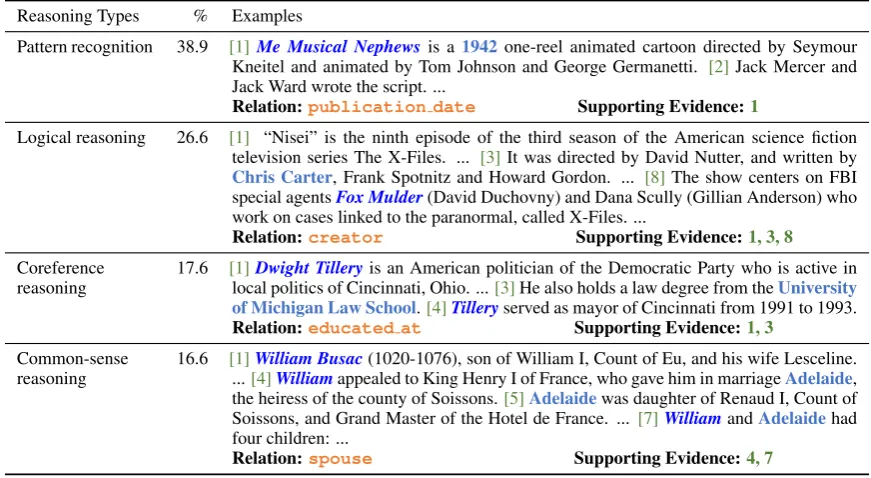
Reasoning Types. We randomly sampled 300
documents from dev and test set, which contain
con-Reasoning Types % Examples
Pattern recognition 38.9 [1]Me Musical Nephewsis a 1942one-reel animated cartoon directed by Seymour Kneitel and animated by Tom Johnson and George Germanetti. [2]Jack Mercer and Jack Ward wrote the script. ...
Relation:publication date Supporting Evidence:1
Logical reasoning 26.6 [1] “Nisei” is the ninth episode of the third season of the American science fiction television series The X-Files. ... [3]It was directed by David Nutter, and written by
Chris Carter, Frank Spotnitz and Howard Gordon. ... [8]The show centers on FBI special agentsFox Mulder(David Duchovny) and Dana Scully (Gillian Anderson) who work on cases linked to the paranormal, called X-Files. ...
Relation:creator Supporting Evidence:1, 3, 8
Coreference reasoning
17.6 [1]Dwight Tilleryis an American politician of the Democratic Party who is active in local politics of Cincinnati, Ohio. ...[3]He also holds a law degree from theUniversity of Michigan Law School.[4]Tilleryserved as mayor of Cincinnati from 1991 to 1993. Relation:educated at Supporting Evidence:1, 3
Common-sense reasoning
16.6 [1]William Busac(1020-1076), son of William I, Count of Eu, and his wife Lesceline. ...[4]Williamappealed to King Henry I of France, who gave him in marriageAdelaide, the heiress of the county of Soissons.[5]Adelaidewas daughter of Renaud I, Count of Soissons, and Grand Master of the Hotel de France. ... [7]WilliamandAdelaidehad four children: ...
[image:5.595.80.516.63.302.2]Relation:spouse Supporting Evidence:4, 7
Table 2: Types of reasoning required for document-level RE on DocRED. The rest0.3%requires other types of reasoning, such as temporal reasoning. Thehead,tailandrelationare colored accordingly.
text. (4) A similar proportion of relation instances (16.6%) has to be identified based on common-sense reasoning, where readers need to combine relational facts from the document with common-sense to complete the relation identification. In summary, DocRED requires rich reasoning skills for synthesizing all information of the document.
Inter-Sentence Relation Instances. We find that each relation instance is associated with1.6 sup-porting sentences on average, where 46.4% rela-tion instances are associated with more than one supporting sentence. Moreover, detailed analy-sis reveals that40.7%relational facts can only be extracted from multiple sentences, indicating that DocRED is a good benchmark for document-level RE. We can also conclude that the abilities of read-ing, synthesizing and reasoning over multiple sen-tence are essential for document-level RE.
4 Benchmark Settings
We design two benchmark settings for super-vised and weakly supersuper-vised scenarios respec-tively. For both settings, RE systems are evalu-ated on the high-quality human-annotevalu-ated dataset, which provides more reliable evaluation results for document-level RE systems. The statistics of data used for the two settings are shown in Table3.
Supervised Setting. In this setting, only human-annotated data is used, which are randomly split
Setting # Doc. # Rel. # Inst. # Fact
Train W 101,873 96 1,508,320 881,298
S 3,053 96 38,269 34,715
Dev S,W 1,000 96 12,332 11,790
Test S,W 1,000 96 12,842 12,101
Table 3: Statistics of data used for the two benchmark settings (Sec.4): supervised setting (S) and weakly su-pervised setting (W).
into training, development and test sets. The supervised setting brings up two challenges for document-level RE systems as follows:
The first challenge comes from the rich reason-ing skills required for performreason-ing document-level RE. As shown in Sec.3, about61.1%relation in-stances depend on complex reasoning skills other than pattern recognition to be extracted, which requires RE systems to step beyond recognizing simple patterns in a single sentence, and reason over global and complex information in a docu-ment.
[image:5.595.310.525.359.421.2]and Gurevych,2017;Christopoulou et al., 2018) are not efficient enough for document-level RE. Thus the efficiency of context-aware RE systems needs to be further improved to be applicable in document-level RE.
Weakly Supervised Setting. This setting is iden-tical to the supervised setting except that the train-ing set is replaced with the distantly supervised data (Sec. 2.2). In addition to the aforemen-tioned two challenges, the inevitable wrong la-beling problem accompanied with distantly su-pervised data is a major challenge for RE mod-els under weakly supervised setting. Many ef-forts have been devoted to alleviating the wrong labeling problem in sentence-level RE (Riedel et al., 2010; Hoffmann et al., 2011; Surdeanu et al., 2012; Lin et al., 2016). However, noise in document-level distantly supervised data is sig-nificantly more than its counterpart in sentence-level. For example, for the recommended relation instances whose head and tail entities co-occur in the same sentence (i.e. intra-sentence relation in-stance) in Stage 4 of human-annotated data col-lection (Sec.2.1),41.4%are labeled as incorrect, while 61.8%inter-sentence relation instances are labeled as incorrect, indicating the wrong label-ing problem is more challenglabel-ing for weakly super-vised document-level RE. Therefore, we believe offering distantly supervised data in DocRED will accelerate the development of distantly supervised methods for document-level RE. Moreover, it is also possible to jointly leverage distantly super-vised data and human-annotated data to further improve the performance of RE systems.
5 Experiments
To assess the challenges of DocRED, we conduct comprehensive experiments to evaluate state-of-the-art RE systems on the dataset. Specifically, we conduct experiments under both supervised and weakly supervised benchmark settings. We also assess human performance and analyze the perfor-mance for different supporting evidence types. In addition, we conduct ablation study to investigate the contribution of different features. Through de-tailed analysis, we discuss several future direc-tions for document-level RE.
Models. We adapt four state-of-the-art RE mod-els to document-level RE scenario, including a CNN (Zeng et al., 2014) based model, an LSTM (Hochreiter and Schmidhuber,1997) based
model, a bidirectional LSTM (BiLSTM) (Cai et al.,2016) based model and the Context-Aware model (Sorokin and Gurevych, 2017) originally designed for leveraging contextual relations to im-prove intra-sentence RE. The first three models differ only at the encoder used for encoding the document and will be explained in detail in the rest of this section. We refer the readers to the original paper for the details of the Context-Aware model for space limitation.
The CNN/LSTM/BiLSTM based models first encode a documentD ={wi}ni=1consisting ofn words into a hidden state vector sequence{hi}ni=1 with CNN/LSTM/BiLSTM as encoder, then com-pute the representations for entities, and finally predict relations for each entity pair.
For each word, the features fed to the encoder is the concatenation of its GloVe word embed-ding (Pennington et al., 2014), entity type em-bedding and coreference emem-bedding. The entity type embedding is obtained by mapping the entity type (e.g., PER, LOC, ORG) assigned to the word into a vector using an embedding matrix. The entity type is assigned by human for the human-annotated data, and by a fine-tuned BERT model for the distantly supervised data. Named entity mentions corresponding to the same entity are as-signed with the same entity id, which is deter-mined by the order of its first appearance in the document. And the entity ids are mapped into vec-tors as the coreference embeddings.
For each named entity mention mk ranging
from thes-th word to thet-th word, we define its representation asmk= t−s1+1
Pt
j=shj. And the
representation of an entityei withK mentions is
computed as the average of the representations of these mentions:ei = K1 Pkmk.
We treat relation prediction as a multi-label classification problem. Specially, for each entity pair(ei, ej), we first concatenate the entity
repre-sentations with relative distance embeddings, and then use a bilinear function to compute the proba-bility for each relation type:
ˆ
ei= [ei;E(dij)], eˆj = [ej;E(dji)] (1)
P(r|ei, ej) = sigmoid( ˆeiTWreˆj +br) (2)
where[·;·]denotes concatenation,dij anddjiare
the relative distances of the first mentions of the two entities in the document, E is an embedding matrix,ris a relation type, andWr,brare relation
Model Dev Test
Ign F1 Ign AUC F1 AUC Ign F1 Ign AUC F1 AUC
Supervised Setting
CNN 37.99 31.47 43.45 39.41 36.44 30.44 42.33 38.98
LSTM 44.41 39.78 50.66 49.48 43.60 39.02 50.12 49.31
BiLSTM 45.12 40.93 50.95 50.27 44.73 40.40 51.06 50.43
Context-Aware 44.84 40.42 51.10 50.20 43.93 39.30 50.64 49.70
Weakly Supervised Setting
CNN 26.35 14.18 42.75 38.01 25.40 13.46 42.02 36.86
LSTM 30.86 15.62 49.91 42.78 29.75 14.97 49.91 42.78
BiLSTM 32.05 16.50 51.72 44.42 29.96 15.50 49.82 42.90
[image:7.595.122.476.63.210.2]Context-Aware 32.43 15.86 51.39 43.02 30.27 15.11 50.14 41.52
Table 4: Performance of different RE models on DocRED (%).
Evaluation Metrics.Two widely used metrics F1 and AUC are used in our experiments. However, some relational facts present in both the training and dev/test sets, thus a model may memorize their relations during training and achieve a better per-formance on the dev/test set in an undesirable way, introducing evaluation bias. However, the over-lap in relational facts between the training and dev/test sets is inevitable, since many common re-lational facts are likely to be shared in different documents. Therefore, we also report the F1 and AUC scores excluding those relational facts shared by the training and dev/test sets, denoted as Ign F1 and Ign AUC, respectively.
Model Performance. Table 4 shows the experi-mental results under the supervised and weakly su-pervised settings, from which we have the follow-ing observations: (1) Models trained with human-annotated data generally outperform their counter-parts trained on distantly supervised data. This is because although large-scale distantly supervised data can be easily obtained via distant supervi-sion, the wrong-labeling problem may harm the performance of RE systems, which makes weakly supervised setting a more difficult scenario. (2) An interesting exception is that LSTM, BiLSTM and Context-Aware trained on distantly supervised data achieve comparable F1 scores as those trained on human-annotated data but significantly lower scores on the other metrics, indicating that the overlap entity pairs between training and dev/test sets indeed cause evaluation biases. Therefore, re-porting Ign F1 and Ign AUC is necessary. (3) Mod-els leveraging rich contextual information gener-ally achieve better performances. LSTM and BiL-STM outperform CNN, indicating the effective-ness of modeling long-dependency semantics in
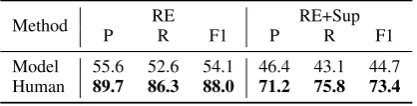
Method RE RE+Sup
P R F1 P R F1
Model 55.6 52.6 54.1 46.4 43.1 44.7 Human 89.7 86.3 88.0 71.2 75.8 73.4
Table 5: Human performance (%).
document-level RE. Context-Aware achieves com-petitive performance, however, it cannot signifi-cantly outperform other neural models. It indi-cates that it is beneficial to consider the associa-tion of multiple relaassocia-tions in document-level RE, whereas the current models are not capable of uti-lizing inter-relation information well.
Human Performance. To assess human
[image:7.595.313.522.258.311.2]Performance v.s. Supporting Evidence Types.
Document-level RE requires synthesizing infor-mation from multiple supporting sentences. To investigate the difficulty of synthesizing informa-tion from different types of supporting evidence, we devide the12,332relation instances in devel-opment set into three disjoint subsets: (1)6,115
relation instances with only one supporting sen-tence (denoted as single); (2) 1,062 relation in-stances with multiple supporting sentences and the entity pair co-occur in at least one support-ing sentence (denoted as mix); (3) 4,668 rela-tion instances with multiple supporting sentences and the entity pair do not co-occur in any sup-porting sentence, which means they can only be extracted from multiple supporting sentences (de-noted asmultiple). It should be noted that when a model predicts a wrong relation, we do not know which sentences have been used as supporting ev-idence, thus the predicted relation instance cannot be classified into the aforementioned subsets and computing precision is infeasible. Therefore, we only report recall of the RE model for each sub-set, which is 51.1% for single, 49.4% for mix, and46.6%formultiple. This indicates that while multiple supporting sentences inmixmay provide complementary information, it is challenging to effectively synthesize the rich global information. Moreover, the poor performance onmultiple sug-gests that RE models still struggle in extracting inter-sentence relations.
Feature Ablations. We conduct feature abla-tion studies on the BiLSTM model to investigate the contribution of different features in document-level RE, including entity types, coreference infor-mation, and the relative distance between entities (Eq. 1). Table 6 shows that the aforementioned features all have a contribution to the performance. Specifically, entity types contribute most due to their constraint on viable relation types. Coref-erence information and the relative distance be-tween entities are also important for synthesizing information from multiple named entity mentions. This indicates that it is important for RE systems to leverage rich information at document level.
Supporting Evidence Prediction. We propose a new task to predict the supporting evidence for re-lation instances. On the one hand, jointly predict-ing the evidence provides better explainability. On the other hand, identifying supporting evidence and reasoning relational facts from text are
nat-Setting Ign F1 Ign AUC F1 AUC
BiLSTM 45.12 40.93 50.95 50.27
- entity type 42.59 37.82 48.67 47.27 - coreference 43.46 38.35 49.35 47.50 - distance 43.98 38.96 50.21 48.48 - all features 40.18 33.82 46.54 43.23
Table 6: Feature ablations on dev set (%).
urally dual tasks with potential mutual enhance-ment. We design two supporting evidence predic-tion methods: (1) Heuristic predictor. We imple-ment a simple heuristic-based model that consid-ers all sentences containing the head or tail entity as supporting evidence. (2) Neural predictor. We also design a neural supporting evidence predic-tor. Given an entity pair and a predicted relation, sentences are first transformed into input represen-tations by the concatenation of word embeddings and position embeddings, and then fed into a BiL-STM encoder for contextual representations. In-spired by Yang et al.(2018), we concatenate the output of the BiLSTM at the first and last posi-tions with a trainable relation embedding to obtain a sentence’s representation, which is used to pre-dict whether the sentence is adopted as support-ing evidence for the given relation instance. As Table 7 shows, the neural predictor significantly outperforms heuristic-based baseline in predicting supporting evidence, which indicates the potential of RE models in joint relation and supporting evi-dence prediction.
Method Dev Test
Heuristic predictor 36.21 36.76 Neural predictor 44.07 43.85
Table 7: Performance of joint relation and supporting evidence prediction in F1 measurement (%).
6 Related Work
A variety of datasets have been constructed for RE in recent years, which have greatly promoted the development of RE systems. Hendrickx et al.
(2010),Doddington et al.(2004) andWalker et al.
(2006) build human-annotated RE datasets with relatively limited relation types and instances.
Riedel et al. (2010) automatically construct RE dataset by aligning plain text to KB via distant supervision, which suffers from wrong labeling problem. Zhang et al. (2017) and Han et al.
(2018b) further combine external recommenda-tions with human annotation to build large-scale high-quality datasets. However, these RE datasets limit relations to single sentences.
As documents provide richer information than sentences, moving research from sentence level to document level is a popular trend for many areas, including document-level event extrac-tion (Walker et al., 2006;Mitamura et al., 2015,
2017), fact extraction and verification (Thorne et al., 2018), reading comprehension (Nguyen et al., 2016; Joshi et al., 2017; Lai et al., 2017), sentiment classification (Pang and Lee,2004; Pret-tenhofer and Stein,2010), summarization ( Nalla-pati et al.,2016) and machine translation (Zhang et al.,2018). Recently, some document-level RE datasets have also been constructed. However, these datasets are either constructed via distant supervision (Quirk and Poon, 2017; Peng et al.,
2017) with inevitable wrong labeling problem, or limited in specific domain (Li et al., 2016; Peng et al.,2017). In contrast, DocRED is constructed by crowd-workers with rich information, and is not limited in any specific domain, which makes it suitable to train and evaluate general-purpose document-level RE systems.
7 Conclusion
To promote RE systems from sentence level to document level, we present DocRED, a large-scale document-level RE dataset that features the data size, the requirement for reading and reasoning over multiple sentences, and the distantly super-vised data offered for facilitating the development of weakly supervised document-level RE. Exper-iments show that human performance is signifi-cantly higher than RE baseline models, which sug-gests ample opportunity for future improvement.
8 Acknowledgement
This work is supported by the National Key Re-search and Development Program of China (No. 2018YFB1004503), the National Natural Science Foundation of China (NSFC No. 61572273) and China Association for Science and Technology (2016QNRC001). This work is also supported by the Pattern Recognition Center, WeChat AI, Ten-cent Inc. Han is also supported by 2018 TenTen-cent Rhino-Bird Elite Training Program.
References
Rui Cai, Xiaodong Zhang, and Houfeng Wang. 2016.
Bidirectional recurrent convolutional neural network for relation classification. InProceedings of ACL, pages 756–765.
Fenia Christopoulou, Makoto Miwa, and Sophia Ana-niadou. 2018. A walk-based model on entity graphs for relation extraction. In Proceedings of ACL, pages 81–88.
Jacob Devlin, Ming-Wei Chang, Kenton Lee, and Kristina Toutanova. 2019. BERT: pre-training of deep bidirectional transformers for language under-standing. InProceedings of NAACL-HLT.
George Doddington, Alexis Mitchell, Mark Przybocki, Lance Ramshaw, Stephanie Strassel, and Ralph Weischedel. 2004. The automatic content extraction (ACE) program-tasks, data, and evaluation. In Pro-ceedings of LREC, pages 837–840.
Fredo Erxleben, Michael G¨unther, Markus Kr¨otzsch, Julian Mendez, and Denny Vrandecic. 2014. Intro-ducing wikidata to the linked data web. In Proceed-ings of ISWC, pages 50–65.
Paolo Ferragina and Ugo Scaiella. 2010. TAGME: on-the-fly annotation of short text fragments (by wikipedia entities). InProceedings of CIKM, pages 1625–1628.
Xu Han, Pengfei Yu, Zhiyuan Liu, Maosong Sun, and Peng Li. 2018a. Hierarchical relation extraction with coarse-to-fine grained attention. In Proceed-ings of EMNLP, pages 2236–2245.
Xu Han, Hao Zhu, Pengfei Yu, Ziyun Wang, Yuan Yao, Zhiyuan Liu, and Maosong Sun. 2018b. FewRel: A large-scale supervised few-shot relation classifica-tion dataset with state-of-the-art evaluaclassifica-tion. In Pro-ceedings of EMNLP, pages 4803–4809.
Sepp Hochreiter and J¨urgen Schmidhuber. 1997. Long short-term memory. Neural Computation, 9:1735– 1780.
Raphael Hoffmann, Congle Zhang, Xiao Ling, Luke Zettlemoyer, and Daniel S. Weld. 2011.
Knowledge-based weak supervision for information extraction of overlapping relations. InProceedings of ACL, pages 541–550.
Mandar Joshi, Eunsol Choi, Daniel Weld, and Luke Zettlemoyer. 2017. TriviaQA: A large scale dis-tantly supervised challenge dataset for reading com-prehension. In Proceedings of ACL, pages 1601– 1611.
Guokun Lai, Qizhe Xie, Hanxiao Liu, Yiming Yang, and Eduard Hovy. 2017. RACE: Large-scale read-ing comprehension dataset from examinations. In
Proceedings of EMNLP, pages 785–794.
Omer Levy, Minjoon Seo, Eunsol Choi, and Luke Zettlemoyer. 2017. Zero-shot relation extraction via reading comprehension. InProceedings of CoNLL, pages 333–342.
Jiao Li, Yueping Sun, Robin J. Johnson, Daniela Sci-aky, Chih-Hsuan Wei, Robert Leaman, Allan Peter Davis, Carolyn J. Mattingly, Thomas C. Wiegers, and Zhiyong Lu. 2016. BioCreative V CDR task corpus: a resource for chemical disease relation ex-traction.Database, pages 1–10.
Yankai Lin, Shiqi Shen, Zhiyuan Liu, Huanbo Luan, and Maosong Sun. 2016. Neural relation extraction with selective attention over instances. In Proceed-ings of ACL, pages 2124–2133.
Mike Mintz, Steven Bills, Rion Snow, and Daniel Ju-rafsky. 2009.Distant supervision for relation extrac-tion without labeled data. In Proceedings of ACL, pages 1003–1011.
Teruko Mitamura, Zhengzhong Liu, and Eduard H. Hovy. 2015. Overview of TAC KBP 2015 event nugget track. InProceedings of TAC, pages 16–17.
Teruko Mitamura, Zhengzhong Liu, and Eduard H. Hovy. 2017. Events detection, coreference and se-quencing: What’s next? overview of the TAC KBP 2017 event track. InProceedings of TAC.
Ramesh Nallapati, Bowen Zhou, C´ıcero Nogueira dos Santos, C¸ aglar G¨ulc¸ehre, and Bing Xiang. 2016.
Abstractive text summarization using sequence-to-sequence rnns and beyond. In Proceedings of CoNLL, pages 280–290.
Tri Nguyen, Mir Rosenberg, Xia Song, Jianfeng Gao, Saurabh Tiwary, Rangan Majumder, and Li Deng. 2016. MS MARCO: A human generated machine reading comprehension dataset. InProceedings of NIPS, the Workshop on Cognitive Computation.
Bo Pang and Lillian Lee. 2004. A sentimental educa-tion: Sentiment analysis using subjectivity summa-rization based on minimum cuts. InProceedings of ACL, pages 271–278.
Nanyun Peng, Hoifung Poon, Chris Quirk, Kristina Toutanova, and Wen-tau Yih. 2017. Cross-sentence n-ary relation extraction with graph LSTMs. TACL, 5:101–115.
Jeffrey Pennington, Richard Socher, and Christopher Manning. 2014. Glove: Global vectors for word representation. In Proceedings of EMNLP, pages 1532–1543.
Peter Prettenhofer and Benno Stein. 2010. Cross-language text classification using structural corre-spondence learning. InProceedings of ACL, pages 1118–1127.
Pengda Qin, Weiran Xu, and William Yang Wang. 2018. Robust distant supervision relation extraction via deep reinforcement learning. InProceedings of ACL, pages 2137–2147.
Chris Quirk and Hoifung Poon. 2017. Distant super-vision for relation extraction beyond the sentence boundary. In Proceedings of EACL, pages 1171– 1182.
Sebastian Riedel, Limin Yao, and Andrew McCallum. 2010. Modeling relations and their mentions with-out labeled text. InProceedings of ECML-PKDD, pages 148–163.
Cicero dos Santos, Bing Xiang, and Bowen Zhou. 2015. Classifying relations by ranking with convo-lutional neural networks. InProceedings of ACL-IJCNLP, pages 626–634.
Richard Socher, Brody Huval, Christopher D. Man-ning, and Andrew Y. Ng. 2012. Semantic composi-tionality through recursive matrix-vector spaces. In
Proceedings of EMNLP-CoNLL, pages 1201–1211.
Daniil Sorokin and Iryna Gurevych. 2017. Context-aware representations for knowledge base relation extraction. InProceedings of EMNLP, pages 1784– 1789.
Mihai Surdeanu, Julie Tibshirani, Ramesh Nallapati, and Christopher D. Manning. 2012. Multi-instance multi-label learning for relation extraction. In Pro-ceedings of EMNLP-CoNLL, pages 455–465.
Kumutha Swampillai and Mark Stevenson. 2010.
Inter-sentential relations in information extraction corpora. In Proceedings of LREC, pages 2637– 2641.
James Thorne, Andreas Vlachos, Christos Christodoulopoulos, and Arpit Mittal. 2018.
Erik F Tjong Kim Sang and Fien De Meulder. 2003. Introduction to the conll-2003 shared task: language-independent named entity recognition. In
Proceedings of NAACL-HLT.
Patrick Verga, Emma Strubell, and Andrew McCallum. 2018. Simultaneously self-attending to all mentions for full-abstract biological relation extraction. In
Proceedings of NAACL-HLT, pages 872–884.
Denny Vrandeˇci´c and Markus Kr¨otzsch. 2014. Wiki-data: a free collaborative knowledgebase. Commu-nications of the ACM.
Christopher Walker, Stephanie Strassel, Julie Medero, and Kazuaki Maeda. 2006. ACE 2005 multilin-gual training corpus. Linguistic Data Consortium, Philadelphia, 57.
Yi Wu, David Bamman, and Stuart Russell. 2017. Ad-versarial training for relation extraction. In Proceed-ings of EMNLP, pages 1778–1783.
Minguang Xiao and Cong Liu. 2016. Semantic rela-tion classificarela-tion via hierarchical recurrent neural network with attention. InProceedings of COLING 2016, pages 1254–1263.
Zhilin Yang, Peng Qi, Saizheng Zhang, Yoshua Ben-gio, William W. Cohen, Ruslan Salakhutdinov, and Christopher D. Manning. 2018. Hotpotqa: A dataset for diverse, explainable multi-hop question answer-ing. InProceedings of EMNLP, pages 2369–2380.
Daojian Zeng, Kang Liu, Yubo Chen, and Jun Zhao. 2015. Distant supervision for relation extraction via piecewise convolutional neural networks. In Pro-ceedings of EMNLP, pages 1753–1762.
Daojian Zeng, Kang Liu, Siwei Lai, Guangyou Zhou, and Jun Zhao. 2014. Relation classification via con-volutional deep neural network. InProceedings of COLING, pages 2335–2344.
Jiacheng Zhang, Huanbo Luan, Maosong Sun, Feifei Zhai, Jingfang Xu, Min Zhang, and Yang Liu. 2018.
Improving the transformer translation model with document-level context. InProceedings of EMNLP, pages 533–542.
A Appendices
A.1 Experimental Details
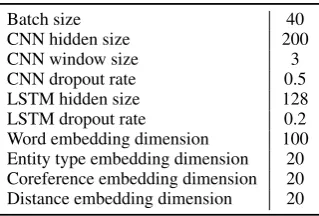
In this section, we provide more details of our ex-periments. To fairly compare the results of dif-ferent models, we optimized all baselines using Adam, with learning rate of0.001,β1 = 0.9,β1 = 0.999. The other experimental hyper-parameters used in our experiments are shown in Table8. Ad-ditionally, due to the document-level distance be-tween entities, distances are first divided into sev-eral bins{1,2, ..,2k}, where each bin is associated with a trainable distance embedding.
Batch size 40
CNN hidden size 200
CNN window size 3
CNN dropout rate 0.5
LSTM hidden size 128
LSTM dropout rate 0.2
[image:12.595.102.262.256.364.2]Word embedding dimension 100 Entity type embedding dimension 20 Coreference embedding dimension 20 Distance embedding dimension 20
Table 8: Hyper-parameter settings.
A.2 Types of Named Entities
In this paper, we adapt the existing types of named entities used in Tjong Kim Sang and De Meul-der (2003) to better serve DocRED. These types include “Person (PER)”, “Organization (ORG)”, “Location (LOC)”, “Time (TIME)”, “Number (NUM)”, and “other types (MISC)”. The types of named entities in DocRED and their covered con-tents are shown in Table9.
Types Content
PER People, including fictional
ORG Companies, universities, institutions, politi-cal or religious groups, etc.
Geographically defined locations, including mountains, waters, etc.
LOC
Politically defined locations, including countries, cities, states, streets, etc.
Facilities, including buildings, museums, stadiums, hospitals, factories, airports, etc. TIME Absolute or relative dates or periods. NUM Percents, money, quantities
Products, including vehicles, weapons, etc.
MISC
Events, including elections, battles, sporting events, etc.
Laws, cases, languages, etc
Table 9: Types of named entities in DocRED.
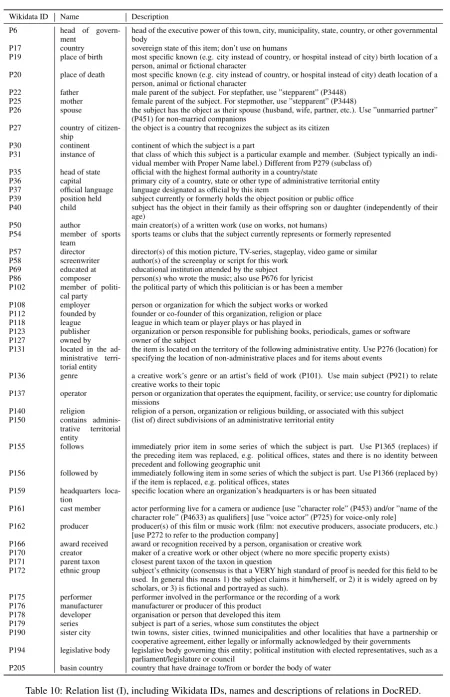
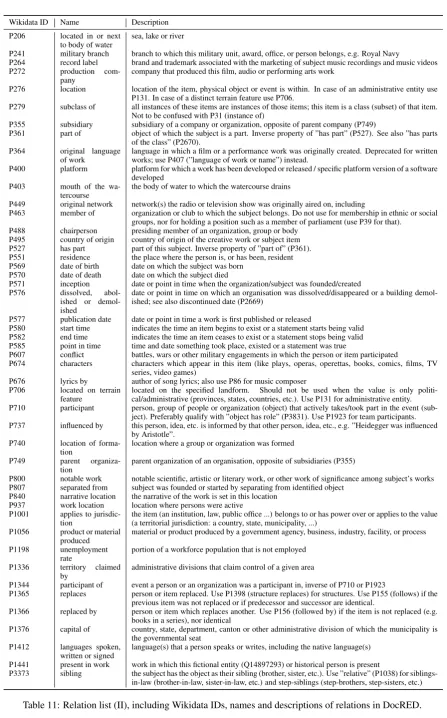
A.3 List of Relations
[image:12.595.78.287.554.727.2]Wikidata ID Name Description
P6 head of
govern-ment
head of the executive power of this town, city, municipality, state, country, or other governmental body
P17 country sovereign state of this item; don’t use on humans
P19 place of birth most specific known (e.g. city instead of country, or hospital instead of city) birth location of a person, animal or fictional character
P20 place of death most specific known (e.g. city instead of country, or hospital instead of city) death location of a person, animal or fictional character
P22 father male parent of the subject. For stepfather, use ”stepparent” (P3448) P25 mother female parent of the subject. For stepmother, use ”stepparent” (P3448)
P26 spouse the subject has the object as their spouse (husband, wife, partner, etc.). Use ”unmarried partner” (P451) for non-married companions
P27 country of citizen-ship
the object is a country that recognizes the subject as its citizen
P30 continent continent of which the subject is a part
P31 instance of that class of which this subject is a particular example and member. (Subject typically an indi-vidual member with Proper Name label.) Different from P279 (subclass of)
P35 head of state official with the highest formal authority in a country/state
P36 capital primary city of a country, state or other type of administrative territorial entity P37 official language language designated as official by this item
P39 position held subject currently or formerly holds the object position or public office
P40 child subject has the object in their family as their offspring son or daughter (independently of their age)
P50 author main creator(s) of a written work (use on works, not humans)
P54 member of sports
team
sports teams or clubs that the subject currently represents or formerly represented
P57 director director(s) of this motion picture, TV-series, stageplay, video game or similar P58 screenwriter author(s) of the screenplay or script for this work
P69 educated at educational institution attended by the subject
P86 composer person(s) who wrote the music; also use P676 for lyricist P102 member of
politi-cal party
the political party of which this politician is or has been a member
P108 employer person or organization for which the subject works or worked P112 founded by founder or co-founder of this organization, religion or place P118 league league in which team or player plays or has played in
P123 publisher organization or person responsible for publishing books, periodicals, games or software
P127 owned by owner of the subject
P131 located in the ad-ministrative terri-torial entity
the item is located on the territory of the following administrative entity. Use P276 (location) for specifying the location of non-administrative places and for items about events
P136 genre a creative work’s genre or an artist’s field of work (P101). Use main subject (P921) to relate creative works to their topic
P137 operator person or organization that operates the equipment, facility, or service; use country for diplomatic missions
P140 religion religion of a person, organization or religious building, or associated with this subject P150 contains
adminis-trative territorial entity
(list of) direct subdivisions of an administrative territorial entity
P155 follows immediately prior item in some series of which the subject is part. Use P1365 (replaces) if the preceding item was replaced, e.g. political offices, states and there is no identity between precedent and following geographic unit
P156 followed by immediately following item in some series of which the subject is part. Use P1366 (replaced by) if the item is replaced, e.g. political offices, states
P159 headquarters loca-tion
specific location where an organization’s headquarters is or has been situated
P161 cast member actor performing live for a camera or audience [use ”character role” (P453) and/or ”name of the character role” (P4633) as qualifiers] [use ”voice actor” (P725) for voice-only role]
P162 producer producer(s) of this film or music work (film: not executive producers, associate producers, etc.) [use P272 to refer to the production company]
P166 award received award or recognition received by a person, organisation or creative work P170 creator maker of a creative work or other object (where no more specific property exists) P171 parent taxon closest parent taxon of the taxon in question
P172 ethnic group subject’s ethnicity (consensus is that a VERY high standard of proof is needed for this field to be used. In general this means 1) the subject claims it him/herself, or 2) it is widely agreed on by scholars, or 3) is fictional and portrayed as such).
P175 performer performer involved in the performance or the recording of a work P176 manufacturer manufacturer or producer of this product
P178 developer organisation or person that developed this item
P179 series subject is part of a series, whose sum constitutes the object
P190 sister city twin towns, sister cities, twinned municipalities and other localities that have a partnership or cooperative agreement, either legally or informally acknowledged by their governments P194 legislative body legislative body governing this entity; political institution with elected representatives, such as a
parliament/legislature or council
[image:13.595.75.526.59.757.2]P205 basin country country that have drainage to/from or border the body of water
Wikidata ID Name Description
P206 located in or next to body of water
sea, lake or river
P241 military branch branch to which this military unit, award, office, or person belongs, e.g. Royal Navy
P264 record label brand and trademark associated with the marketing of subject music recordings and music videos
P272 production
com-pany
company that produced this film, audio or performing arts work
P276 location location of the item, physical object or event is within. In case of an administrative entity use P131. In case of a distinct terrain feature use P706.
P279 subclass of all instances of these items are instances of those items; this item is a class (subset) of that item. Not to be confused with P31 (instance of)
P355 subsidiary subsidiary of a company or organization, opposite of parent company (P749)
P361 part of object of which the subject is a part. Inverse property of ”has part” (P527). See also ”has parts of the class” (P2670).
P364 original language of work
language in which a film or a performance work was originally created. Deprecated for written works; use P407 (”language of work or name”) instead.
P400 platform platform for which a work has been developed or released / specific platform version of a software developed
P403 mouth of the
wa-tercourse
the body of water to which the watercourse drains
P449 original network network(s) the radio or television show was originally aired on, including
P463 member of organization or club to which the subject belongs. Do not use for membership in ethnic or social groups, nor for holding a position such as a member of parliament (use P39 for that).
P488 chairperson presiding member of an organization, group or body P495 country of origin country of origin of the creative work or subject item P527 has part part of this subject. Inverse property of ”part of” (P361). P551 residence the place where the person is, or has been, resident P569 date of birth date on which the subject was born
P570 date of death date on which the subject died
P571 inception date or point in time when the organization/subject was founded/created
P576 dissolved,
abol-ished or demol-ished
date or point in time on which an organisation was dissolved/disappeared or a building demol-ished; see also discontinued date (P2669)
P577 publication date date or point in time a work is first published or released
P580 start time indicates the time an item begins to exist or a statement starts being valid P582 end time indicates the time an item ceases to exist or a statement stops being valid P585 point in time time and date something took place, existed or a statement was true
P607 conflict battles, wars or other military engagements in which the person or item participated
P674 characters characters which appear in this item (like plays, operas, operettas, books, comics, films, TV series, video games)
P676 lyrics by author of song lyrics; also use P86 for music composer P706 located on terrain
feature
located on the specified landform. Should not be used when the value is only politi-cal/administrative (provinces, states, countries, etc.). Use P131 for administrative entity. P710 participant person, group of people or organization (object) that actively takes/took part in the event
(sub-ject). Preferably qualify with ”object has role” (P3831). Use P1923 for team participants. P737 influenced by this person, idea, etc. is informed by that other person, idea, etc., e.g. ”Heidegger was influenced
by Aristotle”. P740 location of
forma-tion
location where a group or organization was formed
P749 parent
organiza-tion
parent organization of an organisation, opposite of subsidiaries (P355)
P800 notable work notable scientific, artistic or literary work, or other work of significance among subject’s works P807 separated from subject was founded or started by separating from identified object
P840 narrative location the narrative of the work is set in this location P937 work location location where persons were active
P1001 applies to jurisdic-tion
the item (an institution, law, public office ...) belongs to or has power over or applies to the value (a territorial jurisdiction: a country, state, municipality, ...)
P1056 product or material produced
material or product produced by a government agency, business, industry, facility, or process
P1198 unemployment
rate
portion of a workforce population that is not employed
P1336 territory claimed by
administrative divisions that claim control of a given area
P1344 participant of event a person or an organization was a participant in, inverse of P710 or P1923
P1365 replaces person or item replaced. Use P1398 (structure replaces) for structures. Use P155 (follows) if the previous item was not replaced or if predecessor and successor are identical.
P1366 replaced by person or item which replaces another. Use P156 (followed by) if the item is not replaced (e.g. books in a series), nor identical
P1376 capital of country, state, department, canton or other administrative division of which the municipality is the governmental seat
P1412 languages spoken, written or signed
language(s) that a person speaks or writes, including the native language(s)
P1441 present in work work in which this fictional entity (Q14897293) or historical person is present
[image:14.595.76.524.49.768.2]P3373 sibling the subject has the object as their sibling (brother, sister, etc.). Use ”relative” (P1038) for siblings-in-law (brother-siblings-in-law, sister-siblings-in-law, etc.) and step-siblings (step-brothers, step-sisters, etc.)