Proceedings of the 55th Annual Meeting of the Association for Computational Linguistics, pages 430–439 Proceedings of the 55th Annual Meeting of the Association for Computational Linguistics, pages 430–439
Learning with Noise: Enhance Distantly Supervised Relation Extraction
with Dynamic Transition Matrix
Bingfeng Luo1, Yansong Feng∗1, Zheng Wang2, Zhanxing Zhu3, Songfang Huang4, Rui Yan1 and Dongyan Zhao1
1ICST, Peking University, China
2School of Computing and Communications, Lancaster University, UK 3Peking University, China
4IBM China Research Lab, China
{bf luo,fengyansong,zhanxing.zhu,ruiyan,zhaody}@pku.edu.cn [email protected]
Abstract
Distant supervision significantly reduces human efforts in building training data for many classification tasks. While promis-ing, this technique often introduces noise to the generated training data, which can severely affect the model performance. In this paper, we take a deep look at the appli-cation of distant supervision in relation ex-traction. We show that the dynamic transi-tion matrix can effectively characterize the noise in the training data built by distant supervision. The transition matrix can be effectively trained using a novel curricu-lum learning based method without any di-rect supervision about the noise. We thor-oughly evaluate our approach under a wide range of extraction scenarios. Experimen-tal results show that our approach consis-tently improves the extraction results and outperforms the state-of-the-art in various evaluation scenarios.
1 Introduction
Distant supervision (DS) is rapidly emerging as a viable means for supporting various classification tasks – from relation extraction (Mintz et al.,2009) and sentiment classification (Go et al., 2009) to cross-lingual semantic analysis (Fang and Cohn,
2016). By using knowledge learned from seed ex-amples to label data, DS automatically prepares large scale training data for these tasks.
While promising, DS does not guarantee per-fect results and often introduces noise to the gener-ated data. In the context of relation extraction,DS works by considering sentences containing both the subject and object of a<subj,rel,obj>triple
as its supports. However, the generated data are not always perfect. For instance,DScould match the knowledge base (KB) triple,<Donald Trump,
born-in, New York>in false positive contexts
likeDonald Trump worked in New York City. Prior
works (Takamatsu et al.,2012;Ritter et al.,2013) show that DS often mistakenly labels real posi-tive instances as negaposi-tive (false negative) or versa vice (false positive), and there could be confu-sions among positive labels as well. These noises can severely affect training and lead to poorly-performing models.
Tackling the noisy data problem of DSis non-trivial, since there usually lacks of explicit super-vision to capture the noise. Previous works have tried to remove sentences containing unreliable syntactic patterns (Takamatsu et al.,2012), design new models to capture certain types of noise or aggregate multiple predictions under the
at-least-one assumption that at least one of the aligned
sentences supports the triple inKB(Riedel et al.,
2010; Surdeanu et al., 2012; Ritter et al., 2013;
Min et al., 2013). These approaches represent a substantial leap forward towards makingDSmore practical. however, are either tightly couple to cer-tain types of noise, or have to rely on manual rules to filter noise, thus unable to scale. Recent break-through in neural networks provides a new way to reduce the influence of incorrectly labeled data by aggregating multiple training instances atten-tively for relation classification, without explicitly characterizing the inherent noise (Lin et al.,2016;
Zeng et al.,2015). Although promising, modeling noise within neural network architectures is still in its early stage and much remains to be done.
In this paper, we aim to enhanceDSnoise mod-eling by providing the capability to explicitly char-acterize the noise in the DS-style training data
within neural networks architectures. We show that while noise is inevitable, it is possible to char-acterize the noise pattern in a unified framework along with its original classification objective. Our key insight is that theDS-style training data typi-cally contain useful clues about the noise pattern. For example, we can infer that since some peo-ple work in their birthplaces,DScould wrongly la-bel a training sentence describing a working place
as a born-in relation. Our novel approach to
noisy modeling is to use a dynamically-generated transition matrix for each training instance to (1) characterize the possibility that theDSlabeled re-lation is confused and (2) indicate its noise pat-tern. To tackle the challenge of no direct guidance over the noise pattern, we employ a curriculum learning based training method to gradually model the noise pattern over time, and utilize trace regu-larization to control the behavior of the transition matrix during training. Our approach is flexible – while it does not make any assumptions about the data quality, the algorithm can make effective use of the data-quality prior knowledge to guide the learning procedure when such clues are available. We apply our method to the relation extraction task and evaluate under various scenarios on two benchmark datasets. Experimental results show that our approach consistently improves both ex-traction settings, outperforming the state-of-the-art models in different settings.
Our work offers an effective way for tackling the noisy data problem of DS, making DS more practical at scale. Our main contributions are to (1) design adynamictransition matrix structure to characterize the noise introduced by DS, and (2) design a curriculum learning based framework to adaptively guide the training procedure to learn with noise.
2 Problem Definition
The task of distantly supervised relation extraction is to extract knowledge triples,<subj,rel,obj>,
from free text with the training data constructed by aligning existing KBtriples with a large cor-pus. Specifically, given a triple inKB, DSworks by first retrieving all the sentences containing both
subj andobj of the triple, and then constructing the training data by considering these sentences as support to the existence of the triple. This task can be conducted in both the sentence and the bag levels. The former takes a sentencescontaining
Encoder sentences embeddings
Prediction Noise Modeling
predicted distr.
transition matrix
Transformation
3 1
2
[image:2.595.309.528.66.109.2]4 Observed distr.
Figure 1: Overview of our approach
bothsubj andobj as input, and outputs the
rela-tion expressed by the sentence betweensubj and obj. The latter setting alleviates the noisy data problem by using theat-least-one assumptionthat at least one of the retrieved sentences containing bothsubjandobjsupports the<subj,rel,obj>
triple. It takes a bag of sentencesSas input where
each sentences ∈S contains both subjandobj,
and outputs the relation betweensubjandobj
ex-pressed by this bag.
3 Our approach
In order to deal with the noisy training data ob-tained throughDS, our approach follows four steps as depicted in Figure1. First, each input sentence is fed to a sentence encoder to generate an embed-ding vector. Our model then takes the sentence embeddings as input and produce a predicted re-lation distribution, p, for the input sentence (or the input sentence bag). At the same time, our model dynamically produces a transition matrix, T, which is used to characterize the noise pattern of sentence (or the bag). Finally, the predicted distribution is multiplied by the transition matrix to produce the observed relation distribution, o, which is used to match the noisy relation labels assigned by DS while the predicted relation dis-tribution p serves as output of our model during testing. One of the key challenges of our approach is on determining the element values of the transi-tion matrix, which will be described in Sectransi-tion4.
3.1 Sentence-level Modeling
Sentence Embedding and Prediction In this
work, we use a piecewise convolutional neural net-work (Zeng et al., 2015) for sentence encoding, but other sentence embedding models can also be used. We feed the sentence embedding to a full connection layer, and usesoftmaxto generate the predicted relation distribution,p.
Noise Modeling First, each sentence embedding
transition matrixT, for each sentence:
Tij =
exp(wT
ijxn+b) P|C|
j=1exp(wijTxn+b)
(1)
whereTij is the conditional probability for the in-put sentence to be labeled as relation j by DS, givenias the true relation,bis a scalar bias,|C|is
the number of relations, wij is the weight vector characterizing the confusion betweeniandj.
Here, we dynamically produce a transition ma-trix,T, specifically for each sentence, but with the parameters (wij) shared across the dataset. By do-ing so, we are able to adaptively characterize the noise pattern for each sentence, with a few pa-rameters only. In contrast, one could also pro-duce a global transition matrix for all sentences, with much less computation, where one need not to computeTon the fly (see Section6.1).
Observed Distribution When we characterize
the noise in a sentence with a transition matrixT, if its true relation isi, we can assume thatimight
be erroneously labeled as relation j by DS with probabilityTij. We can therefore capture the ob-served relation distribution, o, by multiplying T and the predicted relation distribution,p:
o=TT ·p (2)
whereois then normalized to ensurePioi = 1. Rather than using the predicted distribution p to directly match the relation labeled byDS(Zeng et al.,2015;Lin et al.,2016), here we utilizeoto match the noisy labels during training and still use pas output during testing, which actually captures the procedure of how the noisy label is produced and thus protectspfrom the noise.
3.2 Bag Level Modeling
Bag Embedding and Prediction One of the key
challenges for bag level model is how to aggre-gate the embeddings of individual sentences into the bag level. In this work, we experiment two methods, namely average and attention aggrega-tion (Lin et al.,2016). The former calculates the bag embedding,s, by averaging the embeddings of each sentence, and then feed it to asoftmax classi-fier for relation classification.
The attention aggregation calculates an atten-tion value,aij, for each sentenceiin the bag with
respect to each relation j, and aggregates to the bag level assj, by the following equations1:
sj = n X
i
aijxi; aij =
exp(xTi rj)
Pn
i0exp(xTi0rj) (3)
where xi is the embedding of sentence i, n the
number of sentences in the bag, andrj is the ran-domly initialized embedding for relationj. In
sim-ilar spirit to (Lin et al., 2016), the resulting bag embeddingsj is fed to asoftmaxclassifier to pre-dict the probability of relationjfor the given bag.
Noise Modeling Since the transition matrix
ad-dresses the transition probability with respect to each true relation, the attention mechanism ap-pears to be a natural fit for calculating the tran-sition matrix in bag level. Similar to attention ag-gregation above, we calculate the bag embedding with respect to each relation using Equation3, but with a separate set of relation embeddingsr0j. We then calculate the transition matrix,T, by:
Tij =
exp(sTi r0j+bi)
P|C|
j=1exp(sTi r0j+bi)
(4)
wheresi is the bag embedding regarding relation
i, andr0j is the embedding for relationj.
4 Curriculum Learning based Training
One of the key challenges of this work is on how to train and produce the transition matrix to model the noise in the training data without any direct guidance and human involvement. A straightforward solution is to directly align the ob-served distribution, o, with respect to the noisy labels by minimizing the sum of the two terms:
CrossEntropy(o) +Regularization. However,
doing so does not guarantee that the prediction dis-tribution,p, will match the true relation distribu-tion. The problem is at the beginning of the train-ing, we have no prior knowledge about the noise pattern, thus, bothTandpare less reliable, mak-ing the trainmak-ing procedure be likely to trap into some poor local optimum. Therefore, we require a technique to guide our model to gradually adapt to the noisy training data, e.g., learning something simple first, and then trying to deal with noises.
1While (Lin et al.,2016) use bilinear function to
calcu-lateaij, we simply use dot product since we find these two
Fortunately, this is exactly what curriculum learning can do. The idea of curriculum learn-ing (Bengio et al.,2009) is simple: starting with the easiest aspect of a task, and leveling up the dif-ficulty gradually, which fits well to our problem. We thus employ a curriculum learning framework to guide our model to gradually learn how to char-acterize the noise. Another advantage is to avoid falling into poor local optimum.
With curriculum learning, our approach pro-vides the flexibility to combine prior knowledge of noise, e.g., splitting a dataset into reliable and less reliable subsets, to improve the effectiveness of the transition matrix and better model the noise.
4.1 Trace Regularization
Before proceeding to training details, we first dis-cuss how we characterize the noise level of the data by controlling the trace of its transition ma-trix. Intuitively, if the noise is small, the transition matrixTwill tend to become an identity matrix, i.e., given a set of annotated training sentences, the observed relations and their true relations are al-most identical. Since each row of T sums to 1, the similarity between the transition matrix and the identity matrix can be represented by its trace,
trace(T). The larger thetrace(T) is, the larger
the diagonal elements are, and the more similar the transition matrix T is to the identity matrix, indicating a lower level of noise. Therefore, we can characterize the noise pattern by controlling the expected value oftrace(T)in the form of
reg-ularization. For example, we will expect a larger
trace(T)for reliable data, but a smallertrace(T)
for less reliable data. Another advantage of em-ploying trace regularization is that it could help re-duce the model complexity and avoid overfitting.
4.2 Training
To tackle the challenge of no direct guidance over the noise patterns, we implement a curriculum learning based training method to first train the model without considerations for noise. In other words, we first focus on the loss from the predic-tion distribupredic-tionp, and then take the noise model-ing into account gradually along the trainmodel-ing pro-cess, i.e., gradually increasing the importance of the loss from the observed distributionowhile de-creasing the importance ofp. In this way, the pre-diction branch is roughly trained before the model managing to characterize the noise, thus avoids be-ing stuck into poor local optimum. We thus design
to minimize the following loss function:
L=
N X
i=1
−((1−α)log(oiyi) +αlog(piyi))
−βtrace(Ti)
(5)
where 0<α≤1 andβ>0 are two weighting param-eters,yi is the relation assigned byDSfor thei-th instance,Nthe total number of training instances, oiyiis the probability that the observed relation for
thei-th instance isyi, andpiyiis the probability to
predict relationyifor thei-th instance.
Initially, we setα=1, and train our model com-pletely by minimizing the loss from the prediction distributionp. That is, we do not expect to model the noise, but focus on the prediction branch at this time. As the training progresses, the predic-tion branch gradually learns the basic predicpredic-tion ability. We then decrease α and β by 0<ρ<1
(α∗=ραandβ∗=ρβ) everyτ epochs, i.e., learning
more about the noise from the observed distribu-tionoand allowing a relatively smallertrace(T)
to accommodate more noise. The motivation be-hind is to put more and more effort on learning the noise pattern as the training proceeds, with the essence of curriculum learning. This gradu-ally learning paradigm significantly distinguishes from prior work on noise modeling forDSseen to date. Moreover, as such a method does not rely on any extra assumptions, it can serve as our default training method forT.
With Prior Knowledge of Data Quality On the
other hand, if we happen to have prior knowledge about which part of the training data is more re-liable and which is less rere-liable, we can utilize this knowledge as guidance to design the curricu-lum. Specifically, we can build a curriculum by first training the prediction branch on the reliable data for several epochs, and then adding the less reliable data to train the full model. In this way, the prediction branch is roughly trained before ex-posed to more noisy data, thus is less likely to fall into poor local optimum.
Furthermore, we can take better control of the training procedure with trace regularization, e.g., encouraging largertrace(T)for reliable
sub-set and smallertrace(T) for less relaibale ones.
Specifically, we propose to minimize:
L=
M X
m=1
Nm X
i=1
−log(omi,ymi)−βmtrace(T
mi)
whereβmis the regularization weight for them-th data subset,Mis the total number of subsets,Nm the number of instances inm-th subset, andTmi,
ymi andomi,ymi are the transition matrix, the
re-lation labeled byDSand the observed probability of this relation for thei-th training instance in the m-th subset, respectively. Note that different from
Equation5, this loss function does not need to ini-tiate training by minimizing the loss regarding the prediction distributionp, since one can easily start by learning from the most reliable split first.
We also use trace regularization for the most re-liable subset, since there are still some noise anno-tations inevitably appearing in this split. Specifi-cally, we expect itstrace(T)to be large (using a
positiveβ) so that the elements ofTwill be cen-tralized to the diagonal andTwill be more similar to the identity matrix. As for the less reliable sub-set, we expect the trace(T) to be small (using a
negative β) so that the elements of the transition
matrix will be diffusive andTwill be less similar to the identity matrix. In other words, the transi-tion matrix is encouraged to characterize the noise. Note that this loss function only works for sen-tence level models. For bag level models, since reliable and less reliable sentences are all aggre-gated into a sentence bag, we can not determine which bag is reliable and which is not. However, bag level models can still build a curriculum by changing the content of a bag, e.g., keeping re-liable sentences in the bag first, then gradually adding less reliable ones, and training with Equa-tion5, which could benefit from the prior knowl-edge of data quality as well.
5 Evaluation Methodology
Our experiments aim to answer two main ques-tions: (1) is it possible to model the noise in the training data generated through DS, even when there is no prior knowledge to guide us? and (2) whether the prior knowledge of data quality can help our approach better handle the noise.
We apply our approach to both sentence level and bag level extraction models, and evaluate in the situations where we do not have prior knowl-edge of the data quality as well as where such prior knowledge is available.
5.1 Datasets
We evaluate our approach on two datasets.
TIMERE We build TIMERE by using DS to align time-related Wikidata (Vrandeˇci´c and Kr¨otzsch, 2014) KB triples to Wikipedia text. It contains 278,141 sentences with 12 types of re-lations between an entity mention and a time ex-pression. We choose to use time-related relations because time expressions speak for themselves in terms of reliability. That is, given a KB triple
<e, rel, t>and its aligned sentences, the
finer-grained the time expression tappears in the
sen-tence, the more likely the sentence supports the existence of this triple. For example, a sentence containing both Alphabet andOctober-2-2015 is very likely to express theinception-time of
Alphabet, while a sentence containing both
Al-phabet and 2015 could instead talk about many
events, e.g., releasing financial report of 2015, hir-ing a new CEO, etc. Ushir-ing this heuristics, we can split the dataset into 3 subsets according to different granularities of the time expressions in-volved, indicating different levels of reliability. Our criteria for determining the reliability are as follows. Instances with full date expressions, i.e.,
Year-Month-Day, can be seen as the most
re-liable data, while those with partial date expres-sions, e.g., Month-YearandYear-Only, are considered as less reliable. Negative data are con-structed heuristically that anyentity-timepairs in a sentence without corresponding triples in Wiki-data are treated as negative Wiki-data. During training, we can access 184,579 negative and 77,777 pos-itive sentences, including 22,214 reliable, 2,094 and 53,469 less reliable ones. The validation set and test set are randomly sampled from the reli-able (full-date) data for relatively fair evaluations and contains 2,776, 2,771 positive sentences and 5,143, 5,095 negative sentences, respectively.
ENTITYRE is a widely-used entity relation
5.2 Experimental Setup
Hyper-parameters We use 200 convolution
kernels with widow size 3. During training, we use stochastic gradient descend (SGD) with batch size 20. The learning rates for sentence-level and bag-level models are 0.1 and 0.01, respectively.
Sentence level experiments are performed on TIMERE, using 100-d word embeddings pre-trained using GloVe (Pennington et al.,2014) on Wikipedia and Gigaword (Parker et al.,2011), and 20-d vectors for distance embeddings. Each of the three subsets of TIMERE is added after the previ-ous phase has run for 15 epochs. The trace regu-larization weights areβ1= 0.01,β2 =−0.01and
β3 = −0.1, respectively, from the reliable to the
most unreliable, with the ratio ofβ3 andβ2 fixed
to 10 or 5 when tuning.
Bag level experiments are performed on both TIMERE and ENTITYRE. For TIMERE, we use the same parameters as above. For ENTITYRE, we use 50-d word embeddings pre-trained on the NYT corpus using word2vec (Mikolov et al.,
2013), and 5-d vectors for distance embedding. For both datasets,αandβ in Eq.5are initialized
to 1 and 0.1, respectively. We tried various decay rates, {0.95, 0.9, 0.8}, and steps,{3, 5, 8}. We found that using a decay rate of 0.9 with step of 5 gives best performance in most cases.
Evaluation Metric The performance is reported
using the precision-recall (PR) curve, which is a standard evaluation metric in relation extraction. Specifically, the extraction results are first ranked decreasingly by their confidence scores, then the precision and recall are calculated by setting the threshold to be the score of each extraction result one by one.
Naming Conventions We evaluate our
ap-proach under a wide range of settings for sentence level (sent ) and bag level (bag ) models: (1) mix: trained on all three subsets of TIMERE mixed together; (2) reliable: trained using the reliable subset of TIMERE only; (3) PR: trained with prior knowledge of annotation qual-ity, i.e., starting from the reliable data and then adding the unreliable data; (4) TM: trained with dynamic transition matrix; (5) GTM: trained with a global transition matrix. In bag level, we also in-vestigate the performance of average aggregation ( avg) and attention aggregation ( att).
0 . 0 0 . 2 0 . 4 0 . 6 0 . 8 0 . 8 0
0 . 8 5 0 . 9 0 0 . 9 5 1 . 0 0
s e n t _ m i x _ T M s e n t _ P R _ s e g 2 _ T M s e n t _ P R _ T M
Pr
ec
is
io
n
R e c a l l
[image:6.595.314.517.64.212.2]s e n t _ m i x s e n t _ r e l i a b l e s e n t _ P R
Figure 2: Sentence Level Results on TIMERE
6 Experimental Results
6.1 Performance on TIMERE
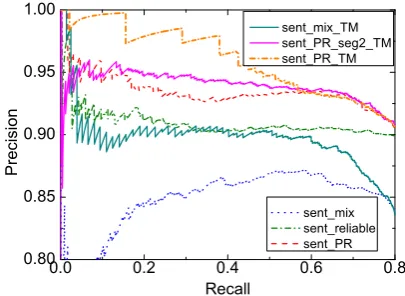
Sentence Level Models The results of sentence
level models on TIMERE are shown in Figure
2. We can see that mixing all subsets together
(sent mix) gives the worst performance,
signif-icantly worse than using the reliable subset only
(sent reliable). This suggests the noisy
na-ture of the training data obtained throughDSand properly dealing with the noise is the key for DS for a wider range of applications. When getting help from our dynamic transition matrix, the model (sent mix TM) significantly improves
sent mix, delivering the same level of
perfor-mance assent reliablein most cases. This suggests that our transition matrix can help to mit-igate the bad influence of noisy training instances. Now let us consider thePRscenario where one can build a curriculum by first training on the reli-able subset, then gradually moving to both relireli-able and less reliable data. We can see that, this simple curriculum learning based model (sent PR) fur-ther outperformssent reliablesignificantly, indicating that the curriculum learning framework not only reduces the effect of noise, but also helps the model learn from noisy data. When apply-ing the transition matrix approach into this cur-riculum learning framework using one reliable subset and one unreliable subset generated by mixing our two less reliable subsets, our model
(sent PR seg2 TM) further improvessent PR
by utilizing the dynamic transition matrix to model the noise. It is not surprising that when we use all three subsets separately, our model
(sent PR TM) significantly outperforms all other
0 . 0 0 . 2 0 . 4 0 . 6 0 . 8 0 . 9 0
0 . 9 2 0 . 9 4 0 . 9 6 0 . 9 8 1 . 0 0
Pr
ec
is
io
n
R e c a l l
b a g _ a t t _ m i x b a g _ a t t _ r e l i a b l e b a g _ a t t _ P R b a g _ a t t _ m i x _ T M b a g _ a t t _ P R _ T M
(a) Attention Aggregation
0 . 0 0 . 2 0 . 4 0 . 6 0 . 8 0 . 9 0
0 . 9 2 0 . 9 4 0 . 9 6 0 . 9 8 1 . 0 0
Pr
ec
is
io
n
R e c a l l
b a g _ a v g _ m i x b a g _ a v g _ r e l i a b l e b a g _ a v g _ P R b a g _ a v g _ m i x _ T M b a g _ a v g _ P R _ T M
[image:7.595.93.510.69.230.2](b) Average Aggregation
Figure 3: Bag Level Results on TIMERE
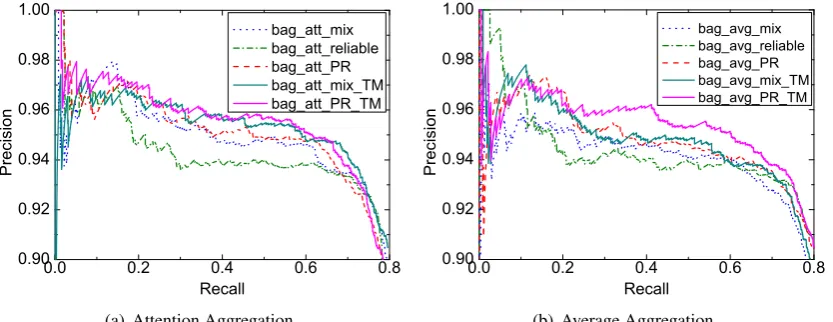
Bag Level Models In this setting, we first look
at the performance of the bag level models with attention aggregation. The results are shown in Figure 3(a). Consider the comparison between the model trained on the reliable subset only
(bag att reliable) and the one trained on
the mixed dataset (bag att mix). In contrast to the sentence level,bag att mixoutperforms
bag att reliableby a large margin, because
bag att mixhas taken theat-least-one
assump-tion into consideration through the attention ag-gregation mechanism (Eq.3), which can be seen as a denoising step within the bag. This may also be the reason that when we introduce either our dynamic transition matrix (bag att mix TM) or the curriculum of using prior knowledge of data quality (bag att PR) into the bag level models, the improvement regardingbag att mixis not as significant as in the sentence level.
However, when we apply our dynamic transi-tion matrix into the curriculum built upon prior knowledge of data quality (bag att PR TM), the performance gets further improved. This hap-pens especially in the high precision part com-pared tobag att PR. We also note that the bag level’s at-least-one assumption does not always hold, and there are still false negative and false positive problems. Therefore, using our transi-tion matrix approach with or without prior knowl-edge of data quality, i.e., bag att mix TMand
bag att PR TM, both improve the performance,
andbag att PR TMperforms slightly better.
The results of bag level models with average ag-gregation are shown in Figure3(b), where the rel-ative ranking of various settings is similar to those with attention aggregation. A notable difference
0 . 0 0 . 2 0 . 4 0 . 6 0 . 8 0 . 9 0
0 . 9 2 0 . 9 4 0 . 9 6 0 . 9 8 1 . 0 0
s e n t _ P R s e n t _ P R _ G T M s e n t _ P R _ T M b a g _ a t t _ P R b a g _ a t t _ P R _ G T M b a g _ a t t _ P R _ T M
Pr
ec
is
io
n
[image:7.595.314.516.268.420.2]R e c a l l
Figure 4: Global TM v.s. Dynamic TM
is that bothbag avg PRandbag avg mix TM improvebag avg mix by a larger margin com-pared to that in the attention aggregation setting. The reason may be that the average aggregation mechanism is not as good as the attention aggre-gation in denoising within the bag, which leaves more space for our transition matrix approach or curriculum learning with prior knowledge to im-prove. Also note thatbag avg reliable per-forms best in the very-low-recall region but worst in general. This is because that it ranks higher the sentences expressing eitherbirth-date or
death-date, the simplest but the most
com-mon relations in the dataset, but fails to learn other relations with limited or noisy training instances, given its relatively simple aggregation strategy.
Global v.s. Dynamic Transition Matrix We
dynam-ically generating a transition matrix for each da-tum, we first initialize an identity matrix T0 ∈
R|C|×|C|, where|C|is the number of relations (in-cludingno-relation). Then the global transi-tion matrixTis built by applyingsoftmaxto each row ofT0so thatPjTij = 1:
Tij =
eTij0 P|C|
j=1eT
0
ij (7)
whereTij andTij0 are the elements in theithrow andjthcolumn ofTandT0. The element values of matrixT0are also updated via backpropagation during training. As shown in Figure4, using one global transition matrix ( GTM) is also beneficial and improves both the sentence level (sent PR) and bag level (bag att PR) models. However, since the global transition matrix only captures the global noise pattern, it fails to characterize individ-uals with subtle differences, resulting in a perfor-mance drop compared to the dynamic one ( TM).
Case Study We find our transition matrix
method tends to obtain more significant im-provement on noisier relations. For
exam-ple, time of spacecraft landing is noisier than
time of spacecraft launch since compared to the
launching of a spacecraft, there are fewer sen-tences containing the landing time of a space-craft that talks directly about the landing. Instead, many of these sentences tend to talk about the activities of the crew. Our sent PR TM model improves the F1 of time of spacecraft landing
andtime of spacecraft launch oversent PR by
9.09% and 2.78%, respectively. The transition matrix makes more significant improvement on
time of spacecraft landing since there are more
noisy sentences for our method to handle, which results in more significant improvement on the quality of the training data.
6.2 Performance on ENTITYRE
We evaluate our bag level models on ENTI -TYRE. As shown in Figure 5, it is not surpris-ing that the basic model with attention aggrega-tion (att) significantly outperforms the average one (avg), where att in our bag embedding is similar in spirit to (Lin et al.,2016), which has re-ported the-state-of-the-art performance on ENTI -TYRE. When injected with our transition matrix approach, bothatt TMandavg TMclearly out-perform their basic versions.
0 . 0 0 . 1 0 . 2 0 . 3 0 . 4 0 . 2
0 . 3 0 . 4 0 . 5 0 . 6 0 . 7 0 . 8 0 . 9 1 . 0
Pr
ec
is
io
n
R e c a l l
[image:8.595.310.508.67.240.2]a v g a t t a v g _ T M a t t _ T M
Figure 5: Results on ENTITYRE
Method P@R 10 P@R 20 P@R 30
Mintz 39.88 28.55 16.81
MultiR 60.94 36.41
-MIML 60.75 33.82
-avg 58.04 51.25 42.45
avg TM 58.56 52.35 43.59
att 61.51 56.36 45.63
att TM 67.24 57.61 44.90
Table 1: Comparison with feature-based methods. P@R 10/20/30 refers to the precision when recall equals 10%, 20% and 30%.
Similar to the situations in TIMERE, sinceatt has taken theat-least-one assumptioninto account through its attention-based bag embedding mech-anism, thus the improvement made byatt TMis not as large as byavg TM.
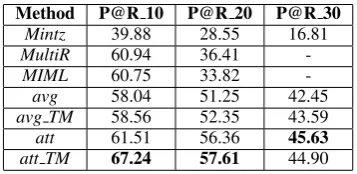
We also include the comparison with three feature-based methods: Mintz (Mintz et al.,
2009) is a multiclass logistic regression model;
MultiR(Hoffmann et al.,2011) is a probabilistic
graphical model that can handle overlapping rela-tions;MIML(Surdeanu et al.,2012) is also a prob-abilistic graphical model but operates in the multi-instance multi-label paradigm. As shown in Ta-ble1, although traditional feature-based methods have reasonable results in the low recall region, their performances drop quickly as the recall goes up, and MultiR and MIML did not even reach the 30% recall. This indicates that, while human-designed featurs can effectively capture certain re-lation patterns, their coverage is relatively low. On the other hand, neural network models have more stable performance across different recalls,
andatt TMperforms generally better than other
[image:8.595.326.505.261.348.2]7 Related Work
In addition to relation extraction, distant supervi-sion (DS) is shown to be effective in generating training data for various NLP tasks, e.g., tweet sentiment classification (Go et al., 2009), tweet named entity classifying (Ritter et al.,2011), etc. However, these early applications of DS do not well address the issue of data noise.
In relation extraction (RE), recent works have been proposed to reduce the influence of wrongly labeled data. The work presented by (Takamatsu et al., 2012) removes potential noisy sentences by identifying bad syntactic patterns at the pre-processing stage. (Xu et al., 2013) use pseudo-relevance feedback to find possible false nega-tive data. (Riedel et al.,2010) make the
at-least-one assumptionand propose to alleviate the noise
problem by considering RE as a multi-instance classification problem. Following this assumption, people further improves the original paradigm us-ing probabilistic graphic models (Hoffmann et al.,
2011;Surdeanu et al.,2012), and neural network methods (Zeng et al.,2015). Recently, (Lin et al.,
2016) propose to use attention mechanism to re-duce the noise within a sentence bag. Instead of characterizing the noise, these approaches only aim to alleviate the effect of noise.
Theat-least-one assumptionis often too strong
in practice, and there are still chances that the sen-tence bag may be false positive or false negative. Thus it is important to model the noise pattern to guide the learning procedure. (Ritter et al.,2013) and (Min et al., 2013) try to employ a set of la-tent variables to represent the true relation. Our approach differs from them in two aspects. We tar-get noise modeling in neutral networks while they target probabilistic graphic models. We further ad-vance their models by providing the capability to model the fine-grained transition from the true re-lation to the observed, and the flexibility to com-bine indirect guidance.
Outside of NLP, various methods have been proposed in computer vision to model the data noise using neural networks. (Sukhbaatar et al.,
2015) utilize a global transition matrix with weight decay to transform the true label distribution to the observed. (Reed et al.,2014) use a hidden layer to represent the true label distribution but try to force it to predict both the noisy label and the in-put. (Chen and Gupta,2015;Xiao et al.,2015) first estimate the transition matrix on a clean dataset
and apply to the noisy data. Our model shares similar spirit with (Misra et al.,2016) in that we all dynamically generate a transition matrix for each training instance, but, instead of using vanilla SGD, we train our model with a novel curriculum learning training framework with trace regulariza-tion to control the behavior of transiregulariza-tion matrix. In NLP, the only work in neural-network-based noise modeling is to use one single global transi-tion matrix to model the noise introduced by cross-lingual projection of training data (Fang and Cohn,
2016). Our work advances them through gener-ating a transition matrix dynamically for each in-stance, to avoid using one single component to characterize both reliable and unreliable data.
8 Conclusions
In this paper, we investigate the noise problem in-herent in theDS-style training data. We argue that the data speak for themselves by providing use-ful clues to reveal their noise patterns. We thus propose a novel transition matrix based method to dynamically characterize the noise underlying such training data in a unified framework along the original prediction objective. One of our key inno-vations is to exploit a curriculum learning based training method to gradually learn to model the underlying noise pattern without direct guidance, and to provide the flexibility to exploit any prior knowledge of the data quality to further improve the effectiveness of the transition matrix. We eval-uate our approach in two learning settings of the distantly supervised relation extraction. The ex-perimental results show that the proposed method can better characterize the underlying noise and consistently outperform start-of-the-art extraction models under various scenarios.
Acknowledgement
References
Yoshua Bengio, J´erˆome Louradour, Ronan Collobert, and Jason Weston. 2009. Curriculum learning. In
ICML. ACM, pages 41–48.
Xinlei Chen and Abhinav Gupta. 2015. Webly super-vised learning of convolutional networks. InICCV. pages 1431–1439.
Meng Fang and Trevor Cohn. 2016. Learning when to trust distant supervision: An application to low-resource pos tagging using cross-lingual projection. InCONLL. pages 178–186.
Alec Go, Richa Bhayani, and Lei Huang. 2009. Twit-ter sentiment classification using distant supervision.
CS224N Project Report, Stanford1(12).
Raphael Hoffmann, Congle Zhang, Xiao Ling, Luke Zettlemoyer, and Daniel S Weld. 2011. Knowledge-based weak supervision for information extraction
of overlapping relations. In Proceedings of ACL.
pages 541–550.
Yankai Lin, Shiqi Shen, Zhiyuan Liu, Huanbo Luan, and Maosong Sun. 2016. Neural relation extraction with selective attention over instances. InACL. vol-ume 1, pages 2124–2133.
Tomas Mikolov, Ilya Sutskever, Kai Chen, Greg S Cor-rado, and Jeff Dean. 2013. Distributed representa-tions of words and phrases and their compositional-ity. InNIPS. pages 3111–3119.
Bonan Min, Ralph Grishman, Li Wan, Chang Wang, and David Gondek. 2013. Distant supervision for relation extraction with an incomplete knowledge
base. InHLT-NAACL. pages 777–782.
Mike Mintz, Steven Bills, Rion Snow, and Dan Ju-rafsky. 2009. Distant supervision for relation ex-traction without labeled data. InACL. pages 1003– 1011.
Ishan Misra, C Lawrence Zitnick, Margaret Mitchell, and Ross Girshick. 2016. Seeing through the human reporting bias: Visual classifiers from noisy human-centric labels. InCVPR. pages 2930–2939.
Robert Parker, David Graff, Junbo Kong, Ke Chen, and Kazuaki Maeda. 2011. English gigaword fifth edi-tion, linguistic data consortium. Technical report, Linguistic Data Consortium, Philadelphia.
Jeffrey Pennington, Richard Socher, and Christopher D Manning. 2014. Glove: Global vectors for word
representation. InEMNLP. volume 14, pages 1532–
1543.
Scott Reed, Honglak Lee, Dragomir Anguelov, Chris-tian Szegedy, Dumitru Erhan, and Andrew Rabi-novich. 2014. Training deep neural networks on
noisy labels with bootstrapping. arXiv preprint
arXiv:1412.6596.
Sebastian Riedel, Limin Yao, and Andrew McCallum. 2010. Modeling relations and their mentions
with-out labeled text. In Joint European Conference
on Machine Learning and Knowledge Discovery in Databases. Springer, pages 148–163.
Alan Ritter, Alan Ritter, Sam Clark, Oren Etzioni, et al. 2011. Named entity recognition in tweets: an
exper-imental study. InEMNLP. Association for
Compu-tational Linguistics, pages 1524–1534.
Alan Ritter, Luke Zettlemoyer, Mausam, and Oren Et-zioni. 2013. Modeling missing data in distant
super-vision for information extraction. TACL1:367–378.
Sainbayar Sukhbaatar, Joan Bruna, Manohar Paluri, Lubomir Bourdev, and Rob Fergus. 2015. Training convolutional networks with noisy labels. InICLR.
Mihai Surdeanu, Julie Tibshirani, Ramesh Nallapati, and Christopher D Manning. 2012. Multi-instance
multi-label learning for relation extraction. In
EMNLP-CoNLL. pages 455–465.
Shingo Takamatsu, Issei Sato, and Hiroshi Nakagawa. 2012. Reducing wrong labels in distant supervision for relation extraction. InACL. pages 721–729.
Denny Vrandeˇci´c and Markus Kr¨otzsch. 2014.
Wiki-data: a free collaborative knowledgebase.
Commu-nications of the ACM57(10):78–85.
Tong Xiao, Tian Xia, Yi Yang, Chang Huang, and Xi-aogang Wang. 2015. Learning from massive noisy
labeled data for image classification. In CVPR.
pages 2691–2699.
Wei Xu, Raphael Hoffmann, Le Zhao, and Ralph Gr-ishman. 2013. Filling knowledge base gaps for distant supervision of relation extraction. In ACL. pages 665–670.
Daojian Zeng, Kang Liu, Yubo Chen, and Jun Zhao. 2015. Distant supervision for relation extraction via piecewise convolutional neural networks. In