Cross-Lingual Word Representations via Spectral Graph Embeddings
Takamasa Oshikiri, Kazuki Fukui, Hidetoshi Shimodaira
Division of Mathematical Science, Graduate School of Engineering Science Osaka University, Japan
1-3 Machikaneyama-cho, Toyonaka, Osaka
{oshikiri, fukui, shimo}@sigmath.es.osaka-u.ac.jp
Abstract
Cross-lingual word embeddings are used for cross-lingual information retrieval or domain adaptations. In this paper, we extend Eigenwords, spectral monolin-gual word embeddings based on canoni-cal correlation analysis (CCA), to cross-lingual settings with sentence-alignment. For incorporating cross-lingual informa-tion, CCA is replaced with its general-ization based on the spectral graph em-beddings. The proposed method, which we refer to as Cross-Lingual Eigenwords (CL-Eigenwords), is fast and scalable for computing distributed representations of words via eigenvalue decomposition. Nu-merical experiments of English-Spanish word translation tasks show that CL-Eigenwords is competitive with state-of-the-art cross-lingual word embedding methods.
1 Introduction
There have been many methods proposed for word embeddings. Neural network based models are popular, and one of the most major approaches is the skip-gram model (Mikolov et al., 2013b), and some extended methods have also been devel-oped (Levy and Goldberg, 2014a; Lazaridou et al., 2015). The skip-gram model has many interest-ing syntactic and semantic properties, and it can be seen as the factorization of a word-context ma-trix whose elements represent pointwise mutual information (Levy and Goldberg, 2014b). How-ever, word embeddings based on neural networks (without neat implementation) can be very slow in general, and it is sometimes difficult to under-stand how they work. Recently, a simple spectral method, called Eigenwords, for word embeddings
+ +
+
+ +
+ +
+
+
+ +
+
+ +
+
+ +
+ +
+
+
+ +
+
−10 −5 0 5 10
−6
−4
−2
0
2
4
6
8
PC1
PC2
italia suecia
grecia austria
francia
finlandia
italy sweden
greece austria
france
finland
roma
estocolmo atenasviena parís
helsinki
rome stockholm athensvienna paris
[image:1.595.305.517.228.409.2]helsinki
Figure 1: PCA projections (PC1 and PC2) of CL-Eigenwords of countries (bold) and its capitals (italic) in Spanish (red) and English (blue). Word vectors of the two languages match quite well, although they are computed using sentence-level alignment without knowing word-level alignment. 100-dim word representations are used for PCA computation.
is proposed (Dhillon et al., 2012; Dhillon et al., 2015). It is based on canonical correlation anal-ysis (CCA) for computing word vectors by maxi-mizing correlations between words and their con-texts. Eigenword algorithms are fast and scalable, yet giving good performance comparable to neural network approaches for capturing the meaning of words from their context.
The skip-gram model, originally proposed for monolingual corpora, has been extended to cross-lingual settings. Given two vector representa-tions of two languages, a linear transformation be-tween the two spaces is trained from a set of word pairs for translation task (Mikolov et al., 2013a), while other researchers use CCA for learning lin-ear projections to a common vector space where
translation pairs are strongly correlated (Faruqui and Dyer, 2014). These methods require word-alignment in the training data, while some multi-lingual corpora have only coarse information such as a set of sentence pairs or paragraph pairs. Re-cently, extensions of the skip-gram model requir-ing only sentence-alignment have been developed by introducing cross-lingual losses in the objective of the original models (Gouws et al., 2015; Coul-mance et al., 2015; Shi et al., 2015).
In this paper, instead of the skip-gram model, we extend Eigenwords (Dhillon et al., 2015) to cross-lingual settings with sentence-alignment. Our main idea is to replace CCA, which is applica-ble to only two different kinds of data, with a gen-eralized method (Nori et al., 2012; Shimodaira, 2016) based on spectral graph embeddings (Yan et al., 2007) so that the Eigenwords can deal with two or more languages for cross-lingual word embeddings. Our proposed method, referred to as Cross-Lingual Eigenwords (CL-Eigenwords), requires only sentence-alignment for capturing cross-lingual relationships. The method is very simple in mathematics as well as computation; it involves a generalized eigenvalue problem, which can be solved by fast and scalable algorithms such as the randomized eigenvalue decomposi-tion (Halko et al., 2011).
Fig. 1 shows an illustrative example of cross-lingual word vectors obtained by CL-Eigenwords. Although only sentence-alignment is available in the corpus, word-level translation is automatically captured in the vector representations; the same words (countries and capitals) in the two lan-guages are placed in close proximity to each other; greeceis close togreciaandromeis close toroma. In addition, the same kinds of relationships be-tween word pairs share similar directions in the vector space; the direction from swedento stock-holmis nearly parallel to the direction fromfinland tohelsinki.
We evaluate the word vectors obtained by our method on the English-Spanish cross-lingual translation task and compare the results with those of state-of-the-art methods, showing that our pro-posed method is competitive with those existing methods. We use Europarl corpus for learning the vector representation of words. Although the ex-periments in this paper are conducted using bilin-gual corpus, our method can be easily applied to three or more languages.
2 Eigenwords (One Step CCA)
CCA (Hotelling, 1936) is a multivariate analysis method for finding optimal projections of two sets of data vectors by maximizing the correlations. Applying CCA to pairs of raw word vector and raw context vector, Eigenword algorithms attempt to find low dimensional vector representations of words (Dhillon et al., 2012). Here we explain the simplest version of Eigenwords called One Step CCA (OSCCA).
We have monolingual corpus consisting ofT to-kens; (ti)i=1,...,T, and the vocabulary consisting
of V word types; {vi}i=1,...,V. Each token ti is
drawn from this vocabulary. We define word ma-trixV∈ {0,1}T×V whosei-th row encodes token
ti by 1-of-V representation; thej-th element is 1
if the word type oftiisvj, 0 otherwise.
Let h be the size of context window. We de-fine context matrixC ∈ {0,1}T×2hV whosei-th row represents the surrounding context of token
ti with concatenated 1-of-V encoded vectors of
(ti−h, . . . , ti−1, ti+1, . . . , ti+h).
We apply CCA toT pairs of row vectors ofV and C. The objective function of CCA is con-structed using V⊤V, V⊤C, C⊤C which
rep-resent occurrence and co-occurrence counts of words and contexts. In Eigenwords, however, we use CV V ∈ RV+×V, CV C ∈ RV+×2hV, CCC ∈
R2hV+ ×2hV with the following preprocessing of these matrices before constructing the objective function. First, centering-process ofV andCis omitted, and off-diagonal elements of C⊤C are
ignored for simplifying the computation of in-verse matrices. Second, we take the square root of the elements of these matrices for “squash-ing” the heavy-tailed word count distributions. Fi-nally, we obtain vector representations of words asC−1/2V V (u1, . . . ,uK), whereu1, . . . ,uK ∈ RV
are left singular vectors ofC−1/2V V CV C C−1/2CC cor-responding to theK largest singular values. The computation of SVD is fast and scalable using recent idea of random projections (Halko et al., 2011).
3 Cross-Lingual Eigenwords
In this section, we introduce Cross-Lingual
Eigenwords (CL-Eigenwords), a novel method
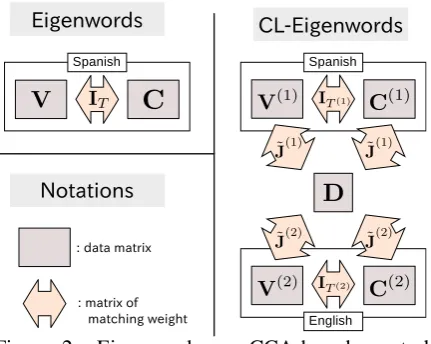
Figure 2: Eigenwords are CCA-based spectral monolingual word embeddings. CL-Eigenwords are CDMCA-based spectral cross-lingual word embeddings, where the two (or more) languages are linked by sentence-alignment.
CL-Eigenwords (withL= 2) are shown in Fig. 2. In the same way as the monolingual Eigen-words, we denote the word matrix and the context matrix forℓ-th language byV(ℓ)∈RT(ℓ)×V(ℓ)
+ and
C(ℓ) ∈RT(ℓ)×2h(ℓ)V(ℓ)
+ respectively, whereV(ℓ)is
the size of vocabulary, T(ℓ) is the number of
to-kens, andh(ℓ)is the size of context window. There
are D sentences (or paragraphs) in the multilin-gual corpora, and each token is included in one of the sentences. The sentence-alignment is repre-sented in the matrixJ(ℓ) ∈RT(ℓ)×D
+ whose(i, j
)-elementJi,j(ℓ)is set to 1 if thei-th tokent(ℓ)i ofℓ-th language corpus comes from the j-th sentence or 0 otherwise. We also define document matrix D whosej-th row encodesj-th sentence by 1-of-D
representation;D =ID, whereID representsD
-dimensional identity matrix.
The goal of CL-Eigenwords is to construct vec-tor representations of words of two (or more) languages from multilingual corpora at the same time. This problem is formulated as an example of Cross-Domain Matching Correlation Analysis (CDMCA) (Shimodaira, 2016), which deals with many-to-many relationships between data vectors from multiple sources. CDMCA is based on the spectral graph embeddings (Yan et al., 2007), and attempts to find optimal linear projections of data vectors so that associated transformed vec-tors are placed in close proximity to each other. The strength of association between two vectors is specified by a nonnegative real value called matching weight. Since CDMCA includes CCA
and a variant of Latent Semantic Indexing (LSI) (Deerwester et al., 1990) as special cases, CL-Eigenwords can be interpreted as LSI-equipped Eigenwords (See Appendix).
In CL-Eigenwords, the data vectors are given as v(ℓ)i ,c(ℓ)i ,di, namely, the i-th row vectors of
V(ℓ),C(ℓ),D, respectively. The matching weights
between row vectors of V(ℓ) and C(ℓ) are
speci-fied by the identity matrix IT(ℓ) because the data
vectors are in one-to-one correspondence. On the other hand, the matching weights between row vectors of V(ℓ) andD as well as those between
C(ℓ) andD are specified by ˜J(ℓ) = b(ℓ)J(ℓ), the
sentence-alignment matrix multiplied by a con-stantb(ℓ). Then we will find linear transformation
matricesA(ℓ)V ,A(ℓ)C ,AD,(ℓ= 1,2, . . . , L)toK
-dimensional vector space by minimizing the ob-jective function
L ∑
ℓ=1 T(ℓ)
∑
i=1
∥v(ℓ)i A(ℓ)V −c(ℓ)i A(ℓ)C ∥22
+∑L
ℓ=1 T(ℓ)
∑
i=1 D ∑
j=1
˜
Ji,j(ℓ)∥v(ℓ)i AV(ℓ)−djAD∥22
+∑L
ℓ=1 T(ℓ)
∑
i=1 D ∑
j=1
˜
Ji,j(ℓ)∥c(ℓ)i AC(ℓ)−djAD∥22 (1)
with a scale constraint for projection matrices. Note that the first term in (1) is equivalent to that of CCA between words and contexts, namely the objective of monolingual Eigenwords, and there-fore word vectors of two languages are obtained as row vectors ofA(ℓ)V (ℓ= 1,2, . . . , L).
Hereafter, we assumeL= 2for notational sim-plicity. A generalization to the case L > 2 is straightforward; redefineX,W, Abelow by re-peating the submatrices, such asV(ℓ)andC(ℓ), for
Ltimes. For solving the optimization problem, we define
X=
V(1) O O O O
O C(1) O O O
O O V(2) O O
O O O C(2) O
O O O O D
,
W=
O IT(1) O O J˜(1)
IT(1) O O O J˜(1)
O O O IT(2) J˜(2)
O O IT(2) O J˜(2)
˜
J(1)⊤ J˜(1)⊤ ˜J(2)⊤ J˜(2)⊤ O ,
[image:3.595.75.291.62.234.2]1 – 1000 1 – 1000 5001 – 6000 5001 – 6000 es→en en→es es→en en→es
Method Time [min] P@1 P@5 P@1 P@5 P@1 P@5 P@1 P@5
Edit distance - 29.1 37.8 20.6 34.4 28.5 40.0 26.4 33.5
BilBOWA (40 dim.) ∗4.6 46.7 59.6 43.6 56.4 44.6 53.6 49.4 58.7
BilBOWA (100 dim.) ∗7.5 43.3 55.9 36.8 49.0 43.6 53.3 48.6 57.9
BilBOWA (200 dim.) ∗11.6 38.8 52.2 29.7 43.2 43.3 52.0 47.3 57.2
[image:4.595.97.501.61.193.2]CL-LSI (40 dim.) 1.4 45.9 54.8 46.9 55.8 31.6 38.5 40.7 45.1 CL-LSI (100 dim.) 2.4 51.7 62.9 48.5 61.8 41.6 49.8 42.8 49.1 CL-LSI (200 dim.) 5.1 55.2 66.5 50.7 65.5 45.5 54.7 45.6 51.9 CL-Eigenwords(40 dim.) 9.5 54.7 66.2 53.3 65.7 40.3 49.2 44.7 50.0 CL-Eigenwords(100 dim.) 19.6 57.7 71.3 54.9 70.3 47.9 59.0 49.3 54.6 CL-Eigenwords(200 dim.) 37.5 58.7 72.4 56.2 72.2 51.6 62.4 50.6 55.7
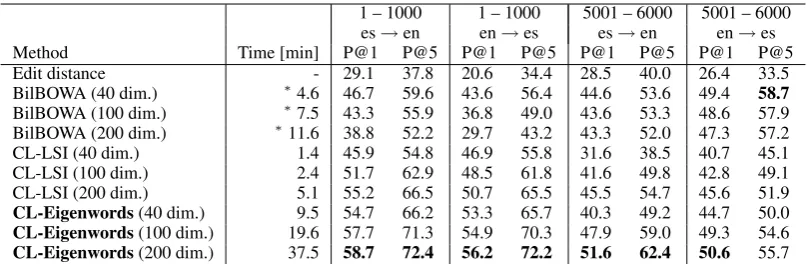
Table 1: Computational times (in minutes) and word translation accuracies (in percent, higher is better) evaluated by Precision@n using the 1,000 test words (the 1st to 1,000th most frequent words or the 5,001st to 6,000th most frequent words). Shown are for Spanish (es) to English (en) translation and for English (en) to Spanish (es) translation. ∗ BilBOWA is executed on 3 threads, while CL-LSI and
CL-Eigenwords are executed on a single thread.
Also defineH =X⊤WX,G=X⊤MX,M =
diag(W1). Then the optimization problem (1) is equivalent to maximizing Tr(A⊤HA) with a
scale constraint A⊤GA = I
K. Following the
Eigenwords implementation (Dhillon et al., 2015), we replaceH,GwithH,Gby ignoring the non-diagonal elements ofGand taking the square root of elements in H,G. The optimization problem is solved as a generalized eigenvalue problem, and the word representations, as well as those for con-texts and sentences, are obtained as row vectors ofAˆ = G−1/2(u
1, . . . ,uK), whereu1, . . . ,uK
are eigenvectors of (G−1/2)⊤HG−1/2 for theK
largest eigenvalues. We chooseK so that all the
K eigenvalues are positive. As in the case of monolingual Eigenwords, we can exploit fast im-plementations such as the randomized eigenvalue decomposition (Halko et al., 2011); our compu-tation in the experiments is only approximation based on the low-rank factorization with rank2K. For measuring similarities between two word vectors x,y ∈ RK, we use the weighted cosine
similarity
sim(x,y) = (∥x∥2· ∥y∥2)−1 K ∑
i=1
λixiyi,
whereλiis thei-th largest eigenvalue.
4 Experiments
The implementation of our method is available on GitHub1. Following the previous works (Mikolov et al., 2013a; Gouws et al., 2015), we use only
1https://github.com/shimo-lab/kadingir
the first 500K lines of English-Spanish sentence-aligned parallel corpus of Europarl (Koehn, 2005) for numerical experiments.
4.1 Word Translation Tasks
Experiments are performed in similar settings as the previous works based on the skip-gram model (Mikolov et al., 2013a; Gouws et al., 2015). We extract 1,000 test words with frequency rank 1–1000 or 5001–6000 from the source language, and translate these words to the target language using Google Translate, assuming they are the cor-rect translations. Then, we evaluate the transla-tion accuracies of each method with precision@n
as the fraction of correct translations for the test words being in the top-nwords of the target lan-guage returned by each method.
4.2 Baseline Systems
We compare CL-Eigenwords with the following three methods.
Edit distance Finding the nearest words
mea-sured by Levenshtein distance.
CL-LSI Cross-Language LSI (CL-LSI) (Littman
et al., 1998) is not originally for word embed-dings. However, since this method can be used for cross-lingual information retrieval, we select it as one of our baselines. For each language, we con-struct the term-document matrix of sizeV(ℓ)×D
whose (i, j)-element represents the frequency of
i-th word inj-th sentence. Then LSI is applied to the concatenated matrix of size(V(1)+V(2))×D.
BilBOWA BilBOWA (Gouws et al., 2015) is one
word embeddings based on the skip-gram model. We obtain vector representations of words using publicly available implementation.2
4.3 Results
In CL-Eigenwords, vocabulary size V(1) =
V(2) = 104, window size h(1) = h(2) = 2, the
constant b(1) = b(2) = 103. The
[image:5.595.327.504.59.109.2]dimensional-ity of vector representations is K = 40,100, or 200. Similarities of two vector representations are measured by the unweighted cosine similar-ity in CL-LSI and BilBOWA. Our experiments were performed on a CentOS 7.2 server with In-tel Xeon E5-2680 v3 CPU, 256GB of RAM and gcc 4.8.5. The computation times and the result accuracies of word translation tasks are shown in Table 1. We observe that CL-Eigenwords is com-petitive with BilBOWA and CL-LSI. In particu-lar, CL-Eigenwords performed very well for the most frequent words (ranks 1–1000) in this par-ticular parameter setting. Furthermore, the com-putation times of CL-Eigenwords are as short as those of BilBOWA for achieving similar accura-cies. Preliminary experiments also suggest that CL-Eigenwords works well for semi-supervised learning where sentence-alignment is specified only partially; the word translation accuracies are maintained well with aligned 240K lines and un-aligned 260K lines.
5 Conclusion
We proposed CL-Eigenwords for incorporating cross-lingual information into the monolingual Eigenwords. Although our method is simple, ex-perimental results of English-Spanish word trans-lation tasks show that the proposed method is com-petitive with other state-of-the-art cross-lingual methods.
Acknowledgments
This work was partially supported by grants from Japan Society for the Promotion of Science KAK-ENHI (24300106, 16H01547 and 16H02789) to HS.
Appendix
In this Appendix, we discuss the relationships be-tween CL-LSI and CL-Eigenwords.
[image:5.595.357.474.345.413.2]2https://github.com/gouwsmeister/ bilbowa
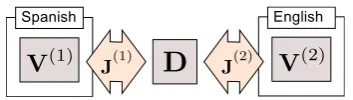
Figure 3: Cross-Language Latent Semantic Index-ing (CL-LSI) does not use the context information.
LetV(1),V(2),D,J(1),J(2)be those defined in
Section 3. In CL-LSI, we consider the truncated singular value decomposition of a word-document matrix
B=
(
V(1)⊤J(1)
V(2)⊤J(2)
)
≈AVΛKA⊤D
using the largestKsingular values. Then row vec-tors ofAV are the vector representations of words
of CL-LSI.
CL-LSI can also be interpreted as an eigenvalue decomposition ofH=X⊤WXwhere
X=
(
V(1) O O
O V(2) O
O O D
)
,
W=
(
O O J(1)
O O J(2)
J(1)⊤ J(2)⊤ O
)
are redefined from those in Section 3 by remov-ing submatrices related to contexts. The structure ofXandW is illustrated in Fig. 3. Similarly to CL-Eigenwords of Section 3, but ignoringG, we define A = (u1, . . . ,uK) with the eigenvectors
ofHfor the largestK eigenvaluesλ1, . . . , λK. It
then follows from
H=
(
O B B⊤ O
)
that A⊤ = 2−1/2(A⊤
V,A⊤D) with the same AV
andAD obtained by the truncated singular value
decomposition. The eigenvalues are the same as the singular values: diag(λ1, . . . , λK) = ΛK.
Therefore CL-LSI is interpreted as a variant of CL-Eigenwords without the context information.
References
Jocelyn Coulmance, Jean-Marc Marty, Guillaume Wenzek, and Amine Benhalloum. 2015.
Trans-gram, fast cross-lingual word-embeddings. In
Scott Deerwester, Susan T. Dumais, George W. Fur-nas, Thomas K. Landauer, and Richard Harshman.
1990. Indexing by latent semantic analysis.
Jour-nal of the American society for information science, 41(6):391.
Paramveer S. Dhillon, Jordan Rodu, Dean P. Foster, and Lyle H. Ungar. 2012. Two step cca: A new spectral method for estimating vector models of words. In John Langford and Joelle Pineau, ed-itors,Proceedings of the 29th International Confer-ence on Machine Learning (ICML-12), ICML ’12, pages 1551–1558, New York, NY, USA, July. Om-nipress.
Paramveer S. Dhillon, Dean P. Foster, and Lyle H. Un-gar. 2015. Eigenwords: Spectral word embeddings.
Journal of Machine Learning Research, 16:3035– 3078.
Manaal Faruqui and Chris Dyer. 2014. Improving vector space word representations using multilingual
correlation. InProceedings of the 14th Conference
of the European Chapter of the Association for Com-putational Linguistics, pages 462–471, Gothenburg, Sweden, April. Association for Computational Lin-guistics.
Stephan Gouws, Yoshua Bengio, and Greg Corrado. 2015. Bilbowa: Fast bilingual distributed
represen-tations without word alignments. In Proceedings
of the 32nd International Conference on Machine Learning, ICML 2015, Lille, France, 6-11 July 2015, pages 748–756.
Nathan Halko, Per-Gunnar Martinsson, and Joel A. Tropp. 2011. Finding structure with random-ness: Probabilistic algorithms for constructing
ap-proximate matrix decompositions. SIAM review,
53(2):217–288.
Harold Hotelling. 1936. Relations between two sets of variates. Biometrika, 28(3/4):321–377.
Philipp Koehn. 2005. Europarl: A Parallel Corpus
for Statistical Machine Translation. InConference
Proceedings: the tenth Machine Translation
Sum-mit, pages 79–86, Phuket, Thailand. AAMT.
Angeliki Lazaridou, The Nghia Pham, and Marco Ba-roni. 2015. Combining language and vision with a
multimodal skip-gram model. InProceedings of the
2015 Conference of the North American Chapter of the Association for Computational Linguistics: Hu-man Language Technologies, pages 153–163. Asso-ciation for Computational Linguistics.
Omer Levy and Yoav Goldberg. 2014a.
Dependency-based word embeddings. InProceedings of the 52nd
Annual Meeting of the Association for Computa-tional Linguistics (Volume 2: Short Papers), pages 302–308. Association for Computational Linguis-tics.
Omer Levy and Yoav Goldberg. 2014b. Neural word
embedding as implicit matrix factorization. In
Ad-vances in Neural Information Processing Systems, pages 2177–2185.
Michael L. Littman, Susan T. Dumais, and Thomas K. Landauer. 1998. Automatic cross-language infor-mation retrieval using latent semantic indexing. In
Cross-language information retrieval, pages 51–62. Springer.
Tomas Mikolov, Quoc V. Le, and Ilya Sutskever.
2013a. Exploiting similarities among
lan-guages for machine translation. arXiv preprint
arXiv:1309.4168.
Tomas Mikolov, Ilya Sutskever, Kai Chen, Greg Cor-rado, and Jeff Dean. 2013b. Distributed represen-tations of words and phrases and their composition-ality. InAdvances in neural information processing systems, pages 3111–3119.
Nozomi Nori, Danushka Bollegala, and Hisashi Kashima. 2012. Multinomial relation prediction in social data: A dimension reduction approach. In
AAAI, volume 12, pages 115–121.
Tianze Shi, Zhiyuan Liu, Yang Liu, and Maosong Sun. 2015. Learning cross-lingual word
embed-dings via matrix co-factorization. In Proceedings
of the 53rd Annual Meeting of the Association for Computational Linguistics and the 7th International Joint Conference on Natural Language Processing (Volume 2: Short Papers), pages 567–572, Beijing, China, July. Association for Computational Linguis-tics.
Hidetoshi Shimodaira. 2016. Cross-validation of matching correlation analysis by resampling
match-ing weights. Neural Networks, 75:126–140.
Shuicheng Yan, Dong Xu, Benyu Zhang, Hong-Jiang Zhang, Qiang Yang, and Stephen Lin. 2007. Graph embedding and extensions: A general framework for
dimensionality reduction.Pattern Analysis and