Detecting Deceptive Groups Using Conversations and Network Analysis
Dian Yu1, Yulia Tyshchuk2, Heng Ji1, William Wallace2
1Computer Science Department, Rensselaer Polytechnic Institute
2Department of Industrial and Systems Engineering, Rensselaer Polytechnic Institute
1,2{yud2,tyshcy,jih,wallaw}@rpi.edu
Abstract
Deception detection has been formulated as a supervised binary classification prob-lem on single documents. However, in daily life, millions of fraud cases involve detailed conversations between deceivers and victims. Deceivers may dynamically adjust their deceptive statements accord-ing to the reactions of victims. In addition, people may form groups and collaborate to deceive others. In this paper, we seek to identify deceptive groups from their con-versations. We propose a novel subgroup detection method that combines linguis-tic signals and signed network analysis for dynamic clustering. A social-elimination game calledKiller Gameis introduced as a case study1. Experimental results demon-strate that our approach significantly out-performs human voting and state-of-the-art subgroup detection methods at dynam-ically differentiating the deceptive groups from truth-tellers.
1 Introduction
Deception generally entails messages and infor-mation intentionally transmitted to create a false conclusion (Buller et al., 1994). Deception detec-tion is an important task for a wide range of ap-plications including law enforcement, intelligence gathering, and financial fraud. Most of the previ-ous work (e.g., (Ott et al., 2011; Feng et al., 2012)) focused on content analysis of a single document in isolation (e.g., a product review). The promot-ers of a product may post fake complimentary re-views, while their competitors may hire people to write fake negative reviews (Ott et al., 2011).
1The data set is publicly available for research purposes
at: http://nlp.cs.rpi.edu/data/killer.zip
However, when we want to detect deception from text or voice conversations, the deception havior may be affected by the following factors be-yond textual statements.
1. Dynamic. Recent research in social science suggests that deception communication is dy-namic and involves interactions among peo-ple (e.g., (Buller and Burgoon, 1996)). Addi-tionally, the research postulates that human’s capacity to learn by observation enables him to acquire large, integrated units of behav-ior by example (Bandura, 1971). Therefore, a person’s behavior concerning deception or truth-telling can change constantly, while he learns from others’ statements during conver-sations.
2. Global. People may form groups for purpose of deception. Research in social psychology has shown that an individual’s object-related behavior may be affected by the attitudes of other people due to group dynamics (Fried-kin, 2010).
Recent studies typically have been conducted over “static” written or oral deceptive statements. There is no obligatory requirement for communi-cation between the author and the readers of these statements (Yancheva and Rudzicz, 2013). As a result, a victim of deception tends to trust the sto-ry mainly based on the statement he reads (Ott et al., 2011). However, in daily life, millions of fraud cases involve detailed conversations between de-ceivers and victims. A deceiver may make a state-ment, which is partially true in order to deceive or mislead victims and adjust his deceptive strate-gies based on the reactions of victims (Zhou et al., 2004). Therefore, it is more challenging to identity a deceiver in an interactive process of deception.
Most deception detection research addressed in-dividual deceivers, but deceivers often act in pairs or larger groups (Vrij et al., 2010). The
Identify a player’s attitude toward other
players based on his statement during
each round
Clustering ①
②
③
Subgroups ①
② ③
Signed Network (each round)
1
1 -1 -1 -1 -1
①
② ③
Player Attitude Profile (each round) ①
②
③
① ② ③
1 −1 1
−1 1 −1
1 −1 1
Partition
Subgroups ①
②
③
Cluster Ensembles
Subgroups ①
[image:2.595.74.526.63.202.2]② ③
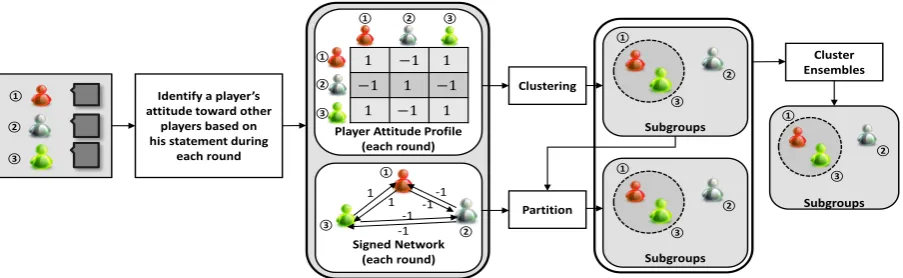
Figure 1: Deceptive group detection for a single round.
tions within a deceptive group have been ignored. For example, a product review from a deceiver may be supported by his teammates so that his deceptive comments can be read by more poten-tial buyers. In this case, we can identify a decep-tive group based on their collaborations and com-mon characteristics, which is more promising than the typical methods of classifying individual state-ments as deceptive or trustworthy.
In order to identify deceptive groups by analyz-ing the evolution of a person’s deception strategy during his interactions with victims and the inter-actions within the deceptive group from conver-sations, we use a social-elimination game called
Killer Game which contains the ground-truth of
subgroups.
The killer game has many variants that involve different roles and skills. We choose a classical version played by three roles/teams: detectives, c-itizens, and killers. The role of eachplayer(game participant) is randomly assigned by a third-party game judge. Every killer/detective is given the i-dentities of his teammates. There are two alter-nating phases of the game: “night”, when killer-s may covertly “murder” a player and detectives may learn one player’s role; and “day”, when sur-viving players are informed of who was killed last “night” and then asked to speculate about the roles of other surviving players. Before a “day” ends, every surviving player should vote for a suspect. The candidate with the most votes is eliminated. A player’s identity is not exposed after his “death”. The game continues until all killers have been e-liminated or all detectives have been killed. The killers are treated as deceivers, and citizens and detectives as truth-tellers.
In this paper, we present an unsupervised ap-proach for differentiating the deceptive groups
from truth-tellers in a game. During each round, we use Natural Language Processing (NLP) tech-niques to identify a player’s attitude toward other players (Section 2), which are used to construc-t a vecconstruc-tor of aconstruc-tconstruc-ticonstruc-tudes for each surviving player (Section 3.1) and a signed social network repre-sentation (Section 3.2) for the discussions. Then we use a clustering algorithm to cluster the atti-tude vector space and obtain results for each round (Section 3.1). We also implement a greedy op-timization algorithm to partition the singed net-work based on the attitude clustering result (Sec-tion 3.2). Finally, we apply a pairwise-similarity approach that makes use of the predicted co-occurrence relations between players to combine all results from each round (Section 3.3). Figure 1 provides an overview of our system pipeline.
The major novel contributions of this paper are as follows.
• This is the first study to investigate conversa-tions and deceptive groups for computerized deception detection.
• The proposed clustering technique is shown to be successful in separating deceptive groups from truth-tellers.
• The method can be applied to dynamically detect subgroups in a network with discus-sants who tend to change their opinions.
2 Attitude Identification
will be used as our illustrative example, as shown in Figure 2.
as shown in Figure 2.
(1), negative (-1) or neutral (0). A game log
from a single round will be used as our illustrative
example, as shown in Figure 2.
tuple list is: [(16, 16, +1), (16, 11, -1), (16, 2, -1),
(16, 1, 0), (16, 3, 0), ..., (16, 15, 0)].
target, polarity)) list. For this work, the polarity
of attitudes can be positive (1), negative (-1) and
neutral (0). A game log from a single round,
as shown in Figure 2, will be used as our
walk-through example. For instance, given Player 16’s
statement, its attitude tuple list is: [(16, 16, +1),
(16, 11, -1), (16, 2, -1), (16, 1, 0), (16, 3, 0), ...,
(16, 15, 0)].
target, polarity)) list. For this work, the polarity
of attitudes can be positive (1), negative (-1) and
neutral (0). A game log from a single round,
as shown in Figure 2, will be used as our
walk-through example. For instance, given Player 16’s
statement, its attitude tuple list is: [(16, 16, +1),
(16, 11, -1), (16, 2, -1), (16, 1, 0), (16, 3, 0), ...,
(16, 15, 0)].
represents them by an attitude 3-tuple ((speaker,
target, polarity)) list. For this work, the polarity
of attitudes can be positive, negative and neutral.
A game log from a single round, as shown in
Figure 2, will be used as our walk-through
exam-ple. For instance, given Player 16’s statement, its
attitudetuplelistis: [(16, 16, +1), (16, 11, -1), (16,
2, -1), (16, 1, 0), (16, 3, 0), ..., (16, 15, 0)].
Combining Group Conversations and Signed Network Analysis for Deception Detection
Abstract In previous studies, deception detection was formulated as a traditional binary classification problem. For example, given a product review, su-pervised learning methods could predict whether it was deceptive or genuine with high accuracy. However, in a daily life, millions of fraud cases involve detailed conversations between criminals and victims. Deceivers may adjust their decep-tive statements according to the reactions of their victims rather than simply making a single state-ment. In addition, people may form a group and collaborate to deceive others. In this paper, we aim to identify a deceptive group from dynamic conversations. We propose a novel subgroup de-tection method that combines content and signed network analyses for dynamic clustering. A social elimination game calledKiller Gameis introduced as a case study. Experimental results demonstrate that our approach significantly outperforms hu-man voting and state-of-the-art subgroup detection methods at dynamically differentiating the decep-tive group from the people telling truths. 1 Introduction
Deception generally entails messages and infor-mation intentionally transmitted to create a false conclusion (Buller et al., 1994). Deception detec-tion is an important task for a wide range of ap-plications including law enforcement, intelligence gathering, and financial fraud. Most of the previ-ous work (e.g., (Ott et al., 2011; Feng et al., 2012)) focused on a content analysis of a single document in isolation (e.g., hotel reviews). However, when we aim to detect deceptions from conversations, the deception behavior may be affected by other factors beyond textual statements. These factors can be both
1.Dynamic. The interpersonal deception theory (Buller and Burgoon, 1996) suggests
that deception communication is not static but rather dynamic and involves interaction between people. The social learning theory (Bandura, 1971) states that human’s capacity to learn by observation enables him/her to acquire large, integrated units of behavior by example. Therefore, a person’s behavior on deception or truth-telling can change constantly, while s/he learns from others’ statements during conversation and 2.Global. In some scenarios, people may form
groups for deception. The social influence network theory (Friedkin, 2010) states that individuals’ object-related behaviors may be affected by the attitudes of other persons due to the group dynamics. There are numerous ways to categorize decep-tion. According to the distance between partici-pants, we can classify deception into two types. The first type is a face-to-face deception, where cues include the deceiver’s body movement, pulse, facial expressions, etc.. The other type is based on text or voice messages. For example, in product reviews, promoters of a product may post fake complimentary reviews, while their com-petitors may hire people to write fake negative reviews (Ott et al., 2011).
Recent studies have been typically conducted over “static” written or oral deceptive statements. There is no obligatory requirement for communi-cation between the author and readers for these statements (Yancheva and Rudzicz, 2013). As a result, a person being deceived tends to trust the story mainly based on the statement she reads (Ott et al., 2011). However, in daily life, millions of fraud cases involve detailed conversations be-tween criminals and victims. Deceivers may make a statement, which is partially true in order to de-ceive or mislead victims and adjust their deceptive strategies based on the reactions of victims (Zhou et al., 2004). Therefore, it is more challenging to
Figure 2: Killer game sample log (1st round).
C: citizen; D: detective; K: killer System: First Round. System: 15 was killed last night. 15(C): I’m a citizen. Over.
16(K): I’m a good person. 11 and 2 are suspicious.
1(K): I’m a good person. It has been a long time since I played as a killer. I’m a citizen. I don’t want to comment on 16’s statement. 2(C): I’m a detective. 6 was proved as a killer last night. Over. 3(C): I don’t know 2’s identity. It’s hard to judge 16’s statement. 1 seems to be a good person. I’m a citizen.4(C): Citizen. I cannot find a killer. I trust 2 since 2 sounds a good person. 16 is suspicious. I regard 16 as a killer. I’m 2’s teammate. 5(D): I’m a detective. I verify 2’s identity and 2 is a killer. 13 is good. 6(C):Whydoyouwanttoattack2? Idon’tunderstand. 14issuspicious. 7(K): It’s hard to define 6’s identity. 4 may be a citizen. I will vote for 2. 6 sounds very strange and I found 6 very suspicious. I will follow the detective 5 to vote for 2.
8(C): We should calm down. 7 seems to be a bad person.
9(C): 1 and 7 seem to be killers. There is no evidence to support 2 as a detective. 3 is a citizen. 4 is possibly a detective. 6 is also good. 10(D): I agree with you. 7 must be a killer. 2 and 7 should debate. 11(C): I don’t know 2 but I think 2 is good. 3 is good. There should be one or two killers among 1, 4 and 7.
12(K): 11 sounds like a killer. 2 is a killer. I’m a citizen. Vote for 2. 13(D): 15 is a citizen. 16 is logically good. I think 1, 8, 9, 10 are OK. I don’t think 2 is a killer. I doubt 7’s intention. Please vote for 7. 14(D): 10, 13, 16 are good. I don’t think 7 must be a killer. 2 is obviously bad. I’m a citizen.
System: 16, 11, 14, 7, 1, 3, 8, 12, 4 vote for 2. 10, 13, 5, 2 vote for 7. 9, 6 vote for 11.2 is out.
2.1 Target and Attitude Word Identification
We start by identifying targets and attitudes
from the conversations. In the killer game, a
target is represented by his/her player ID. We
create a domain-specific vocabulary by applying
word segmentation and part-of-speech (POS)
tagging (Zhang et al., 2003) to identify game
terms from the game’s website
1and related
discussion forums. We collected 41 terms in
total. There are two kinds of game terms:
positive and negative. Positive attitude words
include “citizen”, “good person”, “good person
certified by the detectives”, “detective”, etc..
Negative attitude words include “killer”, “killer
verified by the detectives”, “a killer who claimed
himself/herself to be a detective”, etc.. We assign
the polarity score +1, -1 to positive and negative
terms respectively.
2.2 Attitude-Target Pairing
Then we associate each attitude term with its
corresponding target. We remove interrogative
and exclamatory sentences and only keep the
sen-tences that include at least one attitude term from
a player’s statement during each round.
We propose a rule-based approach for
attitude-target pairing: if there is at least one ID in the
sentence, we associate all attitude terms in that
sentence with it. Otherwise, if ”I” is the only
subject or there are no subjects at all, we associate
attitude terms with the speaker. We reverse the
polarity of an attitude word if it appears in a
negation context. For each attitude-target pair, we
check the POS-tag sequence between them. If
there exists an attitude term, a belief-oriented verb
such as “think”, “believe”, “feel”, or more than
two verbs, we will discard this pair because the
statement is too subjective.
For those targets, the speaker didn’t mention
or there is no positive/negative attitude word used
when they are mentioned, the attitude polarity
score is set to 0.
3 Clustering
In this section, we introduce a method to construct
an attitude profile for each player and a signed
networkbasedontheattitudetuplelistinSection2
and combine them to handle a dynamic network
with discussants telling lies and truths, which has
not been explored previously.
1
e.g.
, http://www.3j3f.com/how/
Figure 2: Killer game sample log (1st round).
C: citizen; D: detective; K: killer
System: First Round.
System: 15 was killed last night.
15(C): I’m a citizen. Over.
16(K): I’m a good person. 11 and 2 are suspicious.
1(K): I’m a good person. It has been a long time since I played as a killer. I’m a citizen. I don’t want to comment on 16’s statement.
2(C): I’m a detective. 6 was proved as a killer last night. Over.
3(C): I don’t know 2’s identity. It’s hard to judge 16’s statement. 1 seems to be a good person. I’m a citizen.
4(C): Citizen. I cannot find a killer. I trust 2 since 2 sounds a good person. 16 is suspicious. I regard 16 as a killer. I’m 2’s teammate.
5(D): I’m a detective. I verify 2’s identity and 2 is a killer. 13 is good.
6(C): Whydo youwantto attack2? Idon’tunderstand. 14is suspicious.
7(K): It’s hard to define 6’s identity. 4 may be a citizen. I will vote for 2. 6 sounds very weird and I found 6 very suspicious. I will follow the detective 5 to vote for 2.
8(C): We should calm down. 7 seems to be a bad person.
9(C): 1 and 7 seem to be killers. There is no evidence to support 2 as a detective. 3 is a citizen. 4 is possibly a detective. 6 is also good.
10(D): I agree with you. 7 must be a killer. 2 and 7 should debate.
11(C): I don’t know 2 but I think 2 is good. 3 is good. There should be one or two killers among 1, 4 and 7.
12(K): 11 sounds like a killer. 2 is a killer. I’m a citizen. Vote for 2.
13(D): 15 is a citizen. 16 is logically good. I think 1, 8, 9, 10 are OK. I don’t think 2 is a killer. I doubt 7’s intention. Please vote for 7.
14(D): 10, 13, 16 are good. I don’t think 7 must be a killer. 2 is obviously bad. I’m a citizen.
System: 16, 11, 14, 7, 1, 3, 8, 12, 4 vote for 2. 10, 13, 5, 2 vote for 7. 9, 6 vote for 11.2 is out.
2.1 Target and Attitude Word Identification
We start by identifying targets and attitudes
from the conversations. In the killer game, a
target is represented by his/her player ID. We
create a domain-specific vocabulary by applying
word segmentation and part-of-speech (POS)
tagging (Zhang et al., 2003) to identify game
terms from the game’s website
1and related
discussion forums. We collected 41 terms in
total. There are two kinds of game terms:
positive and negative. Positive attitude words
include “citizen”, “good person”, “good person
certified by the detectives”, “detective”, etc..
Negative attitude words include “killer”, “killer
verified by the detectives”, “a killer who claimed
himself/herself to be a detective”, etc.. We assign
the polarity score +1, -1 to positive and negative
terms respectively.
2.2 Attitude-Target Pairing
Then we associate each attitude term with its
corresponding target. We remove interrogative
and exclamatory sentences and only keep the
sen-tences that include at least one attitude term from
a player’s statement during each round.
We propose a rule-based approach for
attitude-target pairing: if there is at least one ID in the
sentence, we associate all attitude terms in that
sentence with it. Otherwise, if ”I” is the only
subject or there are no subjects at all, we associate
attitude terms with the speaker. We reverse the
polarity of an attitude word if it appears in a
negation context. For each attitude-target pair, we
check the POS-tag sequence between them. If
there exists an attitude term, a belief-oriented verb
such as “think”, “believe”, “feel”, or more than
two verbs, we will discard this pair because the
statement is too subjective.
For those targets, the speaker didn’t mention
or there is no positive/negative attitude word used
when they are mentioned, the attitude polarity
score is set to 0.
3 Clustering
In this section, we introduce a method to construct
an attitude profile for each player and a signed
networkbasedontheattitudetuplelistinSection2
and combine them to handle a dynamic network
with discussants telling lies and truths, which has
not been explored previously.
1e.g., http://www.3j3f.com/how/
Figure 2: Killer game sample log (1st round).
C: citizen; D: detective; K: killer
System: First Round.
System: 15 was killed last night.
15(C): I’m a citizen. Over.
16(K): I’m a good person. 11 and 2 are suspicious.
1(K): I’m a good person. It has been a long time since I played as a killer. I’m a citizen. I don’t want to comment on 16’s statement.
2(C): I’m a detective. 6 was proved as a killer last night. Over.
3(C): I don’t know 2’s identity. It’s hard to judge 16’s statement. 1 seems to be a good person. I’m a citizen.
4(C): Citizen. I cannot find a killer. I trust 2 since 2 sounds a good person. 16 is suspicious. I regard 16 as a killer. I’m 2’s teammate.
5(D): I’m a detective. I verify 2’s identity and 2 is a killer. 13 is good.
6(C): Why do you want to attack 2? I don’t understand. 14 is suspicious.
7(K): It’s hard to define 6’s identity. 4 may be a citizen. I will vote for 2. 6 sounds very weird and I found 6 very suspicious. I will follow the detective 5 to vote for 2.
8(C): We should calm down. 7 seems to be a bad person.
9(C): 1 and 7 seem to be killers. There is no evidence to support 2 as a detective. 3 is a citizen. 4 is possibly a detective. 6 is also good.
10(D): I agree with you. 7 must be a killer. 2 and 7 should debate.
11(C): I don’t know 2 but I think 2 is good. 3 is good. There should be one or two killers among 1, 4 and 7.
12(K): 11 sounds like a killer. 2 is a killer. I’m a citizen. Vote for 2.
13(D): 15 is a citizen. 16 is logically good. I think 1, 8, 9, 10 are OK. I don’t think 2 is a killer. I doubt 7’s intention. Please vote for 7.
14(D): 10, 13, 16 are good. I don’t think 7 must be a killer. 2 is obviously bad. I’m a citizen.
System: 16, 11, 14, 7, 1, 3, 8, 12, 4 vote for 2· · ·10, 13, 5, 2 vote for 7· · ·9, 6 vote for 11· · ·2 is out.
2.1 Target and Attitude Word Identification
We start by identifying targets and attitudes
from the conversations. In the killer game, a
target is represented by his/her player ID. We
create a domain-specific vocabulary by applying
word segmentation and part-of-speech (POS)
tagging (Zhang et al., 2003) to identify game
terms from the game’s website
1and related
discussion forums. We collected 41 terms in
total. There are two kinds of game terms:
positive and negative. Positive attitude words
include “citizen”, “good person”, “good person
certified by the detectives”, “detective”, etc..
Negative attitude words include “killer”, “killer
verified by the detectives”, “a killer who claimed
himself/herself to be a detective”, etc.. We assign
the polarity score +1, -1 to positive and negative
terms respectively.
2.2 Attitude-Target Pairing
Then we associate each attitude term with its
corresponding target. We remove interrogative
and exclamatory sentences and only keep the
sen-tences that include at least one attitude term from
a player’s statement during each round.
We propose a rule-based approach for
attitude-target pairing: if there is at least one ID in the
sentence, we associate all attitude terms in that
sentence with it. Otherwise, if ”I” is the only
subject or there are no subjects at all, we associate
attitude terms with the speaker. We reverse the
polarity of an attitude word if it appears in a
negation context. For each attitude-target pair, we
check the POS-tag sequence between them. If
there exists an attitude term, a belief-oriented verb
such as “think”, “believe”, “feel”, or more than
two verbs, we will discard this pair because the
statement is too subjective.
For those targets, the speaker didn’t mention
or there is no positive/negative attitude word used
when they are mentioned, the attitude polarity
score is set to 0.
3 Clustering
In this section, we introduce a method to construct
an attitude profile for each player and a signed
network based on the attitude tuple list in Section 2
and combine them to handle a dynamic network
with discussants telling lies and truths, which has
not been explored previously.
1e.g., http://www.3j3f.com/how/
Figure 2: Killer game sample log (1st round).
C: citizen; D: detective; K: killer System: First Round. System: 15 was killed last night. 15(C): I’m a citizen. Over.
16(K): I’m a good person. 11 and 2 are suspicious. 1(K): I’m a good person. It has been a long time since I played as a killer. I’m a citizen. 11 is suspicious and I don’t want to comment on 16’s statement.
2(C): I’m a detective. 6 was proved as a killer last night. Over. 3(C): I don’t know 2’s identity. It’s hard to judge 16’s statement. 1 seems to be a good person. I’m a citizen.
4(C): Citizen. I cannot find a killer. I trust 2 since 2 sounds a good person. 16 is suspicious. I regard 16 as a killer. I’m 2’s teammate. 5(D): I’m a detective. I verify 2’s identity and 2 is a killer. 13 is good. 6(C): Why do you want to attack 2? I don’t understand. 14 is suspicious. 7(K): It’s hard to define 6’s identity. 4 may be a citizen. I will vote for 2. 6 sounds very weird and I found 6 very suspicious. I will follow the detective 5 to vote for 2.
8(C): We should calm down. 7 seems to be a bad person.
9(C): 1 and 7 seem to be killers. There is no evidence to support 2 as a detective. 3 is a citizen. 4 is possibly a detective. 6 is also good. 10(D): I agree with you. 7 must be a killer. 2 and 7 should debate. 11(C): I don’t know 2 but I think 2 is good. 3 is good. There should be one or two killers among 1, 4 and 7.
12(K): 11 sounds like a killer. 2 is a killer. I’m a citizen. Vote for 2. 13(D): 15 is a citizen. 16 is logically good. I think 1, 8, 9, 10 are OK. I don’t think 2 is a killer. I doubt 7’s intention. Please vote for 7. 14(D): 10, 13, 16 are good. I don’t think 7 must be a killer. 2 is obviously bad. I’m a citizen.
System: 16, 11, 14, 7, 1, 3, 8, 12, 4 vote for 2· · ·10, 13, 5, 2 vote for 7· · ·9, 6 vote for 11· · ·2 is out.
2.1 Target and Attitude Word Identification
We start by identifying targets and attitudes from
the conversations. In the killer game, a target is
represented by his/her player ID and game terms
are regarded as attitude words. We collected
41 terms in total from the game’s website
1and
related discussion forum. ICTCLAS (Zhang et
al., 2003) is used for word segmentation and
part-of-speech (POS) tagging (Zhang et al., 2003).
There are two kinds of game terms: positive and
negative. Positive terms include “citizen”, “good
person”, “good person certified by the detectives”,
“detective”, etc.. Negative terms include “killer”,
“killer verified by the detectives”, “a killer who
claimed himself/herself to be a detective”, etc..
We assign the polarity score +1, -1 to positive and
negative terms respectively.
2.2 Attitude-Target Pairing
Then we associate each attitude term with its
corresponding target. We remove interrogative
and exclamatory sentences and only keep the
sen-tences that include at least one attitude term from
a player’s statement during each round.
We develop a rule-based approach for
attitude-target pairing: if there is at least one ID in the
sentence, we associate all attitude terms in that
sentence with it. Otherwise, if ”I” is the only
subject or there are no subjects at all, we associate
attitude terms with the speaker. We reverse the
polarity of an attitude word if it appears in a
negation context.
For each attitude-target pair, we check the POS
tag sequence between them. If there exists an
at-titude term, a belief-oriented verb such as “think”,
“believe”, “feel”, or more than two verbs in the
sequence, we will discard this pair. In our task, we
assume that a target and an attitude term can form
a pair if the target is dominated by the term. (Yu
et al., 2015) showed that we can judge if a word
is dominated by any other word by analyzing the
POS tag sequence between them.
For those targets, the speaker didn’t mention
or there is no positive/negative attitude term used
when they are mentioned, the attitude polarity
score is set to 0.
3 Clustering
In this section, we introduce a method to construct
an attitude profile for each player and a signed
net-work based on the attitude tuple list in Section 2,
and combine them to handle a dynamic network
with discussants telling lies and truths.
1e.g., http://www.3j3f.com/how/
Figure 2: Killer game sample log (1st round).
C: citizen; D: detective; K: killer System: First Round. System: 15 was killed last night. 15(C): I’m a citizen. Over.
16(K): I’m a good person. 11 and 2 are suspicious. 1(K): I’m a good person. It has been a long time since I played as a killer. I’m a citizen. 11 is suspicious and I don’t want to comment on 16’s statement.
2(C): I’m a detective. 6 was proved as a killer last night. Over. 3(C): I don’t know 2’s identity. It’s hard to judge 16’s statement. 1 seems to be a good person. I’m a citizen.
4(C): Citizen. I cannot find a killer. I trust 2 since 2 sounds a good person. 16 is suspicious. I regard 16 as a killer. I’m 2’s teammate. 5(D): I’m a detective. I verify 2’s identity and 2 is a killer. 13 is good. 6(C): Why do you want to attack 2? I don’t understand. 14 is suspicious.
7(K): It’s hard to define 6’s identity. 4 may be a citizen. I will vote for 2. 6 sounds very weird and I found 6 very suspicious. I will follow the detective 5 to vote for 2.
8(C): We should calm down. 7 seems to be a bad person.
9(C): 1 and 7 seem to be killers. There is no evidence to support 2 as a detective. 3 is a citizen. 4 is possibly a detective. 6 is also good. 10(D): I agree with you. 7 must be a killer. 2 and 7 should debate. 11(C): I don’t know 2 but I think 2 is good. 3 is good. There should be one or two killers among 1, 4 and 7.
12(K): 11 sounds like a killer. 2 is a killer. I’m a citizen. Vote for 2.
13(D): 15 is a citizen. 16 is logically good. I think 1, 8, 9, 10 are OK. I don’t think 2 is a killer. I doubt 7’s intention. Please vote for 7. 14(D): 10, 13, 16 are good. I don’t think 7 must be a killer. 2 is obviously bad. I’m a citizen.
System: 16, 11, 14, 7, 1, 3, 8, 12, 4 vote for 2· · ·10, 13, 5, 2 vote for 7· · ·9, 6 vote for 11· · ·2 is out.
2.1 Target and Attitude Word Identification
We start by identifying targets and attitude words
from conversations. In the killer game, a target
is represented by his/her unique ID
1and game
terms are regarded as attitude words. We collected
41 terms in total from the game’s website
2and
related discussion forum. ICTCLAS (Zhang et
al., 2003) is used for word segmentation and
part-of-speech (POS) tagging. There are two kinds
of game terms: positive and negative. Positive
terms include “citizen”, “good person”, “good
person certified by the detectives”, “detective”,
etc.. Negative terms include “killer”, “killer
ver-ified by the detectives”, “a killer who claimed
himself/herself to be a detective”, etc.. We assign
the polarity score +1, -1 to positive and negative
terms respectively.
2.2 Attitude-Target Pairing
Then we associate each attitude word with its
corresponding target. We remove interrogative
and exclamatory sentences and only keep the
sen-tences that include at least one attitude word from
a player’s statement during each round.
We develop a rule-based approach for
attitude-target pairing: if there is at least one ID in the
sentence, we associate all attitude words in that
sentence with it. Otherwise, if ”I” is the only
subject or there are no subjects at all, we associate
attitude words with the speaker. We reverse the
polarity of an attitude word if it appears in a
negation context.
Previous methods pair a target and an
atti-tude word if they satisfy at least one dependency
rules (
e.g.
,(Somasundaran and Wiebe, 2009)). We
check the POS tag sequence between them. For
each attitude-target pair, if there exists an attitude
word, a belief-oriented verb such as “think”,
“be-lieve”, “feel”, or more than two verbs in the
se-quence, we will discard this pair. The assumption
is that POS tag sequences can be used to roughly
summarize dependency rules when statements are
relatively short.
For those targets, the speaker didn’t mention
or there is no positive/negative attitude word used
when they are mentioned, the attitude polarity
score is set to 0. For instance, given Player 16’s
statement in Figure 2, its attitude tuple list is: [(16,
16, +1), (16, 11, -1), (16, 2, -1), (16, 1, 0), (16, 3,
0), ..., (16, 15, 0)].
1Each player has a game ID, assigned by the online game system based on when s/he entered the game room.
2e.g., http://www.3j3f.com/how/
Figure 2: Killer game sample log (1st round).
C: citizen; D: detective; K: killer System: First Round.
System: 15 was killed last night. 15, please leave your last words. 15(C): I’m a citizen. Over.
16(K): I’m a good person. 11 and 2 are suspicious. 1(K): I’m a good person. It has been a long time since I played as a killer. I’m a citizen. 11 is suspicious and I don’t want to comment on 16’s statement.
2(C): I’m a detective. 6 was proved as a killer last night. Over. 3(C): I don’t know 2’s identity. It’s hard to judge 16’s statement. 1 seems to be a good person. I’m a citizen.
4(C): Citizen. I cannot find a killer. I trust 2 since 2 sounds a good person. 16 is suspicious. I regard 16 as a killer. I’m 2’s teammate. 5(D): I’m a detective. I verify 2’s identity and 2 is a killer. 13 is good. 6(C): Why do you want to attack 2? I don’t understand. 14 is suspicious.
7(K): It’s hard to define 6’s identity. 4 may be a citizen. I will vote for 2. 6 sounds very weird and I found 6 very suspicious. I will follow the detective 5 to vote for 2.
8(C): We should calm down. 7 seems to be a bad person.
9(C): 1 and 7 seem to be killers. There is no evidence to support 2 as a detective. 3 is a citizen. 4 is possibly a detective. 6 is also good. 10(D): I agree with you. 7 must be a killer. 2 and 7 should debate. 11(C): I don’t know 2 but I think 2 is good. 3 is good. There should be one or two killers among 1, 4 and 7.
12(K): 11 sounds like a killer. 2 is a killer. I’m a citizen. Vote for 2.
13(D): 15 is a citizen. 16 is logically good. I think 1, 8, 9, 10 are OK. I don’t think 2 is a killer. I doubt 7’s intention. Please vote for 7. 14(D): 10, 13, 16 are good. I don’t think 7 must be a killer. 2 is obviously bad. I’m a citizen.
System: 16, 11, 14, 7, 1, 3, 8, 12, 4 vote for 2· · ·10, 13, 5, 2 vote for 7· · ·9, 6 vote for 11· · ·2 is out.
2.1 Target and Attitude Word Identification
We start by identifying targets and attitude words
from conversations. In the killer game, a target
is represented by his/her unique ID
1and game
terms are regarded as attitude words. We collected
41 terms in total from the game’s website
2and
related discussion forum. ICTCLAS (Zhang et
al., 2003) is used for word segmentation and
part-of-speech (POS) tagging. There are two kinds
of game terms: positive and negative. Positive
terms include “citizen”, “good person”, “good
person certified by the detectives”, “detective”,
etc.. Negative terms include “killer”, “killer
verified by the detectives”, “a killer who claimed
himself/herself to be a detective”, etc.. We assign
the polarity score +1, -1 to positive and negative
terms respectively.
2.2 Attitude-Target Pairing
Then we associate each attitude word with its
corresponding target. We remove interrogative
and exclamatory sentences and only keep the
sentences that include at least one attitude word
from a player’s statement during each round.
We develop a rule-based approach for
attitude-target pairing: if there is at least one ID in the
sentence, we associate all attitude words in that
sentence with it. Otherwise, if ”I” is the only
subject or there are no subjects at all, we associate
attitude words with the ID of the speaker. We
reverse the polarity of an attitude word if it appears
in a negation context.
Previous methods pair a target and an attitude
word if they satisfy at least one dependency rules
(
e.g.
,(Somasundaran and Wiebe, 2009)). We
check the POS tag sequence between them. For
each attitude-target pair, if there exists an attitude
word, a belief-oriented verb such as “think”,
“believe”, “feel”, or more than two verbs in
the sequence, we will discard this pair. The
assumption is that POS tag sequences can be used
to roughly summarize dependency rules when
statements are relatively short.
For those targets, the speaker didn’t mention
or there is no positive/negative attitude word used
when they are mentioned, the attitude polarity
score is set to 0. For instance, given Player 16’s
statement in Figure 2, its attitude tuple list is: [(16,
1Each player has a game ID, assigned by the online game system based on when s/he entered the game room.
2e.g., http://www.3j3f.com/how/
Figure 2: Killer game sample log (1st round).
C: CITIZEN; D: DETECTIVE; K: KILLER
System: First Round.
System: 15 was killed last night. 15, please leave your last words.
15(C): I’m a citizen. Over.
16(K): I’m a good person. 11 and 2 are suspicious.
1(K): I’m a good person. It has been a long time since I played as a killer. I’m a citizen. 11 is suspicious and I don’t want to comment on 16’s statement.
2(C): I’m a detective. 6 was proved as a killer last night. Over.
3(C): I don’t know 2’s identity. It’s hard to judge 16’s statement. 1 seems to be a good person. I’m a citizen.
4(C): Citizen. I cannot find a killer. I trust 2 since 2 sounds a good person. 16 is suspicious. I regard 16 as a killer. I’m 2’s teammate.
5(D): I’m a detective. I verify 2’s identity and 2 is a killer. 13 is good.
6(C): Why do you want to attack 2? I don’t understand. 14 is suspicious.
7(K): It’s hard to define 6’s identity. 4 may be a citizen. I will vote for 2. 6 sounds very weird and I found 6 very suspicious. I will follow the detective 5 to vote for 2.
8(C): We should calm down. 7 seems to be a bad person.
9(C): 1 and 7 seem to be killers. There is no evidence to support 2 as a detective. 3 is a citizen. 4 is possibly a detective. 6 is also good.
10(D): I agree with you. 7 must be a killer. 2 and 7 should debate.
11(C): I don’t know 2 but I think 2 is good. 3 is good. There should be
one or two killers among 1, 4 and 7.
12(K): 11 sounds like a killer. 2 is a killer. I’m a citizen. Vote for 2.
13(D): 15 is a citizen. 16 is logically good. I think 1, 8, 9, 10 are OK. I
don’t think 2 is a killer. I doubt 7’s intention. Please vote for 7.
14(D): 10, 13, 16 are good. I don’t think 7 must be a killer. 2 is
obviously bad. I’m a citizen.
System: 16, 11, 14, 7, 1, 3, 8, 12, 4 vote for 2· · ·10, 13, 5, 2 vote for
7· · ·9, 6 vote for 11· · ·2 is out.
2.1 Target and Attitude Word Identification
We start by identifying targets and attitude words
from conversations. In the killer game, a target is
represented by his/her unique ID
1and game terms
are regarded as attitude words. We collected 41
terms in total from the game’s website
2and
re-lated discussion forum. ICTCLAS (Zhang et al.,
2003) is used for word segmentation and
part-of-speech (POS) tagging. There are two kinds of
game terms: positive and negative. Positive terms
include “citizen”, “good person”, “good person
certified by the detectives”, “detective”, etc..
Neg-ative terms include “killer”, “killer verified by the
detectives”, “a killer who claimed himself/herself
to be a detective”, etc.. We assign the polarity
s-core +1, -1 to positive and negative terms
respec-tively.
2.2 Attitude-Target Pairing
Then we associate each attitude word with
it-s correit-sponding target. We remove interrogative
and exclamatory sentences and only keep the
sen-tences that include at least one attitude word from
a player’s statement during each round.
We develop a rule-based approach for
attitude-target pairing: if there is at least one ID in the
tence, we associate all attitude words in that
sen-tence with it. Otherwise, if ”I” is the only subject
or there are no subjects at all, we associate
atti-tude words with the ID of the speaker. We reverse
the polarity of an attitude word if it appears in a
negation context.
Previous methods pair a target and an
atti-tude word if they satisfy at least one dependency
rules (
e.g.
,(Somasundaran and Wiebe, 2009)). We
check the POS tag sequence between them. For
each attitude-target pair, if there exists an attitude
word, a belief-oriented verb such as “think”,
“be-lieve”, “feel”, or more than two verbs in the
se-quence, we will discard this pair. The assumption
is that POS tag sequences can be used to
summa-rize dependency rules when statements are
rela-tively short.
For those targets, the speaker didn’t mention
or there is no positive/negative attitude word used
when they are mentioned, the attitude polarity
core is set to 0. For instance, given Player 16’s
s-tatement in Figure 2, its attitude tuple list is: [(16,
16, +1), (16, 11, -1), (16, 2, -1), (16, 1, 0), (16, 3,
0), . . . , (16, 15, 0)].
1Each player has a game ID, assigned by the online game system based on when s/he entered the game room.
2e.g., http://www.3j3f.com/how/ Figure 2: Killer game sample log (the 1st round).
2.1 Target and Attitude Word Identification
We start by identifying targets and attitude word-s from converword-sationword-s. In the killer game, a target is represented by his unique ID2 and game terms are regarded as attitude words. We collected 41 terms in total from the game’s website 3 and re-lated discussion forum posts. ICTCLAS (Zhang et al., 2003) is used for word segmentation and part-of-speech (POS) tagging. There are two kind-s of game termkind-s: pokind-sitive and negative. Pokind-si- Posi-tive terms include “citizen”, “good person”, “good person certified by the detectives” and “detective”. Negative terms include “killer”, “killer verified by the detectives” and “a killer who claimed him-self/herself to be a detective”. We assign the po-larity score +1, -1 to positive and negative terms respectively.
2Each player has a game ID, assigned by the online game
system based on when he entered the game room.
3e.g., http://www.3j3f.com/how/
2.2 Attitude-Target Pairing
Then we associate each attitude word with it-s correit-sponding target. We remove interrogative and exclamatory sentences and only keep the sen-tences that include at least one attitude word from a player’s statement during each round.
We develop a rule-based approach for attitude-target pairing: if there is at least one ID in the tence, we associate all attitude words in that sen-tence with it. Otherwise, if “I” is the only subject or there are no subjects at all, we associate atti-tude words with the ID of the speaker. We reverse the polarity of an attitude word if it appears in a negation context.
Previous methods pair a target and an attitude word if they satisfy at least one dependency rule (e.g., (Somasundaran and Wiebe, 2009)). We check the POS tag sequence between them. For each attitude-target pair, if there exists an attitude word, a belief-oriented verb such as “think”, “ be-lieve”, “feel”, or more than two verbs in the se-quence, we will discard this pair. The assumption is that POS tag sequences can be used to summa-rize dependency rules when statements are rela-tively short.
For those targets, the speaker didn’t mention or there is no positive/negative attitude word used when they are mentioned, the attitude polarity core is set to 0. For instance, given Player 16’s s-tatement in Figure 2, its attitude tuple list is: [(16, 16, +1), (16, 11, -1), (16, 2, -1), (16, 1, 0), (16, 3, 0), . . . , (16, 15, 0)].
3 Clustering
Since the statements in conversations are relatively short and concise, it is difficult to identify which one is deceptive, even using deep linguistic fea-tures such as the language style.
In this section, we introduce a method to con-struct an attitude profile for each player and a signed network based on the attitude tuple list in Section 2, and combine them to analyze a dynam-ic network with discussants telling lies and truths.
3.1 Clustering based on Attitude Profile
We call this vector as the discussant attitude pro-file (DAP) following (Abu-Jbara et al., 2012a).
Suppose there are nplayers who participate in a single game. Since a player’s identity is not ex-posed to the public after his death4, people can still analyze the identity of a “dead” player. Therefore, the number of possibly mentioned targets in each round equals ton. Given all the statements from
msurviving players in a single round, each play-er’s DAP hasn+ 1dimensions including his vote and thus we can have am×(n+ 1)attitude ma-trixAwhereAij represents the attitude polarity of
itowardj we got from Section 2. Ai(n+1)
repre-sentsi’s vote.
In a certain round, given a set of m surviving players X = {x1, x2,· · ·, xm} to be clustered
and their respective DAPs, we can modify the Eu-clidean metric to compute the differences in atti-tudes and get anm×mdistance matrixM:
Mij= v u u t
n X
k=1
(Aik−Ajk)2+ (2−2δAi(n+1),Aj(n+1))2
(1)
The Kronecker delta functionδis:
δij=
1 i=j
0 i6=j (2)
We use this function to compare the votes of t-wo players separately because a player’s vote can be inconsistent with his previous statements. We assume that there is a larger distance between two players when they vote for different suspects.
A common assumption in previous research was that a member is more likely to show a positive attitude toward other members in the same group, and a negative attitude toward the opposing group-s (Abu-Jbara et al., 2012a). However, a deceiver may pretend to be innocent by supporting those truth-tellers and attacking his teammates, whose i-dentities have already been exposed. Therefore, it is not enough to judge the relationship between two players by simply measuring the distance be-tween their DAPs.
In addition to comparing DAPs between player-s iandj, we also consider the attitudes of other players toward iand j, as well as their attitudes 4Each round, the player killed by killers and the player
with the most votes are out.
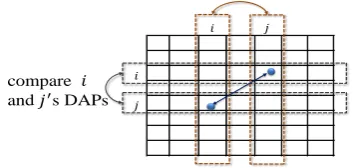
toward each other. We modifyMij as follows and
show it in Figure 3:
Mij0 =Mij+ v u u t
m X
k=1
(Aki−Akj)2+ (h(Aij) +h(Aji))2
(3)
where the function h detects the negative atti-tudes. h(x) = 0 ifx ≥ 0andh(x) = −1 other-wise.
We perform hierarchical clustering on the con-densed distance matrix ofMand use the complete linkage method to compute the distance between two clusters (Voorhees, 1986). We set the num-ber of clusters as 3 since there are three natural groups in the game. We focus on separating ceivers (killers) from truth-tellers (citizens and de-tectives).
𝑖 𝑗
𝑖
𝑗
[image:4.595.327.504.332.416.2]compare 𝑖 and 𝑗′s DAPs
Figure 3: Computation of the distance between playeriandjbased on the attitude matrix.
3.2 Signed Network Partition
When we computed the distance between two players in Section 3.1, we did not consider the net-work structure among all the players. For exam-ple, ifAsupports C,B supportsDandC andD
dislike each other,AandB may belong to differ-ent groups. Thus, we propose to capture the in-teractions in the social network to further improve the attitude-profile-based clustering result.
We can easily convert the attitude matrixAinto a signed network by adding a directed edgei→j
betweeniandjifAij 6= 0. We denote a directed
graph corresponding to a signed network asG = (V, S, N, W), whereV is the set of nodes,Sis the set of positive edges,Nis the set of negative edges andW : (V ×V) → {−1,1} is a function that maps every directed edge to a value, W(i, j) =
Aij.
is constructed such that positive links are dense within groups and negative links are dense be-tween groups. For any potential partition C, we seek to minimize the following error function:
E(C) =X C∈C
[(1−γ)X i∈C j /∈C
W(i, j)Si,j−γ X
i,j∈C
W(i, j)Ni,j]
(4)
where γ ∈ [0,1] controls the balance of the penalty difference between putting a positive edge across and a negative edge within a group. We re-gard these two types of errors as equally important and setγ = 0.5for our experiments.
Initially, we use the clustering result in Sec-tion 3.1 to partiSec-tion nodes into three differen-t groups and an error funcdifferen-tion,E, is evaluated for that cluster. Every cluster has a set of neighbor clusters in the cluster space. A neighbor cluster is obtained by moving a node from one group to another, or exchanging two nodes in two different groups.Eis evaluated for all the neighbor clusters of the current cluster and the one with the lowest value is set as the new cluster. The algorithm is repeated until it finds a minimal solution5. We set the upper limit for the number of subgroups to 3.
3.3 Cluster Ensembles
The relationships between players are dynamic throughout the game. For example, a killer tends to hide his identity and pretends to be friendly to others at later stages in order to survive. Thus, it is insufficient to rely on a single round’s discus-sion to cluster players. In addition, for each single round, we also need to combine the clustering re-sults from the attitude profiles of the players and the signed network.
In a game with information gathered from up tor rounds, letP = {P1, P2,· · ·, Pr}be the set
of r clusterings (partitionings) based on attitude profiles andP0 = {P10, P20,· · ·, Pr0}be the set of
rclusterings based on the signed network. Using the co-occurrence relations between players, we can generate a n×n pairwise simi-larity matrixT based on the information of all r
rounds:
Tijr = λ·voteij + (1−λ)·vote
0
ij
rij (5)
5Since our graphs are small, we search through all
parti-tions. We repeated 1000 times in our experiment.
where voteij, vote0ij are the number of times
that playeriandjare assigned to the same cluster inP andP0 respectively. rij denotes the number
of rounds when both of them survived (rij ≤ r).
Tr
ij ∈ [0,1]. We assign a higher weight to the
re-sult ofP1and setλ= 2/3in our experiments.
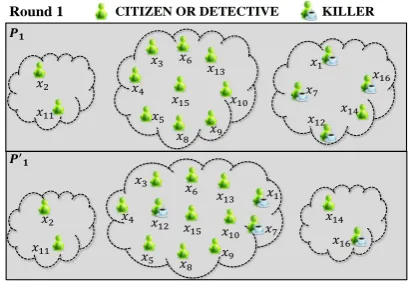
Given the input in Figure 2, x3 andx4 are
as-signed to the same cluster inP1 (vote34 = 1) and
inP10 (vote034 = 1) respectively as shown in Fig-ure 4. x3 and x4 co-occurred in the first round
(r34= 1).T341 = (2/3×1 + 1/3×1)/1 = 1.
𝑥16
𝑷𝟏
𝑷′ 𝟏 Round 1
𝑥2
𝑥11
𝑥1
𝑥7
𝑥12 𝑥14
𝑥3
𝑥15
𝑥4
𝑥5
𝑥13
𝑥10
𝑥8 𝑥9
𝑥6
𝑥2
𝑥11
𝑥14
𝑥3
𝑥15
𝑥4
𝑥5
𝑥13
𝑥10
𝑥8
𝑥9
𝑥6
𝑥16
𝑥1
𝑥7
𝑥12
[image:5.595.313.520.225.366.2]KILLER CITIZEN OR DETECTIVE
Figure 4: Example of cluster ensemble for a single round.
We apply hierarchical clustering (Voorhees, 1986) to the similarity matrix above to obtain the final global clustering results.
4 Experiments
4.1 Dataset Construction
We recorded 10 games from 3J3F6, one of the most popular Chinese online killer game web-sites 7. A screenshot of the game system inter-face is shown in Figure 5. There are 16 partic-ipating players per game: 4 detectives, 4 killer-s and 8 citizenkiller-s. Each player occupiekiller-s a pokiller-si- posi-tion in 1 . All the surviving players can express their attitudes via a voice channel using 2 , while detectives and killers can also communicate with teammates in their respective private team chan-nels 3 via texts. The system provides real-time updates on the game progress, voting results, and so on using the public channel 4 . We manually transcribed speech and stored the text information in the public channel, which contains the voting and death information. The average game length
6http://www.3j3f.com
7All data sets and resources will be made available for
Game
# D N P urityH (%)eD eD+N D N EntropyH eD eD+N
[image:6.595.122.477.62.194.2]1 68.8 75.0 75.0 68.8 75.0 0.48 0.50 0.78 0.63 0.50 2 75.0 68.8 68.8 43.8 81.3 0.71 0.69 0.81 0.73 0.43 3 43.8 81.3 56.3 75.0 75.0 0.77 0.67 0.81 0.72 0.72 4 75.0 62.5 75.0 93.8 93.8 0.78 0.68 0.74 0.28 0.28 5 62.5 75.0 81.3 75.0 75.0 0.61 0.50 0.61 0.72 0.72 6 81.3 81.3 75.0 81.3 81.3 0.64 0.38 0.74 0.60 0.60 7 81.3 75.0 81.3 81.3 87.5 0.65 0.70 0.68 0.51 0.51 8 87.5 75.0 75.0 93.8 93.8 0.41 0.73 0.78 0.23 0.23 9 75.0 43.8 75.0 81.3 87.5 0.76 0.80 0.78 0.67 0.49 10 62.5 75.0 87.5 81.3 81.3 0.78 0.60 0.51 0.61 0.67 Average 71.3 71.3 75.0 77.5 83.2 0.66 0.62 0.72 0.57 0.51
Table 1: Results on subgroup detection. Drefers toDAPC,Nrefers toNetwork,Hrefers toHuman Voting, andeD
refers toextended DAPC.
is about 76.3 minutes and there are on average 5 rounds and 411 sentences per game. Note that our method is language-independent and could easily be adapted to other languages.
Current Speaker: 14
TEAM CHANNEL
PUBLIC CHANNEL
START END
OUT
1
2
3
4
Figure 5: Screenshot of the online killer game in-terface.
4.2 Evaluation Metrics
We use two metrics to evaluate the clustering ac-curacy: Purity and Entropy. Purity (Manning et al., 2008) is a metric in which each cluster is as-signed to the class with the majority vote in the cluster, and then the accuracy of this assignmen-t is measured by dividing assignmen-the number of correcassignmen-tly assigned instances by the total number of instances
N. More formally:
purity(Ω, C) = N1 X k
maxj|wk∩cj| (6)
whereΩ ={w1, w2,· · ·, wk}is the set of clusters
andC ={c1, c2,· · ·, cj}is the set of classes.wk
is interpreted as the set of instances inwk andcj
is the set of instances incj. The purity increases
as the quality of clustering improves.
Entropy (Steinbach et al., 2000) measures the uniformity of a cluster. The entropy for all clusters
is defined by the weighted sum of the entropy of each cluster:
Entropy=−
j
Xnj
n
i
X
P(i, j)×log2P(i, j)
(7)
where P(i, j) is the probability of finding an el-ement from the category iin the cluster j, nj is
the number of items in clusterjandnis the total number of items in the distribution. The entropy decreases as the quality of clustering improves.
4.3 Overall Performance
We compare our approach with two state-of-the-art subgroup detection methods and human perfor-mance as follows:
1. DAPC: In Section 3.1, we introduced our im-plementation of the discussant attitude profile clustering (DAPC) method proposed in (Abu-Jbara et al., 2012a). In the original DAPC method, for each opinion target, there are 3 dimensions in the feature vector, correspond-ing to (1) the number of positive expression-s, (2) negative expressions toward the tar-get from the online posts and (3) the num-ber of times the discussant mentioned the tar-get. For our experiment, we only keep one dimension representing the discussant’s atti-tude (positive, negative, neutral) toward the target since a discussant attitude remains the same in his statement within a single round. 2. Network: We also implemented the signed
[image:6.595.75.288.311.438.2]3. Human Voting: We also compare our meth-ods with human voting results. There are two subgroups based on the voting results. The players with the highest votes each round be-long to one subgroup and the rest of the play-ers are in the other subgroup.
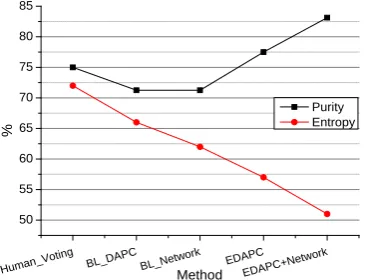
Table 1 shows the overall performance of vari-ous methods on subgroup detection and Figure 6 depicts the average performance. We can see that our method significantly outperforms two baseline methods and human voting. The human perfor-mance is not satisfying, which indicates it’s very challenging even for a human to identify a deceiv-er whose deceptive statement is mixed with plenty of truthful opinions (Xu and Zhao, 2012).
1 Human_V
oting
BL_DAPCBL_Network EDAPC
EDAPC+
Network 50
55 60 65 70 75 80 85
%
Method
[image:7.595.91.274.308.448.2]Purity Entropy
Figure 6: An overview of the average performance of all the methods.
By extending the DAPC method (EDPAC), we can estimate the distance between two players more accurately by considering the attitudes of other players toward them and their attitudes to-ward each other. Given the log in Figure 2 as in-put, players 5 (detective) and 7 (killer) are clutered into one group when DAPC is applied s-ince they don’t have conflicting views on the i-dentities of other players. However, 5 voted for 7 and is supported by more players compared with 7, which indicates that they are less likely to be teammates. We can successfully separate them af-ter re-computing the distance between them.
Adding network information provided 5.7% further gain in Purity. In some cases, the perfor-mance remains the same when EDAPC clustering result is already optimal with the minimum value of the criterion function.
4.4 Dynamic Subgroup Detection
As shown in Figure 7, the performance of our approach improves as the game proceeds. Play-ers seldom maintain their opinions throughout a game. Figure 2 shows that most killers (16,1,12) insisted that citizen 11 should be a killer except 7. As a response to the group pressure (Asch, 1951), 7 changed his opinion and stated that 11 could be a killer in the following round.
In reality, a discussant who participates in an online discussion tends to change his opinion-s about a target aopinion-s he learnopinion-s more information, which shows both the necessity and importance of the dynamic detection of subgroups. Our method can be applied to detect subgroups dynamically by grouping posts into multiple discussion “rounds” based on their timestamps.
1
Purity Entropy 50
60 70 80
%
[image:7.595.327.505.319.460.2]1st round 1st + 2nd rounds all rounds
Figure 7: Average performance based on different rounds.
5 Related Work
5.1 Opinion Analysis
5.2 Deception Detection
Most of the previous computational work for deception detection used supervised/semi-supervised classification methods (Li et al., 2013b). Besides lexical and syntactical fea-tures (Ott et al., 2011; Feng et al., 2012; Yancheva and Rudzicz, 2013), Feng and Hirst (2013) pro-posed using profile compatibility to distinguish fake and genuine reviews. Xu and Zhao (2012) used deep linguistic features such as text genre to detect deceptive opinion spams. Banerjee et al. (2014) used extended linguistic signals such as keystroke patterns. Li et al. (2013a) used topic models to detect the difference between deceptive and truthful topic-word distribution. Researchers have began to realize the importance of analyzing computer-mediated communication in deception detection. Zhou and Sung (2008) conducted an empirical study on deception cues using the killer game as a task scenario and obtained many interesting findings (e.g., deceivers send fewer messages than truth-tellers).
Our work is most related to the work of Chit-taranjan and Hung (2010) on detecting deceptive roles in the Werewolf Game which is another vari-ant of the killer game. They created a Werewolf data set by audio-visual recording 8 games played by 2 groups of people face-to-face and extract-ed audio features and interaction features for their experiments. However, we should note that non face-to-face deception detection emphasizes ver-bal and linguistic cues over less controllable non-verbal communication cues (Walther, 1996).
5.3 Subgroup Detection
In online discussions, people usually split into subgroups based on various topics. The member of a subgroup is more likely to show positive at-titude to the members of the same subgroup, and negative attitude to the members of opposing sub-groups (Abu-Jbara et al., 2012a). Previous work also studied subgroup detection in social media sites. Abu-Jbara et al. (2012a) constructed a dis-cussant attitude profile (DAP) for each disdis-cussant and then used clustering techniques to cluster their attitudes. Hassan et al. (2012; 2012b; 2013) pro-posed various methods to automatically construct a signed social network representation of discus-sions and then identify subgroups by partitioning their signed networks. Qiu et al. (2013) applied collaborative filtering through Probabilistic Matrix
Factorization (PMF) to generalize and improve ex-tracted opinion matrices.
An underlying assumption of the previous work was that a participant will not tell lies nor hide his own stance. Moreover, their work did not take in-to account that a person’s attitude or stance will change as he learns more by reading the com-ments from others and acquiring more background knowledge (Bandura, 1971). Our contribution is that we extend the DAP method and combine it with the signed network partition in order to clus-ter the hidden group members. We also develop a novel cluster ensemble approach in order to ana-lyze the dynamic network.
6 Conclusions and Future Work
Using the killer game as a case study, we present an effective clustering method to detect subgroups from dynamic conversations with lies and truth-s. This is the first work to utilize the dynam-ics of group conversations for deception detec-tion. Experiments demonstrated that truth-tellers and deceptive groups are separable and the pro-posed method significantly outperforms baseline approaches and human voting.
Our work builds a pathway to future work in deception detection in content-rich dynamic envi-ronments such as electronic commerce and repeat-ed interrogation which will require sophisticatrepeat-ed content and network analysis. In real-life suspects may be interrogated about particular events on nu-merous occasions. Our method can potentially be modified to find criminals who act in groups based on their statements. Other applications of this re-search include law enforcement, financial fraud, fraudulent ad campaigns and social engineering.
Acknowledgement
This work was supported by the U.S. DARPA DEFT Program No. FA8750-13-2-0041, ARL NS-CTA No. W911NF-09-2-0053, NSF Award-s IIS-0953149 and IIS-1523198, AFRL DREAM project, gift awards from IBM, Google, Disney and Bosch. The views and conclusions contained in this document are those of the authors and should not be interpreted as representing the of-ficial policies, either expressed or implied, of the U.S. Government. The U.S. Government is autho-rized to reproduce and distribute reprints for Gov-ernment purposes notwithstanding any copyright notation here on.
References
A. Abu-Jbara, M. Diab, P. Dasigi, and D. Radev. 2012a. Subgroup detection in ideological discus-sions. InProc. Annual Meeting of the Association
for Computational Linguistics (ACL 2012).
A. Abu-Jbara, A. Hassan, and D. Radev. 2012b. Atti-tudeminer: mining attitude from online discussions.
InProc. North American Chapter of the Association
for Computational Linguistics - Human Language
Technologies (NAACL HLT 2012).
A. Abu-Jbara, B. King, M. Diab, and D. Radev. 2013. Identifying opinion subgroups in arabic online dis-cussions. In Proc. Association for Computational
Linguistics (ACL 2013).
S. Asch. 1951. Effects of group pressure upon the modification and distortion of judgments. Groups,
leadership, and men. S.
A. Balahur, R. Steinberger, E. Goot, B. Pouliquen, and M. Kabadjov. 2009. Opinion mining on newspaper quotations. In IEEE/WIC/ACM International Joint Conferences on Web Intelligence and Intelligent
A-gent Technologies (WI-IAT 2009).
A. Bandura. 1971. Social Learning Theory. General Learning Corporation.
R. Banerjee, S. Feng, J. Kang, and Y. Choi. 2014. Keystroke patterns as prosody in digital writings: A case study with deceptive reviews and essays. In
Proc. Empirical Methods on Natural Language
Pro-cessing (EMNLP 2014).
D. Buller and J. Burgoon. 1996. Interpersonal decep-tion theory. Communication theory.
David B Buller, Judee K Burgoon, JA Daly, and JM Wiemann. 1994. Deception: Strategic and nonstrategic communication. Strategic
interperson-al communication.
G. Chittaranjan and H. Hung. 2010. Are you awere-wolf? detecting deceptive roles and outcomes in a conversational role-playing game. InIEEE Interna-tional Conference on Acoustics Speech and Signal
Processing (ICASSP 2010).
P. Doreian and A. Mrvar. 1996. A partitioning ap-proach to structural balance. Social networks. V. Feng and G. Hirst. 2013. Detecting deceptive
opin-ions with profile compatibility. InProc. Internation-al Joint Conference on NaturInternation-al Language
Process-ing (IJCNLP 2013).
S. Feng, R. Banerjee, and Y. Choi. 2012. Syntactic stylometry for deception detection. InProc.
Associ-ation for ComputAssoci-ational Linguistics (ACL 2012).
N. E. Friedkin. 2010. The attitude-behavior linkage in behavioral cascades.Social Psychology Quarterly. P. Granhag and L. Str¨omwall. 2002. Repeated
inter-rogations: verbal and non-verbal cues to deception.
Applied Cognitive Psychology.
A. Hassan, A. Abu-Jbara, and D. Radev. 2012. De-tecting subgroups in online discussions by model-ing positive and negative relations among partici-pants. InProc. Empirical Methods in Natural guage Processing and Computational Natural
Lan-guage Learning (EMNLP-CoNLL 2012).
S. Kim and E. Hovy. 2006. Extracting opinions, opin-ion holders, and topics expressed in online news me-dia text. InProc. ACL-COLING 2006 Workshop on
Sentiment and Subjectivity in Text.
J. Li, C. Cardie, and S. Li. 2013a. Topicspam: a topic-model based approach for spam detection. In
Proc. Association for Computational Linguistics
(A-CL 2013).
J. Li, M. Ott, and C. Cardie. 2013b. Identifying ma-nipulated offerings on review portals. InProc. Em-pirical Methods on Natural Language Processing
(EMNLP 2013).
C. Manning, P. Raghavan, and H. Sch¨utze. 2008.
In-troduction to information retrieval. Cambridge
uni-versity press Cambridge.
M. Ott, Y. Choi, C. Cardie, and J. Hancock. 2011. Finding deceptive opinion spam by any stretch of the imagination. InProc. Association for
Computation-al Linguistics (ACL 2011).
G. Qiu, B. Liu, J. Bu, and C. Chen. 2011. Opinion word expansion and target extraction through double propagation. Computational linguistics.
M. Qiu, L. Yang, and J. Jiang. 2013. Mining us-er relations from online discussions using sentimen-t analysis and probabilissentimen-tic masentimen-trix facsentimen-torizasentimen-tion. In
Proc. North American Chapter of the Association for Computational Linguistics - Human Language
S. Somasundaran and J. Wiebe. 2009. Recognizing s-tances in online debates. InProc. Joint Conference of the Annual Meeting of the ACL and the 4th In-ternational Joint Conference on Natural Language
Processing of the AFNLP.
M. Steinbach, G. Karypis, V. Kumar, et al. 2000. A comparison of document clustering techniques. In
Proc. KDD 2000 workshop on text mining.
E. Voorhees. 1986. Implementing agglomerative hi-erarchic clustering algorithms for use in document retrieval. Information Processing & Management. A. Vrij, P. Granhag, and S. Porter. 2010. Pitfalls and
opportunities in nonverbal and verbal lie detection.
Psychological Science in the Public Interest.
A. Vrij. 2000. Detecting lies and deceit: The psychol-ogy of lying and implications for professional prac-tice. Wiley.
J. Walther. 1996. Computer-mediated communication impersonal, interpersonal, and hyperpersonal inter-action. Communication research.
Q. Xu and H. Zhao. 2012. Using deep linguistic features for finding deceptive opinion spam. In
Proc. International Conference on Computational
Linguistics (COLING 2012).
M. Yancheva and F. Rudzicz. 2013. Automatic de-tection of deception in child-produced speech using syntactic complexity features. InProc. Association
for Computational Linguistics (ACL 2013).
H. Zhang, H. Yu, D. Xiong, and Q. Liu. 2003. Hhmm-based chinese lexical analyzer ictclas. In Proc. SIGHAN 2003 workshop on Chinese language
pro-cessing.
L. Zhou and Y. Sung. 2008. Cues to deception in on-line chinese groups. InProc. Hawaii International
Conference on System Sciences (HICSS 2008).
L. Zhou, J Burgoon, J. Nunamaker, and D. Twitchell. 2004. Automating linguistics-based cues for detect-ing deception in text-based asynchronous computer-mediated communications. Group decision and