3362
The Effectiveness of Simple Hybrid Systems for Hypernym Discovery
William Held and Nizar Habash
Computational Approaches to Modeling Language Lab New York University Abu Dhabi, UAE
{wbh230,nizar.habash}@nyu.edu
Abstract
Hypernymy modeling has largely been sep-arated according to two paradigms, pattern-based methods and distributional methods. However, recent works utilizing a mix of these strategies have yielded state-of-the-art results. This paper evaluates the contribution of both paradigms to hybrid success by evaluating the benefits of hybrid treatment of baseline mod-els from each paradigm. Even with a simple methodology for each individual system, uti-lizing a hybrid approach establishes new state-of-the-art results on two domain-specific En-glish hypernym discovery tasks and outper-forms all non-hybrid approaches in a general English hypernym discovery task.
1 Introduction
Discovering word-level hierarchies has long been an important step in constructing language tax-onomies. The most important of these hierar-chical relationships is hypernymy or the ISA-relationship, i.e. ‘chihuahua’ is a ‘dog’, which forms the backbone of word-level taxonomies, most notably WordNet (Fellbaum,1998).
Early works on the modeling of this relation-ship focused on the practical task of discover-ing new instances of the hypernymy relationship given a vocabulary and an existing resource with labeled data about hypernymy, described as hy-pernym discovery by Camacho-Collados (2017). For the purposes of discovery, Hearst (1992) de-veloped a landmark set of lexico-syntactic patterns which indicated hypernymy.
There have been many follow-ups on this con-cept of identifying and utilizing patterns to iden-tify hypernym pairs (Caraballo, 1999; Mann,
2002;Snow et al.,2005,2006). However, by re-stricting the sentences of interest to only those which match patterns, even very large datasets with very loose pattern matching will often return
small co-occurrence numbers, especially for more indirectly connected hypernym pairs.
To tackle the sparsity of pattern-based ap-proaches, recent focus has turned to distribu-tional models of hypernymy. Distribudistribu-tional mod-els are attractive since they use signals drawn from every sentence of training data. Distributional approaches have focused on discovering spatial properties of embedding space which capture the hypernymy relationship (Kotlerman et al., 2010;
Yamane et al.,2016;Shwartz et al.,2017;Nickel and Kiela, 2017;Vulic and Mrksic, 2017). The performance of distributional approaches in hy-pernymy detection shows promise to create a more broad picture of the hypernymy relationship space.
Recently, hybrid models of hypernymy, in both discovery and detection, have surpassed the per-formance of either paradigm individually. Simi-larly, the current state-of-the-art in hypernymy de-tection was set by a classifier which integrated information from both pattern data and distribu-tional word embeddings (Shwartz et al.,2016). In hypernym discovery, where purely distributional methods have struggled, a model which utilized a hybrid approach of patterns and distributional representations far and away led the results of a recent SemEval Task (Camacho-Collados et al.,
2018;Bernier-Colborne and Barriere,2018).
2 Pattern-Based Model
In order to make our pattern-based approach return a reasonable number of candidate hypernyms, we apply two separate methods to increase the num-ber of candidate hypernyms presented by the pat-tern based model.
Extended Pattern Use First, we utilize a set of
47 extended Hearst Patterns as collected in Seit-ner et al. (2016). Additionally, we consider n-gram terms from our vocabulary to inherently con-tain a pattern co-occurrence with their sub-terms, e.g., nuclear physics →hyponym physics. In En-glish, this construction is common and accounts for a high number of “co-occurrences” between hyponyms and hypernyms.
All input sentences are tested by regular expres-sion representations of these 47 patterns, yield-ing a table of candidates for the hypernymy re-lationship, in the form of xhypo, yhyper, and the
number of times the pairs co-occurred in any of the extended Hearst Patterns. This stage is fully unsupervised but aims to extract lexico-syntactic information which indicates direct hypernymy. This raw co-occurrence table can be used to dis-cover hypernym terms, with hypernym candidates scored based on their raw counts.
Hearst Matrix Singular Value Decomposition
While this raw co-occurrence table can be used to discover candidate hypernyms, it still suffers from a high amount of sparsity even for terms which occur in patterns. Roller et al. (2018) showed exactly that performing singular value decompo-sition on co-occurrence tables can yield recall improvements, oftentimes outperforming state-of-the-art distributional methods for the hypernym detection task.
To modify this method for the hypernym dis-covery task, we simply sort all vocabulary terms that occur in Hearst Patterns according to the fol-lowing metric:
sp(x, y) =UxTΣrVy
where U, Σ, and V are taken from the singu-lar value decomposition of the Hearst Pattern co-occurrence matrix andUx, Vy are the row vector
and the column vector for the hyponym and the hypernym respectively. Then, a similarity cutoff is tuned to maximize the F1 score of our predicted hypernyms on any labeled data that we have.
For words which never occur in any patterns, we still lack the ability to generate any reasonable candidates which causes this approach to still suf-fer from low total recall due to query terms never seen in patterns.
3 Distributional Modeling with Hypernyms from Nearest Neighbor
For our distributional methodology, we choose the simplest possible supervised approach to hy-pernym discovery - a single nearest neighbor ap-proach - in which the hypernyms for each query term are transferred from their nearest neighbor in the training data. This approach is motivated by the work of Snow et al. (2006) where linking a new hyponym to a similar known hyponym was shown to effectively encode an enormous amount of signal about correct hypernyms.
Our method is as follows. Suppose we have a training set H consisting of a number of hy-ponyms and their corresponding hypernyms.
H :{Hypoi:Hyper1i...Hyper j i}
For a given query term Q, we find the nearest neighbor Hyponn from the training set by the
cosine similarity of vector representations of the words. The hypernyms of the nearest neighbor are then sorted by descending frequency in the train-ing set, such that the words which served as hy-pernyms to more known terms in the training data come first.
This sorting metric serves as a heuristic of the generality of the hypernyms of the nearest neigh-bor. Since the nearest neighbor is unlikely to be an exact synonym, it is more likely that the query and its nearest neighbor share more general hyper-nyms, those that would appear at a lower depth in a taxonomy, than they are to share extremely spe-cific hypernyms.
Additionally, a similarity cutoff point is trained on tuning data, such that if there is no nearest neighbor with greater similarity the cutoff point, the nearest neighbors strategy simply returns the most frequent hypernyms from the entire training set. Contrasting to the Hearst Patterns, our distri-butional method instead tries to provide as many reasonable guesses to hypernyms as possible un-less the nearest neighbor is very far away.
Embedding Methodology Details In theory,
General Medical Music
Model Variant MAP MRR P@5 MAP MRR P@5 MAP MRR P@5
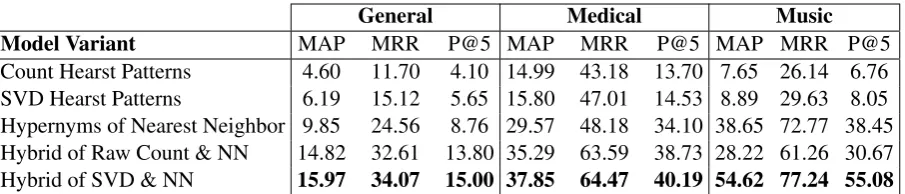
Count Hearst Patterns 4.60 11.70 4.10 14.99 43.18 13.70 7.65 26.14 6.76
SVD Hearst Patterns 6.19 15.12 5.65 15.80 47.01 14.53 8.89 29.63 8.05
Hypernyms of Nearest Neighbor 9.85 24.56 8.76 29.57 48.18 34.10 38.65 72.77 38.45 Hybrid of Raw Count & NN 14.82 32.61 13.80 35.29 63.59 38.73 28.22 61.26 30.67
[image:3.595.75.528.61.158.2]Hybrid of SVD & NN 15.97 34.07 15.00 37.85 64.47 40.19 54.62 77.24 55.08
Table 1: Comparison of model variants on all three sub-tasks of SemEval 2018 Task 9.
nearest neighbor task as it does not explicitly take advantage of any particular features of a partic-ular word embedding. However, in practice, we found that the FastText (Bojanowski et al.,2016) algorithm is preferable since even out of vocabu-lary query words are able to be given reasonable embeddings due to the meaningful embeddings of sub-strings that FastText provides. This guar-antees that the nearest neighbor approach always gives some form of candidate hypernyms, even for words which are out of vocabulary or word n-grams which don’t have specific embeddings. For the purposes of evaluation, we used 100-dimensional embeddings with common n-grams joined together.
4 Hybrid Approach
Ultimately, we combine the methods in order to capture the valuable elements of each. While pattern-based approaches suffer from sparseness, they do tend to generate high precision results when available. Conversely, the nearest neigh-bor approach almost always generates a fair num-ber of candidate hypernyms but suffers from low precision unless the nearest neighbor is an ex-act synonym. Therefore, we propose the follow-ing orderfollow-ing rule for candidate hypernyms. When the pattern-based approach yields results, we rank them as first. Then, the hypernyms of the near-est neighbor are added until our total desired num-ber of candidates is reached. Since this is a super-vised setting, we tune a cutoff similarity value for the pattern-based approaches as described in Sec-tion2.
5 Experiments & Results
We evaluate our model on SemEval 2018 Task 9, the only existing benchmark for the hypernym dis-covery task. Specifically, we focus on the 3 En-glish sub-tasks: general EnEn-glish, Medical litera-ture, and Music literature. Each task comes with a
separate corpus of unlabeled text data, training and trial data of hyponyms labeled with their complete list of hypernyms, and a vocabulary of valid hyper-nyms. The final results of a model are tested on a dataset of equal size to the training data. Further details can be found in Camacho-Collados et al.
(2018)’s paper describing the tasks and their re-spective data.
For each sub-task, we only use the data from the specific sub-task we are evaluating. The provided trial dataset is used to tune our cutoff points for Hearst Pattern frequency and minimum similar-ity for the nearest neighbor hypernyms approach. For each query word, we propose 15 candidates ranked as described in Section4.
Our initial experiments, shown in Table1, com-pare all variations of our described systems on all tasks. The hybrid models consistently outperform the individual independent models by a significant margin, except for the Music task where the raw count method seems to negatively impact the hy-pernyms of nearest neighbor approach. The fact that our simple combination of these two models yields improved results is a positive indication that they each contribute separate signals to the model.
General Medical Music
Model MAP MRR P@5 MAP MRR P@5 MAP MRR P@5
Hybrid of SVD & NN(Our Model) 15.97 34.07 15.00 37.85 64.47 40.19 54.62 77.24 55.08
CRIM(Bernier-Colborne and Barriere,2018) 19.78 36.10 19.03 34.05 54.64 36.77 40.97 60.93 41.31
vTE∗(Espinosa-Anke et al.,2016) 10.60 23.83 9.91 18.84 41.07 20.71 12.99 39.36 12.41
300-sparsans(Berend et al.,2018) 8.95 19.44 8.63 20.75 40.60 21.43 29.54 46.43 28.86
[image:4.595.72.525.61.158.2]Most Frequent Hypernym∗ 8.77 21.39 7.81 28.93 35.80 34.20 33.32 51.48 35.76
Table 2: Results for all three English sub-tasks in SemEval 2018 Task 9. Baselines are marked with *, state-of-the-art is marked in bold.
Our simple hybrid model outperforms all sys-tems in the competition on the general English hy-pernym discovery task except for CRIM. In the general task, we find it worth noting that there is a significant performance gap between our hy-brid approach and all non-hyhy-brid models, despite the simplicity of our model. The state-of-the-art model, CRIM, is also a hybrid model, but it makes much more robust use of the larger training set provided in the general English sub-task.
Perhaps more surprising, our model yields new state-of-the-art results for the Music and Medical sub-domain tasks. As these approaches are both much smaller tasks with around 1/3rd of the train-ing data, we see that our model is able to make effective use out of smaller datasets as well.
6 Analysis
In our goal of evaluating hybrid models in isolation, we quantitatively analyze why these paradigms are beneficial in concert and manually analyze where these models fail and perform well.
Hypernymy Distance Analysis In order to
ex-plain the high degree of compatibility the hybrid model highlights, we explore the idea that each model is modeling not only signal in support of the same hypernyms but tends to model wholly differ-ent types of hypernymy.
In Section 3, we discussed the intuitions be-hind our sorting method that optimizes the nearest neighbor to rank general hypernyms first, as these are more likely to also apply to the query term. By contrast, the Hearst Patterns are more likely to oc-cur when the query and hypernym are directly re-lated. Our intuitions about the type of information captured by each model state that nearest neigh-bors should effectively yield higher portions of the taxonomy, while Hearst Patterns will link direct hypernyms.
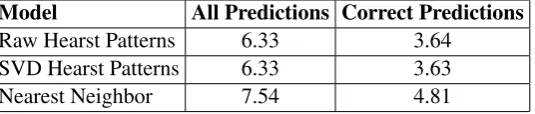
In Table 3, we support this by calculating the
average length of the shortest path between the hyponym and the proposed hypernym for each model. The metric is not dramatic but it clearly separates the two approaches. Correctly predicted hypernyms from the nearest neighbor approach lie on average around one step further away on Word-net from their query words than our correctly pre-dicted hypernyms from the Hearst Patterns.1
Manual Error Analysis In order to more fully
understand the contributions of each model to our results, we perform manual error analysis on a ran-domly selected subset of the test data. 100 ex-amples were selected from the General sub-task and 50 examples each were taken from the Mu-sic and Medical sub-tasks. Results are in Table
4. Within these examples, each candidate is la-beled with which system yielded the answer. We also categorize certain types of error into their own class.
Overall, Hearst Pattern candidates account for 20% of all candidates and have a precision of 18%. Nearest Neighbor candidates are 80% of all candi-dates and also have a precision of 18%. The full Hearst Pattern precision numbers are 10%, 38% and 68% for the General, Music and Medical sub-tasks, respectively. The Nearest Neighbor preci-sion numbers are 9%, 20%and 29%, respectively.
In all datasets, Hearst Patterns alone almost never capture all hypernyms, but especially in special topic fields they show high precision re-sults, as projected by previous work. In the general subtask, Hearst Patterns struggle more, generally when the query term is a term that is used in versions of the patterns that do not trans-late well to actual hypernymy, e.g., consump-tion→bad pattern hyponym factor from the phrase
1This distance is calculated when both terms exist in
Model All Predictions Correct Predictions
Raw Hearst Patterns 6.33 3.64
SVD Hearst Patterns 6.33 3.63
Nearest Neighbor 7.54 4.81
Table 3: Average length of shortest path between predicted hypernyms and their input hyponyms.
Correct Incorrect Near Miss Gold Error
Dataset HP NN HP NN HP NN HP NN
General (100) 24 58 384 893 33 39 25 39
Music (50) 30 188 50 468 7 0 5 2
[image:5.595.168.436.63.120.2]Medical (50) 21 141 8 558 2 0 3 0
Table 4: Error analysis of all all candidate hypernyms in a random sub-sample (number of queries in parentheses).
”Consumption is a factor in...”.
Altogether, our best answers largely come from either very similar nearest neighbors, or hybrid in-stances where the Hearst Patterns capture a few specific hypernyms and rough hypernyms are cap-tured by the nearest neighbor. We view the lat-ter instances as ideal, since they depend neither on a perfect nearest neighbor nor on patterns capturing indirect hypernyms. For example, the queryFudan Universityhas three gold hypernyms
{university,school,educational institution}, uni-versityandschoolare returned by the Hearst Pat-terns andeducational institutionis returned by the nearest neighbor.
In the general sub-task, the selection of a bad nearest neighbor when no Hearst Patterns are found is the source of a large number of major failures. Qualitative analysis generally shows that this occurs when the embedding for a rarely used query word must rely on its sub-string embedding from fastText, leading to a very incorrect nearest neighbor that still has high confidence, e.g.,Queen Elizabeth→bad nearest neighborElizabeth Einstein. In the more specific sub-tasks, this type of error is less common as the domain is constrained in scope, making wildly incorrect nearest neighbors less common. However, in these more specific tasks, outliers with no strong nearest neighbor are much more frequent as the number of low confi-dence nearest neighbors increases in these tasks. In these cases, the model defaults to giving the most frequent hypernyms from training since the confidence cutoffs of neither Hearst Patterns nor the nearest neighbor similarity are met.
We also separate out two interesting categories of error: gold errors (occurring 2.5% of the time)
and near misses (occurring 2.9% of the time). These categories have similar properties and gen-erally form within specific queries. The prior oc-curs primarily when a different sense is captured than the sense in the gold data itself, e.g., ce-real→gold f alse negative{crop,grain,snack, food-stuff, carbohydrate}. The latter occurs primar-ily when an incorrect, but close, famprimar-ily of hy-pernyms is obtained from the data, e.g., mi-croscope→near miss candidates{technology,
facil-ity,observer,measuring device}.
7 Conclusions and Future Work
We studied the impact of utilizing a hybrid of pattern-based and distributional models for hy-pernym discovery by hybridizing simple models from each paradigm. Our results show that hybrid models of even simple systems are able to per-form surprisingly well, consistently outperper-form- outperform-ing more robust soutperform-ingle strategy models. Interest-ingly, a manual error analysis and metrics taken from WordNet suggests each paradigm models different types of hypernymy. We conclude that further work in hypernym discovery should uti-lize signals taken from both historical paradigms of hypernymy modeling, not only to improve con-fidence in answers but also to capture both direct and indirect hypernym relationships.
References
G´abor Berend, M´arton Makrai, and Peter F¨oldi´ak. 2018. 300-sparsans at semeval-2018 task 9: Hy-pernymy as interaction of sparse attributes. pages 928–934.
to hypernym discovery. In Proceedings of The 12th International Workshop on Semantic Evalua-tion, pages 725–731.
Piotr Bojanowski, Edouard Grave, Armand Joulin, and Tomas Mikolov. 2016. Enriching word vec-tors with subword information. arXiv preprint arXiv:1607.04606.
Jose Camacho-Collados. 2017. Why we have switched from building full-fledged taxonomies to simply detecting hypernymy relations. arXiv preprint arXiv:1703.04178.
Jose Camacho-Collados, Claudio Delli Bovi, Luis Es-pinosa Anke, Sergio Oramas, Tommaso Pasini, En-rico Santus, Vered Shwartz, Roberto Navigli, and Horacio Saggion. 2018. Semeval-2018 task 9: Hy-pernym discovery. InProceedings of The 12th Inter-national Workshop on Semantic Evaluation, pages 712–724.
Sharon A Caraballo. 1999. Automatic construction of a hypernym-labeled noun hierarchy from text. In Proceedings of the 37th annual meeting of the Asso-ciation for Computational Linguistics.
Luis Espinosa-Anke, Jose Camacho-Collados, Claudio Delli Bovi, and Horacio Saggion. 2016. Supervised distributional hypernym discovery via domain adap-tation. InConference on Empirical Methods in Nat-ural Language Processing; 2016 Nov 1-5; Austin, TX. Red Hook (NY): ACL; 2016. p. 424-35. ACL (Association for Computational Linguistics).
Christiane Fellbaum. 1998. Wordnet: An electronic lexical database and some of its applications.
Marti A Hearst. 1992. Automatic acquisition of hy-ponyms from large text corpora. InProceedings of the 14th conference on Computational linguistics-Volume 2, pages 539–545. Association for Compu-tational Linguistics.
Lili Kotlerman, Ido Dagan, Idan Szpektor, and Maayan Zhitomirsky-Geffet. 2010. Directional distribu-tional similarity for lexical inference. Natural Lan-guage Engineering, 16(4):359–389.
Gideon S Mann. 2002. Fine-grained proper noun on-tologies for question answering. InProceedings of the 2002 workshop on Building and using seman-tic networks-Volume 11, pages 1–7. Association for Computational Linguistics.
Maximillian Nickel and Douwe Kiela. 2017. Poincar´e embeddings for learning hierarchical representa-tions. InAdvances in Neural Information Process-ing Systems, pages 6341–6350.
Stephen Roller, Douwe Kiela, and Maximilian Nickel. 2018. Hearst patterns revisited: Automatic
hy-pernym detection from large text corpora. CoRR,
abs/1806.03191.
Julian Seitner, Christian Bizer, Kai Eckert, Stefano Faralli, Robert Meusel, Heiko Paulheim, and Si-mone Paolo Ponzetto. 2016. A large database of hy-pernymy relations extracted from the web.
Vered Shwartz, Yoav Goldberg, and Ido Dagan. 2016. Improving hypernymy detection with an inte-grated path-based and distributional method. arXiv preprint arXiv:1603.06076.
Vered Shwartz, Enrico Santus, and Dominik Schlechtweg. 2017. Hypernyms under siege: Linguistically-motivated artillery for hypernymy detection. pages 65–75.
Rion Snow, Daniel Jurafsky, and Andrew Y Ng. 2005. Learning syntactic patterns for automatic hypernym discovery. In Advances in neural information pro-cessing systems, pages 1297–1304.
Rion Snow, Daniel Jurafsky, and Andrew Y Ng. 2006. Semantic taxonomy induction from heterogenous evidence. In Proceedings of the 21st International Conference on Computational Linguistics and the 44th annual meeting of the Association for Compu-tational Linguistics, pages 801–808. Association for Computational Linguistics.
Ivan Vulic and Nikola Mrksic. 2017.
Specialis-ing word vectors for lexical entailment. CoRR,
abs/1710.06371.