1044
Strong Baselines for Neural Semi-Supervised Learning
under Domain Shift
Sebastian Ruder♠♣ Barbara Plank♥3
♠Insight Research Centre, National University of Ireland, Galway, Ireland ♣Aylien Ltd., Dublin, Ireland
♥Center for Language and Cognition, University of Groningen, The Netherlands
3Department of Computer Science, IT University of Copenhagen, Denmark
[email protected],[email protected]
Abstract
Novel neural models have been proposed in recent years for learning under domain shift. Most models, however, only evaluate on a single task, on proprietary datasets, or compare to weak baselines, which makes comparison of models difficult. In this pa-per, we re-evaluate classic general-purpose bootstrapping approaches in the context of neural networks under domain shifts vs. re-cent neural approaches and propose a novel multi-task tri-trainingmethod that reduces the time and space complexity of classic tri-training. Extensive experiments on two benchmarks are negative: while our novel method establishes a new state-of-the-art for sentiment analysis, it does not fare con-sistently the best. More importantly, we arrive at the somewhat surprising conclu-sion that classic tri-training, with some ad-ditions, outperforms the state of the art. We conclude that classic approaches constitute an important and strong baseline.
1 Introduction
Deep neural networks (DNNs) excel at learning from labeled data and have achieved state of the art in a wide array of supervised NLP tasks such as dependency parsing (Dozat and Manning,2017), named entity recognition (Lample et al.,2016), and semantic role labeling (He et al.,2017).
In contrast, learning from unlabeled data, es-pecially under domain shift, remains a challenge. This is common in many real-world applications where the distribution of the training and test data differs. Many state-of-the-art domain adaptation approaches leverage task-specific characteristics such as sentiment words (Blitzer et al.,2006;Wu and Huang,2016) or distributional features (
Schn-abel and Schütze,2014;Yin et al., 2015) which do not generalize to other tasks. Other approaches that are in theory more general only evaluate on proprietary datasets (Kim et al.,2017) or on a sin-gle benchmark (Zhou et al.,2016), which carries the risk of overfitting to the task. In addition, most models only compare against weak baselines and, strikingly, almost none considers evaluating against approaches from the extensive semi-supervised learning (SSL) literature (Chapelle et al.,2006).
In this work, we make the argument that such al-gorithms make strong baselines for any task in line with recent efforts highlighting the usefulness of classic approaches (Melis et al.,2017;Denkowski and Neubig,2017). We re-evaluate bootstrapping algorithms in the context of DNNs. These are general-purpose semi-supervised algorithms that treat the model as a black box and can thus be used easily—with a few additions—with the current gen-eration of NLP models. Many of these methods, though, were originally developed with in-domain performance in mind, so their effectiveness in a domain adaptation setting remains unexplored.
In particular, we re-evaluate three traditional bootstrapping methods, self-training (Yarowsky, 1995), tri-training (Zhou and Li, 2005), and tri-training with disagreement (Søgaard, 2010) for neural network-based approaches on two NLP tasks with different characteristics, namely, a se-quence prediction and a classification task (POS tagging and sentiment analysis). We evaluate the methods across multiple domains on two well-established benchmarks, without taking any further task-specific measures, and compare to the best results published in the literature.
In addition, we proposemulti-task tri-training, which reduces the main deficiency of tri-training, namely its time and space complexity. It establishes a new state of the art on unsupervised domain adap-tation for sentiment analysis but it is outperformed by classic tri-training for POS tagging.
Contributions Our contributions are: a) We pro-pose a novel multi-task tri-training method. b) We show that tri-training can serve as a strong and ro-bust semi-supervised learning baseline for the cur-rent generation of NLP models. c) We perform an extensive evaluation of bootstrapping1algorithms compared to state-of-the-art approaches on two benchmark datasets. d) We shed light on the task and data characteristics that yield the best perfor-mance for each model.
2 Neural bootstrapping methods
We first introduce three classic bootstrapping meth-ods, self-training, tri-training, and tri-training with disagreement and detail how they can be used with neural networks. For in-depth details we refer the reader to (Abney,2007;Chapelle et al.,2006;Zhu and Goldberg,2009). We introduce our novel multi-task tri-training method in §2.3.
2.1 Self-training
Self-training (Yarowsky, 1995; McClosky et al., 2006b) is one of the earliest and simplest boot-strapping approaches. In essence, it leverages the model’s own predictions on unlabeled data to ob-tain additional information that can be used during training. Typically the most confident predictions are taken at face value, as detailed next.
Self-training trains a modelmon a labeled train-ing setL and an unlabeled data set U. At each iteration, the model provides predictionsm(x)in the form of a probability distribution over classes for all unlabeled examplesx inU. If the proba-bility assigned to the most likely class is higher than a predetermined thresholdτ,xis added to the labeled examples withp(x) = arg maxm(x)as pseudo-label. This instantiation is the most widely used and shown in Algorithm1.
Calibration It is well-known that output prob-abilities in neural networks are poorly calibrated (Guo et al.,2017). Using a fixed thresholdτ is thus
1We use the term bootstrapping as used in the semi-supervised learning literature (Zhu,2005), which should not be confused with the statistical procedure of the same name (Efron and Tibshirani,1994).
Algorithm 1Self-training (Abney,2007)
1: repeat
2: m←train_model(L) 3: forx∈U do
4: ifmaxm(x)> τ then
5: L←L∪ {(x, p(x))}
6: untilno more predictions are confident
not the best choice. While theabsoluteconfidence value is inaccurate, we can expect that therelative order of confidences is more robust.
For this reason, we select the topnunlabeled examples that have been predicted with the high-est confidence after every epoch and add them to the labeled data. This is one of the many variants for self-training, calledthrottling(Abney,2007). We empirically confirm that this outperforms the classic selection in our experiments.
Online learning In contrast to many classic al-gorithms, DNNs are trained online by default. We compare training setups and find that training until convergence on labeled data and then training until convergence using self-training performs best.
Classic self-training has shown mixed success. In parsing it proved successful only with small datasets (Reichart and Rappoport,2007) or when a generative component is used together with a reranker in high-data conditions (McClosky et al., 2006b;Suzuki and Isozaki,2008). Some success was achieved with careful task-specific data se-lection (Petrov and McDonald,2012), while oth-ers report limited success on a variety of NLP tasks (Plank, 2011; Van Asch and Daelemans, 2016;van der Goot et al.,2017). Its main down-side is that the model is not able to correct its own mistakes and errors are amplified, an effect that is increased under domain shift.
2.2 Tri-training
Tri-training (Zhou and Li,2005) is a classic method that reduces the bias of predictions on unlabeled data by utilizing the agreement of three indepen-dently trained models. Tri-training (cf. Algorithm 2) first trains three models m1, m2, and m3 on
bootstrap samples of the labeled dataL. An unla-beled data point is added to the training set of a modelmiif the other two modelsmj andmkagree on its label. Training stops when the classifiers do not change anymore.
Algorithm 2Tri-training (Zhou and Li,2005)
1: fori∈ {1..3}do
2: Si ←bootstrap_sample(L) 3: mi←train_model(Si)
4: repeat
5: fori∈ {1..3}do 6: Li ← ∅ 7: forx∈U do
8: ifpj(x) =pk(x)(j, k6=i)then
9: Li ←Li∪ {(x, pj(x))}
mi ←train_model(L∪Li)
10: untilnone ofmichanges 11: apply majority vote overmi
is based on the intuition that a model should only be strengthened in its weak points and that the labeled data should not be skewed by easy data points. In order to achieve this, it adds a simple modification to the original algorithm (altering line 8 in Algorithm2), requiring that for an unlabeled data point on whichmj andmkagree, the other modelmidisagreeson the prediction. Tri-training with disagreement is more data-efficient than tri-training and has achieved competitive results on part-of-speech tagging (Søgaard,2010).
Sampling unlabeled data Both tri-training and tri-training with disagreement can be very expen-sive in their original formulation as they require to produce predictions for each of the three models on all unlabeled data samples, which can be in the millions in realistic applications. We thus propose to sample a number of unlabeled examples at every epoch. For all traditional bootstrapping approaches we sample 10k candidate instances in each epoch. For the neural approaches we use a linearly grow-ing candidate samplgrow-ing scheme proposed by (Saito et al.,2017), increasing the candidate pool size as the models become more accurate.
Confidence thresholding Similar to self-training, we can introduce an additional require-ment that pseudo-labeled examples are only added if the probability of the prediction of at least one model is higher than some thresholdτ. We did not find this to outperform prediction without threshold for traditional tri-training, but thresholding proved essential for our method (§2.3).
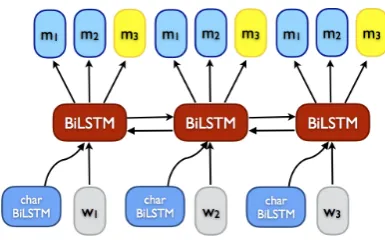
[image:3.595.319.512.59.179.2]The most important condition for tri-training and tri-training with disagreement is that the models are diverse. Typically, bootstrap samples are used
Figure 1: Multi-task tri-training (MT-Tri).
to create this diversity (Zhou and Li, 2005; Sø-gaard,2010). However, training separate models on bootstrap samples of a potentially large amount of training data is expensive and takes a lot of time. This drawback motivates our approach.
2.3 Multi-task tri-training
In order to reduce both the time and space com-plexity of tri-training, we propose Multi-task Tri-training (MT-Tri). MT-Tri leverages insights from multi-task learning (MTL) (Caruana,1993) to share knowledge across models and accelerate training. Rather than storing and training each model sepa-rately, we propose to share the parameters of the models and train them jointly using MTL.2 All models thus collaborate on learning a joint repre-sentation, which improves convergence.
The output softmax layers are model-specific and are only updated for the input of the respective model. We show the model in Figure1(as instan-tiated for POS tagging). As the models leverage a joint representation, we need to ensure that the features used for prediction in the softmax layers of the different models are as diverse as possible, so that the models can still learn from each other’s predictions. In contrast, if the parameters in all output softmax layers were the same, the method would degenerate to self-training.
To guarantee diversity, we introduce an orthog-onality constraint (Bousmalis et al., 2016) as an additional loss term, which we define as follows:
Lorth=kWm>1Wm2k 2
F (1)
where| · k2
F is the squared Frobenius norm and
Wm1 andWm2 are the softmax output parameters
2
of the two source and pseudo-labeled output layers
m1 andm2, respectively. The orthogonality
con-straint encourages the models not to rely on the same features for prediction. As enforcing pair-wise orthogonality between three matrices is not possible, we only enforce orthogonality between the softmax output layers of m1 andm2,3 while m3 is gradually trained to be more target-specific.
We parameterizeLorth byγ=0.01following (Liu et al.,2017). We do not further tuneγ.
More formally, let us illustrate the model by taking the sequence prediction task (Figure1) as il-lustration. Given an utterance with labelsy1, .., yn, our Multi-task Tri-training loss consists of three task-specific (m1, m2, m3) tagging loss functions
(where~his the uppermost Bi-LSTM encoding):
L(θ) =−X i
X
1,..,n
logPmi(y|~h) +γLorth (2)
In contrast to classic tri-training, we can train the multi-task model with its three model-specific outputs jointly andwithoutbootstrap sampling on the labeled source domain data until convergence, as the orthogonality constraint enforces different representations between modelsm1andm2. From
this point, we can leverage the pair-wise agreement of two output layers to add pseudo-labeled exam-ples as training data to the third model. We train the third output layerm3only on pseudo-labeled target
instances in order to make tri-training more robust to a domain shift. For the final prediction, major-ity voting of all three output layers is used, which resulted in the best instantiation, together with con-fidence thresholding (τ = 0.9, except for high-resource POS whereτ = 0.8performed slightly better). We also experimented with using a domain-adversarial loss (Ganin et al.,2016) on the jointly learned representation, but found this not to help. The full pseudo-code is given in Algorithm3.
Computational complexity The motivation for MT-Tri was to reduce the space and time complex-ity of tri-training. We thus give an estimate of its efficiency gains. MT-Tri is ~3× more space-efficient than regular tri-training; tri-training stores one set of parameters for each of the three mod-els, while MT-Tri only stores one set of parameters (we use three output layers, but these make up a comparatively small part of the total parameter bud-get). In terms of time efficiency, tri-training first
3We also tried enforcing orthogonality on a hidden layer rather than the output layer, but this did not help.
Algorithm 3Multi-task Tri-training
1: m←train_model(L) 2: repeat
3: fori∈ {1..3}do
4: Li ← ∅
5: forx∈U do
6: ifpj(x) =pk(x)(j, k6=i)then
7: Li ←Li∪ {(x, pj(x))}
8: ifi= 3thenmi =train_model(Li) 9: elsemi←train_model(L∪Li)
10: untilend condition is met
11: apply majority vote overmi
requires to train each of the models from scratch. The actual tri-training takes about the same time as training from scratch and requires a separate for-ward pass for each model, effectively training three independent models simultaneously. In contrast, MT-Tri only necessitates one forward pass as well as the evaluation of the two additional output lay-ers (which takes a negligible amount of time) and requires about as many epochs as tri-training until convergence (see Table3, second column) while adding fewer unlabeled examples per epoch (see Section3.4). In our experiments, MT-Tri trained about5-6×faster than traditional tri-training.
MT-Tri can be seen as a self-ensembling tech-nique, where different variations of a model are used to create a stronger ensemble prediction. Re-cent approaches in this line aresnapshot ensem-bling(Huang et al.,2017) that ensembles models converged to different minima during a training run, asymmetric tri-training(Saito et al.,2017) (ASYM) that leverages agreement on two models as informa-tion for the third, andtemporal ensembling(Laine and Aila,2017), which ensembles predictions of a model at different epochs. We tried to compare to temporal ensembling in our experiments, but were not able to obtain consistent results.4 We compare to the closest most recent method, asymmetric tri-training (Saito et al.,2017). It differs from ours in two aspects: a) ASYMleverages only pseudo-labels from data points on whichm1andm2agree,
and b) it uses only one task (m3) as final predictor.
In essence, our formulation of MT-Tri is closer to the original tri-training formulation (agreements on two provide pseudo-labels to the third) thereby incorporating more diversity.
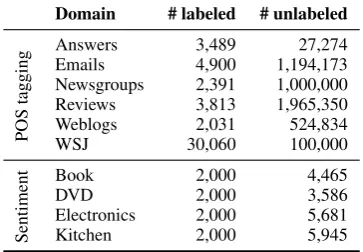
Domain # labeled # unlabeled
POS
tagging
Answers 3,489 27,274 Emails 4,900 1,194,173 Newsgroups 2,391 1,000,000 Reviews 3,813 1,965,350 Weblogs 2,031 524,834 WSJ 30,060 100,000
Sentiment
[image:5.595.89.271.64.190.2]Book 2,000 4,465 DVD 2,000 3,586 Electronics 2,000 5,681 Kitchen 2,000 5,945
Table 1: Number of labeled and unlabeled sen-tences for each domain in the SANCL 2012 dataset (Petrov and McDonald, 2012) for POS tagging (above) and the Amazon Reviews dataset (Blitzer et al.,2006) for sentiment analysis (below).
3 Experiments
In order to ascertain which methods are ro-bust across different domains, we evaluate on two widely used unsupervised domain adaptation datasets for two tasks, a sequence labeling and a classification task, cf. Table1for data statistics.
3.1 POS tagging
For POS tagging we use the SANCL 2012 shared task dataset (Petrov and McDonald,2012) and com-pare to the top results in both low and high-data conditions (Schnabel and Schütze,2014;Yin et al., 2015). Both are strong baselines, as the FLORS tag-ger has been developed for this challenging dataset and it is based on contextual distributional features (excluding the word’s identity), and hand-crafted suffix and shape features (including some language-specific morphological features). We want to gauge to what extent we can adopt a nowadays fairly stan-dard (but more lexicalized) general neural tagger.
Our POS tagging model is a state-of-the-art Bi-LSTM tagger (Plank et al., 2016) with word and 100-dim character embeddings. Word embed-dings are initialized with the 100-dim Glove em-beddings (Pennington et al.,2014). The BiLSTM has one hidden layer with 100 dimensions. The base POS model is trained on WSJ with early stop-ping on the WSJ development set, using patience 2, Gaussian noise withσ = 0.2and word dropout withp= 0.25(Kiperwasser and Goldberg,2016). Regarding data, the source domain is the Ontonotes 4.0 release of the Penn treebank Wall Street Journal (WSJ) annotated for 48 fine-grained POS tags. This amounts to 30,060 labeled
sen-tences. We use 100,000 WSJ sentences from 1988 as unlabeled data, followingSchnabel and Schütze (2014).5 As target data, we use the five SANCL domains (answers, emails, newsgroups, reviews, weblogs). We restrict the amount of unlabeled data for each SANCL domain to the first 100k sentences, and do not do any pre-processing. We consider the development set of ANSWERSas our only target dev set to set hyperparameters. This may result in suboptimal per-domain settings but better resem-bles an unsupervised adaptation scenario.
3.2 Sentiment analysis
For sentiment analysis, we evaluate on the Amazon reviews dataset (Blitzer et al.,2006). Reviews with 1 to 3 stars are ranked as negative, while reviews with 4 or 5 stars are ranked as positive. The dataset consists of four domains, yielding 12 adaptation scenarios. We use the same pre-processing and architecture as used in (Ganin et al.,2016;Saito et al., 2017): 5,000-dimensional tf-idf weighted unigram and bigram features as input; 2k labeled source samples and 2k unlabeled target samples for training, 200 labeled target samples for valida-tion, and between 3k-6k samples for testing. The model is an MLP with one hidden layer with50
dimensions, sigmoid activations, and a softmax output. We compare against the Variational Fair Autoencoder (VFAE) (Louizos et al.,2015) model and domain-adversarial neural networks (DANN) (Ganin et al.,2016).
3.3 Baselines
Besides comparing to the top results published on both datasets, we include the following baselines:
a) the task model trained on the source domain; b) self-training (Self);
c) tri-training (Tri);
d) tri-training with disagreement (Tri-D); and e) asymmetric tri-training (Saito et al.,2017).
Our proposed model is multi-task tri-training (MT-Tri). We implement our models in DyNet ( Neu-big et al., 2017). Reporting single evaluation scores might result in biased results (Reimers and Gurevych, 2017). Throughout the paper, we re-port mean accuracy and standard deviation over five runs for POS tagging and over ten runs for
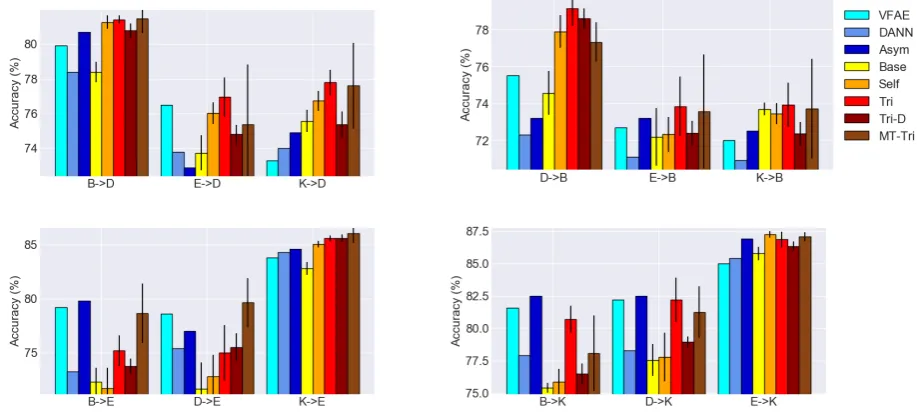
Figure 2: Average results for unsupervised domain adaptation on the Amazon dataset. Domains: B (Book), D (DVD), E (Electronics), K (Kitchen). Results for VFAE, DANN, and Asym are fromSaito et al.(2017).
sentiment analysis. Significance is computed using bootstrap test. The code for all experiments is re-leased at: https://github.com/bplank/ semi-supervised-baselines.
3.4 Results
Sentiment analysis We show results for senti-ment analysis for all 12 domain adaptation sce-narios in Figure2. For clarity, we also show the accuracy scores averaged across each target domain as well as a global macro average in Table2.
Model D B E K Avg
VFAE* 76.57 73.40 80.53 82.93 78.36 DANN* 75.40 71.43 77.67 80.53 76.26 Asym* 76.17 72.97 80.47 83.97 78.39
Src 75.91 73.47 75.61 79.58 76.14
Self 78.00 74.55 76.54 80.30 77.35 Tri 78.72 75.64 78.60 83.26 79.05 Tri-D 76.99 74.44 78.30 80.59 77.58 MT-Tri 78.14 74.86 81.45 82.14 79.15
Table 2: Average accuracy scores for each SA tar-get domain. *: result fromSaito et al.(2017).
Self-training achieves surprisingly good results but is not able to compete with tri-training. Tri-training with disagreement is only slightly better than self-training, showing that the disagreement component might not be useful when there is a strong domain shift. Tri-training achieves the best
average results on two target domains and clearly outperforms the state of the art on average.
MT-Tri finally outperforms the state of the art on 3/4 domains, and even slightly traditional tri-training, resulting in the overall best method. This improvement is mainly due to the B->E and D->E scenarios, on which tri-training struggles. These domain pairs are among those with the highestA -distance (Blitzer et al., 2007), which highlights that tri-training has difficulty dealing with a strong shift in domain. Our method is able to mitigate this deficiency by training one of the three output layers only on pseudo-labeled target domain examples.
In addition, MT-Tri is more efficient as it adds a smaller number of pseudo-labeled examples than tri-training at every epoch. For sentiment analysis, tri-training adds around 1800-1950/2000 unlabeled examples at every epoch, while MT-Tri only adds around 100-300 in early epochs. This shows that the orthogonality constraint is useful for inducing diversity. In addition, adding fewer examples poses a smaller risk of swamping the learned represen-tations with useless signals and is more akin to fine-tuning, the standard method for supervised domain adaptation (Howard and Ruder,2018).
[image:6.595.72.287.501.632.2]Target domains
Model ep Answers Emails Newsgroups Reviews Weblogs Avg WSJ µpseudo
Src (+glove) 87.63±.37 86.49±.35 88.60±.22 90.12±.32 92.85±.17 89.14±.28 95.49±.09 — Self (5) 87.64±.18 86.58±.30 88.42±.24 90.03±.11 92.80±.19 89.09±.20 95.36±.07 .5k Tri (4) 88.42±.16 87.46±.20 87.97±.09 90.72±.14 93.40±.15 89.56±.16 95.94±.07 20.5k Tri-D (7) 88.50±.04 87.63±.15 88.12±.05 90.76±.10 93.51±.06 89.70±.08 95.99±.03 7.7K Asym (3) 87.81±.19 86.97±.17 87.74±.24 90.16±.17 92.73±.16 89.08±.19 95.55±.12 1.5k MT-Tri (4) 87.92±.18 87.20±.23 87.73±.37 90.27±.10 92.96±.07 89.21±.19 95.50±.06 7.6k
[image:7.595.73.528.64.174.2]FLORS 89.71 88.46 89.82 92.10 94.20 90.86 95.80 —
Table 3: Accuracy scores on dev set of target domain for POS tagging for 10% labeled data. Avg: average over the 5 SANCL domains. Hyperparameterep(epochs) is tuned on Answers dev. µpseudo: average amount of added pseudo-labeled data. FLORS: results for Batch (u:big) from (Yin et al.,2015) (see §3).
Target domains dev sets Avg on
Model Answers Emails Newsgroups Reviews Weblogs targets WSJ
TnT* 88.55 88.14 88.66 90.40 93.33 89.82 95.75 Stanford* 88.92 88.68 89.11 91.43 94.15 90.46 96.83
Src 88.84±.15 88.24±.12 89.45±.23 91.24±.03 93.92±.17 90.34±.14 96.69±.08 Tri 89.34±.18 88.83±.07 89.32±.21 91.62±.06 94.40±.06 90.70±.12 96.84±.04 Tri-D 89.35±.16 88.66±.09 89.29±.12 91.58±.05 94.32±.05 90.62±.09 96.85±.06
Src (+glove) 89.35±.16 88.55±.14 90.12±.31 91.48±.15 94.48±.07 90.80±.17 96.90±.04 Tri 90.00±.03 89.06±.16 90.04±.25 91.98±.11 94.74±.06 91.16±.12 96.99±.02 Tri-D 89.80±.19 88.85±.10 90.03±.22 91.98±.09 94.70±.05 91.01±.13 96.95±.05 Asym 89.51±.15 88.47±.19 89.26±.16 91.60±.20 94.28±.15 90.62±.17 96.56±.01 MT-Tri 89.45±.05 88.65±.04 89.40±.22 91.63±.23 94.41±.05 90.71±.12 97.37±.07
FLORS* 90.30 89.44 90.86 92.95 94.71 91.66 96.59
Target domains test sets Avg on
Model Answers Emails Newsgroups Reviews Weblogs targets WSJ
TnT* 89.36 87.38 90.85 89.67 91.37 89.73 96.57 Stanford* 89.74 87.77 91.25 90.30 92.32 90.28 97.43
Src (+glove) 90.43±.13 87.95±.18 91.83±.20 90.04±.11 92.44±.14 90.54±.15 97.50±.03 Tri 91.21±.06 88.30±.19 92.18±.19 90.06±.10 92.85±.02 90.92±.11 97.45±.03 Asym 90.62±.26 87.71±.07 91.40±.05 89.89±.22 92.37±.27 90.39±.17 97.19±.03 MT-Tri 90.53±.15 87.90±.07 91.45±.19 89.77±.26 92.35±.09 90.40±.15 97.37±.07
FLORS* 91.17 88.67 92.41 92.25 93.14 91.53 97.11
Table 4: Accuracy for POS tagging on the dev and test sets of the SANCL domains, models trained on full source data setup. Values for methods with * are from (Schnabel and Schütze,2014).
in the results of Blitzer et al.(2007) and is cor-roborated in the results for asymmetric tri-training (Saito et al.,2017) and our method.
We note a weakness of this dataset is high vari-ance. Existing approaches only report the mean, which makes an objective comparison difficult. For this reason, we believe it is essential to evaluate proposed approaches also on other tasks.
POS tagging Results for tagging in the low-data regime (10% of WSJ) are given in Table3.
Self-training does not work for the sequence prediction task. We report only the best
instantia-tion (throttling withn=800). Our results contribute to negative findings regarding self-training (Plank, 2011;Van Asch and Daelemans,2016).
[image:7.595.73.527.237.540.2]Ans Email Newsg Rev Webl
% unk tag 0.25 0.80 0.31 0.06 0.0 % OOV 8.53 10.56 10.34 6.84 8.45 % UWT 2.91 3.47 2.43 2.21 1.46
Accuracy on OOV tokens
Src 54.26 57.48 61.80 59.26 80.37
Tri 55.53 59.11 61.36 61.16 79.32 Asym 52.86 56.78 56.58 59.59 76.84 MT-Tri 52.88 57.22 57.28 58.99 77.77
Accuracy on unknown word-tag (UWT) tokens Src 17.68 11.14 17.88 17.31 24.79
Tri 16.88 10.04 17.58 16.35 23.65 Asym 17.16 10.43 17.84 16.92 22.74 MT-Tri 16.43 11.08 17.29 16.72 23.13
[image:8.595.72.291.63.263.2]FLORS* 17.19 15.13 21.97 21.06 21.65
Table 5: Accuracy scores on dev sets for OOV and unknown word-tag (UWT) tokens.
the baseline significantly on only 2/5 domains (an-swers and emails). The FLORS tagger (Yin et al., 2015) fares better. Its contextual distributional fea-tures are particularly helpful on unknown word-tag combinations (see §3.4), which is a limitation of the lexicalized generic bi-LSTM tagger.
For the high-data setup (Table4) results are simi-lar. Disagreement, however, is only favorable in the low-data setups; the effect of avoiding easy points no longer holds in the full data setup. Classic tri-training is the best method. In particular, traditional tri-training is complementary to word embedding initialization, pushing the non-pre-trained baseline to the level of SRCwith Glove initalization. Tri-training pushes performance even further and re-sults in the best model, significantly outperform-ing the baseline again in 4/5 cases, and reachoutperform-ing FLORS performance on weblogs. Multi-task tri-training is often slightly more effective than asym-metric tri-training (Saito et al., 2017); however, improvements for both are not robust across do-mains, sometimes performance even drops. The model likely is too simplistic for such a high-data POS setup, and exploring shared-private models might prove more fruitful (Liu et al.,2017). On the test sets, tri-training performs consistently the best.
POS analysis We analyze POS tagging accu-racy with respect to word frequency6and unseen word-tag combinations (UWT) on the dev sets. Table 5 (top rows) provides percentage of
[image:8.595.311.523.67.158.2]un-6The binned log frequency was calculated with base 2 (bin 0 are OOVs, bin 1 are singletons and rare words etc).
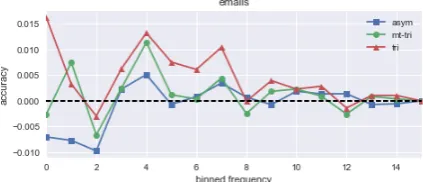
Figure 3: POS accuracy per binned log frequency.
known tags, OOVs and unknown word-tag (UWT) rate. The SANCL dataset is overall very chal-lenging: OOV rates are high (6.8-11% compared to 2.3% in WSJ), so is the unknown word-tag (UWT) rate (answers and emails contain 2.91% and 3.47% UWT compared to 0.61% on WSJ) and almost all target domains even contain unknown tags (Schnabel and Schütze,2014) (unknown tags: ADD,GW,NFP,XX), except for weblogs. Email is the domain with the highest OOV rate and highest unknown-tag-for-known-words rate. We plot ac-curacy with respect to word frequency on email in Figure3, analyzing how the three methods fare in comparison to the baseline on this difficult domain.
Regarding OOVs, the results in Table5(second part) show that classic tri-training outperforms the source model (trained on only source data) on 3/5 domains in terms of OOV accuracy, except on two domains with high OOV rate (newsgroups and we-blogs). In general, we note that tri-training works best on OOVs and on low-frequency tokens, which is also shown in Figure 3 (leftmost bins). Both other methods fall typically below the baseline in terms of OOV accuracy, but MT-Tri still outper-forms Asym in 4/5 cases. Table5(last part) also shows that no bootstrapping method works well on unknown word-tag combinations. UWT tokens are very difficult to predict correctly using an un-supervised approach; the less lexicalized and more context-driven approach taken by FLORS is clearly superior for these cases, resulting in higher UWT accuracies for 4/5 domains.
4 Related work
ap-proaches includeadversarial learning(Ganin et al., 2016) andfine-tuning(Sennrich et al.,2016). There is almost no work on bootstrapping approaches for recent neural NLP, in particular under domain shift. Tri-training is less studied, and only recently re-emerged in the vision community (Saito et al., 2017), albeit is not compared to classic tri-training.
Neural network ensembling Related work on self-ensembling approaches includes snapshot en-sembling (Huang et al.,2017) or temporal ensem-bling (Laine and Aila,2017). In general, the line be-tween “explicit” and “implicit” ensembling (Huang et al.,2017), like dropout (Srivastava et al.,2014) or temporal ensembling (Saito et al.,2017), is more fuzzy. As we noted earlier our multi-task learning setup can be seen as a form of self-ensembling.
Multi-task learning in NLP Neural networks are particularly well-suited for MTL allowing for parameter sharing (Caruana,1993). Recent NLP conferences witnessed a “tsunami” of deep learn-ing papers (Manning, 2015), followed by what we call a multi-task learning “wave”: MTL has been successfully applied to a wide range of NLP tasks (Cohn and Specia,2013;Cheng et al.,2015; Luong et al., 2015;Plank et al., 2016;Fang and Cohn,2016;Søgaard and Goldberg,2016;Ruder et al.,2017;Augenstein et al.,2018). Related to it is the pioneering work on adversarial learning (DANN) (Ganin et al.,2016). For sentiment analy-sis we found tri-training and our MT-Tri model to outperform DANN. Our MT-Tri model lends itself well to shared-private models such as those pro-posed recently (Liu et al.,2017;Kim et al.,2017), which extend upon (Ganin et al.,2016) by having separate source and target-specific encoders.
5 Conclusions
We re-evaluate a range of traditional general-purpose bootstrapping algorithms in the context of neural network approaches to semi-supervised learning under domain shift. For the two examined NLP tasks classic tri-training works the best and even outperforms a recent state-of-the-art method. The drawback of tri-training it its time and space complexity. We therefore propose a more efficient multi-task tri-training model, which outperforms both traditional tri-training and recent alternatives in the case of sentiment analysis. For POS tag-ging, classic tri-training is superior, performing especially well on OOVs and low frequency
to-kens, which suggests it is less affected by error propagation. Overall we emphasize the importance of comparing neural approaches to strong baselines and reporting results across several runs.
Acknowledgments
We thank the anonymous reviewers for their valu-able feedback. Sebastian is supported by Irish Research Council Grant Number EBPPG/2014/30 and Science Foundation Ireland Grant Number SFI/12/RC/2289. Barbara is supported by NVIDIA corporation and thanks the Computing Center of the University of Groningen for HPC support.
References
Steven Abney. 2007.Semisupervised learning for com-putational linguistics. CRC Press.
Isabelle Augenstein, Sebastian Ruder, and Anders Sø-gaard. 2018. Multi-task Learning of Pairwise Se-quence Classification Tasks Over Disparate Label Spaces. InProceedings of NAACL-HLT 2018.
John Blitzer, Mark Dredze, and Fernando Pereira. 2007. Biographies, bollywood, boom-boxes and blenders: Domain adaptation for sentiment classification. An-nual Meeting-Association for Computational Lin-guistics, 45(1):440.
John Blitzer, Ryan McDonald, and Fernando Pereira. 2006. Domain Adaptation with Structural Corre-spondence Learning. Proceedings of the 2006 Con-ference on Empirical Methods in Natural Language
Processing (EMNLP ’06), pages 120–128.
Konstantinos Bousmalis, George Trigeorgis, Nathan Silberman, Dilip Krishnan, and Dumitru Erhan. 2016.Domain Separation Networks.NIPS.
Rich Caruana. 1993. Multitask learning: A knowledge-based source of inductive bias. InProceedings of the Tenth International Conference on Machine Learn-ing.
Olivier Chapelle, Bernhard Schölkopf, and Alexander Zien. 2006. Semi-Supervised Learning, volume 1. MIT press.
Hao Cheng, Hao Fang, and Mari Ostendorf. 2015. Open-domain name error detection using a multi-task rnn. InProceedings of the 2015 Conference on
Empirical Methods in Natural Language Processing,
pages 737–746. Association for Computational Lin-guistics.
Long Papers), pages 32–42, Sofia, Bulgaria. Associ-ation for ComputAssoci-ational Linguistics.
Michael Denkowski and Graham Neubig. 2017. Stronger baselines for trustable results in neural ma-chine translation. arXiv preprint arXiv:1706.09733.
Timothy Dozat and Christopher D. Manning. 2017. Deep Biaffine Attention for Neural Dependency Parsing. InProceedings of ICLR 2017.
Bradley Efron and Robert J Tibshirani. 1994. An intro-duction to the bootstrap. CRC press.
Meng Fang and Trevor Cohn. 2016. Learning when to trust distant supervision: An application to low-resource pos tagging using cross-lingual projection.
InProceedings of CoNLL-16.
Meng Fang and Trevor Cohn. 2017. Model transfer for tagging low-resource languages using a bilingual dictionary. InProceedings of the 55th Annual Meet-ing of the Association for Computational LMeet-inguistics
(Volume 2: Short Papers), pages 587–593.
Associa-tion for ComputaAssocia-tional Linguistics.
Yaroslav Ganin, Evgeniya Ustinova, Hana Ajakan, Pascal Germain, Hugo Larochelle, Francois Lavio-lette, Mario Marchand, and Victor Lempitsky. 2016. Domain-Adversarial Training of Neural Networks.
Journal of Machine Learning Research, 17:1–35.
Rob van der Goot, Barbara Plank, and Malvina Nis-sim. 2017. To normalize, or not to normalize: The impact of normalization on part-of-speech tagging.
InProceedings of the 3rd Workshop on Noisy
User-generated Text, pages 31–39, Copenhagen,
Den-mark. Association for Computational Linguistics.
Chuan Guo, Geoff Pleiss, Yu Sun, and Kilian Q. Wein-berger. 2017. On Calibration of Modern Neural Net-works.Proceedings of ICML 2017.
Luheng He, Kenton Lee, Mike Lewis, and Luke Zettle-moyer. 2017. Deep semantic role labeling: What works and what’s next. InProceedings of the 55th Annual Meeting of the Association for
Computa-tional Linguistics (Volume 1: Long Papers), pages
473–483, Vancouver, Canada. Association for Com-putational Linguistics.
Jeremy Howard and Sebastian Ruder. 2018. Universal Language Model Fine-tuning for Text Classification. InProceedings of ACL 2018.
Gao Huang, Yixuan Li, Geoff Pleiss, Zhuang Liu, John E. Hopcroft, and Kilian Q. Weinberger. 2017. Snapshot Ensembles: Train 1, get M for free. In
Proceedings of ICLR 2017.
Jing Jiang and ChengXiang Zhai. 2007. Instance weighting for domain adaptation in nlp. In Proceed-ings of the 45th Annual Meeting of the Association of Computational Linguistics, pages 264–271. Asso-ciation for Computational Linguistics.
Young-Bum Kim, Karl Stratos, and Dongchan Kim. 2017. Adversarial adaptation of synthetic or stale data. InProceedings of the 55th Annual Meeting of the Association for Computational Linguistics
(Vol-ume 1: Long Papers), pages 1297–1307, Vancouver,
Canada. Association for Computational Linguistics.
Eliyahu Kiperwasser and Yoav Goldberg. 2016. Sim-ple and accurate dependency parsing using bidirec-tional lstm feature representations. Transactions
of the Association for Computational Linguistics,
4:313–327.
Samuli Laine and Timo Aila. 2017. Temporal Ensem-bling for Semi-Supervised Learning. In Proceed-ings of ICLR 2017.
Guillaume Lample, Miguel Ballesteros, Sandeep Sub-ramanian, Kazuya Kawakami, and Chris Dyer. 2016. Neural Architectures for Named Entity Recognition.
InNAACL-HLT 2016.
Pengfei Liu, Xipeng Qiu, and Xuanjing Huang. 2017. Adversarial multi-task learning for text classifica-tion. In Proceedings of the 55th Annual Meeting of the Association for Computational Linguistics
(Volume 1: Long Papers), pages 1–10, Vancouver,
Canada. Association for Computational Linguistics.
Christos Louizos, Kevin Swersky, Yujia Li, Max Welling, and Richard Zemel. 2015. The variational fair autoencoder. arXiv preprint arXiv:1511.00830.
Minh-Thang Luong, Quoc V Le, Ilya Sutskever, Oriol Vinyals, and Lukasz Kaiser. 2015. Multi-task sequence to sequence learning. arXiv preprint
arXiv:1511.06114.
Christopher D Manning. 2015. Computational linguis-tics and deep learning. Computational Linguistics, 41(4):701–707.
David McClosky, Eugene Charniak, and Mark Johnson. 2006a. Effective self-training for parsing. In Pro-ceedings of the Human Language Technology
Con-ference of the NAACL, Main ConCon-ference, New York
City, USA. Association for Computational Linguis-tics.
David McClosky, Eugene Charniak, and Mark John-son. 2006b. Reranking and Self-Training for Parser Adaptation. International Conference on Compu-tational Linguistics (COLING) and Annual Meet-ing of the Association for Computational LMeet-inguistics (ACL), (July):337–344.
Gábor Melis, Chris Dyer, and Phil Blunsom. 2017.On the State of the Art of Evaluation in Neural Lan-guage Models. InarXiv preprint arXiv:1707.05589.
Graham Neubig, Chris Dyer, Yoav Goldberg, Austin Matthews, Waleed Ammar, Antonios Anastasopou-los, Miguel Ballesteros, David Chiang, Daniel Cloth-iaux, Trevor Cohn, et al. 2017. Dynet: The dynamic neural network toolkit. arXiv preprint
Jeffrey Pennington, Richard Socher, and Christopher D. Manning. 2014. Glove: Global vectors for word rep-resentation. In Empirical Methods in Natural
Lan-guage Processing (EMNLP), pages 1532–1543.
Slav Petrov and Ryan McDonald. 2012. Overview of the 2012 shared task on parsing the web. Notes of the First Workshop on Syntactic Analysis of
Non-Canonical Language (SANCL), 59.
Barbara Plank. 2011. Domain adaptation for parsing. University Library Groningen.
Barbara Plank, Anders Søgaard, and Yoav Goldberg. 2016. Multilingual Part-of-Speech Tagging with Bidirectional Long Short-Term Memory Models and Auxiliary Loss. InProceedings of the 54th Annual Meeting of the Association for Computational Lin-guistics.
Roi Reichart and Ari Rappoport. 2007. Self-training for enhancement and domain adaptation of statisti-cal parsers trained on small datasets. In Proceed-ings of the 45th Annual Meeting of the Association of Computational Linguistics, pages 616–623.
Nils Reimers and Iryna Gurevych. 2017. Reporting score distributions makes a difference: Performance study of lstm-networks for sequence tagging. In Pro-ceedings of the 2017 Conference on Empirical
Meth-ods in Natural Language Processing, pages 338–
348, Copenhagen, Denmark. Association for Com-putational Linguistics.
Sebastian Ruder, Joachim Bingel, Isabelle Augenstein, and Anders Søgaard. 2017. Learning what to share between loosely related tasks. arXiv preprint
arXiv:1705.08142.
Kuniaki Saito, Yoshitaka Ushiku, and Tatsuya Harada. 2017. Asymmetric Tri-training for Unsupervised Domain Adaptation. InICML 2017.
Tobias Schnabel and Hinrich Schütze. 2014. FLORS: Fast and Simple Domain Adaptation for Part-of-Speech Tagging. TACL, 2:15–26.
Rico Sennrich, Barry Haddow, and Alexandra Birch. 2016. Improving neural machine translation mod-els with monolingual data. In Proceedings of the 54th Annual Meeting of the Association for Compu-tational Linguistics (Volume 1: Long Papers), pages 86–96, Berlin, Germany. Association for Computa-tional Linguistics.
Anders Søgaard. 2010. Simple semi-supervised train-ing of part-of-speech taggers. InProceedings of the
ACL 2010 Conference Short Papers, pages 205–208.
Anders Søgaard and Yoav Goldberg. 2016. Deep multi-task learning with low level multi-tasks supervised at lower layers. In Proceedings of the 54th Annual Meet-ing of the Association for Computational LMeet-inguis- Linguis-tics, pages 231–235, Berlin, Germany. Association for Computational Linguistics.
Nitish Srivastava, Geoffrey Hinton, Alex Krizhevsky, Ilya Sutskever, and Ruslan Salakhutdinov. 2014. Dropout: A Simple Way to Prevent Neural Networks from Overfitting. Journal of Machine Learning
Re-search, 15:1929–1958.
Mark Steedman, Rebecca Hwa, Stephen Clark, Miles Osborne, Anoop Sarkar, Julia Hockenmaier, Paul Ruhlen, Steven Baker, and Jeremiah Crim. 2003. Example selection for bootstrapping statistical parsers. In Proceedings of the 2003 Human Lan-guage Technology Conference of the North Ameri-can Chapter of the Association for Computational Linguistics.
Jun Suzuki and Hideki Isozaki. 2008. Semi-supervised sequential labeling and segmentation using giga-word scale unlabeled data. pages 665–673.
Vincent Van Asch and Walter Daelemans. 2016. Pre-dicting the effectiveness of self-training: Applica-tion to sentiment classificaApplica-tion. arXiv preprint
arXiv:1601.03288.
Fangzhao Wu and Yongfeng Huang. 2016. Sentiment Domain Adaptation with Multiple Sources. Pro-ceedings of the 54th Annual Meeting of the
Asso-ciation for Computational Linguistics (ACL 2016),
pages 301–310.
David Yarowsky. 1995. Unsupervised Word Sense Dis-ambiguation Rivaling Supervised Methods. In Pro-ceedings of the 33rd annual meeting on Association for Computational Linguistics.
Wenpeng Yin, Tobias Schnabel, and Hinrich Schütze. 2015. Online Updating of Word Representations for Part-of-Speech Tagging. InProceedings of the 2015 Conference on Empirical Methods in Natural
Lan-guage Processing, September, pages 1329–1334.
Guangyou Zhou, Zhiwen Xie, Jimmy Xiangji Huang, and Tingting He. 2016. Bi-transferring deep neu-ral networks for domain adaptation. In Proceed-ings of the 54th Annual Meeting of the Association for Computational Linguistics (Volume 1: Long Pa-pers), pages 322–332, Berlin, Germany. Association for Computational Linguistics.
Zhi-Hua Zhou and Ming Li. 2005. Tri-Training: Ex-ploiting Unlabeled Data Using Three Classifiers.
IEEE Trans.Data Eng., 17(11):1529–1541.
Xiaojin Zhu. 2005. Semi-Supervised Learning Litera-ture Survey. Technical Report 1530, Computer Sci-ences, University of Wisconsin-Madison.