using MALDI-MS
SCOTCHER, K and BRADSHAW, Robert
<http://orcid.org/0000-0003-1533-2166>
Available from Sheffield Hallam University Research Archive (SHURA) at:
http://shura.shu.ac.uk/21622/
This document is the author deposited version. You are advised to consult the
publisher's version if you wish to cite from it.
Published version
SCOTCHER, K and BRADSHAW, Robert (2018). The analysis of latent fingermarks
on polymer banknotes using MALDI-MS. Scientific reports, 8 (1), p. 8765.
Copyright and re-use policy
See
http://shura.shu.ac.uk/information.html
Sheffield Hallam University Research Archive
The analysis of latent ingermarks
on polymer banknotes using
MALDI-MS
K.
Scotcher
& R.
Bradshaw
In September 2016, the UK adopted a new Bank of England (BoE) £5 polymer banknote, followed by the £10 polymer banknote in September 2017. They are designed to be cleaner, stronger and have increased counterfeit resilience; however, ingermark development can be problematic from the polymer material as various security features and coloured/textured areas have been found to alter the efectiveness of conventional ingermark enhancement techniques (FETs). As ingermarks are one of the most widely used forms of identiication in forensic cases, it is important that maximum ridge detail be obtained in order to allow for comparison. This research explores the use of matrix-assisted laser desorption/ ionisation mass spectrometry (MALDI-MS) proiling and imaging for the analysis of ingermarks deposited on polymer banknotes. The proposed methodology was able to obtain both physical and chemical information from ingermarks deposited in a range of scenarios including; diferent note areas, depletion series, aged samples and following conventional FETs. The analysis of forensically important molecular targets within these ingermarks was also explored, focussing speciically on cocaine. The ability of MALDI-MS to provide ridge detail and chemical information highlights the forensic applicability of this technique and potential for the analysis of ingermarks deposited onto this problematic surface.
Fingermark examination has remained one of the most important and commonly used identiication techniques in forensic investigations for over a century1,2. It relies on the comparison and matching of ridge detail between a
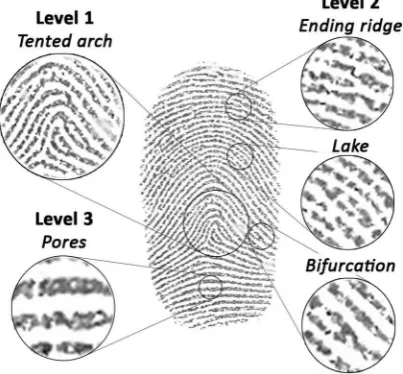
ingermark recovered from an evidential item or crime scene and a control ingerprint stored on record to deter-mine or exclude identiication. Ridge detail can be categorized by the class of mark (e.g. loop, whorl and arch) (level 1), small individual characteristics (minutiae) (level 2) and ine details (such as the shape and location of pores) (level 3)2. A representative example of ingermark characteristics from the primary donor in this research
is depicted in Fig. 1.
Latent, or invisible, ingermarks require development in order to observe the characteristics required for iden-tiication. here are now a range of ingermark enhancement techniques (FETs) which allow for the development of marks deposited onto a variety of surfaces and subjected to a range of conditions (e.g. wetted marks)3. he
‘Fingermark Visualisation Manual’4, produced by the UK Home Oice, ofers a comprehensive overview of the
FETs available to practitioners who are involved in the recovery of ingermarks. he manual guides the applica-tion of these techniques within systematic worklows, whereby the level of destructiveness increases for each step in order to maintain the integrity of any discovered marks, whilst maximising ingermark recovery.
In September 2016, the UK adopted a new Bank of England (BoE) polymer £5 banknote and the £10 note was introduced in September 2017. Although polymer banknotes were irst introduced in Australia in 19885, the
transition into UK currency now necessitates the development of appropriate techniques to allow for ingermark recovery. his has been described as of ‘critical importance to the investigation of crime’6. he polymeric
mate-rial, bi-axially oriented polypropylene (BOPP), is a non-porous substrate with several advantages for use within currency, including; increased counterfeiting resilience, cleanliness and strength7. However, speciality inks and
security features used during the printing and coating process also exhibit semi-porous features8 which can afect
how the ingermark residue interacts with the surface and subsequently, the FET that can be employed.
Currently in the UK, conventional FETs employed on paper banknotes include DFO (1,8-diazaluoren-9-one) and ninhydrin4,9. As these techniques are more suited for porous surfaces, they have proven to be inefective in
developing ingermarks deposited on polymer varieties6. Polymer banknotes used in Australia and Canada share
Biomolecular Science Research Centre, Sheield Hallam University, Sheield, S WB, UK. Correspondence and requests for materials should be addressed to R.B. (email: [email protected])
Received: 12 February 2018 Accepted: 18 May 2018 Published: xx xx xxxx
the same base material, BOPP, as the BoE £5 polymer banknote10. Previous research has demonstrated successful
development of ingermarks using vacuum metal deposition (VMD)11 and cyanoacrylate fuming (CAF)12,13. In
particular, it has been observed that there are signiicant diferences in ingermark recovery from speciic areas of polymer notes, such as; the transparent security window (whereby CAF was observed to be most efective)13
and the opaque sections of the note (whereby VMD processing provided better ingermark development)6,12,13.
However, diferences in inks, opacifying layers, coatings and security features between notes derived from difer-ent countries may also have an efect on the success of the convdifer-entional FETs6.
Recent research on fingermarks deposited onto uncirculated BoE £5 polymer banknotes conducted by Downham et al.6 showed that multi-metal deposition (MMD) and powder suspensions were among the most
efective FETs. It was also determined that CAF and VMD were relatively inefective, an interesting observation as these techniques are generally considered to be amongst the most efective for marks deposited onto semi-porous and non-porous substrates. his contradicts the results of Jones et al.13 who reported on the successful application
of VMD on Australian polymer banknotes due to the ability of the zinc layer to suppress the multi-coloured and patterned background. Additional techniques which have been used to overcome this issue include IR luores-cence examination14 and anti-stokes (“up-converter”) powders15.
Over recent years, an area that has gained increasing popularity in ingermark analysis is the use of modern analytical techniques, such as mass spectrometry. hese have shown the potential to provide an invaluable insight into the lifestyle of an individual through analysis of the chemical content of their residue16, which can also help
to identify potential molecular targets for FETs. Furthermore, many of these techniques have the ability to pro-vide additional ridge detail through imaging functionalities which can assist in identiication in forensic inves-tigations. A selection of mass spectrometry based methodologies that have been utilised for latent ingermark analysis to-date include; Desorption Electrospray Ionisation Mass Spectrometry (DESI-MS)17, Direct Analysis in
Real Time Mass Spectrometry (DART-MS)18,19, Secondary Ion Mass Spectrometry (SIMS)20–22, Surface-Assisted
Laser Desorption/Ionisation Mass Spectrometry (SALDI-MS)19,23–25 and Laser Desorption Ionisation Mass
Spectrometry (LDI-MS)26. here has also been an interest in the use of silver sputtering prior to LDI-MS
analy-sis (Ag-LDI-MS), allowing for physical ingermark development and subsequent chemical analyanaly-sis27,28. In fact,
Moule et al.28 recently showed that this technique is useful for a range of porous and semi-porous surfaces (such
as polypropylene) but have not yet shown its application to polymer banknotes.
One of the most extensively researched areas within these mass spectrometry based techniques is Matrix-Assisted Laser Desorption/Ionisation-Mass Spectrometry Proiling and Imaging (MALDI-MSP and MSI)29. Since the initial publication in 2009, whereby it was shown that a selection of endogenous and exogenous
species could be mapped in latent ingermark residue16, a wide range of applications for this technology have
now been explored29,30. Achievements in this area have led to the development of established methodologies for
the analysis of ingermarks obtained in real forensic scenarios31,32; now allowing for the analysis of ingermarks
recovered from crime scenes33. he advancements within this niche area of ingermark analysis highlight the
power of MALDI-MSP and MSI and the ability to provide additional information from latent ingermarks in forensic scenarios.
[image:3.595.157.359.50.237.2]he aim of the research presented in this paper was to extend the applicability of MALDI-MS to the analysis of latent ingermarks deposited onto polymer banknotes. In order to prove the feasibility of this technique, the following research questions have been investigated; (a) optimal sample preparation considerations for this sur-face, (b) the deposition of ingermarks onto diferent areas (including security features) of the polymer banknotes, (c) the analyses of minute amounts of material in depletion series of both fresh and aged marks, (d) efectiveness
Figure 1. Inked ingermark taken from the primary donor within this research article. Examples of ingermark ridge characteristics have been indicated, including; Level 1 (class of mark - tented arch), Level 2 (minutiae
when used in sequence with conventional FETs and (e) the detection of forensically interesting substances, namely cocaine. Successful application of this methodology would strengthen the claim that MALDI-MS could be selected as a potential option for ingermark analysis in forensic investigations in the future.
Materials and Methods
All ingermarks were deposited by two separate donors who provided full consent for use within this study. Ethical approval was granted by Sheield Hallam University Ethics Research Committee, though the use of in-germarks as samples are considered minor.
Materials.
Triluoroacetic acid (TFA), α-cyano-4-hydroxycinnamic acid (α-CHCA) and cocaine hydrochlo-ride solution (1 mg/mL in MeOH) were purchased from Sigma Aldrich (Poole, UK). Lab grade ethanol (EtOH), HPLC grade methanol (MeOH), and HPLC grade acetonitrile (ACN) were obtained from Fisher Scientiic (Loughborough, UK). Double-sided conductive carbon tape was obtained from TAAB (Aldermaston, U.K.). he materials used for ingermark development; black powder suspension (Wetwop™
) and Rite Lok cyanoacrylate superglue, were generously supplied by West Yorkshire Police (Wakeield, UK). BoE £5 polymer banknotes were obtained from a public cash machine (Sheield, UK). Ultrapure water was obtained from an ELGA Purelab®
Ultra water purity system operating at 13.4 MΩ-cm.Instrumentation and parameters.
MALDI MSI of fingermarks for matrix deposition optimisation (section: Matrix deposition optimisation) was performed using an Applied Biosystems Q-Star XL quadrupole time-of-light (QTOF) instrument equipped with a Nd:YVO4 solid-state laser (Elforlight Ltd., Daventry, UK), having a wavelength of 355 nm, an elliptical spot size of 100 × 150 µm, a pulse duration of 1.5 ns and operating at 1000 Hz.MALDI-MSP and MSI of all other samples were conducted using a modiied Applied Biosystems Q-Star Pulsar i hybrid quadrupole time-of-flight (QTOF) instrument, equipped with a Nd:YVO4 solid-state laser (Elforlight Ltd., Daventry, UK), with a wavelength of 355 nm and a pulse duration of 1.5 ns, operating at 5000 Hz. All images were acquired at a spatial resolution of 150 × 150 µm using a ‘slow’ raster mode with ‘oMALDI Server 5.1’ sotware supplied by MDS Sciex (Concord, Ontario, Canada). he elliptical spot size of the laser was 100 × 150 µm. he mass range analysed was between m/z 50–1000. he declustering potential 2 was set at 15 and the focusing potential at 20.
MALDI-MSP spectra were obtained in positive ion mode within the mass range of m/z 50 and 1000. he declustering potential 2 was set at 15 arbitrary units and the focus potential at 20 arbitrary units. MALDI-MS/ MS spectra were produced on the same instrument in positive ion mode as a product ion scan for cocaine (m/z
304.15). he mass range was set between m/z 50 and 310 with the declustering potential 2 set at 15, the focusing potential at 20, the collision gas at 3 and the collision energy at 25 arbitrary units.
Optical images of all ingermarks were taken using a Foster and Freeman video spectral comparator (VSC 4CX) under incandescent light.
Data processing.
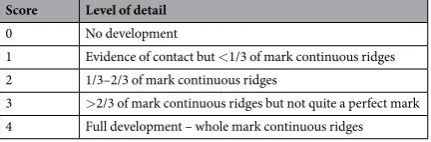
MALDI-MS and MS/MS proiling spectra were processed using the multifunctional open source mass spectrometry sotware, mMass34. All MALDI-MS images were processed using Biomap (Novartis,Basel). In all instances, MALDI-MS imaging data was manually interrogated in order to recover the most abun-dant ions (providing the best ridge clarity) derived from each separate ingermark analysis, which were then normalised against the total ion current (TIC). he ridge pattern continuity and clarity was used to determine the quality of the ingermark according to the grading scheme published by Bandey (2004)35 (Table 1).
Banknote cleaning.
As bank notes were obtained from a public cash machine, a protocol was optimised (data not shown) to remove any contamination from the note surface and to ensure reproducibility between sam-ples. In each instance, the notes were soaked in EtOH for 5 min before being rinsed with ultrapure H2O for 2 min and let to dry in ambient conditions on clean tissue paper.Fingermark deposition.
Ungroomed fingermarks were prepared by washing the hands with a 50:50 EtOH:H2O solution before conducting 15 minutes of normal working activities on a computer which had been cleaned with the same solution. he ingertips were rubbed together thoroughly prior to ingermark deposition to ensure an even distribution of ingermark constituents on the ingertips. All ingermarks were deposited by the same donor (donor 1) throughout the research unless stated otherwise. he use of ungroomed ingermarks was based on Home Oice recommendations36 to avoid the use of purposely ‘loaded’ ingermarks in order to test thefeasibility of a method and to avoid the extensive variation that may be observed in natural marks. Score Level of detail
0 No development
1 Evidence of contact but <1/3 of mark continuous ridges
2 1/3–2/3 of mark continuous ridges
3 >2/3 of mark continuous ridges but not quite a perfect mark
[image:4.595.156.372.47.118.2]4 Full development – whole mark continuous ridges
Matrix deposition optimisation.
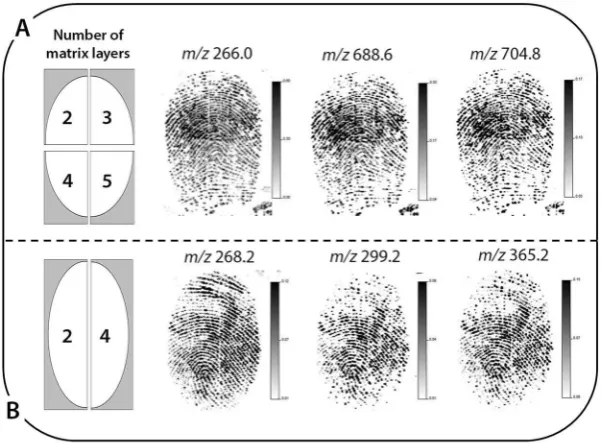
In Experiment A, an ungroomed fingermark was deposited onto the opaque section of a BoE £5 polymer banknote before being cut into quarters. Each quarter was separately sprayed with 2, 3, 4 and 5 layers, respectively, using 5 mg/mL α-CHCA in 70:30 ACN:0.5% TFA. A low rate of 2 µl/min on a ‘slow’ raster setting was employed using a SunCollect sample preparation device or ‘auto-sprayer’ (SunchromGmbH, Friedrichsdorf, Germany), adapted from previous methodology16. he quarters were thenattached to a MALDI OPTI spotless insert (Applied Biosystems, CA, U.S.A.) in their original orientation using double-sided conductive carbon tape before being analysed using MALDI-MSI.
In Experiment B, a diferent donor (donor 2) deposited an ungroomed ingermark onto the same opaque section of a £5 polymer banknote which was subsequently split into two halves. One section was coated with 2 layers and the other with 4 layers of MALDI matrix using the same methodology described in Experiment A.
he optimised conditions were determined to be 2 layers of 5 mg/mL α-CHCA MALDI matrix in 70:30 ACN:0.5% TFA, each at a rate of 2 µl/min on a ‘slow’ raster setting using the ‘SunCollect’ auto-sprayer. hese spraying parameters were were employed for all subsequent experiments.
Depletion series and aged marks.
A depletion series of eight ingermarks from an ungroomed ingertip were deposited on the opaque section of a £5 polymer banknote. he 1st, 3rd, 5th and 8th marks in the series were cut from the polymer banknote, secured on a MALDI target plate and spray coated with the MALDI matrix before being subjected to MALDI-MSI analysis.In an additional experiment, a depletion series of ive ingermarks from an ungroomed ingertip were depos-ited onto the opaque section of a £5 polymer banknote and let to age in a wallet for 6 weeks. he wallet was largely stored within the owner’s back pocket throughout the day. Although this experiment was intended to rep-licate realistic conditions, in order to avoid external contamination, the note was stored within a paper envelope. Following the speciied ageing period, the marks were cut directly from the note, secured on a MALDI target plate using double-sided carbon tape and spray coated with matrix before being analysed using MALDI-MSI.
Fingermarks deposited on diferent areas of a polymer banknote.
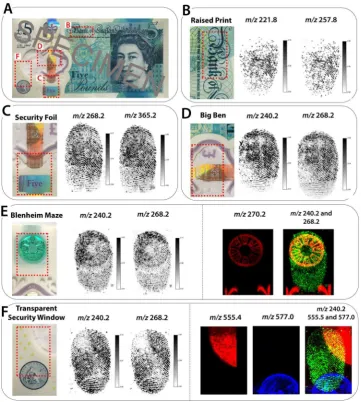
Ungroomed ingermarks were deposited onto various areas of a £5 polymer banknote, namely; the transparent window, security foil, raised print and Blenheim maze areas7. he areas were cut from the note, secured directly on a MALDI target plate usingdouble-sided carbon tape and spray coated with matrix before being submitted to MALDI-MSI analyses.
Fingermark enhancement and MALDI-MSI analysis.
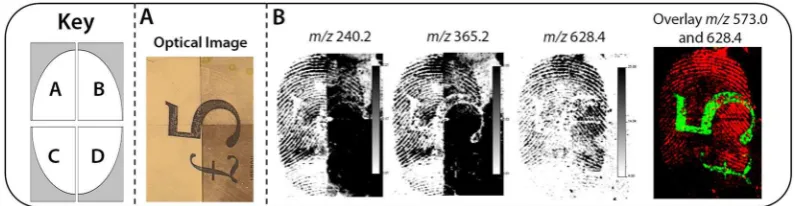
An ungroomed ingermark was deposited on the opaque area of a £5 polymer banknote. he ingermark was cut into quarters and each quarter was subjected to a diferent enhancement protocol; (A) no enhancement, (B) Cyanoacrylate fuming (CAF) followed by black WetwopTM powder suspension (C) CAF and (D) Black WetwopTM powder suspension. he WetwopTM powder suspension was employed as per the Home Oice guidelines37.CAF was performed in a FOLD-A-LAB chamber (Lynn Peavey Company). Following method optimisation (data not shown), a protocol was developed which required a total of 2.5 g of superglue and a beaker containing 100 mL of water being placed onto a hot plate. he section of note containing a ingermark was hung within the chamber and let for 40 min to develop.
Following development using the speciied methodologies, the quarters were arranged together into the orig-inal orientation, attached to a MALDI target plate using double-sided carbon tape and spray coated with matrix before being imaged using MALDI-MSI.
Proiling cocaine and imaging cocaine contaminated marks.
In an initial experiment, a dilution series of cocaine hydrochloride was prepared in MeOH between 0.1 ng/mL–10 µg/mL. A total of 0.5 µL of each solution was deposited, in triplicate, directly onto a polymer banknote surface and let to dry. 0.5 µL of the MALDI matrix solution was then spotted directly onto each of the cocaine spots before being subjected to MALDI-MS and MALDI-MS/MS proiling. All analyses were conducted in ascending concentrations to avoid carry-over and blanks were analysed between samples.he three lowest concentrations (10 ng/mL, 0.1 µg/mL and 1 µg/mL) detectable within the irst experiment were used to contaminate three separate ingermarks using a modiication of the contact-transfer methodol-ogy previously described in Groeneveld et al.38. In this method, a total of 100 µl of each cocaine solution was
applied to a clean Petri dish. An ungroomed ingertip was rubbed in the cocaine solution and was allowed to dry before being deposited onto a polymer banknote. Following ingermark deposition, 0.5 µL spots of the MALDI matrix were deposited in various areas of the residue before being subjected to MALDI-MS and MALDI-MS/MS proiling.
An ungroomed ingermark was then prepared following contamination with 100 µL of the lowest cocaine concentration detectable (0.1 µg/mL) using the previously described contact-transfer methodology (total of 10 ng cocaine). his mark was cut from the note and secured directly on a MALDI target plate using double-sided car-bon tape before being spray coated with MALDI matrix and imaged using MALDI-MSI. Following MALDI-MSI analysis, the same sample was then subjected to MALDI-MS/MS analysis to conirm the presence of cocaine.
In all instances, a ‘blank’ region of the note was also analysed using MALDI MS and MS/MS in order to con-irm that the illicit substance was not present on the note surface prior to ingermark deposition.
Results and Discussion
which showed no diference in the quality of the ingermark ridge detail in each of the quarters (all grade 3) (Fig. 2A).
To corroborate the initial indings from Experiment A, a second experiment (Experiment B), was conducted whereby a second donor (donor 2) deposited an ungroomed ingermark onto the same area of a note. his mark was split into two halves before being sprayed with 2 and 4 layers of the MALDI matrix, respectively. Similarly to the results obtained in Experiment A, the two halves of the ingermark showed similar quality of ridge detail (grade 3) for each of the ion species selected for ingermark reconstruction (m/z 268.2, m/z 299.2 and m/z 365.2) (Fig. 2B). Although the ion species at m/z 268.2 remains to be unidentiied31, putative identiications have been
assigned to m/z 299.2 (nonadecanoic acid) [M + H]+31 and m/z 365.2 (tetracosadienoic acid) [M + H]+39, which
have both been observed within latent ingermark residue previously. Tandem mass spectrometry analysis would be required to conirm the identity of these species.
Based on the MALDI-MS imaging results, the 2-layer methodology was selected for all future sample prepa-ration. his improves upon previous research, whereby ingermark samples have been coated with either four32,33
or ive31,40 layers of MALDI matrix. Not only would this reduce sample preparation time, but it also has the
potential to improve spray-coating reproducibility. Analysing the ingermarks of multiple donors also addresses an important issue, highlighted by Ferguson et al.39, who had shown that results vary across diferent individuals.
he donors in the aforementioned study were subsequently labelled as being ‘good’, ‘intermediate’ or ‘poor’ secre-tors in respect to the results obtained. he consistent results observed for ingermarks deposited onto polymer banknotes, in this instance, provides a positive indication of reproducibility of the 2-layer methodology which is an important factor when considering forensic applicability. It must be noted however, that additional exper-iments are still required on a greater number of donors and natural marks to fully assess the reproducibility of this method.
he use of ungroomed ingermarks throughout this research not only ensures that the minimal amount of endogenous and exogenous components were present (highlighting the sensitivity of the technique), but they also allow for a greater amount of reproducibility to be maintained over extended periods of time in compari-son to natural marks. Previous research regarding the enhancement of latent ingermarks deposited on polymer banknotes has been conducted using natural, groomed or eccrine ingermarks6,11,41 which will generally contain a
greater amount of variation and larger quantity of constituents relative to ungroomed ingermarks.
[image:6.595.155.456.46.269.2]Depletion series.
A depletion series of eight ungroomed ingermarks was deposited onto the opaque section of a polymer banknote. he 1st, 3rd, 5th and 8th depositions were selected and subjected to MALDI-MSI analysis. hree ion species were selected to generate molecular images for all depletions, including; unidentiied ion species at m/z 240.2 and m/z 268.2 and tetracosadienoic acid (m/z 365.2) [M + H]+. By normalising all images and setting them to the same contrast and intensity, it showed that there was no reduction in the intensity of the ion species throughout the depletion series (Fig. 3A). Furthermore, selection of the molecular image with maximum ridge detail and optimal contrast and intensity indicated that the overall quality of ingermark ridge detail recoverable from each of the depletions was consistent (all Grade 2) (Fig. 3B).he investigation of depletion series has importance in forensic applicability, as individuals will touch sur-faces multiple times and limited residue may be present in the ingermark analysed. Further depletions could be explored in future studies to assess the minimal amount of material that can be detected using MALDI-MSI.
Diferent areas of a polymer banknote.
Fingermarks were deposited onto diferent areas of the £5 pol-ymer banknote in order to determine whether the MALDI-MS image quality difered depending on diferences in the composition of the surface. Speciic focus was on the security features, including; the raised print, security foil, Blenheim maze and transparent window. he interaction with the ingermark residue may be afected by the diferent areas of this complex surface, and will ultimately afect the FET selected. Previous research on Australian and Canadian polymer banknotes showed large variation in visualisation of marks deposited on the opaque and transparent sections13,42.MALDI-MSI analysis of ingermarks deposited on to the diferent areas showed that both physical and chemi-cal information could be observed in each instance. In fact, grade 2 images were obtained for ingermarks depos-ited onto the raised print area (m/z 221.8 and m/z 257.8, both unidentiied) and grade 3 on the security foil and Big Ben transparent window areas (Fig. 4B–D, respectively). he Blenheim maze region of the polymer banknote exhibited a strong signal for this security feature at m/z 270.2 (unidentiied) which resulted in signal suppression in the corresponding areas of the ingermark deposited onto this region of the note, shown through the selection of two unidentiied species (m/z 240.2 and m/z 268.2, respectively) (Fig. 4E). Signal suppression is a known issue in MALDI-MS and the efect can arise from contaminants in the sample, on the substrate or the physicochemical properties of the matrix43. Nonetheless, it is important to note that signiicant ridge detail could still be obtained
[image:7.595.157.516.47.423.2]from the areas afected by signal suppression, and Grade 3 ingermark images were obtained overall.
Interestingly, for the ingermark deposited onto the transparent window security feature, strong signals were obtained for two unidentiied species distributed within both the transparent window and the Bank of England stamp (m/z 555.4 and m/z 577.0, respectively). However, images generated for two unidentiied ingermark con-stituents (m/z 240.2 and m/z 268.2, respectively) revealed that this did not afect the ability to obtain chemical and physical information from the ingermark deposited onto these regions (Fig. 4F). In fact, poorer quality of ridge detail was observed in the regions of the ingermark that were not deposited onto the security features. Although the signal intensity in these regions appeared to be reduced, the overall quality of the ingermarks was still deter-mined to be Grade 3.
Fingermark enhancement and MALDI-MSI analysis.
Although these initial results highlighted the potential of employing MALDI-MSI as a means to analyse ingermarks deposited onto polymer banknotes, this methodology would be redundant without initial development using appropriate FETs. his is necessary to indi-cate the presence or location of a ingermark prior to MALDI-MS analyses31–33,38,40. FETs successfully employedon polymer banknotes include MMD, power suspension6, VMD11 and CAF12,13. However, in this research,
CAF and black powder suspension (WetwopTM) were selected as the most appropriate FETs due to equipment availability.
[image:8.595.155.517.44.447.2]In order to assess compatibility, an ungroomed ingermark was deposited onto a polymer banknote and was split into quarters. Each quarter was subjected to diferent enhancement methodologies, namely; (A) no enhance-ment, (B) CAF followed by WetwopTM in a sequential worklow, (C) CAF and (D) black powder suspension
(WetWopTM). Following conventional enhancement, ridge detail was only observed within quarter (B), though this was through negative enhancement due to background staining (Grade 1). No ingermark ridge detail was observed in the undeveloped, CAF enhanced sections, and black WetwopTM powder suspension caused back-ground staining on the polymer banknote, with no ridge detail being observed (all grade 0) (Fig. 5A).
hese results are in disagreement with the work of Downham et al.6 who had demonstrated that powder
suspensions show the greatest potential for ingermark visualisation on BoE £5 polymer banknotes (in addition to MMD). he poor results, therefore, could be due to the hypothesised mechanism for powder suspensions, whereby it is assumed that water insoluble fatty components within a ingermark destabilise the detergent causing the powder to interact with the deposited ingermark37. As ungroomed ingermarks were employed in this study
(containing a minimal amount of ingermark material), the efectiveness of the FET will have been reduced in comparison to these previous studies which used natural and groomed marks.
he results obtained from CAF developed marks, however, are in agreement with prior research on Australian, Canadian and the new £5 polymer banknotes which found poor visualisation of ridge detail ater CAF enhance-ment when compared to other techniques6,13,42.
Post-enhancement MALDI-MSI analysis showed that clear ridge detail could be observed at multiple m/z
species for the undeveloped and cyanoacrylate fumed sections of the deposited ingermark including an uniden-tiied species and tetracosadienoic acid [M + H]+ (m/z 240.2 and m/z 365.2). Furthermore, molecular imaging of an unidentiied ingermark constituent at m/z 628.4 allowed for ridge detail to be observed in all four sections (Grade 2). In each instance, the background signal of the banknote afected image quality, with a number “5” in the centre of each ingermark. An intense signal was observed for an unidentiied species within this region (m/z
573.0), as shown within an overlay image (Fig. 5B), providing further indication that certain banknote features can cause signal suppression.
he improvement in the clarity of physical characteristics and generation of chemical information within CAF enhanced ingermarks corroborates the results obtained in Bradshaw et al.31. However, this is in disagreement
with the work of Groenveld et al.38, who found undeveloped marks to have better ridge detail than CAF enhanced
marks when subjected to MALDI-MSI, though in these instances marks were deposited onto an aluminium substrate. hese results demonstrate that if a FET does not provide suicient ridge detail, but has indicated the presence and location of a ingermark, MALDI-MSI can be used to further enhance the ridge detail and provide additional chemical intelligence about the donor.
As the enhancement techniques used in this research did not provide suicient development of deposited ingermarks, further research into the most efective enhancement techniques for ingermarks on polymer bank-notes in conjunction with MALDI-MSI should be conducted. For example, metal deposition (VMD and MMD) has been referenced amongst the most efective ingermark enhancement techniques on polymer banknotes6,11,12.
VMD has previously been used to enhance ingermarks prior to MALDI-MSI on diferent surfaces, where it was shown that this technique enhances the signal obtained via subsequent MALDI-MS analyses31,38. herefore,
in future work, it would be interesting to observe the efect of this worklow on marks deposited onto polymer banknotes.
Aged ingermarks.
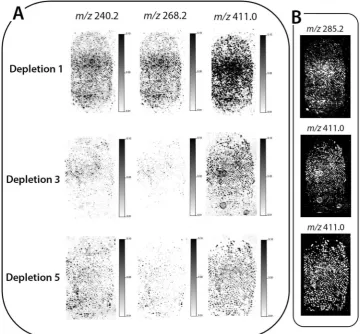
In order to mimic a realistic forensic scenario, a depletion series of 5 ungroomed inger-marks were deposited on a polymer banknote and let to age in a wallet for 6 weeks. hroughout this period, the wallet was used as normal, being stored in the users back pocket between uses. he storage conditions of the aged ingermarks would have subjected the banknote to higher temperatures and pressures than if simply aged at room temperature; however the exact pressure and temperatures could not be monitored during this time. [image:9.595.154.552.46.149.2]All marks were deposited onto the opaque section of the polymer banknote and the 1st, 3rd and 5th ingermark of the depletion series were submitted to analysis by MALDI-MSI. When comparing the image quality of three unidentiied species (m/z 240.2, m/z 268.2 and m/z 411.0), there was a clear reduction in the ion signal intensity
and quality of the ingermark ridges across the depletion series (Fig. 6A). Previous research on polymer bank-notes by Jones et al.13 highlighted that ingermarks deposited onto polymer banknotes degraded very quickly due
to the semi-porous nature of the surface. Nonetheless, selection of the most abundant ion in each of the depletion series, such as putative stearic acid [M + H]+ (m/z 285.2)31 when visualised at an optimal contrast and intensity,
conirmed that grade 2 ingermark images could still be obtained in each instance (Fig. 6B).
Bradshaw et al.31 found that ageing ingermarks under controlled humid conditions compromised the
qual-ity of ridge detail relative to ingermarks aged for the same period of time at room temperature. As the ageing conditions in this research could not be measured; the efect of the temperature, humidity and pressure on the quality of ingermarks cannot be speciied. Further research surrounding aged marks on polymer banknotes in controlled conditions would allow for more accurate information regarding the interaction of ingermarks with the banknote surface over a period of time. Furthermore, it would also be interesting to analyse a note stored in more realistic conditions, whereby the protective element of the paper envelope would be removed during the ageing process.
Detection of exogenous substances on contaminated ingermarks.
Obtaining chemical informa-tion from latent ingermarks is a key advantage of spectrometric techniques, allowing for a wide range of constit-uents to be targeted. hese may include endogenous species, such as; glycerides, fatty acids and amino acids, but also exogenous contaminants such as cosmetics44,45, drugs38 and explosives19.hroughout each of the experiments in this research, the most abundant molecular ions were selected to reconstruct ingermark images. However, it is important to note that the identiication of these species is unim-portant (although putative molecular assignments have been provided where possible), as the primary purpose of this research was to focus on the potential of MALDI-MSI to allow for ridge detail reconstruction of ingermarks deposited on polymer banknotes. Although the clarity of the marks will vary depending on the donor and envi-ronmental conditions44,46, the ability to obtain chemical information on the contents of the ingermark residue
[image:10.595.155.516.47.381.2]has huge forensic importance, potentially providing information on the lifestyle of an individual which can help to direct an investigation. herefore, a set of experiments was designed in order to assess the efectiveness of
MALDI-MSP and MSI in the detection of forensically interesting substances, namely cocaine, deposited onto polymer banknotes.
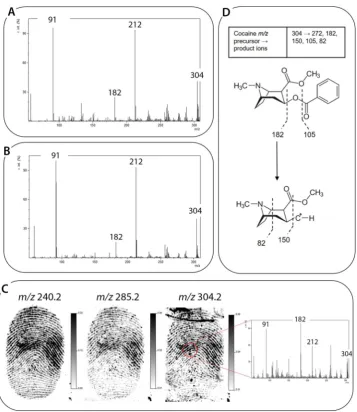
In an initial experiment, serial dilutions of cocaine were deposited directly onto the polymer banknote sur-face before being analysed by MALDI-MS and MS/MS proiling. he limit of detection (LOD) was determined based on the serial dilution which provided an MS/MS spectrum which contained product ions corresponding to that of cocaine (10 ng/mL). his corroborated previous results of Groeneveld et al.38. Ungroomed ingermarks
deposited onto polymer banknotes were then spiked with three diferent concentrations of cocaine, starting with the value determined to be the LOD in the initial proiling experiment (10 ng/mL, 100 ng/mL and 1 µg/mL). MALDI-MSP analysis deemed the LOD of cocaine, when present within ingermark residue, to be 100 ng/mL. In both sets of experiments, MALDI-MS/MS was used to conirm the presence of cocaine through fragmentation of the precursor ion (m/z 304.15) to the primary product ion (m/z 182). Additional peaks observed in the spectra were derived from dimethylbenzylammonium (DMA) (m/z 304.2), with product ions observed at m/z 212 and
m/z 9147 (Fig. 7A,B, respectively).
[image:11.595.158.516.41.454.2]Finally, 100 µL of the LOD concentration observed in ingermarks (100 ng/mL) was used to contaminate a ingermark prior to deposition onto a polymer banknote and analysis by MALDI-MSI (total of 10 ng cocaine). Figure 6C shows that grade 3 ingermark images could be obtained through the selection of an unidentiied species (m/z 240.2) and grade 2 through molecular imaging of stearic acid (m/z 285.2) [M + H]+ and cocaine (m/z 304.1). Conirmation of this exogenous substance was achieved by post-image MALDI-MS/MS analysis.
Figure 7. (A) MALDI MS/MS conirmation of 10 ng/mL cocaine spotted onto a polymer banknote, (B) MALDI MS/MS conirmation of 100 ng/mL cocaine spotted onto a latent ungroomed ingermark deposited onto a polymer banknote, (C) MALDI MS images of an unidentiied species and protonated stearic acid (m/z 240.2 and
he accepted fragmentation mechanism for cocaine has been depicted in Fig. 7D48–50. he total amount of drug
employed here is greater than the lowest amount of cocaine detected in spiked ingermarks using MALDI MS previously38. However, this could still be considered a ‘low’ amount of cocaine which may be obtained from an
individual handling the drug. his provides a positive indication to the sensitivity of the proposed methodology for the detection and identiication of drug residues in ingermarks deposited onto polymer banknotes. he ability to diferentiate between direct transfer and excretion (following drug use) would only be possible through the detection of metabolites in ingermark residue.
Cocaine has previously been shown to contaminate a signiicant proportion of circulated banknotes51–53.
Drugs such as heroin, amphetamines and ∆9-tetrahydrocannabinol (THC) have also been identiied on paper banknotes52,54. his contamination may be signiicantly less on the new £5 polymer banknotes due to their recent
introduction (less time in circulation) and ‘cleaner’ base material. However due to the potential of background contamination, it may be necessary to conduct analysis of latent ingermarks deposited on polymer banknotes using MALDI-MSI, as opposed to proiling, as visualisation of illicit substances contained within the ridges would indicate that they are derived from the donor rather than contamination on the banknote surface (reducing the potential for false positives). he possibility of this has been demonstrated previously through discrimination between external contamination and direct deposition from a ingermark using condom lubricants55.
It is important to note that in all instances where cocaine was detected within ingermarks in this paper, anal-ysis of blank regions conirmed that there was no initial contamination on the note surface prior to ingermark deposition (data not shown).
To alleviate the issue of contamination, a washing protocol was designed to reduce residual contaminants on the polymer banknotes. However, DMA was detected following MALDI MS proiling on the “cleaned” notes. his may have been introduced either in the washing protocol, in the instrument or on the banknote as a con-taminant. DMA has been reported to be found in antiseptics, health care solutions and preservatives56, and has
previously been identiied as a potential contaminant in latent ingermarks47,57. A large scale in-depth study is
required to determine background levels of diferent exogenous contaminants in polymer banknotes to ensure this information is taken into consideration when proiling ingermarks in forensic investigations. It would also be advantageous to assess the ability to detect metabolites of illicit substances, which has the potential to indicate drug use over handling33,58.
Conclusion
he introduction of polymer banknotes into UK currency has created an issue with respect to the recovery of ingermarks from this surface in comparison to the traditional paper varieties. In a forensic scenario, cur-rency is encountered in an array of scenarios (such as thet and money laundering); therefore it is necessary to develop methodologies which maximise ingermark visualisation. As the condition of a ingermark (whether it is depleted, aged or contaminated), location (various security features) and composition of the ingermarks will vary tremendously in each diferent case, a robust and reproducible methodology is imperative. In this research, MALDI-MSI has proven to be afective in addressing each of these potential issues, allowing for the analysis of minimal amounts of material in depletion series and aged marks, ingermarks deposited onto diferent areas of the note and following conventional development. Furthermore, MALDI-MS and MS/MS proiling has proven to be useful for the detection and conirmation of cocaine contained within the residue of ingermarks deposited onto polymer banknotes. he research presented here demonstrates the potential of MALDI-MS in providing both physical and chemical information from latent ingermarks deposited onto polymer banknotes. Ultimately, this highlights the power and sensitivity of this novel analytical approach to ingermark analysis and provides a positive indication to its potential use in forensic investigations in the future.
References
1. James, S. & Nordby, J. Forensic Science: An introduction to Scientiic and Investigative Techniques (3rd Ed.). (CRC Press: 2009).
2. Jackson, A. & Jackson, J. M. Forensic Science (4th ed.). (Pearson Education Limited: 2017).
3. Yamashita, B. & French, M. Latent print development, in: he Fingerprint Sourcebook, U.S. Department of Justice, he National Institute of Justice, Washington, pp. 1–67, www.ncjrs.gov/pdiles1/nij/225327.pdf (2011).
4. Bandey, H., Bleay, S., Bowman, V., Downham, R. & Sears, V. H, Fingermark Visualisation Manual (ed. Bandey, H) (CAST, Home Oice, Sandridge, UK, 2014).
5. McClintock, R. & Whymark, R. Bank of England notes: he switch to polymer. Bank of England. Quarterly Bulletin56(1), 23–32 (2016). 6. Downham, R. P., Brewer, E. R., King, R. S. P., Luscombe, A. M. & Sears, V. G. Fingermark visualisation on uncirculated £5 (Bank of
England) polymer notes: Initial process comparison studies. Forensic Sci Int.275, 30–43 (2017). 7. Bank of England. he New Fiver. At http://www.thenewiver.co.uk/ (2017).
8. Bandey, H. L., Bleay, S. M., Bowman, V. J., Downham, R. P. & Sears, V. G. Process selection, in: H.L. Bandey (Ed.), Fingermark Visualisation Manual, 1st ed., Home Oice Centre for Applied Science and Technology (CAST), Sandridge, UK, ISBN: 978-1-78246-234-7, (Chapter 4) (2014).
9. Bandey, H. L., Bleay, S. M., Bowman, V. J., Downham, R. P. & Sears, V. G. Process selection, in: H.L. Bandey (Ed.), Fingermark Visualisation Manual, 1st ed., Home Oice Centre for Applied Science and Technology (CAST), Sandridge, UK, ISBN: 978-1-78246-234-7, (Chapter 2) (2014).
10. Bank of England. LCA of Paper and Polymer Bank Notes. At http://www.bankofengland.co.uk/banknotes/polymer/Documents/ lcapaperandpolymerbanknotes.pdf (2013).
11. Davis, L., Kelly, P., King, R. & Bleay, S. Visualisation of latent ingermarks on polymer banknotes using copper vacuum metal deposition: A preliminary study. Forensic Sci Int.266, 86–92 (2016).
12. Flynn, J., Stoilovic, M. & Lennard, C. Detection and enhancement of latent ingerprints on polymer banknotes: A preliminary study.
J Forensic Ident.49(6), 594–613 (1999).
13. Jones, N., Kelly, M., Stoilovic, M., Lennard, C. & Roux, C. he development of latent ingerprints on polymer banknotes. J Forensic Ident.53(1), 50–77 (2003).
14. King, R., Hallett, P. & Foster, D. Seeing into the infrared: A novel IR luorescent ingerprint powder. Forensic Science International
15. Ma, R. et al. Fingermark detection on non-porous and semi-porous surfaces using NaYF 4:Er,Yb up-converter particles. Forensic Sci Int.207(1), 145–149 (2011).
16. Wolstenholme, R., Bradshaw, R., Clench, M. & Francese, S. Study of latent fingermarks by matrix-assisted laser desorption/ ionisation mass spectrometry imaging of endogenous lipids. Rapid Commun Mass S.23(19), 3031–3039 (2009).
17. Ifa, D., Manicke, N., Dill, A. & Cooks, R. Latent ingerprint chemical imaging by mass spectrometry. Science (New York, N.Y.)
321(5890), 805 (2008).
18. Musah, R., Cody, R., Dane, A., Vuong, A. & Shepard, J. Direct analysis in real time mass spectrometry for analysis of sexual assault evidence. Rapid Commun Mass S26(9), 1039–1046 (2012).
19. Rowell, F. et al. Detection of nitro-organic and peroxide explosives in latent fingermarks by DART- and SALDI-TOF-mass spectrometry. Forensic Sci Int.221(1), 84–91 (2012).
20. Szynkowska, M., Czerskia, K., Gramsa, J., Paryjczaka, T. & Parczewskib, A. Preliminary studies using imaging mass spectrometry TOF-SIMS in detection and analysis of ingerprints. Imaging Sci J.55(3), 180–187 (2007).
21. Bright, N. et al. Determination of the deposition order of overlapping latent ingerprints and inks using secondary ion mass spectrometry. Anal Chem.84(9), 4083–7 (2012).
22. Bailey, M. J. et al. Enhanced imaging of developed ingerprints using mass spectrometry imaging. he Analyst.138(21), 6246–6250 (2013). 23. Rowell, F., Hudson, K. & Seviour, J. Detection of drugs and their metabolites in dusted latent ingermarks by mass spectrometry.
Analyst.134, 701–707 (2009).
24. Benton, M., Rowell, F., Sundar, L., Jan, M. & Bailey, M. Direct detection of nicotine and cotinine in dusted latent ingermarks of smokers by using hydrophobic silica particles and MS. Surf Interface Anal.42(5), 378–385 (2010).
25. Sundar, L. & Rowell, F. Detection of drugs in lited cyanoacrylate-developed latent ingermarks using two laser desorption/ionisation mass spectrometric methods. Analyst.139(3), 633–642 (2013).
26. Emerson, B., Gidden, J., Lay, J. Jr & Durham, B. Laser desorption/ionization time-of-light mass spectrometry of triacylglycerols and other components in ingermark samples. J Forensic Sci.56(2), 381–389 (2011).
27. Lauzon, N., Dufrense, M., Chauhan, V. & Chaurand, P. Development of Laser Desorption Imaging Mass Spectrometry Methods to Investigate the Molecular Composition of Latent Fingermarks. J. Am. Soc. Mass Spectrom.26, 878–886 (2015).
28. Moule, E. C. et al. Silver-assisted development and imaging of ingermarks on non-porous and porous surfaces. Int. J. Mass. Spectrom
422, 27–31 (2017).
29. Francese, S., Bradshaw, R. & Denison, N. An update on MALDI mass spectrometry based technology for the analysis of ingermarks - stepping into operational deployment. Analyst.142(14), 2518–2546 (2017).
30. Francese, S. et al. Beyond the ridge pattern: multi-informative analysis of latent ingermarks by MALDI mass spectrometry. Analyst.
138, 4215–4228 (2013).
31. Bradshaw, R., Bleay, S., Wolstenholme, R., Clench, M. & Francese, S. Towards the integration of matrix assisted laser desorption ionisation mass spectrometry imaging into the current ingermark examination worklow. Forensic Sci Int.232(1–3), 111–124 (2013). 32. Bradshaw, R., Denison, N. & Francese, S. Development of operational protocols for the analysis of primary and secondary
ingermark lits by MALDI-MS imaging. Anal Methods.8(37), 6795–6804 (2016).
33. Bradshaw, R., Denison, N. & Francese, S. Implementation of MALDI MS proiling and imaging methods for the analysis of real crime scene ingermarks. Analyst.142(9), 1581–1590 (2017).
34. Strohalm, M., Kavan, D., Novák, P., Volný, M. & Havlícek, V. MMass 3: A cross-platform sotware environment for precise analysis of mass spectrometric data. Anal Chem.82(11), 4648–51 (2010).
35. Bandey, H. L. Fingerprint Development and Imaging Newsletter: he Powders Process, Study 1. Home Oice Police Scientiic Development Branch, Sandridge, Report No. 54/04 (2004).
36. Sears, V. G., Bleay, S. M., Bandey, H. L. & Bowman, V. J. A methodology for ingermark research. Sci Justice.52, 145–160 (2012). 37. Home Oice, Fingermark Source Book: Manual of development techniques. At https://www.gov.uk/government/publications/
ingerprint-source-book (2013).
38. Groeneveld, G., De Puit, M., Bleay, S., Bradshaw, R. & Francese, S. Detection and mapping of illicit drugs and their metabolites in ingermarks by MALDI MS and compatibility with forensic techniques. Sci Rep,5, 11716 (2015).
39. Ferguson, L., Creasey, S., Wolstenholme, R., Clench, M. & Francese, S. Eiciency of the dry–wet method for the MALDI‐MSI analysis of latent ingermarks. J Mass Spectrom.48(6), 677–684 (2013).
40. Bradshaw, R., Bleay, S., Clench, M. & Francese, S. Direct detection of blood in ingermarks by MALDI MS proiling and Imaging. Sci Justice.54(2), 110–117 (2014).
41. De Grazia, A. et al. Diacetylene copolymers for ingermark development. Forensic Sci Int.216(1–3), 189–197 (2012).
42. Lam, R., Wilkinson, D., Tse, T. & Pynn, B. Recommended protocols for ingerprint detection on Canadian polymer banknotes - Part I: Chemical development. J Forensic Ident.64(4), 375–401 (2014).
43. Wang, M. & Fitzgerald, M. A. solid sample preparation method that reduces signal suppression efects in the MALDI analysis of peptides. Anal Chem.73(3), 625–631 (2001).
44. Archer, N., Charles, Y., Elliott, J. & Jickells, S. Changes in the lipid composition of latent ingerprint residue with time ater deposition on a surface. Forensic Sci Int.154(2), 224–239 (2005).
45. Ricci, C., Kazarian, S. & Bailey, M. Collection and detection of latent ingermarks contaminated with cosmetics on nonporous and porous surfaces. Surf Interface Anal.42(5), 386–392 (2010).
46. Ferguson, L. et al. Direct detection of peptides and small proteins in ingermarks and determination of sex by MALDI mass spectrometry proiling. Analyst.137(20), 4686–4692 (2012).
47. Bradshaw, R. et al. A novel matrix-assisted laser desorption/ionisation mass spectrometry imaging based methodology for the identiication of sexual assault suspects. Rapid Commun Mass S.25(3), 415–422 (2011).
48. Wang, P. & Bartlett, M. Collision‐induced dissociation mass spectra of cocaine, and its metabolites and pyrolysis products. J Mass Spectrom,33(10), 961–967 (1998).
49. Castiglioni, S., Zuccato, E., Chiabrando, C., Fanelli, R. & Bagnati, R. Mass spectrometric analysis of illicit drugs in wastewater and surface water. Mass Spectrometry Reviews,27(4), 378–394 (2008).
50. Bijlsma, L., Sancho, J., Hernández, F. & Niessen, W. Fragmentation pathways of drugs of abuse and their metabolites based on QTOF MS/MS and MSE accurate‐mass spectra. J Mass Spectrom.46(9), 865–875 (2011).
51. Oyler, J., Darwin, W. & Cone, E. Cocaine Contamination of United States Paper Currency. J Anal Tox.20(4), 213–216 (1996). 52. Sleeman, R., Fletcher, B., Carter, J., Roberts, D. & Hulmston, P. Drugs on money. Anal Chem.72(11), 397–403 (2000).
53. Esteve-Turrillas, F. et al. Validated, non-destructive and environmentally friendly determination of cocaine in euro bank notes. J
Chromatog A.1065(2), 321–325 (2005).
54. Ebejer, K., Brereton, R., Carter, J., Ollerton, S. & Sleeman, R. Rapid comparison of diacetylmorphine on banknotes by tandem mass spectrometry. Rapid Commun Mass S.19(15), 2137–2143 (2005).
55. Bradshaw, R. et al. Spectroscopic imaging based approach for condom identiication in condom contaminated ingermarks. Analyst.
138(9), 2546–57 (2013).
56. Ferrer, I. & Furlong, E. T. Identiication of alkyl dimethylbenzylammonium surfactants in water samples by solid-phase extraction followed by ion trap LC/MS and LC/MS/MS.(Statistical Data Included). Env Sci Tech.35(12), 2583 (2001).
57. Ferguson, L., Bradshaw, R., Wolstenholme, R., Clench, M. & Francese, S. Two-step matrix application for the enhancement and imaging of latent ingermarks. Anal Chem.83(14), 5585–91 (2011).
58. Bailey, M. et al. Rapid detection of cocaine, benzoylecgonine and methylecgonine in ingerprints using surface mass spectrometry.
Author Contributions
R.B. and K.S. wrote the manuscript. K.S. performed the laboratory work under the supervision of R.B.
Additional Information
Competing Interests: he authors declare no competing interests.
Publisher's note: Springer Nature remains neutral with regard to jurisdictional claims in published maps and institutional ailiations.
Open Access This article is licensed under a Creative Commons Attribution 4.0 International License, which permits use, sharing, adaptation, distribution and reproduction in any medium or format, as long as you give appropriate credit to the original author(s) and the source, provide a link to the Cre-ative Commons license, and indicate if changes were made. he images or other third party material in this article are included in the article’s Creative Commons license, unless indicated otherwise in a credit line to the material. If material is not included in the article’s Creative Commons license and your intended use is not per-mitted by statutory regulation or exceeds the perper-mitted use, you will need to obtain permission directly from the copyright holder. To view a copy of this license, visit http://creativecommons.org/licenses/by/4.0/.