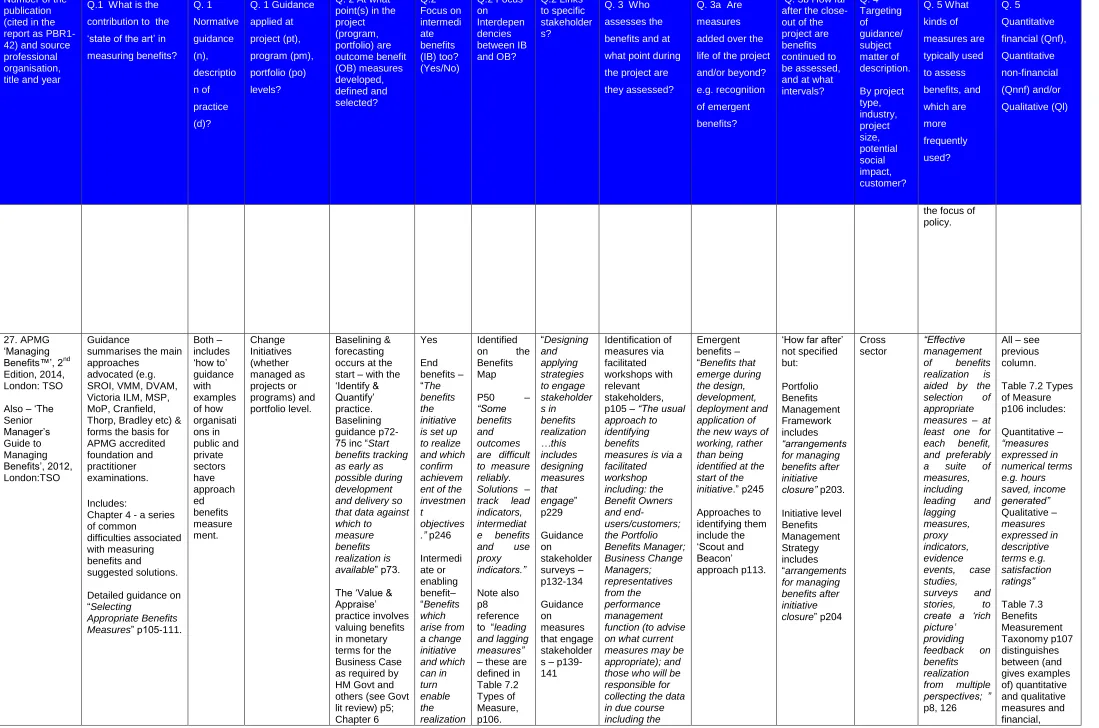
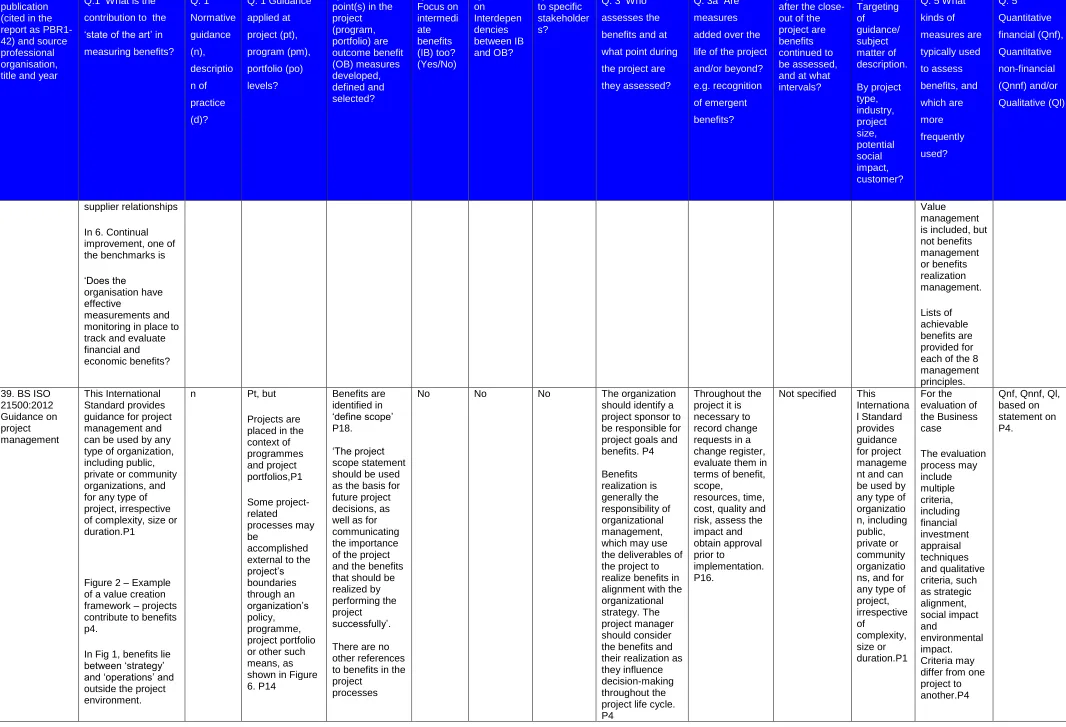
Measures for benefits realization.
BREESE, Richard, JENNER, Stephen, SERRA, Carlos, THORP, John,
BADEMI, Amgad and CHARLTON, Michael
Available from Sheffield Hallam University Research Archive (SHURA) at:
http://shura.shu.ac.uk/18957/
This document is the author deposited version. You are advised to consult the
publisher's version if you wish to cite from it.
Published version
BREESE, Richard, JENNER, Stephen, SERRA, Carlos, THORP, John, BADEMI,
Amgad and CHARLTON, Michael (2018). Measures for benefits realization. Project
Report. Report produced by Sheffield Hallam University for the Project Management
Institute.. (Unpublished)
Copyright and re-use policy
See
http://shura.shu.ac.uk/information.html
Sheffield Hallam University Research Archive
Appendix 2 Professional Body Literature Review
Number of the publication (cited in the report as PBR1-42) and source professional organisation, title and year
Q.1 What is the
contribution to the ‘state of the art’ in
measuring benefits?
Q. 1
Normative
guidance
(n),
descriptio
n of
practice
(d)?
Q. 1 Guidance
applied at
project (pt),
program (pm),
portfolio (po)
levels?
Q. 2 At what point(s) in the project (program, portfolio) are outcome benefit (OB) measures developed, defined and selected?
Q.2 Focus on intermedi ate benefits (IB) too? (Yes/No)
Q.2 Focus on
Interdepen dencies between IB and OB?
Q.2 Links to specific stakeholder s?
Q. 3 Who
assesses the
benefits and at
what point during
the project are
they assessed?
Q. 3a Are
measures
added over the
life of the project
and/or beyond?
e.g. recognition
of emergent
benefits?
Q. 3b How far after the close-out of the project are benefits continued to be assessed, and at what intervals?
Q. 4 Targeting of
guidance/ subject matter of description.
By project type, industry, project size, potential social impact, customer?
Q. 5 What
kinds of
measures are
typically used
to assess
benefits, and
which are
more
frequently
used?
Q. 5
Quantitative
financial (Qnf),
Quantitative
non-financial
(Qnnf) and/or
Qualitative (Ql)
1. PMI, A Guide to the Project Management Body of Knowledge, (PMBOK®) 5th Edition, 2013.
"Business Value" seen as unique to each organisation. A combination of "tangible and intangible benefits". Role of project, program and portfolio management to employ processes that "obtain greater business value" p.530.
n Pt, but links with BRM at PM & PO levels
Benefit realisation not the
responsibility of organisational project
management – success is determined by
compliance, cost, quality, time and "customer satisfaction". Guidance follows the language of "deliverables" at PM level NOT benefits.
"Success" as measured by the satisfaction of needs and benefits occurs at program level. Benefit "realization" at portfolio level p.8.
Generic process guidance on "deliverables" only and "interim deliverables" for phased projects p.102.
No No None Not specified None Not specified Generic Not specified Not specified
2. PMI, A Guide to the Project Management Body of Knowledge, (PMBOK®) 6th Edition, 2017
Standard reference text for PM
profession so it is crucial that benefits are mentioned
n Pt, but links with BRM at PM & PO levels
Iteratively & from early in the PLC: The Project Benefits Management Plan "describes the mechanisms that should be in place to
measure those
No No None Not specified – although the Benefits Owner is identified as the accountable person to monitor, record and report realized benefits - p33
Implied – see reference to the Benefits
Management Plan being maintained as an "iterative activity"
Not specified although it recognises benefits may be realized after project closure – in which case the "portfolio management
Generic Refers to tangible and intangible value; financial value is expressed as NPV; and metrics/measu res are classified as
QnF measured by NPV
Ql - refers to direct and indirect measures
Appendix 2 Professional Body Literature Review
Number of the publication (cited in the report as PBR1-42) and source professional organisation, title and year
Q.1 What is the
contribution to the ‘state of the art’ in
measuring benefits?
Q. 1
Normative
guidance
(n),
descriptio
n of
practice
(d)?
Q. 1 Guidance
applied at
project (pt),
program (pm),
portfolio (po)
levels?
Q. 2 At what point(s) in the project (program, portfolio) are outcome benefit (OB) measures developed, defined and selected?
Q.2 Focus on intermedi ate benefits (IB) too? (Yes/No)
Q.2 Focus on
Interdepen dencies between IB and OB?
Q.2 Links to specific stakeholder s?
Q. 3 Who
assesses the
benefits and at
what point during
the project are
they assessed?
Q. 3a Are
measures
added over the
life of the project
and/or beyond?
e.g. recognition
of emergent
benefits?
Q. 3b How far after the close-out of the project are benefits continued to be assessed, and at what intervals?
Q. 4 Targeting of
guidance/ subject matter of description.
By project type, industry, project size, potential social impact, customer?
Q. 5 What
kinds of
measures are
typically used
to assess
benefits, and
which are
more
frequently
used?
Q. 5
Quantitative
financial (Qnf),
Quantitative
non-financial
(Qnnf) and/or
Qualitative (Ql)
benefits." and it includes
"metrics e.g. the measures used to show benefits realized...The metrics provide verification of the business value and validation of the project's success" P33. The
development of this plan begins "early in the project life cycle with the
definition of the target benefits to be realized" and is
maintained as an "iterative activity" p33
office (PMO), portfolio steering committee or some other business function...shou ld evaluate the success at a later date to determine if the outcomes met the business objectives." p547
direct and indirect (p33 & 546). Also p546 refers to "financial and qualitative criteria for project success" under the heading "Project Success and Benefits Management"
for project success" p546
So the gap appears to be no ref to QnnF.
3. PMI, The Standard for Program Management 3rd Edition, 2013.
Note Section 4 Program Benefits Management (p33-44)
"It is especially important to quantify the incremental delivery of benefits so that the full realisation of planned benefits may be measured during the performance of the program" p.37.
n PM
Program
Program mandate specifies benefits expected to be realized p.35.
Identification of benefits includes "quantifying business benefits"; "developing meaningful metrics and KPIs to measure actual delivery.." And processes
Language of
"incremen tal benefits" because each project occupies a different point on the schedule p.5
Yes but focus is on component s/
incremental benefit
Generic advice on stakeholder s such as performing organisatio n,
customers or
program's intended beneficiarie s.
Program manager "continually" assesses the value and impact of program benefits p.33.
Program benefits management occurs
"throughout" and "during" "program benefits delivery phase".
Performance generally begins "top down" and bottom up in later
Yes, through completion of benefits register which also takes into account specified phases of "transition" and "sustainment"
Generic guidance on the importance of "sustained benefits"
Generic Quantification of typical benefits "hours saved, profit increased, cultural, political, or legislative improvement achieved, market share, competitor strength reduced [sic]" p.37
"Qualification"
Qnf and Qnnf Quantification of incremental benefits
including timing
Appendix 2 Professional Body Literature Review
Number of the publication (cited in the report as PBR1-42) and source professional organisation, title and year
Q.1 What is the
contribution to the ‘state of the art’ in
measuring benefits?
Q. 1
Normative
guidance
(n),
descriptio
n of
practice
(d)?
Q. 1 Guidance
applied at
project (pt),
program (pm),
portfolio (po)
levels?
Q. 2 At what point(s) in the project (program, portfolio) are outcome benefit (OB) measures developed, defined and selected?
Q.2 Focus on intermedi ate benefits (IB) too? (Yes/No)
Q.2 Focus on
Interdepen dencies between IB and OB?
Q.2 Links to specific stakeholder s?
Q. 3 Who
assesses the
benefits and at
what point during
the project are
they assessed?
Q. 3a Are
measures
added over the
life of the project
and/or beyond?
e.g. recognition
of emergent
benefits?
Q. 3b How far after the close-out of the project are benefits continued to be assessed, and at what intervals?
Q. 4 Targeting of
guidance/ subject matter of description.
By project type, industry, project size, potential social impact, customer?
Q. 5 What
kinds of
measures are
typically used
to assess
benefits, and
which are
more
frequently
used?
Q. 5
Quantitative
financial (Qnf),
Quantitative
non-financial
(Qnnf) and/or
Qualitative (Ql)
for measuring progress against the business plan P.36.
Benefits register set out list of benefits, how to measure, KPIs and thresholds for evaluating and responsible party.
Benefits realization plan – define the metrics p.39.
phases p 34.
Program manager and stakeholders assess whether or not benefits exceed control thresholds.
[sic] of intangible benefits e.g. "improved morale" and/or "perception of the
organisation" p.37.
4. PMI, The Standard for Portfolio Management 3rd Edition, 2013.
Section 1.6 on "Business value" broadly
contextualises portfolio
management's role in optimizing and aligning project and program benefits p10.
Broad guidance on value measurement frameworks setting out the value types to be achieved and how value will be
measured p96. "Facilitates comparison of expected value across
components..." P96.
n PO (programs and projects defined as "components"). Illustrations at all levels in guidance.
Scoring models are used to assess benefits of
programs/projec ts against criteria.
Weighting of criteria can be changed "when conditions change" p.101
Not specified
Results chain tools permit illustration of cause and effect relationship s showing gaps and overlaps in how portfolios effectively realize planned benefits (p.103).
General stakeholder s only. Comparing outcome probability analysis with stakeholder risk
tolerance
WHO:
Portfolio manager measures and monitors metrics such as "ROI, NPV, Payback, IRR and
scorecards" p.15.
WHEN: As components are "completed", the organisation "realises consequential benefits" p.97 ...but also..."the portfolio
management plan provides for the continual
identification and assessment of the portfolio benefits". P.98.
Not specified Not specified Cross sector
Economic benefits to business. Source acknowledg es many forms of value - societal, channel partner, managerial value etc. "are not directly measured in monetary terms" p.103.
Scoring models using simple scales for intangible portfolio benefits p.100-101.
Comparative advantage; cost-benefit analysis; portfolio efficient frontier.
Qnf
Qnnf
Appendix 2 Professional Body Literature Review
Number of the publication (cited in the report as PBR1-42) and source professional organisation, title and year
Q.1 What is the
contribution to the ‘state of the art’ in
measuring benefits?
Q. 1
Normative
guidance
(n),
descriptio
n of
practice
(d)?
Q. 1 Guidance
applied at
project (pt),
program (pm),
portfolio (po)
levels?
Q. 2 At what point(s) in the project (program, portfolio) are outcome benefit (OB) measures developed, defined and selected?
Q.2 Focus on intermedi ate benefits (IB) too? (Yes/No)
Q.2 Focus on
Interdepen dencies between IB and OB?
Q.2 Links to specific stakeholder s?
Q. 3 Who
assesses the
benefits and at
what point during
the project are
they assessed?
Q. 3a Are
measures
added over the
life of the project
and/or beyond?
e.g. recognition
of emergent
benefits?
Q. 3b How far after the close-out of the project are benefits continued to be assessed, and at what intervals?
Q. 4 Targeting of
guidance/ subject matter of description.
By project type, industry, project size, potential social impact, customer?
Q. 5 What
kinds of
measures are
typically used
to assess
benefits, and
which are
more
frequently
used?
Q. 5
Quantitative
financial (Qnf),
Quantitative
non-financial
(Qnnf) and/or
Qualitative (Ql)
Cost-benefit analysis "should be tracked".." as required" as portfolio components change or as the environment changes
(competitive and financial)
5. PMI, Organizational Project Management Maturity Model (OPM3®) 3RD Edition, 2013
OPM3 is a strategy execution framework utilising portfolio, program and project management as well as organisational enabling processes p2.
Within the OPM Framework, The Delivery and Benefits Management Area of Expertise
“encompasses 6 processes: Understand the Organization, Define the Scope, Conduct Assessment, Create Recommendations, Select Initiatives, and Implement
Improvements, but not ‘measure results’ p41.
Includes brief coverage of Cost-benefit analysis
n Incorporates pt, pm, po.
Not specified, however does refer to OPM Success Metrics p162.
Not specified
Not specified
Not specified
Not specified Not specified Not specified Any organisatio n wishing to adopt OPM3.
Not specified Not specified, but the planning and
Appendix 2 Professional Body Literature Review
Number of the publication (cited in the report as PBR1-42) and source professional organisation, title and year
Q.1 What is the
contribution to the ‘state of the art’ in
measuring benefits?
Q. 1
Normative
guidance
(n),
descriptio
n of
practice
(d)?
Q. 1 Guidance
applied at
project (pt),
program (pm),
portfolio (po)
levels?
Q. 2 At what point(s) in the project (program, portfolio) are outcome benefit (OB) measures developed, defined and selected?
Q.2 Focus on intermedi ate benefits (IB) too? (Yes/No)
Q.2 Focus on
Interdepen dencies between IB and OB?
Q.2 Links to specific stakeholder s?
Q. 3 Who
assesses the
benefits and at
what point during
the project are
they assessed?
Q. 3a Are
measures
added over the
life of the project
and/or beyond?
e.g. recognition
of emergent
benefits?
Q. 3b How far after the close-out of the project are benefits continued to be assessed, and at what intervals?
Q. 4 Targeting of
guidance/ subject matter of description.
By project type, industry, project size, potential social impact, customer?
Q. 5 What
kinds of
measures are
typically used
to assess
benefits, and
which are
more
frequently
used?
Q. 5
Quantitative
financial (Qnf),
Quantitative
non-financial
(Qnnf) and/or
Qualitative (Ql)
6. PMI, Managing Change in Organizations: A Practice Guide, 2013
Section 4. Change Management at the Portfolio level includes:
4.4 Measure Benefits realization –
“Successful execution of the change can only be measured through benefits realization… Establishing
expected benefits requires a systems view of the portfolio where each expected benefit is aligned with the vision and its contribution to the change purpose at the organizational level.”
Section 5 Change Management at the Program level – reflects the guidance in The Standard for Program
Management re Benefits Transition (section 4.4) and Benefits Sustainment (section 4.5).
Section 6 Change Management in the project management context – includes – “when viewed from a change management perspective, the project manager is responsible for ensuring that the
n Pt, pm, po - chapter for each, plus preceding chapter on managing change in an organisational project management context.
‘measurement is the instrument of
change..determi ne existing indicators and where systems are not in place establish measurement systems as the first part of any change initiative p39.
For program management, ‘the expected benefits and measures of success are set and aligned with the vision at the formulation stage p88.
Distinctio n made between ‘intermedi ate and tangible benefits’ (p88).
Benefits breakdow n
structure (benefits mapping approach) diagram, p73.
Capabilities lead to results, lead to outcomes, lead to benefits p73.
Not specified
4.4.1 The role of the Portfolio Manager in Measuring Benefits Realization.
Acts as primary conduit between managers of portfolio
components and portfolio
stakeholders, including
Measures and monitors the value to the organisation through portfolio performance metrics and targets.
5.3.5.3 covers the role of program management in measuring benefits
realization, which requires the program team to build a benefits register (see Q5 final column) p88-89.
6.3.5.3 Measure Benefits
Realization – “The process of
measuring benefits
realization starts
Not specified – term emergent not used, but stress on adaptive change.
Short, medium and long term measures of success are identified, but causal relationships are
acknowledged as being problematic in the long term (P85)
generic Benefits mapping and benefits registers will address: Acceptance rates
Adoption rates Project Outcomes Assumptions
Qnf, Qnnf, Ql
‘not all measures of success ca n be translated into financial terms p75, and an example of s flawed measure is provided.
‘Benefits registers are used to report to the executive level when benefits are identified in qualitative terms....when used as a program management tool the measurements are quantitative’ p89. Example of Exec. Level benefits register is provided.
Appendix 2 Professional Body Literature Review
Number of the publication (cited in the report as PBR1-42) and source professional organisation, title and year
Q.1 What is the
contribution to the ‘state of the art’ in
measuring benefits?
Q. 1
Normative
guidance
(n),
descriptio
n of
practice
(d)?
Q. 1 Guidance
applied at
project (pt),
program (pm),
portfolio (po)
levels?
Q. 2 At what point(s) in the project (program, portfolio) are outcome benefit (OB) measures developed, defined and selected?
Q.2 Focus on intermedi ate benefits (IB) too? (Yes/No)
Q.2 Focus on
Interdepen dencies between IB and OB?
Q.2 Links to specific stakeholder s?
Q. 3 Who
assesses the
benefits and at
what point during
the project are
they assessed?
Q. 3a Are
measures
added over the
life of the project
and/or beyond?
e.g. recognition
of emergent
benefits?
Q. 3b How far after the close-out of the project are benefits continued to be assessed, and at what intervals?
Q. 4 Targeting of
guidance/ subject matter of description.
By project type, industry, project size, potential social impact, customer?
Q. 5 What
kinds of
measures are
typically used
to assess
benefits, and
which are
more
frequently
used?
Q. 5
Quantitative
financial (Qnf),
Quantitative
non-financial
(Qnnf) and/or
Qualitative (Ql)
intended business benefits will be achieved through the project’s results.””
during the planning process and is a constant source of
attention for project managers throughout the implementation of the change and the transition of outcomes into business operations. The role of project management in benefits
realization is the routine and rigorous
measurement of early indicators of change success: acceptance, adoption, and early results of change and its benefits. The integrated measurement of benefits
realization is the responsibility of program management when the project is part of a larger program.
7. PMI, Practice Standard for Project Risk Management, 2009
Standard for risk management, linked to PMBOK 4th edition ‘Benefit’ not listed in index or contents. But glossary includes the following
N (but says it has a descriptiv e
purpose, p2)
Pt only Not specified Not specified
Not specified
Not specified
Not specified Not specified, but emergent approach to risk management should be undertaken (p26)
Appendix 2 Professional Body Literature Review
Number of the publication (cited in the report as PBR1-42) and source professional organisation, title and year
Q.1 What is the
contribution to the ‘state of the art’ in
measuring benefits?
Q. 1
Normative
guidance
(n),
descriptio
n of
practice
(d)?
Q. 1 Guidance
applied at
project (pt),
program (pm),
portfolio (po)
levels?
Q. 2 At what point(s) in the project (program, portfolio) are outcome benefit (OB) measures developed, defined and selected?
Q.2 Focus on intermedi ate benefits (IB) too? (Yes/No)
Q.2 Focus on
Interdepen dencies between IB and OB?
Q.2 Links to specific stakeholder s?
Q. 3 Who
assesses the
benefits and at
what point during
the project are
they assessed?
Q. 3a Are
measures
added over the
life of the project
and/or beyond?
e.g. recognition
of emergent
benefits?
Q. 3b How far after the close-out of the project are benefits continued to be assessed, and at what intervals?
Q. 4 Targeting of
guidance/ subject matter of description.
By project type, industry, project size, potential social impact, customer?
Q. 5 What
kinds of
measures are
typically used
to assess
benefits, and
which are
more
frequently
used?
Q. 5
Quantitative
financial (Qnf),
Quantitative
non-financial
(Qnnf) and/or
Qualitative (Ql)
definition of a benefit.
Benefit – “Positive effect on a project objective arising from the occurrence of an opportunity p109.
Risks related to project objectives defined as time. Cost, quality, scope etc. p26.
8. PMI, Project Manager Competency Development Framework, 2nd edition, 2007
This competency development framework refers to the role of project managers in
achieving outcomes, which are defined as ‘the tangible or intangible result of applying a capability P74. Therefore the link with benefits is not made explicitly
n pt Under initiating
a project, alignment with organisational objectives and customer needs is referred to. Under 5. Closing a project ‘project outcomes are accepted’ P11
Not specified
Not specified
Not specified
Not specified Project manager ‘looks for opportunities to improve project value or execution’ P33
Not specified generic Not specified Not specified
9. PMI - Business Analysis for Practitioners A Practice Guide, 2015
Main section(s) P167-168 on Acceptance criteria
The guide defines what BA is, and how it relates to projects and programs (p1).
The roles of business analysis involve 5 domains, needs assessment, business analysis planning,
requirements elicitation and analysis,traceability and monitoring and solution evaluation (p8-9).
n Pt, pm. No reference to po in the ‘purpose of the guide’ p1
Solution evaluation is undertaken to validate a full solution or segment of a solution, that is about to be, or has already been
implemented P157.
The approach depends on the nature of the life-cycle
No, but the example on P168 illustrates the derivation of a financial benefit from an outcome.
No Reference to
‘customer metrics’ – P.163.
In a wider context, stakeholder s are identified for the different stages in business analysis, eg p12 for
The document uses RACI, and identifies the business analyst as responsible for business plan preparation, P13.
....post release, stakeholders may identify new metrics that tie in to the current or new objectives’ p172.
Evaluating the long term performance of the solution is part of assessing business benefits (p171).
In relation to the example given, evaluation could continue over a
quarterly basis
Generic, products, services and process changes.
Broad ctegories of KPI’s are listed p 162,
including finance, customer etc. Project goals will be associated with these KPI’s, leading to the
identification of metrics, but there may be additional
Qnf, Qnnf, Ql.
Appendix 2 Professional Body Literature Review
Number of the publication (cited in the report as PBR1-42) and source professional organisation, title and year
Q.1 What is the
contribution to the ‘state of the art’ in
measuring benefits?
Q. 1
Normative
guidance
(n),
descriptio
n of
practice
(d)?
Q. 1 Guidance
applied at
project (pt),
program (pm),
portfolio (po)
levels?
Q. 2 At what point(s) in the project (program, portfolio) are outcome benefit (OB) measures developed, defined and selected?
Q.2 Focus on intermedi ate benefits (IB) too? (Yes/No)
Q.2 Focus on
Interdepen dencies between IB and OB?
Q.2 Links to specific stakeholder s?
Q. 3 Who
assesses the
benefits and at
what point during
the project are
they assessed?
Q. 3a Are
measures
added over the
life of the project
and/or beyond?
e.g. recognition
of emergent
benefits?
Q. 3b How far after the close-out of the project are benefits continued to be assessed, and at what intervals?
Q. 4 Targeting of
guidance/ subject matter of description.
By project type, industry, project size, potential social impact, customer?
Q. 5 What
kinds of
measures are
typically used
to assess
benefits, and
which are
more
frequently
used?
Q. 5
Quantitative
financial (Qnf),
Quantitative
non-financial
(Qnnf) and/or
Qualitative (Ql)
Benefits are only explicitly discussed in relation to solution evaluation, but there are other unexplored links, eg to
requirements (p7),
(P158), but early definition of evaluation criteria is an ‘excellent way to specify or confirm both functional and non-functional requirements (p158).
Outcome is seen as a precursor for derivation of financial benefit (P168).
Solution evaluation facilitates the go/no go decision p170.
However, when evaluation is planned, key metrics are identified well before
evaluation takes place p172.
needs analysis.
(p172).. metrics and acceptance criteria, some of which are about the solution and some on project
execution (see p162-164).
example given.
Examples are given of methods for validating solution results, which include a specific benefits example, but which are more widely relevant P164-168.
10. PMI, Navigating Complexity, A Practice Guide, 2014
Provides practical ways to recognise and navigate
complexity, but does not focus on benefits.
Literature review refers to ‘The Information Paradox’ p80
N, includes scenarios too
Pt, pm Refers to the use of external audits to assess the validity of senior management expectations on costs and benefits p26.
Link to optimism bias p13
Not specified
Not specified
Not specified
Not specified, but collaboration between senior management and the program or project manager is important for successful outcomes where there is a high degree of complexity.
Emergence identified as a characteristic of complexity p21.
Not specified Generic – complexity seen as widely relevant
Benefits are not referred to, but metrics can be derived for many performance categories, including financial and customer staisfaction
Appendix 2 Professional Body Literature Review
Number of the publication (cited in the report as PBR1-42) and source professional organisation, title and year
Q.1 What is the
contribution to the ‘state of the art’ in
measuring benefits?
Q. 1
Normative
guidance
(n),
descriptio
n of
practice
(d)?
Q. 1 Guidance
applied at
project (pt),
program (pm),
portfolio (po)
levels?
Q. 2 At what point(s) in the project (program, portfolio) are outcome benefit (OB) measures developed, defined and selected?
Q.2 Focus on intermedi ate benefits (IB) too? (Yes/No)
Q.2 Focus on
Interdepen dencies between IB and OB?
Q.2 Links to specific stakeholder s?
Q. 3 Who
assesses the
benefits and at
what point during
the project are
they assessed?
Q. 3a Are
measures
added over the
life of the project
and/or beyond?
e.g. recognition
of emergent
benefits?
Q. 3b How far after the close-out of the project are benefits continued to be assessed, and at what intervals?
Q. 4 Targeting of
guidance/ subject matter of description.
By project type, industry, project size, potential social impact, customer?
Q. 5 What
kinds of
measures are
typically used
to assess
benefits, and
which are
more
frequently
used?
Q. 5
Quantitative
financial (Qnf),
Quantitative
non-financial
(Qnnf) and/or
Qualitative (Ql)
11. PMI, Practice Standard for Earned Value Management, 2nd edition, 2011
None n/a n/a n/a n/a n/a n/a n/a n/a n/a n/a n/a n/a
12. PMI, Practice Standard for Project Configuration Management, 2007
This standard is a guide for the PM, team and other stakeholders to understand PCM and apply it. Comsistent and repeatable processes are required to manage time/cost/ quality and ensure project success.p vii.
However, benefits are not referred to in the domains for PCM (P7).
Reference back to 3rd ed of PMBOK
n pt Not specified.
Configuration Management relies on baselines, including performance measurement baseline. Definition on P48.
Not specified
Not specified
Not specified
Not specified Not specified. Under configuration change control metrics are referred to as ‘a communication tool used by the project manager to assess control of the project to determine if process improvements are made. P22
Not specified Generic Not specified Not specified
13. PMI, Implementing Organizational Project
Management: A Practice Guide, 2014
The guide outlines OPM's contribution to linking portfolio, program and project management to other business practices and enablers. OPM itself contains a benefit realization plan
n Generally at a meta-level, but this depends on tailoring to a specific organisation with specific scale and portfolio
complexity. The implementationo f an OPM initiative is achieved through a typical "program" perspective but
"benefits metrics" p36 emerge from piloting and implementing OPM.
Benefits realised and monitored as plan is being implemented.
A scorecard is used (with OPM metrics) to measure progress of
No No General Measurement
program should contain "basic measures" and the start and the evolve into models that are more complex p37.
Not specified Not specified but "after the project management methodology has been tailored" the business value/benefit should be measured p54.
Not specified
"percentage of project
managers in each internal organisation that have attained the desired level of education for their position.." P36
Example is useful "in beginning stage of OPM" but not
Appendix 2 Professional Body Literature Review
Number of the publication (cited in the report as PBR1-42) and source professional organisation, title and year
Q.1 What is the
contribution to the ‘state of the art’ in
measuring benefits?
Q. 1
Normative
guidance
(n),
descriptio
n of
practice
(d)?
Q. 1 Guidance
applied at
project (pt),
program (pm),
portfolio (po)
levels?
Q. 2 At what point(s) in the project (program, portfolio) are outcome benefit (OB) measures developed, defined and selected?
Q.2 Focus on intermedi ate benefits (IB) too? (Yes/No)
Q.2 Focus on
Interdepen dencies between IB and OB?
Q.2 Links to specific stakeholder s?
Q. 3 Who
assesses the
benefits and at
what point during
the project are
they assessed?
Q. 3a Are
measures
added over the
life of the project
and/or beyond?
e.g. recognition
of emergent
benefits?
Q. 3b How far after the close-out of the project are benefits continued to be assessed, and at what intervals?
Q. 4 Targeting of
guidance/ subject matter of description.
By project type, industry, project size, potential social impact, customer?
Q. 5 What
kinds of
measures are
typically used
to assess
benefits, and
which are
more
frequently
used?
Q. 5
Quantitative
financial (Qnf),
Quantitative
non-financial
(Qnnf) and/or
Qualitative (Ql)
the OPM effort is continuous in nature.
specific components of an enabling process p36.
WHEN:
"after the project management methodology has been tailored" the business value/benefit should be quantified p54.
suitable for evidence of benefits realization p36.
Benefits realization KPIs (examples): "business process productivity increase"; "cycle time reduction" p54. 14. PMI
Governance of Portfolios, Programs and Projects: A Practice Guide, 2016
The report links the metrics related to benefits to the full governance processes across OPM, portfolio, program and project levels
n Mainly pm and po, as the project level is concerned mainly with deliverables rather than benefits(P58).
The
Organizational project
management (OPM) level provides an overall governance framework, and its itself is subject to performance measures (P35, P36)
Benefits and performance metrics for evaluation at the portfolio and
Not specified – other guidance covers life-cycles for benefits.
No No Only
internal responsibilit ies (see Qu. 3)
The role of the Portfolio Manager includes
‘Measure and monitor portfolio value
performance metrics and targets such as benefit ratios, return on
investment (ROI), net present value (NPV), payback period (PP), internal rate of return (IRR), and scorecards. Government and not-for-profit organizations may have other
measures and targets such as productivity and customer satisfaction improvements’
Not specifically referred to, but under the ‘performance domain’ for portfolios and programs there are lose responsibilities for changes to benefits
measures (P49, P62). Project performance is not tied so closely to benefits (P74).
Not specified Generic At the portfolio level, metrics and targets include: benefit ratios, return on investment (ROI), net present value (NPV), payback period (PP), internal rate of return (IRR), and
scorecards. Government and not-for-profit
organizations may have other
measures and targets such as productivity and customer satisfaction improvements
Appendix 2 Professional Body Literature Review
Number of the publication (cited in the report as PBR1-42) and source professional organisation, title and year
Q.1 What is the
contribution to the ‘state of the art’ in
measuring benefits?
Q. 1
Normative
guidance
(n),
descriptio
n of
practice
(d)?
Q. 1 Guidance
applied at
project (pt),
program (pm),
portfolio (po)
levels?
Q. 2 At what point(s) in the project (program, portfolio) are outcome benefit (OB) measures developed, defined and selected?
Q.2 Focus on intermedi ate benefits (IB) too? (Yes/No)
Q.2 Focus on
Interdepen dencies between IB and OB?
Q.2 Links to specific stakeholder s?
Q. 3 Who
assesses the
benefits and at
what point during
the project are
they assessed?
Q. 3a Are
measures
added over the
life of the project
and/or beyond?
e.g. recognition
of emergent
benefits?
Q. 3b How far after the close-out of the project are benefits continued to be assessed, and at what intervals?
Q. 4 Targeting of
guidance/ subject matter of description.
By project type, industry, project size, potential social impact, customer?
Q. 5 What
kinds of
measures are
typically used
to assess
benefits, and
which are
more
frequently
used?
Q. 5
Quantitative
financial (Qnf),
Quantitative
non-financial
(Qnnf) and/or
Qualitative (Ql)
program level are specified as part of the portfolio/progra m governance management plan (P86, P93).
P47.
The role of the program manager includes
‘Manage, monitor, and track the overall program benefits
realization.’ P48.
The role of the program sponsor includes
accountability for the delivery of benefits(P60).
15. PMI, Pulse of the
Profession report – The Strategic Impact of Projects Identify benefits to drive
business results.
In this in-depth report, we focus on the essential
planning milestone of identifying benefits before the start of a project. This rarely captured activity both ensures alignment to strategy and allows executives to measure intended impact on customer products, services, and delivery. P.1
The report also says
‘In addition, the approach requires attention to metrics. Part of the
conversation when benefits are identified is how the
organization will
Descriptiv e, leading on to normative . Survey in Decembe r, 2015 of 1,189 project managem ent practition ers around the world who provide project, program, or portfolio managem ent services on a
full-The survey questions were specific to project management, but one of the recommendatio ns is ‘linking benefits identification to both project and programme management’ P16. Also, the respondents included program and portfolio managers
The report divides the benefits life-cycle into 3 phases – identify benefits, execute benefits management and sustain benefits management. The ‘identify’ phase is aligned with the
development and approval of the business case.
There is an appreciati on that some benefits may take a long time to be realised.
‘Those front-end discussio ns also help organizati ons understan d a project’s benefits, even when they are not immediat
No specific reference to this.
Stakeholde rs are referred to explicitly in the
communica tios plan for benefits (P8).
All the options for accountabili ty for benefits (Q3) are internal stakeholder s or likely to be mainly internal, eg Steering Committee (P18)
The survey was only concerned with the benefits identification stage, and three questions were asked –
accountability for identification, accountability for alignment with strategic goals and signing off benefits (P18).
Most frequently mentioned were Functional VP or Director, project manager and Executive sponsor.
There is a recognition that benefits may change in response to uncertain environments and strategic shifts
Considering that strategic
objectives can change quickly in an uncertain economy, it is imperative that project teams be kept aware of such shifts and that
organizational leaders recognize that project requirements
Not specific, but see the distinction between short and long term benefits (Q2).
Also,
Perhaps surprisingly, we discovered that nearly three quarters of
organizations frequently identify
benefits before the start of a project. Yet, 83 percent— the vast majority—still report a lack of maturity with
The respondent s come from a wide variety of industries, with the top frquency being IT (16%). They are mainly large organisatio ns (P23)
The survey asked about the type of benefits which are routinely identified in a business case. They include a wide variety of quantitative and qualitative measures.
The highest responses were ‘customer or user
satisfaction’ and
‘achievement of strategic business objectives’. (P21)
Appendix 2 Professional Body Literature Review
Number of the publication (cited in the report as PBR1-42) and source professional organisation, title and year
Q.1 What is the
contribution to the ‘state of the art’ in
measuring benefits?
Q. 1
Normative
guidance
(n),
descriptio
n of
practice
(d)?
Q. 1 Guidance
applied at
project (pt),
program (pm),
portfolio (po)
levels?
Q. 2 At what point(s) in the project (program, portfolio) are outcome benefit (OB) measures developed, defined and selected?
Q.2 Focus on intermedi ate benefits (IB) too? (Yes/No)
Q.2 Focus on
Interdepen dencies between IB and OB?
Q.2 Links to specific stakeholder s?
Q. 3 Who
assesses the
benefits and at
what point during
the project are
they assessed?
Q. 3a Are
measures
added over the
life of the project
and/or beyond?
e.g. recognition
of emergent
benefits?
Q. 3b How far after the close-out of the project are benefits continued to be assessed, and at what intervals?
Q. 4 Targeting of
guidance/ subject matter of description.
By project type, industry, project size, potential social impact, customer?
Q. 5 What
kinds of
measures are
typically used
to assess
benefits, and
which are
more
frequently
used?
Q. 5
Quantitative
financial (Qnf),
Quantitative
non-financial
(Qnnf) and/or
Qualitative (Ql)
know whether it’s on track to achieving them. As central components of benefits realization management, metrics and benefits tracking help to define objectives and critical success factors and to determine if—and how—they are achievable’ P7.
time basis within organizati ons. Additional in-depth interviews were conducte d with senior executive s
and PMO directors and directors of project managem ent for the purpose of obtaining deeper insights into opinions and examples of
situations (Preface).
ely realized. Some benefits, especially the more intangible, may not come to fruition for several years. So measurin g return requires a longer-range view of related business activities’. P6.
Also, a distinction is made between deliverabl es and benefits
‘Research confirms that organizati ons often confuse new products and services (project outputs) and new capabilitie
may need to change—as may the anticipated benefits. (p15)
their benefits realization. This suggests that they don’t have a comprehensiv e approach in place; that they lack effective guidelines; or that they don’t have the right mix of people participating in the process— or a
combination of these.
Appendix 2 Professional Body Literature Review
Number of the publication (cited in the report as PBR1-42) and source professional organisation, title and year
Q.1 What is the
contribution to the ‘state of the art’ in
measuring benefits?
Q. 1
Normative
guidance
(n),
descriptio
n of
practice
(d)?
Q. 1 Guidance
applied at
project (pt),
program (pm),
portfolio (po)
levels?
Q. 2 At what point(s) in the project (program, portfolio) are outcome benefit (OB) measures developed, defined and selected?
Q.2 Focus on intermedi ate benefits (IB) too? (Yes/No)
Q.2 Focus on
Interdepen dencies between IB and OB?
Q.2 Links to specific stakeholder s?
Q. 3 Who
assesses the
benefits and at
what point during
the project are
they assessed?
Q. 3a Are
measures
added over the
life of the project
and/or beyond?
e.g. recognition
of emergent
benefits?
Q. 3b How far after the close-out of the project are benefits continued to be assessed, and at what intervals?
Q. 4 Targeting of
guidance/ subject matter of description.
By project type, industry, project size, potential social impact, customer?
Q. 5 What
kinds of
measures are
typically used
to assess
benefits, and
which are
more
frequently
used?
Q. 5
Quantitative
financial (Qnf),
Quantitative
non-financial
(Qnnf) and/or
Qualitative (Ql)
s (project outcomes ) as being benefits. But the real benefits result from these deliverabl es’. P13.
Terms such as ‘intermedi ate’ and ‘interim’ are not used, but short and long term are used.
Our research shows just how erroneous benefits identificati on can be if the strategic objectives don’t guide the benefits conversati on. Only one-third of organizati ons report that they
them that the reason for the effort is not just to complete another program, but that we were adding value to achieving strategic goals. Explaining how and why program team effort affects the
Appendix 2 Professional Body Literature Review
Number of the publication (cited in the report as PBR1-42) and source professional organisation, title and year
Q.1 What is the
contribution to the ‘state of the art’ in
measuring benefits?
Q. 1
Normative
guidance
(n),
descriptio
n of
practice
(d)?
Q. 1 Guidance
applied at
project (pt),
program (pm),
portfolio (po)
levels?
Q. 2 At what point(s) in the project (program, portfolio) are outcome benefit (OB) measures developed, defined and selected?
Q.2 Focus on intermedi ate benefits (IB) too? (Yes/No)
Q.2 Focus on
Interdepen dencies between IB and OB?
Q.2 Links to specific stakeholder s?
Q. 3 Who
assesses the
benefits and at
what point during
the project are
they assessed?
Q. 3a Are
measures
added over the
life of the project
and/or beyond?
e.g. recognition
of emergent
benefits?
Q. 3b How far after the close-out of the project are benefits continued to be assessed, and at what intervals?
Q. 4 Targeting of
guidance/ subject matter of description.
By project type, industry, project size, potential social impact, customer?
Q. 5 What
kinds of
measures are
typically used
to assess
benefits, and
which are
more
frequently
used?
Q. 5
Quantitative
financial (Qnf),
Quantitative
non-financial
(Qnnf) and/or
Qualitative (Ql)
differentia te between short-term benefits (those expected shortly after project completio n) and long-term benefits (those expected months or years later).(p14 )
16. PMI, Pulse of the
Profession report – Delivering value: focus on benefits during project
execution
NEW SOURCE
As the second of the ‘pulse of the
profession’ reports, on the middle phase of the benefits life-cycle, the report builds on the previous entry.
Descriptiv e, leading on to normative . Survey of 717 project managem ent practition ers in April, 2016. Additional in-depth interviews were conducte d with senior executive s to gain deeper insight into how
The survey questions were specific to project management, but the report generally brackets project and program management together in its analysis and recomendations.
The role of the portfolio manager for benefits realisation is referred to (P13), but otherwise there is little focus on the portfolio level.
The report identifies that benefits management during project execution is often lacking.
‘During project execution, regular monitoring is required to determine whether the project is progressing as expected. That effort has to begin at the outset, so that information can be used to guide ongoing
resource
Terms such as ‘intermedi ate’ and ‘interim’ are not used, and there is no detailed analysis of the timing of benefits of different types.
One of the recomme ndations is for an owner for on-going
No specific reference to this.
Stakeholde rs are referred to in terms of stakeholder engagemen t in benefits monitoring and the communica tion of benefits during execution (P21 and 23).
One of the recommend ations is the
engagemen t of cross-functional teams for
The report asks who is
responsible for Revisiting benefits, communication, alignment with strategy and reviewing progress against the business case. In all cases it is usually the project manager.
One of the recommendations is for an owner for on-going benefits measurement to be identified, for long term value creation. (P17).
The report identified that most
respondents revisited expected benefits during execution (P21), although it is unclear if this would lead to further benefits measures being added
The report asked whether organisations have a method for analysing benefits upon completion of the project, to assess the relative contributions of project execution success and external environmental factors (P23)
The respondent s come from a wide variety of industries, with the top frequency being IT (17%). They are mainly large organisatio ns (P24)
There is a wide of quantitative and qualitative measures, which varies slightly from the list in the first ‘Pulse of the profession report’. P19 and 20. The highest frequencies were for ‘customer or user
satisfaction, customer retention or loyalty’ and ‘ROI, efficiency of operations, margin
All – Qnf, Qnnf, Ql.
Appendix 2 Professional Body Literature Review
Number of the publication (cited in the report as PBR1-42) and source professional organisation, title and year
Q.1 What is the
contribution to the ‘state of the art’ in
measuring benefits?
Q. 1
Normative
guidance
(n),
descriptio
n of
practice
(d)?
Q. 1 Guidance
applied at
project (pt),
program (pm),
portfolio (po)
levels?
Q. 2 At what point(s) in the project (program, portfolio) are outcome benefit (OB) measures developed, defined and selected?
Q.2 Focus on intermedi ate benefits (IB) too? (Yes/No)
Q.2 Focus on
Interdepen dencies between IB and OB?
Q.2 Links to specific stakeholder s?
Q. 3 Who
assesses the
benefits and at
what point during
the project are
they assessed?
Q. 3a Are
measures
added over the
life of the project
and/or beyond?
e.g. recognition
of emergent
benefits?
Q. 3b How far after the close-out of the project are benefits continued to be assessed, and at what intervals?
Q. 4 Targeting of
guidance/ subject matter of description.
By project type, industry, project size, potential social impact, customer?
Q. 5 What
kinds of
measures are
typically used
to assess
benefits, and
which are
more
frequently
used?
Q. 5
Quantitative
financial (Qnf),
Quantitative
non-financial
(Qnnf) and/or
Qualitative (Ql)
various roles and responsibi lities align with benefits realization managem ent during project execution.
(Preface).
allocation, risk management, and other decisions that will keep the project on track. Organizations often struggle in this phase. According to our research, only one in three organizations has a formal, statistical methodology to assess the contribution of project execution success once the project is completed.’
The report identifies the frequency of various processes during execution (P23).
benefits measure ment to be identified, for long term value creation. (P17).
benefits realization.
improvement, revenue generation, share of market’.
17. PMI, Pulse of the
Profession report – Beyond the project : sustain benefits to optimise business value
NEW SOURCE
As the third of the ‘pulse of the profession’ reports, on the final phase of the benefits life-cycle, the report builds on the previous two entries
Descriptiv e, leading on to normative . Survey in
May/June 2016 among 1,112 project managem ent professio
The survey questions were specific to project management, but the report generally brackets project and program management together in its analysis and recomendations.
This report is concerned with the end of the process. It does suggest that there may be unanticipated benefits at the end of the benefits life-cycle (see Qu. 3a)
No No Have
benefits been optimised with all key stakeholder s is a key question for the sustain phase (P9).
Monitoring and measuring
Various benefits-related activities at project transfer to BAU are listed and
responsibilities for them identified. The project manager and business/benefit owner feature strongly in terms of responsibilities.
There is a reference to unanticipated benefits, and whether they are
communicated back to the project team (P22) although it is unclear if this is about the incidence of unanticipated
One of the case studies refers to an engagement internally to integrate with and support business goals over 1-2 years (P14)
The respondent s come from a wide variety of industries, with the top frequency being IT (15%). They are mainly large organisatio
Key lessons regarding metrics are summarised on Page 15. These are general principles, rather than being specific to the sustain phase.
All - Qnf, Qnnf, Ql.
Appendix 2 Professional Body Literature Review
Number of the publication (cited in the report as PBR1-42) and source professional organisation, title and year
Q.1 What is the
contribution to the ‘state of the art’ in
measuring benefits?
Q. 1
Normative
guidance
(n),
descriptio
n of
practice
(d)?
Q. 1 Guidance
applied at
project (pt),
program (pm),
portfolio (po)
levels?
Q. 2 At what point(s) in the project (program, portfolio) are outcome benefit (OB) measures developed, defined and selected?
Q.2 Focus on intermedi ate benefits (IB) too? (Yes/No)
Q.2 Focus on
Interdepen dencies between IB and OB?
Q.2 Links to specific stakeholder s?
Q. 3 Who
assesses the
benefits and at
what point during
the project are
they assessed?
Q. 3a Are
measures
added over the
life of the project
and/or beyond?
e.g. recognition
of emergent
benefits?
Q. 3b How far after the close-out of the project are benefits continued to be assessed, and at what intervals?
Q. 4 Targeting of
guidance/ subject matter of description.
By project type, industry, project size, potential social impact, customer?
Q. 5 What
kinds of
measures are
typically used
to assess
benefits, and
which are
more
frequently
used?
Q. 5
Quantitative
financial (Qnf),
Quantitative
non-financial
(Qnnf) and/or
Qualitative (Ql)
nals. Additional in-depth interviews were conducte d with senior executive s and PMO leaders to gain deeper insight into how various roles and responsibi lities align with benefits realization managem ent to sustain benefits (Preface).
There is little focus on the portfolio level.
benefits performanc e and reporting results to key stakeholder s is one of the
recommend ations.
No
breakdown or
categorisati on of stakeholder s is included.
However, the recommendations of the report strongly recommend cross-functional responsibilities and ownership. (P17)
benefits or the incidence of communication about them.
ns (P25)
18. PMI Thought Leadership Series- Connecting business strategy and project management: Business realization management
NEW SOURCE
This is a summary document based upon the pulse of the profession reports.
Mark Langley’s introduction says
‘We discovered very quickly that everyone is interested in benefits realization but few organizations are doing it well. There is confusion within organizations about who is
normative Focus on alignment of strategy, portfolios, programs and projects P2
Assumption that the ‘benefits identification stage’ is when this happens
Not specified
Not specified
See Q.3 Key factors for BRM, in terms of roles of different individuals and groups is found on P6. This highlights key relationships between the Csuite, business owners and project managers over BRM.
Not specified Not specified Generic guidance
‘Some may think that developing KPIs adds a layer of bureaucracy, yet BRM requires only a minimally sufficient set of metrics
(typically one to three) that focus on lead indicators of project performance,
Appendix 2 Professional Body Literature Review
Number of the publication (cited in the report as PBR1-42) and source professional organisation, title and year
Q.1 What is the
contribution to the ‘state of the art’ in
measuring benefits?
Q. 1
Normative
guidance
(n),
descriptio
n of
practice
(d)?
Q. 1 Guidance
applied at
project (pt),
program (pm),
portfolio (po)
levels?
Q. 2 At what point(s) in the project (program, portfolio) are outcome benefit (OB) measures developed, defined and selected?
Q.2 Focus on intermedi ate benefits (IB) too? (Yes/No)
Q.2 Focus on
Interdepen dencies between IB and OB?
Q.2 Links to specific stakeholder s?
Q. 3 Who
assesses the
benefits and at
what point during
the project are
they assessed?
Q. 3a Are
measures
added over the
life of the project
and/or beyond?
e.g. recognition
of emergent
benefits?
Q. 3b How far after the close-out of the project are benefits continued to be assessed, and at what intervals?
Q. 4 Targeting of
guidance/ subject matter of description.
By project type, industry, project size, potential social impact, customer?
Q. 5 What
kinds of
measures are
typically used
to assess
benefits, and
which are
more
frequently
used?
Q. 5
Quantitative
financial (Qnf),
Quantitative
non-financial
(Qnnf) and/or
Qualitative (Ql)
responsible for benefits identification, monitoring, and sustainment. And there is no one path to benefits realization maturity that will work in every organization’.
risks and interdependen cies, and value delivery. These
metrics—along with regular updates (typically once every two to four weeks)— link individual projects back to strategy and create
transparency’. P6.
19. PMI Thought Leadership Series- Strengthening benefits awareness in the C-suite
Focus on C-suite executives, and contrast between mature and immature organisations in BRM terms.
Creating metrics that can be used in BRM was seen as
challenging by more ‘very mature’
organisations, compared to ‘immature’ ones. Fig 13 P15.
Descriptiv e, leading to
normative .
Sources: A survey of 503 senior executive s from a wide range of industries and functions: 52 percent of responde nts are C-suite or board members
and
Additional desk research
Applied at project level, and at the ‘project portfolio’ level. Only one reference to programs.
Recommendatio n to
Embed BRM in strategy making and portfolio management from the start:P19
Amongst more mature
organisations, BRM is embedded fullt in the early stages of project portfolio
management (P18)
Recommendatio n to
Embed BRM in strategy making and portfolio management from the start:P19.
Not specified
Not specified
Focus on C-suite links with projects, and alignment with strategy.
For the very mature, the barriers are more practical. Issues that are
particularly challenging are measurement of benefits,
especially
intangible ones; a lack of BRM skills; and where to assign
accountability for benefits realization
‘The common assumption that benefits can all be understood up front and pursued as a purely rational, step-by-step process is overly simplistic, says Associate Professor Per Svejvig of Aarhus
University. “We lack a good conceptualizatio n of benefits management and tend to be too reductionist,” he said. “You have a planned strategy, but then you have an emerging strategy [as events take
Not specified Generic, but
particularly targeted at the C-suite
For the very mature, the barriers are more practical. Issues that are particularly challenging are
measurement of benefits, especially intangible ones; a lack of BRM skills; and where to assign accountability for benefits realization.
Advice on using existing metrics P16.
Appendix 2 Professional Body Literature Review
Number of the publication (cited in the report as PBR1-42) and source professional organisation, title and year
Q.1 What is the
contribution to the ‘state of the art’ in
measuring benefits?
Q. 1
Normative
guidance
(n),
descriptio
n of
practice
(d)?
Q. 1 Guidance
applied at
project (pt),
program (pm),
portfolio (po)
levels?
Q. 2 At what point(s) in the project (program, portfolio) are outcome benefit (OB) measures developed, defined and selected?
Q.2 Focus on intermedi ate benefits (IB) too? (Yes/No)
Q.2 Focus on
Interdepen dencies between IB and OB?
Q.2 Links to specific stakeholder s?
Q. 3 Who
assesses the
benefits and at
what point during
the project are
they assessed?
Q. 3a Are
measures
added over the
life of the project
and/or beyond?
e.g. recognition
of emergent
benefits?
Q. 3b How far after the close-out of the project are benefits continued to be assessed, and at what intervals?
Q. 4 Targeting of
guidance/ subject matter of description.
By project type, industry, project size, potential social impact, customer?
Q. 5 What
kinds of
measures are
typically used
to assess
benefits, and
which are
more
frequently
used?
Q. 5
Quantitative
financial (Qnf),
Quantitative
non-financial
(Qnnf) and/or
Qualitative (Ql)
and a series of in-depth interviews were conducte d with corporate leaders and academic s.
place]. You have to have the same
understanding of benefits.” Some unforeseen gains may emerge, which need to be considered part of BRM’ P8.
20. PMI Thought Leadership Series- Establishing Benefits Ownership and Accountability
NEW SOURCE
‘We see from our research that a clear understanding of BRM and identifying who owns the benefits can aid in their effective identification, delivery, and sustainability’P1
To better understan d the specific roles and responsibi lities of BRM, we surveyed 774 people with accounta bility for business results, with titles of director, manager/ senior manager, vice president, or head of a
business unit/produ ct line. These responde nts initiate or
The focus is on projects and programs within a portfolio. There is no attempt to distinguish the respective roles of projects and programs in BRM.
In the ‘identify’ phase
No No No,
sometimes stakeholder s
distinguishe d from other actors, such as ‘senior leadership’ P5.
In terms of the
responsibilit y for BRM,
‘The most optimal location for a BRM function would be where the greatest project and external visibility would be in an
enterprise program
More mature organizations have a single person
accountable for BRM for each initiative or group of initiatives—24 percent versus 13 percent of
organizations with low maturity. P4
Since many anticipated benefits are not seen until after the project is delivered, having one owner for ongoing benefits measurement and validation is critical. It puts someone in charge of consciously and deliberately monitoring and measuring benefits. This role can fall under many names—
Appendix 2 Professional Body Literature Review
Number of the publication (cited in the report as PBR1-42) and source professional organisation, title and year
Q.1 What is the
contribution to the ‘state of the art’ in
measuring benefits?
Q. 1
Normative
guidance
(n),
descriptio
n of
practice
(d)?
Q. 1 Guidance
applied at
project (pt),
program (pm),
portfolio (po)
levels?
Q. 2 At what point(s) in the project (program, portfolio) are outcome benefit (OB) measures developed, defined and selected?
Q.2 Focus on intermedi ate benefits (IB) too? (Yes/No)
Q.2 Focus on
Interdepen dencies between IB and OB?