Prime Implicant Computation Using Satisfiability Algorithms
Vasco
M.
Manquinho, Paulo E Flores, Jo20 P. Marques Silva, Arlindo
L.
Oliveira
Cadence European Laboratories
IS TANES C
1000
Lisboa, Portugal
[email protected],{pff,jpms,aml}@inesc.pt
Abstract
The computation of prime implicants has several and significant applications in different areas, including Auto- mated Reasoning, Non-Monotonic Reasoning, Electronic Design Automation, among others. In this paper we describe a new model and algorithm for computing mini- mum-size prime implicants of propositional formulas. The proposed approach is based on creating an integer linear program (ILP) formulation f o r computing the minimum- size prime implicant, which simplijes existing formula- tions. In addition, we introduce two new algorithms f o r solving ILPs, both of which are built on top of an algo- rithm for propositional satisjability (SAT). Given the organization of the proposed SAT algorithm, the resulting ILP procedures implement powerful search pruning tech- niques, including a non-chronological backtracking search strategy, clause recording procedures and iden@- cation of necessary assignments. Experimental results, obtained on several benchmark examples, indicate that the proposed model and algorithms are significantly more e f i - cient than other existing solutions.
1
Introduction
Given a propositional formula cp in Conjunctive Nor- mal Form (CNF), denoting a boolean functionf, the prob-
lem of computing a minimum-size assignment (in the number of literals) that satisfies f is referred to as the mini- mum-size prime implicant problem. Minimum-size prime implicants find application in many areas including, among others, Automated Reasoning, Non-Monotonic Reasoning and Electronic Design Automation. Moreover, interest on computing minimum-size prime implicants of boolean functions has motivated extensive research work (see for example [ 8 , 9 ] , which include comprehensive bib- liographic references.).
In this paper we describe an Integer Linear Program (ILP) formulation for computing minimum-size prime implicants of boolean functions described by Conjunctive Normal Form (CNF) formulas. The proposed ILP model, first introduced in [ 141, significantly simplifies the one
originally described in [9]. Moreover, we propose two new algorithms for solving ILPs where the variables have bool- ean domains (01-ILPs). Both algorithms are based on propositional satisfiability (SAT). The first one generalizes the SAT-based ILP algorithm originally described in [2], whereas the second one describes a branch and bound ILP procedure built on top of a SAT solver. For both algo- rithms the GRASP SAT solver [12, 151 is used. Prelimi- nary results, obtained on several satisfiable instances of the DIMACS benchmarks [6], indicate that the proposed model and algorithms can be used for computing mini- mum-size prime implicants for several classes of boolean functions. Furthermore, we show that widely used ILP algorithms, most of which are based on linear-program- ming (LP) relaxations [7], may be inadequate for comput- ing minimum-size prime implicants. This result strongly suggests using dedicated ILP algorithms for solving the minimum-size prime implicant problem. Finally, we note that the proposed ILP algorithms, implement powerful search pruning techniques commonly used in SAT algo- rithms, which include a non-chronological backtracking search strategy, clause recording procedures and identifi- cation of necessary assignments.
The paper is organized as follows. In Section 2 the notational framework used throughout the paper is intro- duced. Afterwards, we describe the ILP model for com- puting minimum-size prime implicants of boolean functions described with CNF formulas. This model is based on the one proposed in [9], but significantly reduces the number of variables as well as the size of their domains. Consequently, the worst-case size of the search space becomes drastically reduced, and hence a smaller search space is expected for most practical examples. In Section 4 we describe two new SAT-based ILP algorithms and illustrate how the identification of prime implicants can be iterated. The procedure proposed in this paper for
iterating prime implicants by increasing size is provably more efficient than the one described in [9]. The different algorithms are experimentally evaluated in Section 5 .
2 Definitions
follows:2n
min C y j
j = 1
The paper follows the definitions introduced in [12, 141, in particular for the organization of the GRASP SAT algorithm which is described in Section 4. In general,
a
propositional formula cp in CNF denotes a boolean func- tionf
: ( 0 , 1 }-+
{ 0, 1 }, where each clause w is a sum of litcrals, and a literal I is cither a variablc x i or its com- plement x i . For a search-based algorithm for SAT, a con- flict i s said to he identified when all literals of at least oneclause are assigned value 0. The GRASP SAT [ 121 algo- rithm implements several techniques for pruning the amount of search based on the diagnosis of conflicts iden- tified during the search.
A clause w = (11
+
...+
Z k ) denotes a constraint which can also be viewed as a linear inequality,1,
+
.
. .+
I,> 1.
We use this alternative representation when appropriate. Furthermore, since a literal 1 = xi' can also be defined by 1 = 1 - x i , we shall in general use this latter representation when viewing clauses as linear ine- qualities.3 Prime Implicant Computation Using Inte-
ger Programming
Given a description of a Boolean function in CNF, it is straightforward to formulate the computation of the minimum-size prime implicant as an integer linear pro- gram [9]. In this paper we show how to simplify the for- mulation proposed in [9], thus allowing for a significant reduction in the worst-case search space. This improved model was first described in 1141.
Given a CNF formula cp, which is defined on a set of variables {xl,
.
. ., xn}, with p clauses { w,, . . .,op},
and which denotes a Boolean functionf :
(O,l}n+ ( 0 , l}, apply the following transformation.1. Create a new set of boolean variables {yl, ...,y2,,},
where y 2 i - is associated with literal x i , and y Z i is associated with literal
x;
.
2. For each clause
o
= ( I l+
...
+
1,),
replace each literal lj with y 2 k - , iflj
= x k , or with y Z k if 1. = n.'.
3. For each pair of variables, y 2 i - and y 2 i , require that at most one is set to one. Hence, y2i-
+
y 2 i I 1 .4. The set of inequalities obtained from steps 2. and 3. can be viewed as a single set of inequalities A . y 2 b . Furthermore, define the cost function to be,
1 1
2 n
min C y j (1)
j = 1
5. The complete ILP formulation is thus defined as
s.t. A . y 2 b
It is clear that the solution of (2) denotes a minimum- size prime implicant of the original CNF formula cp, and from [9] we have,
Proposition 1. Given a CNF formula cp and associated boolean function
f,
the solution of the optimization prob- lem (2) is a minimum-size prime implicant off.The proposed ILP model is based on the one described in [9]. However, the model proposed in [9] asso-
ciates an integer variable
Ai
with each inequality created from each original clause w i . As we showed above, such integer variables are unnecessary and only increase the worst-case search space. Indeed, for the ILP model of ( 2 ) , the worst-case search space is,22n = 4" ( 3 )
whereas for the ILP model of [9], the worst-case search space is,
4 n .
f I , w i ,
(4)i = 1
where lwll denotes the number of literals of clause w,
,
and represents the least upper bound on the integer vari- able hi associated with clausem i
and introduced in the ILP model of [9]. Consequently, the worst-case search space for the ILP model we propose in this paper is prov- ably less than for the model proposed in [Y]. We should note that for both models, and for a search-based ILP algo- rithm, a straightforward arrangement of the order of the decision variables leads to a worst-case search space of 3n(since only 3 assignments are possible for each of the n pairs of variables), but unfortunately this information can- not in general be made available to the ILP solver.
The construction of the ILP model (2) will be illus- trated with the following CNF formula:
( 5 )
First, we start by creating a new set of variables {yl, y Z , y3, y4,
Y ~ ,
y+, and associate y Z i - with eachxi
and y2i with each x i.
Consequently, from ( 5 ) the folloa- ing modified CNF formula cp' is obtained:cp = ( x l + X 2 + X 3 ) . ( x 1 ' + x 2 ' ) . ( X l ' + X 3 ' )
an equivalent inequality:
Y , + Y , + Y 5 2 1
Y 2 + Y 4 2 1 (7)
Y 2 + Y g 2 '
The next step is to require that at most one variable of each pair of variables y2i-
,
, y Z i can be set to one, which yields:y , + y z < 1 , a - y 1 - y 2 > - 1
y 3 + y 4 1 1 '%y3-y42-l (8)
y 5 + y 6 $ 1 e % - y 5 - y g 2 - 1
Thus allowing for a given variable xi not to be assigned. Equations (7) and (8) define the set of inequali- ties A . y 2 b . The next step is to identify the cost func- tion, which minimizes the number of variables assigned value one, i.e. the number of variables x i with an assigned value. Finally the resulting ILP model becomes:
min Y 1 + Y 2 + Y 3 + Y 4 + Y 5 f Y 6
s.t. A . y 2 b (9)
One solution to the integer linear program (9) is, for example, x1 = 0 and x2 = 1
.
4 Search Algorithms for Solving ILPs
In [2] P. Barth described how to solve ILPs using a propositional satisfiability algorithm. However, the ILP algorithm described in [2] is based on the Davis-Putnam
[ 5 ] procedure, which has been shown to be particularly inefficient for a large number of instances of SAT [ 121.
In this section we describe two different algorithms for solving ILPs associated with instances of the mini- mum-size prime implicant problem. Both are based on SAT algorithms. The first algorithm follows P. Barth's approach, whereas the second builds a branch and bound procedure on top of a SAT engine. The two algorithms use the GRASP SAT algorithm described in [12], which includes several powerful pruning techniques for reducing the amount of search associated with instances of SAT. Among the pruning techniques included in GRASP, the following have been shown to be particularly significant:
GRASP implements a non-chronological backtracking search strategy'. This backtracking strategy potentially permits skipping over large portions of the decision tree for some instances of SAT.
1. Some variations of this strategy are also commonly referred to as dependency-directed backtracking and backjumping [lo].
GRASP utilizes selective clause recording techniques. During the search process, and as conflicts are diagnosed, new clauses are created from the causes of the conflicts. These clauses represent implicates of the boolean function associated with the CNF formula, and are often referred to as nogoods [ I l l . Newly recorded clauses are then used for pruning the subsequent search. Moreover, bounds on the size of recorded clauses can be imposed, thus preventing an excessive growth of the resulting CNF formula.
In most practical situations, instances of SAT can have highly structured CNF representations. The intrinsic structure of these representations can be exploited by GRASP, after diagnosing the causes of conflicts, by identifying necessary assignments required for preventing conflicts from being identified during the search.
In addition, other pruning techniques can be straightforwardly applied to SAT algorithms. In particular, and as described in [13], several techniques commonly used in algorithms for different variations of the set covering problem [4].
4.1
SAT-Based Linear Search Algorithm
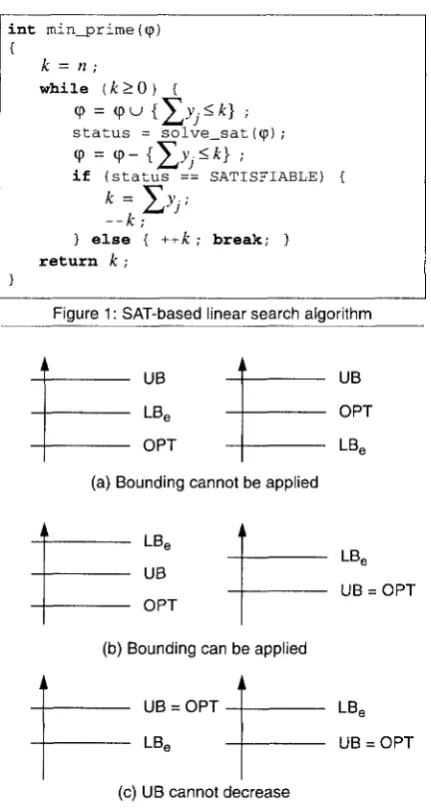
The first ILP algorithm follows P. Barth's ILP algo- rithm [2] and was first described in [14]. Let us consider the cost function (1). The possible values assumed by the cost function for the different assignments to the variables in the set {y,, . . . , y Z n } range from 0, when all variables are assigned value 0, to 2 n , when all variables are assigned value 1. Note however, that for the minimum- size prime implicant problem
a
trivial upper bound is n ,since for any pair of variables yZi- , yZi at most one can be assigned value 1. P. Barth's [2] approach consists of applying the following sequence of steps, starting from an upper bound of k = n on the value of the cost function:
1. Create a new inequality x y j I k . This inequality basically requires that a computed solution must have no more than k literals assigned value 1.
2. Solve the resulting instance of satisfiability. (Note that the resulting instance of satisfiability is defined on linear inequalities, but modifying most SAT algorithms for handling this generalization is straightforward.)
3. If the instance of SAT is satisfiable decrement k (i.e. specify a new value for the cost function) and go back to step 1. Otherwise, report that the solution to the ILP is
k + l .
int m i n j r i m e ('p)
t
k = n ;
while ( k 2 0 ) {
cp =
cpu
{status = solve-sat(q);
cp = 9 - { x l ; ' k } ;
if (status == SATISFIABLE) {
Y . l k } ;
c ,
k = X y j ; - - k ;
1 else { + + k ; break; 1
return k ;
I
Figure 1 : SAT-based linear search algorithm
+--
2
:::
(a) Bounding cannot be applied
:","
:=OPT OPT(b) Bounding can be applied
f
YE3,=OPT+ LB,UB = OPT
[image:4.616.83.299.75.481.2](c) UB cannot decrease
Figure 2: Using bounding in the ILP algorithm
Figure 1. For our particular case, the solve-sat function call invokes the GRASP SAT algorithm [12].
4.2
SAT-Based Branch and Bound Algorithm
A different algorithmic organization consists of using a variation of the branch and bound procedure [ 7 ] , where upper bounds to the cost function (1) are identified and lower bounds to the current set of variable assignments are estimated. In our implementation, we have used the lower bound estimation procedures described in [4].
The operation of bounding for the proposed procedure is illustrated in Figure 2. Let UB denote the lowest com-
puted upper bound on the solution of (2), LB, denote an
estimated lower bound on the solution of (2) and OPT denote the solution of (2). If the estimated lower bound is less than the already computed upper bound (as shown in Figure 2-(a)), then the search cannot be bound since it may still be possible to reduce the value of the upper bound. Clearly, the search can be bound whenever the estimated lower bound to the value of ( I ) is,larger than or equal to the existing upper bound to the value of (I), as illustrated in Figure 2-(b). Finally, observe that Figure 2-(c) denotes the conditions after which the upper bound will no longer be updated during the search.
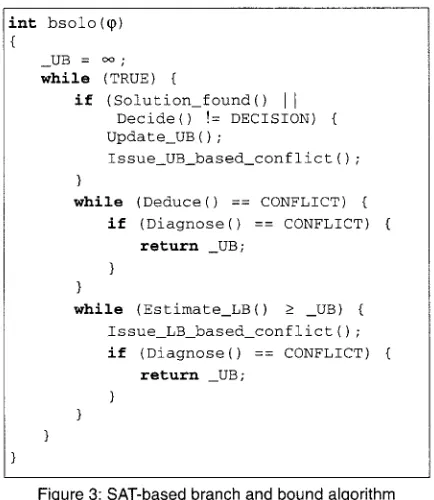
Moreover, since the branch and bound procedure is embedded in the SAT algorithm, every pruning technique used by the SAT algorithm can also be used in solving the ILP. This is particularly useful whenever a constraint of (2) becomes unsatisfied. Consequently, the branch and bound procedure consists of the following steps:
1. Initialize the upper bound to highest possible value. (Valid ILPs must correspond to instances of the minimum-size prime implicant problem.)
2. If no decision can be made (i.e. a solution to the constraints has been identified), then compute an upper bound on the minimum value of the cost function of the ILP formulation. Update current upper bound and issue a conflict to guarantee that the search is bound. Otherwise, branch on a given decision variable (i.e. make decision assignment).
3. Apply boolean constraint propagation [16]. If a conflict is reached, then diagnose conflict, record relevant clauses, and proceed with the search process or
backtrack if required.
4. Estimate lower bound. If this value is larger than or equal to the current upper bound, then issue a conflict, diagnose the conflict, backtrack, and continue the search from step 2.
The pseudo-code for the algorithm is shown in Figure 3. Observe that the proposed branch and bound SAT-based ILP algorithm has the following main differences with respect to the linear search ILP algorithm:
No clauses involving the cost function are created. The exception occurs when the estimated lower bound is no less than the computed upper bound. In this situation a
clause involving some of the literals in the cost function is temporarily created, thus causing the search procedure to backtrack. (See [I21 for details of the backtrack search SAT algorithm.)
tnt b s o l o ( c p )
UB = m ; while (TRUE) {
if (Solution-found0
1 1
Decide0 != DECISION) Update-UB ( ) ;Issue-UB-based-conflict(); 1
while (Deduce ( ) == CONFLICT) {
if (Diagnose0 == CONFLICT) {
return -UB; I
I
while (Estimate-LBO 2 -UB) {
Issue-LB-based-conflict(); if (Diagnose0 == CONFLICT) {
I
return -UB;
I
1 t
Fiaure 3: SAT-based branch and bound alaorithm
can also be used [ 3 , 71. Clearly, the tightness of the lower bounding procedure is crucial for the efficiency of the branch and bound procedure.
4.3
Extensions to the Basic ILP Algorithms
One extension to the proposed ILP algorithms is the ability to incrementally enumerate prime implicants by increasing size [9]. The procedure proposed in [9] basi- cally recreates the search for each new prime implicant to be computed. Clearly, this solution can introduce signifi- cant and unnecessary computational overhead. One possi- ble improvement is based on the SAT-based linear search ILP algorithm of Figure 1, and is organized as follows:
1. Keep a stack of pairs of computed solutions and associated upper bound values k.
2. Use the current top of the stack to find the next minimum-size prime implicant.
3. For a given solution-upper bound pair k , apply the algorithm of Figure 1 until the next optimal solution is found. For this new optimal bound, enumerate all solution assignments.
4. As soon as a given pair solution-upper bound yields no more solutions, pop the stack and go back to step 2. Repeat until stack of solution-upper bound pairs becomes empty.
Since for each prime implicant size only part of the search space is visited, the above algorithm ensures abet-
ter worst-case time complexity than the algorithm of [9].
5
Experimental Results
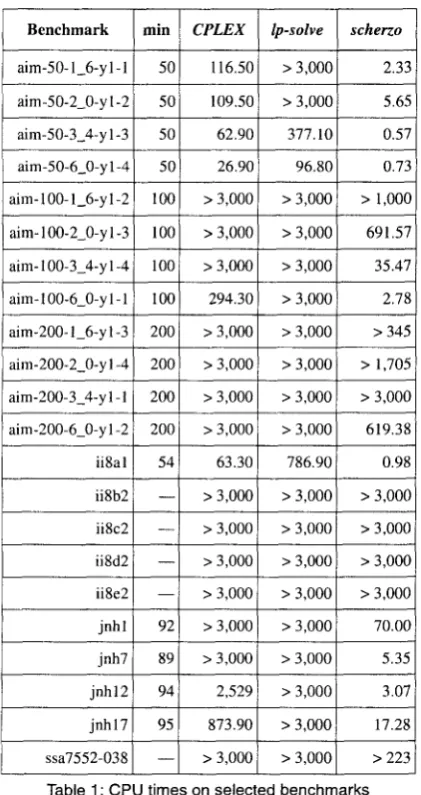
[image:5.615.75.292.83.333.2]In this section we include experimental results of two tools for computing minimum-size prime implicants, min- prime [14] and bsolo. min-prime is based on linear search through the possible values of the cost function as described in Section 4.1, whereas bsolo uses the SAT- based branch and bound algorithm as described in Section 4.2. We also compare these two SAT-based ILP algorithms with other ILP solvers, lp-solve [3], opbdp [2], and the commercial optimization tool CPLEX. Moreover, the binate covering tool scherzo [4] is also evaluated, since minimum-size prime implicant computation can also be viewed as a restricted form of the binate covering prob- lem. For this purpose we selected a set of satisfiable instances of the DIMACS benchmarks [6], from most of the available classes of instances. The CPU times, obtained on a SUN 5/85 machine with 64 MByte of physi- cal memory, are shown in Table 1 and Table 2, where Table 2 includes the results for the SAT-based algorithms. For each benchmark and for each tool 3000 seconds of CPU time were allowed. Column min indicates the size of the minimum-size prime implicant, when this size is
known. (Observe that for some of the benchmarks the minimum size prime implicant is still unknown.) Table 3 and Table 4 include the upper bound on the minimum size prime implicant computed by each algorithm for each benchmark. When each tool terminates, it reports the min- imum size prime implicant if it was identified, otherwise the lowest computed upper bound is reported provided at least one upper bound was identified. For the results
shown, whenever a tool quits earlier than 3000 sec, then the tool exceeded the available virtual memory (i.e. 64 MB y te) .
As can be concluded, general-purpose ILP solvers, such as CPLEX and lp-solve, may be inadequate for com- puting minimum-size prime implicants. Similarly, despite the very promising results as an algorithm for solving binate covering problems [4], scherzo performs particu- larly poorly when computing minimum-size prime impli- cants. The three SAT-based ILP solvers can handle a large number of benchmarks and, in general, min-prime and
bsolo perform better and are more robust than opbdp,
which is unable to find the solution on a larger number of instances. For the JNH benchmarks, opbdp performs bet-
Benchmark min CPLEX lp-solve scherzo
aim-50-2-0-yl-2 109.50 > 3,000
aim-50-3-4-yl-3 50 62.90 377.10 0.57
aim-50-6-0-yl-4 50 26.90 96.80 0.73
aim-100-1-6-yl-2 100
1
aim-100-6-0-y1-11
100) 294.30) >3,000\ 2.78)> 3,000 > 3,000 > 1,000
aim-50-2-0-y1-2 0.64 0.02
aim-50-6-0-yl-4
aim-100-1-6-yl-2
50 0.48 0.07 0.17
100 > 3,000 0.09 0.22
aim-100-2-0-yl-3
I
!!i
1
: ::4:I
::::
1
aim- 100-3-4-y 1-4aim- 100-6-0-y 1 - 1 0.18 0.32 0.52 aim-100-2-0-yl-3
aim-100-3-4-yl-4
100 > 3,000 > 3,000 691.57
100 > 3,000 > 3,000 35.47
aim-200-1-6-yl-3
aim-200-2-0-y1-4
1
aim-200-3-4-yl-I1
200I
> 3,000I
> 3,000I
> 3,000I
200 > 3,000 > 3,000 > 345200 > 3,000 > 3,000 > 1,705
1
aim-200-6-0-yl-21
2001
> 3,000I
> 3,000)
619.381
aim-200- 1-6-yl-3
aim-200-2-0-yl-4
aim-200-3-4-y1-I
1
4i:::I aim-200-6-0-y1-2ii8al 1.93 861.53 3.51
200 > 3,000 0.22 0.76
200 > 3,000 0.83 2.60
ii8b2
ii8c2
- > 3,000 > 3,000 > 3,000
- > 3,000 > 3,000 > 3,000
jnh7
ii8b2
ii8c2
- > 3,000 > 3,000 > 3,000
> 3,000 > 3,000 > 3,000 -
ii8d2
ii8e2
jnhl
jnh7
1
jnh121 941 0.121 0.581::l.:I
jnhl7 0.30 2.53
ssa7552-038 - > 3,000 > 1,205 > 500
> 3,000 > 3,000 > 3,000
-
3,000 > 3,000 > 3,000 -
92 2.24 17.96 11.39
[image:6.623.88.299.78.476.2]9.06 2.88 89 0.45
Table 1 : CPU times on selected benchmarks jnhl2
jnhl7
Table 2 : CPU times on selected benchmarks 94 2,529 >3,000 3.07
95 873.90 >3,000 17.28
problem, these additional clauses involve all variables in the problem representation. Hence, conflicts involving this clause necessarily lead to chronological backtracking2, and so the most useful features of GRASP cannot be exploited. Finally, we note that bsolo tends to be a more efficient search algorithm than min-prime, as the experi- mental results suggest.
From the obtained experimental results, it can also be concluded that the computation of the minimum-size prime implicant can be a particularly hard problem for
specific sets of instances. This is the case, for example, with the ii8 and ssa7552 benchmarks.
2. In such a situation, each conflict involves all variables and so backtracking is necessarily chronological, to the most recent decision assignment [12].
6 Conclusions
In this paper we describe a new model and algorithms for computing minimum size prime implicants of boolean functions. The model is based on an ILP formulation and the proposed algorithms are built on top of existing SAT solvers. To our best knowledge min-prime and bsolo are the first SAT-based ILP algorithms that incorporate con- flict diagnosis techniques [ 121 in solving optimization problems. Both min-prime and bsolo incorporate several powerful search-pruning techniques which are known to
[image:6.623.323.536.78.472.2]I
BenchmarkI
min1
CPLEX1
Zp-solveI
scherzoI
aim-50-3-4-y1-3
aim-50-6-0-yl-4
Benchmark
1
minI
opbdp1
min-primeI
bsoloI
50
so
50 50SO 50 50 50
1
aim-50-1-6-yl-11
501 501-1
501aim-50-6-0-yl-4
aim- 100- 1-6-y 1-2
aim-50-1-6-yl-1
1
S O / 501 501 50150 50 50 50
100 - - -
1
aim-50-2-0-yl-21
501 501-1
501
aim- 100-3-4-y 1-4
aim-100-6-0-y1-1
100 100 100 100
100 100 100 100
aim-200-3-4-yl-1
aim-200-6-0-y1-2
200 200 200 200
200 200 200 200
ii8al
ii8b2
54 54 54 54
- 388 474 -
ii8al
ii8b2
54 54 54 54
- - 379 379
ii8d2
ii8e2
- -
- 588
- 653 - -
ii8d2
ii8e2
- - 540 540
- - 494 494
jnhl
jnh7
92 92 92 92
89 89 89 89
jnhl7
ssa7552-038
95 95 95 95
- 1452 1448 1448 ssa7552-038 - 1449 1450 -
aim-100-1-6-yl-2/ 1001 1001 1001 1001
aim-100-2-0-yl-3
I
1001 1001 1001 10011
aim-100-6-0-yl-l/ 1001 1001-1
10011
aim-200-1-6-yl-31
2001-1
-1
-1
aim-200-1-6-yl-31
2001-1
2001 2001aim-200-2-0-y l-4
1
2001
-1
2001 20011
aim-200-6-0-yl-2I
200I
-1
-I
2001
I
ii8c2/-1
6291 6681-1
I
jnh7/ 891 901-1
891assignments.
As the results given in the previous section clearly show, the proposed algorithms, min-prime and bsolo, are by far the most competitive for the set of benchmarks con- sidered. Thus, for these classes of benchmarks either min- prime or bsolo would be the option of choice. Moreover, as the experimental results show, the branch and bound SAT-based ILP algorithm bsolo is in general more efficient than the SAT-based linear search ILP algorithm.
Despite the promising results given in the previous section, more work needs to be done before an ILP algo- rithm can be used for solving instances of the minimum- size prime implicant problem which have a practical impact. Furthermore, observe that even though both the minimum size prime implicant problem and the binate
covering problem have similar formulations, the algo- rithms for solving each problem should have different organizations, as the experimental results of min-prime [ 141, bsolo and scherzo [4] clearly suggest.
As mentioned earlier, one key bottleneck of the pro- posed min-prime algorithmic solution is the ILP layer around GRASP. The repeated addition of large clauses to the CNF formula reduces the ability of GRASP for back- tracking non-chronologically and in several cases causes GRASP to always backtrack chronologically. In contrast,
with bsolo, since no large clauses are created, non-chrono- logical backtracking can in general be exercised.
the procedure described in Section 4.3. Its usefulness
depends on the target number of prime implicants. If all prime implicants are required, this approach clearly becomes impractical when the total number of prime implicants is exponential on the number of variables.
Finally, other realizations of the SAT-based branch and bound ILP algorithm can be envisioned and used for computing minimum-size prime implicants. These other realizations utilize different bounding procedures. We are currently experimenting with bounding procedures based on LP-relaxations [ 3 , 71 and on Lagrangian relaxations [ I , 71.
References
[ I ] R. K. Ahuja, T. L. Magnanti and J. B. Orlin, Network Flows: Theory, Algorithms, and Applications, Prentice- Hall, 1993.
[2] P. Barth, “A Davis-Putnam Based Enumeration Algorithm
for Linear Pseudo-Boolean Optimization,” Technical Report MPI-1-95-2-003, Max-Planck-Institut fur Informa- tik, January 1995.
[3] M. R. C. M. Berkelaar, UNIXTM Manual Page of Ip-solve. Eindhoven University of Technology, Design Automation Section, 1992.
[4] 0. Coudert, “On Solving Covering Problems,” in Proceed- ings of the Design Automation Conference, June 1996. [5] M. Davis and H. Putnam, “A Computing Procedure for
Quantification Theory,” Journal of the Association for Com- puting Machinery, vol. 7 , pp. 201-215, 1960.
[6] D. S. Johnson and M. A. Trick (eds.), Second DIMACS Implementation Challenge, DIMACS Series in Discrete Mathematics and Theoretical Computer Science, 1993. DIMACS benchmarks available in ftp://Dimacs.Rut-
gers.EDU/pub/challenge/sat/benchmarks/cnf.
[7] G. L. Nemhauser and L. A. Wolsey, Integer and Combina- torial Optimization, John Wiley & Sons, 1988.
[8] T. Ngair, “A New Algorithm for Incremental Prime Impli- cant Generation,” in Proceedings of the International Joint Conference on Artificial Intelligence, 1993.
[9] C. Pizzuti, “Computing Prime Implicants by Integer Pro-
gramming,” in Proceedings of International Conference on
Tools with Artijicial Intelligence, November 1996.
[IO] S . J. Russell and P. Norvig, Art$cial Intelligence: A Mod- ern Approach, Prentice-Hall, 1994.
[ I l l T. Schiex and G . Verfaillie, “Nogood Recording for Static and Dynamic Constraint Satisfaction Problems,” in Pro- ceedings of the International Conference on Tools with Arti- ficial Intelligence, pp. 48-55, 1993.
[12] J. P. M. Silva and K. A. Sakallah, ‘‘Conflict Analysis in Search Algorithms for Propositional Satisfiability,” in Pro- ceedings of the International Conference on Tools with Arti- jcial Intelligence, November 1996.
[I31 J. P. M. Silva and A. L. Oliveira, “Improving Satisfiability
Algorithms with Dominance and Partitioning,” in Interna- tional Workshop on Logic Synthesis, May 1997.
141 J. P. M. Silva, “On Computing Minimum Size Prime Impli- cants,” in International Workshop on Logic Synthesis, May
1997.
151 J. P. M. Silva, GRASP source code, available from ftp://
algos.inesc.pt/pub/users/jpms/soft/grasp/.
1161 R. Zabih and D. A. McAllester, “A Rearrangement Search Strategy for Determining Propositional Satisfiability,” in