Abstract—This study reports the results of an experimental investigation of the effect of microstructural features on mechanical properties of unalloyed medium carbon (EN8) steel with emphasis on the effects of grain size within solid phase mixtures and the mechanical response of the material. Specimens with a range of microstructures (grain size and phase) were prepared by heat treatment. The microstructures were carefully characterized using both optical electronic microscope (OEM) and scanning electron microscope (SEM) and the mechanical properties were studied using tensile and hardness tests. The results indicated that tensile strength and hardness of unalloyed medium carbon (EN8) steel increases with decrease in grain size while elongation decreases.
Keywords: grain sizes; microstructures; mechanical properties; medium carbon steel
I. INTRODUCTION
he prediction of mechanical properties of materials is more complicated because of different mechanisms that come in play such as chemical composition, the evolution of deformation microstructure, amount of deformation, heat treatment profile, and average grain size distribution. Many of the important mechanical properties of steel, including yield strength and hardness, the ductile-brittle transition temperature and susceptibility to environmental embrittlement can be improved considerably by refining the grain size [1]. [2, 3] . With the knowledge of dynamical interplay between deformation and grain microstructures size, it is possible to predict the behavior of steel when subjected to various working conditions [4, 5] . Numerous aspects of microstructures and their effects on mechanical
Manuscript received August 03, 2014; revised August 04, 2014. The authors gratefully acknowledge the financial supports of Faculty of Engineering, Department of Mechanical Engineering, Cape Peninsula University of Technology, Cape Town and Faculty of Engineering and the Built Environment, Department of Chemical Engineering University of Johannesburg, South Africa
Cullen M. Moleejane is with the Faculty of Engineering, Department of Mechanical Engineering, Cape Peninsula University of Technology, Cape Town , South Africa
Kazeem O. Sanusi, is with the Faculty of Engineering and the Built Environment, Department of Chemical Engineering, University of Johannesburg, South Africa.
Olukayode L. Ayodele is with the Faculty of Engineering, Department of Mechanical Engineering, Cape Peninsula University of Technology, Cape Town, South Africa; corresponding author phone: +27820925793 E mail. [email protected]
Graeme J. Oliver is with the Faculty of Engineering, Department of Mechanical Engineering, Cape Peninsula University of Technology, Cape Town , South Africa.
behaviour of metals have been studied, including grain size [6, 1] , grain boundary [7, 8, 9] , crystal structure [10], crystal orientation [11].The production of different Materials with the controlled manipulation of their microstructure in order to improve properties is an active field of study in materials science. [1, 12, 13]. In general, as the average grain size decreases, the metal becomes more resistant to plastic flow (yield strength increase) and as the grain size increases, the opposite effect on strength occurs (yield strength decreases) [12, 1, 8, 13] .
EN8 steel is an unalloyed medium carbon steel with good tensile strength. This steel is suitable for the manufacture of parts such as general purpose axles and shafts, gears, bolts and studs. The materials is usually recommended by the suppliers to carried out heat treatment after initial stock removal to achieved better mechanical properties toward the core. The aim of this study is to investigate the microstructure of EN8 steel by the size and morphologies of constituent phases and or grains after subsequent heat treatment, also using a tensile and hardness tests to study the effects of heat treatment on the mechanical property of this material From this study, the influence of grain size on mechanical behaviour of steel based on heat treatment history can be understood
II. MATERIAL AND METHODS
The test specimen used in this investigation was unalloyed carbon steel designated as (EN8), the steel was received as rolling bar. The chemical composition was determined and is given in table 1. Tensile specimens were machined in standard dimensions and prepared using heat treatment experiments. They were divided into four sets for tensile tests. These sets were shown in Table 2. Scanning electron microscopy (SEM) and optical electronic microscope (OEM) were used for phase identification and microstructure characterization of these samples. The test specimen was examined for the following features: The size, shape and type of grain present. The aim of the heat treatment is to obtain a range of microstructures (grain size and phase). The mechanical properties were determined through tensile test and hardness test.
Microstructural Features and Mechanical
Behaviour of Unalloyed Medium Carbon Steel
(EN8 Steel) after Subsequent Heat Treatment
Cullen M. Moleejane, Kazeem O.Sanusi ,Member, IAENG, Olukayode L. Ayodele, Graeme J. Oliver
Table I: Chemical composition of EN8
Elements Compositions wt %
C 0.036
Si 0.02
P 0.025
Mn 0.54
S 0.05
[image:2.595.69.268.71.171.2]Fe Balance
Table II: Heat treatment regime used produces various microstructural
features
Specimen Heat Treatment
A Austenised at 9500C , held for 180 minutes and cooled in furnace. B Austenised at 9140C, held for 10
minutes, cooled in furnace to 6800C C Austenised at 9140C, held for 10
minutes, cooled in furnace
D Austenised at 9140C held for 3 minutes cooled in furnace to 7150C and quenched in oil
III. RESULTS AND DISCUSSION
A. Metallographic studies
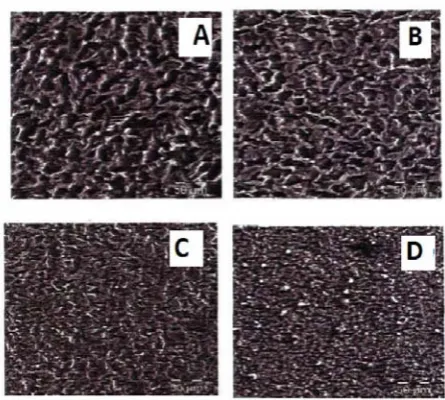
Figures 1a show the SEM and figure 1b OEM image of as-received EN8 steel used for this experiment, while figures 2 show the SEM images of the specimens A, B, C and D prepared and figure 3 shows the OEM images of the specimens A, B, C and D prepared according the heat treatment regime described in table 2. It can be observed from these figures that the heat treatment regime employed produced five different microstructures. The images show both grains and phase present in the specimens. Another interesting feature that can be observed with SEM and OEM is the individual grain boundaries, which can be distinguished quite easily at higher magnifications (see figure 4).
Figure 1: (a) SEM and (b) OEM images of the as received EN8 steel
[image:2.595.315.547.289.502.2]samples
Figure 2: SEM images of samples prepared according the heat treatment
regime described
Figure 3: OEM images of samples prepared according the heat treatment
regime described
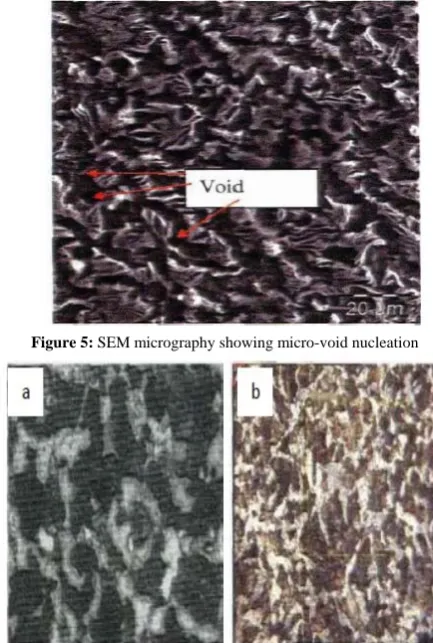
[image:2.595.62.271.579.709.2]phase volume fraction in comparison to the microstructure obtained in treatment D. This is suspected to be martensite. Table III shows the volume fraction of the steel phases obtained from statistical analysis of OEM for all the microstructures obtained by the heat treatments A, B, C and D investigated in this study and table 4 shows the average grain size and hardness test results of the specimen. It can be observed that an increase in time at an inter-critical temperature increased the grain size. Heat treatment of specimen D produced microstructure with small grains, while heat treatment of specimen B promoted grain growth. From micrograph C results, it can be observed that the soaking time above critical temperature had a major influence on the microstructure. Heat treatment either at or above the critical temperature caused metallurgical changes and soaking time favoured the growth of grains. The distribution of the phases and grains also showed a continuous change of the microstructure with increasing temperature and soaking time. As reported by [14] grains generally grow, coalesce and coarsen with increasing temperature and soaking time, [15] reported that nucleation of micro-void in ductile material is generally governed by large strains of the material. They initiate at discontinuities soon after the onset of plastic yielding and grow due to plastic deformation [16] of the surrounding matrix material [17]. Upon further plastic deformation of the material the micro-voids tend to grow and possibly change shape by means of deviatoric and volumetric strain [18, 19, 20] which may result in the formation of micro-cracks as micro-voids start to combine micro-void nucleation at the areas of large strains (at the necked area) was distinctly evident (see figure 5). Figure 6 also shows the micrographs of EN8 showing variation in grain size where specimen A with larger grain sizes and Specimen D with smaller grain sizes.
Table III: Phase volume obtained from OEM analysis
Specimen phase 1 Phase 2 Phase 3 Phase 4
% volume % volume % volume % volume
A 21.05 74.94 3.91 0.13
B 17.18 75.95 6.71 0.16
C 16.09 73.56 7.00 3.35
D 23.04 61.62 8.38 6.96
Table IV: Grain size and Brinell hardness values of EN8 studied.
Specimen Average grain
size (um)
Hardness (Brinell)
A 123.46 164
B 156.25 147
C 46.3 194
D 39.6 206
Figure 4: (a) SEM micrography showing individual grains and grain
[image:3.595.314.531.280.602.2]boundaries. (b) OEM micrography showing individual grains and the grain boundaries obtained in the heat treatment B. Ferrite (clear), martensite and bainite (dark)
Figure 5: SEM micrography showing micro-void nucleation
Figure 6 : Micrographs of EN8 showing variation in grain size (a)
specimen A with larger grain sizes (b) Specimen D with smaller grain sizes .
B. Mechanical properties
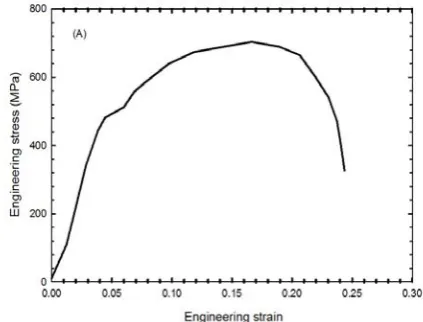
[image:3.595.40.297.500.579.2] [image:3.595.43.298.618.718.2]minutes, cooled in furnace to 6800C. The The YS, UTS and the corresponding elongation were 397.86 MPa, 492.59 MPa and 16.9 %, respectively.
Figure 7a: stress vs strain curve of En8 austenised at 9500C , held for 180 minutes and cooled in furnace.
Figure 7b : stress vs strain curve of En8 austenised at 9140C, held for 10
minutes, cooled in furnace to 6800C.
The reduction of the strength values observed in specimen B can be attributed, among other factors, to coarse grains. The reduction in the yield strength and tensile strength values in specimen B was worsened by small volume fraction of the harder phase (martensite). Specimen B exhibits relatively lower strength and higher ductility as compared to specimen A. This can be attributed to relatively large grains of specimen as there is very little difference in the volume fraction of the fourth phase between specimens A and B. Figure 8a shows the stress vs strain curve of En8 austenised at 9140C, held for 10 minutes, cooled in furnace and figure 9b shows the stress vs strain curve of En8 austenised at 9140C held for 3 minutes cooled in furnace to 7150C and quenched in oil. The YS, UTS and the corresponding elongation of En8 austenised at 9140C, held for 10 minutes, cooled in furnace were 762.26 MPa, 762.57 MPa and 11.8 %, respectively. For En8 steel austenised at 9140C held for 3 minutes cooled in furnace to 7150C and quenched in oil , The YS, UTS and the corresponding elongation 789.41 MPa, 781.41 MPa and 9.4 %, respectively.
The results of hardness test carried out on the steel samples were shown in table 4. it is observed that increase in
austenising temperature soaking time and slow cooling rate in heat treatment B induced a marked decrease in hardness in specimen B . This reduction in hardness may be attributed to two microstructural aspects: grain coarsening and reduction in fourth phase observed in specimen B. The maximum hardness values were obtained in heat treatments C and D. This confirmed the suspicion of the presence of harder phases (martensite and bainite) in specimens C and D as alluded to above. However, from the analysis of the phase volume fractions, grain size and hardness values of specimens A, B, C and D; it is observed that grain size has a major influence on variation in the hardness values observed.
[image:4.595.63.279.297.461.2]Figure 8a: stress vs strain curve of En8 Austenised at 9140C, held for 10 minutes, cooled in furnace.
Figure 8b : Stress vs strain curve of En8 austenised at 9140C held for 3 minutes cooled in furnace to 7150C and quenched in oil.
[image:4.595.327.538.424.577.2]process and keep impurities in the steel to minimum acceptable levels. In this study, the heat treatment regime was designed in such a way that formation of martensite and bainite phases was limited to a bare minimum level.
A.Effects of Phase volume fraction on yield strength
It has been observed that the yield stress and work hardening of steel depend on individual phases present in the material .Considering the variation of yield strength with grain size and phase volume fractions [21].
[image:5.595.63.273.311.465.2]Based on the experimental results, the effects of microstructural features such as grain size and phase volume fraction and mechanical properties (Young’s modulus, the yield strength, the ultimate tensile strength, and elongation at failure) on the deformation behaviour of the steel studied can be predicted. Since any structural parameter that directly controls the yield strength, the ultimate tensile strength and elongation at failure, should have some influence (direct or indirect) on the stress flow and formability of the material.
Figure 9: Fracture specimen showing a cone and cup fracture mode
IV. CONCLUSION
In the study, the plastic deformation behavior and experimental methods used to quantify grain size and mechanical properties were described and following the analysis of the results obtained, the following conclusions were drawn;
1. Grain size and its distribution have a significant impact on the yielding characteristics of steel. It was observed that when a structure is composed of multiphase with different grain size distribution, the maximum plastic deformation will occur within the "weaker" phase. While the 'stronger" phase will experience higher von Mises stress.
2. The annealing temperature and holding time have great influence on the grain size and phase distribution. The increase in annealing temperature and soaking time promotes the coarsening of grains and even an increase in formation of second phases (bainite and martensite) upon cooling.
3. Since the yield strength, increased linearly with decreasing grain size in conventional materials and, elongation at failure decreasing with decreasing grain size, coarse grains obtained in heat treatment B would be beneficial for manufacturing processed that depend on material flow (for example cold forming). Heat treatment C
and D would be ideal for applications where high strength and high hardness values are required.
ACKNOWLEDGMENT
The authors gratefully acknowledge the financial supports of Faculty of Engineering, Department of Mechanical Engineering, Cape Peninsula University of Technology, Cape Town and Faculty of Engineering and the Built Environment, Department of Chemical Engineering University of Johannesburg, South Africa
REFERENCES
[1] J. Morris Jr, "The influence of grain size on the mechanical properties of steel," eScholarship Repository,University of Califonia, pp. 1-8, 2001.
[2] E. Hall, "The Deformation and Ageing of Mild Steel: III Discussion of Results," Proceedings of the Physical Society of London, pp. 747-753, 1951.
[3] N. Petch, "The Cleavage Strength of Polycrystals,," Journal of the Iron and Steel Institute, pp. 25-28, 1953.
[4] R. Armstrong, "The influence of polycrystal grain size on several mechanical properties of materials," Metalurgical and Materials Transactions B, vol. 1, no. 5, pp. 1169-1176, 1970.
[5] B. Agrawal, Introduction to Engineering Materials, New Delhi: TATA McGRAW-HILL, 1988.
[6] M. Zhao, T. Qiu, K. Nagai and K. Yang, "Grain growth and Hall-Petch relation in dual-sized ferrite/cementite steel with nano-sized cementite particles in a heterogenous and dense distribution," Scripta Materialia,
pp. 1193-1197, 2006.
[7] R. Ueji, N. Tsuji, Y. Minamino and Y. Koizumi, "Ultra grain refinement of plain low carbon steel by cold rolling and annealing of martensite," Acta Materialia, pp. 4177-4189, 2002.
[8] S. Chen and D. Gan, "Effects of Grain Boundary Carbides on the Tensile and Impact Properties of Type 316 Stainless Steel," Materials Science and Engineering, pp. 65-76, 1986.
[9] K. Muszka, J. Majta and L. Bienias, "Effects of Grain Refinement on Mechanical Properties of Microalloyed Steel," Metallurigal and Foundary Engineering, vol. 32, no. 2, 2006.
[10] K. Liu, Y. Shan, Z. Yang, J. Liang, L. Lu and K. Yang, "Effect of Heat Treatment on Prior Grain Size and Mechanical Property of a Maraging Stainless Steel," Journal of Material. Science and Technology, vol. 22, no. 6, 2006.
[11] Y. Liu, P. Wanga, J. Lia, C. Lua, K. Quekb and G. Liuc, "Parametric study of a sprorocket system during heat -treatment process," Finite Elements in Analysis and Design, pp. 25-40, 2003.
[12] I. Sen, S. Tamirisakandala, B. Miracle and U. Ramamurty, “Microstructural effects on the mechanical behaviour of B-modified H-6Al-4V alloys,” Acta Materialia, pp. 4983-4993, 2007.
[13] H. Rack, "Age Hardening-Grain Size Relationships in 18Ni Maraging Steels," Materials Science and Engineering, pp. 263-270, 1978.
[14] H. Tamehiro and H. Nakasugi, "Austenite Grain Size of Tltaniun microalloyed," Continuously Cast Steel Slabs, p. 311, 1985.
1679-1713, 2003.
[16] F. Barlat, H. Aretz, J. Yoon, KarabinM.E., J. Brem and R. Dick, "Linear transfomation-based anisotropic yield functions,"
International Journal of Plasticity 21, pp. 1009-1039, 2005.
[17] N. Bonora, "A nonlinear CDM model for ductile failure," Engineering Fracture mechanics, vol. 58, no. 1/2, pp. 11-28, 1997.
[18] D. Lassance, F. Scheyvaerts and T. Pardoen, "Growth and coalescence of penny-shaped voids in metallic alloys," Engineering Fracture Mechanics 73, pp. 1009-1034, 2006.
[19] G. Voyiadjis and F. Abed, "A coupled temperature and strain rate dependent yield function for dynamic deformations of bee metals,"
International Journal of Plasticity, vol. 22, pp. 1398-1431, 2006.
[20] J. Mediavijla, R. Peerlings and M. Geers, "Prediction of phase transformation during laser surface hardening of AISI 4140 including the effects ofinhomogeneous austenite formation," Material Science and Engineering A, Vols. 435-436, pp. 547-555, 2006.
[21] L. Mahdi and L. Zhang, "A Numerical Algorithm for the full coupling of mechanical deformation and phase transformation in surface grinding," Computational Mechnaics, vol. 26, pp. 148-156, 2000.