
transmissions over dispersive wide-band mobile channels. This scheme is shown to give a significant improvement in terms of the mean bit error rate (BER) and bits per symbol (BPS) performance compared to that of the individual fixed modulation modes. The structural equivalence of the RBF DFE to the optimal Bayesian equalizer enables it to potentially outperform the conventional Kalman-filtered AQAM DFE scheme.
Index Terms—Adaptive modulation, decision feedback
equaliza-tion, radial basis funcequaliza-tion, wide-band modem.
I. INTRODUCTION
B
URST-BY-BURST adaptive quadrature amplitude mod-ulation (AQAM) schemes employ a higher order modu-lation mode in a transmission burst, when the channel quality is favorable, in order to increase the bits per symbol (BPS) throughput and, conversely, a more robust but lower order mod-ulation mode is utilized in those transmission bursts, where the instantaneous channel quality drops [1], [13]. Stimulated by Webb and Steele [1], in recent years intensive research was con-ducted toward advancing the state-of-the-art in AQAM [2]–[6]. In this contribution, we propose a novel AQAM scheme for transmissions over wide-band fading channels, which employs a radial basis function decision feedback equalizer (RBF DFE), in order to mitigate the effects of the dispersive wide-band channel. We will show that this RBF-AQAM scheme naturally lends it-self also to channel quality estimation.II. SYSTEMOVERVIEW
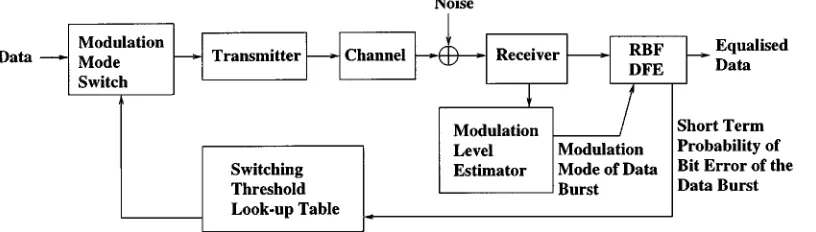
The structure of our AQAM RBF DFE is portrayed in Fig. 1. The receiver extracts the AQAM mode signaling bits from its received data burst. Then the received data burst is equalized, the estimated BER of the received burst is evaluated at the output of the RBF DFE and it is used as the AQAM mode-switching criterion. The estimated BER of the received burst is compared to a set of switching thresholds and the modulation mode to be used in the next transmission burst is decided accordingly. The
a posteriori probabilities of the -QAM
Paper approved by C.-L. Wang, the Editor for Equalization of the IEEE Com-munications Society. Manuscript received April 26, 1999; revised February 12, 2000, November 24, 2000, and April 20, 2001. This work was supported by EPSRC, U.K., the Commission of the European Communities, Brussels, Bel-gium, and Motorola ECID, Swindon, U.K., and the Virtual Centre of Excel-lence (VCE) in Mobile Communications. This paper was presented in part at Globecom’99, Rio de Janeiro, Brazil, December 5–9, 1999.
The authors are with the Department of Electronics and Computer Sci-ence, University of Southampton, Southampton SO17 1BJ, U.K. (e-mail: [email protected]).
Publisher Item Identifier S 0090-6778(02)05118-8.
(1)
where , and are the RBF’s centers, weights, and acti-vation function, respectively. Furthermore, the equalizer’s input is and the dimension of the vectors and is equivalent to the equalizer’s feedforward order , while is the number of channel states. The RBF centers and weights are assigned to , respectively, where is the noiseless channel output vector or the channel state and is the prob-ability of occurrence of a specific channel state [7], [9]. The actual number of channel states is determined by the design of the algorithm that reduces the number of channel states from the maximum of [8], where is the channel im-pulse response (CIR) duration. In this contribution, we use a RBF DFE, which invokes its previous decision for either RBF subset center selection [8] or space translation [10], in order to reduce the number of channel states required in computing the equalizer output and therefore to reduce its computational com-plexity. We can obtain the a posteriori probabilities of the th bits, from the a posteriori probability of each -ary sym-bols at signaling instance . The probability of bit error associ-ated with the decision that the th bit has the value (either 0 or 1) exhibiting the maximum a posteriori probability, ,
is given by . For our AQAM RBF DFE
scheme, we are unable to employ the true average probability of bit error, which is given by , as the AQAM modem mode-switching criterion, since a prompt near-instan-taneous modem mode selection is required for accommodating the channel’s fluctuating quality. Hence we invoked the esti-mated short term probability of bit error or BER, , which was estimated by averaging over a single transmission burst according to
(2)
where is the number of bits per symbol and is the number of AQAM symbols per burst. Thus, we could esti-mate the channel quality on a burst-by-burst basis, using (2). The short-term BER of (2) is compared to a set of AQAM mode-switching BER values associated with the current modu-lation mode of the received data burst. The modumodu-lation modes
Fig. 1. System schematic of the joint adaptive modulation and RBF equalizer scheme.
TABLE I
MODULATIONSWITCHINGMECHANISMBASED ONSHORT-TERMBERP
ANDITSCORRESPONDINGSWITCHINGTHRESHOLDSP , i = 2; 4; 16; 64
CORRESPONDING TO ASPECIFICCURRENTM-QAM MODE
utilized in our system are BPSK, 4-QAM, 16-QAM, 64-QAM, and no transmission (NO TX). Therefore, the modulation mode is switched according to the estimated short-term BER, of (2), using the regime of Table I.
III. PERFORMANCESTUDY
A. Assumptions
The achievable best-case performance of the RBF DFE AQAM scheme was derived by stipulating the following assumptions. Firstly, perfect CIR estimation or channel state estimation was assumed at the receiver. The RBF’s centers were assigned the values of the channel states. Secondly, the CIR was time-invariant for the duration of the transmission burst, but varied from burst to burst, which corresponds to assuming that the channel is slowly varying. Thirdly, we assumed that the receiver had perfect knowledge of the AQAM mode used in its received burst. In reality, modem mode control signaling is employed to convey the modulation mode used to the receiver [2], [5]. Finally, the RBF DFE used in the system neglected error propagation due to erroneous decision feedback, which in practical terms implied a negligibly low probability of symbol errors, hence feeding the correct symbol to the RBF subset center selection or translation process [8], [10].
B. Simulation Model
In our experiments, we used slot-by-slot time division duplex (TDD), where the UL/DL slots followed each other directly. The simulation parameters are listed in Table II. We evaluated the performance of the AQAM RBF DFE for two different systems. The higher integrity scheme had a target BER of 10 ,
TABLE II SIMULATIONPARAMETERS
which can be rendered near-error-free with the aid of channel coding, and hence we referred to this arrangement as a data transmission scheme. By contrast, the lower integrity scheme was designed for maintaining a BER of 10 , which is adequate for speech transmission. The target BPS throughput values of these schemes were 3 and 4.5, respectively. The BER switching thresholds , corresponding to -QAM, can be obtained by estimating the BER degradation/improvement, when the modulation mode is switched from the current -QAM mode to a higher/lower number of BPS. Explicitly, we obtain this BER degradation/improvement estimate from the RBF DFE’s short-term BER according to (2) upon switching from every possible modulation mode to every possible legitimate next AQAM mode, as described in [12].
Comparison With Constituent Fixed Modulation Modes: The BER and BPS performance was evaluated for two
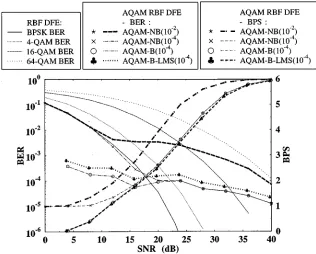
Fig. 2. The BER and BPS performance of the AQAM RBF DFE, showing also the BER performance of the constituent fixed modulation modes, namely BPSK, 4-QAM, 16-QAM, and 64-QAM, over the two-path Rayleigh-fading CIR of Table II. The modem mode switching levels used for the AQAM RBF DFE scheme are listed in Table III. The switching levels are obtained using the method described in [12]. The RBF DFE had a feedforward order ofm = 2, feedback order ofn = 1, and decision delay of = 1 symbol. The AQAM-NB scheme always transmits data without transmission blocking and the AQAM-B scheme utilizes transmission blocking. The AQAM-B-LMS scheme uses transmission blocking and a LMS CIR estimator with a step-size of 0.2
TABLE III
SWITCHINGBER THRESHOLDSP OF THEJOINTADAPTIVEMODULATION ANDRBF DFE SCHEME FOR THETARGETBEROF10
AND10 OVER THETWO-PATHRAYLEIGHFADINGCHANNEL OFTABLEII
the AQAM-NB (BER 10 ) scheme is equivalent to that of the BPSK scheme at 8 dB and to that of the 4-QAM scheme at 15 dB, the mean BPS throughput of the AQAM-NB (BER 10 ) scheme improved by a factor of 1.35 and 2.6, respec-tively. However, the AQAM-NB (BER 10 ) scheme could only achieve the target BER of 10 and BPS of 4.5, if the channel SNR was above 9 dB and 22 dB, respectively. Similar trends were observed for higher integrity transmission, i.e., for the 10 target BER scheme in Fig. 2. The AQAM-B (BER 10 ) scheme achieved the target mean BER at channel SNRs above 13 dB, while the AQAM-NB (BER 10 ) scheme could only achieve the target BER at average SNRs in excess of 20 dB. Note, however, that the target BPS performance of 4.5 and 3 of the lower and higher integrity schemes, respectively, can only be achieved by the AQAM scheme for channel SNRs in excess of about 22 dB. Fig. 2 shows the performance
degradation when the CIR is estimated with the aid of the least mean square (LMS) channel estimator. Observe that the AQAM-B-LMS scheme suffers from a slight BER and BPS performance degradation, since the accuracy of the short-term BER estimation is affected, when the LMS-based CIR estimate is used for evaluating (1). However, the required target BER performance can be still maintained by using a set of slightly more conservative switching thresholds at the cost of a slightly degraded BPS throughput.
Comparison of the RBF DFE and Kalman-Filtered DFE: Let us now embark on a comparative analysis of the
best-case performance of the AQAM RBF DFE and the conven-tional Kalman-filtered AQAM DFE scheme proposed by Wong
et al. [11] for wide-band channels. The AQAM DFE scheme
Fig. 3. Simulated best-case performance of the AQAM RBF DFE scheme and the numerical best-case performance of the AQAM conventional DFE scheme for target BER’ of 10 [11] with transmission blocking. The figure shows also the BER performance of the constituent lowest and highest order fixed modulation modes, namely BPSK and 64-QAM. The channel parameters are listed in Table II and the assumptions stated in Section III-A. The modem mode optimized switching levels used for the AQAM conventional DFE scheme [11] are as follows:f = 8:304 59 dB, f = 10.4541 dB, f = 16:8846 dB, f = 23:051 dB. The RBF DFE had a feedforward order ofm = 2, feedback order of n = 1 and decision delay of = 1 symbol and the conventional DFE had a feedforward order ofm = 15, feedback order of n = 2, and decision delay of = 15 symbols.
were chosen such that it exhibited the best possible performance for our simulation scenario, and hence a further increase of the equalizer’s order would not give a significant performance improvement. For our best-case performance comparisons assuming no channel quality estimation latency, the channel quality was estimated perfectly prior to transmission and the appropriate AQAM mode was chosen for the data burst to be transmitted, which satisfied the target BER requirement.
According to Fig. 3, the performance of the AQAM-B DFE and AQAM-B RBF DFE is fairly similar for the target BER of 10 over the average SNR range of 5–12 dB, but the BPS per-formance of the AQAM-B RBF DFE is better than that of the AQAM-B DFE in that range. In this average SNR range, the lower order modulation modes such as BPSK and 4-QAM domi-nate. Since the RBF DFE can provide a better BER performance than that of the conventional DFE for the lower order BPSK and 4-QAM modes, the BPS performance of the AQAM-B RBF DFE can be improved, while maintaining a similar BER per-formance to that of the AQAM-B DFE. As the average SNR increases above 12 dB, the BER performance of the AQAM-B RBF DFE is still better at the expense of a lower BPS perfor-mance. In the higher SNR range, the BER performance dif-ference between the AQAM-B DFE and AQAM-B RBF DFE decreases. This is because at higher SNRs the 64-QAM mode prevails, since the 64-QAM BER performance of the conven-tional DFE was better than that of the RBF DFE. Hence the mean BER improvement of the AQAM-B DFE scheme was
expected. The overall results of our simulations show that the AQAM RBF DFE is capable of performing as well as the con-ventional AQAM DFE. Furthermore, the performance of the AQAM RBF DFE can be improved by increasing both the de-cision delay and the feedforward order , as argued in [9]. However, the computational complexity of the RBF DFE is de-pendent on the AQAM mode, since the number of RBF centers increases with the number of modulation levels [9]. This is not so in the context of the Kalman-filtered DFE, where the com-putational complexity is only dependent on the feedforward and feedback order.
IV. CONCLUSION
Our simulation results showed that the proposed RBF DFE-assisted burst-by-burst AQAM modem outperformed the indi-vidual constituent fixed modulation modes in terms of the mean BER and BPS throughput. Our results also showed that the AQAM RBF DFE scheme has the potential of outperforming the conventional AQAM DFE at the expense of a higher com-putational complexity.
REFERENCES
[1] W. T. Webb and R. Steele, “Variable rate QAM for mobile radio,” IEEE
Trans. Commun., vol. 43, pp. 2223–2230, July 1995.
tion networks,” IEEE Trans. Neural Networks, vol. 4, pp. 570–579, July 1993.
[8] S. Chen, B. Mulgrew, and S. McLaughlin, “Adaptive Bayesian equalizer with decision feedback,” IEEE Trans. Signal Processing, vol. 41, pp. 2918–2927, Sept. 1993.
![Fig. 3.Simulated best-case performance of the AQAM RBF DFE scheme and the numerical best-case performance of the AQAM conventional DFE scheme fortarget BER’ of 10[11] with transmission blocking](https://thumb-us.123doks.com/thumbv2/123dok_us/1028549.618178/4.612.145.455.60.355/simulated-performance-numerical-performance-conventional-fortarget-transmission-blocking.webp)
