The effect of silo mentality on supply
base information sharing
Bachelor Thesis
© 2011 Capgemini. All rights reserved. 2
Preface
March 9th, 2011. Student association A.S.V. Taste organized a company dinner at restaurant ‘Jou & Mij’ in Enschede. Twenty-five student were selected based on their resume and enthusiasm to accompany this diner. The purpose of this dinner was to introduce students to the different companies and vice versa, for application for possible internships.
Two delegates of five different companies were also present during this evening. Amongst these companies was the Capgemini Corporation. More specifically, the consultancy service of Capgemini Corporation. As the evening progressed, we came to speak Christian Bercz and Robbert den Braber, senior consultant respectively managing consultant. It became clear that they were searching for two students, wanting to graduate for their bachelor in business administration. After exchanging business cards, we held contact till the actual signing of contracts to start a duo bachelor assignment. The final end report, and thus result of this duo bachelor assignment lies before you.
May 2th, 2011, the duo bachelor assignment started. For the next 3 months, we travelled to the headquarters of Capgemini Corporation (NL) in Utrecht, three or four days a week. Due to the distance and long travelling time between Enschede and Utrecht, we stayed at our parents home during these weeks. Tightly suited and all tied up, we arrived around 9 a.m. each morning, as interns of cluster 51. This cluster was part of the
consultancy service, and is called ‘supply chain management’. More specifically, we were part of the ‘purchasing’ function of the supply chain management practice.
As many students would confirm, conducting your bachelor assignment and writing an academic report is no easy job. Fortunately, we had very valuable and much guidance from Christian Bercz, our first mentor. Christian is very precise, and always had something to make comments about. We not always agreed, but at the end, our collaboration was very pleasant. Almost every day when we were present in Utrecht, Christian spent at least 1 hour helping and guiding our assignment. Therefore, our greatest acknowledgements go out to him. We would also like to thank Paul van Wilgen, our second mentor of Capgemini Corporation. His comments and very professional way of working, made us realize what this assignment was all about.
Off course, we would also like to thank Jos van Hillegersberg, our mentor from the University of Twente. In the months we conducted our research, we had several appointments with Jos to discuss our progress and report so far. During these appointments, Jos usually pointed out some issues and/or directions which we could used for the next few weeks. His remarks were very useful. Lastly, we would also like to thank Holger Schiele, our second mentor of the University of Twente.
Last but not least, we would also like to thank our parents for the support and confidence. We left home about 4 to 5 years ago, to start our studies in Enschede. But during our bachelor assignment, it felt like being 18, under our parents wings, again.
© 2011 Capgemini. All rights reserved. 3
Management summary
Introduction
Over the last few years, Capgemini Consulting identified capabilities of software solutions that support procurement business processes by conducting several studies. These software solutions focused much on ‘traditional’ purchasing processes, e.g. sourcing and contract management. These type of solutions are called Supplier Relationship Management (SRM) solutions. However, the market for these type of solutions has matured; many companies have adopted and are currently using these kind of software solutions.
Nowadays, multinationals have suppliers all around the world. Along with this global network of suppliers come new business developments, stated as ‘mega trends’ in this report (Caps research, 2007). The word ‘trends’ is used, as all organizations in the business will eventually encounter or will be influenced by the trends. Product life cycles become shorter and shorter, innovation occurs more rapidly and production is done globally, are some examples of these trends. They do not only exercise pressure on the relation between suppliers and buyers; it involves all functions within a company.
Often, many different departments and functions of a company interact with suppliers. It is not only the purchasing function which regulates the relationships with these suppliers. All these departments and
functions require (a certain need) information about the suppliers. This information consist of data concerning the supply base, managed in supply base management (SBM). The sharing of information to and over the supply base, is the focus of this research.
Research Model
This research tries to indentify and determine the influence of other organizational functions on the purchasing function in the context of supply base information management. The main and underlying assumption of this research, is that a silo mentality or silo organization may be the cause that organizations cannot cope well with the mega trends. With silo mentality is meant that every function or department of an organization has its own way of collecting, developing, sharing and exchanging information with the supply base in this case.
Using academic literature, an ideal situation for all different functions in an organization is sketched; this forms a reference model in this research. Using an empirical study, information on how organizations are performing and organizing their supply base management is gathered. For this empirical study, managers of eight different large manufacturing organizations are interviewed. By comparing the reference model and the findings from the empirical study, an analysis is made and conclusions are drawn.
Findings
Most information about suppliers is documented within the information systems of the companies which participated in this research. In most cases, the organizations knew what (kind of) information is documented and for what purpose (giving feedback to supplier and regulating orders for example). However, this
information is not easily accessible for higher level management, including the purchasing function, because this information is being documented at operational level. Therefore, strategic decision making concerning supply base management is difficult.
It seems that the effects of silo mentality are prevalent in the organizations, but it is not that the different departments and/or functions work solely or on their own. Many interviewed managers acknowledge that because of choices in the past, different departments and functions have developed their own best of breed systems or solutions. So there is no silo mentality but silo organization. Which reveals itself in the form of a restriction in work activities due to the use of (different) information systems. Generally, systems are not integrated, linked or working together, whereby the exchange of information often needs to be done manually. Discussion and further research
© 2011 Capgemini. All rights reserved. 4 supply base. When these aspects are studied more specifically and in a larger study group, their impact on firms performance could be more significantly tested.
© 2011 Capgemini. All rights reserved. 5
Table of contents
A
BBREVIATIONS... 7
1
I
NTRODUCTION... 8
1.1 Changes in the procurement function ... 8
1.2 Research context ... 10
1.3 Impact of mega trends ... 10
1.4 Research model; the silo mentality ... 11
1.5 Research contribution... 12
1.6 Research questions ... 13
1.7 Focus ... 13
1.8 Supply Base Management ... 14
1.9 Research process ... 15
1.10 Interview method ... 15
1.11 Division in tasks ... 16
2
T
HEORETICAL FRAMEWORK... 17
2.1 Supply Chain Management ... 17
2.2 Purchasing ... 19
2.3 Quality Assurance ... 21
2.4 Asset management ... 23
2.5 Inbound logistics ... 24
2.6 Finance ... 25
2.7 Research & Development ... 26
2.8 Reference model ... 27
3
D
ATA COLLECTION... 29
3.1 Participating organizations ... 29
3.2 The omission of inbound logistics ... 31
4
R
ESULTS... 32
4.1 The silo mentality & organization ... 32
4.2 Most important topics ... 33
4.2.1 Organization of purchasing (processes) ... 33
4.2.2 Issues in the organization ... 34
4.3 Comparison with reference model ... 36
4.3.1 Purchasing ... 36
4.3.2 Quality Assurance ... 37
4.3.3 Asset Management ... 38
4.3.4 Finance ... 39
4.3.5 Research & Development ... 39
4.4 Table of summaries ... 40
© 2011 Capgemini. All rights reserved. 6
6
D
ISCUSSION&
FURTHER RESEARCH... 43
7
A
PPENDIXES... 44
8
R
EFERENCES... 48
List of figures and Tables
Figures
Figure 1: Geographical Presence Capgemini ... 8Figure 2: Activities and firms in a supply chain ... 17
Figure 4: the purchasing process ... 19
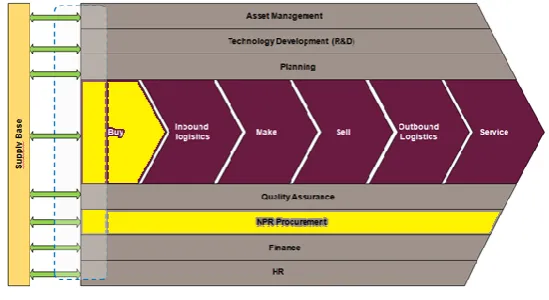
Figure 3: Position of (NPR)Procurement and 'Buy' ... 19
Figure 5: Position of QA ... 21
Figure 6: Position of Asset Management ... 23
Figure 7: Position of Inbound Logistics ... 24
Figure 8: Finance its position in Porters Model... 25
Figure 9: Position of R&D ... 26
Figure 10: The silo mentality ... 32
Figure 11: Maturing information sharing in the supply base ... 42
Tables
Table 1: Differences between purchasing and procurement ... 20Table 2: Information demand of purchasing... 21
Table 3: Information demand of QA ... 22
Table 4: Information demands of Asset Management ... 23
Table 5: Demand of information for Inbound Logistics ... 24
Table 6: Information demand of Finance ... 26
Table 7: information needs for R&D ... 27
Table 8: Reference model ... 28
Table 9: Position of interviewed managers ... 29
Table 10: General overview of interviewed companies ... 31
Table 11: Main process of each function ... 33
Table 12: Comparison between reference model and interview results for purchasing ... 37
Table 13: Comparison between reference model and interview results for QA ... 38
Table 14: Comparison between reference model and interview results for Asset Management ... 38
Table 15: Comparison between reference model and interview results for Finance ... 39
Table 16: Comparison between reference model and interview results for R&D ... 39
© 2011 Capgemini. All rights reserved. 7
Abbreviations
Abbreviation Meaning
BIS Business Information System(s)
BOM Bill Of Materials
CAPS Center for Advanced Procurement and Supply
chain management
ERP Enterprise Resource Planning
GRC Governance, Risk and Compliance
IT Information Technology
KPI Key Performance Indicator
MDM Master Data Management
OPCO Operating Company
PO Purchasing Order
PLC Product Life Cycle
PLM Product Lifecycle Management
QA Quality Assurance
QMS Quality Management Systems
RFQ Request For Quotation
SBM Supply Base Management
SCM Supply Chain Management
SIM Supplier Information Management
SPM Supplier Performance Management
SQM Supplier Quality Management
SRM Supplier Relationship Management
SRMM&T Supplier Risk Model Map and Track
© 2011 Capgemini. All rights reserved. 8
1
Introduction
Businesses are developing constantly; not only the day to day job has changed, communication and coordination of their activities might have changed even more. The Internet, ERP systems and other information (technology) systems shape organizations. Many organizations rely on information technology (systems) nowadays. These systems offer possibilities for the businesses, along with their advantages as well as disadvantages. This chapter describes the motivation for this research and its contents.
Capgemini Consulting was looking for two bachelor students for a 3 month joint assignment. Capgemini Consulting focuses much on consultancy from an IT perspective. To keep up with developments in a growing market, the firm does a lot of research in this field of business. As stated on the internet site of Capgemini: “Capgemini, one of the world's foremost providers of consulting, technology and outsourcing services, enables its clients to transform and perform through technologies. Present in 36 countries, Capgemini reported 2007 global revenues of EUR 8.7 billion and employs over 88,000 people worldwide.
Capgemini Consulting is the strategy and transformation consulting division of the Capgemini Group, with a team of over 4,000 consultants worldwide. Leveraging its deep sector and business expertise, Capgemini Consulting advises and supports organizations in transforming their business, from strategy through to execution. Working side by side with its clients, Capgemini Consulting crafts innovative strategies and transformation roadmaps to deliver sustainable performance improvement.”
(Capgemini, 2011)
Figure 1: Geographical Presence Capgemini Source: (Capgemini Consulting, sheets ‘Procurement transformation sales deck’, 2011)
This chapter will continue explaining the assignment in more detail. The focus of the assignment, the problem definition (including the goal and research question) and at last the research method will be given.
1.1
Changes in the procurement function
© 2011 Capgemini. All rights reserved. 9 Product life cycles become shorter and shorter, innovation occurs more rapidly and production is done globally (Gunasekarana et al., 2005). Moreover, customers and governments are increasingly demanding about quality and corporate social responsibility of the entire supply chain (Tan, K. C. , Handfield, R. B. and Krause, D. R., 1998).
Figure 2: Megatrends in Supply chain management Source: (Carter et al., 2007)
The developments are visualized in Figure. These developments may be called ‘mega trends’, as written in the CAPS research of the institute of supply chain management (Carter et al., 2007). As a result of these
megatrends, there is a greater demand for supplier performance and quality management. As information technology develops, firms tend to be more integrated (Zhou & Benton Jr., 2007). According to a study of Capgemini (sheets The future in procurement and supply management, 2011) and the CAPS research (Carter et al., 2007), seven trends can be distinguished in supply base management, these are explained briefly below: Globalization and the Rise of Emerging Markets
Sources of supply shift towards emerging markets. Relocation of manufacturing driven by lower labor costs and proximity to emerging (consumer) markets.
Technological Advances & Innovation
Core technologies become commoditized, leading to supply base consolidation and effecting SC structure and supplier relationships. Shortages of raw materials and energy sources lead to technology changes.
Increased Product Variety and Shortening product life cycle (PLC)
Mass customization, shorter product life cycles, late customization and different consumer tastes in emerging markets.
Supply Market Challenges & Opportunities
Volatility in raw material & energy prices, risk in shortages of key materials, maturing supplier capabilities.
Governmental Regulation
Increased regulations to improve trade security, transparency and record keeping. Stricter regulations to enforce corporate social responsibility and environmental protection.
Corporate Social Responsibility
Reduce energy consumption, reduce harmful emissions and reduce waste. Increased risk of exposure to unethical practices such as child labor, working standards and damages & pollution of the
© 2011 Capgemini. All rights reserved. 10 Mergers & Acquisitions and Supply Market Consolidation
Supply management is expected to deliver a major part of the cost savings from Mergers &Acquisitions. Supply market consolidation increases the capabilities as well as the power for suppliers.
With an eye to the focus and scope of this assignment and the (central) research question(s), the next paragraph will introduce the concept ‘supply base’.
1.2
Research context
According to academic literature, a ‘supply base’ may be defined as ‘all businesses engaged in value-adding activities purchase goods and services from a group of suppliers’ ((Dobler, D., Burt D., 1996); (Handfield R.B., Nichols E.L., 1999)). This group of suppliers is called the ‘supply base’ and the buying company that purchases from the group of suppliers, is referred to as the ‘focal company’ (Choi T.Y. & Krause D.R., 2006). This can be visualized as in Figure 3.
Figure 3: The supply base Source: (Choi T.Y. & Krause D.R., 2006)
This figure shows the overall relationship between a focal company and its suppliers; the supply base. The arrows symbolize the influence and its direction (control and coordination). Blue lines symbolize the relationships between suppliers as a result of this influence or which developed naturally (mergers, joint ventures, collaborative product development, etc.).
Companies rely on business information systems (BIS) that enable visibility in supplier information, performance, risk, and standardized supplier quality & performance management processes. Supply Base Management (SBM) is the term used to indicate all the interactions and activities between the suppliers and the focal company. SBM will be explained and defined in the paragraph ‘Supply base management’.
Besides purchasing, many other business functions interact with the supply base. These business functions use their own (point) solutions, such as product lifecycle management (PLM) tools, plant maintenance and quality assurance solutions. The next paragraph will describe what the influence of the mega trends is on the purchasing function and why this is relevant for this assignment.
1.3
Impact of mega trends
© 2011 Capgemini. All rights reserved. 11 what kind of information is useful, is obviously different for each company. Due to the mega trends, Capgemini consulting sees a rising problem within companies. Their main question is, why can companies not share information (concerning their supply base) properly, in such a way that they are able to cope with these mega trends? Spekman et al. (1998) state:
‘Again, we hear the theme that a gap exists between the goals and concerns of senior managers and the activities of the procurement function – buyers have not fully responded to the challenges of managing suppliers with the intent of gaining the full complement of skills afforded by an integrated supply chain.’
A gap between organizations objectives and their real outcome exists as Spekman et al. (1998) found in a study of 25 complete supply chains. The challenge now is to cope with the megatrends. In the next paragraph, this will be explained more extensively.
1.4
Research model; the silo mentality
Besides purchasing many other business functions interact with the supply base. These business functions use their own (point) solutions, such as PLM, Plant Maintenance and Quality Assurance solutions. This is the result of the organizational form of companies/how companies are organized. Traditional companies are divided into independent business functions. They all had their own choice and money in selecting a certain IT system, resulting in all kind of different systems within one company without integration. According to Feld et al. (2009, this may be called a ‘silo organization’. Feld et al. (2009) state that such a platform with a wide variety of vertically oriented data silos which serve individual corporate units (HR, accounting, and so on) should be replaced with a clean, horizontally oriented architecture designed to serve the company as a whole.
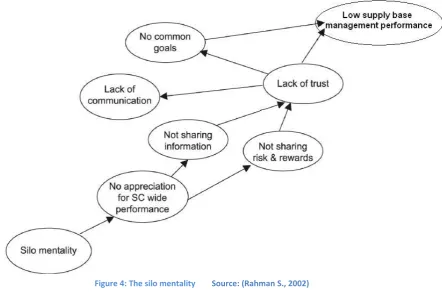
[image:11.595.78.521.423.718.2]Because of the use of different IT systems, this resulted in a poor way of information sharing and eventually a low supply base management function performance. This view of Capgemini consulting matched with academic literature and is visualized in Figure 4.
Figure 4: The silo mentality Source: (Rahman S., 2002)
© 2011 Capgemini. All rights reserved. 12 collecting, developing, sharing and exchanging information with the supply base.
This research tries to break down those silo’s walls and contribute to the development of collecting, developing, sharing and exchanging information between all of the different functions that interact with the supply base, so that it is useful for all stakeholders.
This was also the idea when ERP systems were developed and implemented. A definition of an ERP system; ‘configurable information systems packages that integrate information and information-based processes within and across functional areas in an organization’ (Kumar K., van Hillegersberg J. , 2000).
However, many functions and departments in organizations kept using their own ‘best of breed’ systems, which developed further and offered more functionality than an ERP system. This ‘silo mentality’ and ‘silo organization’ might be the cause that organizations are not able to react properly to the mega trends. How to determine whether a silo mentality or silo organization is prevalent in a company, will be described under paragraph ‘research process’.
1.5
Research contribution
Companies often do not have a system or process to store information in a way that it can be shared effectively with all stakeholders. More specifically, what information companies want to share with their suppliers and between functions is often not clear, and which functionality(s) information systems need to have, to support this. Companies have invested in many different point solutions that are poorly integrated. The consequence is information which is required to manage supply risk and supplier performance, is stored in various systems. If information is present, it is often incomplete with regard to supplier capabilities, qualifications, product roadmaps, supplier contact data, etc. or stored in an inconsistent way, e.g. different material and vendor codification. Thus, extracting relevant information to manage supply risk and supplier performance is therefore inefficient and/or ineffective.
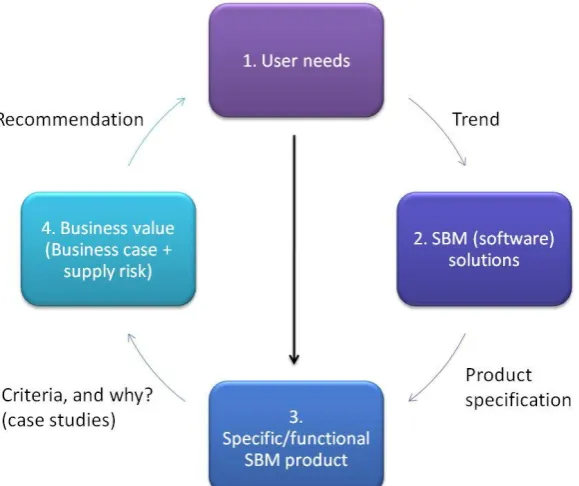
Normally, the ‘users’ (buying/focal companies) create a demand for information (systems). Thus, a pull market demand. Software producing companies respond by producing software modules which should support this demand. From those software, users should benefit by optimizing their SBM and thus create business value. To illustrate this story, Figure is shown.
The result of this research will provide a set of actions which a company can perform in order to achieve the goal of this research: an optimal use of information sharing in the supply base. These actions are supported by IT systems. When statements can be made about what processes that need to be covered by certain
© 2011 Capgemini. All rights reserved. 13 Figure 5: Software creation cycle Source: Burger & Pot (2011)
1.6
Research questions
According to the problem definition and goal, the central research question of this assignment:
How could supply base information sharing be organized in order to fulfill the needs of all functions of an organization that interact with the supply base?
Sub questions:
How should information concerning the supply base be optimally organized per business function according to academic literature?
Do companies experience a silo mentality in their organization and what kind of effects does this have on their organization?
What, in practice, are the information needs of the purchasing, quality assurance, asset management, inbound logistics, finance and R&D function in order to manage supplier performance and supplier risk?
To support the central research question and to ensure this research is useful for Capgemini, sub questions were added to find out how (in academic literature) information in a supply base is optimally organized. Furthermore, this research will determine whether silo mentality is prevalent, and what the actual information needs are within a company.
1.7
Focus
The sharing of information about and over the supply base is the main focus of this research. Although there might be plenty of reasons for the limited use of information systems in companies, the silo mentality will be the only perspective used in this research. This means however, that only a small part of the problem as described under ‘problem definition’ can be answered.
© 2011 Capgemini. All rights reserved. 14 problem. To stimulate, create or force change in an organization, introducing another way of using information systems is probably not sufficient.
Large manufacturing companies, often have a large amount of suppliers. Therefore, their supply base is huge and complex. Suppliers are playing a more significant role in the supply chain of manufacturing companies nowadays, and their products make up to 80% of the input materials (Reader purchase management, 2007). It is for this reason, these kind of companies are taken to account in this research, for most relevant results can be acquired from these companies.
1.8
Supply Base Management
In this paragraph, Supply Base Management (SBM) will be explained and defined. Also, the scope of the research process will be presented.
Literature describes SBM in the following way: ‘A portion of the supply network that is actively managed by the focal company through contracts and purchasing of parts, materials, and services.’ (Choi T.Y. & Krause D.R., 2006). Whereas the supply network can be defined as ‘All inter-connected companies that exist upstream to any one company in the value system’ (Choi T.Y. & Krause D.R., 2006).
The two definitions above contain concepts such as ‘purchasing’, ‘parts’, ‘materials’ and
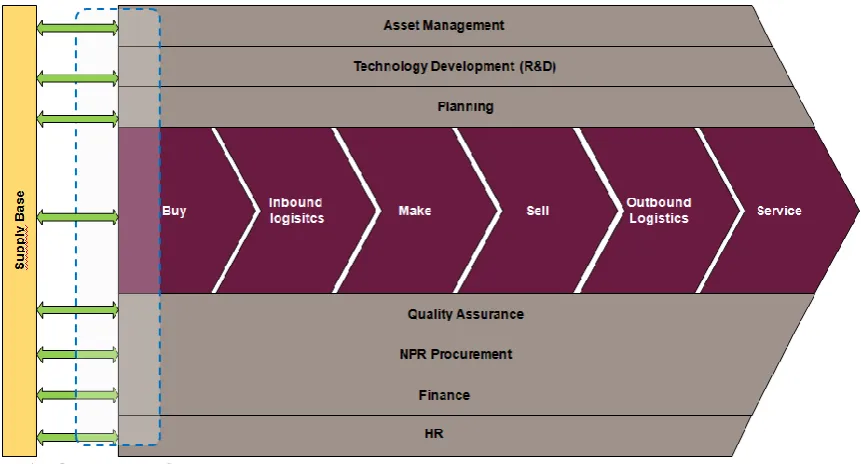
[image:14.595.73.504.346.578.2]‘companies…upstream…value system’. These terms are characteristic when speaking about a value chain of manufacturing companies. To have a better understanding of supply base management and what it contains, Figure is presented.
Figure 6: Functions within the supply base
Source: (Capgemini consulting, 2011)
This figure is based on the ‘value chain’ of Porter (Porter M. E., 1985). The original value chain brings strategically, relevant activities of an organization together (see Appendix A). Porter’s model is useful in researching external stakeholders of an organization. It helps to identify an organization’s core competencies and analyze their sources of competitive advantage (Porter M. E., Millar, V. E., 1985).
© 2011 Capgemini. All rights reserved. 15 It can be seen that, not only the purchasing function interacts with the supply base, but several other functions as well as quality assurance, finance and R&D. These functions will be explained and discussed in Chapter 3 more extensively. The choice whether to include functions will be based on their interaction with the supply base. Functions which interact often with the supply base are relevant to include in this research, for there is much to investigate and achieve in terms of SBM.
Therefore, only primary activities as stated in Porters model (1985) such as purchasing, quality assurance, asset management, inbound logistics, finance and R&D will be included in the scope.
1.9
Research process
How this research is conducted will be presented in this paragraph. A literature study and an empirical study (using interviews), will be used in order to answer the research questions.
1. The first step is performing a literature study. This is to identify supply base management best practices for each function that interacts with the supply base. Another reason to start with a literature study is that not only the results of the empirical(field) study can be compared with the results from this literature study, it also gives one a better view and insight in supply base management and what academic literature states about this subject.
2. The second part will enhance the empirical part of this research. Therefore, interviews with managers from several manufacturing companies will be held. Eight different companies, preferably two managers per company need to be interviewed, to gain enough input for this study. Organizations were selected based on a few criteria; the organization has over 250 employees, operates on a global supply base and has a significant purchasing volume.
3. The final step combines the findings from the interviews and the literature study to draw conclusions. Is a silo mentality prevalent at the companies interviewed? And how do the results in the empirical study correspond with the results found in the theories? The aim is to create a model, where several steps or levels which show the current position of a certain company and what needs to be done, if it wants to develop further. To determine what is needed to get to the next level, a checklist is made for each step. This checklist will contain processes, strategic decisions or IT functionalities which have to be met by the organization.
1.10
Interview method
Semi-structured interviews will be used to interview the managers of selected companies. The interviews will take about 1 hour per person. A questionnaire (see Appendix B) guides the interview along certain topics. However, managers are free to speak about their own experiences or business function. By adapting questions and anticipating to the answers of the managers the interview will take place. All of the interviews will be recorded (if agreed by the interviewed person) and notes shall be made.
The interviews will be a combination of structured and semi-structured questions. The structured questions are used to gather basic facts and figures about the company and business function. In the theory of Meridith et al. (1989) states:
The main reason for personal interviewing is to control the situation and responses, thereby aiding uniformity in analysis. The results may then be systematically analyzed through non-quantitative means or subjected to intensive statistical analysis to identify factors, clusters, and other such relationships in a statistically significant way. In structured interviewing, a fixed format is followed for the interview and the details of every answer are carefully noted as the interview proceeds. All questions are the same so that the typically constrained answers (check marks, values on a given scale) can be compared across interviews, situations, plants, and so forth. (Meredith, 1989)
© 2011 Capgemini. All rights reserved. 16 Here, people are interviewed using open-ended questions. As issues or points of interest to the researcher arise, these are followed up on the spot or in later interviews to give further insight to the researcher. This approach is particularly good for the descriptive and exploratory phases of research. It has the advantage that
the issues are framed by the participants and the researcher may not have even been aware of them. (Meredith et al., 1989)
The exploratory phase of research is the reason why also unstructured interview questions are used. It allows us as researchers to ask for developments. Therefore we made not only a questionnaire but also a question matrix (see Appendix C) to ask open questions about certain topics.
1.11
Division in tasks
This assignment has been executed by two bachelor students. The aim is to work parallel as much as possible on the assignment. The research proposal will be written jointly by the two students. For setting up the interview and surveys with the companies, tasks will be split up equally.
© 2011 Capgemini. All rights reserved. 17
2
Theoretical framework
A literature study will be conducted first of all. This is to give better insight in supply base management and eventually to be able to give best practices (per function). Therefore, the first sub question ‘How should information concerning the supply base be optimally organized per business function according to academic literature?’ can be answered. This chapter concludes with a reference model which is used to make a comparison with the empirical study. This reference model is the summary of all paragraphs as stated in this chapter. Thus, this reference model is the answer to the first sub question.
The literature study is conducted using the online library of the University of Twente, several books and a reader for the course ‘Purchasing’ of the University of Twente. Scopus, Google Scholar, Picarta and the online catalogue from the University of Twente are used to search for articles, books and (online) journals. The ‘snowball’ method is used to quickly find journals and articles with many citations and good references. The snowball methods is a simple method where one picks an article leading on a certain subject (an article with many citations) and then uses the references of that article to search more articles. Many different search terms or key words are used to find a broad set of literature. To enhance results and to oversee the literature, this method proves very useful. In total, approximately 50 articles are found, which are used as input for this literature study (see ‘References’).
Keywords used: supply chain, supply chain management, supply base, supply base management, performance management, supplier development, quality management, quality assurance, purchasing, asset management, planning, (NPR) procurement, ERP and trends in supply base/chain (management).
At the end of this chapter, a theoretical framework is shown in Table 8. This is the summary of the literature study. This framework is the combination of the paragraphs in this chapter, presented in a table . It describes per function (see under Focus which functions):
1. Definition of the function according to the theory.
2. Which information and where is it needed to perform at the desired level? 3. What information is needed from other functions, and where is an overlap?
When all functions are described in terms of these three points, a comparison (in chapter Results) can be made with the results from the interviews.
2.1
Supply Chain Management
To understand where all functions are part of, the literature study will be started with supply chain management. Supply base management for example, is a part of supply chain management (SCM). Supply chain management however, is a very broad term for which academic literature offers many definitions. This section will give some of these widely used definitions, according to various authors/literature.
[image:17.595.83.517.615.755.2]Some authors see SCM as a single process; not as different parts performing their own function (Tan, 2001). One way of looking at SCM is the ‘system approach’. This is shown in Figure 2.
© 2011 Capgemini. All rights reserved. 18 Value chain is an acronym for supply chain. Figure 2 shows how a particular value chain looks like. It starts with the extraction of raw materials from the earth. Manufacturers, wholesalers and retailers eventually sell their products to the end users. Recycling has not always been seen as a part of the value chain. Now that environmental, ecological and CSR issues become more important, recycling becomes a fundamental part of the value chain (New, Payne, 1995).
This perspective at SCM, is characterized by the system approach; ‘a sort of thinking that emphasizes the interdependence and interactive nature of elements within and external to an organization.’ (Free computer dictionary, 2011)
Daft (2007) defined SCM as ‘managing the sequence of suppliers and purchasers, covering all stages of processing from obtaining raw materials to distributing finished goods to final customers.’
In an article of Tan (Tan, 2001), two definitions of SCM are given as:
Harland (1996)describes supply chain management as ‘managing business activities and relationships (1) internally within an organization, (2) with immediate suppliers, (3) with first and second-tier suppliers and customers along the supply chain, and (4) with the entire supply chain.’
Scott & Westbrook (1991) and New & Payne (1995) describe supply chain management as ‘the chain linking each element of the manufacturing and supply process from raw materials through to the end user,
encompassing several organizational boundaries.’
According to Mentzer et al. (2001), definitions of SCM can be classified into three categories: 1) a management philosophy, 2) implementation of a management philosophy, and 3) a set of management processes.
From a management philosophy perspective, SCM is seen as a system approach (as visualized in Figure 2). A process which runs step by step thru the whole system. Other authors focused on the activities that procure SCM, this is the ‘implementation of a management philosophy’ perspective. These activities are:
1. Integrated behavior
2. Mutually sharing information 3. Mutually sharing risks and rewards 4. Cooperation
5. The same goals and the same focus on serving customers 6. Integration of processes
7. Partners to build and maintain long-term relationships (Mentzer J. T., 2001)
A set of management processes is a viewpoint on SCM; all of the different functions within an organization are key processes. These functions must overcome their ‘silo approach’ and adopt a process approach. A process approach sees SCM as a single entity instead of individual parts or steps in the process, each performing its own function (Ellram L. M., Cooper M. C., 1990).
For this assignment, the definition of SCM from Mentzer (2001) is used. This because of the goals set to SCM, it is a theory which focuses more on what SCM could do for a company rather than a descriptive (or system) approach such as the theory from News and Payne. This research focuses on how in the end a company could be made better on a certain area, an theory which measures on performance is therefore more usable. The total definition the research uses is:
© 2011 Capgemini. All rights reserved. 19
2.2
Purchasing
Purchasing and (not product related) procurement, are terms which are overlapping and very similar. Purchasing is the acquiring of goods and services from another company, a supplier, as input for an organization’s production. Procurement can be a department, function or process in an organization. Therefore, procurement refers to the ‘purchasing’ process.
Purchasing according to van Weele (1994) contains the specification (what), selection (who), contracting (how), ordering, monitoring and the after-care
activities for acquiring certain goods or services for an organization. NPR (not product related) purchasing refers to the purchasing of any item in the organization which is not related to the product itself. One can think of pencils, copy machines, chairs, etc.. In the context of supply base management in a manufacturing
environment, procurement contains: contract management, Sourcing and P2P (Purchase 2 Pay).
Daft (2007), defines procurement as ’purchasing supplies, services, and raw materials for use in the production process’. Whereas Rainer & Cegielski (2007), define procurement as ‘sourcing goods and materials, negotiating with suppliers, paying for goods, and making delivery arrangements’.
Purchasing can be defined as ‘the management of external resources, in such a way that the supply of all goods, services, capabilities, and knowledge which are necessary for running, maintaining and managing the
company’s primary and supportive activities is secured under the most favorable conditions.’ (Telgen, Buter, Schotanus, 2007 - 2008) and (van Weele , 1994).
Many authors agree that purchasing is more of a tactical nature, whereas others procurement is more of a strategic nature.
[image:19.595.244.519.97.247.2]The purchasing process contains six steps:
Figure 4: the purchasing process Source: Reader ‘Purchasing’ (Telgen, Buter, Schotanus, 2007 - 2008)
In the specifying phase, it is defined what is going to be purchased. Listing the requirements of the
products/services, which are going to be purchased, is very important. Selection is about choosing the supplier who makes the best offer. The suppliers use the product/service requirement list to come up with their proposal. Then, the contracting takes place. In this phase, a supplier has been selected, and both parties try to agree on certain terms and conditions. Ordering is the actual request of a delivery. E-procurement focuses on this part of the purchasing process, because of the administrative processes involved.
[image:19.595.75.448.471.649.2]Once an order has been placed, monitoring keeps track on incoming invoices, and whether the buyer and/or supplier abide on the agreed terms/conditions. Finally, the after-care is about handling situation in which
© 2011 Capgemini. All rights reserved. 20 something has gone wrong during the purchasing process. Therefore, it uses information from the monitoring phase. (van Weele, 1994)
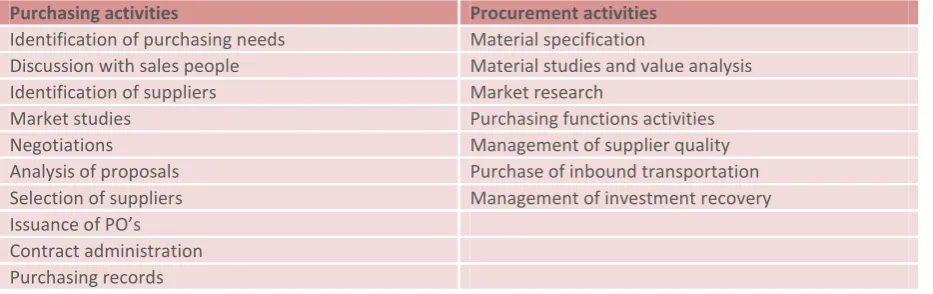
To highlight differences between purchasing and procurement (defined in the first part of this paragraph), some activities are listed in Table 1.
Purchasing activities Procurement activities
Identification of purchasing needs Material specification
Discussion with sales people Material studies and value analysis
Identification of suppliers Market research
Market studies Purchasing functions activities
Negotiations Management of supplier quality
Analysis of proposals Purchase of inbound transportation
Selection of suppliers Management of investment recovery
[image:20.595.66.533.145.292.2]Issuance of PO’s Contract administration Purchasing records
Table 1: Differences between purchasing and procurement Source: (Hahn, Kaufmann, 2002)
The purchasing function has become more and more transit with supply management, where traditional purchasing was a function about buying goods and ensures they were there in the right amount, time and at the right place. As Kraljic (1983) mentioned that purchasing should become more like supply management. A purchasing manager should look more closely to her or his suppliers, vendor rating, risk management etc. were introduced (Kraljic, 1983)
Supply (chain) management has changed over the last decades. The costs of purchased goods and services are the majority of total costs or spend for most companies. Also, outsourcing of manufacturing activities, due to low labor countries and developing technology, ensures that companies are more and more dependent on other companies. When designing supply base management of an organization, the purchasing function therefore is very important. (Dubois, 2003). This importance of purchasing can also be described as Cammisch & Keough (1991) and Dyer (1998) state:
‘A typical manufacturing company spends between half and three-quarters of its turnover on purchases such as raw materials, components and semi-manufactured goods’.
According to these authors, one may conclude that the purchasing function is of high importance to a
company. The function performs many processes and faces many challenges. Therefore, scientists do not agree on a single best practice for the purchasing function.
There is no single ‘best practice’ on how to organize the purchasing function, as each organization is different. It can identify the best suppliers in the market, try to reduce costs in the supply chain or negotiate the best offers, the impact of purchasing is determined by the relative importance and corporate strategy of a certain company according to Ellram and Cooper (1990).
© 2011 Capgemini. All rights reserved. 21
The information needs of purchasing
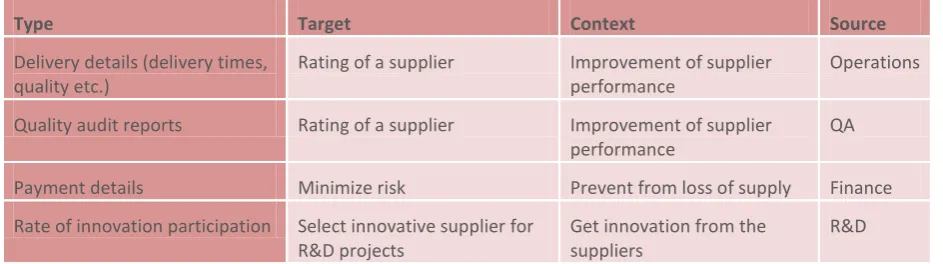
Purchasing needs information from many other functions and departments. In practice, this means doing audits, managing supplier performance and maintaining close relationships with suppliers (Kraljic, 1983). E.g. to make a vendor rating, the purchasing function needs information from operations concerning delivery times, payment details from finance and quality audit reports from QA. To determine what information purchasing needs,is difficult. Companies might have different priorities for certain key performance indicators (KPI's). For example, a food and beverage company could need information about quality as most important, whereas an offshore company has more preference for delivery time information.
Table 2 contains several ‘types’ of information which are used by the purchasing function. Under ‘target’ is described for what purpose the information is used. Under ‘context’ is described what the goal of using this information is. Under ‘source’ is stated from which function this information should be provided.
Type Target Context Source
Delivery details (delivery times, quality etc.)
Rating of a supplier Improvement of supplier performance
Operations
Quality audit reports Rating of a supplier Improvement of supplier performance
QA
Payment details Minimize risk Prevent from loss of supply Finance
Rate of innovation participation Select innovative supplier for R&D projects
Get innovation from the suppliers
[image:21.595.64.536.239.371.2]R&D Table 2: Information demand of purchasing
Operations: Delivery information is used for one of the main tasks of purchasing; rate suppliers. This information is needed to make vendor ratings in order to keep track and improve the suppliers performance.
QA: should provide information concerning the quality of products delivered by a supplier. It is not only interesting for purchasing to know what the quality of delivered products is, but also what quality standards a supplier uses. This is important to be able to make decisions concerning e.g. corporate social responsibility (CSR) and determine KPI's such as working standards or pollution numbers. Finance: (un)paid invoices can be used as input for measuring the financial status of a supplier. R&D: If an innovation project starts and supplier involvedness is necessary, purchasing has to choose
which suppliers are best. R&D should thus provide information about how innovation driven the suppliers are, which impact they had on former projects, confidentiality etc.
2.3
Quality Assurance
Quality assurance (QA) contains practices that may be defined as ‘a set of activities and attitudes in the firm that promotes collective involvement to work together in a process of continuous improvement and product and service quality assurance’ (Gonzalez-Benito, Martinez-Lorente and Dale, 2003).
In the context of supply base management in a manufacturing environment, quality assurance can be for example: supplier auditing, supplier certification, incoming goods inspection and monitoring supplier performance/products. Figure 5 shows the place where QA is placed in Porters model.
[image:21.595.72.291.641.759.2]QA, risk and corporate social responsibility (CSR), are hot topics in supply chain management nowadays. Customers and governments are increasingly focusing on CSR. CSR means that a corporation may be held responsible socially and ethically accountable, in relation to its stakeholders (employees, customers, communities, governments, etc.) (Maloni M. J., Brown M. E. , 2006).
© 2011 Capgemini. All rights reserved. 22 QA refers partly to the inspection of purchased goods; process control, building quality into the product; and process improvement; modification of the process (Tan, Handfield and Krause, 1998). Certification systems, ISO 9000 and similar quality systems are important for internal operations of QA; it ensures that supplied
components meet the product specifications. Reason is to ensure the quality of the production process. Quality of purchased products has always been one of the main performance indicators of an organization. In supplier selection, quality is used as one of the major drivers for selecting and choosing suppliers.
For managing quality assurance, a good supplier-buyer relationship is most important. This is measured in many ways, but Goffin (2006) states the following: The relationship between a manufacturer and supplier can take many forms and the distinguishing factors have been identified as the number of transactions, the longevity of the relationship, and the closeness. Close relationships with selected suppliers can enable manufacturers to reduce costs, improve quality and enhance new product development (Goffin K., Lemke F., Szwejczewski M., 2006). So to keep a good relation, information such as the number (and value) of transactions should be saved within an organization.
Nowadays, more and more organizations are linking quality assurance to supply chain management. The combination of these two concepts can be called Supply Chain Quality Management (SCQM). SCQM can be defined as ‘the formal co-ordination and integration of business processes involving all partner organizations in the supply channel to measure, analyze, and continually improve products, services, and processes in order to create value and achieve satisfaction of intermediate and final customers in the marketplace’ (Robinson, Malhotra, 2005)
Companies use supplier evaluation and performance measures, to identify supplier shortcomings. The measurement of suppliers' delivery, quality, and cost performance, site visits, certification of suppliers' products and processes, and the setting of performance goals are examples of such measurements (Tan, Handfield and Krause, 1998)
QA information demands
Delivery information, quality of purchased products and cost performance are indicators which are collected at operational level. Site visits are often done by QA itself. To get access to certifications (and contracts) of suppliers, QA should consult purchasing. This is because purchasing is responsible for these certifications. Purchasing needs quality KPI's and QA needs agreements and certifications from suppliers. Obviously, it can be possible that certifications are gathered directly from the supplier, but the purchasing function should be the communicator towards suppliers and thus supplying such information to other functions. An overview of these requirements is given in Table 3.
Type Target Context Source
Delivery details (delivery times, quality etc.)
Rating of a supplier Improvement of supplier performance
Operations
Certifications and contract Keep up running contracts and regulations
[image:22.595.66.531.521.602.2]© 2011 Capgemini. All rights reserved. 23
2.4
Asset management
Asset management has many definitions. The term ‘asset’ refers to property owned by a person or company, regarded as having value and available to meet debts, commitments, or legacies (Oxford Dictionaries, 2011).
According Michael (2005), asset management can be defined as ‘The process that guides the gaining of assets, along with their use and disposal in order to make the most of the assets and their potential
throughout the life of the assets. While doing this, it also manages and maintains any costs and risks associated with the assets. It is not something you
can buy, but rather a discipline you must follow in order to maintain your assets.
There are 5 main points an asset manager should entail:
1. Optimize asset use and manage all maintenance efforts involved by making assets as accurate, reliable, and efficient as possible.
2. Reducing the demand for new assets and thus save money by using demand management techniques and maintaining current assets.
3. Uses a form of asset tracking: knowing where the asset is at all times, how much the asset is worth, and how much the asset cost you to begin with. It should also incorporate this throughout the entire life of the asset. 4. Always try to achieve greater value for money through evaluating the asset options: the cost of maintaining, producing, the use of it, etc.
5. Always provide a report on the value of the assets, along with any costs involved in maintaining the assets. (Michael, 2005)
In the context of supply base management in a manufacturing environment, asset management can be described as the management of physical capital. Decisions related to the supply base are e.g.: plant maintenance/investments, equipment for bill of materials (BOM) and material requirements and inventory management of spare parts.
Asset management in relation to other functions
Asset management needs information from several other functions in the organization. In Table 4 is shown what information is needed exactly.
Type Target Context Source
Asset financial details Make decisions on repair or buy problems
Optimize the use of assets Finance
Status of assets on the work floor
Clear overview of status from assets
Prevent unexpected repairs or failures and minimize costs
[image:23.595.289.511.98.215.2]Operations Table 4: Information demands of Asset Management
What it is worth concerns obviously information that should be provided by the financial function/department. E.g. information about depreciation and weighted average cost of capital. What the current condition, deferred maintenance and the remaining service life is a task for
operations to check. Sometimes asset does this on its own, but companies which produce and operate globally often do not have an asset management functions at all its operating facilities. What they own and what they fix first are things that asset management have to do on their own.
[image:23.595.69.529.543.625.2]With the help of operations they should have lists or databases with information about what is where and combined with the other entire information step 6 can be made.
© 2011 Capgemini. All rights reserved. 24 Asset management needs a lot of information from operations and marginal information of finance. What is actually shared by the asset management function with suppliers, is limited to maintenance. Regular communication with suppliers about the state of machinery for example seems reasonable.
2.5
Inbound logistics
Materials handling, warehousing (management), inventory control and transportation are concepts which define this function. In the context of supply base management in a manufacturing environment, inbound logistics activities can be: material planning, store management, inventory management and logistics management.
Nowadays, many organizations have a huge amount of suppliers all over the world. Logistics have a crucial role in the purchasing process, as it is concerned with the physical transportation of these products. To perform as a company on a global basis the logistics need to be well organized. However, a well organized network of suppliers and logistics processes does not guarantee improved organizational performance (Stock, 2000). According to Wu et al. (2006), there are ten risk factors concerned with inbound logistics. By managing these risks, the company can save money, time and effort. The ten risk factors are:
1. Quality 2. Cost
3. On-time delivery 4. Engineering/production 5. Technical/knowledge resource 6. Financial and insurance issue 7. Management related issue 8. Accident
9. Market strength 10. Internal legal issue
Inbound logistics information requirements
To manage and control the ten risk factors, inbound logistics has to communicate with other functions. In Table 5 is shown what information is needed. Below the table is explained what the information contains and if it is used by other functions as well.
Type Target Context Source
Delivery details (delivery times, cost, quality, accidents etc.)
Reduce risks Monitoring of incoming goods
Operations
Engineering and technical resource
Have knowledge from what is on the floor
Prevent unexpected repairs or failures and minimize costs
Operations/Engineering or Make
Financial, internal legal & management issues and the market strength
Keep up with current policies
Ensure the company its strategy and policies are followed
[image:24.595.71.300.189.310.2]Purchasing/Finance
[image:24.595.63.529.609.759.2]© 2011 Capgemini. All rights reserved. 25 Information about Quality, Cost, On-time Delivery and Accident is documented operational level. Thus,
operations has to provide this kind of information to inbound logistics.
Engineering and Technical resource information is being documented to prevent unexpected
maintenance or machine failures. This information can be gained from engineering and production or in the Porter model the 'Make' part.
The other items such as financial issues are gathered from either finance or purchasing. Most of the time, these issues are policies that all functions within an organization have to deal with. To keep up with these issues, inbound logistics should be provided with information about these issues (in document form).
2.6
Finance
This department is concerned with all financial activities of an organization. In the context of supply base management in a manufacturing environment, finance activities can be for example: financial administration, spend analysis or invoice control. The position of finance in Porters model, is shown in Figure 8.
Making payments, invoice controlling, bank guarantees, processing and regulating discounts and managing the conditions of payments are the core activities of finance. Besides these activities, finance supports purchasing in risk management. This is because when dependency increases between companies, in the form of supplier-buyer relationships, exposure to risks of other companies increases (Hallikasa, 2004).
Valuation of supplier risks is done using several
indicators. The direct risk of bankruptcy on one side, and
the risk of becoming too dependent on a single or more suppliers on the other.
The issue of bankruptcy is that suppliers who not deliver any longer, while a payment has already been made, and so the production is in danger because the (unexpected) loss of supply. The other side is becoming too depended on a single or more suppliers, meaning there is little room for negotiation in price. The valuation of suppliers is done using complex models, trying to predict and foreseeing risks of suppliers. It is the
responsibility of purchasing that the supplier’s portfolio is managed; it is finance that supports them in doing so.
Academic literature does not state on how to deal with bankruptcy of a supplier or how invoices should be handled. A reason might be that a best practice is a breakeven point between the risk of failure and the lower price for materials of products. It is up to a company to set their own breakeven point according to their strategy. The dependency on suppliers however, is a field of study where many scientific articles are written about.
It is for a company important to be not to dependent on their suppliers. When the dependency between
companies increases, they become more exposed to the risks of other companies. Networking also increases the supplier responsibilities and sometimes investment risks may be transferred to the suppliers. The optimal strategy is to aim at share and balance rewards and risks between organizations. Companies should also avoid being too dependent on a single network or organization. (Hallikasa, 2004)
Choi & Krause (2006) state it may be true that high complexity of the supply base network leads to high transaction costs and high supply risks. So there is an optimum between different strategies. The challenge for each company will be determining where that optimum lies within their strategy. That optimum is determined by purchasing and supported by finance. So the question is, what information does finance need to support purchasing in their decisions? This is discussed in the next paragraph.
[image:25.595.271.509.259.386.2]Information needs for finance to support p urchasing
© 2011 Capgemini. All rights reserved. 26 Finance exchanges a lot of information with purchasing. However, purchasing is not the only function which needs information of the finance department. In Table 6 is summarized what type of information finance needs.
Type Target Context Source
Contract details Keep up with all contracts Contract management, ensure discounts are included etc.
Purchasing
Delivery details, completeness and on time delivery
Pay only for delivered, good and on time products
Keep the financial flows in the company at a safe levels
Operations
Quality of delivered products Meet the set standards Contract management QA Table 6: Information demand of Finance
To execute their core processes, finance needs information from other functions. Information concerning payments, price hedging, supplier quotations need to be provided by purchasing. Details are often summarized in framework contracts. On the other hand, finance provides purchasing with financial details about suppliers.
To check if deliveries of suppliers are complete, finance has to match invoices with deliveries. This information needs to be provided by operations. Specific details such as the completeness of a product or any damages are relevant for finance, for e.g. waiting or making payments to suppliers. Again to check on incoming supplies, information from QA is needed about the quality of the
purchased goods as they are delivered.
2.7
Research & Development
The R&D function handles issues regarding research & development and new products and/or process innovations (Dowlatshahi, 1998). In the context of supply base management in a manufacturing environment, technology development activities can be for example: design and product life cycle management, product development or innovation management. The relation with the supply base may particularly be important for open innovation, an innovation strategy where a company
not only invents new products etc. by them self but also learn from their suppliers (or other actors in the supply chain).
The R&D function handles most of the product development processes. An important aspect of these processes is the new product development (NPD). It is here were R&D has it links with suppliers. The influence of a supplier in product development is defined as the
integration of capabilities (Dowlatshahi, 1998) or as the information suppliers provide and their participation in decision making (Handfield, Nichols, 1999). In terms of using innovation in products and the organization, Stones (2001) states that suppliers are the most important external resource for co-operation ahead of customers and all other partners nowadays.
In an article of Echtelt (2008) is argued that the main factors to achieve a successful involvement of supplier in NPD, concerning two important aspects; how a company deals with them on a project basis and how they deal with them on a more long-term strategic level.
According to this part of the study, van Echtelt(2008) concluded that companies spend too much time on the operational aspect of a relation with the supplier. In contradiction, companies should have a set of strategic decision-making processes that help to create an alignment in the long-term with a supplier. Giving the supplier influence from the design phase, new product development increases the chance to establish a long-term relationship. Combined with a more strategic view on supplier management, firms can benefit more from their R&D (van Echtelt, 2008).
[image:26.595.67.529.128.229.2]Information requirements from R&D
© 2011 Capgemini. All rights reserved. 27 According to the theory, R&D should (try to) sustain a long term relation with suppliers. What type of
information is needed for this relation is not really clear. Obviously, sharing of this information should be smooth. The purchasing function has most contact with suppliers, so it is purchasing which should provide R&D with useful information. This information contains innovative ideas from suppliers or new product
developments from the market etc.
This means R&D gets only specific information of purchasing, concerning innovation related issues. The target for R&D is to use this information to start innovation projects collaboratively with suppliers, in the context of open innovation rather than closed innovation.
Type Target Context Source
Innovation related information (e.g. market developments)
Start innovation projects with suppliers
Innovation should not only come from the company itself but also from suppliers
[image:27.595.76.532.195.257.2]Purchasing
Table 7: information needs for R&D
2.8
Reference model
To summarize the theory as stated in the paragraphs, a reference model has been made and is shown in Table 8. It summarizes what kind of information is needed according to theory and of which business function this information should be provided. The model contains several ‘types’ of information which are used one or more business function(s). Under ‘target’ is described for what purpose the information is used.. Under ‘context’ is described what the goal of using this information is. Under ‘source’ is stated from which function provides this information. Under ‘user’ is described what business functions use this information.
With this reference model, a comparison can be made with the results of the empirical study.
Type Target Context Source User
Delivery details (delivery times, completeness etc.)
Rating of a supplier
Improve supplier performance
Operations Purchasing
Quality audit reports
Rating of supplier Improver supplier performance
QA Purchasing
Payment details Minimize risk Prevent from loss of supply or money
Finance Purchasing
Delivery details (delivery times, completeness etc.)
Rating of a supplier
Improve supplier performance
Operations QA
Certification and contract details
Keep up running contracts and regulations
Maintain a high quality
Purchasing QA
Asset financial details
Make decisions on repair or buy problems
Optimize the use of assets
Finance Asset
Management
Status of assets on the work floor (engineering & technical resource)
Clear overview of status from assets
Prevent
unexpected repairs or failures and minimize costs
Operations Asset
© 2011 Capgemini. All rights reserved. 28 Payment details Reduce risks Monitoring
incoming goods
Operations Inbound Logistics
Status of assets on the work floor (engineering & technical resource)
Have knowledge from what is on the floor
Prevent
unexpected repairs or failures and minimize costs Operations/Engineering or Make Inbound Logistics Financial, internal legal & management issues and the market strength
Keep up with current policies Ensure the company its strategy and policies are followed
Purchasing/Finance Inbound Logistics
Payment details Pay only for delivered, good and on time products
Keep the financial flows in the company at a safe levels
Operations Finance
Certification and contract details
Keep up with all contracts
Contract management, ensure discounts are included etc.
Purchasing Finance
Quality of
delivered products
Meet the set standards
Contract management
QA Finance
Innovation related information (e.g. market developments) Start innovation projects with suppliers Innovation should not only come from the company itself but also from suppliers
[image:28.595.68.531.69.440.2]Purchasing R&D
© 2011 Capgemini. All rights reserved. 29
3
Data collection
To answer the research questions, data is collected by using an empirical study. This chapter gives an overview of the companies which participated in this research, and how these have organized their purchasing function. The information gained during the interviews will be compared with the reference model in chapter 4. The data was gathered with semi structured interviews, based on face-to-face conversations with one or two quality, purchasing, R&D, asset management, finance and/or supply (chain) related manager(s). Most
interviews took place at an office or headquarters of these companies itself, and lasted for approximately one hour. The interviews were recorded and written reports (in Dutch) were elaborated from the audio file. To obtain enough data and input for our research, managers from eight different organizations have been interviewed. Organizations were selected based on a few criteria: the organization has over 250 employees, operates on a global supply base and has a significant purchasing volume. This is to get significant results, as the purchasing function within those companies plays a significant role.
Table 9 shows which companies and persons were interviewed. It also shows to what position in the organization the interviewers is reporting to.
Company Position of interviewed person in company
Interviewed person in company reports to
Electronic/telecommunication company
Director Procurement Services/proc. & design to cost manager
CPO
Off Shore company 1 Consultant to procurement manager Procurement manager & VP corporate services
Off Shore company 2 CPO COO & Fleet manager
Oil company CPO Global purchase manager
Food & Beverages company 1 Procurement manager CPO Food & Beverages company 2 Procurement business process
manager/ supplier QESH man.
CPO/ technical director
Aviation company Procurement manager CPO
[image:29.595.67.529.287.510.2]Electronic/aerospace company CPO/Head of SCM COO
Table 9: Position of interviewed managers
The next paragraph describes what kind of organizations participated in this research.
3.1
Participating organizations
© 2011 Capgemini. All rights reserved. 30 To start, Figure 14 shows a part of the results of the questionnaire. It provides details about the percentage of third party expenditure and key suppliers, as well as the (total) number of employees and in the purchasing function. This is part of the structured interview method as described under paragraph 1.10.
Figure 14: Results of the questionnaire
If one looks at the structure of the organization from the companies, some differences can be seen. At food & beverages company 1 for example, different operating companies (opco’s) are responsible for their own production, sales and profit. These opco’s are divided on their geographical location. The purchasing function is only responsible for the delivery of the purchased goods to these opco’s. Food & Beverages company 2, is or