The larvae of herring (Clupea harengus L.) can osmoregulate in salinities ranging from 5 to 50 ‰ and maintain their body fluids between 230 and 400 mosmol kg−1(Holliday, 1963), despite an initial low level of organogenesis and a large area-to-volume ratio (de Silva, 1974). The processes by which this is achieved are only partly understood. Tytler et al. (1993) found that the permeability of herring larvae, in terms of the turnover of tritiated water, was similar to that of the gills of adult teleost fish. However, considered in relation to the large relative surface area, the permeability coefficients were lower than for adults. In a similar study by Ramsay et al. (1993), the permeability of herring larvae was found to be much lower, implying a very slow water turnover. The primordial gut has been shown to play an important role in maintaining water balance, in that changes in external salinity elicit adjustments in the rates of drinking and water absorption (Tytler and Blaxter, 1988; Tytler and Ireland, 1993). Gills and branchial chloride cells are not present in the early larval stages, but similar mitochondrion-rich cells have been found in the skin (Wales and Tytler, 1996), and these cells may be responsible for the regulation of monovalent ion levels by fish in hyperosmotic environments, but this has not yet been tested. The pronephros, the primordial kidney, has been shown to be functional in terms of glomerular filtration and urine
production (Tytler et al., 1996), but little is known about its role in osmoregulation. In the present study, the effects of changes in external salinity and temperature on the function of the urinary bladder and, consequently, on urine flow rate in early-stage herring larvae were investigated.
Materials and methods Larval rearing
Mature herring (Clupea harengus L.), from three stocks, were caught by trawling on their respective spawning grounds; North Sea herring on the Buchan Bank, Clyde herring on Ballantrae Bank and Manx herring off the Isle of Man. Gonads were removed and transported back to the laboratory in glass jars, over ice, in a coolbox. Eggs were plated onto 20 cm×20 cm glass plates and fertilised in sea water. The plates were then placed in 200 l opaque aquaria which had a through-flow of sea water maintained at appropriate temperatures; 12–13 °C (Buchan stock), 10–11 °C (Clyde stock) and 11 °C (Manx stock). From 2 days post-hatch, microalgae (Isochrysis galbana) and algae-enriched rotifers (Brachionus plicatilis) were added to the tanks until approximately 4–6 days post-hatch when the larvae were large enough to feed on the algae-enriched nauplii of Artemia sp. (Léger et al., 1986).
Printed in Great Britain © The Company of Biologists Limited 2000 JEB2494
Major changes in the morphology of the urinary bladder were observed during the transition from yolk-sac to feeding larval stages of herring, in particular bladder volume increased almost sixfold. Initially, the urine flowed into the hindgut, but within days of hatching a separate urinary duct, leading to the exterior, had formed. Micturation was intermittent but quite regular. The period between micturations increased from 1.6 to 4 min in the progression between the two larval stages. The discharge volume was approximately 50 % of the full bladder volume in all stages studied. Urine flow rate (UFR) in sea water rose slightly from 1 to 1.7 nl mg−−1h−−1 during early larval
development. Exposure to low salinities significantly
reduced UFR in yolk-sac larvae, but in the later stages UFR increased significantly in hypo-osmotic salinities, so that UFR in 4 ‰ salinity was 2.5 times that in 34 ‰ salinity. The main variable influencing UFR was discharge frequency. Cardiac output was not influenced by salinity and was considered not to be a controlling factor in the UFR response to salinity change. UFR increased with temperature with Q10 of 2.3 in stage 1 larvae and 1.5 in
stage 2 larvae, over 7–15 °C.
Key words: pronephros, bladder, urine, temperature, salinity, larva, Atlantic herring, Clupea harengus.
Summary
Introduction
THE INFLUENCE OF SALINITY AND TEMPERATURE CHANGE ON THE
FUNCTIONING OF THE URINARY BLADDER IN THE EARLY LARVAL STAGES OF
THE ATLANTIC HERRING CLUPEA HARENGUS L.
P. TYTLER* ANDJ. IRELAND
Department of Biological and Molecular Sciences, University of Stirling, Stirling FK9 4LA, UK
*e mail: [email protected]
Pronephric and bladder function Salinity and temperature acclimation
Four batches of approximately 50 larvae at 3–5 days post-hatch (stage 1; Doyle, 1976) and 11–14 days post-post-hatch (stage 2) were taken from each of the stock tanks, holding North Sea and Clyde herring, and placed in 2 l beakers containing sterile sea water. Three of the batches had the ambient salinity reduced to 17–20, 11–12 and 4–6 ‰ over an 8 h period by gradually adding distilled water, and they were subsequently left overnight to acclimate at 12 °C. Three batches of 50 Manx herring, reared at 11 °C, were transferred to 2 l beakers containing sterile sea water and were acclimated overnight to 15, 11 and 7 °C.
Urine flow rate and cardiac output measurement
The methods used are similar to the microvideo techniques recommended and used by Burggren and Fritsche (1995). After the acclimation periods, individual larvae were lightly anaesthetised in a 20 mg l−1solution of Benzocaine (ethyl p-aminobenzoate, Sigma) in a salinity and temperature appropriate to the conditions of acclimation. Each larva was transferred, in the anaesthetic solution, to a small glass Petri dish fitted with a water jacket connected to a Hetofrig water bath, from which cooling water was pumped to maintain the acclimation temperature, and mounted on the stage of a Zeiss Axiovert-135 microscope. The larvae were allowed to settle for 15 min before recording the movements of the urinary bladder and heart over periods of 20 and 2 min, respectively, using a
×20 LD Acroplan objective (NA 0.4), differential interference contrast (DIC 3-4) optics, a closed-circuit television video camera (Panasonic VW-BL600) and a video recorder (Panasonic NV-SD 200). The video recordings were then played back, and the midsagittal areas of the bladder, ventricle and bulbus arteriosus were measured from sequential freeze-frame images (Fig. 1) using an image-processing work station (Improvision 2000) based on an Apple McIntosh Quadra 900 computer. Histological examinations of the three structures have shown them to be ellipsoid, and the bladder volume was therefore calculated using the formula:
V = 1.33A×0.5W ,
where V is volume, A is sagittal area and W is width.
Urine flow rate (UFR) was calculated from the rate of volume change during filling (mean dV/dt, where t is the period of filling) and emptying (accumulated discharge volume/period of recording). The mean discharge volume was calculated and expressed as a percentage of the mean maximum bladder volume for each larva. Stroke volume was calculated from the difference between the maximum (diastolic) and minimum (systolic) ventricle volumes. Distension of the bulbus arteriosus was also measured using the same approach, with the purpose of estimating systemic pulse pressure. In adult fish, the bulbus is an elastic windkessel, the distension of which is related to the changes in arterial pressure (Priede, 1976). It is assumed that the bulbus in larvae serves the same function and responds similarly to arterial pressure change. Heart rate,
0
5 s
10 s
1 mm
15 s
A
B
N
HG
[image:2.609.164.561.424.738.2]UD
which was measured from the video playback, was combined with stroke volume to calculate cardiac output (Fig. 2).
Statistical analyses
The effects of salinity and temperature on UFR were tested using analysis of variance (ANOVA), and differences between means were tested using the Mann–Whitney two-sample rank procedure. Data are given as means ± 1 S.E.M.
Results Bladder development
Immediately after hatching (stage 1a), the urinary bladder in herring opens into the hindgut. By 2 days post-hatch (stage 1b), the bladder empties directly to the environment by a separate duct and sphincter (Fig. 1). The volume of the bladder at this stage is still small, but varied in size with the stock of herring; mean maximum volumes of 0.06 nl and 0.14 nl were measured in 3-day-post-hatch Clyde and Manx herring respectively. During development, the bladder volume increased but the difference between stocks declined, so that by 12 days post-hatch (stage 2a) mean maximum bladder volumes
(0.23–0.27 nl) recorded from the three stocks were found not to be significantly different. Comparing stages 1 and 2 larvae of Clyde herring, the mean volume was significantly smaller in the former group (P<0.005).
The dynamics of filling and emptying of the urinary bladder
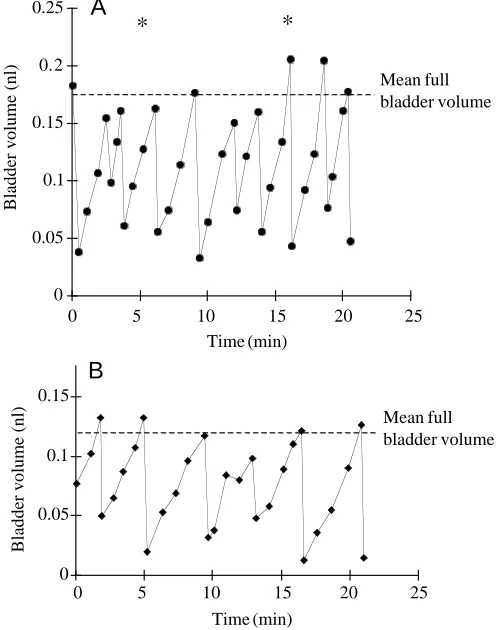
The pattern of filling and emptying of the urinary bladder in seawater-adapted larvae varied with developmental stage and among individuals at the same stage (Figs 3, 4). Some individuals, particularly the older larvae, had a more regular cycle, while the periods for filling and the discharge volume varied markedly for others. The mean frequency of bladder emptying for stage 1 larvae in sea water (37±4.5 h−1) was consistently higher (P<0.005) than for stage 2 larvae (14.7±1.6 h−1). In general, the mean discharge volumes were similar for the two stages, ranging between 44 and 57 % of the full bladder volume. Thus, at the end of each discharge phase, the mean residual urine volume in the bladder was relatively high. However, the degree of emptying was variable, with maximum discharge volumes being as high as 90 %. The mean values of UFR, based on both filling and emptying of the bladder, were not significantly different; consequently, only the latter values were used throughout. In sea water, the mean values of UFR (emptying), 0.98±0.26 nl h−1 for stage 1 and 1.67±0.29 nl h−1 for stage 2 larvae, were not significantly different (Table 1).
v
v
B
A
[image:3.609.351.525.71.359.2]0.1 mm
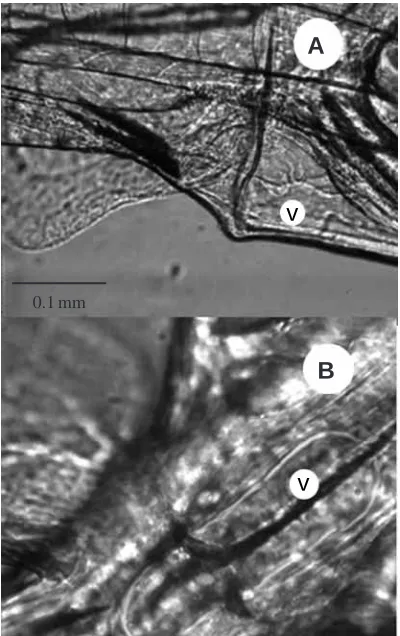
Fig. 2. Freeze-frame video images of lateral (A) and ventral (B) views of the ventricle (v) of late yolk-sac (stage 1c) herring larvae. Images were captured and digitised by an Improvision 2000 image-processing work station. The bright-line outline of the ventricle was initially produced by differential interference contrast optics and secondarily enhanced by Biovision imaging software (Improvision).
A
0 0.05 0.1 0.15
0 6 10 12
Time (min)
Bladder volume (nl)
*
B
0 0.05 0.1 0.15
Bladder volume (nl)
*
*
2 4 8
0 6 10 12
Time (min)
2 4 8
*
*
[image:3.609.74.274.73.391.2]Influence of salinity change on bladder function and UFR Stage 1 larvae
Bladder emptying frequency was found to be significantly lower at the lowest salinity (Table 1). Also, UFR was significantly lower (P<0.05) in 6 ‰ salinity than in the other two salinities.
Stage 2 larvae
Salinity had a significant influence on UFR (P<0.05, ANOVA), with the mean UFR in 4 ‰ salinity (5.1±0.9 nl h−1) being significantly higher than that in sea water (1.7±0.3 nl h−1). There was no significant difference between the means in the other salinities (Table 1). The frequency of emptying was the only component of UFR significantly affected by salinity (P<0.05), with a higher frequency in 4 ‰ (32.0±5.8 h−1) than in 34 ‰ (14.7±1.6 h−1) salinity. In contrast, mean discharge volumes varied little, between 50 and 57 %, over the salinity range. The upward trend in UFR in hypo-osmotic salinities is shown in Fig. 5.
The influence of temperature on bladder function and UFR Stage 1 larvae
Mean UFR was significantly influenced by temperature (P<0.05, ANOVA), with the mean of 1.82 nl h−1at 7 °C being significantly lower than the value of 3.58 nl h−1 at 15 °C, producing a Q10of 2.3 (Table 2). Neither discharge volumes nor frequencies varied significantly with temperature. The
B
0 0.05 0.1 0.15
0 5 10 15 20 25
Time (min)
Bladder volume (nl)
Mean full bladder volume 0
0.05 0.1 0.15 0.2 0.25
Bladder volume (nl)
*
*
0 5 10 15 20 25
Time (min)
A
[image:4.609.43.291.76.391.2]Mean full bladder volume
Fig. 4. The time courses of filling and emptying of the urinary bladder of 11–12-day-post-hatch Clyde herring in (A) 6 ‰ and (B) 34 ‰ salinity. An asterisk indicates the occurrence of peristalsis in the hindgut.
Table 1. The frequency of emptying, full bladder volume, relative discharge volumes and urine flow rate in herring larvae in
different salinities
Frequency Full Maximum Mean Urine Salinity of emptying bladder volume discharge volume discharge volume flow rate
Stage (‰) (h−1) (nl) (%) (%) (nl h−1) N
1 6 25.1±2.2* 0.029±0.00 89±4 51±8 0.38±0.06* 5 12 47.4±3.26 0.069±0.01 93±2 34±5 1.08±0.14 5 34 37.4±4.46 0.061±0.02 90±3 44±3 0.98±0.26 6 2 4 32.0±5.8* 0.26±0.04 79±9 52±10 5.07±0.89* 5 6 22.2±2.6 0.25±0.03 86±4 54±3 3.12±0.59 6 11 15.0±1.2 0.28±0.03 87±1 57±5 2.43±0.33 5 17 23.4±3.6 0.22±0.04 85±2 50±5 2.66±0.22 5 34 14.7±1.6 0.23±0.04 85±3 51±5 1.67±0.29 7
Values are means ±S.E.M.
*Significantly different (P<0.05) from seawater-adapted means (34 ‰ salinity). 0 1 2 3 4 5 6 7
0 5 10 15 20 25 30 35 40 Salinity (‰)
Urine flow rate (nl h
-1) Iso-osmotic point
[image:4.609.295.561.78.212.2]*
[image:4.609.51.560.578.712.2]mean full volume of the bladder of the larvae at 7 °C was significantly smaller (P<0.01) than those in the higher temperatures and appeared to be the main factor influencing UFR in stage 1 larvae.
Stage 2 larvae
Temperature also had a significant influence on the UFR in stage 2 larvae (P<0.05), with a Q10 of 1.5 (Table 2). At this stage, it was the mean UFR at 15 °C (4.04±1.22 nl h−1) that was significantly higher than at the other temperatures. No significant differences were found in the means of the various components of UFR at the different temperatures.
Cardiac output and its relationship to UFR
Cardiac and UFR measurements were made from recordings of Manx larvae at the end of the stage 1 in 6 ‰ and 34 ‰ salinity at 12 °C (Table 3). Mean values of UFR in the two salinities were significantly different (P<0.05), but there were no significant differences in mean values of cardiac output or distension of the bulbus arteriosus. The mean cardiac outputs in 34 and 6 ‰ salinity were 36 and 33 ml kg−1min−1 respectively. The mean change in the volume of the bulbus arteriosus in larvae adapted to 34 ‰ salinity was 0.09±0.01 nl, which represented 25 % of stroke volume, a value remarkably similar to that calculated by Priede (1976) for adult rainbow trout.
Discussion
The volume of the full urinary bladder increased rapidly during development, rising from 0.046 ml kg−1in stage 1 to a maximum value of 0.15 ml kg−1in stage 2 larvae of herring in sea water. The latter larger value falls short of bladder volumes of 2.2 ml kg−1 in adult rainbow trout (Oncorhynchus mykiss) estimated by Curtis and Wood (1991) or of 0.45 and 1.5 ml kg−1obtained by Arnold-Reed and Balment (1991) for winter and summer flounder (Platichthys flesus) respectively. Matsubara (1994) measured bladder volumes of 2 and 24 ml kg−1 in mature and immature rose bitterling (Rhodeus
ocellatus ocellatus) respectively. Similarly large urine
volumes, of up to 11 ml kg−1, in the bladder of adult
Pleuronectes platessa were estimated by Fletcher (1990).
[image:5.609.48.568.99.218.2]The rhythm of filling and emptying of the larval bladder varied from intermittent to regular (Figs 3, 4). Initially, it was thought that gut peristalsis, which occurred irregularly, was stimulating premature emptying of the bladder, but subsequent analysis revealed no such correlation. The cycle had a characteristic saw-tooth pattern with a longer filling period, during which the rate of volume change was often sigmoidal. Curtis and Wood (1992) found that adult trout ‘urinated in an extremely uniform pattern’, with emptying taking place at 25 min intervals. However, in an earlier study, Curtis and Wood (1991) recorded a ‘natural urination pattern’ (non-catherized), on the basis of the excretion of tritiated
Table 3. A comparison of cardiac performance indices and urine flow rates at 12 °C in 6-day-old Manx herring larvae adapted
to 6 and 34 ‰ and in seawater-adapted European eel and rainbow trout
Salinity Stroke volume Heart rate Cardiac output (Q˙) UFR
Species (‰) (ml kg−1) (beats min−1) (nl min−1) (ml kg−1min−1) (ml kg−1h−1) (%)
Clupea harengus 6 0.4±0.1 82±4.3 48.5±7.7 33±4.5 2.0±0.4 0.10 34 0.4±0.1 90±5.3 48.5±5.5 36±2.3 1.2±0.3 0.06
Anguilla anguilla 35 − − − 23.3a 0.25a 0.018
Oncorhynchus mykiss 35 0.3–0.4b 53b − 23.1b 0.32c 0.023
Values for herring are means ±S.E.M. (N=5). UFR, urinary flow rate.
[image:5.609.49.566.604.704.2]aHickman and Trump (1969); bGraham and Farrell (1989); cBrown et al. (1980).
Table 2. The influence of temperature on the full bladder volume, frequency of emptying, maximum and mean discharge volumes
and urine flow rate of seawater-adapted Manx herring larvae
Discharge Full Maximum Mean Urine Temperature frequency bladder volume discharge volume discharge volume flow rate
Stage (°C) (h−1) (nl) (%) (%) (nl h−1) N
1 7 32.8±5.3 0.10±0.01* 94.8±1.2 50.0±3.6 1.8±0.5 6 11 44.5±6.3 0.14±0.01 82.0±3.0 46.3±6.3 2.7±0.5 6 15 47.3±4.3 0.15±0.01 87.3±1.6 50.1±2.0 3.6±0.3 7 2 7 23.3±2.8 0.30±0.03 77.5±3.0 42.0±4.2 2.9±0.4* 7 11 30.2±7.4 0.24±0.04 82.9±0.4 46.7±6.2 2.8±0.5* 7 15 34.0±6.2 0.23±0.04 79.2±3.9 45.8±4.6 4.0±1.2 7
Values are means ±S.E.M.
*Significantly different (P<0.05) from the value at 15 °C.
PEG-4000, which was similar to our observations of herring larvae, with variations in both the filling period and degree of discharge. Compared with adult trout, the mean periods of filling in seawater-acclimated herring larvae were much shorter, 1.6 and 4 min for stages 1 and 2 respectively. Thus, herring larvae have relatively small bladders and high rates of emptying. The emptying phase tended to occur when the mean full bladder volume was reached, although there was some variation about the mean (Fig. 4). Curtis and Wood (1992) suggested that the act of micturation in adult trout is triggered by a critical filling volume or pressure in the bladder, in a similar way to that in humans. Our observations suggest that a similar mechanism may be present in early-stage fish larvae. The paucity of records of the frequency of urination in adult marine fish may be explained by the observation of Fletcher (1990) that bladder emptying in the plaice (Pleuronectes platessa) occurred ‘less than once in 3 days’!
The mean relative discharge volume in larvae was approximately 50 % of the full bladder volume. Curtis and Wood (1992) found that the discharge volume in adult rainbow trout in fresh water was 0.8–0.9 ml kg−1, equivalent to approximately 40 % of the full bladder volume. Thus, in both larval herring and adult trout, the volume of retained urine is considerable. In contrast, Fletcher (1990) suggests that complete bladder emptying occurs in adult plaice. The significance of urine residence time and residual volume in relation to net reabsorption was discussed by Curtis and Wood (1991). Clearly the very short residence time in the larval urinary bladder is not conducive to efficient absorption of ions and water by the bladder epithelium, but the high retention volume may compensate for this deficiency. In fact, Tytler et al. (1996) found evidence of water absorption from the bladder in the form of progressive concentration of inulin in the bladder during the filling phase in the larvae of both herring and turbot (Scophthalmus maximus).
UFR in seawater-adapted larvae was found to increase significantly from 1.0–1.67 ml kg−1h−1from stage 1 to stage 2 respectively. Higher estimates of UFR were previously obtained by Tytler et al. (1996) on the basis of an instantaneous rate of volume change of the urinary bladder, which may overestimate UFR. No estimates of UFR in adult herring have been found in the literature but, in keeping with the above comparison of bladder function with that of adult rainbow trout, lower UFRs of 0.32 ml kg−1h−1(5.31µl kg−1min−1) were measured in seawater-adapted trout (Brown et al., 1980). Similar values for UFR of 0.2 and 0.72 ml kg−1h−1 were recorded from seawater-adapted salmon (Salmo salar) at 12 °C (Talbot et al., 1989, 1992). Fletcher (1990), in reviewing urine flow in marine teleosts, gave a range of 0.09–1.2 ml kg−1h−1, the lowest value being his own estimate for plaice. In view of the relatively large surface area of the skin (de Silva, 1974) compared with branchial gill area in adults, it is not unexpected that UFR is high in small herring larvae. However, diffusional permeability coefficients for water and ions were found to be lower in marine fish larvae (Ramsay et al., 1993; Tytler and
Bell, 1989), which may explain why UFRs in larvae are still close to those of adult fish.
The effect of changing salinity on bladder function in herring larvae is different in the two stages studied. In the yolk-sac larvae (stage 1), there was either no significant effect or the UFR in hypo-osmotic salinity was lower, whereas in the later feeding stages UFR was higher in 4 ‰ salinity. It is not yet clear whether this difference between stages is due to the progressive development of physiological competence or to variations in the size of the bladder in the yolk-sac larvae. In stage 2 larvae, the increase in UFR in low salinity is in line with observed responses in adult teleost fish (Hickman and Trump, 1969). In most studies, comparisons are made between UFR in freshwater-adapted and seawater-adapted fish. For example, Talbot et al. (1989) found a sixfold increase in UFR after the transfer of salmon from sea water to fresh water. Interestingly, they also found that, in the longer term (3 months), UFR returned to only 180 % of the seawater-adapted value, the implication being that the initial diuresis may be a stress response. In stage 2 herring larvae, UFR increased threefold 24 h after transfer from sea water to 4 ‰ salinity. The UFR of stage 2 herring larvae in 4 ‰ salinity was 3.3 ml kg−1h−1which is higher than, but still quite close to, the values of 2.4 and 2.0 ml kg−1h−1 measured for freshwater-adapted rainbow trout and salmon respectively (Curtis and Wood, 1991; Talbot et al., 1992). Assuming that the primary function of the pronephros is to excrete excess water in hypo-osmotic environments (Howland, 1921; Tytler et al., 1996), as is the case with the opisthonephros, then the similarities in the UFR suggest that the permeabilities of larval herring and adult salmonid fishes are also similar. The trend, shown in Fig. 5, suggests that diuresis occurs in larvae only in hypo-osmotic conditions, which is similar to that found for adult teleost fish. UFR was significantly affected by temperature in both larval stages, particularly at the higher temperature (15 °C). It is not clear why temperature sensitivity (Q10) is greater in the yolk-sac stages. Permeability and drinking rates in herring larvae in sea water have been shown to have a similar thermal sensitivity to that of UFR (Tytler et al., 1993), which emphasises the overall sensitivity of the osmoregulatory system to temperature change, with significant effects demonstrable over a 5 °C change. Similar effects have been found for adult eel Anguilla
anguilla (Motais and Isaia, 1972).
known, but it may be related to limited differentiation of the blood circulation at this stage in development. In both stages of herring larvae, gills have not developed and branchial arteries are reduced in number, so that transbranchial resistance to blood flow and the resulting pressure gradient may be considerably less than in adults. Also, the pronephric renal corpuscle is supplied by a short renal artery directly from the anterior dorsal aorta (Tytler, 1988; Tytler et al., 1996). Both features may result in a higher proportion of cardiac output passing through the pronephric corpuscle. Since cardiac output and distension of the bulbus arteriosus, representing the systemic pressure pulse, were unaffected by salinity change, it would appear more likely that UFR in herring larvae is altered by vasomotor control of the pronephric arteriole, by adjustment in water absorption in the tubules and urinary bladder or by a combination of both. As yet, the control mechanisms are not understood, but angiotensin II receptors have been found in the pronephroi of larval fish (F. B. Eddy, personal communication), implying that some hormonal control mechanisms may be in place in these early larval stages. However, the reasons for relatively high urine flow rates in herring larvae also remain unresolved. Throughout these experiments, it was necessary to immobilise the larvae using mild anaesthesia. It has been shown that anaesthetics can alter renal function in vertebrates (Mercatello, 1990) and cause cardiac depression in adult rainbow trout (Ryan et al., 1993). The level of anaesthesia used was not sufficient to depress heart rate in the larvae below that recorded from unanaesthetised embryos just prior to hatching. Also, cardiac output did not fall measurably during the experimental period. It is possible, therefore, that anaesthesia may have altered the level of urination in herring larvae. In addition, stress, which is thought to influence osmotic water diffusion (Fletcher, 1992), may have enhanced the hypo-osmotic urination response.
We wish to thank Dr Bob Batty, Dunstaffnage Marine Laboratory, Oban, Dr Clive Fox, Fisheries Laboratory, Lowestoft, Dr Audrey Geffen, University of Liverpool, Port Erin Marine Laboratory, Isle of Man, and Captain Buchan of the MFV ‘Sparkling Star’ for providing such high-quality herring gonads. We are grateful to the Natural Environment Research Council for supporting this work as part of the Inter-University Marine Research Initiative.
References
Arnold-Reed, D. E. and Balment, R. J. (1991). Salinity tolerance and its seasonal variation in the flounder, Platichthys flesus. Comp.
Biochem. Physiol. 99A, 145–149.
Brown, J. A., Oliver, J. A., Henderson, I. W. and Jackson, B. A. (1980). Angiotensin and single nephron glomerular function in the trout Salmo gairdneri. Am. J. Physiol. 239, R509–R514.
Burggren, W. and Fritsche, R. (1995). Cardiovascular measurements in animals in the milligram range. Braz. J. Med. Biol.
Res. 28, 38–61.
Curtis, B. J. and Wood, C. M. (1991). The function of the urinary
bladder in vivo in the freshwater rainbow trout. J. Exp. Biol. 155, 567–583.
Curtis, B. J. and Wood, C. M. (1992). Kidney and urinary bladder responses of freshwater rainbow trout to isosmotic NaCl and NaHCO3infusion. J. Exp. Biol. 173, 181–203.
de Silva, C. D. (1974). Development of the respiratory system in herring and plaice larvae. In The Early Life History of Fish (ed. J. H. S. Blaxter), pp. 465–485. Berlin: Springer-Verlag.
Doyle, M. J. (1976). Growth and differentiation in herring and plaice larvae. MSc thesis, University of Stirling.
Fletcher, C. R. (1990). Urine production and urination in the plaice,
Pleuronectes platessa. Comp. Biochem. Physiol. 96A, 123–129.
Fletcher, C. R. (1992). Stress and water balance in the plaice
Pleuronectes platessa. J. Comp. Physiol. B 162, 513–519.
Graham, M. S. and Farrell, A. P. (1989). The effect of temperature acclimation and adrenaline on the performance of a perfused heart.
Physiol. Zool. 62, 38–61.
Hickman, C. P. and Trump, B. F. (1969). The kidney. In Fish
Physiology, vol. I (ed. W. S. Hoar and D. J. Randall), pp. 91–239.
San Diego, London: Academic Press.
Holliday, F. G. T. (1963). Osmoregulation in marine teleost eggs and larvae. Calif. Coop. Oceanic Fish. Invest. Rep. X, 89–95. Howland, R. B. (1921). Experiments on the effect of the removal of
the pronephros of Ambystoma punctatum. J. Exp. Zool. 32, 355–384.
Léger, P., Bengtson, D. A., Simpson, K. L. and Sorgeloos, P. (1986) The use and nutritional value of Artemia as a food source.
Oceanogr. Mar. Biol. Annu. Rev. 24, 521–623.
Matsubara, T. (1994). Role of urine in the spawning of the female rose bitterling, Rhodeus ocellatus ocellatus. Fish Physiol. Biochem. 13, 399–405.
Mercatello, A. (1990). Alterations in renal function due to anaesthesia. Ann. Franc. d’Anaesth. Reanim. 9, 507–524.
Motais, R. and Isaia, J. (1972). Temperature dependence of permeability to water and sodium of the gill epithelium of the eel,
Anguilla anguilla. J. Exp. Biol. 56, 587–600.
Priede, I. G. (1976). Functional morphology of the bulbus arteriosus of rainbow trout (Salmo gairdneri Richardson). J. Fish Biol. 9, 209–216.
Ramsay, N., Stagg, R. and Houlihan, D. (1993). Osmoregulation of developing herring, Clupea harengus L.; Effects of chronic exposure to sublethal levels of heavy metals. In
Physiological and Biochemical Aspects of Fish Development
(ed. B. T. Walther and H. J. Fyhn), pp. 263–268. Bergen: University of Bergen.
Ryan, S. N., Davie, P. S., Gesser, H. and Wells, R. M. G. (1993). The effect of MS-222 on paced ventricle strips and the perfused heart of rainbow trout, Oncorhynchus mykiss. Comp. Biochem.
Physiol. 106C, 549–553.
Talbot, C., Eddy, F. B., Potts, W. T. W and Primmett, D. R. N. (1989). Renal function in migrating adult Atlantic salmon, Salmo
salar L. Comp. Biochem. Physiol. 92, 241–245.
Talbot, C., Stagg, R. M. and Eddy, F. B. (1992). Renal, respiratory and ionic regulation in Atlantic salmon (Salmo salar L.) kelts following transfer from fresh water to seawater. J. Comp. Physiol. B 162, 358–364.
Tytler, P. (1988). Morphology of the pronephros of the juvenile brown trout, Salmo trutta. J. Morph. 195, 189–294.
Tytler, P. and Bell, M. V. (1989). A study of diffusional permeability of water, sodium and chloride in yolk-sac larvae of cod (Gadus
Tytler, P., Bell, M. V. and Robinson, J. (1993). The ontogeny of osmoregulation in marine fish: Effects of changes in salinity and temperature. In Physiological and Biochemical Aspects of Fish
Development (ed. B. T. Walther and H. J. Fyhn), pp. 249–258.
Bergen: University of Bergen.
Tytler, P. and Blaxter, J. H. S. (1988). The effects of external salinity on the drinking rates of larvae of herring (Clupea
harengus), plaice (Pleuronectes platessa) and cod (Gadus morhua). J. Exp. Biol. 138, 1–15.
Tytler, P., Fitches, E. and Ireland, J. (1996). A study of the structure and function of the pronephros in the larvae of the turbot (Scophthalmus maximus) and the herring (Clupea harengus). Mar.
Freshwater Behav. Physiol. 28, 3–18.
Tytler, P. and Ireland, J. (1993). Drinking and water absorption by the larvae of herring (Clupea harengus) and turbot (Scophthalmus
maximus). J. Fish Biol. 44, 103–116.